© 2017, IRJET | Impact Factor value: 5.181 | ISO 9001:2008 Certified Journal | Page 2451
EXPERIMENTAL STUDY ON LIGHTWEIGHT CONCRETE USING PERLITE
BHUVANESHWARI. K
1, Dr. DHANALAKSHMI. G
2, KALEESWARI. G
3M.E. (Structural Engineering), Department of Civil Engineering, Oxford Engineering College, Tiruchirappalli,
Tamilnadu , India
1Professor & Head, Department of Civil Engineering, Oxford Engineering College, Tiruchirappalli, Tamilnadu ,
India
2Assistant Professor, Department of Civil Engineering, Oxford Engineering College, Tiruchirappalli, Tamilnadu ,
India
3---***---Abstract
- For structural application of lightweight concrete, the density is more important than the strength. A low density for the same strength level reduces the self-weight, foundation size and construction costs. In this study, structural lightweight aggregate concrete was designed with natural Perlite aggregate that will provide an advantage of reducing dead weight of structure also compared the strength of normal concrete with Perlite concrete by partially replacing of Perlite with sand as a percentage of 5%, 10%, 15%, 20% and 25% in normal concrete mix. The investigations are to be carried out using several tests which include compressive test, split tensile test and flexural test.Key words: Perlite aggregate, Compressive strength, Split tensile strength and Flexural strength.
1. INTRODUCTION
Perlite concrete consists of a mixture of Ordinary Portland Cement, Perlite aggregate, sand and water; its weight can be varied in the range of 20 to 50 pounds per cubic foot, depending on the mix design selected. This is in comparison to sand and gravel concrete which weighs 140 to 150 pounds per cubic foot and the 60 to 120 pounds per cubic foot weight of expanded slag, shale or clay. Because of its exceptionally light weight, Perlite concrete is not considered a true structural concrete.
However, it is the strongest concrete in its weight class and has more than adequate strength for floor fills, light structural roof decks placed over form boards, and metal lath or paper backed wire mesh, and makes an economical and versatile insulation fill over metal decking and structural concrete. It can also be sprayed as a fire retardant backup for metal curtain walls.
2. MATERIALS USED
2.1 Cement
The Cement used for this experimental study is 43 grade Ordinary Portland Cement. All properties of cement are tested by referring IS 12269-1987.
2.2 Perlite
© 2017, IRJET | Impact Factor value: 5.181 | ISO 9001:2008 Certified Journal | Page 2452
2.3 Sand
Good quality natural river sand is used as fine aggregate. The sand is sieved in 2.36mm sieve as the sand passing through this sieve is use as fine aggregate. Zone of the fine aggregate used in this work is zone II.
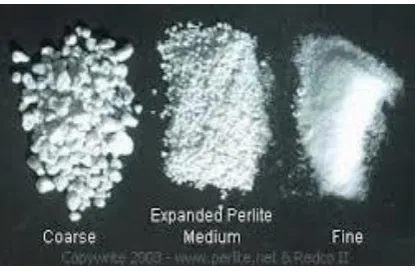
Fig -1: Perlite
2.4 Coarse Aggregate
Hard granite broken stone was used as coarse aggregate. The coarse aggregate is sieved in 20mm sieve and the aggregate passing through the sieve is used as coarse aggregate.
2.5 Water
Clean potable water conforming to IS 456-2000 was used in preparation of the concrete. The qualities of water samples are uniform. pH of water lies between 6 to 8 and the water is must be free of all acids, based and other dissolved salts.
2.6 Superplasticizer
A superplasticizer of Sulfonated Naphthalene Formaldehyde
was used as an admixture during
mixing of fresh concrete.
3. PROPERTIES OF MATERIALS
Table -1: Properties of Cement
S.NO. Property Result
1 Initial setting time 45 minutes
2 Final setting time 466 minutes
3 Consistency 30%
4 Specific Gravity 3.15
[image:2.595.50.259.207.344.2]5 Fineness 8.5%
Table -2: Properties of Perlite
S.NO. Property Result
1 specific gravity 2.2
2 physical state micronized powder
3 Colour White
4 Water absorption 1.5%
Table -3: Properties of Sand
S.NO. Property Result
1 Fineness modulus 2.58
2 Specific gravity 2.44
3 Grading zone II
4 Water absorption 1.0%
Table -4: Properties of Coarse aggregate
S.NO. Property Result
1 Fineness modulus 3.44
2 Specific gravity 2.98
© 2017, IRJET | Impact Factor value: 5.181 | ISO 9001:2008 Certified Journal | Page 2453
Table -5: Properties of Superplasticizer
S.NO. Property Result
1 Appearance Brown liquid
2 Specific gravity 1.2 to 1.22 @ 20° C
3 % of chloride < 0.1%
4 Chemical
composition
Sulfonated Naphthalene Formaldehyde
4. RESULTS AND DISCUSSIONS
4.1 Compressive strength test
[image:3.595.35.280.429.636.2]The 150 x 150 x 150 mm cubes were tested at the age of 7 and 28 days after curing using Compression Testing machine (CTM). The ultimate load divided by the cross- sectional area of the specimen is equal to the cube compressive strength.
Table -6: The compressive strength results
S.NO. Specimen details
Compressive strength (MPa)
7 Days 28 Days
1 Conventional mix 15.64 20.52
2 5% Perlite 14.67 19.24
3 10% Perlite 13.17 20.9
4 15% Perlite 13.80 18.8
5 20% Perlite 9.00 12.56
6 25% Perlite 6.11 7.49
0 5 10 15 20 25
0% P 5% P 10% P 15% P 20% P 25% P
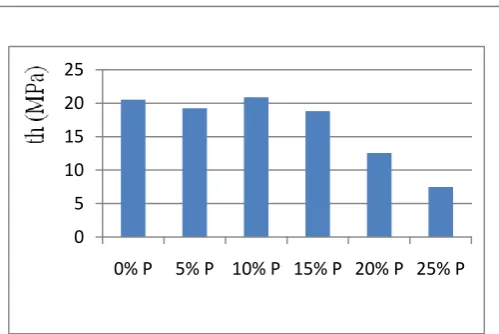
Chart -1: Comparison of Compressive strength of cubes on 28 days.
1.85% increment in the compressive strength is found at 10% replacement of sand by Perlite at 28 days when compared to normal concrete.
4.2 Split Tensile strength test
[image:3.595.307.553.518.722.2]This test is used to determine the
tensile strength of
concrete with specimen of size 150 mm Diameter (D) and 300 mm Long (L) at the age of 7 and 28 days after curing using CTM. The split tensile strength of concrete was found using (2P/πLD) where. P is the maximum load on the cylinder.Table -7: The split tensile strength results
S.NO. Specimen details
Tensile Strength (MPa) 7 Days 28 Days
1 Conventional mix 1.22 2.39
2 5% Perlite 1.47 2.41
3 10% Perlite 1.66 2.64
4 15% Perlite 1.62 2.50
5 20% Perlite 1.71 2.55
© 2017, IRJET | Impact Factor value: 5.181 | ISO 9001:2008 Certified Journal | Page 2454
Chart -2: Comparison of Split tensile strength of cylinders on 28 days
10.46% increment in the split tensile strength is found at 10% replacement of sand by Perlite at 28 days when compared to normal concrete.
4.3 Flexural strength test
Flexural strength test was carried out on beam specimens of size 100 x 100 x 500 mm at the age of 28 days after curing using CTM. The flexural strength of concrete was found using
PL/bd2or 3Pa/bd2 where P is the maximum load on the
[image:4.595.271.544.52.257.2]cylinder and ‘a’ is the distance of crack from nearest support of a>20 cm and a<20 cm respectively.
Table -8: The flexural strength results
S.NO. Specimen details
Flexural Strength (MPa) 28 Days
1 Conventional mix 5.39
2 5% Perlite 5.71
3 10% Perlite 5.94
4 15% Perlite 5.87
5 20% Perlite 5.75
6 25% Perlite 5.52
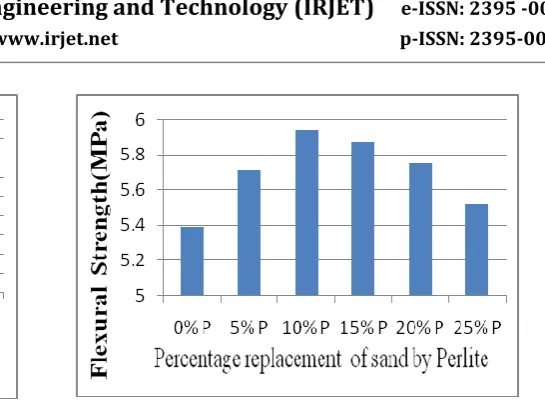
Chart -3: Comparison of Flexural strength of beams on 28 days
10.20% increment in the flexural strength is found at 10% replacement of sand by Perlite at 28 days when compared to normal concrete.
5. CONCLUSION
The following results are obtained.
1. The Compressive Strength was high at 10% Perlite and the percentage increasing was 1.85 % at 28 days.
2. The Split Tensile Strength was high at 10% Perlite and the percentage increasing was 10.46% at 28 days.
3. The Flexural Strength was high at 10% Perlite and the percentage increasing was 10.20% at 28 days
4. The optimum replacement percentage of sand by Perlite is 10%. The compressive, split tensile and flexural strength were reduced if the replacement percentage of Perlite will be increased.
REFERENCES
[1] M.Dhawal Desai, Institute of Technology Bombay, “Experimental study on Partial replacement of Perlite”.
© 2017, IRJET | Impact Factor value: 5.181 | ISO 9001:2008 Certified Journal | Page 2455 [3] Mesut Asik, “Structural Lightweight Concrete with
Natural Perlite Aggregate and Perlite Powder” September 2006.
[4] Bairagi N.K. and Mr. Dubal N.S., The experimental work done by authors on Effect of thermal cycles on compressive strength, modulus of rupture and dynamic elastic modulus of concrete, 1996.
[5] Arora, S.P. and Bindra, S.P., "Building Construction, Planning Techniques and Method of Construction", Dhanpat Rai and Sons, 1997
[6] Saeed Ahmad and Shahid Mahmood, ”Effects of crushed and natural sand on the properties of fresh and hardened concrete”, Our World in Concrete & Structures, August 2008.
[7] IS 456 : 2000, Plain and Reinforced Concrete - Code of Practice, Bureau of Indian Standards.