Int J Physiother 2014; 1(2) Page | 74
ORIGINAL RESEARCH
LONG TERM EFFECT OF CYRIAX PHYSIOTHERPY WITH
SUPERVISED EXERCISE PROGRAM IN SUBJECTS WITH
TENNIS ELBOW
Pallavi Shridhar Thakare
1Vinod Babu .K
2Sai Kumar .N
3Ayyappan .V.R4
CORRESPONDING AUTHOR
*2 Dr. Vinod Babu .K, MPT, MD (AM), Assistant Professor in Physiotherapy, K.T.G. College of Physiotherapy and K.T.G. Hospital, Bangalore-560 091, India.
e-mail: [email protected]; [email protected]
Int J Physiother. Vol 1(2), 74-82, June (2014) ISSN: 2348 - 8336
IJPH
Y
ABSTRACT
Background: The purpose is to find long term effect of Cyriax physiotherapy with supervised exercise program in the reduction of pain and improvement of functional ability for subjects with tennis elbow.
Method: An experimental study design, 30 subjects with Tennis Elbow randomized 15 subjects each into Study and Control group. Control group received Supervised Exercise program while Study group received Cyriax Physiotherapy with Supervised exercises program thrice in a week for 4 weeks and post intervention follow up after 2 weeks. Outcome measurements were measured for pain using Visual analogue Scale (VAS) and Patient Rated Tennis Elbow Evaluation (PRTEE) for functional ability.
Results: There is no statistically significant difference in pre- intervention means of VAS and PRTEE when compared between the groups using independent ‘t’ test as a parametric and Mann Whitney U test as a non-parametric test. When means of post intervention and follow-up measurements were compared there is a statistically significant (p<0.05) difference in VAS and PRTEE scores between the groups. However greater percentage of improvements was obtained in study group than control group.
Conclusion: It is concluded that there is significant long term effect with greater percentage of improvement in pain and functional ability up to 2 weeks follow-up following 4 weeks of combined Cyriax physiotherapy with supervised exercise program than only supervised
exercise program for subjects with tennis elbow.
Key words: Cyriax Physiotherapy, Mills manipulation, Deep Friction massage, supervised exercise program, Tennis Elbow, Pain, Visual analogue scale, functional ability, lateral epicondylitis, PRTEE.
1 MPT Post Graduate Student 2012-2014,
*2 Assistant Professor,
3 Professor & Principal,
4 Associate Professor,
K.T.G. College of Physiotherapy and
K.T.G Hospital, Affiliated to Rajiv Gandhi
University of Health Sciences, Bangalore,
Karnataka, India.
Introduction
Tennis Elbow or lateral epicondylitis is clinically defined as pain in the region of the lateral epicondyle, which is provoked by resisted use of the extensor muscle of the wrist such as extensor carpi radialis brevis (ECRB) and extensor carpi radialis longus (ECRL) which causes pain, functional impairment and reduces productivity. The commonly affected arm is the dominant arm, with a prevalence of 1–3% in the general population, but the incidence rapidly increases to 19% between 30–60 years of age and seems to be more severe and long-standing in women. In tennis elbow, microscopic and macroscopic lesions can be found in the Extensor Carpi Radialis Brevis (ECRB).1
Cyriax suggested use of deep transverse friction massage in combination with mill's manipulation for the treatment of tennis elbow.2 Cyriax physiotherapy found superior treatment approach in obtaining significantly greater improvement regarding pain, pain free grip and functional status compared to phonophoresis and exercise in managing lateral epicondylalgia.2 Even thoughCyriax physiotherapy is commonly used in the treatment of tennis elbow but more research is needed to assess its effectiveness of both its components.3
The conventional treatment intervention of tennis elbow is most often accompanied by exercise program which may include strengthening, flexibility, or endurance training exercises3. It is recommended the use of static stretching of the Extensor Carpi Radialis Brevis (ECRB) and eccentric strengthening exercises4 for the wrist extensors is beneficial in the treatment of lateral epicondylitis.5 The eccentric exercise has faster effect on reducing pain and improving muscle strength, but there was no major difference in improving functional ability. Future studies are needed to investigate factors that may influence the outcome of eccentric training is painful and duration of eccentric training.6,7 However, supervised exercise program found superior to home exercise program to reduce pain and improve functional ability in patient with tennis elbow.8 Several authors have reported the effectiveness of the many treatment techniques but after the initial reduction or disappearance of the symptoms some patients have had recurrence of pain.
Both Cyriax physiotherapy and exercises program found limited with its effects, it was found that there is significant combined effect of Cyriax Physiotherapy and supervised exercise program on improvement in pain and functional ability for subjects with Tennis Elbow. However the study has been limited to find
the long term effect of this combined techniques.There is a need to know the long term effect of Cyriax Physiotherapy and Supervised exercise program in subjects with Tennis Elbow. This study with research question whether the cyriax physiotherapy with supervised exercise program does have long term effect on reducing pain and improving functional ability for subjects with Tennis Elbow? Hence, the purpose of the study with objective to find long term effect of Cyriax physiotherapy with supervised exercise program in reduction of pain and improvement of functional ability for subjects with tennis elbow. It was hypothesized that there will be a significant long term effect of Cyriax physiotherapy with supervised exercise program in the treatment of tennis elbow. Materials and Methods:
Pre to post test follow-up experimental study design with two group- Study and Control group. As this study involved human subjects the Ethical Clearance was obtained from the Ethical Committee of KTG College of Physiotherapy and K.T.G. Hospital, Bangalore as per the ethical guidelines for Bio-medical research on human subjects. The study was registered with University (RGUHS) No.: 09_T031_39088. The study was conducted at K.T.G Hospital, Bangalore. Subject were included both male and females, age group between 30 to 45 years, subjects with tennis Elbow more than 3 weeks confirmed by tenderness on palpation over the lateral epicondyle of humerus, positive mill’s and cozen’s test, having symptoms such as pain, functional disability from past 8 to 10 weeks.Subjects who willing to participate. Subjects excludedwith neurological impairments, neuromuscular diseases previous trauma to the elbow region, previous surgery to the elbow region, peripheral nerve entrapment, Cervical radiculopathy, Corticosteroid injection within 6 months. Total 30 Subject (n=30) were recruited by Simple random sampling method using Group marked 30 paper slips in closed envelopes randomly allocated 15 subjects into study group and 15 into control group. Intervention was given 3 sessions in week for 4 week and subjects were asked to follow-up after 2 weeks following post intervention. No subjects were missed any treatment sessions and dropped from the study. All the subjects fulfilling the inclusion criteria were informed about the study and a written informed consent was taken. Procedure of Intervention Study group:
Cyriax physiotherapy – This consists of 10 minutes of deep transverse friction massage immediately followed by a single application of Mill's manipulation. The Deep transverse friction for tennis elbow was applied patient positioned comfortably with the elbow fully supinated and in 90° of flexion. After palpating the anterolateral aspect of the lateral epicondyle of humerus, the area of tenderness was mapped. Deep transverse friction was applied with the side of the thumb tip. The pressure was applied in a posterior direction on the tenoosseous junction. It was applied for ten minutes after the numbing effect has been attained, to prepare the tendon for Mill's manipulation.9
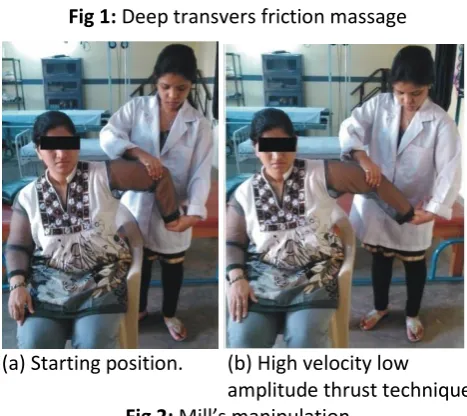
Mills manipulation – Patient was positioned comfortably in the seating position with the affected extremity in 90° of abduction with internal rotation enough so that the olecranon faced up. The therapist stabilized the patient's wrist in full flexion and pronation with one hand, while other hand was placed over the olecranon.10 While assuming full wrist flexion and pronation position, the therapist applied a high-velocity low-amplitude thrust at the end range of elbow extension.
After receiving cyriax physiotherapy patient was asked to take a rest for 15 minutes then subject received supervised therapeutic exercise program. Supervised exercise program – This included static stretching of the Extensor Carpi Radialis Brevis followed by eccentric strengthening of the wrist extensors. Static stretching was performed in the seated position with elbow extension, forearm pronation, and wrist flexion with ulnar deviation.11 According to the patient tolerance stretch force was applied. This stretch position was held for duration of 30–45 seconds and was performed 3 times before and 3 times after the eccentric exercise portion of the treatment for a total of 6 repetitions. There was a 30-second rest interval between each bouts of stretching. Eccentric strengthening exercise was performed in the seated position with full elbow extension, forearm pronation, and maximum wrist extension. From this position, the patient slowly lowered wrist into flexion for a count of 30, using the contralateral hand to return the wrist to maximum extension.Patients were instructed to continue the exercise even when they experience mild discomfort and to stop the exercise if the pain worsens and becomes disabling.
For whom the eccentric exercise could be performed without minor discomfort or pain, the load was increased using free weights based on the patients 10
RM (Repetition Maximum). Three sets of ten repetitions were performed during each treatment, with a one-minute rest interval between each set. Patients were also provided with education manual regarding ergonomics and activity modification technique to avoid aggravation of symptoms.
Procedure of Intervention control group:
In this group, the subjects received only supervised exercise program same as study group.
Fig 1: Deep transvers friction massage
(a) Starting position. (b) High velocity low amplitude thrust technique
Fig 2: Mill’s manipulation
Outcome Measurements:
Measurements were measured for pain using Visual analogue Scale (VAS) and Patient Rated Tennis Elbow Evaluation (PRTEE) for functional ability before, after 4 weeks of intervention and follow-up at 2 weeks post intervention.
Visual analogue Scale (VAS) for pain: VAS is presented as 10cm line. No pain at one end and worst imaginable pain at other end. Patient is asked to mark a 10 cm line to indicate pain intensity. VAS is highly reliable and concurrent valid pain measurement tool.12,13,14,15
Patient Rated Tennis Elbow Evaluation (PRTEE) for functional ability:
15-item questionnaire designed to measure forearm pain and disability in patients with lateral epicondylitis (also known as “tennis elbow”). The PRTEE allows patients to rate their levels of tennis elbow pain and disability from 0 to 10, and consists of 2 subscales: Pain subscale (0 = no pain, 10 = worst imaginable) Pain - 5 items; Function subscale (0 = no difficulty, 10 = unable to do), Specific activities - 6 items, Usual activities - 4 items. Computing the Total Score: Total Score = Sum of pain + function scores (Best Score = 0, Worst Score = 100). The responses to the fifteen items are totaled out of 100, where pain and disability are equally weighted. PRTEE for Tennis Elbow provide a simple, quick, reliable estimate of arm pain and function in patient with epicondylities. The pain (ICC = 0.89), function (1CC=0.83), and the total (ICC = 0.89) scores all demonstrated excellent reliability. The ICCs were all greater than 0.75. 16,17,18,19
Statistical Methods
Descriptive statistical analysis was carried out in the present study. Outcome measurements analyzed are presented as mean SD. Significance is assessed at 5 % level of significance with p value was set at 0.05 less than this is considered as statistically significant difference. Repeated Measures Analysis of Variance (RAMANOVA) and Friedman’s ANOVA was used analysis for Visual analog scale in centimeters and functional ability using Patient Rated Tennis Elbow Evaluation (PRTEE) within the group and Bonferroni’s as post-hoc test was used to find the significance in pair-wise comparison pre to post treatment, post to follow-up treatment and pre-treatment to follow-up. Paired ‘t’ test as a parametric and Wilcoxon signed rank test as a non-parametric test have been used to analysis the variables pre-intervention to post-intervention with calculation of percentage of
change. Independent ‘t’ test as a parametric and Mann Whitney U test as a non-parametric test have been used to compare the means of variables between two groups with calculation of percentage of difference between the means. The statistical software namely SPSS 16.0, Stata 8.0, MedCalc 9.0.1 and Systat 11.0 were used for the analysis of the data and Microsoft word and Excel have been used to generate graphs, tables, etc.
Results
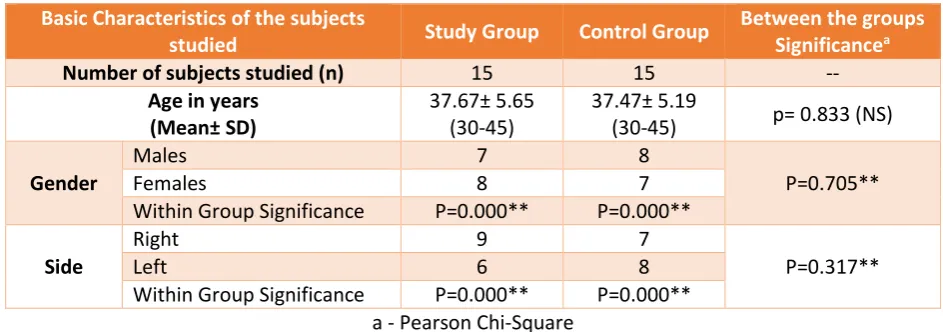
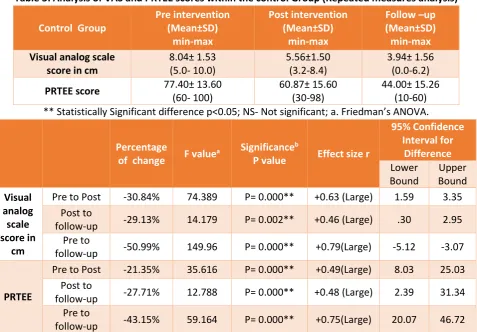
The table-1 shows that in study group there were 20 subjects with mean age 41.15 years and there were 9 males and 11 females were included in the study. In control group there were 15 subjects with mean age 30.07 years and were 6 males and 9 females were included in the study. There is no significant difference in mean ages between the groups. In both the groups there were 8 right sided and 7 left sided subjects with no significant difference between the side distributions between the groups. The table-2 and 3 shows that there is a statistically significant change in means of VAS and PRTEE when means were analyzed from pre intervention to post intervention and to follow measurements within the groups with negative percentage of change showing that there is decrease in the post means and with positive percentage of change showing there is increase in post means. There is a clinical significance effect with large effect size. In table-4 shows that there is no statistically significant difference in pre- intervention means of Visual analogue scores for pain and PRTEE for functional ability when compared between study and Control groups. When means of post intervention and follow-up measurements were compared there is a statistically significant difference in means of Visual analogue scores and PRTEE scores between the groups.
Table 1: Basic Characteristics of the subjects studied
Basic Characteristics of the subjects
studied Study Group Control Group
Between the groups
Significancea
Number of subjects studied (n) 15 15 --
Age in years (Mean± SD)
37.67± 5.65 (30-45)
37.47± 5.19
(30-45) p= 0.833 (NS)
Gender
Males 7 8
P=0.705**
Females 8 7
Within Group Significance P=0.000** P=0.000**
Side
Right 9 7
P=0.317**
Left 6 8
Table 2: Analysis of VAS and PRTEE scores within the study Group (Repeated measures analysis)
Study Group
Pre intervention (Mean±SD)
min-max
Post intervention (Mean±SD)
min-max
Follow –up (Mean±SD) min-max
Visual analog scale score in cm
7.46± 1.67 (3.8- 10.0)
3.78±1.69 (1.5-8.4)
1.96± 1.34 (0.1-5.4)
PRTEE score 82.53± 15.42
(40- 98)
32.00± 13.20 (10-60)
15.87± 11.45 (5-50) ** Statistically Significant difference p<0.05; NS- Not significant; a. Friedman’s ANOVA.
Study Group
Percentage of change
F
valuea
Significanceb
P value Effect size r
95% Confidence Interval for
Difference
Lower Bound
Upper Bound Visual
analog scale score in
cm
Pre to Post -49.32% 62.498 P= 0.000** +0.73 (Large) 2.25 5.10 Post to
follow-up -48.14% 79.735 P= 0.000** +0.51 (Large) 1.19 2.44 Pre to
follow-up -73.72% 203.08 P= 0.000** +0.87(Large) -6.68 -4.31
PRTEE
Pre to Post -61.22% 165.93 P= 0.000** +0.86(Large) 38.49 62.57 Post to
follow-up -50.40% 73.89 P= 0.000** +0.54 (Large) 10.37 21.89 Pre to
follow-up -80.77% 282.54 P= 0.000** +0.92(Large) -78.83 -54.49 Adjustment for multiple comparisons: Bonferroni.
Table 3: Analysis of VAS and PRTEE scores within the control Group (Repeated measures analysis)
Control Group
Pre intervention (Mean±SD)
min-max
Post intervention (Mean±SD)
min-max
Follow –up (Mean±SD) min-max
Visual analog scale score in cm
8.04± 1.53 (5.0- 10.0)
5.56±1.50 (3.2-8.4)
3.94± 1.56 (0.0-6.2)
PRTEE score 77.40± 13.60
(60- 100)
60.87± 15.60 (30-98)
44.00± 15.26 (10-60) ** Statistically Significant difference p<0.05; NS- Not significant; a. Friedman’s ANOVA.
Percentage
of change F value
a Significanceb
P value Effect size r
95% Confidence Interval for
Difference
Lower Bound
Upper Bound Visual
analog scale score in
cm
Pre to Post -30.84% 74.389 P= 0.000** +0.63 (Large) 1.59 3.35 Post to
follow-up -29.13% 14.179 P= 0.002** +0.46 (Large) .30 2.95 Pre to
follow-up -50.99% 149.96 P= 0.000** +0.79(Large) -5.12 -3.07
PRTEE
Pre to Post -21.35% 35.616 P= 0.000** +0.49(Large) 8.03 25.03 Post to
follow-up -27.71% 12.788 P= 0.000** +0.48 (Large) 2.39 31.34 Pre to
Table 4: Comparison of means of VAS and PRTEE scores between control and study Groups
Percentage of difference
Effect size t valuea
Parametric
Significance a
P value
Z valueb
Non-parametric Significance
P value b
Visual analog
scale score in cm
Pre 7.31% +0.17 ( Small) -.977 p=0.337 (NS) -.955 p=0.345 (NS) Post 38.11% +0.48 (Large) -3.045 p=0.005** -2.864 p=0.003** Follow-up 67.11% -0.56(Large) -3.702 p=0.001** -3.113 p=0.004**
PRTEE
Pre -6.41% +0.17( Small) 0.967 p=0.342 (NS) -1.189 p=0.235 (NS) Post 62.17% +0.70 (Large) -5.470 p=0.000** -4.005 p=0.000** Follow-up 93.98% +0.72 (Large) -5.710 p=0.000** -3.823 p=0.000**
Graph- 1: Comparison of means of pain between control and study Groups
Graph 1 shows that there is no statistically significant difference in pre- intervention means of Visual analogue scores for pain when compared between study and Control groups. When means of post
intervention and follow-up measurements were compared there is a statistically significant difference in means of Visual analogue scores between the groups.
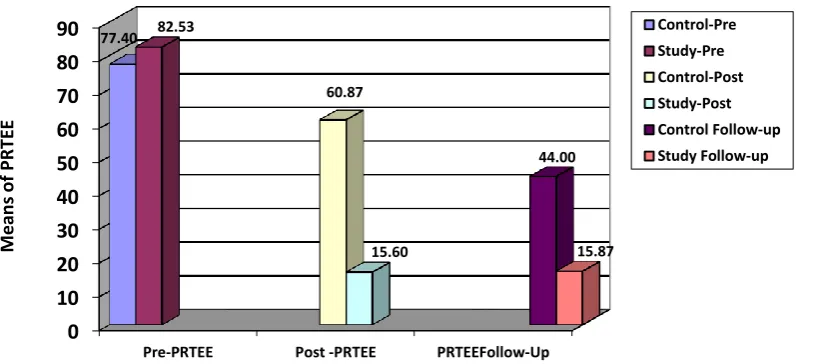
Graph- 2: Comparison of means of PRTEE between control and study Groups
Graph 2 shows that there is no statistically significant difference in pre- intervention means of PRTEE for functional ability when compared between study and Control groups. When means of post intervention
and follow-up measurements were compared there is a statistically significant difference in means of PRTEE scores between the groups.
0
1
2
3
4
5
6
7
8
9
10
Pre-intervention Post-intervention Follow-up 8.04
7.46
5.56
3.78 3.94
1.96
Mea
n
s
o
f
V
A
S
in
cm
Control-Pre
Study-Pre
Control-Post
Study-Post
Control Follow-up
Study follow-up
0 10 20 30 40 50 60 70 80 90
Pre-PRTEE Post -PRTEE PRTEEFollow-Up
77.40 82.53
60.87
15.60
44.00
15.87
M
ean
s
of PRTE
E
Discussion
The finding from the present study found that there is statistically significant long term effect for a period of 2 weeks following 6 weeks of intervention on improvement of pain and functional ability, in study group who received Cyriax Physiotherapy with Supervised Exercise Program showed greater effect than control group subjects who received only Supervised Exercise Program.
In control group, statistically significant improvement in outcome measures from pre intervention to post intervention, and post intervention to follow up within the group could be because of effects of the eccentric training and stretching exercise. Eccentric training results in tendon strengthening by stimulating mechano-receptors in tenocytes to produce collagen, which is probably the key cellular mechanism that determines recovery from tendon injuries. In addition, eccentric training may induce a response that normalises the high concentrations of glycosaminoglycans. It may also improve collagen alignment of the tendon and stimulate collagen cross-linkage formation, both of which improve tensile strength. The effects of exercise programmes for tendon injuries may be attributable to either the effect of stretching, with a lengthening of the muscle-tendon unit and consequently less strain experienced during joint motion, or the effects of loading within the muscle-tendon unit, with hypertrophy and increased tensile strength in the tendon. Ohberg et al believe that, during eccentric training, the blood flow is stopped in the area of damage and this leads to neovascularisation, the formation of new blood vessels, which improves blood flow and healing in long term which leads to reduces pain and improves functional capacity.20
In study group, statistically significant greater percentage of improvement in outcome measures from pre intervention to post intervention, and post intervention to follow up within the group could be because of effects of the eccentric training and stretching exercise along with Cyriax physiotherapy. Cyriax deep transverse friction massage has a local pain diminishing effect and results in better alignment of connective tissue fibrils. After application of deep transverse friction massage leads to immediate pain relief, the patient experiences a numbing effect during the session and reassessment immediately after shows reduction in pain. Pain relief during and after deep transverse friction massage may be due to modulation of the nociceptive impulses at the level of the spinal cord. Based on “gate control theory” centripetal projection into the
dorsal horn of the spinal cord from the nociceptive receptor system is inhibited by the concurrent activity of the mechanoreceptors located in the same tissues. According to Cyriax and Cyriax deep transverse friction massage also leads to increased destruction of pain provoking metabolites, such as Lewis’s substances. This metabolite, if present in too high concentration, causes ischaemia and pain. It has also been suggested that a 10 minute deep transverse friction massage treatment of a localised area may give rise to lasting peripheral disturbance of nerve tissue, with local anaesthetic effect. Another mechanism by which reduction in pain may be achieved is through diffuse noxious inhibitory controls, a pain suppression mechanism that releases endogenous opiates. The latter are inhibitory neurotransmitters which diminish the intensity of the pain transmitted to higher centres. In addition, the application of deep transverse friction can produce therapeutic movement by breaking down the strong cross links or adhesions that have been formed, softening the scar tissue and mobilising the cross links between the mutual collagen fibres and the adhesions between repairing connective tissue and surrounding tissues.
When the means of Post intervention and follow up were compared there is statistically significant difference in VAS and PRTEE between the control and study groups. Subjects receiving Cyriax physiotherapy with supervised exercise program found reduction in pain level by -48.14% than the one who receive only exercise found reduction by -29.13%. Study group also showed reduction in PRTEE by -50.40% than the control group which was reduced by -27.71%. There is clinical significant improvement in post intervention values with large effect size in both groups with VAS +0.48 and PRTEE + 0.70.
study might have affected the long term effect. However, there is clinical significant improvement in follow up values with large effect size in both groups with VAS +0.56 and PRTEE + 0.72.
Therefore, based on the findings the present study found that there is a statistically significant long term effect of Cyriax physiotherapy with supervised exercise programme in improving pain and functional ability than supervised exercises programme alone. Hence, the present study rejects null hypothesis. LIMITATIONS OF THE STUDY
Subjects with small range group between 30 to 45 years of age were considered for the study, thus results cannot be generalized to individual age. The duration for long term effect measured only for 2 weeks follow-up. Only pain and functional ability were studied, measurements such as grip strength, sensitivity to pain, range of motion and quality of life were not studied. The effects on occupation related tennis elbow was not studied. Advising home program during and after intervention was not considered.
RECCOMENDATION FOR FUTURE RESEARCH
Further randomized controlled trails on Cyriax combined with other techniques in addition with exercises program with ideal duration and frequency of treatment techniques are needed on tennis elbow. Studies on occupation related Tennis Elbow is needed. Further study can be carried using other outcome measurement such as grip strength, sensitivity of pain, ROM and quality of life as outcome measures. Studies are needed to find the effects using these techniques with modification on Medial Epicondylitis.
Conclusion
It is concluded that there is significant long term effect with greater percentage of improvement in pain and functional ability up to 2 weeks follow-up following 4 weeks of combined Cyriax physiotherapy with supervised exercise program than only supervised exercise program for subjects with tennis elbow. It is clinically important to consider combined Cyriax physiotherapy and supervised exercise program for patients with Tennis Elbow when the treatment effect is aiming for long term effect. Acknowledgement
Authors were expressing their sense of gratitude’s to the people who helped and encouraged them for the guidance and completion of this study. I sincerely acknowledge my indebtedness to Asha. D, Associate Professor and I also thank my family and friends Bhavana Desai, Lisa Pereira, Sweety Carvalho for their
moral support and continuous encouragement throughout the study.
Conflicts of interest: None References:
1. Rajadurai Viswas, Rejeeshkumar Ramachandran, Payal Korde nant kumar. Comparison of effectiveness of supervised exercise program and cyriax physiotherapy in patients with Tennis elbow. The scientific world journal. 2012:1-8. 2. Amit V. Nagrale AV, Christopher R Herd, Shyam
Ganvir, Gopichand RamTeke. Cyriax physiotherapy versus phonophoresis with supervised exercise in subjects with lateral epicondylalgia: a randomized clinical trial. The Journal of Manual and Manipulative Therapy. 2009; 17(3):171–178.
3. Stasinopoulos D, Johnson MI. Cyriax physiotherapy for tennis elbow/lateral epicondylitis. British Journal of Sports Medicine. 2004; 38 (6):675–677.
4. Peterson, Magnus, chronic Tennis elbow: Aspects on pathogenesis and Treatment in a soft tissue pain condition, A randomized controlled trial of eccentric versus concentric exercise in chronic tennis elbow. European Journal.2011
5. J. A. N. Verhaar, G. H. I. M. Walenkamp, H. Van Mameren, A.D.M.. Kester, A.J.Van Der. Linden. Local corticosteroid injection versus cyriax physiotherapy for tennis elbow. J Bone Joint Surg.1995;77(3):128-132.
6. J. R. Basford, C. G. Sheffield, and K. R. Cieslak, “Laser therapy: a randomized, controlled trial of the effects of low intensity Nd:YAG laser irradiation on lateral epicondylitis,” Archives of Physical Medicine and Rehabilitation.2000; 81(11):1504–1510.
7. Peter Malliaras, Nicola Maffulli, Giorgio Garau. Eccentric training programmes in the management of Lateral Elbow Tendinopathy. 2008;30 (20-22):1590-1596.
8. Stasinopoulos D, Stasinopoulou K, Johnson MI. An exercise programme for the management of lateral elbow tendinopathy. British Journal of Sports Medicine. 2005; 39 (12):944–947.
9. Baltaci G, Ergun N, Tunay VB. Effectiveness of Cyriax manipulative therapy and elbow band in the treatment of lateral epicondylitis. European Journal of Sports Traumatology and Related Research. 2001; 23 (3):113–118.
11. Pienimäki TT, Tarvainen TK, Siira PT, Vanharanta H. Progressive strengthening and stretching exercises and ultrasound for chronic lateral epicondylitis. Physiotherapy. 1996; 82(9):522– 530.
12. Ngoc Quan Phan, Christine Blome, Fleur Fritz, Joachim Gers, Adam Reich, Toshi Ebata , Matthias Augustin, JacekC. Szepieto wski, Sonja Stander. Assessment of pruritusi intensity: prospective study on validity and reliability of the visual analogue scale, numerical rating scale and verbal rating scale in 471 Patients with chronic pruritus. Acta Derm Venereol 2012; 92(5): 502-507. 13. Leighann Litcher-Kelly, Sharon A. Martino, Joan E.
Broderick, and Arthur A. Stone. A systematic review of measures used to assess chronicmusculoskeletal pain in clinical and randomized controlled clinical trials. J Pain.2007; 8(12): 906–913.
14. Sandra A Sherman, Sarajane Eisen. The PedsQLTM Present Functioning VAS: Preliminary reliability and validity: BML Health and Quality of life Outcomes: Oct 2006.
15. Polly E. Bijur, Wendy Silver. E, John Gallagher. Reliability of VAS for measurement of acute pain. Academic Emergency Medicine. 2001; 8(12): 1153-1157.
16. Tom J Overend, Jennifer C, Wuori-fearn, John F Kramer. Reliability of PRTEE. Journal of Hand Therapy.1999;12(1):31-37
17. Bryan Chung, J Ability du e Wiley. Validity, Responsiveness and reliability of PRTEE. Hand Therapy September 2010; 15 (3): 62-68.
18. Overend TJ, Wuori-Fearn JL, Kramer JF, et al. Reliability of a patient-rated forearm evaluation questionnaire for patients with lateral epicondylitis. J Hand Ther 1999; 12:31-37. 19. Joy C. Mac Dermid. The Patient-Rated Tennis
Elbow Evaluation (PRTEE)-User Manual. December 2007.
20. Stasinopoulus DI, Stasinopoulos I. Comparison of effects of Cyriax physiotherapy, a supervised exercise programme and polarized polychromatic non-coherent light (Bioptron light) for the treatment of lateral epicondylitis. Clinical Rehabilitation. 2006; 20(1):12–23.