Research Report
Profile of Policystic Ovarian Syndrome Patients in Dr. Cipto Mangunkusumo
General Hospital Jakarta March 2009 - March 2010
Gambaran Penderita Sindroma Ovarium Polikistik di Rumah Sakit Umum Dr. Cipto Mangunkusumo Jakarta Periode Maret 2009 - Maret 2010
Niken P. Pangastuti, Kanadi Sumapradja
Department of Obstetrics and Gynecology Medical Faculty of Indonesia University/ Dr. Cipto Mangunkusumo General Hospital
Jakarta
INTRODUCTION
Polycystic ovary syndrome (PCOs) is one of the most common female endocrine disorders. It is affecting approximately 5% - 10% of women of reproductive age that are caused by overproduction of ovarian an-drogen.1-6 Common symptoms are hirsutism, acnes, disorders of menstrual period, and infertility. Re-cently, PCOs is also correlated with metabolic disor-ders. Endocrine disorders triggers anovulatoir cycle that causes infertility and menstrual period disorders.6 PCOs is found in 75% women with infertility and 30 - 80% in women with multiple abortion.7,8
Diagnosis of PCOs is based on a world consensus, in 2003 Rotterdam criteria, which is the revision of 1990 NIH and 2002 Homburg criteria. Patient is di-agnosed with PCOs if 2 out of 3 Rotterdam criteria are fulfilled, oligo/anovulatoir, clinically hyperandro-genism, and or with polycystic ovary.9 Recent studies shows that more disorders are related to PCOs, such as insulin resistance, obesity, acnes, increase of LH/ FSH ratio and increase of serum testosterone. These disorders may cause various phenotypes that are found in PCOs.1-6 Researches about PCOs that were done in Indonesia have not emphasize on the profile of
Abstract
Objective: To study phenotype profile and correlation between fasting blood glucose-fasting insulin ratio and luteinizing hormone-follicle stimulating hormone ratio with free androgen index in poly-cycstic ovarian syndrome in Dr. Cipto Mangunkusumo Hospital Jakarta.
Method: A descriptive cross-sectional study was carried out at Dr. Cipto Mangunkusumo General Hospital Jakarta in March 2009 - March 2010, using secondary data, were involved 105 reproduc-tive age women who has been diagnosed as PCOs with Rotterdam criteria. History of the subjects was taken from medical record that consist of interview result about menstrual history and clinical manifestations of hyperandrogenemia and clinical, biochemical, and ovarian ultrasound assessment.
Result: From 105 women were identified, 100 women with oligo/amenorrhea (94.2%) and 34 women with hirsutism (32.4%). Further evaluation of the 105 cases, it was identified 80% subjects with polycystic ovaries morphology, 34.3% with hyperandrogene-mia, 71.4% with insulin resistant, and 66.7% with increasing LH and FSH ratio. While, the most symptom and sign combination is oligo/amenorrhea and polycystic ovaries morphology, that is 44.8%. With Spearman non parametric correlation test, there were a signifi-cant correlation between fasting blood glucose-fasting insulin ratio and free androgen index (FAI) with coefficient of correlation -0.342 and and between LH/FSH and FAI with coefficient of correlation 0.386.
Conclusion: The most common symptom and sign of PCOs pa-tients in this study were oligo/amenorrhea and polycystic ovaries and insulin resistant. There were significant correlations between fasting blood glucose-fasting insulin ratio and LH/FSH with FAI.
[Indones J Obstet Gynecol 2011; 35-1: 8-13]
Keywords: polycystic ovarian syndrome, insulin resistance, lu-teinizing hormone hypersecretion, hyperandrogenemia
Abstrak
Tujuan: Mengetahui profil serta hubungan antara nisbah gula darah puasa-insulin puasa dan luteinizing hormone-follicle stimu-lating hormone dengan nilai free androgen index pada penderita SOPK (Sindroma Ovarium Poli Kistik) di RSCM.
Metode: Penelitian deskriptif analitik dengan desain potong lin-tang, menggunakan data sekunder dari 105 perempuan usia repro-duksi (18 - 40 tahun) yang didiagnosis SOPK dengan kriteria Rot-terdam 2003. Dari rekam medik didapatkan hasil anamnesis untuk mengetahui pola haid dan manifestasi klinis hiperandrogen dan ke-mudian data pemeriksaan fisik, ultrasonografi serta hasil laborato-rium.
Hasil: Dari 105 kasus SOPK ditemukan 100 perempuan me-ngalami oligo/amenorea (94,2%), dan 34 perempuan dengan hirsu-tisme (32,4%). Gambaran ovarium polikistik dijumpai pada 80% subjek dan 32,4% perempuan mengalami hiperandrogenemia. Dari penelitian ini dijumpai 50,5% perempuan dengan resistensi insulin dan 66,7% dengan peningkatan rasio LH dan FSH. Adapun, kombi-nasi gejala oligo/amenorea dan gambaran ovarium polikistik ada-lah yang terbanyak yaitu 44,8%. Dari uji korelasi non parametrik Spearman, didapatkan hubungan bermakna antara nisbah Gp/Ip dengan FAI dengan koefisien korelasi -0,342 dan hubungan ber-makna antara nisbah LH/FSH dengan FAI dengan koefisien kore-lasi 0,386.
Kesimpulan: Profil pada penderita SOPK sangat beragam. Pa-da penelitian ini, gejala Pa-dan tanPa-da yang paling sering muncul paPa-da penderita SOPK adalah oligo/amenorea, gambaran ovarium poli-kistik, dan peningkatan rasio LH/FSH. Terdapat hubungan ber-makna antara nisbah Gp/Ip serta LH/FSH dengan kadar FAI de-ngan korelasi lemah.
[Maj Obstet Ginekol Indones 2011; 35-1: 8-13]
Kata kunci: sindroma ovarium polikistik, resistensi insulin, hi-persekresi LH, hiperandrogen
PCOs patients itself, so this study hopefully can give us a view of PCOs patient profile in Indonesia. This study takes place in Yasmin Clinic Dr. Cipto Mangun-kusumo Hospital Jakarta.
Hyperandrogenism, shown by the amount of Free Androgen Index (FAI), are one of important agent that can cause PCOs symptoms and signs. High level of FAI are influenced by many things, such as insulin resistance and increase of LH/ FSH ratio.9 Chen et al showed that insulin resistance were intermediately correlated with Free Androgen Index.10 LH over-secretion in patients can increase androgen over-secretion and cause PCOs. Fulgeshu et al showed LH levels are significantly correlated with FAI in 100 patients with PCOs.11
Studies that have found the relation of insulin re-sistance and increase LH/ FSH ratio with FAI can lead to more effective and appropriate therapy of PCOs. This study hopefully can show the relation of insulin resistance (fasting blood glucose-fasting insu-lin ratio < 10.1) and increase of LH/FSH ratio (LH/ FSH ratio > 1) with FAI.
METHODS
This was a descriptive-analytic observational study with cross-sectional design. A minimum sample size needed in this study was 96 patients. Inclusion criteria were reproductive women (18 - 40 years old) that match 2003 Rotterdam criteria for PCOs at Obstetric Gynaecologic Polyclinic Dr. Cipto Mangunkusumo Hospital and Yasmin Clinic Dr. Cipto Mangunkusu-mo Hospital in a period of March 2009 to March 2010 who are willing to participate. Exclusion of this study was subjects that had hormonal treatments in 3 months before time of study.
Secondary data from medical records was used to get demographic data and menstrual cycle period, physical examination, ultrasound and lab examina-tions. Hirsutism or excessive growth of terminal hair in this study was measured by Ferriman-Gallwey mo-dification (mF-G). Hirsutism is diagnosed when value of mF-G > 8.12
Hyperandrogenemia was measured by Free Andro-gen Index (FAI). FAI calculation comes from testos-teron levels (nmol/l) divide by steroid-hormone bin-ding globulin (SHBG) level. Subject was hyperandro-genemic if FAI count > 5.13
Transvaginal ultrasound images shows that PCOs is defined if there are more than 12 follicle in ovary, with a diameter of 2 - 9 mm (immature follicle), with a volume > 10 ml, and hyperechoic stroma (thicken-ing of ovary stroma).14 Level of LH/FSH ratio is in-creased if ratio is more than 1.15 Insulin resistance (hyperinsulinemia) defined as fasting glucose and fasting insulin ratio more than 10.1.16
All data were analyzed with SPSS 17.0 for Win-dows to find the frequency and combination of each phenotypes on subjects. To evaluate the relation of fasting blood glucose-fasting insulin (fG/fI) ratio and LH/FSH ratio with FAI, numeric variable data was analyzed with Pearson test, and if conditions were not met, Spearman test will then be used.
RESULTS
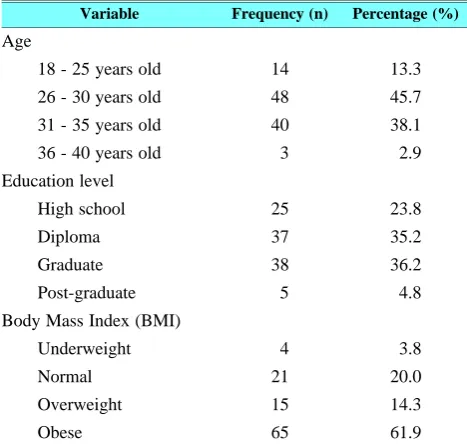
Characteristic of 105 subjects in this study that were diagnosed with PCOs using Rotterdam criteria shown on Table 1.
Table 1. Characteristic of this study.
Variable Frequency (n) Percentage (%)
Age
18 - 25 years old 14 13.3
26 - 30 years old 48 45.7
31 - 35 years old 40 38.1
36 - 40 years old 3 2.9
Education level
High school 25 23.8
Diploma 37 35.2
Graduate 38 36.2
Post-graduate 5 4.8 Body Mass Index (BMI)
Underweight 4 3.8
Normal 21 20.0
Overweight 15 14.3
Obese 65 61.9
BMI based on WHO Asia-Pacific criteria, underweight (BMI < 18.5); normal (BMI 18.5 - 23.0); overweight (BMI 23.0 - 25.0); and obese (BMI > 25.0).
Subject population age is range from 22 to 39 years old, with 45.7% in 26 - 30 years old group, and fol-lowed by 38.1% in 31 - 35 years old group. All sub-jects have a senior high school equivalent education levels, 4.8% of them have a post graduate education level. Average body mass index (BMI) was 26.85; with 20% was a normoweight; 3.8% was under-weight; 14.3% overunder-weight; and 61.9% was obese.
The most frequent symptom found from 105 sub-jects in this study was oligo/amenorrhea (95.2%). 84 subjects had polycystic ovary (80%), 34 subjects had clinical hyperandrogen (32.4%), 34 subjects had FAI score more than 5 (32.4%), 53 subjects had insulin resistance (50.5%). 70 subjects had an increase of LH/FSH ratio (66.7%). This various phenotypes are shown on Table 2.
Table 2. Phenotype of PCOs patients in this study.
Symptom and Sign
Frequency (n = 105)
Percentage (%)
Oligo/amenorrhea 100 95.2%
Polycystic ovary (PCO) 84 80%
Clinical hyperandrogen (FGs > 8) 34 32.4%
Hyperandrogen (FAI > 5) 34 32.4%
Insulin resistance (fG/fI > 5) 53 50.5%
LH/FSH ratio > 1 70 66.7%
If subjects were divided into 2 groups, obese (BMI > 25) and non-obese, then significant phenotype dif-ference can be seen, as in Table 3. In obese group, insulin resistance is greater (70.8%) compared to
obese group (17.5%), polycystic ovary is greater in obese group (87.7%) compared to non-obese group (67.5%), and hyperandrogen lab value (FAI > 5) is greater in obese group (40%) than non obese group (25%).
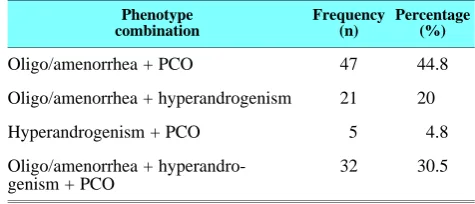
Based on Rotterdam criteria, the most frequent phenotype combination in this study is oligo/amenor-rhea and polycystic ovary on ultrasound exam (44.8%) shown on Table 4.
Relation between fG/fI ratios with FAI in this study was analyzed with Spearman non-parametric test. Bivariate analysis of fG/fI ratio and FAI shows significant relation (p = 0.0001) between variables, but the strength of relation was weak, and shows op-posite relationship. The lower the values of fG/fI ra-tio, the higher the values of FAI in subjects, with cor-relation coefficient -0.342 in this study (0.200 - 0.400 shows weak correlation, and negative values show re-verse correlation).
Relation between LH/FSH ratios with FAI in this study was also analyzed with Spearman non-parame-tric test. There is a significant relation between LH/FSH ratio and FAI (p = 0.001), and the strength of relation was also weak, and shows parallel rela-tionship. The higher the values of LH/FSH ratio, the higher the values of FAI in subjects, with a correla-tion coefficient +0.386 in this study.
Table 4. Phenotype combination found based on 2003 Rotter-dam criteria.
Phenotype combination
Frequency (n)
Percentage (%)
Oligo/amenorrhea + PCO 47 44.8
Oligo/amenorrhea + hyperandrogenism 21 20
Hyperandrogenism + PCO 5 4.8
Oligo/amenorrhea + hyperandro-genism + PCO
32 30.5
A very wide range of minimum and maximum val-ues of fG/fI ratio, LH/FSH ratio, and FAI is shown on Table 5.
Table 5. Laboratory values of fG/fI ratio, LH/FSH ratio, and Free-Androgen Index (FAI).
Numeric variable Median Minimum; maximum
fG/fI ratio 10 (2.14; 48.5)
LH/FSH ratio 1.4 (0.028; 9)
FAI 3.42 (0.24; 21.39)
DISCUSSION
This study was done on women in their reproductive age (22 - 39 years old), who has mid to high education level and more than 76% subjects were overweight or obese (BMI ≥ 23.0). Characteric of subjects are quite similar with previous study by Majumdar et al, where 66.6% of the subjects of PCOs patients were overweight or obese. This study also found, in ac-cordance with Allahbadia et al theory,17 that obesity are related with insulin resistance and hyperandro-genism may have an important role in pathogenesis of PCOs.
Oligo/amenorrhea is the most common PCOs phe-notype found (95%) in this study. Azziz et al18 found only 22.4% subjects has irregular menstrual period in their study. This difference may be caused by differ-ent inclusion criteria, Azzizz et al18 did not use Rot-terdam 2003 criteria to diagnose PCOs. Hsu et al19, a study from Taiwan, that use the Rotterdam 2003 criteria found that 79% of PCOs may be due to ovu-lation disorders, which 71% of them were oligome-norrhea and 8% were ameoligome-norrhea.
One of PCOs clinical signs are hyperandrogene-mia, and the symptoms that goes along with it are hirsutism. Hirsutism were found in 32.4% subjects in this study, similar with 30% subjects found from Hsu et al,19 different from Azziz et al,18 that only found 6.8% subjects with hirsutism. Meanwhile, higher pre-valence of hirsutism 53.1% were found in Kumarapeli et al study.9 Different hair distribution between races and tribes, and also different genetic responses from pilocebaceous gland to circulating androgen hormon-es, may contribute in this difference.19
Table 3. Phenotypes found in non-obese and obese PCOs patients.
Phenotype Non Obese Obese
Total Percentage (%) Total Percentage (%)
Oligo/amenorrhea 38 95 62 95.4
Polycystic ovary (PCO) 27 67.5 57 87.7
Clinical hyperandrogen (FGs > 8) 17 42.5 17 26.2
Hyperandrogen (FAI > 5) 10 25 26 40
Insulin resistance (fG/fI > 5) 7 17.5 46 70.8
Free Androgen Index (FAI) lab test, to find out the states of hyperandrogenemia in subjects, are more re-levant to show the effect of increased androgen hor-mones inside the body, as androgen horhor-mones that are not bind with Sex Hormone Binding Globulin (SHBG) are proportionally measured. Free circulating hormones can bind to steroid receptors that eventually cause certain biologic effects. PCOs subjects found that have Free Androgen Index (FAI) more than 5 in this study is 32.4%. Hsu et al,19 found 59% PCOs patients, due to increased level of serum testosterone, were categorized as hyperandrogenemia. Nonetheless, testosterone serum examination cannot describe the proportion of free circulating testosterone hormones, because it reflects the total testosterone level in sub-ject’s body (free and binded hormones measured al-together). Kumarapeli et al,9 only found 6.8% subjects with hyperandrogenemia, this difference may be caused by the criteria of hyperandrogenemia used in their study (hyperandrogenemia is positive, above 2 standard deviation from women reproductive age av-erage). Different criteria used in these studies may cause different results, then methods and criteria in future studies should be better thought and planned, especially about all factors that have strong relations with pathogenesis, treatments and outcomes.
In this study, prevalence of hyperandrogenemia (FAI > 5) is in compliance with hirsutism (FG score > 8). It seems that there was a relation between free circulating androgen with hirsutism symptoms. But, after further evaluation, there was no difference in proportion between subjects with hirsutism (FG score > 8) and non-hirsutism (FG score < 8), either in hy-perandrogenemia group (FAI > 5) or non-hyperandro-genemia group (FAI < 5). So, further statistical analy-sis was not needed. Clinical response of hyperandro-genemia is widely influenced by genetic factor that the FAI > 5 definition in this study might not be sen-sitive enough to screen patients with hirsutism.
Polycystic ovaries were found in 80% subjects in this study, similar with studies from Hsu et al,19 (96.7%), Kumarapelli et al,9 (91%), and van der Wes-thuizen et al,20 (82.2%), respectively. Slight differ-ence in percentage may be caused by ultrasound (US) examinations taken that were very operator-depen-dant, so there might be inter-observer variations.
Insulin resistance and increase of LH/ FSH ratio are PCOs phenotypes included in 1997 NIH and 2002 Homburg criteria, but they are not included in Rot-terdam criteria. Eventhough these phenotypes does not effect diagnosis of disease, practicioner still uses insulin resistance and LH hypersecretion data in terms of treatment plan. About 50.5% subjects shows insu-lin resistance in this study, similar to 53% subjects found in Legro et al,14 study. Another study from Muharam,21 in Indonesia found higher insulin resis-tance, 64.8%. This proportion difference might be due to different method of measurement taken in these studies. Legro et al,14 uses HOMA-IR (Homeostasis Model Assesment for Insulin Resistant) method, and Muharam,21 uses three diagnosis criteria of insulin re-sistance (said to be positive if one of three criteria fulfilled). Fasting blood glucose-fasting insulin (fG/fI) ratio < 10.1 used in this study, was also taken from Muharam previous study with 90.2% sensitivity and
90.9% specificity. Higher percentage of insulin re-sistance, polycystic ovaries, and hyperandrogenemia (FAI > 5) in PCOs was found on obese group than non obese. This findings is in accordance with a theo-ry that obesity will cause insulin resistance and then causes hyperandrogenemia and influence follicle ma-turity that causes polycystic ovaries.
Increase of LH/FSH ratio indicate an increase of LH level in PCOs patients. Ratio of LH/ FSH is in-crease when LH/FSH > 1, taken from Hsu et al,22 study with 69% sensitivity and 80% specificity. About 66.7% subjects in this study has an increase of LH/ FSH ratio, higher than other studies from Balen et al,13 (40%) and Frank et al,23 (51%). Those other studies have more sample and uses only LH measure-ment as in 2002 Homburg criteria. LH/FSH ratio has to be considered because there is a decrease of FSH in PCOs that can influence the maturity of follicles as stated in 2003 Rotterdam criteria.
Rotterdam criteria that combines 2 out of 3 signs of PCOs, will get 3 phenotypes, that is oligo/anovu-latoir + hyperandrogenemia, oligo/anovuoligo/anovu-latoir + cystic ovaries (PCO), and hyperandrogenemia + poly-cystic ovaries. This study found that the most frequent signs were oligo/anovulatoir + PCO (75.2%), similar with Kumarapeli et al9 study at even higher percent-age 91.4%. The second combination of signs were oligo/anovulatoir + hyperandrogenemia, found 50.5% in this study and 54.4% in Kumarapeli et al,9 study. The least frequent signs found in this study were hy-perandrogen + PCO (35.2%), similar with Kumarapeli et al,9 (5.2%). This difference in percentage is thought to be caused by difference in clinical signs observed and different criteria used in determining hyperandro-genemia in lab exam, where Kumarapeli et al,9 used testosteron in their study and not free androgen index as in this study.
Previous studies had found the relation of insulin resistance and hyperandrogenemia. Weak correlation of fG/fI ratio as a parameter of insulin resistance and free androgen index (FAI) (correlation coefficient -0.342, p < 0.001) found in this study shows that the fewer fG/fI ratio, the more FAI increased, similar with Chen et al study,10 eventhough their study used HOMA-IR index as an insulin resistance parameter with a medium correlation (correlation coefficient 0.56, p < 0.001) that shows the higher HOMA-IR in-dex the more FAI increased. We can conclude that fG/fI ratio or HOMA-IR index both will shows the degree of insulin resistance in relation with free an-drogen index.
The result of this study are consistent with the the-ory of the incidence of insulin resistance. Decrease of glucose response to insulin, due to resistance from the insulin receptors, or insulin clearance from the liver and/or increase of pancreas sensitivity is the main pathogenesis of insulin resistance that later will cause hyperinsulinemia. Insulin can affect androgen production that are stimulated by LH, through insulin receptors or IGF-1 receptors. Hyperinsulinemia can also decrease SHBG production that later cause free circulating testosteron level. Hyperinsulinemia will also decrease the insulin growth factor binding pro-tein-1 (IGBP-1) production that trigger the increase of free IGF-1 and free IGF-2. Increase of free IGF
will stimulates ovary to produce more androgen through IGF-1 receptors. Insulin itself will also in-crease P450c17∝ that are essential in steroid hor-mones biosynthesis.24
Other sign that are found in PCOs is hypersecretion of LH. High level of LH can increase androgen pro-duction in theca cells, that afterwards will be chan-nelled to granulose cells. Under the influence of cer-tain levels of FSH, granulose cells will convert an-drogen into estradiol through aromatase enzyme activation. Estradiol hormones that are produced by granulose cells is an important factor in follicle growth and maturity. So the relation between LH and FSH ratio with free androgen index is also important to be analyzed.24
There was a weak parallel correlation between LH/FSH ratio and FAI in this study (correlation co-efficient = +0.318; p = 0.001) that means the higher LH/FSH ratio in PCOs, then the higher level of FAI. This findings is accordance to Fulgeshu et al11, that has found a significant relation between LH with FAI in 100 PCOs patient, but unfortunately Fulgeshu et al,11 was just doing an analysis without FSH measu-rement.
All of these findings in this study is accordance with the theories. Over production of LH can cause androgen hormon production in ovaries. Combination of high level of androgen and low level of SHBG can cause increase in free testosteron in circulation, rep-resented with FAI index. Finally, folliculogenesis dis-orders followed with hyperandrogenemia can be shown in PCOs patients. There was a significant weak rela-tion between fG/fI and LH/FSH ratio with FAI in PCOs patients.24,25
PCOs treatment usually consists of clomiphene cit-rate to deal with follicle maturity problems, Laparo-scopic Ovarian Drilling (LOD) to deal with polycystic ovary, simptomatic therapy (hormonal therapy to help regulate periods, contraceptive treatment with cypro-terone acetate that has anti-androgenic effect, and aes-thetic treatment to deal with hirsutism and acne vul-garis). Results of this study shows that insulin resis-tance and the high level of LH/FSH ratio in PCOs also need to be dealt with. With the unfolding of a clear correlation that can give more understanding in-to the etiology of PCOs, treatments is expected in-to be more focused towards the cause. We ought to give rational, holistic and proper treatment, so expected signs and symptoms of PCOs such as hyperandro-genemia will get resolved on its own.
Etiologic-based approach in treatment of PCOs, not just symptomatic approach, is recommended with most recent studies. Low levels of LH will lead to lack of androgen aromatization, and then decrease es-trogen produced, and finally lowering the chance of ovulation. While high levels of LH will inhibit aro-matization process so the growth of follicles will be attenuated. We can conclude that, to produce ovula-tion, it is necessary to have the optimal levels of LH, this is known as the LH ceiling concept.26 This gives the idea to suppress the high LH levels in PCOs pa-tients in order to improve the success of ovarian sti-mulation treatment. The discovery of fG/fI ratio cut-off point of 10.1 to determine the condition of insulin resistance can also be used as an indicator to treat
these conditions before making efforts to stimulate, or as a combine treatment of ovarian stimulation (with medication to overcome the insulin resistance).21
Use of cross-sectional design is the main weakness of this study. It does not tell the causal relationship of the variables studied, such as fG/fI ratio and LH/ FSH ratio with FAI, that can be done with cohort de-sign. Next studies can also consider the use of control groups, so it can compare signs, symptoms, and other parameters in PCOs with non-PCOs patients, and to know the normal cut-off point of FAI in Indonesian people. More clinical trials and researches on the ap-propriate therapy for patients with PCOs is needed, whether treating the conditions of insulin resistance and elevated levels of LH can increase the effective-ness and overall success of PCOs treatments.
CONCLUSION
PCOs patients phenotype is quite diverse with the most frequent phenotype found which is oligo/ame-norrhea, and the phenotype combination found with Rotterdam criteria which is also quite diverse, with the most frequent phenotype which is oligo/anovula-toar and PCO. There is a significant relation between fG/fI ratio and LH/FSH ratio with Free Androgen In-dex in patients with PCOs.
REFERENCES
1. Brown MA, Chang RJ. Polycystic Ovary Syndrome: Clini-cal and Imaging Features. Ultrasound Quarterly. 2007; 23(4): 233-8
2. Goodarzi MO. Diagnosis, epidemiology, and genetics of the polycystic ovary syndrome. Best Practice and Research Clinical Endocrinology and Metabolism. 2006; 20: 193-205 3. Balen A. Polycystic ovary syndrome-a systematic disorder? Best Practice and Research Clinical Obstetrics and Gynae-cology. 2003; 17: 263-74
4. Hart R. Definition, prevalence and symptoms of polycystic ovaries and polycystic ovary syndrome. Best Practice and Research Clinical Obstetrics and Gynaecology. 2004; 18: 671-83
5. Hart R, Norman R. Polycystic ovarian syndrome-prognosis and outcomes. Best Practice and Research Clinical Obstet-rics and Gynaecology. 2006; 20: 751-78
6. Bako AU, Morad S, Atiomo WA. Polycystic ovary syn-drome: An overview. Review in Gynecological Practice. 2005; 5: 115-22
7. Homburg R. Management of infertility and prevention of ovarian hyperstimulation in women with polycystic ovary syndrome. Best Practice and Research Clinical Obstetrics and Gynaecology. 2004; 18: 773-88
8. Kousta E, White D, Cela E, McCarthy MI, Franks S. The prevalence of polycystic ovaries in women with infertility. Hum Rep. 1999; 14: 2720-3
9. Kumarapeli V, Seneviratne RA, Wijeyaratne CN, Yapa RMSC, Dodampahala SH. A simple screening approach for assessing community prevalence and phenotype of polycys-tic ovary syndrome in a semiurban population in Srilanka. Am J Epidemiol. 2008: 1-8
10. Chen MJ, Yang WS, Chen CL, Wu MY, Yang YS, Ho HN. The relationship between anti-Mullerian hormone, an-drogen and insulin resistance on the number of antral fol-licles in women with polycystic ovary syndrome. Hum Rep 2008; 23(4): 952-7
12. Fauser BCJM. Classification of chronic hyperandrogenic anovulation. In: Bennink HJTC, Vemer HM, Keep PAv, eds. Chronic Hyperandrogenic Anovulation. 1st Ed. New Jersey: The Parthenon Publishing Group 1991: 13-7 13. Balen A, Conway G, Kaltsas G. Polycystic ovary
syn-drome: the spectrum of the disorder in 1741 patients. Hum Rep. 1995; 10: 2107-11
14. Legro R, Kunselman A, Dodson W, Dunaif A. Prevalence and predictor of risk for type 2 diabetes mellitus and im-paired glucose tolerance in polycystic ovary syndrome: a prospective, controlled study in 254 affected women. J Clin Endocrinol Metab. 1999; 84: 165-9.
15. Schorge JO, Schaffer JI, Halvorson LM, Hoffman BL, Bradshaw KD, Cunningham FG. Polycystic Ovarian Syn-drome and Hyperandrogenism. In: Williams Gynecology. USA: McGraw Hill 2008: 388
16. Archer JS, Chang RJ. Hirsutism and acne in polycystic ovary syndrome. Best Practice and Research Clinical Ob-stetrics and Gynaecology. 2004; 18: 737-54
17. Allahbadia GN. Merchant R. Polycystic ovary syndrome in the Indian subcontinent. Seminars in Reproductive Medi-cine. 2008; 26(1): 24.
18. Azziz R, Woods KS, Reyna R, Key TJ, Knochenhauer ES, Yildiz BO. The prevalence and features of the polycystic ovary syndrome in an unselected population. J Clin Endo-crinol Metab. 2004; 89: 2745-9
19. Hsu MI, Liou TH, Chou SY, Chang CY, Hsu CS. Diag-nostic criteria for polycystic ovary syndrome in Taiwanese Chinese women: comparison between Rotterdam 2003 and NIH 1990. Fertil Steril. 2007; 88: 727-9
20. Van der Westhuizen S, van der Spuy ZM. Ovarian morpholo-gy as a predictor of hormonal values in polycystic ovary syn-drome. Ultrasound Obstet Gynecol. 1996; 7: 335-41 21. Muharram R. Mengetahui nisbah gula darah puasa/insulin
puasa pada ovarium polikistik [tesis]. Program Studi Ob-stetri dan Ginekologi Program Pendidikan Dokter Spesialis I Fakultas Kedokteran Universitas Indonesia Jakarta. 2001 22. Hsu MI, Liou TH, Liang SJ. Inappropiate gonadotropin se-crestion in polycystic ovary syndrome. Fertil Steril 2009; 91: 1168-74
23. Franks S. Controversy in clinical endocrinology. Diagnosis of polycystic ovarian syndrome: in defense of the Rotter-dam criteria. J Clin Endocrinol Metab. 2006; 91: 786-9 24. Balen A. The pathophysiology of polycystic ovary
syn-drome: trying to understand PCOs and its endocrinology. Best Practice and Research Clinical Obstetrics and Gynae-cology. 2004; 18: 685-706
25. Tsilchorozidou T, Overton C, S. Conway G. The patho-physiology of polycystic ovary syndrome. Clin Endocrinol. 2004; 60: 1-17
26. Wiweko B. Review literature. Peran suplementasi LH dalam hiperstimulasi ovarium terkendali. 2008