The Thirty-Third AAAI Conference on Artificial Intelligence (AAAI-19)
Composable Modular Reinforcement Learning
Christopher Simpkins, Charles Isbell
College of Computing Georgia Institute of Technology
801 Atlantic Drive Atlanta, GA 30332-0280, USA
[email protected], [email protected]
Abstract
Modular reinforcement learning (MRL) decomposes a mono-lithic multiple-goal problem into modules that solve a por-tion of the original problem. The modules’ acpor-tion preferences are arbitrated to determine the action taken by the agent. Truly modular reinforcement learning would support not only decomposition into modules, but composability of sep-arately written modules in new modular reinforcement learn-ing agents. However, the performance of MRL agents that arbitrate module preferences using additive reward schemes degrades when the modules have incomparable reward scales. This performance degradation means that separately written modules cannot be composed in new modular reinforcement learning agents as-is – they may need to be modified to align their reward scales. We solve this problem with a Q-learning-based command arbitration algorithm and demonstrate that it does not exhibit the same performance degradation as exist-ing approaches to MRL, thereby supportexist-ing composability.
Introduction
Decomposition is an important tool in designing software systems in general and, as we will see in the next section, an important tool for dealing with the larger state spaces likely to be encountered in real-world problems. Hierarchical re-inforcement learning (HRL), discussed in the Related Work section, decomposes reinforcement learning problems tem-porally, modeling intermediate tasks as higher-level actions. HRL has also formed the basis of reinforcement learning-based programming systems.
MRL decomposes the original problem concurrently, modeling an agent as a set of concurrently running rein-forcement learning modules. MRL has been used primarily to model multiple-goal problems and to deal with large state spaces. We would like to use MRL as a basis for reinforce-ment learning-based programming systems but, as we dis-cuss in the section on composability in modular reinforce-ment learning, current approaches to MRL have a serious limitation – a requirement for module reward scale compa-rability – which limits their usefulness in programming sys-tems. The work we present in this paper solves the reward scale comparability problem.
Copyright c2019, Association for the Advancement of Artificial Intelligence (www.aaai.org). All rights reserved.
Figure 1: In the grid world above, the bunny must pursue two goals simultaneously: find food and avoid the wolf. The bunny may move north, south, east, or west. When it finds food it consumes the food and new food appears elsewhere in the grid world, when it meets the wolf it is eaten and “dies.”
The Curse of Dimensionality
As with other kinds of machine learning, reinforcement learning must deal with the curse of dimensionality. In re-inforcement learning the curse of dimensionality manifests itself primarily in the size of the state space, namely, the state space grows exponentially in the number of state features.
As an example, consider the5×5grid of the bunny world in Figure 1. The bunny, food, and wolf can be in one of 25 possible locations. If the task of the bunny were only to reach a particular location, then the number of states would be 25. Add the task of avoiding a wolf and the state space grows to252 = 625. Add finding food and the state space grows to253 = 15625. If you model this problem as two
another in which the bunny finds food, then each module solves a problem with a state space of 252 = 625 states
(bunny plus wolf and bunny plus food).
Modular Reinforcement Learning
An MRL (Russell and Zimdars 2003; Sprague and Ballard 2003b) agent is decomposed into several modules each of which concurrently learns a different subgoal of the origi-nal, complex, multiple-goal learning problem. In an MRL agent each module observes the action taken by the agent, the state transition and a reward signal specific to the mod-ule. At each time step, the agent combines the action pref-erences of the modules to compute the joint policy. In most MRL algorithms the joint policy is derived from a joint Q-function in which the Q-values for each module are added:
Qjoint(s, a) =
X
Qi(si, a) (1)
where each module mi has its own state abstraction, si
for eachs∈S.
Russell’s and Zimdars’ Q-decomposition (Russell and Zimdars 2003) is equivalent to Sprague and Ballard’s GM-Sarsa (Sprague and Ballard 2003b). Both of these investi-gations of Q-function decomposition showed that Sarsa is a better choice for agent modules than Q-learning because Sarsa is on-policy. Sarsa updates its Q-function based on the policy being followed by the agent while Q-learning updates its Q-function assuming the module’s locally optimal pol-icy will be followed. Because modules do not have direct control over the policy being followed, modules using on-policy learning algorithms like Sarsa perform better because the global action is communicated to the modules to update local Q-functions. Because we evaluate our algorithm using the same problem as Sprague and Ballard, in this work we will refer mostly to GM-Sarsa.
There is clearly a desire to model agents with multiple goals represented as reinforcement learning modules. We list only a few examples here. Sprague and Ballard have ap-plied GM-Sarsa to problems in eye movement scheduling (Sprague and Ballard 2003a; Sprague, Ballard, and Robin-son 2007). Konidaris and Barto applied an algorithm de-rived from GM-Sarsa to adaptive robot control (Konidaris and Barto 2006). Aissani and colleagues used GM-Sarsa to develop a system for dynamic scheduling of mainte-nance tasks in the petroleum industry (Aissani, Beldjilali, and Trentesaux 2009; Chaari et al. 2014). Rowe and col-leagues used GM-Sarsa for interactive narrative planning (Rowe and Lester 2013).
All of the work applying MRL has been done by single teams of researchers applying MRL to research problems. Thus, modules were authored together with comparable re-ward scales. To support reusability in a software engineering sense we need to support the separate authoring of modules. Separately authored modules may use reward scales that are internally consistent within modules but incomparable to the rewards used in other modules. In this paper we show that existing approaches to MRL degrade when modules use in-comparable reward scales and present an algorithm that does not exhibit the same degradation.
Composability in Modular Reinforcement
Learning
Our ultimate goal with modular reinforcement learning is to facilitate the integration of reinforcement learning into a programming language in order to support intelligent agent software engineering, as we outlined in earlier work (Simp-kins et al. 2008). To support software engineering we would like MRL components to be truly modular. In particular, we would like the components to be reusable without modifi-cation – composable. Unfortunately, current approaches im-plicitly require a global, monolithic reward signal, which de-tracts from composability. In particular, an agent program-mer cannot locally define the reward function for a module because the reward scales of other modules must be taken into account. For example, if a Bunny (Figure 1) agent pro-grammer creates a FindFood module and then decides to use an AvoidWolf module written by another programmer but the AvoidWolf module uses a reward scale several times higher than FindFood, then a MRL algorithm that uses ad-ditive rewards will favor AvoidWolf to the near exclusion of FindFood. One of the modules would need to be modified to align the reward scales of all the modules. As we sum-marize briefly in the following section, Bhat and colleagues showed that this limitation is inherent in existing approaches to modular reinforcement learning (Bhat, Isbell, and Mateas 2006).
Ideal Action Selection is Impossible
Aside from the practical challenges cited above, Bhat, et., al. (Bhat, Isbell, and Mateas 2006) showed that ideal action selection from modules that vote on the agent’s single action is impossible in full generality because the problem reduces to Arrow’s Paradox (Arrow 1963): an agent is a “society” of modules, and action selection is social choice. The problem is that we want the action selection mechanism to have the following reasonable properties:
• Universality: the ability to handle any possible set of modules.
• Unanimity: guarantee that if every module prefers action A, action A will be selected.
• Independence of Irrelevant Alternatives: each mod-ule’s preference for actions A and B are independent of the availability of any other action C. This property pre-vents any particular module from affecting the global ac-tion choice by dishonestly reporting its own preference ordering.
• Scale Invariance: ability to scale any module’s Q-values without affecting the arbitrator’s choice. This is the cru-cial property that allows separately authored modules with incomparable reward signals.
Reformulating MRL
Bhat, et., al., (Bhat, Isbell, and Mateas 2006) argued for a “benevolent dictator”, a special module executing a com-mand arbitration function for action selection but left the arbitration algorithm unspecified. Here we present a com-mand arbitration algorithm embodying the ideas in (Bhat, Isbell, and Mateas 2006) and show that it performs compet-itively with other MRL algorithms and shows superior ro-bustness to module modification. This roro-bustness to module modification is the chief enabler of truly modular reinforce-ment learning in which modules can be transferred from one system to another without having to re-engineer the reward signals to fit the new host system.
This formulation relaxes the non-dictatorship requirement of ideal action selection if you think of the arbitrator as a special module. By Arrow’s theorem, other properties will still hold. In the next section we present a reformulation of MRL based on this idea.
Formalization
Our reformulation of MRL adds a command arbitrator
which has a state space that may be the same as or different from the modules’ state spaces, an action set that represents choosing a module,ACA = 1...nfor an agent withn
mod-ules, and a reward signal that represents the agent’s overall goal. The arbitrator’s reward function,RCA(s), is
indepen-dently defined rather than being derived from the module rewards. Note thatRCA(s)may or may not be equal to the
sum of the rewards of the agent’s modules. In fact, the mod-ules’ rewards,Ri(s, a), may not have any relation to the
ar-bitrator’s rewardRCA(s).
The agent’s policy is defined indirectly by the arbitrator’s policy,πCA(s, a), which assigns probabilities to the
selec-tion of a module for each state, where the selected module’s preferred action becomes the agent’s action in that state.
For the agent author, this formulation adds the require-ment of authoring a dedicated reward signal for the arbitra-tor. For our bunny agent, this is LiveLongProsper:
• Whyavoid predator,whyeat? To live longer.
• Encodes the tradeoffs between modules – perhaps food is more important to some bunnies.
• The arbitrator could be hand-authored, or could be an-other RL agent.
For the small cost of authoring a reward signal that repre-sents the “greater good” you get true modularity, that is, the ability to combine separately authored modules with incom-parable rewards. This new reward signal is now the metric we use to measure the performance of the agent.
In our MRL framework an agent is an arbitrator plus a list of modules. Formally, an agent consists of the following elements (we useCAin subscript to refer to the command arbitrator and numbers orito refer to modules):
1. A reward function for the command arbitrator,RCA(s),
2. An action setAfor the agent as a whole, shared by each module,
3. A set of reinforcement learning modules,M
4. A state abstraction function, moduleStatei for each
modulemi
5. A reward function,Ri(s)for each modulemi
In the next section we present our Arbi-Q algorithm which implements the arbitrator in this framework.
The Arbi-Q Command Arbitration Algorithm
Our command arbitrator is itself a reinforcement learner. The state space for the arbitrator may be the world state, in which no state abstraction is used for the arbitrator, or may employ a state abstraction like the modules. The arbitrator’s action set,ACA, is a set of integer indexes to the agent’s list
of modules. As with any reinforcement learner, the arbitrator learns a policy. In the case of the arbitrator this policy,πCA
is a mapping from states to modules. The modules’ policies are mappings from abstracted module state to actions in the world, that is, the agent’s actions. The arbitrator’s policy de-fines which module chooses the agent’s action in a particular state.
Our Arbi-Q implementation uses the Sarsa algorithm (Rummery and Niranjan 1994) to learn the arbitrator’s pol-icy, but any reinforcement learning algorithm may be used. At each time step the arbitrator uses its policy to select a module, then the module uses its local policy to select an tion that the agent executes. The results of executing the ac-tion are communicated to the arbitrator as a consequence of the module selection, and to the modules as a consequence of action selection. Each module uses a state abstraction function to transform the world state into the the subset of the state relevant to the module, and a reward function that is based on the module’s state abstraction. In this way the modules are coupled to the world in which they operate – the modules can only operate in worlds which contain the state features expected by its state abstraction function – but the modules are not coupled to other modules or to an arbitra-tor. The Arbi-Q algorithm is sketched in Algorithm 1. While the algorithm presented here shows the modules learning at the same time the arbitrator is learning, it is also possible to pre-train the modules and hold them constant while train-ing the arbitrator. Because Arbi-Q uses Sarsa to learn its module-selection policy it inherits the convergence proper-ties of Sarsa (Singh et al. 2000).
Algorithm 1Arbi-Q (sketch)
QCA←random initial values
foreach moduleido
Qi←random initial values
end for
foreach time stepdo
Command arbitrator chooses a modulemfromQCA
a←−greedy action forsmfromQm
Executea, observe effectsrCAands0
UpdateQCA(sCA, m)from actionmandRCA(sCA)
foreach moduleido
UpdateQi(si, a)from actionaandRi(si, a)
Experiments
Our principal claim is that Arbi-Q is robust to modules with incomparable reward scales, which would be an au-thoring error in existing MRL approaches. Our experiments show that GM-Sarsa/Q-decomposition degrades when mod-ules are modified to have incomparable reward scales and that Arbi-Q is robust to such modification.
Bunny-Wolf World
We use a world derived from Sprague and Ballard (Sprague and Ballard 2003b). In Bunny-Wolf world, our agent is a bunny that must eat food and avoid being eaten by a wolf. The bunny world is a continuing world rather than an episodic world. There is no specified start state and there is no termination of episodes. When the bunny finds and eats food, a new food item appears elsewhere. When the wolf eats the bunny the bunny “respawns” in a new location, sim-ilar to video games. We can represent such a bunny agent in our formulation as follows:
• Module 1: FindFood. The bunny agent must find food in order to continue living. When the bunny finds food it gets a reward of 1.0. In each step that it does not eat the bunny gets a reward of -0.1 to represent increasing hunger.
• Module 2: AvoidWolf. The bunny agent must avoid the wolf. Meeting the wolf gives the bunny a reward of -1.0. In each time step that the bunny avoids the wolf the bunny receives a reward of 0.1 to represent that it successfully lived another day.
• Agent’s overall goal (implemented in arbitrator): Live-LongProsper – get as much food per time step as possi-ble, which will require balancing food finding with wolf avoidance. The arbitrator’s reward function is 0.0 for meeting the wolf, 1.0 for finding food, and 0.5 for each step in which the wolf is avoided but no food is eaten. This is the same as the score used to evaluate algorithm perfor-mance (discussed below). Using the score makes sense because maximizing a global “score” is the overall goal of the agent.
To facilitate comparison between Arbi-Q and GM-Sarsa we use a performance metric – a score – that is indepen-dent of the reward received by any modules or agents as a whole. The learning of the modules is still guided by their reward functions, but an independent score is necessary for comparison between algorithms to avoid coupling their re-ward scales. The score we use is 0.0 for meeting the wolf, 1.0 for finding food, and 0.5 for each step in which the wolf is avoided but no food is eaten. We validate Arbi-Q’s perfor-mance by comparing it with GM-Sarsa, as we discuss below. We evaluate each algorithm similarly to Sprague and Bal-lard (Sprague and BalBal-lard 2003b), running each algorithm fornsteps, suspending learning everyn/100steps to eval-uate performance. Performance is evaleval-uated by running the greedy policy in the world for 1000 episodes and calculating the average score per time step. Each algorithm used a dis-count rate of 0.9 and-greedy action selection during train-ing withlinearly discounted from 0.4, as in Sprague and
Ballard’s experiments. For baselines, GM and Arbi-Q algo-rithms used modules with similarly scaled rewards. For ro-bustness validation, we scaled the AvoidWolf module reward by 10 to simulate the swapping out of separately-authored learning modules. Although we also compared to mono-lithic, or “flat”, reinforcement learners, we do not present a comparison to a flat Q or Sarsa learner here because GM-Sarsa has already been shown to be superior to a flat Q or Sarsa learner on this problem (Sprague and Ballard 2003b).
Results
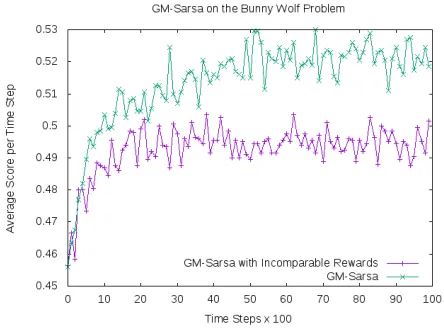
Empirical results show that the performance of GM-Sarsa degrades when the reward scales of the modules are not comparable. The learning curves depicted in Figure 2 show that GM-Sarsa bunny agent with incomparable reward scales for its modules converges to a lower score than with compa-rable rewards.
Figure 2: Performance of GM-Sarsa/Q-decomposition on the bunny-wolf problem. The learning curves show that Greatest Mass command arbitration degrades significantly when its module rewards are incomparable.
As Figure 3 shows, Arbi-Q does not exhibit any perfor-mance degradation when the agent’s modules have incom-parable reward scales. Arbi-Q does not use the Q-values of its modules directly. Instead, Arbi-Q learns when it should listen to a particular module. More precisely, Arbi-Q de-velops a probability distribution for each state which says which module has the best advice in that state. Using the ex-ample above with incomparable reward scales, the modules would learn the same local policies using the same Q-values as above, but the arbitrator would learn a policy based on Q-values for selecting modules that chose actions that resulted in particular rewardsfor the agent as a whole. The result-ing Q-values for the arbitrator represent moduleselection,
not action selection. So Arbi-Q learns that when the wolf
Figure 3: Performance of Arbi-Q on the bunny-wolf prob-lem. Arbi-Q converges to similar scores as GM-Sarsa and shows no degradation in performance when modules have incomparable rewards. By solving the module reward scale comparability problem, Arbi-Q better supports modular re-inforcement learning agents with separately written mod-ules.
Arbi-Q is Robust to Algorithm Choice
Sprague and Ballard, and Russell and Zimdars showed that Greatest-Mass (Sprague and Ballard 2003b) (or Q-decomposition (Russell and Zimdars 2003)) action selec-tion achieved better learning performance when modules used Sarsa instead of Q-Learning because Sarsa is on-policy and Q-learning is off-policy. The reason for this sensitiv-ity to module learning algorithm is that the arbitrator uses the modules’ q-functions directly. Modules using off-policy learning algorithms (Q-learning) update their q-functions based on the optimal future actions for the modules rather than for the agent as a whole, which biases the action selec-tion of an arbitrator using an additive q-funcselec-tion away from the optimal joint policy. Modules using on-policy learning (Sarsa) update their q-functions based on the actual action taken by the agent, resulting in convergence to the optimal global policy as long as the reward scales are comparable (Russell and Zimdars 2003).
Although our primary aim here is to achieve robustness to incomparable reward scales in modules, Arbi-Q is also robust to the algorithm used in the modules. Unlike Greatest-Mass/Q-decomposition, Arbi-Q exhibits the same learning performance whether its modules use Sarsa or Q-Learning, and whether the arbitrator uses Sarsa or Q-learning to learn the delegation policy, as shown in Figure 4.
Discussion
Arbi-Q achieves composability by decoupling module re-ward scales at the cost of requiring a separately authored reward function. While it is not obvious how to author arbi-trator reward, a few rules of thumb have proved useful in practice: (1) thinking of the arbitrator reward function as representing greater good, ”why” find food, ”why” avoid
Figure 4: Performance of Arbi-Q on the bunny-wolf problem using Q-learning for the modules and Q-learning to learn the command arbitration policy. Arbi-Q exhibits the same learning performance using Q-learning, suggesting that it is not only robust to modules with incomparable reward scales, but to modules using different algorithms to learn their local policies.
wolf – to live longer; and (2) thinking of the arbitrator re-ward function as score in a video game, e.g., Pac Man eats food pellets, eats cherries, and either runs from or chases ghosts, but thereasonfor doing these things is to maximize a score.
Each module, as well as the arbitrator, may use state abstraction (a subset of the word state which results in a smaller state space). These state abstractions are often ob-vious for modules but may may not be obob-vious for the arbi-trator. If the reward function of the command arbitrator uses the original world state rather than a state abstraction, then its state space is the same size as a monolithic reinforcement learner. It would seem that a chief benefit of MRL has been lost. However, in most cases there is still a benefit. In partic-ular, the savings in learning speed compared to a monolithic reinforcement learner is the ratio of actions to the number of modules. The Q-table of a monolithic reinforcement learner would have|S| × |A|entries. The Q-table of arbitrator has
Related Work
Hierarchical reinforcement learning (HRL) employs a tem-poral decomposition of the Q function. In the case of HRL, the designer typically specifies a delegation hierarchy of components with points of adaptation where a policy is learned to perform the delegation. The designer programs the policies of some of these components, which constitute a partial specification of the agent’s behavior, and some of the components use reinforcement learning to adapt to the hierarchy by learning the control policies for their parts of the problem. The adaptive components relieve the designer from writing the parts of the program that are hard to spec-ify, or require difficult to write adaptivity, and the partial pro-gram constrains the learning problem faced by the adaptive components, which speeds convergence. Components can be reused in other contexts, providing for modularity in tem-poral problem decompositions.
The current state of the art in HRL is based on the the-ory ofSemi-Markov Decision Processes (SMDPs). In an SMDP some actions are allowed to take more than one time step. These multi-step actions, sometimes called macros, subroutines, options, or hierarchical machines represent a form of procedural abstraction that may allow a programmer to write reinforcement learning agents in a manner similar to writing other kinds of computer programs.
Precup’s Options (Precup, Sutton, and Singh 1998; Sut-ton, Precup, and Singh 1999; Precup 2000) framework de-velops a detailed theory of temporal abstraction abstrac-tion based on SMDPs. Dietterich’s MAXQ (Dietterich 1998; 2000) and Hierarchical Abstract Machines (Parr and Rus-sell 1998) models decompose an MDP into a hierarchies of smaller MDPs. These smaller MDPs represent
subrou-tinesin the MAXQ framework or HAMsin the
Hierarchi-cal Abstract Machines framework. Andre’s Programmable
Hierarchical Abstract Machines (Andre and Russell 2000; 2002) develops a programming language for HAMs called ALisp (Adaptive Lisp), and Marthi and colleagues (Marthi et al. 2005) extend ALisp (Concurrent ALisp) for single re-inforcement learning agents with multiple simultaneous ac-tions, such as as robots with multiple effectors or a con-troller for multiple characters in a computer game. Zhang, Song and Ballard (Zhang, Song, and Ballard 2015) build on Sprague’s and Ballard’s earlier work on GM-Sarsa to develop three algorithms for deriving a global policy from independent modules. All of these algorithms still rely on the internal Q-values of the modules and thus require com-parable reward scales. Rohanimanesh and Mahadevan ex-tended the options HRL framework to concurrent settings in which multiple agents executing multiple simultaneous actions (Rohanimanesh and Mahadevan 2001; 2002). Their work differs from ours in that their framework applies to a single agent taking multiple actions or multiple agents tak-ing simultaneous actions, whereas we are concerned with a single agent executing a single action that is decided by multiple reinforcement learning modules. Marthi and col-leagues (Marthi et al. 2005) suggest extending their work in concurrent ALisp to include the Q-decomposition algo-rithm of Russell and Zimdars (Russell and Zimdars 2003), but this line of research was not pursued. Lau and colleagues
developed a MRL system that uses a central coordinator for multiple concurrent MPDs (Lau, Lee, and Hsu 2012). Lau’s work differs form ours in that they develop a constraint sys-tem in the central coordinator that limits the allowable ac-tions of the component reinforcement learners, thereby con-straining their learning. Our approach does not require the arbitrator to know details of component learners, and com-ponent learners require no explicit or implicit knowledge of the arbitrator or the other components.
Due to the curse of dimensionality, abstraction of vari-ous kinds has long been an active area of research in re-inforcement learning. One thread in abstraction is to use examples to guide abstraction. Zang and colleagues used examples of nearly optimal action sequences, or trajecto-ries, to dynamically discover options from data, delivering speedups of up to 30 times in some cases (Zang et al. 2009). Learning from demonstration (Ng, Russell, and others 2000; Zang et al. 2010b) uses human input to improve reinforce-ment learning performance. Zang and colleagues developed a value function approximation algorithm that leveraged hu-man input to speed convergence for function approximation-based reinforcement learning algorithms (Zang et al. 2010a). Cobo Rus and colleagues’ Abstraction from Demonstra-tion technique uses human demonstraDemonstra-tions to infer state abstractions and builds policies based on those state ab-stractions (Rus et al. 2011; Rus, Isbell, and Thomaz 2012; Rus et al. 2014).
Another thread in abstraction seeks to use models from the physical world to create abstractions of (simulated) physical state spaces. Cobo Rus and colleagues created ab-stractions of state spaces by organizing state spaces into classes of objects and using non-optimal Q-functions to es-timate the risk of ignoring certain classes of objects. Cobo Rus’s Object-Focused Q-Learning (OFQ) achieved expo-nential speedups in some cases (Rus, Isbell, and Thomaz 2013). Scholz and colleagues developed Physics-Based Re-inforcement Learning (Scholz et al. 2014), which uses com-putational physics engines such as Box2D (Catto 2013) as model representations, resulting in more sample-efficient learning compared to traditional object-oriented MDP ap-proaches. Physics-based reinforcement learning was then applied successfully in robotic mobile manipulation (Scholz et al. 2015) and robot navigation (Scholz et al. 2016) appli-cations.
Contributions, Limitations, and Future Work
(Simpkins, Rugaber, and Isbell 2017) that suggest continued development. Nevertheless, the present work on modular re-inforcement learning has limitations.
The first limitation of Arbi-Q is that the agent’s action al-ways comes from one of the modules. It may be that the best action in a given state is not chosen by any module. Ap-proaches to module cooperation such as negotiated-W learn-ing (Humphrys 1997) have been shown to be inferior to GM-Sarsa (and thus Arbi-Q) for problems such as the one pre-sented here, but it is worth investigating mixed approaches to action selection. The recent work of Zhang, Song and Bal-lard (Zhang, Song, and BalBal-lard 2015) may provide a promis-ing direction.
The second limitation is that achieving a substantial re-duction in total state space depends on the state abstraction of the arbitrator, which depends on the agent-level reward function. Techniques for authoring arbitrator reward func-tions need to be investigated.
A third limitation is that we use fairly standard tabu-lar Q-learning algorithms. Future work should investigate newer function approximation approaches such as hierarchi-cal Deep Q-Networks (Kulkarni et al. 2016).
Finally, we have demonstrated our algorithm’s perfor-mance on a small domain chosen so that we can compare it directly to previous work. Future work should evaluate our approach on larger domains with varied characteristics.
References
Aissani, N.; Beldjilali, B.; and Trentesaux, D. 2009. Dy-namic scheduling of maintenance tasks in the petroleum in-dustry: A reinforcement approach. Engineering
Applica-tions of Artificial Intelligence22(7):1089–1103.
Andre, D., and Russell, S. 2000. Programmable reinforce-ment learning agents. InAdvances in Neural Information
Processing Systems (NIPS), volume 13. MIT Press.
Andre, D., and Russell, S. 2002. State abstraction for pro-grammable reinforcement learning agents. InAAAI-02. Ed-monton, Alberta: AAAI Press.
Arrow, K. J. 1963. Social Choice and Individual Values. John Wiley and Sons, 2nd edition.
Bhat, S.; Isbell, C.; and Mateas, M. 2006. On the diffi-culty of modular reinforcement learning for real-world par-tial programming. InProceedings of the Twenty-First
Na-tional Conference on Artificial Intelligence (AAAI-06).
Catto, E. 2013. Box2d physics engine.
Chaari, T.; Chaabane, S.; Aissani, N.; and Trentesaux, D. 2014. Scheduling under uncertainty: Survey and research directions. InAdvanced Logistics and Transport (ICALT),
2014 International Conference on, 229–234. IEEE.
Dietterich, T. G. 1998. The MAXQ method for hierarchical reinforcement learning. InProc. 15th International Conf.
on Machine Learning, 118–126. Morgan Kaufmann, San
Francisco, CA.
Dietterich, T. G. 2000. Hierarchical reinforcement learning with the maxq value function decomposition. Journal of
Artificial Intelligence Research13:227–303.
Humphrys, M. 1997. Action selection methods using rein-forcement learning. Technical Report UCAM-CL-TR-426, University of Cambridge, Computer Laboratory.
Konidaris, G., and Barto, A. 2006. An adaptive robot moti-vational system. InInternational Conference on Simulation
of Adaptive Behavior, 346–356. Springer.
Kulkarni, T. D.; Narasimhan, K.; Saeedi, A.; and Tenen-baum, J. 2016. Hierarchical deep reinforcement learning: Integrating temporal abstraction and intrinsic motivation. In Lee, D. D.; Sugiyama, M.; Luxburg, U. V.; Guyon, I.; and Garnett, R., eds.,Advances in Neural Information
Process-ing Systems 29. Curran Associates, Inc. 3675–3683.
Lau, Q. P.; Lee, M. L.; and Hsu, W. 2012. Coordination guided reinforcement learning. InProceedings of the 11th International Conference on Autonomous Agents and
Multi-agent Systems-Volume 1, 215–222. International Foundation
for Autonomous Agents and Multiagent Systems.
Marthi, B.; Russell, S.; Latham, D.; and Guestrin, C. 2005. Concurrent hierarchical reinforcement learning. InIN
PRO-CEEDINGS IJCAI-2005, 779–785.
Ng, A. Y.; Russell, S. J.; et al. 2000. Algorithms for inverse reinforcement learning. InIcml, 663–670.
Parr, R., and Russell, S. 1998. Reinforcement learning with hierarchies of machines. In Jordan, M. I.; Kearns, M. J.; and Solla, S. A., eds.,Advances in Neural Information
Process-ing Systems, volume 10. The MIT Press.
Precup, D.; Sutton, R. S.; and Singh, S. 1998.Theoretical re-sults on reinforcement learning with temporally abstract
op-tions. Berlin, Heidelberg: Springer Berlin Heidelberg. 382–
393.
Precup, D. 2000. Temporal Abstraction in Reinforcement
Learning. Ph.D. Dissertation, University of Massacheusetts
Amherst.
Roberts, K. W. 1980. Interpersonal comparability and social choice theory.The Review of Economic Studies421–439. Rohanimanesh, K., and Mahadevan, S. 2001. Decision-theoretic planning with concurrent temporally extended ac-tions. InProceedings of the Seventeenth Conference on
Un-certainty in Artificial Intelligence, 472–479. Morgan
Kauf-mann Publishers Inc.
Rohanimanesh, K., and Mahadevan, S. 2002. Learning to take concurrent actions. InAdvances in neural information
processing systems, 1619–1626.
Rowe, J. P., and Lester, J. C. 2013. A modular reinforce-ment learning framework for interactive narrative planning.
InProceedings of the 9th AAAI Conference on Artificial
In-telligence and Interactive Digital Entertainment, 57–63.
Rummery, G. A., and Niranjan, M. 1994. On-line
Q-learning using connectionist systems. University of
Cam-bridge, Department of Engineering.
Rus, L. C. C.; Zang, P.; Isbell, C. L.; and Thomaz, A. 2011. Automatic State Abstraction from Demonstration. In Pro-ceedings of the Twenty-Second International Joint
Confer-ence on Artificial IntelligConfer-ence (IJCAI).
for Efficient Reinforcement Learning in High-Dimensional Domains.Artificial Intelligence216(0):103–128.
Rus, L. C. C.; Isbell, C. L.; and Thomaz, A. 2012. Au-tomatic Decomposition and State Abstraction from Demon-stration. InProceedings of the Eleventh International Joint Conference on Autonomous Agents and Multiagent Systems
(AAMAS).
Rus, L. C. C.; Isbell, C. L.; and Thomaz, A. 2013. Ob-ject Focused Q-learning for Autonomous Agents. In Pro-ceedings of the Twelfth International Joint Conference on
Autonomous Agents and Multiagent Systems (AAMAS).
Russell, S., and Zimdars, A. L. 2003. Q-decomposition for reinforcement learning agents. InProceedings of the Twenti-eth International Conference on Machine Learning
(ICML-2003).
Scholz, J.; Levihn, M.; Isbell, C. L.; and Wingate, D. 2014. A Physics-Based Model Prior for Object-Oriented MDPs.
InProceedings of the 31st International Conference on
Ma-chine Learning (ICML).
Scholz, J.; Levihn, M.; Isbell, C. L.; Christensen, H.; and Stilman, M. 2015. Learning Non-Holonomic Object Models for Mobile Manipulation. InProceedings of the the 2015 IEEE International Conference on Robotics and Automation
(ICRA).
Scholz, J.; Nehchal, J.; Levihn, M.; and Isbell, C. L. 2016. Navigation Among Movable Obstacles with Learned Dy-namic Constraints. InProceedings of the the 2016 IEEE/RSJ International Conference on Intelligent Robots and Systems
(IROS).
Simpkins, C.; Bhat, S.; Isbell, C.; and Mateas, M. 2008. Towards adaptive programming: Integrating reinforcement learning into a programming language. In OOPSLA ’08: ACM SIGPLAN Conference on Object-Oriented Pro-gramming, Systems, Languages, and Applications, Onward!
Track.
Simpkins, C.; Rugaber, S.; and Isbell, C. L. 2017. Dsl design for reinforcement learning agents. InWorkshop on
Domain-Specific Language Design and Implementation (DSLDI).
Singh, S.; Jaakkola, T.; Littman, M. L.; and Szepesv´ari, C. 2000. Convergence results for single-step on-policy reinforcement-learning algorithms.Machine learning
38(3):287–308.
Sprague, N., and Ballard, D. 2003a. Eye movements for reward maximization. InAdvances in neural information
processing systems, None.
Sprague, N., and Ballard, D. 2003b. Multiple-goal reinforce-ment learning with modular sarsa(o). InIJCAI’03: Proceed-ings of the 18th international joint conference on Artificial
intelligence, 1445–1447. San Francisco, CA, USA: Morgan
Kaufmann Publishers Inc.
Sprague, N.; Ballard, D.; and Robinson, A. 2007. Modeling embodied visual behaviors. ACM Transactions on Applied
Perception (TAP)4(2):11.
Sutton, R. S.; Precup, D.; and Singh, S. P. 1999. Between MDPs and semi-MDPs: A framework for temporal
abstrac-tion in reinforcement learning.Artificial Intelligence 112(1-2):181–211.
Zang, P.; Zhou, P.; Minnen, D.; and Isbell, C. L. 2009. Dis-covering Options from Example Trajectories. In Proceed-ings of the Twenty-sixth International Conference on
Ma-chine Learning (ICML).
Zang, P.; Irani, A.; Zhou, P.; Isbell, C. L.; and Thomaz, A. 2010a. Using Training Regimens to Teach Expanding Func-tion Approximators. In Proceedings of the Ninth Interna-tional Joint Conference on Autonomous Agents and
Multia-gent Systems (AAMAS).
Zang, P.; Tian, R.; Isbell, C. L.; and Thomaz, A. 2010b. Batch versus interactive learning by demonstration. In Pro-ceedings of the Ninth International Conference on
Develop-ment and Learning (ICDL).