The Thirty-Third AAAI Conference on Artificial Intelligence (AAAI-19)
Multi-View Multi-Instance Multi-Label
Learning Based on Collaborative Matrix Factorization
∗Yuying Xing,
1Guoxian Yu,
1,2,∗Carlotta Domeniconi,
3Jun Wang,
1Zili Zhang,
1,4Maozu Guo
51College of Computer and Information Science, Southwest University, Chongqing, China
2Hubei Key Laboratory of Intelligent Geo-Information Processing, China University of Geosciences, Wuhan, China 3Department of Computer Science, George Mason University, Fairfax, USA
4School of Information Technology, Deakin University, Geelong, Australia
5School of Electrical and Information Engineering, Beijing University of Civil Engineering and Architecture, Beijing, China
{yyxing4148, gxyu, kingjun, zhangzl}@swu.edu.cn, [email protected], [email protected]
Abstract
Multi-view Multi-instance Multi-label Learning (M3L) deals with complex objects encompassing diverse instances, repre-sented with different feature views, and annotated with multi-ple labels. Existing M3L solutions only partially explore the inter or intra relations between objects (or bags), instances, and labels, which can convey important contextual information for M3L. As such, they may have a compromised performance. In this paper, we propose a collaborative matrix factorization based solution called M3Lcmf. M3Lcmf first uses a hetero-geneous network composed of nodes of bags, instances, and labels, to encode different types of relations via multiple rela-tional data matrices. To preserve the intrinsic structure of the data matrices, M3Lcmf collaboratively factorizes them into low-rank matrices, explores the latent relationships between bags, instances, and labels, and selectively merges the data matrices. An aggregation scheme is further introduced to ag-gregate the instance-level labels into bag-level and to guide the factorization. An empirical study on benchmark datasets show that M3Lcmf outperforms other related competitive solutions both in the instance-level and bag-level prediction.
Introduction
Multi-Instance Multi-Label learning (MIML) is a framework for modeling complex objects, in which each object (or bag) contains one or more instances and is annotated by several semantic labels (Zhou et al. 2012). Let’s consider nbags
Bi = {xi1,xi2,· · ·,xik}(i = 1, . . . , n), where each bag
encompassesni ≥1instances, andxij ∈R
dis the feature vector of thej-th instance of thei-th bag. Thenbags and the m=Pn
i=1niinstances are annotated withqdistinct labels.
Yi∈R1×qis theq-dimensional label vector for thei-th bag.
Given a training datasetD={(Bi,Yi)}ni=1, MIML aims at learning an instance-levelf(x)∈Rq(or bag-level) predictor,
which maps the input features of instances (or bags) onto the label space.
Most MIML algorithms focus on single view data, where instances of bags are represented by one set of features. However, in real-world applications, a instance multi-label object can often be represented via different views
∗
Corresponding author, [email protected] (Guoxian Yu). Copyright c2019, Association for the Advancement of Artificial Intelligence (www.aaai.org). All rights reserved.
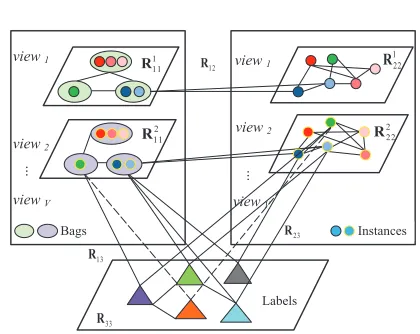
(Nguyen, Zhan, and Zhou 2013; Shao et al. 2016). For example, as shown in Figure 1, three exemplar bags en-compassing diverse instances are represented withV het-erogenous feature views. Since there are multi-type rela-tions between bags and between instances, learning from multi-view bags is more difficult and challenging than the recently heavily studied MIML task (Feng and Zhou 2017; Zhu, Ting, and Zhou 2017).
Bags Instances
Labels
...
viewV
view2
view1 view1
view2
... ...
viewV
1 11 R
2 11 R
1 22
R
2 22 R
33
R
13
R
12 R
23 R
Figure 1: An illustrative example of view multi-instance multi-label objects.{Rvij}V
v=1 are the multi-type relational data matrices between bags (objects), instances, and labels acrossV heterogeneous feature views.
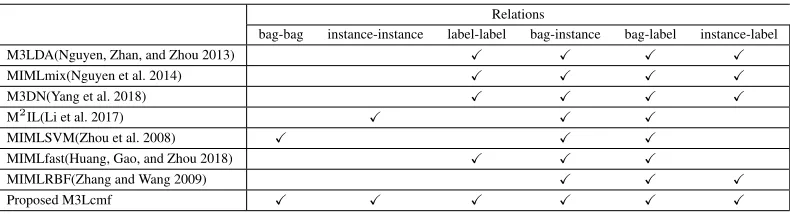
Table 1: Relations exploited by representative M3L and MIML methods.
Relations
bag-bag instance-instance label-label bag-instance bag-label instance-label M3LDA(Nguyen, Zhan, and Zhou 2013) X X X X
MIMLmix(Nguyen et al. 2014) X X X X
M3DN(Yang et al. 2018) X X X X
M2IL(Li et al. 2017) X X X
MIMLSVM(Zhou et al. 2008) X X X
MIMLfast(Huang, Gao, and Zhou 2018) X X X
MIMLRBF(Zhang and Wang 2009) X X X
Proposed M3Lcmf X X X X X X
views. Li et al. (2017) developed a multi-view multi-instance learning algorithm (M2IL), which generates different graphs with different parameters to represent various contextual re-lations between instances of a bag. It then integrates these graphs into a unified framework for bag classification based on sparse representation and multi-view dictionary learning. Yang et al. (2018) introduced a deep neural network based approach called M3DN. M3DN separately applies a deep net-work for each view, and requires the bag-based predictions from different views to be consistent within the same bag. In addition, M3DN adopts the Optimal Transport theory (Villani 2008) to capture the geometric information of the underlying label space and to quantify the quality of predictions.
However, these M3L approaches, like MIML solutions, only considerlimitedtypes of relations between bags or be-tween instances, as summarized in Table 1. M3L approaches generally capture the relations between bags and instances, and the associations between bags and labels. Some ap-proaches additionally exploit the relations between bags (Zhou et al. 2008), between instances (Li et al. 2017), and the correlations between labels (Huang, Gao, and Zhou 2018; Yang et al. 2018). Furthermore, other approaches use the asso-ciations between instances and labels (Zhang and Wang 2009; Nguyen et al. 2014) to learn labels of bags at the instance level. All these types of relations simultaneously exist in M3L, however,noneof the existing solutions explicitly ac-counts for all these relations.
To take advantage of multiple feature views of instances (or bags), an intuitive solution is to concatenate features from different views into a long vector, and then to apply MIML algorithms on the concatenated vector. However, this con-catenation causes over-fitting on a small number of training samples, and ignores the specific statistical property of each view (Xu, Tao, and Xu 2013). Ensemble learning can also work on multi-view data and MIML classifiers are readily available for each view. But the base classifiers are sepa-rately trained on individual views; as such, they may have a low performance given the insufficient information of each view and the neglect of complementary information across views. Subspace learning-based approaches (He et al. 2016; Tan et al. 2018) aim at obtaining a latent subspace shared by multiple views under the assumption that the input views are generated from a latent subspace. Latent subspace-based solutions may alleviate the issue of the “curse of dimension-ality”, but may neglect the intrinsic structure of individual views. For multi-view data, the intrinsic structures of bags
and instances may be different across views. Therefore, a competent M3L approach should account formultiple types of relationsbetween bags, instances and labels, and the in-trinsic structures of different feature views.
In this paper, we introduce an approach called M3Lcmf. M3Lcmf first constructs a heterogeneous network composed of nodes of bags, instances, and labels, to capture the intra-relationsbetween nodes of the same type, inter-relations
between bags and instances, between bags and labels, and between instances and labels. To respect and employ the intrinsic structure of the subnetworks of the intra and inter-relations, it collaboratively factorizes the association matrices of the subnetworks into rank matrices to pursue the low-rank representation of the nodes and the latent relationships among them, and also to selectively integrate multiple feature views of bags and instances. M3Lcmf additionally introduces an aggregation term into the factorization objective, which not only can aggregate the instance-label associations into bag-level, but also can reversely guide the prediction of these associations. The main contributions of this work are summa-rized as follows:
(i) Unlike existing solutions that can only account for several types of relations between bags and instances, M3Lcmf can simultaneously take into account multiple types of relations between bags, instances, and labels.
(ii) Our proposed M3Lcmf can selectively combine ple feature views of bags and instances, preserve multi-ple intrinsic intra- and inter-relations without mapping inter-relations into the homologous network of bags or instances. It can make predictions at the instance-level and automatically aggregate the predictions to the bag-level.
The Proposed Method
Problem Formulation
Without loss of generality, we assume instances (or bags) have V feature views,Bv
i = {x v i1,x
v i2,· · · ,x
v
ik}, where
xv∈
Rdv(v= 1,2,· · ·, V)is the feature space of instances
in thev-th view.Yi∈R1×qis theq-dimensional label space
for thei-th bag across all the views. The task of M3L is to learn a predictive functionf({Bv}V
v=1,Y)∈Rq, which maps multiple input feature views onto the label space.
To address this task, we first construct a heterogeneous network to encode multiple types of relations between bags, instances, and labels. Next, we collaboratively factorize the relational data matrices of the heterogeneous network into low-rank matrices, and predict the instance-label association based on the respective low-rank matrices; we then aggregate the instance-level predictions onto bag-level. The following two subsections elaborate on the network construction and collaborative matrix factorization.
Heterogeneous Network Construction
As shown in Figure 1, there are three types of nodes in the het-erogeneous network: bags, instances, and labels. Each type of nodes has a different intrinsic structure. Bags and instances can have multiple heterogeneous feature views, which often provide complementary information. We first construct a het-erogeneous network to represent intrinsic structures between nodes of multiple information sources.
It is recognized that relations among instances in a bag convey important contextual information in multi-instance learning, and they influence the overall performance (Li et al. 2017). To explore the intrinsic structure of instances, we construct a subnetwork of instances for each feature view. For simplicity, we measure the relation betweenxv
i andxvj in thev-th view using the Gaussian heat kernelRv
11(i, j) = exp(−||xvi−xvj||2F
σ2 ), whereσis the average Euclidean distance
between all theminstances of thev-th view.
In M3L, a bag contains one or more instances and has its own characteristics, which are different from those of instances. Here, we construct a bag subnetwork to capture the contextual information of bags based on a composite Hausdorff distance for each view as follows:
H(i, j)
=1 3
X
p∈η
P a∈Bv
iminb∈Bvjd(a,b)+ P
b∈Bv
j mina∈Bvid(a,b) |Bv
i|+|Bvj|
(p=avg),
max{maxa∈Bv
iminb∈Bvjd(a, b),
maxb∈Bv
jmina∈Bvid(a, b)}(p=max),
mina∈Bv
iminb∈Bvjd(a, b)(p=min)
where p ∈ η = {‘avg0,‘max0,‘min0},d(a, b)is the Eu-clidean distance between two instances (aandb). Then, we defineRv
22(i, j) =exp(− H(i,j)
σ2 H
)as the similarity between thei-th bag andj-th bag in thev-th view, andσHis set to the average composite Hausdorff distance between all the bags of this view. These three types of Hausdorff distances are
widely used in MIML(Zhou et al. 2012). Different Hausdorff distances have different focuses. The minimal Hausdorff dis-tance indicates the minimal disdis-tance between all insdis-tances of one bag and those of another bag; the maximal Hausdorff distance computes the maximum distance between instances of a bag and the nearest instances of another bag; while the average Hausdorff distance takes into account more geomet-ric relations between instances of two bags (Zhang and Zhou 2009). This composite similarity can integrate the merits of the Hausdorff distance metrics.
In M3L, each bag is simultaneously annotated with sev-eral semantic labels, and the labels are not mutually exclu-sive. Different pairs of labels may have different degrees of correlation. Label correlation can be leveraged to boost the performance multi-label learning (Zhang and Zhou 2014). To quantify label correlations, we adopt the widely used cosine similarity to construct a subnetwork of labels. Since instances and bags share the same label space, only one label subnet-work is constructed. LetY(·, c)∈Rnstore the distribution of labelcacross all the bags. The correlation between two labelsc1andc2can be empirically estimated as follows:
R33(c1, c2) =
Y(·, c1)TY(·, c2)
kY(·, c1)kkY(·, c2)k
(1)
The specific distance metrics used to construct the three types of intra-relations in the subnetworks have been chosen for their simplicity and wide applicability. Other distance metrics can be used as well.
There are three types of inter-relations between bags, in-stances, and labels. The bag-instance inter-relational data ma-trixR12∈Rn×mcan be specified based on the known bag-instance associations, which are readily available in multi-instance data. The bag-label relational matrixR13∈Rn×q can be directly specified based on the known labels of bags. For the instance-label relational data matrixR23 ∈Rm×q, since the initial labels of instances are generally unknown in multi-instance learning, we initially setR23 =0. If the labels of instances are partially known, we can also specify R23based on the known labels of instances.
By referring to Table 1, we can say that the heterogeneous network can account for all types of relations between bags, instances, and labels.
Collaborative Matrix Factorization
To combine multiple intra-relational data matricesRv
11and Rv
data matrices. The objective function of this framework is as follows:
minZ(G,S G≥0
) = X Rij∈R
||Rij−GiSijGTj||
2
F
+
maxiti
X
t=1
tr(GTΘ(t)G)
(2)
where|| · ||2
F is the Frobenius norm.Rij ∈Rni×nj, i, j ∈
{1,2,· · ·, N}stores the inter-relation between thei-th ob-ject and the j-th object. Gi ∈ Rni×di, G
j ∈ Rnj×dj,
Sij ∈Rdi×dj(dini, dj nj),G=diag(G1, ...,GN) whereGi is the low rank representation of thei-th object type, andNis the number of object types. Suppose thei-th type of objects hasti data sources, represented byti con-straint matrices {Θt
i ∈ Rni×ni} ti
t=1(t ∈ {1, ...maxiti}).
Θ(t) = diag(Θ(t) 1 , ...,Θ
(t)
N ), which collectively stores all the block diagonal matrices.
Based on the constructed heterogeneous network, and for the non-negativity of the inter and intra-relational data matri-ces, we extend Eq. (2) and define the objective function of M3Lcmf as follows:
minZ(G1,G2,G3) G1,G2,G3≥0
=||R12−G1GT2||2F
+||R13−G1GT3||2
F
+||R13−ΛR12G2GT3||2
F
+M R(G)
(3)
whereG1 ∈Rn×d,G2 ∈ Rm×d, andG3 ∈ Rq×dare the
low rank representations of multiple bags, instances, and labels, respectively. M3Lcmf has two prediction objectives. The first one is to predict instance-label associationsR23by approximating it toG2GT3. The other objective is to predict labels of bags by approximatingR13toG1GT3. Instead of approximatingR13byG1GT3, we add an aggregation term
||R13−ΛR12G2GT3||2F into Eq. (3) to aggregate label in-formation of instances to their originating bags.Λ∈Rn×n is a diagonal matrix, andΛ(i, i) = 1/ni. This aggregation term is also driven by the multi-instance learning principle that the labels of a bag depend on the labels of its instances. Note, this aggregation term can reversely guide the pursue of G2andG3. As such, the labels of instance can also be learnt from those of bags. The last termM R(G)is the manifold regularization (Belkin, Niyogi, and Sindhwani 2006) onG.
The intra-relations between bags, instances, and labels carry important contextual information, whose usage can improve the overall performance. SinceG1,G2, andG3can be viewed as the latent low-dimensional representation of bags, instances, and labels, we follow the idea of manifold regularization to enforce two data points with a high intra-association value being nearby in the low-dimensional space, and formulate the last term in Eq. (3) as below to use three
types of intra-associations:
M R(G) =
V
X
v=1
αvtr(GT1(D
v
11−R
v
11)G1)
+
V
X
v=1
βvtr(GT2(D
v
22−R
v
22)G2)
+tr(GT3(D33−R33)G3) +λ1||α||2F+λ2||β||2F
s.t. V
X
v=1 αv= 1,
V
X
v=1 βv= 1.
(4) where αv and βv are two parameters to balance the im-portance of thev-th bag view andv-th instance view, re-spectively. Dv11 and Dv22 are two series of diagonal ma-trices, with each diagonal entry equal to the row sum of Rv
11andRv22, respectively;D33follows a similar definition. tr(GT
1(Dv11−Rv11)G1)can be viewed as the smoothness loss on thev-th bag view.λ1≥0andλ2≥0are introduced to avoid selecting single view alone. If these two parameters are excluded, onlyRv
11andRv22with the smallest loss will be selected. Our empirical study shows thatαvandβvcan indeed selectively integrate different views and reduce the impact of noisy views by assigning smaller or zero weights to them. We can see that DFMF equally treats all the relational matrices{Rv
ij}3i,j=1, it does not differentiate the different degrees of relevance of{Rv
11}Vv=1and{Rv22}Vv=1toward the prediction task. Unlike DFMF, which simply reverses the sign of{Rvi,i}V
v=1(i∈ {1,2,3})to fulfilΘ
(t)in Eq. (2), M3Lcmf uses the graph Laplacian matrix to guide the approximation, and has a good geometric explanation.
From the above analysis, we can conclude that M3Lcmf can predict labels for complicated objects both at instance-level and bag-instance-level, and can simultaneously preserve multi-type relations between bags and instances. Besides the aggre-gation term, another distinction between M3Lcmf and DFMF is that the former can selectively combine multiple intra-relational data matrices, whereas the latter equally treats all the relational data matrices. As such, M3Lcmf can reduce the impact of noisy (or irrelevant) intra-relational data matrices for the target prediction task.
Following the idea of standard nonnegative matrix fac-torization (Lee and Seung 2001) and Alternating Direction Method of Multipliers (ADMM), we alternatively optimizes one variable ofG1,G2,G3,αvandβvone time with other variables fixed. Due to page limit, the optimization proce-dures of these variables are provided in the Supplementary file.
We then use the optimizedG2 andG3 to approximate R∗23(instance-label association matrix) as follows:
R∗23=G2GT3 (5)
To further map the labels of instances onto the corresponding bag, we approximate the bag-label association matrixR∗13∈
Rl×q as follows:
R∗13=ΛR12R∗23 (6)
Experiments
Experimental Setup
We perform three experiments to investigate the performance of the proposed M3Lcmf. In the first experiment, six rep-resentative and related approaches, including four MIML methods (MIMLSVM (Zhou et al. 2008), MIMLRBF (Zhang and Wang 2009), MIMLNN (Zhou et al. 2012), and MIML-fast (Huang, Gao, and Zhou 2018)) and two M3L methods (MIMLmix (Nguyen et al. 2014) and M2IL(Li et al. 2017)) are compared against M3Lcmf on both the bag-level and instance-level prediction. In the second experiment, four vari-ants of M3Lcmf are designed to quantify the contribution of different types of relations. The third experiment studies the parameter sensitivity of M3Lcmf.
Nine publicly available multi-instance multi-label datasets from different domains are used for the experiments. The details of the datasets are given in Table 2. The first five datasets are collected from http://lamda.nju.edu.cn/CH.Data. ashx and http://github.com/hsoleimani/MLTM/tree/master/ Data. They only have the bag-level labels and are used for evaluating the bag-level predictions. The original De-licious dataset includes 12234 bags with 223285 instances; to avoid an excessively heavy computational load, we ran-domly selected 1000 bags with 17613 instances from De-licious for the experiments. The last four datasets have instance-level labels (Winn, Criminisi, and Minka 2005; Briggs, Fern, and Raich 2012), they are used for instance-level prediction and evaluation (Huang, Gao, and Chen 2017; Chen et al. 2018).
Table 2: Statistics of night datasets used for the experiments. bag,instance, andlabelare the number of bags, instances, and labels, respectively. avgBI is the average number of in-stances per bag, and avgBL is the average number of labels per bag.
Dataset bag instance label avgBI avgBL Haloarcula marismortui 304 951 234 3.1 3.2 Geobacter sulfurreducens 379 1214 320 3.2 3.1 Azotobacter vinelandii 407 1251 340 3.1 4.0 Pyrococcus furiosus 425 1321 321 3.1 4.5 Delicious 1000 17613 20 17.6 2.8 Letter Frost 144 565 26 3.9 3.6 Letter Carroll 166 717 26 4.3 3.9 MSRC v2 591 1758 23 1.0 2.5 Birds 548 10232 13 18.7 2.1
To evaluate the effectiveness of M3Lcmf, four widely-used multi-label evaluation metrics are adopted, including Ranking Loss (RankLoss), macro AUC (Area Under re-ceiver operating Curve) (macroAUC), Average Recall ( Av-gRecall), and Average F1-score (AvgF1). Due to space limitation, the formal definition of these metrics is omit-ted here but can be found in (Zhang and Zhou 2014; Gibaja and Ventura 2015). The smaller the values of Ran-kLoss, the better the performance is. As such, to be consistent with the other evaluation metrics, we report1-RankLoss in-stead. For the latter metrics, larger values are an indication of a better performance.
Prediction Results at the Bag-Level
We randomly partition the samples of each dataset into a train-ing set (70%) and a testtrain-ing set (30%), and independently run each algorithm in each partition. We report the average results (10 random partitions) and standard deviations in Table 3. Since there are no off-the-shelf view datasets for multi-instance multi-label learning, for MIMLmix (Nguyen et al. 2014), M2IL(Li et al. 2017) and the proposed M3Lcmf, we divide the original features of each bag into two views by ran-domly selecting half features for one view, and the remaining features for the other view. We initializeR12(i, k) = 1when thei-th bag encompasses thek-th instance;R12(i, k) = 0 otherwise. We set R13(i, c) = 1when thei-th bag is an-notated with thec-th label;R13(i, c) = 0otherwise. Both λ1 andλ2 are fixed to 1000, and the low-rank size ofGi (i∈ {1,2,3}) is fixed to 140. The input parameters of these comparing methods are specified (or optimized) as suggested by the authors in their code or papers, and the setting of the parameters for M3Lcmf will be investigated later.
M3Lcmf generally outperforms these comparing methods across different datasets and the used metrics. We further used the signed-rank test (Demˇsar 2006) to check the signifi-cance between M3Lcmf and these methods (except MIML-RBF). All thep-values are small than 0.02, and thep-value between M3Lcmf and MIMLRBF is 0.13. MIMLmix did not complete the computation on the Delicious dataset over the period of two weeks. As a result, we could not report the results of MIMLmix on this dataset. M3Lcmf, MIMLmix, and M2IL are M3L methods, and M3Lcmf frequently out-performs the latter two, which only use limited types of relations between objects. This fact shows the importance of accounting for multi-type relations in M3L. M3Lcmf has a lower1-RankLossbut a higherAvgRecallandAvgF1than MIMLmix, the possible reason is that MIMLmix captures label correlations by assuming the labels being sampled from Multinomial distribution and it samples a label indicator for each instance, whereas M3Lcmf simply uses the cosine simi-larity to measure the correlation. M3Lcmf outperforms three MIML solutions (MIMLNN, MIMLfast and MIMLSVM), which utilize much fewer relations between bags, instances and labels than M3Lcmf does. This comparison again corrob-orates the advantage of leveraging multiple types of relations in M3L, and also suggests the importance of integrating multiple data views. Although MIMLRBF considers limited types of relations between bags and instances, it still obtains a comparable performance with M3Lcmf. The possible cause is that MIMLRBF additionally uses the RBF neural network to learn an enhanced feature representation and a nonlinear classifier.
Prediction Results at the Instance-Level
To investigate the performance of M3Lcmf at the instance-level, we conduct experiments on the last four datasets with instance-level labels in Table 4. MIMLfast, MIMLmix and the proposed M3Lcmf are tested on these datasets under the same experimental protocol at the bag-level. The result values of1-RankLossandAvgF1are reported in Table 4.
Table 3: Results of bag-level prediction on different datasets.•/◦indicates whether M3Lcmf is statistically (according to pairwise t-test at 95% significance level) superior/inferior to the other method.
Metric MIMLNN MIMLRBF MIMLSVM MIMLfast MIMLmix M2IL M3Lcmf
Haloarcula marismortui
1-RankLoss 0.713±0.029• 0.761±0.021◦ 0.689±0.027• 0.553±0.022• 0.782±0.000◦ 0.828±0.000◦ 0.728±0.026 macroAUC 0.624±0.029◦ 0.658±0.034◦ 0.603±0.022◦ 0.717±0.029◦ 0.547±0.000• 0.442±0.000• 0.582±0.022 AvgRecall 0.079±0.015• 0.184±0.028• 0.175±0.022• 0.007±0.023• 0.002±0.000• 0.016±0.000• 0.299±0.041 AvgF1 0.128±0.019• 0.257±0.027• 0.218±0.022• 0.092±0.022• 0.033±0.000• 0.019±0.000• 0.301±0.022
Azotobacter vinelandii
1-RankLoss 0.656±0.021• 0.693±0.032◦ 0.681±0.016◦ 0.537±0.021• 0.813±0.000◦ 0.805±0.000◦ 0.663±0.019 macroAUC 0.564±0.048• 0.638±0.040◦ 0.565±0.028• 0.666±0.021◦ 0.621±0.000◦ 0.509±0.000• 0.617±0.045 AvgRecall 0.069±0.024• 0.105±0.024• 0.116±0.021• 0.054±0.018• 0.019±0.000• 0.004±0.000• 0.178±0.022 AvgF1 0.109±0.033• 0.157±0.029• 0.148±0.023• 0.069±0.017• 0.072±0.000• 0.007±0.000• 0.199±0.013
Geobacter sulfurreducens
1-RankLoss 0.656±0.018• 0.688±0.024◦ 0.694±0.020◦ 0.552±0.019• 0.798±0.000◦ 0.821±0.000◦ 0.684±0.000 macroAUC 0.564±0.027• 0.608±0.033◦ 0.567±0.015◦ 0.691±0.022◦ 0.375±0.000• 0.499±0.000• 0.567±0.000 AvgRecall 0.077±0.016• 0.129±0.021• 0.137±0.018• 0.042±0.009• 0.032±0.000• 0.012±0.000• 0.296±0.000 AvgF1 0.120±0.021• 0.186±0.026• 0.173±0.022• 0.058±0.009• 0.040±0.000• 0.014±0.000• 0.277±0.000
Pyrococcus furiosus
1-RankLoss 0.722±0.014• 0.732±0.000• 0.727±0.027• 0.469±0.035• 0.760±0.000◦ 0.809±0.000◦ 0.733±0.015 macroAUC 0.593±0.029◦ 0.520±0.000• 0.613±0.043◦ 0.469±0.030• 0.488±0.000• 0.485±0.000• 0.543±0.011 AvgRecall 0.069±0.017• 0.105±0.000• 0.134±0.029• 0.119±0.038• 0.004±0.000• 0.006±0.000• 0.341±0.038 AvgF1 0.086±0.015• 0.116±0.000• 0.174±0.034• 0.115±0.021• 0.056±0.000• 0.008±0.000• 0.307±0.025
Delicious
1-RankLoss 0.685±0.012◦ 0.735±0.008◦ 0.580±0.053• 0.466±0.023• −− 0.439±0.000• 0.636±0.000 macroAUC 0.627±0.010◦ 0.670±0.012◦ 0.583±0.009◦ 0.466±0.024• −− 0.549±0.000◦ 0.480±0.000 AvgRecall 0.112±0.014• 0.029±0.019• 0.142±0.030• 0.619±0.045◦ −− 0.097±0.000• 0.178±0.000 AvgF1 0.180±0.018• 0.054±0.033• 0.201±0.032• 0.264±0.013◦ −− 0.136±0.000• 0.252±0.000
Table 4: Results on different multi-instance datasets.•/◦ indi-cates whether M3Lcmf is statistically (according to pairwise t-test at 95% significance level) superior/inferior to the other methods.
Metric MIMLfast MIMLmix M3Lcmf Letter Frost
1-RankLoss 0.426±0.049• 0.667±0.000• 0.734±0.050 AvgF1 0.094±0.015• 0.150±0.000• 0.352±0.107
Letter Carroll
1-RankLoss 0.458±0.065• 0.410±0.000• 0.692±0.012 AvgF1 0.096±0.023• 0.086±0.000• 0.104±0.012
MSRC v2
1-RankLoss 0.419±0.030• 0.579±0.000• 0.652±0.005 AvgF1 0.111±0.005• 0.333±0.000◦ 0.208±0.074
Birds
1-RankLoss 0.524±0.184• 0.937±0.000◦ 0.666±0.000 AvgF1 0.061±0.070• 0.503±0.000◦ 0.286±0.000
the Birds dataset. Among these three comparing methods, MIMLmix often ranks the 2nd place and MIMLfast the 3rd place. MIMLmix does not make use of bag-bag relation and instance-instance relation as summarized in Table 1. MIML-fast additionally does not make use of instance-label relation, so it loses to MIMLmix, and say nothing of M3Lcmf, which utilizes all six types of relations. These comparisons again prove the effectiveness of leveraging multi-type relations in M3L. In summary, M3Lcmf can not only accurately predict labels of bags, but also labels of instances.
Contribution of Different Types of Relations
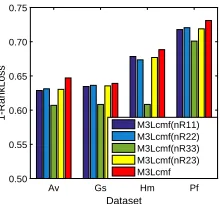
To further analyze the contribution of different relations used by M3Lcmf, we introduce four variants. (i) M3Lcmf (nR11) does not consider the relation between bags, i.e.,Rv11= 0; (ii) M3Lcmf (nR22) does not consider the relation between instances, i.e.,Rv
22= 0; (iii) M3Lcmf (nR33) does not con-sider the relation between labels, i.e.,R33= 0; (iv) M3Lcmf (nR23) does not consider the relation between instances and labels, i.e.,R∗13=G1GT3, instead ofR∗13=ΛR12G2GT3. We follow the experimental protocol at the bag-level pre-diction, and report the results of 1-RankLossobtained by M3Lcmf and its variants in Fig. 2.
Dataset
Av Gs Hm Pf
1-RankLoss
0.50 0.55 0.60 0.65 0.70 0.75
M3Lcmf(nR11) M3Lcmf(nR22) M3Lcmf(nR33) M3Lcmf(nR23) M3Lcmf
M3Lcmf significantly outperforms its variants, which sep-arately disregard one type of relations. M3Lcmf often outper-forms M3Lcmf (nR11) and M3Lcmf (nR22). This observa-tion suggests the relaobserva-tion between bags and that between instances have an important effect on M3Lcmf. Besides, M3Lcmf(nR33) is outperformed by all the other variants, which shows the importance of considering the label corre-lation. In addition, we can observe that M3Lcmf (nR23) is outperformed by M3Lcmf. This observation not only proves the effectiveness of the introduced aggregation term, but also shows the importance of instance-label relations in boosting the prediction performance.
From these results, we can conclude that multiple types of relations between bags, instances, and labels should be simultaneously considered in M3L.
Parameter Sensitivity Three parameters (λ1,λ2, and the low-rank sizedofG) may affect the performance of M3Lcmf. We conduct additional experiments to investigate the sensitiv-ity of these parameters. For brevsensitiv-ity, we only report the results on Azotobacter vinelandii and MSRC v2, and the results on the other datasets lead to similar conclusions.
6 4
log
10 1
2 0 -2 -2 0
log10 2
2 4 0.5 0.6 0.7
6
1-RankLoss
(a)Azotobacter vinelandii
6 4
log
10 1 2 0 -2 -2 0
log
10 2 2 4 6 0.5 0.6 0.7
1-RankLoss
(b)MSRC v2
Figure 3:1-RankLossof M3Lcmf under different combina-tions ofλ1 andλ2 on Azotobacter vinelandii and MSRC v2.
From the explicit solution forαv andβv in the supple-mentary file, it is clear that once the valuesλ1andλ2are specified, the weights assigned toRv
11andRv22can be com-puted based on the reconstruction loss of those matrices. To investigate the sensitivity of these two parameters, we vary λ1andλ2in the range{10−2,10−1,· · ·,106}, and report the average1-RankLossof M3Lcmf under different combina-tions of them in Fig. 3. We can see that M3Lcmf achieves a stable performance under a wide range of combinations of values forλ1andλ2. For Azotobacter vinelandii, M3Lcmf achieves a good performance withλ1andλ2in[102,106], and it shows a significantly reduced1-RankLosswhen either λ1 orλ2 are set to a too small value. This is because the predictions are made and evaluated at the bag-level and the bag-level intra-relation plays a more important role, but only one bag-level intra relational data matrix is selected under this setting. Unlike the pattern on Azotobacter vinelandii, M3Lcmf holds a relatively stable performance on MSRC v2 under different combinations of values forλ1andλ2. This is because Azotobacter vinelandii provides more structural in-formation and feature inin-formation for the intra-relational data matrices of bags (or instances) than MSRC v2. Particularly,
the former has more instances per bag than the latter, and the bag in MSRC v2 generally has one instance. Besides, the feature dimensionality of instances in Azotobacter vinelandii is much larger than that of MSRC v2. This investigation sug-gests the importance of structural information of bags (or instances) in M3L. From these results, we can conclude that an effective combination ofλ1andλ2can be easily found.
60 80 90 100 120 130 140 170 180 190 200
1-RankLoss
0.5 0.55 0.6 0.65 0.7
0.75 Decomposed dimension of G
(a)Azotobacter vinelandii
5 7 9 11 13 15 17 19 21 23
1-RankLoss
0.6 0.65 0.7 0.75
0.8 Decomposed dimension of G
(b)MSRC v2
Figure 4:1-RankLossvs.d(low-rank size) on Azotobacter vinelandii and MSRC v2.
The low-rank size dofGis an essential parameter for M3Lcmf. Fig. 4 shows the results of M3Lcmf under different input values ofdon Azotobacter vinelandii and MSRC v2 withλ1= 103andλ2= 103. We observe an increasing trend of1-RankLoss, and an overall good performance whend≥
140ord≥11. M3Lcmf does not show a high1-RankLoss
when a smalld is adopted, that is because a too smalld can not sufficiently encode the latent feature information of bags, instances, and labels. However, we can still find that an effective input valuedcan be easily selected.
Contributions of Weighting Intra-Relational Data
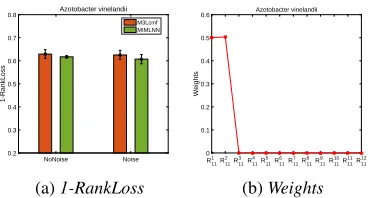
To investigate the contribution of weighting intra-relational data and the capability of M3Lcmf on discarding noisy intra-relational data matrices, we added 10 syntheticnoisy intra-relational data matrices of bags on the Azotobacter vinelandii dataset. Particularly, the 10 noisy data matrices are obtained by randomly shuffling the nonzero entries of each row of two valid matrices, which are constructed in the same way as in the first type of experiments. For reference, we also applied MIMLNN on the same dataset with the same 10 noisy data matrices, and reported the results in Fig. 5(a).
Even with 10 noisy data matrices, M3Lcmf does not show a decreased performance, but MIMLNN shows a clearly re-duced performance (by 2%). That is because M3Lcmf explic-itly considers the different relevances of intra-relational data matrices, and it can selectively integrate these matrices. In contrast, MIMLNN does not account for the different rele-vances of these matrices. As a result, it is more impacted by these noisy matrices.
NoNoise Noise
1-RankLoss
0.2 0.3 0.4 0.5 0.6 0.7
0.8 Azotobacter vinelandii M3Lcmf MIMLNN
(a)1-RankLoss
R11 1R11
2R11 3R11
4R11 5R11
6R11 7R11
8R11 9R11
10R11 11R11
12
Weights
0 0.1 0.2 0.3 0.4 0.5
0.6 Azotobacter vinelandii
(b)Weights
Figure 5: (a) Prediction results with and without the noisy data matrices, (b) Weights assigned by M3Lcmf to 12 intra-relational data matrices of bags. The first 2 are valid data matrices, and the last 10 are noisy ones.
to account for different relevances of multiple intra-relation data matrices.
Conclusion
In this paper, we proposed a collaborative matrix factor-ization based multi-view multi-instance multi-label learn-ing approach called M3Lcmf. M3Lcmf utilizes a heteroge-neous network to capture different types of relations in M3L, and collaboratively factorizes the relational data matrices of the network to explore the intrinsic relations between bags, instances, and labels. Extensive experimental results on different datasets corroborate our hypothesis that multiple types of relations can boost the performance of M3L, and their joint usage contributes to a significantly improved per-formance of M3Lcmf against competitive approaches. The Supplementary file and code of M3Lcmf are available at http://mlda.swu.edu.cn/codes.php?name=M3Lcmf.
Acknowledgments
The authors appreciate the reviewers for their helpful comments on improving our work. This work is sup-ported by NSFC (61872300, 61741217, 61873214 and 61871020), NSF of CQ CSTC (cstc2018jcyjAX0228, cstc2016jcyjA0351 and CSTC2016SHMSZX0824), the Open Research Project of Hubei Key Laboratory of In-telligent Geo-Information Processing (KLIGIP-2017A05), the National Science and Technology Support Program (2015BAK41B03 and 2015BAK41B04), and Fundamen-tal Research Funds for the Central Universities of China (XDJK2019D019 and XDJK2019B024).
References
Belkin, M.; Niyogi, P.; and Sindhwani, V. 2006. Manifold regu-larization: A geometric framework for learning from labeled and unlabeled examples.JMLR7(11):2399–2434.
Blei, D. M.; Ng, A. Y.; and Jordan, M. I. 2003. Latent dirichlet allocation.Journal of Machine Learning Research3:993–1022. Briggs, F.; Fern, X. Z.; and Raich, R. 2012. Rank-loss support instance machines for miml instance annotation. InKDD, 534–542. Chen, X.; Yu, G.; Domeniconi, C.; Wang, J.; Li, Z.; and Zhang, Z. 2018. Cost effective multi-label active learning via querying subexamples. InICDM, 1–6.
Demˇsar, J. 2006. Statistical comparisons of classifiers over multiple data sets.JMLR7(1):1–30.
Feng, J., and Zhou, Z.-H. 2017. Deep miml network. InAAAI, 1884–1890.
Gibaja, E., and Ventura, S. 2015. A tutorial on multilabel learning. ACM Computing Surveys47(3):52.
Gligorijevi´c, V., and Prˇzulj, N. 2015. Methods for biological data integration: perspectives and challenges.Journal of the Royal Society Interface12(112):20150571.
He, J.; Du, C.; Zhuang, F.; Yin, X.; He, Q.; and Long, G. 2016. Online bayesian max-margin subspace multi-view learning. In IJCAI, 1555–1561.
Huang, S.-J.; Gao, N.; and Chen, S. 2017. Multi-instance multi-label active learning. InIJCAI, 1886–1892.
Huang, S.-J.; Gao, W.; and Zhou, Z.-H. 2018. Fast multi-instance multi-label learning.TPAMI99(1):1–14.
Lee, D. D., and Seung, H. S. 2001. Algorithms for non-negative matrix factorization. InNIPS, 556–562.
Li, B.; Yuan, C.; Xiong, W.; Hu, W.; Peng, H.; Ding, X.; and May-bank, S. 2017. Multi-view multi-instance learning based on joint sparse representation and multi-view dictionary learning. TPAMI 39(12):2554–2560.
Nguyen, C. T.; Wang, X.; Liu, J.; and Zhou, Z. H. 2014. Labeling complicated objects: multi-view multi-instance multi-label learning. InAAAI, 2013–2019.
Nguyen, C. T.; Zhan, D. C.; and Zhou, Z. H. 2013. Multi-modal image annotation with multi-instance multi-label lda. InIJCAI, 1558–1564.
Shao, W.; Zhang, J.; He, L.; and Philip, S. Y. 2016. Multi-source multi-view clustering via discrepancy penalty. InIJCNN, 2714– 2721.
Tan, Q.; Yu, G.; Domeniconi, C.; Wang, J.; and Zhang, Z. 2018. Incomplete multi-view weak-label learning. InIJCAI, 2703–2709. Villani, C. 2008. Optimal transport: old and new, volume 338. Springer Science & Business Media.
Winn, J.; Criminisi, A.; and Minka, T. 2005. Object categorization by learned universal visual dictionary. InICCV, 1800–1807. Xu, C.; Tao, D.; and Xu, C. 2013. A survey on multi-view learning. arXiv preprint arXiv:1304.5634.
Yang, Y.; Wu, Y.-F.; Zhan, D.-C.; Liu, Z.-B.; and Jiang, Y. 2018. Complex object classification: A modal instance multi-label deep network with optimal transport. InKDD, 2594–2603. Zhang, M. L., and Wang, Z. J. 2009. Mimlrbf: Rbf neural networks for multi-instance multi-label learning. Neurocomputing 72(16-18):3951–3956.
Zhang, M.-L., and Zhou, Z.-H. 2009. Multi-instance clustering with applications to multi-instance prediction.Applied Intelligence 31(1):47–68.
Zhang, M., and Zhou, Z. 2014. A review on multi-label learning algorithms.TKDE26(8):1819–1837.
Zhou, Z. H.; Zhang, M. L.; Huang, S. J.; and Li, Y. F. 2008. Miml: A framework for learning with ambiguous objects.Corr Abs2012. Zhou, Z.-H.; Zhang, M.-L.; Huang, S.-J.; and Li, Y.-F. 2012. Multi-instance multi-label learning.Artificial Intelligence176(1):2291– 2320.