
Recombinants: Theoretical Propositions to Practical Dispositions for Resolving
Conflicts in African Metropolis and Periphery
Rexford Assasie Oppong, PhD
Department of Architecture
Kwame Nkrumah University of Science & Technology
Kumasi, Ghana
Abstract
This paper is exploratory and uses Accra, Ghana as a case study to draw examples of conflicts and contradictions that exist between African Metropolis and Periphery. This paper argues that the attainment of sustainable merging of the periphery and the metropolis is a complex system of urban development practices and theories. To connect the metropolis and the periphery, individual behaviors and institutions, this paper proposes “recombinant design” as a tool to investigate the modularity of the periphery and metropolis. This paper concludes amongst others that the development of recombinant tools based on “localisation theory” provides great opportunities for establishing an ‘African Centre of Recombinant Urban Studies (ACORUS)’ for study of the dynamics of the relationship between the African Metropolis and its periphery.
Keywords:
Recombinant, African Metropolis and Periphery, Conflicts, Contradictions, City of Accra, Ghana1.0 Introduction
1.1 Can the Periphery be thought of as a Full‐Fledged Part of the City that Reaches Beyond a Mono‐Functional Zone for Dwelling?
This section seeks to dwell on existing body of knowledge especially by Kevin Lynch (1960) and Léon Krier (1984; 1980; 1977) with Accra, Ghana as an example to deal with the above question. Krier, in his writings demonstrates that mono-functional zoning that is productive, commercial, administrative, educational, residential, and recreational is the technical instrument of fragmentation. Krier and others including Paul Drewe have argued for and against mono-functionalism and blamed urban design masters such as Le Corbusier for city-peripheries throes. Krier on one hand notes; ‘functional zoning is not an innocent or neutral planning instrument; it has been the most effective means in destroying the infinitely complex social and physical fabric of pre-industrial urban communities, of urban democracy and culture. The true grandeur of a city depends on the intelligence of its physical and social organization, on the familiarity of its public spaces, the beauty of its monuments and finally, on the wisdom with which one knows how to exploit the beauties and the accidents of nature to the greatest advantage of all its citizens. It depends, above all, on the identification of each citizen with the present as much as with the past’.
As perceived, the periphery destroys the structure of the historical centre. Mono-functional zoning promotes high concentrations of administrative and commercial activities in the historic centre, and the periphery remains a purely residential area. The old city becomes the heart of too-large a body, and under the combined pressures of building speculation and the growing tertiary sectors, it slowly disintegrates, with the population in the centre dropping. Mono-functional zoning can be identified as the most radical instrument in the destruction of cities, for example, in Europe. Not only does Mono-functional zoning promote land and building speculation at the large scale, but it also strengthens the centralising tendencies of political bureaucracies and justifies the monopolization of commerce. Thus, it destroys the refined and delicate physical fabric of most cities, and it has also become the most brutal means for destroying the social fabric and the complex cultural and economic relationships within the surviving urban community (Krier, 1980).
Paul Drewe on the other hand, notes that; the creation of mono-functional zones for dwellings, work and facilities, for example, for recreation, naturally induces traffic between zones and the rise of the automobile and the accompanying expansion of the road network have produced a “mobility problem” that is still unsolved today (Drewe,2000). Again, Drewe (2000) asserts that ‘mainstream urbanism has rather been dominated by zonal thinkers like Le Corbusier(1929/1987) as opposed to network thinkers such as Ildefons Cerdà (1815-1876) who, when the government of a time in Spain finally gave in to public pressure and allowed Barcelona’s city walls to be torn down, realised the need to plan the city’s expansion so that the new extension would become an efficient and liveable place, unlike the congested, epidemic-prone old town within the walls. And Frank Lloyd Wright, whose thoughts on suburban design, proposed subdivision layout that strayed from traditional suburban lot layouts on a philosophy of community planning hinged on decentralization, Wright advocated that new communities must be away from the city but all services and facilities should be by factories side by side, and that farm and home could coexist.
A B
C
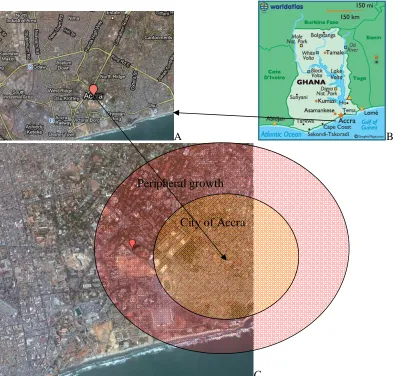
Figure 1: A and B- Context Maps of Accra and Ghana; C – Conceptual Boundaries of the City of Accra and that of the Peripheries Merged to form One Entity
Boundaries of the City of Accra and that of the peripheries are apparently merged but the two are notably administered as separate entities. The peripheries of Accra are treated as “mono‐functional zone for dwelling” but the reality is that since most of the periphery-dwellers are ‘ejected occupants’ of the City of Accra, they inadvertently become dependants of the city; especially for socio-economic livelihoods because all the industries, economic and recreational facilities are concentrated in the city of Accra. What makes Accra case interesting is that the peripheries of the City appear mono-functional zones without mono-functional planning qualifications: there are sub-metropolitan authorities with conflicting devolved responsibilities for the day-to-day functioning of the peripheries. For instance, the sub-metropolitan authorities depend on the central government for development budget allocation amongst many others. That somewhat corroborates Léon Krier’s argument elsewhere that mono-functional programming and the privileged allocation of financial resources to such programmes are its political and economic motor as industrial development is effected through the fragmentation of integrated and multifunctional complexes of cities, villages, districts, quarters, parishes into mono-functional suburban zones viz. residential neighbourhoods, campuses, shopping centres, industrial parks and so forth.
Again, Accra as metropolis is formed by a smaller independent and autonomous suburbs and towns. However,
Peripheral growth
The peripheries are characterised by amorphous planning of high density residential and commercial as well as recreational and educational facilities: And, perhaps, the peripheries could be thought of as a full‐fledged part of the city that reaches beyond a mono‐functional zone for dwelling.
A B
Figure 2: Maps Juxtaposition of (A) Portion of Accra City Central Core and (B) Portion of Periphery [Suburban] of Accra, Ghana
The conclusion from the foregoing, perhaps, supports Krier’s assertions that ‘the city needs no suburb to live and the suburb cannot live without a city and a suburb without a city is like a cancer without a body...mono-functional zoning of cities only dissolves complex urban communities into cities for sleeping, cities for working, and cities for consumption. The only solution now is not better public transport, but the elimination of much of the commuting traffic by integrating again urban functions like living/working in the same urban area’. The question that follows, then, is:
1.2 How can the Connections between City Centre and Periphery be Conceived?
There exists a plethora of works published on the city, the peripheries or suburban, much of which, purely, combine theoretical or technical in contemporary philosophical approach to deal with the developed or the so-called first world countries. This paper contends that tactics for resolving and managing conflicts (e.g. spatial) to merge the city [metropolis] and suburbia [periphery] remain non - existent or a minimalist concept in Africa even though the periphery ‘functions as an important locus of acculturation into city life and a vivid zone of transition between rural and urban cultures’.
Ellen (1996), unless otherwise mentioned, asserted that there has been tremendous growth of suburbs around cities after the Second World War and there have been a number of attempts to “reconceived the city” without a consensus among urban social scientists. Since 1960s, cities have tended to be defined in a deliberately vague way, as settings in which certain characteristics appear together but need not occur in every case. Likewise urban historians as well as architectural historians, theorists, and critics have also been unwilling to pin definitions on the city. It is not surprising, then, that urban designers – architects and planners – have been struggling with the question of how to define the canvas upon which they labour. Among several others, it is argued elsewhere that “if the city is redefined, so the process of urban growth- or urbanization – and the lifestyle of city dwellers – or urbanism-must be. Manuel Castells (1972) proposed that we define the urbanization in global terms as the integration of regions into the world system and that we define urbanism as the culture of the world system. Immanuel Wallerstein (1974) similarly redefined urbanisation as the growth and development of the world capitalist system and urbanism as the culture of this system.
After the Second World War when massive suburbination could not be explained by Ernest Burgess’s theory of graduated concentric zones, and as “way of life” in cities no longer conformed to Louis Wirth’s description in “Urbanism as a way of Life”; Herbert Gans revised Wirth’s thesis in “Urbanism and Suburbanism as Ways of Life”, in which was the explanation that rise of metropolitan regions in the United States revealed the inadequacy of the rural/urban distinction posited by Wirth. Rather, one’s “way of life,” Gans said, has less to do with whether one lives in the city, the suburbs, or the countryside, than with such factors as social class, life-cycle stages and rates of social mobility, unless people are free to make choices.
Figure 3: Percentage of the World’s Population Living in Urban Areas, 1975, 1995 and 2015
Source: Population Information Programmes 1996).
Circumstances of urbanism are occurring very fast and moving ahead, and not backwards and therefore pragmatic methods and theories are needed. The world as a whole is experiencing a rapid rate of urbanisation (Figure 3).The growth rate of urban population on African continent is high and it is predicted to rise by several authors (see, for example, Mabogunje, 1968; Aluko, 1971; Bascom, 1955; Olotuah, 2005). The resultant effect of the high rate of urbanisation has been the formation of more peripheries or suburban areas which are fully grown with population to that of a city but continually depend on their parent cities for survival with consequent conflicts and contradistinctions.
As indicated earlier on in this section, there is the need for tactics to resolve and manage conflicts to merge the city and periphery as the periphery functions as an important locus of acculturation into city life and a vivid zone of transition between rural and urban cultures. In that regard, this paper proposes Recombinant Design as methodology to generate “informed urban design model(s)” to serve as policy rationale for the creation of sustainable metropolis in Ghana and Africa in general. Following the foregoing theoretical insights, the next section considers recombinant –its theory and practice, and explores how it can be applied to urban design issues for African metropolises and peripheries, with Accra, Ghana, as the focus.
2.0 Recombinant as Theory/Theorem
It has been applied into benefit and enhanced knowledge in economics (Weitzman, 1998), biophysical and biochemical and DNA studies and analyses (see, for example, Glazer and Nikaido, 2007; Arakawa and Philo, 2002; Fry, 1992; Bennett, 1986; Richards, 1978), and in the music industry known as InSoc Recombinant.1
3.0 Recombinant as (Urban/Social) Design Tool
According to Luoni (2011) recombinant as a design tool integrates metrics from ecology, engineering, architecture, urban design, and social policy into design patterns not possible in their respective parent disciplines. Much like recombination in the biological sciences where the concept has been applied extensively, recombinant is tactically plausible for policy triangulation, administration, and design through various development tools involving ecotone, matrix, transect, map, and table to sort and sequence environmental resources. Likewise, design’s disciplinary capacity is thickened by the absorption of another’s tools (metadisciplinary), enabling co-evolutionary planning approaches solicitous of feedback with the social; and environmental energies of a local context. Again, Luoni (2011) asserts that, the University of Arkansas Community Design Center (UACDC) in its mission to advance in Arkansas through education, research, and design solutions to the physical environment is developing a repertoire of recombinant design methodologies applicable to community development issues in Arkansas with currency that goes beyond the state. UACDC design solutions introduce a triple bottom line, integrating social and environmental measures with economic development. UACDC works multilaterally with clients, collaborators, and government agencies to build networks that facilitate creative development, triangulating development in policy, best management practices, and design. Recombinant development embeds ecological metrics into otherwise obdurate or stubbornly entrenched planning conventions governing land-use policy and infrastructure (Luoni, 2011).
On the social realm, recombinant is akin to the Chicano activist and writer Armando Réndon’s concept of the Barrio Union – where neighbourhoods-based organisation, with its own community or multi-use facility, charged with providing a forum for residents to meet, discuss their needs and interest, share their understanding of issues facing their communities, and develop actions plans to address these concerns; residents select officers from among themselves to speak for the communities in question to: “bargains collectively with city, county, state or authorities to remedy possible complaints, such as street lighting, paving, sewer improvements, improve police for fire protection, … zoning laws, and distribution of jobs in businesses or industries relocating near communities”(Orosco,2007).
In order to fully comprehend the complexity of cities, David Grahame Shane (2005) argues that recombinant urban modelling techniques provide a methodology for understanding the polymorphous layers of influence that shape the city form. Although the Shane’s modelling techniques provide a clear and concise method of analysing the morphological changes that have occurred throughout history, we would argue that his generalised approach concentrates mainly on the top down approaches to design, engaging primarily with architects and planners with little mention of clients or the users of urban space. This paper wishes to argue that embodying perspective of the city user, has the potential to understand the successes and failures of the functionality which are prescribed to urban space and additionally highlights the potential of practices that deviate from conventional uses.Finally, the ensuing section, albeit not tentative, as way forward, explores ways in which the theory/theorem of recombinant tools including: media of mapping, cinematography and/or as narratives could apply to a better understanding of how the City of Accra and its peripheries functionally interrelate. The paper seeks to illuminate the city of Accra in an attempt to make the city more legible and more comprehensible to its inhabitants.
4.0 The Way Forward: Recombinant as Urban Design Study Tool in Ghana
Reflexively, the application of recombinant as urban design study tool in Ghana, specifically to the city of Accra is apparently weak because little is known of the theorem in the field of urbanism in developing nations; unlike the developed nations (Francis and Lorimer, 2011). A painstaking World Wide Web searches for developing nations that have used or using recombinant as urban development/design tool always end in futility thus far. Notably, recombinant as a tool abounds in the medical sciences, for example, in the area of biotechnology in developing and third world countries (see, Kenny and Buttel, 1985; Niba, 2003, Madan, 2005).Therefore, with hindsight, poverty, illiteracy, logistics and integrating the knowledge of recombinant for diverse urban development professional use are possible but surmountable obstacles in a developing nation like Ghana.
1
Insomuch as these obstacles are real, constant contact with a complex and ephemeral visual landscape of the city has bred a population remarkably adept at navigating those complexities casually, indifferently. And, whole academic fields, from public relations to visual studies programs, have emerged to examine and control the verbal-visual amalgam that makes up much of the texture of everyday life (Isenstadt, 2001). In the light of the foregoing, this paper proposes to explore mapping, narratives and the media of photography and cinematography/filming as recombinant tools/tactics in Accra, Ghana.
4.1Understanding the City through Medium of Mapping
In order to fully comprehend the complexity of cities, Shane (2005) argues that recombinant urban modelling techniques amongst others provide a methodology for understanding the polymorphous layers of influence that shape the city form. “Mapping has emerged in the information age as a means to make the complex accessible, the hidden visible the unmappable mappable” (Abrams and Hall, 2006). Coincidentally, there is Cultural mapping project using Danish-Osu, a historic suburb of the City of Accra with the aim of gathering data on cultural assets and human resources of the city of Accra in order to generate strategies to turn Accra into a cultural capital of West Africa. This paper suggests the use of mapping as a pilot recombinant tool to configure day time, night time, seasonal time to show the complexities and temporal dimensions of Danish-Osu, Accra. We present the argument that mapping as a recombinant tool will help teach the city of Accra dwellers to perceive their cities in new ways. Mapping could be applied to pull up, for instance, three major issues together, that is: what can the heritage space ( the historic places, sites and structures of Danish Osu), the people (various groups such as the local residents, tourists and visitors who move through the space at Danish Osu), the people’s activities ( everyday life ways, special occasions, festive events e.g. the August Street Carnival streaming through the space) create scenarios for future meaningful development of such historic space to help make Accra an African cultural capital?
It is envisaged that the use of recombinant tools would not only enhance the proposed Accra Cultural Mapping project but carry relevance to the author’s desire for future postgraduate programme in urban studies to be mounted in Department of Architecture of the Kwame Nkrumah University of Science and Technology, Kumasi. The use of cultural mapping in Accra would pay particular attention to the use of public space and disused space which could be considered as the residual remnants of urban development. The uses of other cities in Ghana are also plausible.
4.2 Understanding the City through Narratives
There are increasing demands that public spaces should not be only convivial but also communicative – of history and other narratives, requiring the incorporation of media into the environment (Frenchman, 2001). The role of the media cannot be overemphasised as a tool for democratization (Warf, 2007). According to Holcomb (2001) for society to function, there must be some shared image of reality. Without that, communication is impossible. The demand for “mediated environments” is raising important challenges for designers not only in terms of how to physically construct such places, but also in deciding what messages they should carry. The response is leading to what we see today as new practice of city design (Jenkins, 2001). Reading from Lynch (1960) the perspective of someone who studies cinema and not cities, what one can find most striking is that he discusses urban form in a vocabulary that closely parallels the ideals of the classically constructed narrative. Lynch (1960), for example, speaks of a “melodic” structuring of landmarks and regions along a succession of paths, which he suggests might follow a “classical introduction-development-climax-conclusion” pattern (Jenkins, 2001).
4.3 Understanding the City through the MEDIA of PHOTOGRAPHY, CINEMATOGRAPHY/FILMING
Lynch (1960) saw urban design studies as a way of building a more educated and appreciative audience for city design. He recognised that our images of the cities are shaped partially by formal properties of the cities themselves and partially by the process of perception through which we construct mental representations of those properties (Jenkins, 2001). An ill-considered development deal may mar the urban landscape, blocking our ability to see important landmarks or move fluidly between nodes. In one sense, the cinema would seem to be the perfect form to express the dynamic properties of the city of Accra, since like city design, cinema is a “temporal art from”; but the cinema brings its own expectations about what a classically constructed story looks like – expectations that urban-based stories are often unable to satisfy. Classically constructed stories remain focused on particular characters, their motives, their goals, their memories, and their experiences. The challenge for the filmmaker is to create a story that situates the individual in relation to the city in such a way that the film preserves what is distinctive about the metropolis-congestion, simultaneity, heterogeneity, randomness, fragmentation in short incoherence (Jenkins, 2001).
Arguably, the Accra study would present the viewpoint that the embodied-perspective of the city-user has the potential to understand the successes and failures of the functionality which is prescribed to urban space, and additionally highlight the potential of practices that deviate from conventional uses. The use of urban space is directly connected to a multitude of social values and technological implications. This new urban modelling technique (recombinanting) essentially plays on the importance of appropriation of space to determine its future use, and gives more urban actors the tools for shaping the built environment.
5.0 Concluding Remarks
Thus far, this paper has briefly presented and theoretically explored the city of Accra as a case for African metropolis and ‘cancerous’ peripheral growth. Again, it has hinted that the periphery plays a useful role for urban outcasts simply because their livelihoods depend on the city. Yet, the city and the periphery are perceived as two different entities. This paper contends that as long as African governments do not provide housing and socio-economic opportunities within cities for their ever increasing populations, then attention must be given by Great African cities to their peripheries which are almost invariably, sporadic, and mad in nature, with “disturbing possibilities”. Following, this paper has argued for recombinant as tools/tactics for resolving and managing conflicts (e.g. spatial) to merge the city [metropolis] and suburbia [periphery] in Africa so long as the periphery ‘functions as an important locus of acculturation into city life and a vivid zone of transition between rural and urban cultures’. For instance, Corbusier argued that:
The city determines everything: war, peace and toil. Great cities are the spiritual workshops in which the work of the world is done. The solutions accepted in the great city are those which are singled out in the provinces; fashions, styles, development of ideas and technical methods. That is the reason why the reorganization of the great city carries with the renewal of the whole country (Corbusier, 1929/1989:85).
African cities appeared “brutalised and battered by torrents” of the peripheries but recombinant DNA of design and planning resilience2(Sterner,2011) that include residential, commercial, and retail components, transportation networks, public events spaces, enhanced access and effective connection between City and Periphery as well peoples’ perceptions/narratives should lead the way to avoid conflicts between African metropolis [city] and periphery [suburban] as research elsewhere (Falk,2008) has shown that urban development that includes a wider social mix-matrix and careful design and management, is formula for conflict avoidance. This paper has explored mapping, narratives and the media of photography and cinematography/filming as recombinant tools/tactics for Accra, Ghana; and therefore, concludes that development of recombinant tools based, perhaps, on “localisation theory”, is likely to provide great opportunities for establishing ‘African Centre of Recombinant Urban Studies (ACORUS)’ for training/practice and research. ACORUS is still exploratory and perhaps, Design, Development and Research (DDR) 2013 Conference can join this exploration for developing African cities through recombinant design.
2
Complex Adaptive Systems (CAS) suggests- an adaptive theory as an emerging discipline that studies the way systems
self-organise, learn, and change proactively. It is argued that a central concept of CAS theory is resilience- the ability of a system
References
ABRAMS, J. and HALL, P. (2006) Else/Where: Mapping. New Cartographies of Networks and Territories. University of Minnesota Press, Minneapolis.
ADARKWA, K. K. and OPPONG, R.A. (2005) Gentrification, Use Conversion and Traditional architecture in Kumasi’s Central Business District – Case Study of Odum Precinct. Journal of Science and Technology, Vol.25, No.2, pp 80 – 90.
ALUKO, S. A. (1971) Resource Allocation and Overall Strategy in Nigeria, 2nd Development Plan, 1970-1974: A Symposium. Quarterly Journal of Administration, Vol.5 No 3 pp 267-284.
ANTWI, A. Y. (2000) Urban Land Markets in sub-Saharan Africa: A Quantitative Study of Accra, Ghana. Unpublished PhD Thesis, Napier University.
BASCOM, W.R. (1955) Urbanisation Among the Yorubas. American Journal of Sociology, LX (5) pp 446-454. BENNETT, D.J. (1986) The politics of uncertainty: regulating recombinant DNA research in Britain.Routledge &
Kegan Paul, London.
CROOK, R. (2007) DFID project on land disputes and legal institutions in Ghana and Cote D'Ivoire Research Report. No. 58, http://www.ids.ac.uk/ids/bookshop/rr.html.
DIXON, J. M. (2003) Urban Spaces No.3 – The Design of Public Places. Visual Reference Publications, New York and Urban Land Institute, Washington, DC.
DREWE, P. (2000) ICT and urban form urban planning and design - off the beaten track. Design Studio ‘The Network City’, Faculty of Architecture- Delft University of Technology. June 2000.
ELLEN, N. (1996) Postmodernism Urbanism. Blackwell Publishers inc., Oxford-UK and Cambridge-USA, pp.245-247.
FALK, N. (2008) “The DNA of Successful Places” In: Placemking –celebrating quality and innovation in urban life. A synthesis of professional practice and case studies about better living environments, RUDI with the Academy of Urbanism, London, pp.48-50.
FRANCIS, R. A. and LORIMER, J. (2011) Urban reconciliation ecology: The potential of living roof and walls. Journal of Environmental Management, Vol. 92, Issue 6, pp.1429-1437.
FRENCHMAN, D. (2001) “Narrative Places and the New Practice of Urban Design” In: Imaging the City- Continuing Struggles and New Directions, Lawrence J. Vale and Sam Bass Warner Jr.(eds), Center for Urban Policy Research, New Jersey, pp.257-282.
FRY, J.C. (1992) Release of genetically engineered and other micro-organisms. Cambridge University Press, Cambridge.
GLAZER, A.N. and NIKAIDO, H. (2007) Microbial biotechnology: fundamentals of applied microbiology. 2nd ed., p.196, Cambridge University Press, Cambridge.
ISENSTADT, S. (2001) “Image Renewal: Polemic and Presentation in the Urban Theory of Rem Koolhaas and Leon Krier”. In: Imaging the City- Continuing Struggles and New Directions, Lawrence J. Vale and Sam Bass Warner Jr.(eds), Center for Urban Policy Research, New Jersey, pp.213-235.
JENKINS, P., SMITH, H. and, YING, Y. P. (2007) Planning and housing in the rapidly urbanising world. New York: Routledge.
KENNY, M and BUTTEL, F. (1985) Biotechnology: Prospects and Dilemmas for Third World Development. Development and Change, Vol.16, Isuue1, pp. 61-91.
KRIER, L. (1980) “The Reconstruction of the European City” In: “Léon Krier: Drawings”, Archives d'Architecture Moderne, Brussels, pages xxv-xxxi. Revised version in: Architectural Design, Vol. 54 Nov/Dec, 1984, pp.16-22
Le CORBUSIER (1929/1987) The City of To-morrow and its planning. Translated from the 8th French edition of URBANISME with an introduction by Frederick Etchells, London: The Architectural Press.
MABOGUNJE, A.L. (1980): The Development Process: A Spatial Perspective 2nd Ed; London: Unwin Harman Ltd, pp 189-193, 217-218;
MABOGUNJE, A. (1994) “Overview of research priorities in Africa” In: Stren, R., editor, Urban research in the developing world, Volume 2 Africa. Centre for Community Studies. Toronto: University of Toronto Press, 21–45.
MADAN, M.L. (2005) Animal biotechnology: applications and economic implications in developing countries. Rev. sci.tech.Off.int.Epiz, Vol. 22, No. 1, pp. 127-139.
MAHAMA, C. and DIXON, M (2006) “Acquisition and Affordability of land for Housing in Urban Ghana: a study in the formal land market dynamics”, RICS Research paper series, Volume 6 Number 10, October. MBIBA, B. and HUCHZERMEYER, M. (2002) “Contentious development: peri-urban studies in sub-Saharan
Africa”, Progress in Development Studies 2: 113 DOI: 10.1191/1464993402ps032ra, http://pdj.sagepub.com/content/2/2/113.
NIBA, L. (2003) The relevance of biotechnology in the development of functional foods for improved nutritional and health quality in developing countries. African Journal of Biotechnology, Vol.2, No.12, pp.631-635. OBENG-ODOOM, F. (2009): “An urban twist to politics in Ghana”, Habitat International xxx, 1-8
www.elsevier.com/locate/habitatint.
OBENG-ODOOM, F. (2010a) “Is Decentralisation in Ghana pro-poor?” A Commentary, Commonwealth Journal of Local Governance, Issue 6: July 2010, http://epress.lib.uts.edu.au/ojs/index.php/cjlg.
OBENG-ODOOM, F. (2010b) Jim Stanford, Economics for Everyone: A Short Guide to the Economics of Capitalism. African Review of Economics and Finance, doi,31.1201/j.aref.2010.12, p.1.
OLOTUAH, A.O. (2005) Urbanisation, Urban Poverty, and Housing Inadequacy. Proceedings of Africa Union of Architects Congress, 23-28 May, Abuja, Nigeria, pp. 185-199.
OROSCO, J.-A. (2007) Neighborhood Democracy and Chicano/o Cultural Citizenship in Armando Réndon’s Chicano Manifesto. Ethics, Place and Environment, Vol.10, No.2, pp.121-139.
POPULATION INFORMATION PROGRAMMES. (1996) Population Reports. John Hopkins University, Vol. XXIV, N° 3.
RICHARDS, J. (1978) Recombinant DNA: science, ethics, and politics. Academic Press, New York.
SHANE, D.G. (2005) Recombinant Urbanism – Conceptual Modelling in Architecture, Urban Design, and City Theory.pp.304-315, John Wiley & Sons Ltd.
STERNER, C.S. (2011) “Designing Resilience – Sustainable Design from a Complex System Perspective” In: New directions in sustainable design. Adrian Parr and Michael Zaretsky (eds), Routledge Taylor and Francis Group, pp.152-169.
STREN, R. (1994) Urban Research in Africa, 1960-92. Urban Studies 31: 729, DOI: 10.1080/00420989420080651, http://usj.sagepub.com/content/31/4-5/729.
TSUTOMU ARAKAWA, T. and PHILO, J.S. (2002) “Recombinant Proteins Structure and Analysis of Proteins” In: Pharmaceutical biotechnology: an introduction for pharmacists and pharmaceutical scientists. Daan J.A. Crommelin and Robert D. Sindelar (eds), 2nd edition, p.25, London: Routledge.
JENKINS, H. (2001) “Tales of Manhattan: Mapping the Urban Imagination through Hollywood Film”In: Imaging the City- Continuing Struggles and New Directions. Lawrence J. Vale and Sam Bass Warner Jr. (eds), pp.179-211, New Jersey: Center for Urban Policy Research.
![Figure 2: Maps Juxtaposition of (A) Portion of Accra City Central Core and (B) Portion of Periphery [Suburban] of Accra, Ghana](https://thumb-us.123doks.com/thumbv2/123dok_us/9724738.1956005/4.612.93.519.104.290/figure-juxtaposition-portion-accra-central-portion-periphery-suburban.webp)

