Balancing Trusted Cloud Transactionsby Using
Policy Based Authorization System
I
BhagyarajBarma,
IIProf. S.A Madival
IM. Tech (CNE), IIAssociate Professor
I,IIDept. of CSE, APPA Institute of Engineering and Technology, Gulbarga, Karnataka, India
I. Introduction
The major IT industries such as Amazon, Google, Yahoo and Microsoft uses next generation data centers which stores and computes the data from different organization called cloud computing. These companies help free organizations from expensive infrastructure and expertise in-house, and make the cloud service providers to provide full support and maintain the access to all high-end resources. The cloud consumers can be charged based on pay as use pricing policy, and save huge IT investments[8]. Elasticity is one of the major aspects of cloud computing which provides illusion of resources that are present and makes more attractive environment for scalable data and provide multitier application approach. The Amazon’s DB provides scalable access to huge amounts of datafor the end user[9].
This consistency model allows data to be conflict among some
replicas, but it ensures that the update process will be eventually
propagated to all replicas (duplicate file). This makes it strictly difficult to maintain. The ACID guarantees, as the ’C’ the consistency part of ACID was sacrificed to provide availability. In systems that
host sensitive resources, the user can access their resources via authorization process which describe the conditionsfor accessing the resources. The policydescribesrelationships between the
system principals, and the certified credentials that users provide to access their specified attributes. In a transactional database
system deployed in a highly elastic and distributed system such as the cloud, policies would be typically replicated among multiple clouds[10].
As the distributed transactional database system is deployed in cloud environments the use of policy-based authorization system is to protect sensitive resources, interestingly some consistency problems arises. In addition to handling this consistency problem among database replicas, we should also handle two types of security conditions.
Firstly, the system can suffer from policyconflict during policy
updates caused by loosely coupled consistency model. For example, it is possible for several policies to be observed at multiple client systems within a single transaction, which leads to an unsafe access of the data.
Secondly, it is possible that external factors can cause conflicts
over the period of a transaction. For time being, a user’s login process could not be validated after collection by the authorization server system, but before completion of the transaction period.
A. What is cloud computing?
Cloud computing:cloud computing is the secure way of using the computing resources such as hardware and software that are used for delivering a service over a network typically via the internet
connection. Cloud computing consists of many services such as
the hardware and the software resources that are made available on the Internet to the end user and are managed by thirsted third-party services providers.
.
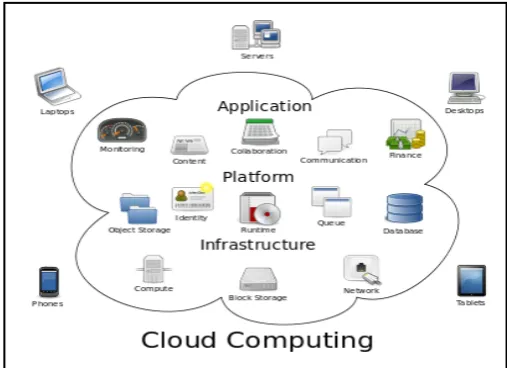
Fig. 1 : Structure of cloud computing.
B. How Cloud Computing Works?
The aim of cloud computing is to apply high-performance computing power, effectively used by many military and research facilities where high level of data integrity is to be preserved over the network and should have the capability of performing tens to trillions of computations power per second, in consumer-oriented
applications like financial portfolios, to deliver personalized
Abstract
In this paper, a new policy based authorization system is introduced for balancing transactions in trusted cloud such as performance, accuracy and precision. In cloud servers, distributed transactional database systems are deployed, entities are used in such a way that they must co-operate to form a proof of authorizations through a set of certified credentials. These proofs and credentials can be evaluated and collected over an extended period of time under the risk of having inconsistent states under authorization policies. Some sensitive resources are being threatened by making unsafe decisions by using policy based authorization systems. This paper focuses on the criticality about the user credentials, and defines the notion of transactions while dealing with the proofs. This proposed system has the stronger levels of policy consistency and different approaches to ensure the completeness of transaction that are executed on cloud servers. This proposed system implements a Two Phase Validation Commit protocol (2PVC) as a solution, which is the modified version of basic 2PVC protocol. Finally by using both simulations and analytical evaluation, to navigate the decision makers to analyze which approach to use.
Keywords
information over a large, immersive computer games for providing data storage.
The cloud computing uses networks of large groups of servers running at low-cost consumer desktop technology with specialized connections for spreading data-processing chores across. The shared IT infrastructure contains large resource pools of systems that are linked together for computing. Virtualization techniques are used to maximize the power,performance, availability, etc. of cloud computing.
C. Characteristics
The salient characteristics of cloud computing are as follows,
as defined in National Institute of Standards and Terminology (NIST):
On-demand self-service
• : A consumer can provision resources, as needed automatically without requiring human interaction.
Broad network access
• : The network has the capabilities of accessing the data through standard mechanisms. By heterogeneous clients such as thin clients as mobile phones, laptops, and thick clients as PDAs.
Resource pooling
• : The resources are pooled to serve multiple consumers or clients using a multi-tenant model that contains different physical and virtual resources which are dynamically assigned and reassigned to the client process
according to consumer need. Cloud computing provides
location-independence service as the customer generally have access or control or knowledge about the exact location of the resources accessing. Examples of resources include storage, processing, bandwidth.
Rapid elasticity
• : the computing resources can be elastically provisioned, to quickly scale out and quickly scale in. To the consumer, the resources that are available for provisioning can be outsourced in any quantity at any instance of time from the service provider.
Measured service
• : resource usage can be managed, controlled and reporting service providing transparency for the provider
and consumer. Cloud system provides metering capability to
some or all type of services.
Fig.1.2 Characteristics of cloud computing.
D. Services Models
There are 3 different service models in cloud computing they are
IaaS (Infrastructure-as-a-Service) •
PaaS (Platform-as-a-Service) •
SaaS (Software-as-a-Service) •
The three service models are present at end user layer which compresses the end user’s perspective on cloud computing environment. If the end user accesses services on the infrastructure layer of the service model then, for instance, the user can run their own applications on the resources provided by infrastructure and be responsible for supporting, maintenance, and security of these applications. If the user accesses a service on the application layer of the service models, these tasks are taken by the cloud service provider.
Fig.1.3 : Structure of service models.
II. Literature Survey
(Renzo Davoli, 2005) has proposed “VDE: Virtual Distributed Ethernet”. The idea of VDE is very effective but simple and can
be applied in many configurations to provide different services.
It is a sort of Swiss knife of emulated networks. It can be utilized
as a general virtual private network (VPNs) and additionally a
bolster innovation for versatility, an apparatus for testing, a general
reconfigurable overlay arrange, a layer for actualizing security
protecting innovations and numerous others. A model VDE has been actualized and discharged as free programming under the GPL permit.
(Raicu, et al., 2007) have proposed “A Fast and Light-Weight Task Execution Framework”. To enable the rapid execution of many tasks on compute clusters, they have developed Falkon, a Fast and
Light-weight tasK executiON framework. Falkon incorporates (1)
multi-level booking to partitioned asset obtaining (through, e.g.,
solicitations to clump schedulers) from errand dispatch, and (2)
a streamlined dispatcher. Falkon’s incorporation of multi-level booking and streamlined dispatchers conveys execution not gave by some other framework.
(T.Dornemann, et al., 2009) have proposed “On-Demand
Resource Provisioning for BPEL Workflows Using Amazon’s Elastic Compute Cloud”. BPEL is the accepted standard for business
procedure demonstrating in today’s endeavors and is a promising
contender for the mix of business and Grid applications. Current
BPEL usage doesn’t give systems to calendar administration calls concerning the heap of the objective hosts. In this work, an answer that naturally plans work process ventures to underutilized has
part of crest burden circumstances is displayed.
(K.D. Bowers, et al., 2009) have proposed “HAIL: A
High-Availability and Integrity Layer for Cloud Storage”. They present HAIL (High-Availability and Integrity Layer), a circulated
cryptographic framework that permits an arrangement of servers to demonstrate to a customer that a put away document is in place and retrievable. HAIL reinforces, formally binds together, and streamlines unmistakable methodologies from the cryptographic
and dispersed frameworks groups. Confirmations in HAIL are
effectively process able by servers and exceedingly conservative -regularly tens or many bytes, independent of record size. HAIL cryptographically checks and responsively reallocates record offers. It is vigorous against a dynamic, portable foe, i.e., one that may continuously degenerate the full arrangement of servers. (P.K.Chrysanthis, et.al) have proposed “Recovery and
Performance of Atomic Commit Processing in Distributed
Database Systems”, It characterizes an exchange is customarily characterized to give the properties of atomicity, consistency,
integrity, and durability (ACID) for any operation it performs. To
guarantee the atomicity of circulated exchanges, a nuclear submits convention should be trailed by all destinations partaking in an exchange execution to concede to the last result, that is, confer or prematurely end.
(Priyadharshini. B, et.al) have proposed “the cloud storage system consists of a collection of storage servers and key servers”. Putting away information in an outsider cloud framework causes genuine concern on information privacy, so a client separates the information into pieces, scrambles and stores them in different stockpiling servers. The storage server encodes the information utilizing eradication codeword. At the point when the sender needs to share his messages, he sends a re-encryption key to the storage server. The key server recovers re-scrambled codeword and performs halfway decoding so that the collector joins the squares to recover the information.
(Ning Cao, et.al) have proposed, characterized and tackled the testing issue of security saving multi-keyword ranked search over
encrypted cloud data (MRSE).They set up an arrangement of strict
protection prerequisites for such a protected cloud information use framework. Among different multi-watchword semantics,
they pick the proficient comparability measure of “direction
coordinating”, i.e., whatever number matches as would be prudent, to catch the pertinence of information reports to the hunt inquiry. They further utilize “internal item likeness” to quantitatively assess such closeness measure.
III. Statement of The Problem
The cloud services often make use of heavy duplications to provide the scalability to ensure consistent performance and availability. When data throughout the system, cloud services may relay on the notion of eventual consistency. This consistency model allows the data to be inconsistent among the replicas during the updation process, but ensures that all the updates will eventually
be transmitted to all the replicas. This will be very difficult to maintain the ACID guarantees, as the ’C’ part of the ACID that is consistency sacrificed to provide fair availability [10].
IV. Objectives
Here the concept of trusted transactions if formed.
•
Here the various levels of policy consistency constraints
•
and corresponding approaches are enforced to guarantee the completeness of transactions which are executing on the
cloud servers.
A Two-Phase Validation Commit (2PVC) protocol is proposed •
that ensures that the transactions are safe or not by checking policies, credentials, and data consistency during execution of the transaction.
An experimental evaluation of proposed approaches is
•
carried out and a trade-off discussion is made to navigate decision makers to use appropriate approaches during various situations.
V. Background
Two-Phase Validation (2PV) Algorithm: A common characteristic
of most of proposed approaches is to achieve trusted transactions which are the need for policy consistency validation process at the end of a transaction.That is, in order to achieve a trusted transaction
to commit, its TM has to enforce either view or global conflict
among the servers of the network that are participating in the transaction. The proposed algorithm called Two-Phase Validation
(2PV) it operates in two phases:Collection and validation.During collection, the TM firstly sends a Prepare-to-Validate message to
each participant server of the transaction network. In response
to this message, each participant servers 1) evaluates the proofs
for each query of the transaction using the latest policies that is
available with it and 2) sends a reply back to the TM containing the truth value (TRUE/FALSE) along with the version number and policy identifier. Further, each participant servers keeps track of their respective reply (i.e., the state of each query) which includes id of the TM (TMid), the id of the transaction (Tid) to which the
query belongs, along with a set of policy versions.Once the TM receives the replies from all the participant servers of the network of transaction, it moves on to the validation phase. If all polices are done, then the protocol honors the truth value where any FALSE
value causes an ABORT and all TRUE cause a CONTINUE. In the case of conflict policies, the TM identifies the latest policy and sends an Updation message to each out-of-date participant servers with a policy identifier and returns to the first (collection) phase. In this case, the participant systems 1) update their policies, 2) reevaluate the proofs and, 3) send a new reply to the TM.
Algorithm 1 Two-Phase Validation - 2PV(TM) 1. Send “Prepare-to-Validate” to all participants
2. Wait for all replies (a True/False, and a set of policy versions for each unique policy)
3. Identify the largest version for all unique policies
4. If all participants utilize the largest version for each unique policy
5. If any responded False 6. ABORT
7. Otherwise
8. CONTINUE
9. Otherwise, for all participants with old versions of policies
10. Send “Update” with the largest version number of each
policy 11. Go to 2.
Algorithm 2 Two-Phase Validation Commit - 2PVC (TM)
1. Send “Prepare-to-Commit” to all participants
2. Wait for all replies (Yes/No, True/False, and a set of policy versions for each unique policy)
3. If any participant replied No for integrity check
4. ABORT
5. Identify the largest version for all unique policies
policy
7. If any responded False 8. ABORT
9. Otherwise
10. COMMIT
11. Otherwise, for participants with old policies
12. Send “Update” with the largest version number of each
policy
13. Wait for all replies 14. Go to 5.
VI. Simulation Results
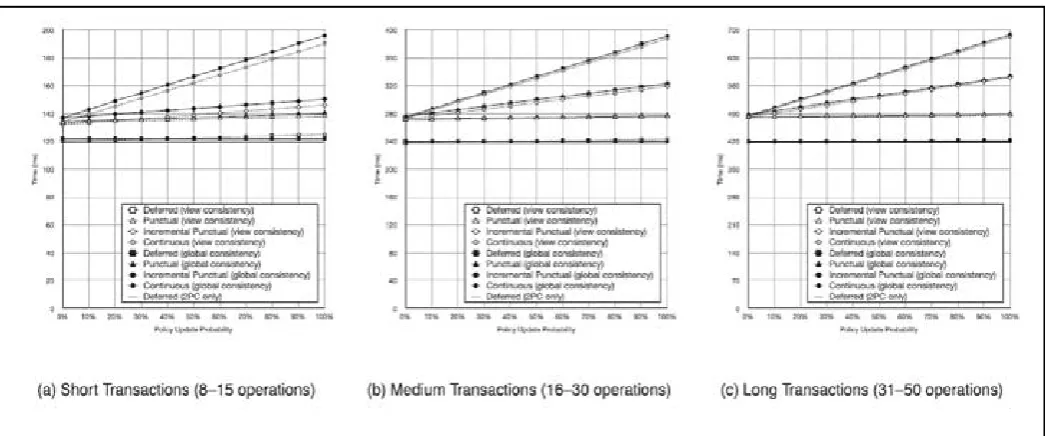
Figs. 3 show Simulation results for the LAN arrangement. Each figure shows the execution time of the committed transaction (y-axis) as the probability of the policy update changes (x-axis).
The figures contrast between the four different approaches for
proofs of authorizations each with the two validation modes,
namely, view and global consistency. The figures show different transactions length: 1) short transactions involve 8-15 operations running on up to five servers, 2) medium transactions involve 16-30 operations running on up to 15 servers, and 3) long transactions
involve 31- 50 operations running on up to 25 servers. For each case, and as a baseline, we measured the transaction execution time when transactions execute without any proof of authorization and
are terminated using the basic 2PC (shown in figures as a solid line referring to deferred 2PC only).In all cases, the average transaction execution time of deferred proofs with 2PVC was effectively the same as thebaseline indicating that 2PVC has negligible overhead over the basic 2PC.
Fig. 3 : Results For LAN Experiment
VII. Conclusion
Presently a day’s cloud administrations are turning out to be most mainstream and their wide appropriation by undertakings and governments, yet at the same time cloud suppliers need administrations that ensure both information and access control strategy consistency over various server farms. In this paper distinguished a few consistency issues that can emerge amid cloud-facilitated exchange preparing utilizing powerless consistency models, especially if strategy based approval frameworks are
utilized to implement access controls. Likewise gave the benefits to remote client and also the Data Owner. Uploading of feature
and sound records expending additional time as contrasted and the content, picture, and java documents. In future need to chip away at transferring features inside shorter time.
References
[1] R. Davoli, &ldquo,VDE: Virtual Distributed Ethernet,&rdquo, Proc. Testbeds and Research Infrastructures for the Development of Networks and Communities, Int’,l Conf., pp. 213-220, 2005.
[2] Raicu, Y. Zhao, C. Dumitrescu, I. Foster and M. Wilde, &ldquo,Falkon: A Fast and Light-Weight TasK ExecutiON Framework,&rdquo, Proc. ACM/IEEE Conf. Supercomputing
(SC ,07), pp. 1-12, 2007.
[3] T. Dornemann, E. Juhnke and B. Freisleben, &ldquo,On-Demand Resource Provisioning for BPEL Workflows Using Amazon’,s Elastic Compute Cloud,&rdquo, Proc. Ninth IEEE/ACM Int’,l Symp. Cluster Computing and the Grid (CCGRID ‘,09), pp. 140-147, 2009.
[4] K.D. Bowers, A. Juels, and A. Oprea, “HAIL: A High-Availability and Integrity Layer for Cloud Storage,” Proc. 16th ACM Conf. Computer and Comm. Security (CCS ’09), 2009.
[5] P.K. Chrysanthis, G. Samaras, and Y.J. Al-Houmaily, “Recovery and Performance of Atomic Commit Processing in Distributed Database Systems,” Recovery Mechanisms in Database Systems, Prentice Hall PTR, 1998.
[6] A Secure Code Based Cloud Storage System Using Proxy Re-Encryption Scheme in Cloud Computing Priyadharshini. B.1, Mrs. Carmel Mary Belinda2, M. Ramesh Kumar3 1(M. E. Student VelTechMultiTech Dr. Rangarajan Dr. SakunthalaEngineering College) 2, 3 (Assistant professor VelTechMultiTech Dr. Rangarajan Dr. Sakunthala Engineering College).
KuiRen, and WenjingLouDepartment of ECE, Worcester Polytechnic Institute, Email: ncao, mingli, wjlou}@ece.wpi. edu.
[8] M. Armbrust et al., “Above the Clouds: A Berkeley View of Cloud Computing,” technical report, Univ. of California, Feb. 2009.
[9] S. Das, D. Agrawal, and A.E. Abbadi, “Elastras: An Elastic Transactional Data Store in the Cloud,” Proc. Conf. Hot Topics in Cloud Computing (USENIX HotCloud ’09), 2009.