Volume 2, Issue 3, March 2013
Page 1
A
BSTRACTCheaper establishment, wider coverage area and high data rates, makes WiMAX (Worldwide interoperability for microwave access) to be one of the most developing technology for offering wireless last-mile connection. Group mobility scenarios are widely seen in military environment, emergency and rescue activities. Group mobility refers to the scenarios that multiple mobile nodes (MNs) move in a group at the same time, usually in the same direction with a small distance of separation. There are various challenges associated with group mobility concept. In the group handover mechanism in WiMAX networks, initiation of the handover at the same time due to different users results in network congestion. So, when a group leader is introduced, it paves a solution for this problem. The Group Leader integrates several handover processes for the group of MSs into only one, which could eliminate the collision of the ranging requests from the individual MNs in a group in to a single request and shorten the latency incurred in the network.
Keywords: WiMAX, Mobility Model, Group Mobility, Group Leader
1.
I
NTRODUCTIONWiMAX is a fourth generation wireless communication technology and it is based on IEEE 802.16 specification which is a standard for Wireless Metropolitan Area Network (WMAN). It is a promising technology that offers higher data rate, supports large number of users and covers a larger area [1]. Mobility in a network describes the movement of the nodes in the network. Group mobility is a concept in which a group of MNs moves at a same time particularly in the same direction with small space of the interval between individual nodes in a particular group [2,3]. Military tactical communication, disaster recovery, emergency and rescue operations are some of the widespread scenarios of group mobility. Handover is one of the most essential process because mobile nodes cannot acquire contact to the same BS during mobility [4]. There are various challenges associated with the concept of group mobility handover. In a group handover mechanism, network congestion would occur as a large number of mobile nodes in a group initiates handover at an equivalent time, which in turn raises the chances of handover blocking and also raises the handover latency due to collision involved and the corresponding backoff. So, when a group leader concept is introduced, it paves a solution for this problem. The Group Leader integrates numerous handover processes from the group of MN’s into single request, which could eliminate the collision of the ranging request at the base station and reduce the latency found in the network.
The work has been implemented using Qualnet version 5.0.2 and performance analysis is made between the network With group leader and Without group leader respectively. The paper is structured as follows: Section II describes the Related Work, Section III tells about the system architecture, Section IV deals with Results and Discussion and Section V concludes the paper.
2.
R
ELATEDW
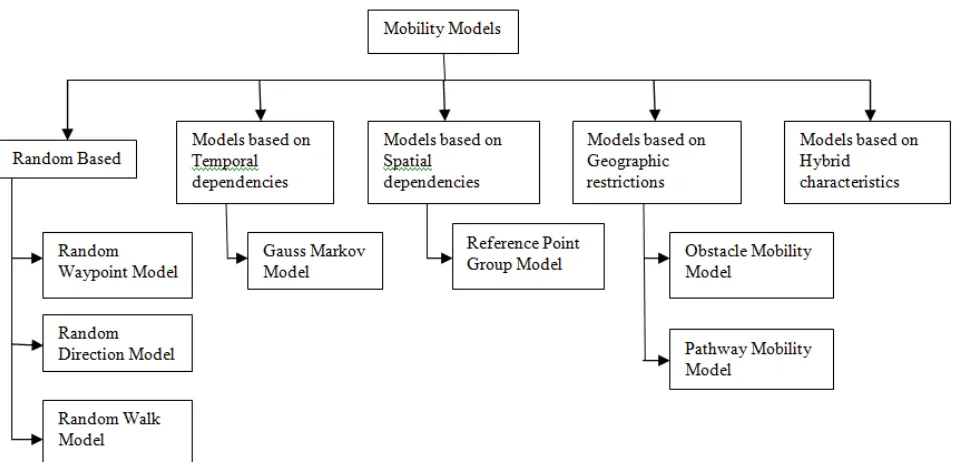
ORKMobility models depict the movement pattern, location, acceleration change over time and the velocity of the mobile nodes. This movement pattern is responsible for determining the performance of the protocol. These mobility models are classified based on the restrictions and dependencies as,
Random based: Nodes move randomly and there are neither dependencies nor restrictions modeled
Temporal dependencies: The movement of the past decides the movement of the nodes at present
Spatial dependencies: The movement of a node is influenced by the nodes present around that node
Geographic restrictions: The node movement is restricted to a particular area
Performance Analysis of Group Mobility
Handover in Wimax Networks With and
Without Group Leader Concept
Shalini E.1, Sundararajan T. V. P.2
1
PG Student, Department of Electronics and Communication Engineering, Bannari Amman Institute of Technology, Sathyamangalam-638401, Erode, Tamilnadu
2
Volume 2, Issue 3, March 2013
Page 2
Hybrid characteristics: It is the combination of Temporal dependencies, Spatial dependencies and Geographic restrictions
Figure 1: Different Mobility Models
Random Waypoint Model (RWP) [5] is a random model for the movement, their location, acceleration change over time and the velocity of the mobile nodes. As they are random based mobility model, mobile nodes move freely and randomly without any limitations. In this model, the destination, speed and directions are chosen randomly. Random Walk Model and Random Direction Model are the variants of Random Waypoint Model. This model consists of pause time between changes in direction or speed. When the specified pause time is crossed, the mobile node selects the destination randomly and chooses the speed uniformly between the minimum and maximum speed and travels with the speed of interval (0, ). gives the degree of mobility. The mobile node moving towards the destination stays there for the specified pause time and vice versa. This model is widely used in simulations due to its simplicity.
Random Walk Model is originally used for emulating the random movement of the particles which is also termed as Brownian motion in physics. It is similar to Random Waypoint Model but with zero pause time. Here, the nodes can change their speed and direction at each time interval. This model is a memory less mobility process in which previous information is not used for taking the future decisions. In Random Direction Model, each node moves until they reach the specified boundary of the simulation. After reaching the boundary, it again starts moving in another direction. Gauss Markov model which is based on temporal dependencies is used to overcome the drawbacks of the RWP model. According to this model, the node determines the new vector based on the past direction and speed. However, this model is not widely used for simulation studies since the computational complexity of the movement of the node is high, that is, it has larger trace file compare to RWP model. All these models are used for simulating the individual mobile node but whereas Reference Point Group Mobility Model [3] is used for simulating the group behavior, where each node belongs to a group with a group leader which determines the movement of the group. All the nodes in a group are distributed randomly around the reference point. The nodes in a group may use different mobility model and added to the reference point for driving the individual nodes in the direction of the group. Each node has a unique speed and direction at every instant, which has been derived by randomly deviating from that of the leader of the group. This makes it useful for creating a variety of models for different mobility applications. Such group mobility models are used for military battlefield applications, where a number of soldiers move together in a group.
3.
S
YSTEM ARCHITECTUREVolume 2, Issue 3, March 2013
Page 3
WiMAX stands for Worldwide Interoperability for Microwave access is a developing technology which is a fourth generation wireless technology with the standard IEEE 802.16. It is a broadband wireless access (BWA) system mainly designed for the Wireless Metropolitan Area Network (WMANs).The standard IEEE 802.16-2004 is mainly designed for providing broadband access to internet for the users who are fixed with small business and the standard IEEE 802.16e supports broadband access to mobile users resulting in Mobile Wimax [6 & 7].ThusIEEE Std 802.16e offers improvement to IEEE Std 802.16-2004 for supporting users moving at vehicular speeds and thereby specifies a system for combined fixed and mobile broadband wireless access (BWA) [8]. It plug-in the gap between the very high data rate wireless local area networks and very high mobility cellular systems. Group Mobility scenario occurs mainly in the military environment where a troop of soldiers moves from one location to the other. During movement, handover is an essential process for switching the signal strength from one base station to the other. This handover causes latency in the network due to the collision of the ranging request from the individual MNs in a group. The introduction of group leader concept overcomes this drawback by adding the entire request from the MNs in a group into a single request.
4.
S
IMULATIONR
ESULTS ANDD
ISCUSSION4.1Simulation Setup Of Group Mobility Scenario
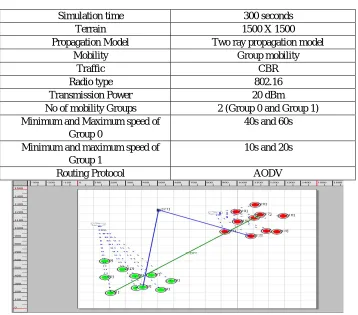
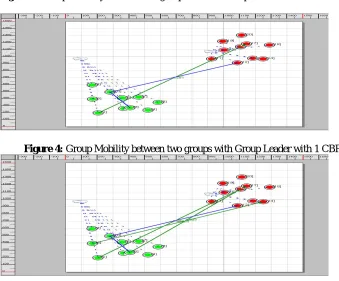
The group mobility scenario is simulated using Qualnet 5.0.2. Two scenarios are constructed With Group Leader and Without Group Leader respectively. These two scenarios are analyzed with different CBR connections and also based on Throughput and jitter. Each scenario consists of two groups with the minimum of 2 nodes to the maximum of 10 nodes respectively. The simulation parameters used for scenario simulation is given in the table given below. The scenarios are analyzed by varying the CBR connections. Figure 2 represents group mobility scenario with two groups in WiMAX networks without Group Leader and one CBR connection. Here, nodes 1 to 10 are grouped as Group 0 and nodes 11 to 20 are grouped as Group 1. As the number of CBR connection is increased, latency increases since the network congestion increases which is analyzed from the scenario shown in the figure 3. Similarly figure 4 represents the group mobility scenario with two groups in WiMAX networks with Group Leader and one CBR connection and figure 5 shows the same scenario with 3 CBR connections respectively.
Table 1: Simulation parameters
Simulation time 300 seconds
Terrain 1500 X 1500
Propagation Model Two ray propagation model
Mobility Group mobility
Traffic CBR
Radio type 802.16
Transmission Power 20 dBm
No of mobility Groups 2 (Group 0 and Group 1) Minimum and Maximum speed of
Group 0
40s and 60s
Minimum and maximum speed of Group 1
10s and 20s
Routing Protocol AODV
Volume 2, Issue 3, March 2013
Page 4
Figure 3: Group Mobility between two groups without Group Leader with 3 CBRFigure 4: Group Mobility between two groups with Group Leader with 1 CBR
Figure 5: Group Mobility between two groups with Group Leader with 3 CBR
4.2Results and Discussion 4.2.1 Handover Latency
Handover latency is defined as the latency incurred in the network during the handover process from one base station to the another base station. The figure 6 depicts that the handover latency is high for the network that does not uses Group Leader and the network that uses more CBR connections since there is more collision of requests from the individual MS in a group at the base station. The introduction of Group Leader integrates all these requests from individual MS in a group into a single request and thus avoids latency in the network.
Volume 2, Issue 3, March 2013
Page 5
4.2.2ThroughputThroughput is the amount of number of packets effectively transferred in a network, in other words throughout is data transfer rate that are delivered to all terminals in a network. It is measured in terms of packets per second or per time slot. Figure 7 shows the throughput performance for the scenarios Without Leader MS and With Group Leader involving one CBR connection. Here, the throughput value is found to be high for the network that does not involves Group Leader and similarly as the speed of the nodes gets increases there is decrease in the throughput subsequently. Figure 8 depicts the throughput value for the similar networks with three CBR connections. Here, as the number of CBR connections increases, there is a decrease in the throughput value due to increase in congestion involved the network.
Figure 7: Throughput of the networks with 1 CBR connection
Figure 8: Throughput of the networks with 3 CBR
4.2.3Average Jitter
Jitter can be observed as the end-to-end delay variation between two consecutive packets. The value of jitter is calculated from the end to end delay. Jitter reveals the variations in latency in the network caused by congestion, route changes, queuing, etc. It determines the performance of the network and indicates how much consistence and stable the network is. The table 2 shown below depicts the average jitter value for a group with ten mobile nodes. It says that, the jitter is high for the network that does not use Group Leader and for the network that uses more CBR connections.
Table 2: Average Jitter for a group with ten mobile nodes
Leader MS with 1 CBR
Leader MS with 3 CBR
No Leader with 1 CBR No Leader with 3 CBR
0.0039 0.0042 0.0241 0.0455
5.
C
ONCLUSIONVolume 2, Issue 3, March 2013
Page 6
R
EFERENCES[1] Westall, James M., and James J. Martin. "Performance characteristics of an operational wimax network." Mobile Computing, IEEE Transactions, 941-953, 2011
[2] Hong, X., Gerla, M., Pei, G. and Chiang C., “A Group Mobility Model for Ad hoc Wireless Networks” In Proceedings of the ACM/IEEE MSWIM’99, pp.53-60, Seattle, WA, August 1999.
[3] Qi Lu, Maode Ma “Group mobility support in mobile WiMAX networks” in Journal of network and computer applications,pp. 1272–1282, Feb 2011
[4] Kim, Dongmyoung, et al. "Performance measurement over Mobile WiMAX/IEEE 802.16 e network." World of Wireless, Mobile and Multimedia Networks, 2008. WoWMoM 2008. 2008 International Symposium on a. IEEE, 2008.
[5] Bai, Fan, and Ahmed Helmy. "A survey of mobility models." Wireless Adhoc Networks. University of Southern California, USA 206 , 2004.
[6] Makelainen, Antti. Analysis of handoff performance in Mobile WiMAX networks. Diss. Helsinki University of Technology, 2007.
[7] Ashoka, B. Eyers, D. Zhiyi Huang, ‘’Handover Delay in Mobile WiMAX: A Simulation Study’’,IEEE International conference communications,pp 305-312, 2012.
[8] Daniel, K. ; Rohde, S. ; Subik, S. ; Wietfeld, C. (2009) ‘’Performance Evaluation for Mobile WiMAX Handover’’ Mobile WiMAX Symposium, pp 30-35, October 2009.
[9] Rahim, R. ; El Hassan, B. ; Afifi, H, (2004) ’’Evaluation of handover time in different network technologies’’, IEEE International conference communications, pp 217-218, Jan 2004.
[10] P. Barber, (2004) Revision of Handover Mechanism for Mobility Enhancement. IEEE 802.16 Broadband Wireless Access Working Group Project, IEEE C802.16e-03/57, 30 October 2003. http://wirelessman.org/tge/contrib/C80216e-03 57.pdf
A
UTHOR’
SP
ROFILEShalini .E has received her B.E degree in Electronics and Communication Engineering from Anna University, Coimbatore, 2011. She is currently pursuing her Master of Engineering in Communication Systems in Bannari Amman Institute of Technology under Anna University, Chennai. Her areas of interest in research are Wireless Communication & Wireless Networks. She has published 2 articles in international journal and 4 papers in national and international conferences.