1.
Introduction
Fortified cereal base milk is being introduced in the market in order to satisfy nutrition conscious population who are reading the labels containing nutritional information of the products. Oats contain high percentage of protein with a superior amino acid balance. In contrast to other cereals oat also contain a high percentage of lipids which are highly unsaturated and contain substantial amounts of essential fatty acids. Oats are also a great source of number of essential vitamins and minerals such as vitamin E and folic acid1. Oat β-glucan a soluble fiber is a viscous polysaccharide made up of units of the sugar D-glucose. Soluble fiber reduces LDL cholesterol, controls insulin levels and provides satiety. Thus play an important role in management of CVD, Diabetes mellitus and Obesity.
The consumption of oats is increasing day by day and it is recommended for solving for various ailments especially chronic degenerative diseases like CHD, obesity, hypertension etc. Oats are mostly available in the form of flakes hence they can be used mostly in the form of porridge with or without sugar invariably used as a breakfast food. Recently some of the corporate sectors have started claiming several health attributes marketing oat based products in the form of biscuits, oats
masala mix, etc. The consumption of oats in the same form over a period of time will cause monotony in eating pattern of the individuals. To combat this issue the proposed research will be an attempt to introduce oat flakes milk and create awareness regarding oats nutrition and therapeutic value. Oat milk could be used in the preparation of beverages as coffee, tea and flavoured milk. The oats and barley milk extract can also be used in various recipes in place of regular milk.
Soluble fiber present in oats is β-glucan2 being the principal compound to control cholesterol level. Many supporting papers have been published by which states that dietary soluble fiber has a role in lowering of plasma cholesterol3,4. Introduction of oats and barley based cholesterol control molecules flavoured ready to drink and its use in regularly consumed coffee and tea beverages would initiate the intake of β-glucan molecule.
Barley is a versatile cereal grain with rich nut like flavoured. It is derived from annual grass Hordeum Vulgare. Like oats, barley is a whole grain and has soluble fiber ‘β -glucan’ which can reduce abnormal blood cholesterol, maintain blood glucose levels along with several other health curing properties. Types of barley available include hulled, hulless and pearled barley. Many health curing properties of barley have been reported however the key molecule for cholesterol reduction is β-glucan in sufficient quantity in barley. Kay M Behall et al.5 has reported that increased intake of barley in diet would help to reduce LDL cholesterol.
Whyte et al6 conducted randomized controlled, cross over trial on 23 male hypercholesterolemic subjects with an average age of 45 years in their investigation found out that
Abstract
Background & Aim: Dyslipidemia one of the risk factor in coronary heart diseases is on rise due to various lifestyle related. Diet plays a crucial role in combating dyslipidemia, hence there is a need to develop the products with therapeutic value to tackle dyslipidemia. The present investigation is focused on developing value added cereal based (oat flakes and pearl barley) flavored milk containing β-glucan as the research has highlighted the role of β-glucan in reducing cholesterol levels. Methodology: The flavored milk was developed with different combination of oat and barley extract along with cow’s milk. Different combinations of oats and barley extract were tried in developing the flavored milk to arrive at a combination based on sensory evaluation using a Hedonic rating scale with a panel of 10 expert judges. The key molecule β-glucan content was analyzed using assay procedure K-BGLU 06/11 – Megazyme kit 2011. The developed product was analyzed for its biochemical, microbiological quality. Results: The product developed had 126 mg of β-glucan for 100 ml and was well accepted by the reviewers.
Keywords: Oats, β-glucan, sensory attributes, heart diseases.
@2014 BioMedAsia All right reserved
REVIEW Open Access
ISSN 2278-1404
International Journal of Fundamental & Applied Sciences
Development of Cereal based flavored milk and estimation of
β
-glucan in oats
and barley extract
BV Vijetha1*, Lalitha Reddy1, AM Natarjan2
1
Department of Food and Nutrition research center, Smt.VHD Central Institute of Home Science, Bangalore:-560001, Karnataka, India, 2Head, R & D center K C Das Pvt. Ltd Bangalore, Karnataka, India.
*Corresponding author
Full Address :
Department of Food and Nutrition research center, Smt.VHD Central Institute of Home Science, Bangalore:-560001, India
Phone no. +91-8256002212 E-mail: [email protected]
supplementation of soluble oat fibre over a period of 4 weeks resulted in substantially greater reduction in TC and LDL levels while consumption of wheat fibre had no effect. Onning et al7 studied the effect of consumption of oat milk, soya milk on plasma lipids levels and antioxidant capacity in healthy subjects. These authors found that oat milk can be used as an alternative to other milk and intake of oat milk reduces LDL cholesterol values.
A study published in Journal of American diet association 2001, has suggested that daily consumption of 2 servings of oats can contribute to further lipid alterations when compared to other dietary regimes. A clinical study showed an intake of fermented, ropy, oat based product containing 1.2g of β-glucan s thrice a day in 5 weeks gave a significant decrease in total cholesterol and LDL values by approximately 5 % compared with baseline.8 The literatures cited above has shown that oats and barley based foods if consumed regularly would address health problems related to CVD, CHD and diabetic health disorder. Hence in this investigation attempts were made to standardize methods for extraction of milk from oats and barley and to used this in the preparation of regularly and often consumed beverages like coffee, tea and flavoured milk and there by ensure sufficient intake of betaglucan which reported to control cholesterol level and also help in diabetic control9.
2. Material and methods
Different brands of oats flakes and pearl barley grain were purchased from super market.
2.1 Estimation of β-glucan
Estimation of β-glucan was carried out by following the assay procedure K-BGLU 06/11 – Megazyme kit 201110.
2.2 Chemical analysis
2.2.1 Determination of pH and carbohydrate
pH and carbohydrates of the product were determined as per the procedure from analytical chemistry of foods James(199511
2.2.2 Determination of available fatand protein:
Determination of fat and protein were done using standard protocol provided by manual in dairy chemistry ICAR,198212.
2.2.4 Microbiolsogical analysis:
Microbiolsogical analysis was done using protocol provided by Marth, American Public Health Association (APHA-1978)13
2.2.5 Sensory Evaluation:
Sirlakshmi (1999)14 Hedonic Rating scale was used for sensory evaluation assay.
Statistical analysis
The experiments were conducted in controlled conditions using laboratory facilities at KC Das pvt.ltd, Bangalore recognized by Ministry of Health, India in triplates. Statistical analysis was done using SPSS software.
3. Results
The yield obtained by soaking oat flakes for 6 hours was found
to be higher (320.2ml) followed by 3hours (303.5) and 1hour (294.5) respectively (Table I). The carbohydrate and β-glucan content was also found to be higher comparatively. The statistical analysis of the data relieved statistically significant difference between the soaked duration and chemical quality parameters namely yield, carbohydrate and β-glucan . Even though the variation in pH, acidity, fat and protein were found to be statistically non significant.
Table II indicates the difference between various brands of oats pertaining to the yield (ml), pH, acidity and β- glucan. The results when subjected to statistical analysis revealed a statistically significant difference between the varieties pertaining to the yield and chemical quality. The quality brand is chosen for further experiments based on the yield and good quantity of β- glucan content.
The oat flakes milk extract obtained by soaking for one hour, three hours and six hours respectively were subjected to microbiological analysis. Table III clearly shows that there was no significant difference as per as the bacteriological quality of the oat extract milk irrespective of the soaking hours.
The oat flakes milk prepared from quality oats soaked for different period of time one hour, three hours and six hours respectively were subjected to sensory evaluation using 7 point hedonic scale. The oat flakes milk extracted after soaking for 6 hours of time was found to be highly acceptable based on the sensory qualities. The results were found to be statistically significant at 1% level. (Table IV)
3.1 Effect of various stabilizers on quality and stability of oat milk
Oat flakes extract milk prepared by standard procedure by soaking QUALITY brand of oat flakes however lacked in homogeneity. In order to achieve uniform consistency oats milk was treated with different concentration of stabilizers which include dry sodium phosphate, sodium citrate, xanthumgum, sodium alignate. Incorporation of 0.3 per cent sodium citrate resulted in homogeneous milk with no signs of sedimentation during storage.(Table V)
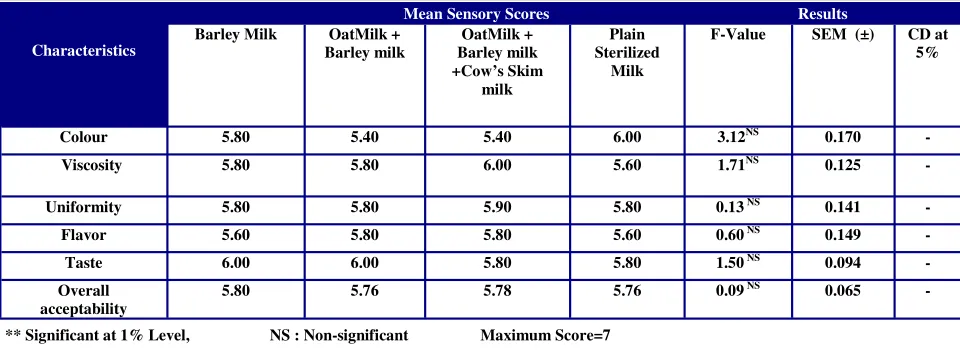
The mean sensory scores of barley milk, oat milk and combination of barley, oats and cows milk was subjected to sensory evaluation adopting 7 point hedonic scale. It was found that there was no significant difference between the different milks pertaining to colour, viscosity, uniformity, flavour, taste and overall acceptance. Among the different milks combined milk consisting of barley, oats and cows milk secured slightly higher score. (Table VI)
The beverages such as coffee, tea and vanilla flavoured milk prepared from combination milk (oat, barley and cows milk) were subjected to sensory evaluation adopting 7 point hedonic scale. It was found that there was no significant difference between the beverages pertaining to colour, mouth feel, uniformity, flavour and taste. The product was awarded such as score of 5.72 to the falls under grade of good quality. (Table VII)
Table I: Chemical Quality of Oat flakes extract milk prepared from Quality brand
ISSN 2278-1404 Int. J. Fund. Appl. Sci. Vol. 3, No. 1 (2014) 11-16 Cereal based flavored milk and estimation of β-glucan in oats and barley extract
Chemical Quality Soaked Duration Results
1 hr 3 hr 6 hr F-Value SEm ± CD at
5%
Yield (ml) 320.2 303.5 294.5 8.33** 4.572 13.259
pH 6.455 6.411 6.400 0.40 NS 0.044
-Acidity (%) 0.065 0.060 0.065 1.50 NS 0.002
-Fat (%) 0.080 0.084 0.082 0.77 NS 0.002
-Protein (%) 1.033 1.035 1.042 2.00 NS 0.003
-CHO 33.51 32.20 35.10 9.69** 0.467 1.354
β-glucan(mg/100ml) 123.8 120.4 126.2 7.08** 4.195 12.165
** Significant at 1% Level, NS : Non-significant
Chemical Quality
Brands Results
Quaker Manna Bagrry’s Quality Jambo Weikfied
F-Value
SEm ±
CD at 5%
Yield (ml) 249.0 230.8 255.3 362.3 300.8 229.0 76.83
**
5.891 17.084
pH 6.124 6.373 6.090 6.380 6.352 6.224 13.35
**
0.035 0.101
Acidity (%) 0.046 0.041 0.046 0.038 0.168 0.060 2.33
NS 0.033
-β- glucan
(mg/100ml)
109.9 127.8 131.5 126.0 122.7 122.8 7.08
*
2.787 8.082
Table II: Chemical quality of Oat flakes extract milk prepared from various brands of oat flakes soaked for six hours time
** Significant at 1% Level, NS : Non-significant
** Significant at 1% Level, NS : Non-significant
Bacteriological Quality Soaked Duration Results
1 hr 3 hr 6 hr F-Value SEm ± CD at
5%
Total bacterial counts 772.0 956.2 967.5 1.43 NS 71.118 -
Yeast & Mould count/ ml 101
17.67 20.00 16.00 0.75 NS 1.790 -
Coliform count/ml 101 Nil Nil Nil - - -
Table III: Bacteriological quality of Oat flakes extract milk Prepared from Quality brand soaked for one hour, 3 hours and 6 hours of time.
Sensory Characteristics Soaked Duration Results
1 hr 3 hr 6 hr F-Value SEM
(±)
CD at 5%
Colour 5.20 5.80 6.00 14.62** 0.109 0.316
Surface tension 3.50 3.80 5.80 74.05** 0.145 0.421
Whey Separation 4.80 5.00 6.00 69.75** 0.077 0.223
Texture 5.00 4.20 5.80 24.00** 0.163 0.473
Flavor 4.70 4.40 6.00 43.40** 0.129 0.374
Taste 3.85 4.80 6.00 43.99** 0.162 0.470
Overall Acceptability 4.51 4.67 5.93 103.68** 0.077 0.223
Table IV: Sensory evaluation of oat flakes milk
The combination of oat, barley and cows milk was found to be less acidic compared to barley milk, oat and barley combined milk. The fat percentage of combined milk (oat, barley and cows milk) was significantly higher compared to other two forms of milk. The protein and moisture content of the combined milk was higher and compared to other barley and oats milk. The carbohydrate percentage and the β-glucan content of the combined milk (oats, barley and cows milk) was significantly lower than the other two types milk. The protein and moisture content of the combination milk was higher and the difference was found to be statistically significant. The carbohydrate percentage and the β-glucan content of the
combination milk were significantly lower than the other two types of milk because only 30 %, 20 % ,50 % of oat milk, barley milk and cow’s milk was taken. (Table VIII)
4. Discussion
In India Oats are marketed in the form of flakes under different brand names. Manna, Quality, Jumbo, Quaker, Bagrry’s, Weikfied brands were selected randomly for the experiments. Among these QUALITY brand oats milk extract was preferred due to high total betaglucan content and yield.
Determination of Soaking Time for experimental work: To arrive at optimal soaking time based on the yield and quality of oats flakes milk extract, brand QUALITY oat flakes were found to be good among the different brands. The flakes were soaked in water for one, three and six hours respectively for better extract of milk from the flakes. It was found that 120 gms of oat flakes soaked in 600 ml followed by extraction of milk found to meet the required acceptable consistency and homogeneity.
Soaked oat flakes in water was grinded in a blender followed by filtration using plastic mesh of size 0.1cm. The yield of oat Int. J. Fund. Appl. Sci. Vol. 3, No. 1 (2014) 11-16
Vijetha et al ISSN 2278-1404
Table V: Soluble and Insoluble fiber Scores of different combination of milk
Characteristics
Mean Sensory
Scores
Results
Oat Milk
Barley milk
F-Value
SEM(±) CD at
5%
Soluble Fibre(g/100ml) 1.56 2.56 445.86 *
0.193 0.596
Insoluble Fibre(g/100ml) 0.36 1.64 428.62 *
0.042 0.128
** Significant at 1% Level, NS : Non-significant
Characteristics
Mean Sensory Scores Results
Barley Milk OatMilk +
Barley milk
OatMilk + Barley milk +Cow’s Skim
milk
Plain Sterilized
Milk
F-Value SEM (±) CD at
5%
Colour 5.80 5.40 5.40 6.00 3.12NS 0.170 -
Viscosity 5.80 5.80 6.00 5.60 1.71NS 0.125 -
Uniformity 5.80 5.80 5.90 5.80 0.13 NS 0.141 -
Flavor 5.60 5.80 5.80 5.60 0.60 NS 0.149 -
Taste 6.00 6.00 5.80 5.80 1.50 NS 0.094 -
Overall acceptability
5.80 5.76 5.78 5.76 0.09 NS 0.065 -
** Significant at 1% Level, NS : Non-significant Maximum Score=7 Table VI: Sensory Evaluation scores of different combination of milks
Characteristics
Mean Sensory Scores Results
Coffee
Bever-age
Tea Beverage Vanilla
Fla-vored Milk
F-Value SEM
±
CD at 5%
Colour 5.80 5.80 5.70 0.19NS 0.133 -
Mouth feel 5.60 5.60 5.90 1.56NS 0.139 -
Uniformity 5.80 5.80 5.80 0.0 NS 0.133 -
Flavor 5.80 5.80 5.40 2.57 NS 0.144 -
Taste 5.60 5.60 5.80 0.56 NS 0.154 -
Overall acceptability
5.72 5.72 5.72 0.00 NS 0.055 -
Table VIII: Chemical Quality Scores of Different combination of milk
extract milk was found to be around 300-360 ml. Six hours of soaking was preferred from the point of view of yield, consistency, flavour and β-glucan content. Soaking beyond six hours resulted in highly viscous and sticky fluid which lacked in sensory attributes.
It was also found that six hours of soaking of oat flakes did not require any grinding procedure since the soaked oat flakes when subjected to gentle churning and filtration using plastic mesh yielded more quantity and possessed good quality. Therefore this modified method of oat milk extract from QUALITY brand oat flakes was found to be ideal for use in the preparation of commonly consumed beverages.
Selection of oat flakes brand for experimental work: Oat flakes extract milk from all the six brands was prepared by adopting the method developed in this investigation. All the six batches of oats flakes milk using different brands were subjected to chemical analysis. It was found that QUALITY brand of oat flakes gave maximum yield of 350 ml comparatively. This milk also had an edge over the other brands pertaining to β-glucan content which was estimated using standard procedure. Hence QUALITY brand was selected to extract ilk for use in further experimental trials. Since oats extracted milk was little short total solids it was found necessary to mix cereal based in cows milk.
Oats milk from QUALITY brand recorded low incidence of total bacterial count with nil coli form, yeast and mould count and hence considered safe and use in the development of beverages such as coffee, tea and flavoured milk. Since preparation/extraction of oat milk from flakes of QUALITY brand is attempted for the first time, relevant literature on these aspects is not available for comparative evaluation of the data.
Use of different stabilizers to obtain homogenous oats flakes milk extract: A homogeneous milk is necessary for use in the preparation of beverages. Hence in order to bring about homogeneity in the extracted oat flakes milk was treated with
different approved stabilizer which include dry sodium phosphate, sodium citrate, xanthumgum, and sodium alignate. It was found that incorporation of sodium citrate (0.3%) was found to be effective in obtaining homogenous milk extract .Sodium citrate is a well known stabilizer commonly known as a melting salt and used in various food to obtain homogenecity.
Sensory Evaluation of oats flakes milk extract :
Oat flakes from QUALITY brand were soaked six hours and milk was extracted following procedure developed in this investigation. The oat flakes milk after treated with the stabilizer sodium citrate (0.3%) was subjected to sensory evaluation by a panel of 6 expert judges using 7 point hedonic scale. It was found that the oats flakes milk received good sensory scores on the basis of its colour, consistency, flavoured, texture and taste.
A method was also standardised for extracting barley milk from barley grains same procedure adopted for extracting milk from oat flakes. New scientific studies showed that β-glucan of barley is effective in reduction of cholesterol 9
The chemical quality and sensory evaluation of barley milk was acceptable and hence it was used along with oats and cows milk to further enhance its nutritive and therapeutic value. The present investigation is focused in developing cereal based coffee, tea and flavoured milk from combined oat milk (30%), barley milk (20%) and cows milk (50%), various flavours namely vanilla, strawberry, chocolate and banana wre tried in the preparation of flavoured milk. Among these milk flavoured with vanilla was found to be highly acceptable based on sensory scores. Tea and coffee commonly and regularly consumed beverages by large section of population, method for preparation of these two hot beverages from combined milk was also standardized. In order to obtain homogenous milk preventing sedimentation of the combined milk was treated with sodium citrate popularly known as melting salt. Thus these Int. J. Fund. Appl. Sci. Vol. 3, No. 1 (2014) 11-16
* Significant at 5% Level, NS : Non-significant Characteristics
Mean Sensory Scores Results
Barley Milk
Oat Milk + Barley milk
Oat Milk + Barley milk + Cow’s Skim
milk
F-Value SEm ± CD at
5%
PH 5.48 6.21 6.19 55.97* 0.056 0.161
Acidity (%) 0.053 0.046 0.052 1.61NS 0.003 -
Fat (%) 0.569 0.390 1.460 581.59 * 0.024 0.069
Protein (%) 1.18 2.58 2.46 327.77 * 0.043 0.124
CHO (%) 21.60 21.12 18.74 27.49 * 0.292 0.847
Moisture (%) 76.59 75.92 77.35 4.92* 0.322 0.936
β-glucan(mg/100ml) 223.0 319.3 126.3 994.51* 3.059 8.877
there beverages would benefit the consumers also intake of betaglucan will provide cumulative effect to provide cholesterol lowering health benefits.
Findings of these investigation would contribute to value addition by way of developing new betaglucan enriched beverages and fulfill the expectations from the consumers who are willing to accept new beverages if it means providing health benefits.
Conclusion
The present investigations have given oats a larger market for product development in the form of flavoured milk, beverages such as coffee tea and traditional breakfast recipes and indigenous sweet. The potential health benefits of oats and barley along with mil have been a slugged of growing commercial interest in the context of health promotion. These food products developed within this investigation offers an excellent basis of novel health promoting concept of personalized nutrition. New discoveries regarding the health benefits of oat milk based with oats and barley foods would offer newer options and varieties to the consumers in view of increased demand for higher value added and product performing health foods to the consumers. This heralds the promotion of health by means of a designed diet and interesting opportunities to the food industry or expansion in the field of its operation.
Acknowledgement
We would like to thank UGC grants commission for sponsoring this major project( F:No: 39-83/2010 (SR) and NDRI adugodi Bangalore Karnataka Scientist Dr.Surendranath for helping to conduct β-glucan analysis and use the facilities of their laboratory and also R & D centre K C Das pvt ltd Bangalore.
Conflict of interest:- None stated by authors.
References
1. Lockhart HB & Hurt DH Nutrition of oats. In oats: chemistry and technology American Association of Cereal Chemist30 (1986) 297 -308
2. Bratten JT, Wood P, Scott F W, Wolynetz MS, Lowe MK, Bradley -White P & Collins MV Oat betaglucan reduces blood cholesterol concentration in hypercholesterolemic subjects European journal Clinical Nutrition48 (1994) 465-474
3. Kerckhoffs DAJM, Brouns F, Hornstra G & Mensisnk RP Effects on the human serum lipoprotein profile and betaglucan, soy protein and isoflavones, plant sterols and stanols and tocotrienols Journal of Nutrition132 (2002) 2494-2505
4. Theuwissen E & Mensink RP Water-soluble dietary fiber and cardiovascular disease Physiology & Behavior94 (2008) 285-292 5. Behall KM, Scholfield DJ & Hallfrisch J Diets containing barley
significantly reduce lipids in hypercholesterolemic men and women, American Society for Clinical Nutrition 80 (2004) 1185-93 6. Whyte JL, McArthur R, Topping D & Nestel P Oat bran lowers plasma cholesterol levels in mildly hypercholesterolemic men J American Dietetic Association92(4) (1992) 446-449
7. Onning G, Akesson B, Oste R & Lundquist I Effects of consumption of oat milk, soya milk or cow’s milk on plasma lipids and antioxidative capacity in healthy subjects. Annals in Nutrition and Metabolism42 (1998) 211-220
8. Martensson O, Biorklund M, Lambo MA, Duenas-Chasco MT, Irastorza A, Holst O, Norin E, Walling G, Oste R & Onning G Fermented ropy oat-based products reduce cholesterol levels and stimulate the bifidobacteria flora in humans Nutrition Research 25 (2005) 429-442
9. Truswell AS, Cereal grains and coronary heart disease. European
Journal of Clinical Nutrition,56 (2002)1-14.
10. Wood P Cereal β-glucans in diet and health. Journal of Cereal Sciences46 (2007) 230-238
11. James CS Analytical chemistry of foods (1995), Chapman Hall, New York.
12. Manual of Diary Chemistry, ICAR (1982), 129-132.
13. Assay of mixed-linkage β-glucan , AOACC method, ICC standard Method No.168
14. Srilakshmi B Food Science, Third Edition, New Age International (P) Limited, Publishers (2003) 17-72