The Thirty-Third AAAI Conference on Artificial Intelligence (AAAI-19)
On Lifted Inference Using Neural Embeddings
Mohammad Maminur Islam,
1Somdeb Sarkhel,
2Deepak Venugopal
11The University of Memphis2Adobe Research
[email protected], [email protected], [email protected].
Abstract
We present a dense representation for Markov Logic Net-works (MLNs) called Obj2Vec that encodes symmetries in the MLN structure. Identifying symmetries is a key challenge for lifted inference algorithms and we leverage advances in neural networks to learn symmetries which are hard to spec-ify using hand-crafted features. Specifically, we learn an em-bedding for MLN objects that predicts the context of an ob-ject, i.e., objects that appear along with it in formulas of the MLN, since common contexts indicate symmetry in the dis-tribution. Importantly, our formulation leverages well-known skip-gram models that allow us to learn the embedding ef-ficiently. Finally, to reduce the size of the ground MLN, we sample objects based on their learned embeddings. We inte-grate Obj2Vec with several inference algorithms, and show the scalability and accuracy of our approach compared to other state-of-the-art methods.
Introduction
Neural embeddings have been extremely successful as a general approach to learn efficient and effective repre-sentations for a variety of real-world domains including words (Mikolov et al. 2013; Pennington, Socher, and Man-ning 2014), knowledge graphs (Nickel et al. 2016), im-ages (Kiela and Bottou 2014), etc. Inspired by these suc-cesses, in this paper, we present a novel representation for Markov Logic Networks (MLNs) (Domingos and Lowd 2009) using neural embeddings to represent symmetries in the model. Our main motivation for such a representation stems from the fact that over the last several years, it has been widely recognized that exploiting symmetries in MLNs (and in other statistical relational models such as PSL (Bach et al. 2017)) yields exponential improvements in the scala-bility of inference algorithms. Thus, several algorithms that are collectively referred to aslifted inference(Poole 2003) algorithms have been proposed that exploit symmetries in the MLN.
However, identifying symmetries in the MLN efficiently and effectively is non-trivial. Previous lifted inference meth-ods have developed first-order rules to identify symme-tries (de Salvo Braz 2007; Van den Broeck et al. 2011; Gogate and Domingos 2011). However, such rules can
Copyright c2019, Association for the Advancement of Artificial
Intelligence (www.aaai.org). All rights reserved.
identify a relatively small subset of symmetries and are severely limited when the MLN is conditioned on evi-dence variables (Van den Broeck and Darwiche 2013). Consequently, more recent lifted inference algorithms try to exploit approximate symmetries using matrix factoriza-tion for binary evidence (Van den Broeck and Darwiche 2013) or clustering (Venugopal and Gogate 2014). Further, algorithm-specific scalable lifting methods include cluster-ing for MAP (Sarkhel, Scluster-ingla, and Gogate 2015) and ap-proximate messaging in BP (Singla, Nath, and Domingos 2014). Other lifted inference techniques focus on detecting symmetries using the graph structure of the Markov net-work underlying the MLN have been proposed. Specifically, Bui et al. (Bui, Huynh, and Riedel 2013) connected au-tomorphism groups in the Markov network structure with lifted variational inference. Similar approaches have been developed for MAP inference using ILPs (Apsel, Kersting, and Mladenov 2014) and marginal inference (Mladenov and Kersting 2015). However, these approaches are essentially “bottom-up” approaches meaning that they work by instanti-ating the MLN to create the Markov network and then detect symmetries. For practical problems in domains such as in-formation extraction (Venugopal et al. 2014) or question an-swering (Khot et al. 2015; Venugopal and Rus 2016), creat-ing the Markov network quickly becomes infeasible. There-fore, we develop a generic, scalable approach that learns subsymbolic vector representations for the MLN based on symmetries.
ar-chitectures (Mikolov et al. 2013) to perform domain lifting efficiently. To perform tractable inference using the Obj2Vec embedding, we sample from the embedding and create a smaller MLN with fewermeta-objectsthat represent groups of exchangeable objects.
We perform experiments on marginal and MAP infer-ence algorithms implemented in two state-of-the-art systems Tuffy (Niu et al. 2011) and Magician (Venugopal, Sarkhel, and Gogate 2016), and compare our approach with other approaches for lifting, binary matrix factorization (Van den Broeck and Darwiche 2013) and clustering (Venugopal and Gogate 2014). Our results clearly show that our approach is more scalable and accurate for several benchmark inference problems.
Background
Markov Logic Networks
Markov logic networks (MLNs) are template models that de-fine uncertain, relational knowledge as first-order formulas with weights. Weights encode uncertainty in a formula.∞
weight formulas are hard constraints which should always be true. Similarly, formulas with −∞weights are always false. Thus, MLNs offer a flexible framework to mix hard and soft formulas. In MLNs, we assume that each argument of each predicate in the MLN is typed and can only be as-signed to a finite set of constants. By extension, each logical variable in each formula is also typed. Thus, each variable corresponds to a specific domain of objects. A ground atom is an atom where each of its variables has been substituted by constants from their respective domains. A ground formula is a formula containing only ground atoms.
Given a set of constants that represent the domains of vari-ables in the MLN, an MLN represents a factored probabil-ity distribution over the possible worlds, in the form of a Markov network. A world in an MLN is an assignment of 0/1 to all ground atoms of the MLN. Specifically, the distri-bution is given by,
Pr(ω) = 1 Z exp
X
i
wiNi(ω)
!
(1)
wherewiis the weight of formulafi,Ni(ω)is the number of
groundings of formulafithat evaluate to True given a world
ω, andZ is the normalization constant. The two common inference problems over MLNs are marginal inference and MAP inference which are both intractable problems.
Skip-Gram Models
Skip-gram models are used to learn an embedding over words based on the context in which they appear in the training data (i.e., nearby words). Word2vec (Mikolov et al. 2013) is a popular model of this type, where we train a neu-ral network based on pairs of words seen in the training data. Specifically, we use a sliding window of a fixed size and generate all pairs of words within that sliding window. Each word is first represented as a one-hot encoded vector. Then, for each pair of words, we consider one word of the pair as input and the other word as a target. That is, we learn to pre-dict a word based on its context or nearby words. The hidden
layer typically has a much smaller number of dimensions as compared to the input/output layers. Thus, the hidden-layer learns a low-dimensional embedding that is capable of mapping words to their contexts. Typically the hidden-layer output is used as features for other text processing tasks, as opposed to using hand-crafted features.
Related Work
Lifted inference is the predominant approach to improving the scalability of inference in relational models. Exact lifted inference approaches include (Poole 2003; de Salvo Braz 2007; Gogate and Domingos 2011; Van den Broeck et al. 2011). Approximate inference methods that exploit exact symmetries include (Singla and Domingos 2008; Niepert 2012; Venugopal and Gogate 2012; Sarkhel et al. 2014). Our approach is most closely related to pre-processing ap-proaches that exploit approximate symmetries such as bi-nary evidence processing (Van den Broeck and Darwiche 2013) and clustering methods that use specific count-based features (Venugopal and Gogate 2014). However, our ap-proach is more general since it can be applied to all evi-dence types, and also does not use hand-coded features. The second line of research in lifted inference identifies symme-tries on the Markov network structure using automorphism in graphs (Niepert 2012; Bui, Huynh, and Riedel 2013; Van den Broeck and Niepert 2015). Specifically, color pass-ing algorithms are used to find exchangeable variables for marginal as well as MAP inference (Apsel, Kersting, and Mladenov 2014; Mladenov and Kersting 2015). However, such algorithms compute symmetries on the ground Markov network, and for large practical problems, this becomes infeasible. In contrast to detecting symmetries, Kopp et al. (Kopp, Singla, and Kautz 2015) used symmetry break-ing techniques commonly used in the SAT community and applied it to lifted inference. Anand et al. (Anand et al. 2016) developed methods that detect contextual symmetries for probabilistic graphical models. These methods also re-quire the ground Markov network structure in order to adapt them to MLNs.
Obj2Vec
We next describe our model for embedding MLN objects. First, we define what symmetry means for two objects. Note that previous works have defined symmetry in terms of orbits in the automorphism groups of variables in the Markov network underlying the MLN (Bui, Huynh, and Riedel 2013). Here, we characterize symmetry based on the exchangeability of objects in ground formulas.
Definition 1. Given an MLNMand evidence databaseD, letXandY be two objects in the same domain∆.XandY
are exchangeable (denoted asX ∼ Y) if we can exchange
X and Y in all groundings of the MLN in which they oc-cur without changing the truth assignment of the groundings (according toD).
The above definition can now be used to define the dis-tance between two objects in a domain as,
Definition 2. Given an MLNMand evidence databaseD, letXandY be two objects in the same domain∆.δ(X, Y) =P
fI(f, X, Y), whereI(f, X, Y) = 0if the truth assign-ment tof does not change when we exchangeXandY, and
1otherwise.
Instead of using a threshold function to represent the dif-ference between mismatches in the ground formula assign-ment, we now define a continuous approximation of the δ function as a sigmoid function. This allows us to represent approximate symmetries between domain objects. Specifi-cally,
Definition 3. Given an MLNMand evidence databaseD, letXandY be two objects in the same domain∆.δ(X, Y) =1+e1−βm, wheremis the number of ground formulas that have a difference in assignments before and after exchang-ing the objectsX andY, andβ is a hyper-parameter that controls the shape of the sigmoid function.
We can now search for an optimal set of approximately exchangeable objects in ∆ by finding a subset that mini-mizesδ. Specifically,
arg min ∆0⊆∆
X
X∈∆0,Y∈N(X)
δ(X, Y)
whereN(X)is the set of objects in∆thatX exchanges with, and with the constraints that∪XN(X) = ∆and|∆0| ≤α, for some constantα.
However, the above approach is computationally infeasi-ble since the number of subsets is exponential. Alternatively, we can cast the above problem as a clustering problem that heuristically findαclusters of approximately exchangeable objects withδ(X, Y)as the distance function. However, note that even finding a heuristic solution using such a clustering formulation is difficult due to thecurse of dimensionality. Specifically, as the number of ground formulas increase, the number of clustering dimensions increase accordingly.
To avoid the curse of dimensionality, we instead learn a dense neural representation that yields a more compact, distributed representation for the objects. However, the key challenge here is, how can we encode or vectorize an ob-ject to learn the subsymbolic representation scalably?. One
approach is to design an encoding over the ground for-mulas. Specifically, the vector encoding for an object X, vX is a vector that specifies whether a ground formula is
True/False/unknown. For groundings whereXdoes not appear, the vector component has a valueunknown. How-ever, such an encoding leads to an extremely large input layer, since the size of the encoding is equal to the size of the ground Markov network, and is thus not scalable for MLNs. Therefore, we develop a more scalable representa-tion inspired by theskip-grammodel which is widely used in word embeddings.
Learning Scalable Embeddings
The main idea in our approach is to train a neural network that predicts objects from other objects. Specifically, bor-rowing terminology from skip-gram models, we seek to pre-dict thecontextof an object. The hidden layer of the neu-ral network learns to represent the input object vectors in a reduced dimension such that objects that appear in similar contexts are placed close together in the embedded space.
Definition 4. Given an MLNMand evidenceD, suppose
f is a ground formula satisfied byDand whereX occurs, the context for objectX inf,C(f, X), is the set of objects (other thanX) that occur inf.
When defining the context, it is important to note the di-chotomy between satisfied formulas and unsatisfied formu-las. Specifically, we define the context of an object only when the object appears in satisfied ground formulas. In gen-eral, there can be ground formulas with an unknown truth value (since not every ground atom is specified as evidence). In such a case, we do not have sufficient information to state whether the context of an object is valid (according to the data) or not. To determine the context of objects in such a ground formula, we first need to infer the most likely truth assignment to the formula, which in turn requires us to perform inference (e.g. MAP), or treat unknown atoms as missing and run an EM algorithm, both of which are computationally expensive. Therefore, we ignore such for-mulas when defining context of an object. For example, let us assume a simple MLN formula,R(x)∧S(x, y)with ev-idenceR(X1),S(X1, Y1),R(X2),S(X2, Y1),S(X3, Y1). In this case,R(X3)∧S(X3, Y1)has an unknown truth value, so the available data cannot assert thatY1is in the context of X3forR(X3)∧S(X3, Y1), but it can assert thatY1is in the context ofX1andX2forR(X1)∧S(X1, Y1)andR(X2)∧
S(X2, Y1)respectively.
Proposition 1. SupposeX,Y ∈∆are exchangeable, then
X andY have common contexts.
Proof. (Sketch) IfXandY are exchangeable, then, to guar-antee that the MLN structure does not change, for every for-mulafwhereXoccurs, we need to find a corresponding for-mulaf0whereYoccurs, such that we replace occurrences of
XinftoY, and occurrences ofY inf0toX, and the mod-ified formulas are equivalent to the original formulas given
Thus, our task in learning the embedding is to ensure that objects with common contexts lie close to each other in the embedding. To do this, we vectorize an objectX as a one-hot encoding represented y vectorvX. Specifically, the
en-coding is as large as the maximum domain size, and each object in the domain is represented as a 0/1 value in this vec-tor.vXwill set the vector component corresponding toXto
1 and the other components to 0. Note that, the size of the input encoding in this case equal to the maximum domain size which is orders of magnitude lesser than the number of ground formulas.
To learn the embedding, we assume a canonical form for all the formulas in the MLN. Specifically, we assume that each formula is a clause, and that there is an ordering over the predicates. That is, in each formula, predicates appear according to a pre-specified ordering. This is needed to give a sequential ordering to the objects in the formulas. To learn the embedding, for every ground formula satisfied by the ev-idence, we predict an object given the surrounding objects or context. Specifically, letf1. . . fKdenote the ground
formu-las, and letOirepresent the sequence of objects infi, and
the oij represents the j-th object in thei-th formula. The
learning algorithm seeks to maximize,
K
X
i=1
|Oi|
X
j=1 X
−c≤k≤c;k6=0
logP(oij+k|oij)
Specifically,cdefines a sliding window-size over the ob-jects inOi. Here,P(oij+k|oij)is defined as a softmax
func-tion proporfunc-tional toexp(vo0>ij+kvoij), wherevorefers to the
input vector representation for objecto, andv0orefers to its output vector representation. An example of specifying the training data to learn the embedding is shown below.
Example 1. Consider a simple formulaR(x)∧S(x, y). Let
∆x={X1, X2, X3}and∆y={Y1, Y2}. Assume a closed world with the evidence database R(X1), R(X2), R(X3),
S(X1, Y1),S(X2, Y1),S(X3, Y2). The training instances in-clude,vX1, vY1;vX2, vY1; vX3, vY2;. That is, givenX1 or
X2at the input layer, we predictY1at the output layer, and given X3 as input we predict Y2 as the output layer. This means that the hidden layer in the model will derive features such thatX1andX2will make common predictions at the output layer. At the same time, sinceX3has a different
con-text, it needs to predictY2at the output layer, and therefore, the hidden layer encoding forX3will be different from that
ofX1andX2.
Context in Partially Satisfied Formulas. Defining context of an object only in satisfied ground formulas has limita-tions when the evidence is very sparse. In such cases, very few ground formulas may be satisfied. For example, con-sider an MLNR(x)∧S(x, y)∧T(y), with evidenceR(X1),
S(X1, Y1),R(X2),S(X2, Y1),S(X2, Y2). Since none of the ground formulas are satisfied by the evidence, we are unable to detect any symmetries in this case. To account for sparse evidences, we make aclosed worldassumption, where un-known atoms are assumed false in partially satisfied formu-las, and then compute the contexts as before.
Representing Joint Symmetries. Our embedding approach implicitly propagates symmetries across domains, since we are learning symmetries jointly over all objects. Specifically, supposeP(Y1|X1)≈P(Y2|X1)≥, i.e., we can predictY1 andY2fromX1with accuracy , whereY1, Y2 ∈∆1, and X1 ∈∆2. Then, as→ 1, the embedded vector distance
|v0Y
1−v 0
Y2|diminishes since a compact embedding will try
to representY1andY2using a similar representation.
Sampling the Embedding
We reduce the size of the ground Markov network by remov-ing objects that are sufficiently close (in the embeddremov-ing) to an object that we retain in the MLN. Note that one approach to doing this is to formulate a clustering problem using the embedded vectors as features, use K-Means to cluster the objects, and then sample the clusters. However, K-Means is known to get stuck in local optima, and as we observed in our experiments, it often creates imbalanced clusters. This is problematic for MLNs. Specifically, in MLNs, a reduction in the number of objects changes the structure of the under-lying Markov network, and thus the distribution changes ac-cordingly. There are some special cases where we can bound this change in the absence of evidence (Sarkhel, Singla, and Gogate 2015). However, bounding this change in the pres-ence of evidpres-ence is known to be very challenging, and is still an open problem. Intuitively though, sampling from im-balanced clusters leads to some meta-atoms(atoms in the reduced MLN) representing a large cluster of atoms, and others representing a small cluster of atoms of the original distribution. Since we project the meta-atom results to all atoms in its cluster (marginal probability or MAP assign-ment), inference error tends to get amplified on larger clus-ters. Therefore, a heuristic that we use to minimize this error is to sample objects from more balanced groups.
Given a domain,∆i, let∆ˆi ⊆∆i, and letd(Xj, Xk)
de-note the distance betweenXj,Xk∈∆i in the embedding.
LetNK(X,∆ˆi)denote theKclosest neighbors ofXin∆ˆi.
We want to search for∆ˆiby minimizing,
arg min ˆ ∆i⊆∆i
X
X∈∆ˆi
X
Y∈NK(X,∆i\∆ˆi)
d(X, Y) (2)
with the constraint that|∆ˆi| ≤α. To do this, we start with
an empty∆ˆi. In each iteration, we chooseXthat minimizes
P
Y∈NK(X,∆i\∆ˆi\X)d(X, Y), remove it from∆i and add
it to ∆ˆi. We also removeK nearest neighbors of X from
∆i. SpecificallyK is chosen to be equal to ∆αi to ensure
balanced clusters. This neighborhood is now represented by X.
We stop adding elements to∆ˆi when|∆ˆi| ≥α. If there
are objects that remain in∆i, we sample one of them to
rep-resent all remaining objects and add it to∆ˆi. Since we
Algorithm 1:Obj2vec Lifting
Input:MLN structureM, EvidenceD, Inference algorithmI, embedding dimensionsm, object boundα
Output:Inference resultsR
// Encoding
1 foreach ground formulaf obtained fromDdo 2 iffis satisfied byDthen
3 forsliding windowcdo
4 (vi, vo) =Create vectorized object pairs of
input object and predicted context object
5 Add(vi, vo)to training dataT
// Embedding
6 H=Learn an embedding using skip-gram model
architecture and training dataT
// Sampling Objects 7 foreach domaindo
8 ∆i=original domain
9 ∆ˆi={}
10 while|∆ˆi| ≤αdo
11 Xt=With probabilityp, choose from∆i
greedily
12 Xt=With probability1−p, choose∆i
uniformly at random
13 ∆ˆi=Xt∪∆ˆiRemoveXtand its
neighborhood from∆i
// Inference
14 ConvertDtoD0using new domains∆ˆ1,. . .∆ˆn
15 R0=RunIonMconditioning onD0 16 R=ProjectRon original atoms 17 returnR
greedy iterations. That is, with probability1−p, we select a randomX, and with probability p, we choose X greed-ily. Thus, in each iteration, we remove a cluster of neighbors that are symmetric with the chosen object added to∆ˆi. We
denote the neighborhood ofX¯tbyH( ¯Xt). All inference re-sults obtained onX¯tare assumed to hold forH( ¯Xt).
Given the new domains∆ˆ1,. . .∆ˆk, we change the
ev-idence databaseD, by removing all evidences that contain objects that are not in the new domains. We map the results obtained from inference using this new evidence database to inference results on the original MLN as follows. The in-ference results (marginal probability, MAP assignment, etc.) obtained after conditioning on the changed evidence, for an atom grounded with objectsX1 . . . Xk is assumed to hold
for all atoms in the original MLN grounded with objects
H(X1)× . . . × H(Xk). Our complete approach is
sum-marized in Algorithm 1.
Experiments
Setup
We conducted our experiments on three problems, Web-page classification (Webkb), Entity Resolution (ER) and
Protein Interaction (Protein), all of which are publicly available in Alchemy (Kok et al. 2006). We implemented Obj2vec using the Gensim package ( ˇReh˚uˇrek and Sojka 2010). For the sampler, we set p= 0.01 to insert random walks into the sampling. For performing inference, we inte-grated Obj2vec with two state-of-the-art inference systems, Tuffy (Niu et al. 2011) and Magician (Venugopal, Sarkhel, and Gogate 2016). Tuffy uses databases to perform effi-cient grounding, while Magician uses approximate count-ing within inference to scale up. In Tuffy, we performed marginal inference using MCSAT and MAP inference using MaxWalkSAT. In Magician, we used Gibbs sampling with approximate counting for marginal inference. Note that we also tried to perform inference with algorithms implemented in Alchemy, but due to problems in grounding the MLN, Alchemy could not work with our benchmarks. Note that we assumed the objects come from a fixed finite domain (as is done in most cases for MLNs), so this means that there are no unknown objects during testing (otherwise Obj2Vec may not be able to embed these objects during testing).
We compared our Obj2Vec-based pre-processing ap-proach which we refer to as NE, with two other pre-processing based approaches that learn approximate symme-tries. Venugopal and Gogate’s (Venugopal and Gogate 2014) approach (VG) available in Magician compresses the MLN using K-Means clustering, with features based on counts of atoms satisfied by the evidence. Binary Matrix Factorization (BMF) (Van den Broeck and Darwiche 2013) pre-processes binary evidence. Specifically, we implemented BMF using the NIMFA library in python and smoothed binary evidences using a low-rank approximation. Finally, we added a base-line method that reduces the evidence database by randomly sampling the evidence atoms in the evidence, which we refer to as Random.
Results
Accuracy For each of the benchmarks, we learned the weights using Magician (Venugopal, Sarkhel, and Gogate 2016) (since learning is more efficient here than Tuffy). We then used around10% of the benchmark data as test data. We needed to do this to ensure that the baseline inference results that we obtained were reliable using existing infer-ence systems since for larger datasets, inferinfer-ence in Tuffy does not scale up. For Obj2vec, we set the hidden layer to have 300 neurons (a typical size recommended for word em-beddings (Mikolov et al. 2013)) (results on varying this pre-sented later).
con-0.3 0.4 0.5 0.6 0.7 0.8 CR
0.0 0.2 0.4 0.6 0.8
KLD
(a) ER
0.3 0.4 0.5 0.6 0.7 0.8 CR
0.1 0.2 0.3 0.4 0.5 0.6 0.7 0.8
KLD
(b) Protein
0.3 0.4 0.5 0.6 0.7 0.8 CR
0.0 0.1 0.2 0.3 0.4 0.5 0.6 0.7 0.8
KLD
(c) WebKB
0.3 0.4 0.5 0.6 0.7 0.8 CR
40 50 60 70 80 90
F1
(d) ER
0.3 0.4 0.5 0.6 0.7 0.8 CR
70 75 80 85 90 95 100
F1
(e) Protein
0.3 0.4 0.5 0.6 0.7 0.8 CR
20 40 60 80 100
F1
(f) WebKB
0.3 0.4 0.5 0.6 0.7 0.8 CR
0.00 0.05 0.10 0.15 0.20 0.25 0.30 0.35 0.40
KLD
(g) ER
0.3 0.4 0.5 0.6 0.7 0.8 CR
0.00 0.05 0.10 0.15 0.20 0.25 0.30
KLD
(h) Protein
0.3 0.4 0.5 0.6 0.7 0.8 CR
0.00 0.05 0.10 0.15 0.20 0.25
KLD
(i) WebKB
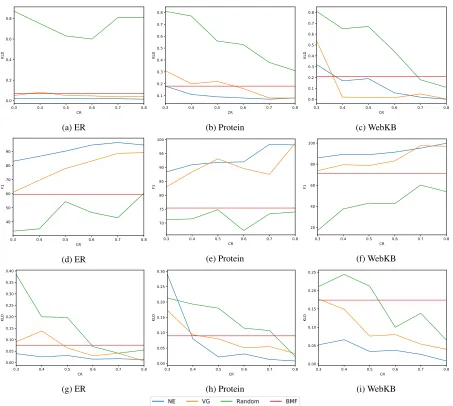
Figure 1: Inference results. (a) - (c) Marginal Inference in Tuffy (d) - (f) MAP Inference in Tuffy (g) - (i) Marginal Inference in Magician.
trol this by setting theαvalue during sampling to achieve the required CR. For Random, we control the sample size to achieve the required CR. For BMF, achieving the right CR was not possible since changing rank does not change the CR. Therefore for BMF, we varied rank from 20 to 100 (30 is the fault value in NIMFA), which is similar to the ranks used in (Van den Broeck and Darwiche 2013), and report the best results across the ranks.
Using the pre-processed evidence obtained using Obj2vec, VG, and BMF, we performed marginal inference and MAP inference using Tuffy and Magician. For MAP inference, we computed the F1-score based on the atoms on which we correctly obtained the MAP assignment. Specifically, the gold standard is the set of atoms set to true in the MAP assignment, when we perform inference with the original evidence. Based on this gold standard, we compute the precision and recall of MAP inference after pre-processing with Obj2vec and VG respectively. For
marginal inference, we computed the average error on the marginal probabilities computed for the query variables, where the error is measured w.r.t the marginal probabilities obtained when we perform inference using the full evidence (no pre-processing).
Fig. 1 shows our results for all benchmarks, inference al-gorithms, and lifting approaches. It is evident that our ap-proach consistently outperforms every other apap-proach on all benchmarks for both marginal and MAP inference.
Exact InferenceWe evaluated our approach with a synthetic MLN on which exact inference is tractable. Specifically, we constructed m formulas of the form R(x) ∨ S1(x, y)
∨T1(x, z);. . . R(x)∨Sm(x, y)∨Tm(x, z), with weights
ranging from−1to1. We set the domain ofxto have 50 ob-jects, and the domains ofyandzto have 100 objects each. We only set evidence onS1 . . . SmandT1 . . . Tm atoms,
0.0 0.1 0.2 0.3 0.4 0.5 0.6 0.7 0.8 0.9 CR
0.07 0.08 0.09 0.10 0.11 0.12
Error
NE VG
(a) Exact
2 4 6 8 10 12 14
Number of formulas 0.07
0.08 0.09 0.10 0.11 0.12 0.13 0.14
Error
NE VG
(b) Exact
100 200 300 400 500 600 Embedding Dimension
84 86 88 90 92 94 96
F1
ER Protein WebKB
(c) Embedding
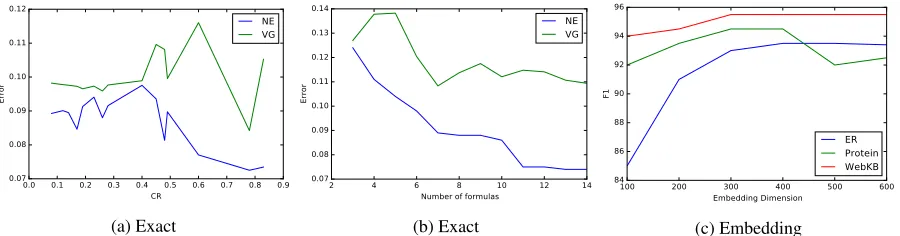
Figure 2: (a) Error on synthetic MLN using exact inference baseline for different compression ratios (CR), for BMF we obtained an error of around 0.1 (b) Error on synthetic MLN using exact inference baseline, varying with the number of formulas in the synthetic MLN. (c) Variation of MAP Inference Accuracy with Embedding size
Benchmark Orig BMF VG Rand NE
ER 28;56.1 4.7;15.2 12.2;15.3 21.5;47 7.3;12.7
Protein 21.9;61 5;15.5 10.4;19.8 18.3;43.3 6.1;14.2
WebKB 41.3;112.6 5.3;23.4 17;22 32.8;79.9 7.8;31.4
Table 1: Comparison of running times (in minutes) for MAP inference using Tuffy and Marginal inference using Magi-cian. The results are reported in the format (MAP;Marginal) in each column.
could compute the exact marginal probabilities for the query atoms. We computed the average absolute error between marginals obtained before pre-processing and marginals ob-tained after pre-processing for the query atoms (form= 10). Fig. 2(a) shows our result for different values of CR. As seen here, with increased CR, the marginals approach the true marginal probabilities much faster in NE as compared to VG, and the accuracy obtained is better than BMF. Increasing Context. For the same synthetic MLN (de-scribed above), we changed the context by varyingm, i.e., changing the number of formulas. As the number of for-mulas increase, the context for the domain objects corre-sponding to xwill increase. This leads to our embedding being much better and learning better representations for the objects as opposed to VG (which uses hand-coded fea-tures), leading to increasingly better performance as seen in Fig. 2(b).
Embedding Dimension Fig. 2(c) shows the accuracy of MAP inference (in terms of F1) as we change the number of neurons in the hidden layer, i.e., we change the embedding dimensions. As seen here, for WebKB and Protein bench-marks, the results were relatively stable as we varied the dimensions. For ER, changing the dimensions had a more significant effect. As with other applications of neural net-works, choosing the right embedding size is challenging in our case as well. In the future, we plan to integrate our ap-proach while learning the MLN, in which case, we can op-timize the embedding size based on training or validation sets.
Running Time We measured the total time required to generate the embedding and reduce the objects, plus the time for inference on the reduced MLN. We measured the running
time for Tuffy (MAP) and Magician (marginal). Table. 1 shows our results where we averaged the running times for VG, NE and Random across CRs ranging from 0.1 to 0.8. The pre-processing time is much smaller (less than 10%) than the time taken for inference in each of our benchmarks. As seen in these results, NE is more scalable than VG while generating more complex symmetry features. BMF was the fastest algorithm, but the accuracy (as seen in the previous section) was lower than NE and VG.
Conclusion
In this paper, we proposed a novel subsymbolic representa-tion for MLNs that is based on symmetries in the under-lying model. The main motivation for this representation was that leveraging symmetries is crucial to scaling up in-ference in MLNs. We proposed an efficient way to learn the symmetry-based representation by predicting objects in the context of other objects in the MLN akin toskip-grambased word embeddings. Our formulation leveraged efficient im-plementations for learning the embeddings scalably. Our ex-periments that used the object embeddings within inference algorithms showed our approach to be more scalable and ac-curate as compared to state-of-the-art systems. Future work includes leveraging neural network architectures to perform scalable discriminative learning (Islam, Sarkhel, and Venu-gopal 2018; Farabi, Sarkhel, and VenuVenu-gopal 2018).
References
Anand, A.; Grover, A.; Mausam; and Singla, P. 2016. Con-textual Symmetries in Probabilistic Graphical Models. In In-ternational Joint Conference in Artificial intelligence, 3560– 3568.
Apsel, U.; Kersting, K.; and Mladenov, M. 2014. Lifting Re-lational MAP-LPs Using Cluster Signatures. InUncertainty in Artificial Intelligence, 2403–2409.
Bach, S. H.; Broecheler, M.; Huang, B.; and Getoor, L. 2017. Hinge-loss Markov Random Fields and Probabilistic Soft Logic. J. Mach. Learn. Res.18(1):3846–3912. Bordes, A.; Weston, J.; Collobert, R.; and Bengio, Y. 2011. Learning Structured Embeddings of Knowledge Bases. In
Bui, H. H.; Huynh, T. N.; and Riedel, S. 2013. Automor-phism Groups of Graphical Models and Lifted Variational Inference. InUncertainty in Artificial Intelligence, 132–141.
de Salvo Braz, R. 2007. Lifted First-Order Probabilistic Inference. Ph.D. Dissertation, University of Illinois, Urbana-Champaign, IL.
Domingos, P., and Lowd, D. 2009. Markov Logic: An In-terface Layer for Artificial Intelligence. San Rafael, CA: Morgan & Claypool.
Farabi, K. M. A.; Sarkhel, S.; and Venugopal, D. 2018. Effi-cient Weight Learning in High-Dimensional Untied MLNs. In International Conference on Artificial Intelligence and Statistics, 1637–1645.
Gogate, V., and Domingos, P. 2011. Probabilistic Theorem Proving. InUncertainty in Artificial Intelligence, 256–265.
Islam, M. M.; Sarkhel, S.; and Venugopal, D. 2018. Learn-ing Mixtures of MLNs. In AAAI Conference on Artificial Intelligence, 6359–6366.
Kautz, H.; Selman, B.; and Jiang, Y. 1997. A General Stochastic Approach to Solving Problems with Hard and Soft Constraints. In Gu, D.; Du, J.; and Pardalos, P., eds.,
The Satisfiability Problem: Theory and Applications. New York, NY: American Mathematical Society. 573–586.
Khot, T.; Balasubramanian, N.; Gribkoff, E.; Sabharwal, A.; Clark, P.; and Etzioni, O. 2015. Exploring Markov Logic Networks for Question Answering. InEmpirical Methods in Natural Language Processing, 685–694.
Kiela, D., and Bottou, L. 2014. Learning Image Embed-dings using Convolutional Neural Networks for Improved Multi-Modal Semantics. InEmpirical Methods in Natural Language Processing, 36–45.
Kok, S.; Sumner, M.; Richardson, M.; Singla, P.; Poon, H.; and Domingos, P. 2006. The Alchemy System for Statistical Relational AI. Technical report, Department of Computer Science and Engineering, University of Washington, Seattle, WA. http://alchemy.cs.washington.edu.
Kopp, T.; Singla, P.; and Kautz, H. A. 2015. Lifted Symme-try Detection and Breaking for MAP Inference. InNeural Information Processing Systems, 1315–1323.
Mikolov, T.; Sutskever, I.; Chen, K.; Corrado, G. S.; and Dean, J. 2013. Distributed Representations of Words and Phrases and their Compositionality. InNeural Information Processing Systems, 3111–3119.
Mladenov, M., and Kersting, K. 2015. Equitable Partitions of Concave Free Energies. InUncertainty in Artificial Intel-ligence, 602–611.
Nickel, M.; Murphy, K.; Tresp, V.; and Gabrilovich, E. 2016. A Review of Relational Machine Learning for Knowledge Graphs.Proceedings of the IEEE104(1):11–33.
Niepert, M. 2012. Markov Chains on Orbits of Permutation Groups. InUncertainity In Artificial Intelligence, 624–633.
Niu, F.; R´e, C.; Doan, A.; and Shavlik, J. W. 2011. Tuffy: Scaling up Statistical Inference in Markov Logic Networks using an RDBMS.PVLDB4(6):373–384.
Pennington, J.; Socher, R.; and Manning, C. D. 2014. Glove: Global Vectors for Word Representation. InEmpricial Meth-ods in Natural Language Processing.
Poole, D. 2003. First-Order Probabilistic Inference. In Pro-ceedings of the 18th International Joint Conference on Arti-ficial Intelligence, 985–991.
ˇ
Reh˚uˇrek, R., and Sojka, P. 2010. Software Framework for Topic Modelling with Large Corpora. InProceedings of the LREC 2010 Workshop on New Challenges for NLP Frame-works, 45–50.
Rockt¨aschel, T., and Riedel, S. 2017. End-to-end Differen-tiable Proving. InNeural information Processing Systems, 3791–3803.
Sarkhel, S.; Venugopal, D.; Singla, P.; and Gogate, V. 2014. Lifted MAP inference for Markov Logic Networks. In Inter-national Conference on Artificial Intelligence and Statistics, 859–867.
Sarkhel, S.; Singla, P.; and Gogate, V. 2015. Fast Lifted MAP Inference via Partitioning. InNeural Information pro-cessing Systems, 3222–3230.
Singla, P., and Domingos, P. 2008. Lifted First-Order Belief Propagation. InAAAI Conference in Artificial Intelligence, 1094–1099.
Singla, P.; Nath, A.; and Domingos, P. 2014. Approximate Lifting Techniques for Belief Propagation. InAAAI Confer-ence in Artificial IntelligConfer-ence, 2497–2504.
Van den Broeck, G., and Darwiche, A. 2013. On the Com-plexity and Approximation of Binary Evidence in Lifted In-ference. InAdvances in Neural Information Processing Sys-tems 26, 2868–2876.
Van den Broeck, G., and Niepert, M. 2015. Lifted Prob-abilistic Inference for Asymmetric Graphical Models. In
AAAI Conference in Artificial Intelligence, 3599–3605. Van den Broeck, G.; Taghipour, N.; Meert, W.; Davis, J.; and De Raedt, L. 2011. Lifted Probabilistic Inference by First-Order Knowledge Compilation. InInternational Joint Conference on Artificial Intelligence, 2178–2185.
Venugopal, D., and Gogate, V. 2012. On Lifting the Gibbs Sampling Algorithm. InProceedings of the 26th An-nual Conference on Neural Information Processing Systems (NIPS), 1664–1672.
Venugopal, D., and Gogate, V. 2014. Evidence-based Clus-tering for Scalable Inference in Markov Logic. InEuropean Conference on Machine Learning.