The Thirty-Third AAAI Conference on Artificial Intelligence (AAAI-19)
Learning Resource Allocation and
Pricing for Cloud Profit Maximization
Bingqian Du, Chuan Wu, Zhiyi Huang
The University of Hong KongAbstract
Cloud computing has been widely adopted to support vari-ous computation services. A fundamental problem faced by cloud providers is how to efficiently allocate resources upon user requests and price the resource usage, in order to max-imize resource efficiency and hence provider profit. Exist-ing studies establish detailed performance models of cloud resource usage, and propose offline or online algorithms to decide allocation and pricing. Differently, we adopt a black-box approach, and leverage model-free Deep Reinforcement Learning (DRL) to capture dynamics of cloud users and better characterize inherent connections between an optimal alloca-tion/pricing policy and the states of the dynamic cloud sys-tem. The goal is to learn a policy that maximizes net profit of the cloud provider through trial and error, which is better than decisions made on explicit performance models. We combine long short-term memory (LSTM) units with fully-connected neural networks in our DRL to deal with online user arrivals, and adjust the output and update methods of basic DRL algo-rithms to address both resource allocation and pricing. Eval-uation based on real-world datasets shows that our DRL ap-proach outperforms basic DRL algorithms and state-of-the-art white-box online cloud resource allocation/pricing algo-rithms significantly, in terms of both profit and the number of accepted users.
Introduction
Cloud computing has proliferated in recent years. Large public cloud platforms are available for various users to run computation jobs; enterprises are building on-premise clouds for internal usage, where users from different depart-ments submit and run their jobs. A fundamental problem faced by the cloud provider/operator, no matter in public or private clouds, is how to efficiently allocate and price cloud resources, provisioned by physical servers in clusters, to the requesting users, such that resource utilization is most effi-cient and profit of the provider is maximized.1
The most common form of resource provisioning in to-day’s cloud platforms is to run virtual machines (VMs) (or containers) with different resource configurations, and lease
Copyright c2019, Association for the Advancement of Artificial Intelligence (www.aaai.org). All rights reserved.
1
In case of a private cloud, the prices may serve as gauges of job values to decide job admission, and the profit can be interpreted as total value of executed jobs.
them to the users. For example, Microsoft Azure provides Burstable VMs (1 CPU core and 1GB RAM), Compute opti-mized VMs (2 CPU cores and 4GB RAM), General Purpose VMs (2 CPU cores and 8GB RAM), and a number of other types of VMs (Azu ). Upon a user’s VM request, the cloud provider should decide on which server to run the asked VM and how to price it.
Most cloud providers post prices which do not change in months,e.g., Microsoft Azure (Azu ) and Google Cloud (Goo ) publish hourly pay-as-you-go prices for different types of VMs, leaving users to decide whether to use the cloud service, according to their budgets. Such static posted pricing does not adapt well to demand and supply changes in the cloud system, and may well jeopardize cloud provider’s profit (Mazrekaj, Shabani, and Sejdiu 2016). We advocate dynamic resource pricing according to demand and supply in the cloud, which is closely related to VM placement in the server cluster, to maximize cloud provider’s profit.
Dynamic resource allocation and pricing is challenging, as users may submit their VM requests at any time, ask-ing for different types of VMs for different durations. The resource allocation problem is essentially an online, multi-dimensional packing problem, well known for its hardness, not to mention that an associated pricing scheme is also in need. There have been recent studies proposing online al-gorithms for dynamic resource pricing and allocation upon user arrivals (Zhang et al. 2015; Shi et al. 2014). These studies formulate resource allocation into detailed optimiza-tion problems, and compute allocaoptimiza-tion and pricing decisions based on online optimization techniques. Due to the com-plexity of a cloud system, simplification assumptions often have to be made, in order to convert the optimization prob-lems to linear or convex probprob-lems, allowing efficient solu-tions.
data is a promising approach for solving real-world prob-lems in a model-free manner. The Deep Deterministic Policy Gradient (DDPG) method, which is based on the actor-critic model (Lillicrap et al. 2015), further enables DRL to handle problems with continuous action spaces. We employ DRL for obtaining a good cloud resource allocation and pricing policy, as DRL is potentially more suitable to model the complex dynamic cloud system than existing white-box ap-proaches, as its NN may capture more inherent connections than a simplified linear/convex model.
The key challenges of designing a DRL approach for cloud resource allocation and pricing include: (i) our deci-sions include both discrete actions (VM placement) and con-tinuous actions (pricing); (ii) the online user arrivals render non-Markovian time-variant dynamics. Basic DRL methods such as DQN (Mnih et al. 2015) or DDPG (Lillicrap et al. 2015) are not directly applicable, since their update meth-ods are based on the Markovian Decision Process (MDP) as-sumption and they can handle either a discrete action space or a continuous one, instead of a mixed one. We adopt a number of techniques, in combination with a DDPG-based approach, to address the above challenges. Our main contri-butions are as follows:
1. We novelly use a model-free DRL approach to make cloud resource pricing and allocation decisions for profit maximization, rather than relying on white-box perfor-mance models of the cloud system.
2. We jointly consider VM pricing and placement of VMs in our DRL model, to maximize the profit of cloud provider to the largest extent.
3. We consider time-variant user dynamics, rather than sim-ply assuming user arrivals are i.i.d.
4. We combine LSTM with DDPG to deal with time-variant user dynamics to resolve the non-MDP issue, and use a new update method to allow them to work together smoothly, to learn optimal decisions directly from input states.
5. We train our DRL model using real-world workload from Azure and Google clouds. Extensive validation experi-ments show that our DRL approach outperforms basic DRL algorithms and state-of-state-the-art white-box on-line cloud resource allocation/pricing algorithms signifi-cantly, in terms of both provider profit (by at least 30%) and the number of accepted users (by about 15% to 25% in majority of the cases).
Background and Related Work
Deep Reinforcement Learning. In reinforcement learn-ing (RL), the learnlearn-ing agent observes a state st from the environment in each step t, and then chooses one action
at according to its policy π(st); after the action is taken, the state transits to the next state st+1, and the agent
re-ceives a reward rt. The goal of the agent is to learn the best policy to maximize its accumulated discounted reward
Rt = P T t=1γ
t−1r
t, where γ ∈ [0,1]is the discount fac-tor. DRL uses deep neural networks in RL, enabling itself
to handle large state and action spaces (Mnih et al. 2015; Lillicrap et al. 2015).
Handling a discrete action space, Deep Q-Network (DQN) (Mnih et al. 2015) outputs Q-values for all actions when receiving an input state, and chooses an action with the highest Q value; its Q-values are estimated using tem-poral difference learning. Double DQN (Van Hasselt, Guez, and Silver 2016) improves over DQN to alleviate its Q-value over-estimation issue.
For problems with continuous action spaces, the DQN type of approaches are not sufficient, due to the need of producing Q-values for all possible actions. The DDPG ap-proach (Lillicrap et al. 2015) uses policy gradients for model training, to handle continuous control problems, which is built on the actor-critic architecture. In the actor-critic model, an actor network (the policy network) learns the pol-icyπand produces actions, while a critic network (the value network) estimates the Q-value, Q(s, a) = Eπ(Rt|st =
s, at=a), for each state-action pair; Q-values produced by the critic network are used in the update of the actor network (to evaluate performance of the current policy), in order to stablize policy learning, especially in case of a large action space (e.g., a continuous acton space).
For a RoboCup game with both discrete and continuous actions to take, Hausknecht et al. (Hausknecht and Stone 2015) use DRL to teach a robot how to kick the ball and score a goal, in order to win the game: each time a dis-crete action is chosen from an action set (Dash, Turn, Tackle, Kick), and then a real value is specified, representing direc-tion or power, for the chosen acdirec-tion. They divide the output of the actor NN into two parts: one to produce a probability distribution over all discrete actions, and the other to out-put the real values corresponding to the discrete actions; in-verting gradients are used to constrain the output continuous values within a specific range. We organize our actions in a similar fashion, while we do not constrain our action space for prices as such, and can still achieve good results with a much larger action space.
Reinforcement Learning for Resource Allocation.RL has been applied in resource allocation problems in recent years. Tesauroet al.(Tesauro et al. 2006) train a hybrid RL model for server allocation among multiple Web applications, to maximize the total payment. Galstyanet al.(Galstyan, Cza-jkowski, and Lerman 2004) study grid resource allocation using multi-agent RL, by treating users as heterogeneous RL agents, which learn by submitting requests for resources and using job completion time as rewards. Wanget al. (Wang et al. 2017) use tabular, dueling double deep Q-learning for cloud provisioning, aiming at balancing resource cost and performance. Begaet al.(Bega et al. 2017) use RL for net-work resource allocation in future 5G netnet-works, for rev-enue maximization. These studies largely assume the envi-ronment is Markovian and apply existing DRL algorithms. Instead, we produce both VM provisioning and pricing de-cisions, and consider online user arrivals which may break the MDP assumption, if not properly handled.
advertiser bid distribution and a Monte Carlo tree search method to learn the best reserve prices for the website. Wu
et al.(Wu, Joseph, and Russell 2016) use tabular Q-learning to set prices for Uber-type on-demand economies, by dis-cretizing prices into ranges as actions. Kimet al.(Kim et al. 2014) use tabular Q-learning to decide the electricity prices in smart grids, for charging users’ energy consump-tion. These studies mostly consider simpler models and use tabular RL to handle the relatively small state and action spaces. Our NN-based DRL model is more realistic and han-dles many more possible states and actions.
Problem Model
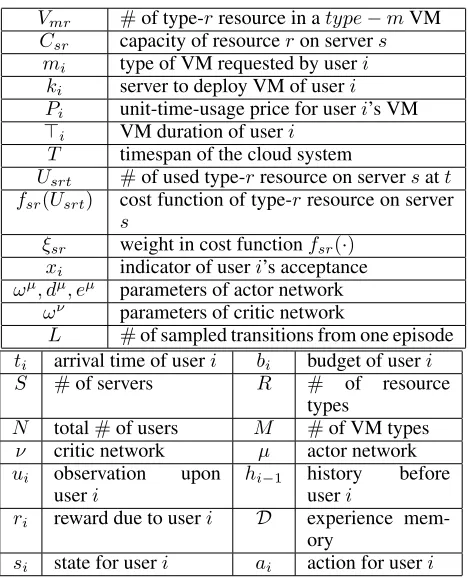
We consider a cloud data center withSphysical servers, of-feringM types of virtual machines (VMs) to users. Each type of VM,m = 1,2, . . . , M, are composed ofR types of resources (e.g., CPU, memory, disk storage) at pre-configured amounts. LetVmr be the demand of type-r re-source in a type-mVM. Csr is the capacity of type-r re-source on servers,∀s= 1, . . . , S, r= 1, . . . , R. Letfsr(·) be the cost function of serverson the amount of type-r re-source used on the server in timet, as indicated byUsrt. The cost is mainly due to power consumption of the server: in practice, most cloud data centers keep their servers on, which remain in the low-power idle mode if no VMs are running (to avoid boot-up delay from the off state); the power usage increases with the increase of resource con-sumption on the server. We define the cost function as fol-lows (Zhang et al. 2015), where parameterξsrindicates the relative weight of the cost due to consumption of type-r re-source in the overall server cost.
fsr(Usrt) =
ξsrUsrt, Usrt∈[0, Csr]
+∞, Usrt> Csr (1)
In totalNusers submit VM requests to the cloud provider in a potentially large system timespan T. Without loss of generality, we assume the users arrive at different times in T. Upon arrival at ti, user i requests one VM of type
mi∈ {1, . . . , M}, and specifies how long it will use the VM for, denoted by>i. The cloud provider releases to the user a unit-time-usage pricePifor running the VM; the user de-cides if he is to accept the price and run his VM in the cloud, or leave without taking the price, according to his budget
bi. The budget information is private to the user and not re-vealed to the cloud provider. If the user takes the price, the VM will be immediately launched on a serverki (that the cloud provider decides) and run for>iwithout interruption (i.e., we practically do not consider VM preemption in the cloud). Upon completion of the VM usage atti+>i, the occupied resources will be returned to the cloud pool and can be used to create other VMs.
The cloud provider sets the prices for VMs dynamically according to demand and supply, i.e., costs of the servers due to current resource consumption on the servers and es-timated user budgets. The goal is to maximize the cloud provider’s accumulated profit in T. Let binary variablexi indicate whether useriaccepts pricePi:xi = 1if yes and
Table 1: Notation
Vmr #of type-rresource in atype−mVM
Csr capacity of resourceron servers
mi type of VM requested by useri
ki server to deploy VM of useri
Pi unit-time-usage price for useri’s VM
>i VM duration of useri
T timespan of the cloud system
Usrt #of used type-rresource on serversatt
fsr(Usrt) cost function of type-rresource on server
s
ξsr weight in cost functionfsr(·)
xi indicator of useri’s acceptance
ωµ, dµ, eµ parameters of actor network
ων parameters of critic network
L #of sampled transitions from one episode
ti arrival time of useri bi budget of useri
S #of servers R # of resource
types
N total#of users M #of VM types
ν critic network µ actor network
ui observation upon useri
hi−1 history before
useri
ri reward due to useri D experience mem-ory
si state for useri ai action for useri
xi = 0otherwise. Overall profit of the cloud provider is computed by total payment minus overall cost, as follows:
T otal P rof it=
N
X
i=1
Pi>ixi− S
X
s=1
R
X
r=1
T
X
t=1
fsr(Usrt) (2)
We seek to derive an online VM placement and pricing policy based on DRL, using which the cloud provider de-cideskiandPiupon the arrival of each useri, without know-ingbi. Table 1 summarizes key notation in the paper.
DRL Algorithm for Resource Allocation and
Pricing
We first present our approaches to address the two DRL de-sign challenges.
and post the price of the corresponding server. We revise the actor-critic DDPG algorithm according to such a joint action space.
Non-Markovian Time-variant Dynamics.The online ar-rival of user requests may well be irrelevant with current re-source availability in the cloud and previous user requests. That is, the next state of the system is not completely de-cided by the previous state and action, violating the basic MDP assumption of RL algorithms. To render an MDP pro-cess, we add an LSTM module into our DRL NNs, and include the history into our state representation. The his-tory encodes states and actions in the past. Existing stud-ies have shown patterns in cloud workload (Han, Chan, and Leckie 2013)(Cortez et al. 2017); the LSTM module, well known for encoding time series (Hochreiter and Schmidhu-ber 1997), is useful for learning arrival patterns of the re-quests for different types of VMs, and user budget distribu-tions.
DRL Model
In our problem, atransitionoccurs (i.e., state transits to the next state) upon the arrival of a new user request.
State si = [ui, hi−1]: the first part ui =
[{U1rti,· · · , USrti}∀r=1,...,R, mi,>i] includes the
cur-rent resource availability on all servers and information of the new VM requesti; the second parthi−1 is the history
encoded by LSTM.h0is initialized to an all-zero vector. Actionai = [vi1, vi2]: the first partvi1=[o1,· · ·, oS]is a vector including probabilities of selecting the respective servers; the second part, vectorvi2=[pi1,· · ·, piS], contains the respective prices on theSservers, wherepisis the unit-time-usage price if VMiis to be run on servers. The DRL agent outputs the server ki with the highest probability in
vi1, and the corresponding pricepiki fromvi2. The price is
posted to useri,i.e.,Pi =piki.
Reward If user i accepts the posted price, the reward is the payment of user (i.e., Pi>i) minus the increased cost of server ki due to running user i’s VM; other-wise, the reward is 0. Specifically, reward ri = Pi>i −
(PR
r=1
Pti+>i
t=ti [fkir(Ukirt+Vmir)−fkir(Ukirt)]).
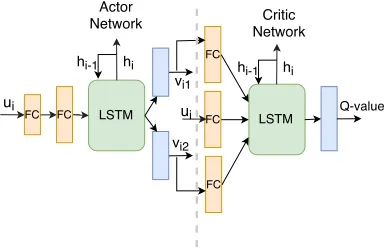
Fig. 1 illustrates the architecture of our DRL model. The input to the actor network includes stateuiand historyhi−1;
the output from the actor network is action ai. The actor network contains two fully-connected layers followed by one LSTM layer, and then two output layers, for produc-ingvi1 andvi2, respectively. The input to the LSTM layer
contains output from the second fully-connected layer (pro-duced based on ui), and the history vector hi−1 it
pro-duced in the previous step. hi−1 encodes information of u1, . . . , ui−1. When producing vi1, we further use masks
to ensure zero probabilities for choosing servers without enough resources to host the VM; for producingvi2, we use
masks to make sure that each price can at least cover the in-creased cost of the respective server, if the VM is to be run on the server.
The input to the critic network includes stateui, actions
vi1andvi2produced by the actor network, and historyhi−1;
the output is the corresponding Q-value. The inputui, vi1
FC
ui
LSTM hi
FC
hi-1 FC
FC FC vi1
vi2
ui
LSTM hi hi-1
Q-value Actor
Network NetworkCritic
Figure 1: DRL Architecture
andvi2 are each connected to a fully-connected layer, and
output from the three is concatenated and fed into an LSTM layer, followed by an output layer. The fully-connected lay-ers are meant for extracting different features from the three types of input, which will then be combined to estimate the Q-value. The history hi−1 produced by the LSTM in the
critic network encodes both statesu1, . . . , ui−1and actions a1, . . . , ai−1from the actor network.
DRL Algorithm
To leverage the DDPG algorithm for DRL model training, we store all the transitions within anepisode(containing all
N transitions inT,i.e., one epoch in repeated training) in an experience memoryD. However, if we update the actor and critic networks using all transitions in an episode, the strong correlation between transitions will make the training process unstable (Mnih et al. 2015). We adopt the experi-ence replay technique, and randomly pick several transitions from an episode to use for updating the actor and critic net-works. For each picked transitioni, we cannot use its saved historyhi−1for updating the current actor (critic) NN, as it
is produced using previous LSTM model parameters which have been updated all the time; to obtain the correcthi−1
produced by the current LSTM layer, we use all the histor-ical states beforeias input to the current LSTM model and obtainhi−1accordingly (Song et al. 2017).
The update of the critic network, ν, is done by mini-mizing the mean square error between the output Q-value of the critic network and the target Q-value yi = ri +
Q(ui+1, hi, ai+1|ων, ai+1 ∼µ), whereων is the set of
pa-rameters in the critic NN andµrepresents the actor network. The loss function for critic network update is as follows, where historyhiis used, making it different from the stan-dard form (Mnih et al. 2015)(Lillicrap et al. 2015):
L(ων) =Eui[(Q(ui, hi−1, ai|ω
ν)−y
i)2] (3)
Let ωµ represent the set of parameters in the actor NN (i.e.,µ), excluding the parameters in its two output layers. Letdµ andeµ be the set of parameters in the output layer for producing vi1 and vi2, respectively. Each step of
(ωµ, dµ)and(ωµ, eµ), respectively, by applying the chain rule to the expected Q-value from the critic network:
∆(ωµ, dµ) =Eui[∂Q(ui, hi−1, vi1, vi2)|vi1,vi2∼µ(ui,hi−1)]
=Eui[
∂Q(ui, hi−1, vi1, vi2) ∂vi1
∂µ(ui, hi−1) ∂ωµ∂dµ ]
(4)
∆(ωµ, eµ) =Eui[∂Q(ui, hi−1, vi1, vi2)|vi1,vi2∼µ(ui,hi−1)]
=Eui[
∂Q(ui, hi−1, vi1, vi2) ∂vi2
∂µ(ui, hi−1) ∂ωµ∂eµ ]
(5)
Further, we adopt the target network technique (Mnih et al. 2015), where a target network is a slightly older version of an NN, used to provide target values for loss computation in training the NN, for stabilizing the training process.
Our complete DRL algorithm,LAPP, is given in Alg. 1.
M ax Episode indicates the maximum number of epochs we train the DRL model for. We sample Batch Size
episodes from the experience replay buffer (line 13), and further prepare a batch ofLtransitions sampled from each selected episode (lines 16-22); we update the actor and critic networks once using each batch (lines 23-25).
Performance Evaluation
Algorithm Implementation. We implement LAPP using TensorFlow on a server equipped with one Nvidia GTX 1080 GPU, Intel Xeon E5-1620 CPU with 4 cores, and 32GB memory. The actor NN we use has 300 and 400 neu-rons in the two fully-connected layers, respectively, and the output from the LSTM is a vector of 256 units (Ming et al. 2017); the activation function is softmax for outputting
vi1 and rectifier for outputting vi2. The critic NN has 400
neurons in each fully-connected layer and the output of the LSTM layer has a size of 256; the activation function is rec-tifier for its output layer. The learning rates in the actor net-work and the critic netnet-work are10−4and10−4, respectively. We setBatch Size= 32,γ= 0.99, andL= 4.
Datasets.We make use of two sets of public traces: (i) Mi-crosoft Azure dataset (Cortez et al. 2017), which contains VM workload information (including VM request arrival time, VM lifetime, VM size in terms of CPU and memory configurations) for several subscriptions in one geographi-cal region over a 30-day span, where a subscription includes logically related workload, as a unit for billing and access control (Cortez et al. 2017). (ii) Google cluster-usage dataset (Reiss, Wilkes, and Hellerstein 2011), which provides infor-mation about MapReduce type of jobs (start time, end time, maximum CPU and memory usage, etc.) in one datacenter in U.S. east over a one-month period; we map each job to one VM in our experiments.
DRL Training.We extract one week’s workload of a sub-scription from the Azure dataset for training our DRL model. This subscription includes about 6000 VMs of 4 types: a type-1VM uses 1 CPU core and 1.75GB RAM, a
Algorithm 1: DRL Algorithm for VM Placement and Pricing,LAPP
Initialize:parametersωµ, dµ, eµ,ωνin actor networkµ and critic networkν
Initialize:parametersωµ0=ωµ,dµ0 =dµ, eµ0 =eµ,
ων0=ων for target actor networkµ0and target critic networkν0
Initialize:Experience Replay MemoryD 1 forepisode= 1toM ax Episodedo
Initialize:historyh0
2 foruseri=1toN do
3 Observe current observationui, setsi= [ui, hi−1];
4 Inference on actor network to obtainai= [vi1, vi2] andhi;
5 ProducekiandPifromai;
6 ifPi>i≤bi(user accepts the price)then
7 Allocate VM of userion serverki; 8 Receive rewardri=Pi>i
-(PR
r=1
Pti+>i
t=ti [fkir(Ukirt+Vmir)− fkir(Ukirt)]);
9 else
10 Rewardri= 0;
11 end
12 Store transition(ui−1, ai−1, ui, ri−1)into
D[episode];
13 forBatch= 1 toBatch Sizedo
14 Sample an episodeD[ep]fromDrandomly; 15 SampleLtransitions fromD[ep]randomly;
16 forl = 1 toLdo
17 For transition(ui, ai, ui+1, ri) corresponding to thelth sampled transition:
18 Calculatehi−1using transitions before i;
19 Calculatehiusinghi−1;
20 Calculate target Q-value:
21 yi=ri+γQ0(ui+1, hi, µ0(ui+1, hi));
22 end
23 Update the critic network using SGD by
minimizing loss in (3) with theBatch
data;
24 Update the actor network using SGD with
gradients computed using (4) and (5) with theBatchdata;
25 Update target actor and critic networks
using standard method as DDPG (Lillicrap et al. 2015) with theBatchdata;
26 end
27 end
28 end
subscription (i.e., scale down the VM arrival rate by about 20), while retaining the same arrival pattern as in the com-plete workload.
In training, we set the unit-time-usage budgets of users according to normal distributions N(µ, σ2)(Agmon Ben-Yehuda et al. 2013):µandσare set to (1.5, 0.1), (3.0, 0.2), (6.0, 0.3), and (12, 0.4) for the four types of VMs, respec-tively. The number of physical servers to host the VMs is 30. By default, each server is equipped with 8 CPU cores and 30GB RAM.ξsr in the server cost functions is set to 0.5 and 0.02 for CPU and RAM, respectively (Kansal et al. 2010).
The one-week workload is trained repeatedly for about 2000 times (i.e.,M ax Episode = 2000) until model con-vergence, which takes about 15 hours.
Validation data.We evaluate our trained DRL model using a workload of more than 500 VM requests in another week from the same subscription in the Azure dataset, as well as a workload of about 200 VM requests from the Google dataset (we map each VM to the closet VM type in the Azure dataset, according to its resource composition). We use two types of distributions to produce user budgets in model vali-dation: one is the normal distribution used in model training, and the other is a Pareto distribution, commonly used to de-scribe wealth distribution in the real world (Souma 2002). Especially, we set the minimal value of the Pareto tion to 0.5 and Pareto index to 2, and use this Pareto distribu-tion to produce unit-time-usage budgets for users requesting type-1 VMs; we scale the budgets for type-1 VMs up, to produce user budgets for other types of VMs, according to resource configurations of those VMs as compared to those of type-1VMs.
Baselines.We compareLAPPwith 5 baselines:
(1) Basic DDPG algorithm (DDP G) (Lillicrap et al. 2015), with the same output as in our DRL algorithm.
(2) RP D2 from (Zhang et al. 2015), which is a
state-of-the-art online resource allocation and pricing algorithm based on the primal-dual optimization framework. It sets VM prices on each server based on an exponentially increas-ing function on the amount of consumed resources on the server, and places a VM on a server that leads to the largest profit gain. The rationale is to produce low unit prices when the system has abundant resources, in order to accept more user requests, and raise the prices to filter out low-value re-quests when the resources are rare, to save the resources for upcoming high-value requests.
(3) T wice−the−Cost(T C)and (4)T wice−the− Index(T I), which are similar to the online algorithm
RP D2, but set the unit price on a server to twice of the
cur-rent marginal cost of the server, and the marginal cost of the server on twice of the current resource consumption (Blum et al. 2011)(Zhang et al. 2015), respectively.
(5) An algorithm (Spot) which uses prices similar to the Spot instance prices on Amazon EC2 (Agmon Ben-Yehuda et al. 2013), and places VMs in a round-robin fash-ion on servers with sufficient capacities. Especially, we use theAR(1)Reserve P rice Algorithmdevised in (Agmon Ben-Yehuda et al. 2013) to approximate EC2 Spot Instance pricing, which takes the smallest and the largest user
bud-gets for a certain VM type as input to produce prices for VMs of the type. For each of our four types of VMs, we in-voke theAR(1)Reserve P rice Algorithmwith the small-est/largest budget values according to our budget distribu-tion in use.
Evaluation results. Fig. 2a and Fig. 2b show the over-all profit (computed using Eqn. (2)) and the total number of accepted user requests achieved by LAPPand the first four baselines, using Azure workload trace, under different user budget distributions. LAPPachieves 25% more profit and accepts 5% more users requests, as compared to the basic DDPG algorithm, which does not include an LSTM module. This shows that including a history-based pattern prediction module in our DRL helps making better deci-sions. Compared with online algorithms RP D2, T I, and T C,LAPPimproves the profit by at least 40% (though ac-cepting less user requests under the Pareto budget distribu-tion thanRP D2). This reveals the effectiveness of a
DRL-based approach, as compared to white-box online optimiza-tion approaches. When Google trace is used, Fig. 2c shows thatLAPPstill achieves the largest overall profit.
Since online algorithms are designed to work well in worst-case scenarios, we construct a sequence of VM re-quests that the online algorithms should be able to handle well, and investigate performance ofLAPPin such a worst-case scenario. 40 VM requests arrive sequentially, one in a minute, each requesting to use a VM of 8 CPU cores and 14-GByte RAM (one server can only host one such VM) for 300 minutes; the unit-time-usage budget of the first 30 users is the same, 5, and that of the later 10 users is 13. If the first 30 low-value VM requests were accepted, with one VM on one server, then the next 10 high-value requests would be rejected due to lack of available resources. Fig 2d shows thatLAPPstill outperforms other algorithms by about 30%, implying that our DRL approach can handle worse-case sce-narios better as well.
We next compareLAPPwith the fifth baseline,Spot, with Azure and Google traces under two types of budget distribu-tions, respectively. In Fig 2e, N and P stand for Normal dis-tribution and Pareto disdis-tribution, respectively;LAPPalways obtains more overall profit.
For more detailed investigation, Fig. 3a shows the unit-time-usage prices produced byLAPPandSpot, respectively, using the Azure validation dataset and Pareto user budget distribution. Note that the Spot prices are produced given the largest and smallest budgets in the budget distribution, whileLAPPis oblivious of the budget distribution. We ob-serve that the majority of prices produced byLAPPare in similar ranges as theSpotprices, exhibitingLAPP’s ability in learning user budget distribution.
Normal Pareto 0
1 2 3
Profit
1e4
LAPP DDPG RPD_2 TI TC
(a) Profit: Azure trace
Normal Pareto 0.00
0.25 0.50 0.75 1.00
# of accepted users
1e2
LAPP DDPG RPD_2 TI TC
(b)#of accepted user requests
Normal Pareto 0
1 2 3
Profit
1e3
LAPP DDPG RPD_2 TI TC
(c) Profit: Google trace
LAPP DDPG RPD_2 TI TC 0.00
0.25 0.50 0.75 1.00 1.25
Profit
1e2
(d) Profit: worst-case scenario
Azure(N) Azure(P) Google(N)Google(P) 0
1 2 3
Profit
1e4
LAPP Spot
(e) Profit: comparison withSP OT
Normal Pareto 0
1 2 3 4
Profit
1e4
LAPP Spot DDPG RPD_2 TI TC
(f) Heterogenous servers
Figure 2: Evaluation results
CPU core), followed by requests asking for type-3or
type-4 VMs (requesting 4 or 8 CPU cores each). Although the resources on the selected servers to host those type-1VMs are sufficient (8 cores available as shown in Fig. 3c), the output prices on the chosen servers are largely higher than the respective user budgets (as shown in Fig. 3b). Hence, users submitting those type-1 VM requests do not accept the posted prices, and cloud resources are saved for serv-ing upcomserv-ing VMs requirserv-ing more resources, from users with larger budgets. This shows that our DRL approach can learn/predict VM request patterns and make better online de-cisions.
Heterogenous Servers. We further evaluate our DRL ap-proach in a more heterogenous setting with two types of servers: 15 servers each have 8 CPU cores and 30GB RAM, and the rest 15 each have 12 CPU cores and 25GB RAM.ξsr is set to 0.6 and 0.02 for CPU and RAM, respectively, for the first type of servers, and to 0.5 and 0.01 for the second type of servers. We train our DRL model under this heterogenous setting and validate the model using different Azure datasets. Fig. 2f shows thatLAPPoutperforms other algorithms by at least 25% in this more complex environment.
Conclusion
This paper studies a deep reinforcement learning approach for cloud resource allocation and pricing, targeting provider profit maximization. We combine LSTM with basic DRL to handle online user arrivals, ensuring the MDP assump-tion, and design new update methods for model training. We validate our DRL approach using real-world cloud work-load, and compare it with state-of-the-art online cloud re-source allocation and pricing algorithms. The results are quite promising: in majority of the cases, our DRL approach achieves significantly more profit and accommodate more
0 100 200 300 400 500
User Request Index
0 10 20
Price
LAPP Price Spot Price
(a)
0 20 40 60 80 100
User Request Index
0 5 10 15 20 25
Price/Budget
LAPP Price User Budget
(b)
0 20 40 60 80 100
User Request Index
4 5 6 7 8
# of available CPU cores
on selected server
type-1 VM type-2 VM type-3 VM type-4 VM
(c)
user requests, under various user arrival patterns and budget distributions, even in worst-case scenarios which online op-timization algorithms are designed to handle. We believe this an interesting attempt in comparing DRL approach with on-line optimization approaches, and plan to do more in-depth investigation of the pros and cons of both approaches in making online scheduling decisions in our future work.
Acknowledgements
This work was supported in part by grants from Hong Kong RGC under the contracts HKU 17204715, 17225516, 17202115E, C7036-15G (CRF), grants NSFC 61628209, HKU URC Matching Funding, and Huawei HIRP HO2016050002BE.
References
Agmon Ben-Yehuda, O.; Ben-Yehuda, M.; Schuster, A.; and Tsafrir, D. 2013. Deconstructing amazon ec2 spot instance pricing.ACM Transactions on Economics and Computation. Microsoft azure linux virtual machines pricing. https://azure.microsoft.com/en-us/pricing/details/
virtual-machines/linux/.
Bega, D.; Gramaglia, M.; Banchs, A.; Sciancalepore, V.; Samdanis, K.; and Costa-Perez, X. 2017. Optimising 5g infrastructure markets: The business of network slicing. In
INFOCOM.
Blum, A.; Gupta, A.; Mansour, Y.; and Sharma, A. 2011. Welfare and profit maximization with production costs. In
Foundations of Computer Science (FOCS), 2011 IEEE 52nd Annual Symposium.
Cortez, E.; Bonde, A.; Muzio, A.; Russinovich, M.; Fon-toura, M.; and Bianchini, R. 2017. Resource central: Un-derstanding and predicting workloads for improved resource management in large cloud platforms. InProceedings of the 26th Symposium on Operating Systems Principles.
Galstyan, A.; Czajkowski, K.; and Lerman, K. 2004. Re-source allocation in the grid using reinforcement learning. InProceedings of the Third International Joint Conference on Autonomous Agents and Multiagent Systems-Volume 3. IEEE.
Google Compute Engine Pricing. https://cloud.google.com/ compute/pricing.
Han, Y.; Chan, J.; and Leckie, C. 2013. Analysing vir-tual machine usage in cloud computing. InServices (SER-VICES), 2013 IEEE Ninth World Congress.
Hausknecht, M., and Stone, P. 2015. Deep reinforce-ment learning in parameterized action space.arXiv preprint arXiv:1511.04143.
Hochreiter, S., and Schmidhuber, J. 1997. Long short-term memory.Neural computation.
Kansal, A.; Zhao, F.; Liu, J.; Kothari, N.; and Bhattacharya, A. A. 2010. Virtual machine power metering and provision-ing. In Proceedings of the 1st ACM symposium on Cloud computing.
Kim, B.-G.; Zhang, Y.; Van Der Schaar, M.; and Lee, J.-W. 2014. Dynamic pricing for smart grid with reinforcement
learning. InComputer Communications Workshops (INFO-COM WKSHPS), 2014 IEEE Conference.
Lillicrap, T. P.; Hunt, J. J.; Pritzel, A.; Heess, N.; Erez, T.; Tassa, Y.; Silver, D.; and Wierstra, D. 2015. Continuous control with deep reinforcement learning. arXiv preprint arXiv:1509.02971.
Mazrekaj, A.; Shabani, I.; and Sejdiu, B. 2016. Pricing schemes in cloud computing: an overview. International Journal of Advanced Computer Science and Applications. Ming, Y.; Cao, S.; Zhang, R.; Li, Z.; Chen, Y.; Song, Y.; and Qu, H. 2017. Understanding hidden memories of recurrent neural networks. arXiv preprint arXiv:1710.10777.
Mnih, V.; Kavukcuoglu, K.; Silver, D.; Rusu, A. A.; Veness, J.; Bellemare, M. G.; Graves, A.; Riedmiller, M.; Fidjeland, A. K.; Ostrovski, G.; et al. 2015. Human-level control through deep reinforcement learning. Nature.
Reiss, C.; Wilkes, J.; and Hellerstein, J. L. 2011. Google cluster-usage traces: format + schema. Technical report, Google Inc., Mountain View, CA, USA. Revised 2014-11-17 for version 2.1. Posted at https://github.com/google/ cluster-data.
Shen, W.; Peng, B.; Liu, H.; Zhang, M.; Qian, R.; Hong, Y.; Guo, Z.; Ding, Z.; Lu, P.; and Tang, P. 2017. Re-inforcement mechanism design, with applications to dy-namic pricing in sponsored search auctions. arXiv preprint arXiv:1711.10279.
Shi, W.; Zhang, L.; Wu, C.; Li, Z.; and Lau, F. 2014. An on-line auction framework for dynamic resource provisioning in cloud computing. ACM SIGMETRICS.
Silver, D.; Huang, A.; Maddison, C. J.; Guez, A.; Sifre, L.; Van Den Driessche, G.; Schrittwieser, J.; Antonoglou, I.; Panneershelvam, V.; Lanctot, M.; et al. 2016. Mastering the game of go with deep neural networks and tree search.
nature.
Song, D. R.; Yang, C.; McGreavy, C.; and Li, Z. 2017. Recurrent network-based deterministic policy gradient for solving bipedal walking challenge on rugged terrains.arXiv preprint arXiv:1710.02896.
Souma, W. 2002. Physics of personal income. InEmpirical science of financial fluctuations. Springer.
Tesauro, G.; Jong, N. K.; Das, R.; and Bennani, M. N. 2006. A hybrid reinforcement learning approach to autonomic re-source allocation. InAutonomic Computing, 2006. ICAC’06. IEEE International Conference on.
Van Hasselt, H.; Guez, A.; and Silver, D. 2016. Deep rein-forcement learning with double q-learning. InAAAI. Wang, Z.; Gwon, C.; Oates, T.; and Iezzi, A. 2017. Auto-mated cloud provisioning on aws using deep reinforcement learning.arXiv preprint arXiv:1709.04305.
Wu, T.; Joseph, A. D.; and Russell, S. J. 2016. Automated pricing agents in the on-demand economy.