Volume 2, Issue 8, August 2013
Page 247
Abstract
Nowadays the use of cloud computing is expanding rapidly. Moving data and applications to Internet and access them through different services. Cloud Computing offers better computing through improved utilization and reduced administration and infrastructure costs. This Technology is still at its infant stage and a very new to this changing world, it is a style of computing where scalable and elastic IT-related capabilities are provided as a service to customers using Internet technologies. This technology is Internet-based computing, whereby shared resources, software and information are provided to computers and ot her devices on-demand, like the electricity grid. The simplest definition for Cloud Computing can be given as “Cloud Computing is using the Internet to access someone else’s software running on someone else’s hardware in someone else’s data centre while paying only for what you use.” In this paper, we have presented the idea that how Oracle 10g can be used as a Service over the Cloud.
Keywords: Cloud Computing, Software as a Service (SAAS), Oracle Database10g Express Edition.
1.
I
NTRODUCTIONCloud computing is a practical approach to experience direct cost benefits and it has the potential to transform a data center from a capital-intensive set up to a variable priced environment. The idea of cloud computing is based on a very fundamental principal of reusability of IT capabilities. The difference that cloud computing brings compared to traditional concepts of “grid computing”, “distributed computing”, “utility computing”, or “autonomic computing” is to broaden horizons across organizational boundaries. Forrester Research defines cloud computing as: “A pool of abstracted, highly scalable, and managed compute infrastructure capable of hosting end-customer applications and billed by consumption.” Today a lot of people are consulting their mail online through webmail clients, writing collaborative documents using web browsers, creating virtual albums to upload their photos. They are running applications and storing data in servers located in Internet and not in their own computers. Something as simple as enter in a web page is the only thing a user needs to begin to use services that reside on a remote server and lets him share private and confidential information, or using computing cycles of a pile of servers that he will ever see with his own eyes. And every day its being used more this services that are called cloud computer services. That name is given because of the metaphor about Internet, as something than the user see like a cloud and cannot see what’s inside. This services can be offered by free or by paying by demand (pay for consume), can be simply like a function calling (like the electricity grid or complex (like the usage of a virtual machine with its own operating system, applications and storage space for running applications). This means that many users and organizations can avoid install some applications in their computer or can have more computational power using cloud computer through internet, or they can make their own private cloud to manage it completely, or they can use both options for the moments of high demand of consume.
Cloud computing is a recently developing paradigm of distributed computing. In 1969 L. Kleinrock anticipated, as of now, computer networks are still in their infancy. But as they grow up and become more sophisticated, we will probably see the spread of 'computer utilities' which, like present electric and telephone utilities, will service individual homes and offices across the country [14]." His vision was the true indication of today's utility based computing paradigm. One of the giant steps towards this world was taken in mid 1990s when grid computing was first coined to allow consumers to obtain computing power on demand. The origin of cloud computing can be seen as an evolution of grid computing technologies. The term Cloud computing was given prominence first by Google's CEO Eric Schmidt in late 2006 (may be he coined the term). So the birth of cloud computing is very recent phenomena although its root belongs to some old ideas with new business, technical and social perspectives. From the architectural point of view cloud is naturally build on an existing grid based architecture and uses the grid services and adds some technologies like virtualization and some business models. In brief cloud is essentially a bunch of commodity computers networked together in same or different geographical locations, operating together to serve a number of customers with different need and workload on demand basis with the help of virtualization. Cloud services are provided to the cloud users as utility services like water, electricity, telephone using pay-as-you-use business model. These utility services are generally described as XaaS (X as a
Providing ORACLE 10g (Software) as a Service
(SAAS) on Cloud
Shreyas Mulay1, Sanjay Jain2
1Student, Computer Science and Engineering Department, Amity School of Engineering and Technology (ASET), Amity
University Rajasthan (AUR)
2Assistant Professor, Computer Science and Engineering Department, Amity School of Engineering and Technology (ASET),
Volume 2, Issue 8, August 2013
Page 248
popularity day by day for their availability, reliability, scalability and utility model. These applications made distributed computing easy as the critical aspects are handled by the cloud provider itself.Cloud computing is growing now-a-days in the interest of technical and business organizations but this can also be beneficial for solving social issues. In the recent time E-Governance is being implemented in developing countries to improve efficiency and effectiveness of governance. This approach can be improved much by using cloud computing instead of traditional ICT. In India, economy is agriculture based and most of the citizens live in rural areas. The standard of living, agricultural productivity etc can be enhanced by utilizing cloud computing in a proper way. Both of these applications of cloud computing have technological as well as social challenges to overcome [3].
2.
C
LOUDA
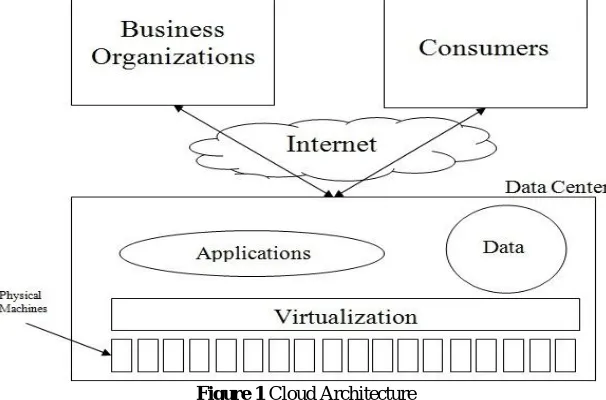
RCHITECTUREThe cloud providers actually have the physical data centers to provide virtualized services to their users through Internet. The cloud providers often provide separation between application and data. This scenario is shown in the Figure 1. The underlying physical machines are generally organized in grids and they are usually geographically distributed. Virtualization plays an important role in the cloud scenario. The data center hosts provide the physical hardware on which virtual machines resides. User potentially can use any OS supported by the virtual machines used [11].
Figure 1 Cloud Architecture
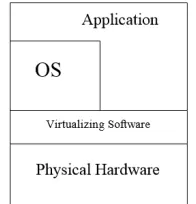
Operating systems are designed for specific hardware and software. It results in the lack of portability of operating system and software from one machine to another machine which uses different instruction set architecture. The concept of virtual machine solves this problem by acting as an interface between the hardware and the operating system called as system Virtual Machines. Another category of virtual machine is called process virtual machine which acts as an abstract layer between the operating system and applications. Virtualization can be very roughly said to be as software translating the hardware instructions generated by conventional software to the understandable format for the physical hardware. Virtualization also includes the mapping of virtual resources like registers and memory to real hardware resources. The underlying platform in virtualization is generally referred to as host and the software that runs in the Virtual Machine environment is called as the guest.
Volume 2, Issue 8, August 2013
Page 249
Figure 2 Virtualization Basic3.
C
LOUDB
ASEDD
ELIVERYCloud Providers offer services that can be grouped into three categories:
3.1. Software as a Service (SaaS):
In this model, a complete application is offered to the customer, as a service on demand. A single instance of the service runs on the cloud & multiple end users are serviced. On the customers‟ side, there is no need for upfront investment in servers or software licenses, while for the provider, the costs are lowered, since only a single application needs to be hosted & maintained. It also refers to the software delivered over a browser. SaaS eliminates the need to install and run applications on the customer's own computers/servers and simplifies maintenance, upgrades and support. Application delivery is typically closer to a one-to-many model (single instance, multi-tenant architecture) than to a one-to-one model. Today SaaS is offered by companies such as Google, Salesforce, Microsoft, Zoho, etc.
3.2. Platform as a Service (PaaS):
Here, a layer of software or development environment is encapsulated & offered as a service, upon which other higher levels of service can be built. The customer has the freedom to build his own applications, which run on the provider’s infrastructure. To meet manageability and scalability requirements of the applications, PaaS providers offer a predefined combination of OS and application servers, such as LAMP platform (Linux, Apache, MySQL and PHP), restricted J2EE, Ruby etc. Google’s App Engine, Force.com, etc are some of the popular PaaS examples.
3.3. Infrastructure as a Service (IaaS):
IaaS provides basic storage and computing capabilities as standardized services over the network. Servers, storage systems, networking equipment, data centre space etc. are pooled and made available to handle workloads. The customer would typically deploy his own software on the infrastructure. Some common examples are Amazon, GoGrid, 3 Tera, etc [12].
Figure 3 Cloud Service Stack
4.
I
NTRODUCTIONT
OO
RACLED
ATABASEVolume 2, Issue 8, August 2013
Page 250
5.1 Network ConnectionsOracle Net Services is Oracle’s mechanism for interfacing with the communication protocols used by the networks that facilitate distributed processing and distributed databases. Communication protocols define the way that data is transmitted and received on a network. Oracle Net Services supports communications on all major network protocols, including TCP/IP, HTTP, FTP, and WebDAV. Using Oracle Net Services, application developers do not need to be concerned with supporting network communications in a database application. If a new protocol is used, then the database administrator makes some minor changes, while the application requires no modifications and continues to function.
Oracle Net, a component of Oracle Net Services, enables a network session from a client application to an Oracle database server. Once a network session is established, Oracle Net acts as the data courier for both the client application and the database server. It establishes and maintains the connection between the client application and database server, as well as exchanges messages between them. Oracle Net can perform these jobs because it is located on each computer in the network.
5.2 Starting Up the Database
The three steps to starting an Oracle database and making it available for system wide use are: 1. Start an instance.
2. Mount the database. 3. Open the database.
A database administrator can perform these steps using the SQL*Plus STARTUP statement or Enterprise Manager. When Oracle starts an instance, it reads the server parameter file (SPFILE) or initialization parameter file to determine the values of initialization parameters. Then, it allocates an SGA and creates background processes.
5.3 How Oracle Works
The following steps describe the most basic level of operations that Oracle performs. This illustrates an Oracle configuration where the user and associated server process are on separate computers (connected through a network). 1. An instance has started on the computer running Oracle (often called the host or database server).
2. A computer running an application (a local computer or client workstation) runs the application in a user process. The client application attempts to establish a connection to the server using the proper Oracle Net Services driver.
3. The server is running the proper Oracle Net Services driver. The server detects the connection request from the application and creates a dedicated server process on behalf of the user process.
4. The user runs a SQL statement and commits the transaction. For example, the user changes a name in a row of a table. 5. The server process receives the statement and checks the shared poolfor any shared SQL area that contains a similar SQL statement. If a shared SQL area is found, then the server process checks the user’s access privileges to the requested data, and the previously existing shared SQL area is used to process the statement. If not, then a new shared SQL area is allocated for the statement, so it can be parsed and processed.
6. The server process retrieves any necessary data values from the actual datafile (table) or those stored in the SGA. 7. The server process modifies data in the system global area. The DBWn process writes modified blocks permanently to disk when doing so is efficient. Because the transaction is committed, the LGWR process immediately records the transaction in the redo log file.
8. If the transaction is successful, then the server process sends a message across the network to the application. If it is not successful, then an error message is transmitted.
9. Throughout this entire procedure, the other background processes run, watching for conditions that require intervention. In addition, the database server manages other users’ transactions and prevents contention between transactions that request the same data [19].
6.
P
ROVIDINGO
RACLE10
G AS AS
ERVICE INC
LOUDVolume 2, Issue 8, August 2013
Page 251
Figure 4 Problem with Oracle10gFrom the Figure 4, let us assume that there are two users of Oracle10g database with their respective Username and Password. Both Users want to access the database for their respective purpose, so they have to install the software on their respective sites i.e. on their respective machines. Now that’s the problem we find out, as we can see that the above example is only for two users and for small number of users like 10 to 20 we can think of installing the database software on every machine but if there are thousands of users which want to use the database we have to install the software thousand times on their machines. Firstly this is not a feasible thing to do, secondly by doing this the processing power of every machine will degrade and thirdly by doing a thorough research, running Oracle 10g can make other background processes run slower i.e. they cannot run according to their environment. So, the question emerges out, “What to do now? Is there any way to solve this problem?”
As we all know that Cloud Computing has three main services SAAS, PAAS and IAAS as discussed earlier. The answer to this question is “Yes” there is a way to solve this problem. By doing complete research, we have figured out how the above problem can be solved, by using Cloud Computing Concept i.e. by providing Oracle10g Database as a Service over Internet, by doing this we are going to achieve the Software as a Service (SAAS) Concept of Cloud Computing and it can be done by shear programming concepts.
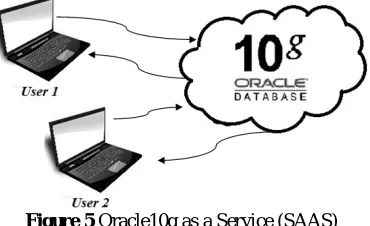
The Figure 5 shows how Cloud Computing can help in providing Oracle10g as a Service.
Figure 5 Oracle10g as a Service (SAAS)
In the Figure 5, we can see that the scenario is same i.e. there are 2 users of Oracle 10g with their respective usernames and passwords. Now by using the concepts of the Cloud Computing, I have taken the Oracle10g Database to a Server (Cloud) itself not on the respective machines, by doing this the users which are using the database software can easily accesses it without losing any processing power and also this solution is suitable for more than 100 users.
7.
C
ONCLUSIONIn this paper, firstly the Cloud Computing is discussed. The specific area we researched during our study was Software as a Service (SAAS). We have found that Cloud Computing is a very hot topic now days and many enterprises are interested in it. Most of the enterprises have idea about it but still there is confusion about the real definition of Cloud Computing. This is understandable as this technology is in its infant stage however, as it evolved from Grid Computing therefore, most of the enterprises which have used Grid Computing are better able to understand the term Cloud Computing. There is a confusion or disagreement about the boundaries of Cloud Computing as many enterprises and even cloud providers believe that private cloud is a part of Cloud Computing. However, in my research I have found that Cloud Computing is the sum of Software as a Service (SaaS) and Utility Computing.
Volume 2, Issue 8, August 2013
Page 252
some huge organizations can have all this information can be a handicap for this technology. In a nutshell, I will conclude that Cloud Computing is emerging as a big and beneficial technology of present day and future. Much of work is being put in it and one can expect more progress in Cloud Computing technology. The most important finding is that the Cloud Computing is ideal for medium and small sized enterprises.References
[1] Cloud Computing- Wikipedia, the free Encyclopedia, accessed via the web: http://en.wikipedia.org/wiki/Cloud_computing.
[2] What is Cloud Computing, Software-as-a-Service - Wolf Database Platform, accessed via the web: http://www.wolfframeworks.com/cloudcomputing.asp.
[3] InfoWorld, What Cloud Computing really means | Cloud Computing, accessed via the web: http://www.infoworld.com/d/cloud-computing/what-cloud-computing-really-means-031.
[4] Armbrust, M. Fox, A., Griffth, R., et al., “Above the clouds: A Berkeley View of Cloud Computing”, UCB/EECS-2009-28, EECS Department University of California Berkeley, 2009, accessed via the web: http://www.eecs.berkeley.edu/Pubs/TechRpts/2009/EECS-2009-28.pdf.
[5] Privacy in Cloud Computing, ITU-T Technology Watch Report, March 2012 accessed via the web: http://www.itu.int/dms_pub/itu-t/oth/23/01/T23010000160001PDFE.pdf.
[6] Anthony T. Velte, Toby J. Velte and Robert Elsenpeter, “Cloud Computing- A Practical Approach”, Publication Date: September 22, 2009 | ISBN-10: 0071626948 | ISBN-13: 978-0071626941 | Edition: 1.
[7] Won Kim, “Cloud Computing: Today and Tomorrow”, Journal of Object Technology: Volume 8, Number 1, pp. 65-72, 2009
[8] Yi Wei and M. Brian Blake, “Service-Oriented Computing and Cloud Computing Challenges and Opportunities”, accessed via the web: http://users.cs.cf.ac.uk/A.B.Harrison/distributed/cmt607pack/contents/cloud/soa-cloud.pdf. [9] R. Buyya, C. S. Yeo, S. Venugopal, J. Broberg, and I. Brandic, “Cloud computing and emerging it platforms: Vision,
hype, and reality for delivering computing as the 5th utility”, Computer Systems: Volume 25, Number 6, pp. 599-616, 2009
[10]Y. Zhao, I. Raicu, I. Foster, “Scientific Workflow Systems for 21st Century, New Bottle or New Wine?”, 2008 IEEE Congress on Services - Part I: pp. 467-471, 2008
[11]L. M. Vaquero, L. Rodero-Merino, J. Caceres, and M. Lindner, “A break in the clouds: towards a cloud definition”, ACM SIGCOMM Computer Communication Review: Volume 39, Number 1, pp. 50-55, 2009
[12]X Wang, B Wang and J Huang, “Cloud Computing and its Key Techniques”, Journal of Computer Applications, 978-1-4244-8728-8/11, pp. 404-410, 2011
[13]J.E. Smith and R. Nair, “An overview of virtual machine architectures”, pp. 1-20, October 2001, accessed via the web: http://www.csc.lsu.edu/~gb/csc7700/Reading/smith-vm-overview.pdf.
[14]Leonard Kleinrock, “An internet vision: the invisible global infrastructure”, Ad Hoc Networks: 1(1), pp. 3 - 11, 2003,
accessed via the web:
http://www.lk.cs.ucla.edu/data/files/Kleinrock/An%20Internet%20Vision%20The%20Invisible%20Global%20Infrast ructure.pdf.
[15]K.I. Juster, “Cloud Computing Can Close the Development Gap”, accessed via the web: http://www.salesforce.com/assets/pdf/misc/IT-development-paper.pdf.
[16]I. Foster, Yong Zhao, I. Raicu, and S. Lu., “Cloud computing and grid computing 360-degree compared”, Technical report. Grid Computing Environments Workshop, 2008, accessed via the web: http://arxiv.org/ftp/arxiv/papers/0901/0901.0131.pdf.
[17]Cloud Computing- IT Encyclopedia- whatis.com, accessed via the web: http://searchcloudcomputing.techtarget.com/definition/cloud-computing.
[18]Oracle 10g- An Overview accessed via the web: http://www.oracle.com/technetwork/database/enterprise-edition/overview/index.html.
Volume 2, Issue 8, August 2013
Page 253
Authors
Shreyas Mulay received his Bachelor’s Degree in Computer Science and Engineering From Rajiv Gandhi Proudyogiki Vishwavidyalaya, Bhopal, Madhya Pradesh, India in 2011.At present, he is an M.Tech. Candidate in Computer Science & Engineering Department at Amity University Rajasthan (AUR), Jaipur, Rajasthan, India. His Research Interest lies in Cloud Computing.