The Thirty-Third AAAI Conference on Artificial Intelligence (AAAI-19)
Semantic Relationships Guided
Representation Learning for Facial Action Unit Recognition
Guanbin Li,
1Xin Zhu,
1Yirui Zeng,
1Qing Wang,
1,2Liang Lin
1,2∗ 1School of Data and Computer Science, Sun Yat-sen University, China2Dark Matter AI Inc.
[email protected], [email protected]
[email protected], [email protected], [email protected]
Abstract
Facial action unit (AU) recognition is a crucial task for fa-cial expressions analysis and has attracted extensive atten-tion in the field of artificial intelligence and computer vision. Existing works have either focused on designing or learn-ing complex regional feature representations, or delved into various types of AU relationship modeling. Albeit with vary-ing degrees of progress, it is still arduous for existvary-ing meth-ods to handle complex situations. In this paper, we investi-gate how to integrate the semantic relationship propagation between AUs in a deep neural network framework to en-hance the feature representation of facial regions, and propose an AU semantic relationship embedded representation learn-ing (SRERL) framework. Specifically, by analyzlearn-ing the sym-biosis and mutual exclusion of AUs in various facial expres-sions, we organize the facial AUs in the form of structured knowledge-graph and integrate a Gated Graph Neural Net-work (GGNN) in a multi-scale CNN frameNet-work to propagate node information through the graph for generating enhanced AU representation. As the learned feature involves both the appearance characteristics and the AU relationship reason-ing, the proposed model is more robust and can cope with more challenging cases, e.g., illumination change and partial occlusion. Extensive experiments on the two public bench-marks demonstrate that our method outperforms the previous work and achieves state of the art performance.
Introduction
Facial expression and its behavior is one of the most cru-cial channels for emotional communication between indi-viduals. Intelligent facial expression analysis has recently attracted wide research interest due to its potential
appli-∗
Corresponding author is Liang Lin (Email: [email protected]). This work was supported in part by the National Key Re-search and Development Program of China under Grant No.2018YFC0830103, in part by the NSFC-Shenzhen Robotics Projects (U1613211), in part by the National Natural Science Foun-dation of China under Grant No.61702565, in part by National High Level Talents Special Support Plan (Ten Thousand Talents Program), in part by the Fundamental Research Funds for the Cen-tral Universities under Grant 18lgpy63, and in part by the Sci-ence and Technology Plan of Guangdong Province under Grant No.2015B010128009.
Copyright c2019, Association for the Advancement of Artificial Intelligence (www.aaai.org). All rights reserved.
Happiness Surprise
Disgust Sadness
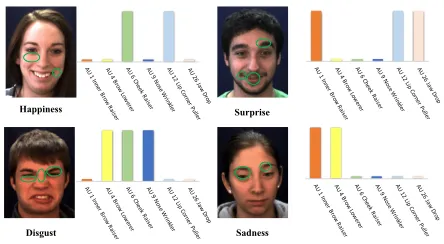
Figure 1: Coupling effect of multiple AUs caused by a vari-ety of facial expressions.
cations in the field of human-robot interaction and com-puter vision. As defined in the Facial Action Coding System (FACS) (Friesen and Ekman 1978), which is the most widely used and versatile method for measuring and describing fa-cial behaviors, the fafa-cial action units (AUs) refer to the local facial muscle actions and plays a paramount role in express-ing comprehensive facial expressions. AU recognition has thus become a long-standing research topic in the field of artificial intelligence and computer vision (Li et al. 2017b; Li, Abtahi, and Zhu 2017; Zhao, Chu, and Zhang 2016).
representa-tions in a data-driven manner without explicitly considering and modeling the local characteristics of the facial organs and the linkage relationship between the facial muscles. As a common sense, facial action units are not independent from one another, considering the linkage of a same facial expres-sion to multiple action units and the anatomical characteris-tics of faces. As shown in Fig. 1, a happiness expression ac-tivates both AU6 and AU12, as we generally “raise cheek” and “pull lip corners” when we smile. On the other hand, due to structural limitations of facial anatomy, some action units are generally not likely to be activated simultaneously. For instance, we can not simultaneously stretch our mouth and raise our cheek.
Base on the above concerns, some of the research works propose to improve the AU recognition based on the AU re-lationship modeling. For example, Tong et al. (Tong, Liao, and Ji 2007) proposed to apply a dynamic Bayesian net-work (DBN) to model the relationships among different AUs, Wang et al. (Wang et al. 2013) developed a more com-plex model based on restricted Boltzmann machine (RBM) to exploit the global relationships among AUs and Chu et al. (Ginosar et al. 2015) recently proposed to model both the spatial and temporal prior cues for more accurate fa-cial AU detection. However, existing AU relationship based recognition methods have the following three shortcomings. First of all, existing AU relationship modeling are designed based on handcrafted low level features and are applied as a post-processing or embedded as a priori rule into complex classification models, usually in isolation with the feature representation, and are hence limited to the performance of feature extraction. Secondly, existing methods only attempt to capture local pair-wise AU dependencies based on lim-ited facial expressions observation. This pair-wise data is not combined to form a graph structure for more comprehensive AU relationship reasoning. Last but not the least, since the AU relationship modeling relies on the preamble feature ex-traction, the whole algorithm framework can not be run end-to-end, which greatly restricts the model efficiency and the performance of the method. Moreover, existing end-to-end deep learning based models also have not explicitly consid-ered the AU relationship in their model design.
Taking into account the above shortcomings and being inspired by the differentiability of the graph neural net-work and its superior performance in the entity relationships learning, we propose an AU semantic relationship embed-ded representation learning (SRERL) framework to gradu-ally enhance the regional facial feature by fully exploiting the structural collaboration between AUs. Specifically, we organize the facial action units in the form of structured knowledge-graph and propose to integrate a Gated Graph Neural Network (GGNN) (Li et al. 2015) in a multi-scale CNN framework to propagate node information through the graph. As the proposed network framework is able to em-bed the globally structured relationships between AUs in the learning process of features in an end-to-end fashion, the learned feature thus involves both the appearance character-istics and the AU relationship reasoning and is more robust towards more challenging cases, e.g., illumination change and partial occlusion.
In summary, this paper has the following contributions:
• This work formulates a novel AU semantic relationship embedded representation learning framework which in-corporate AU knowledge-graph as an extra guidance for the enhancement of facial region representation. To the best of our knowledge, we are the first to employ graph neural network for AU relationship modeling.
• With the guidance of AU knowledge-graph and the dif-ferentiable attributes of the gated graph neural network, we are able to collaboratively learn the appearance repre-sentation of each facial region and the structured semantic propagation between AUs in an end-to-end fashion.
• We conduct extensive experiments on the widely used BP4D and DISFA datasets and demonstrate the superi-ority of the proposed SRERL framework over the state-of-the-art facial AU recognition methods.
Related Work
Automatic facial action unit recognition has attracted widespread research interest and achieved great progress in recent years. The existing AU recognition methods can be roughly divided into robust feature representation based methods and semantic relationship modeling based meth-ods.
Traditional feature representation based AU recognition methods focus on the design of more discriminative hand-crafted features. For instance, Valstar et al (Valstar and Pan-tic 2006) proposed to analyze the temporal behavior of ac-tion units in video and used individual feature GentleBoost templates built from Gabor wavelet features for SVM based AU classification. Baltrusaitis et al (Baltruˇsaitis, Mahmoud, and Robinson 2015) designed a facial AU intensity estima-tion and occurrence detecestima-tion system based on the fusion of appearance and geometry features. However, these hand-crafted low level feature based algorithms are relatively frag-ile and difficult to deal with various types of complex situ-ations. In recent years, deep convolutional neural networks have been widely used in a variety of computer vision tasks and have achieved unprecedented progress (He et al. 2016; Li and Yu 2018; Li et al. 2017a; Liu et al. 2018). There are also attempts to apply deep CNN to facial AU recogni-tion (Zhao, Chu, and Zhang 2016; Li, Abtahi, and Zhu 2017; Bishay and Patras 2017; Chu, De la Torre, and Cohn 2016). Zhao et al (Zhao, Chu, and Zhang 2016) proposed a unified architecture for facial AU detection which incorporates a deep regional feature learning and multi-label learning mod-ules. Li et al (Li, Abtahi, and Zhu 2017) proposed an ROI framework for AU detection by cropping CNN feature maps with facial landmarks information. However, non of these methods explicitly take into consideration the linkage rela-tionship between different AUs.
24 AU regions
crop
Image representation VGG19
C
onv
gr
oup1
C
onv
gr
oup2
C
onv
gr
oup3
C
onv
gr
oup4
Feature map 14x14x(512+256+128+64)
224x224x3 Input image
4x4 pool 2x2 pool 8x8 pool
L
oc
al
r
es
pons
e nor
m
ROI 6x6x960
… AU Label
distribution
GGNN
Knowledge graph for AU correlation
…
Region learning
conv fc
fc conv
conv fc
fc conv
av
erag
e
av
erag
e
… 12 AU
features
sym
m
et
ri
c
sym
m
et
ri
c
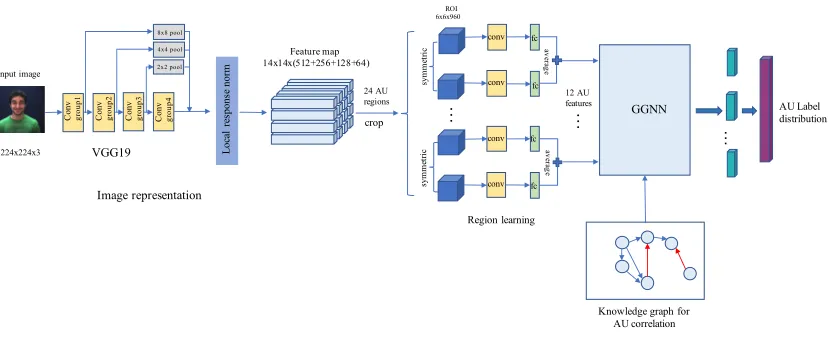
Figure 2: An overall pipeline of our proposed AU semantic relationship embedded representation learning (SRERL) framework. It is composed of a multiscale feature learning and cropping module followed by a GGNN for node information propagation.
three-layer Restrict Boltzmann Machine (RBM) to exploit the global relationships between AUs. However, these early works simply model the AU relations from target labels and are independent with feature representation. Wu et al. (Wu, Wang, and Ji 2016) proposed a 4-layer RBM to simultane-ously capture both feature level and label level dependen-cies for AU detection. As they are based on handcrafted low level features, the whole algorithm framework can not be performed end-to-end, which greatly restricts the model efficiency and the performance of the method. Recently, Corneanu et al. (Corneanu, Madadi, and Escalera 2018) pro-posed a deep structured inference network (DSIN) for AU recognition which used deep learning to extract image fea-tures and structure inference to capture AU relations by passing information between predictions in an explicit way. However, the relationship inference part of DSIN also works as a post-processing step at label level and is isolated with the feature representation.
Method
In this section, we introduce our semantic relationship em-bedded representation learning framework in detail. Firstly, we briefly review the gated graph neural network (GGNN) and introduce the construction of the AU relationship graph, which will work as a guided knowledge-graph for GGNN propagation in our framework. Then, we present the structure of our proposed SRERL framework. The overall pipeline of our framework is illustrated in Figure 2.
Preliminary: Gated Graph Neural Network (Li et
al. 2015)
Given a graph withN nodes and the initial representation of each node, the idea of GGNN is to generate an output for each graph node or a global output, by learning a propaga-tion model similar to LSTM. Specifically, denote the node set asV and its corresponding adjacency matrixA. For each nodev ∈ V, we define a hidden state representationht
v at
every time stept. Whent = 0, the hidden state
representa-tion is set as the initial node featurexv. Adjacency matrix
A encodes the structure of the graph. The basic recurrent process of GGNN is formulated as
h(1)v = [xTv,0] (1)
a(vt)=ATv[h1(t−1)· · ·h(|Vt−|1)]T +b (2)
zvt=σ(Wzav(t)+Uzh(vt−1)) (3)
rvt =σ(Wrav(t)+Urh(vt−1)) (4)
f
ht
v=tanh(W a
(t)
v +U(r
t
vh
(t−1)
v )) (5)
hv(t)= (1−zvt)hv(t−1)+zvthftv (6)
whereAvis a sub-matrix ofAwhich refers to the adjacency
matrix for nodev.W andU are learned parameters.sigma and tanh are the logistic sigmoid and hyperbolic tangent functions. means element-wise multiplication operation. The essence of the iterative update of GGNN evolution is to compute the hidden state of next time-step by looking into the combination of the current hidden state of each node and its adjacent information, as shown in Eq (3-6).
AfterT time steps, we get the final hidden states. Then the node-level output can be computed as follow
ov=g(h(vT), xv) (7)
wherexv is the annotation of node v, function gis a fully
connected network.
Preliminary: AU Relationship Graph Construction
AU1 AU1 AU2
AU2
AU6
AU6 AU7
AU10 AU10
AU12,14,15
AU12,14,15 AU17
AU17 AU23 AU23
AU24
AU4 AU1 AU2
AU4
AU6
AU7
AU 10 AU 12 AU 14 AU 15 AU 17 AU 23
AU 24
Figure 3: The location of facial AUs and the constructed AU relationship graph.
Node SetV: Each node in graph represents a correspond-ing AU. Given a dataset that coversCAUs, the constructed graph is formed by a node setV containingCentities.
Edge Set E: According to FACS (Friesen and Ekman 1978), there exists strong relationship between AUs due to the linkage of each facial expression to multiple action units and the anatomical characteristics of faces. The relationship can further be divided into positive and negative ones, where positive correlation means that two AUs are likely to co-occur while negative correlation refers to that the two rarely appear together. We capture most of the AU relationship by calculating the conditional probability on the training sam-ples, which is formulated as
aposi,j= [P(yi= 1|yj= 1)−P(yi= 1)> ppos], (8)
a negi,j= [P(yi= 1|yj= 1)−P(yi= 1)< pneg], (9)
where yn denote the n-th AU label. ppos and pneg is the threshold for positive and negative relationship, respectively. aposi,j ∈ Apos and anegi,j ∈ Aneg. Thus, we can gen-erate the adjacency matrix of AU relationship graph with the positive relationship matrixAposand negative
relation-ship matrixAneg,i.e.,A = [Apos−I(A),−Aneg,(Apos− I(A))T,−AT
neg]. I(A) denotes the identity matrix of the same dimension asA.
However, due to the limitation of dataset, there are still a few common relationships that are not counted. Refer-ring to the latest research on AU relations (Zhang et al. 2018), we add some additional relationships. Specifically, we add (AU4, AU7), (AU15, AU24) as positive correlation and (AU2, AU6), (AU12, AU15), (AU12, AU17) as nega-tive correlation for BP4D dataset (Zhang et al. 2013). These relationship are summarized in Figure 3, where green lines represent positive correlation and red lines represent nega-tive ones. For clarity, we use a line with arrow to represent a one-way relationship and a line without arrows to represent a two-way relationship.
Relationship-Embedded Representation Learning
As shown in Fig. 2, our proposed SRERL framework is composed of a multiscale CNN based feature learning and cropping module followed by a GGNN for node information
propagation. The GGNN takes as input the cropped facial re-gion feature and propagate on the defined knowledge-graph to learn relationship-embed AU feature representation. We elaborate these two components in the following.
Multiscale Feature Learning and Cropping We choose the VGG19 (Simonyan and Zisserman 2014) model as our backbone network, which is composed of 5 groups of con-volutional layers with down-sampling. For the sake of the trade-off between feature performance and its resolution, we use the first 4 groups of convolutional layers for initial ap-pearance feature extraction. The input to the feature extrac-tor is a224×224RGB facial image with its landmarks in-formation. Since the size of the relevant regions of each AU varies (e.g. the area corresponding to AU6 “Cheek Raiser” is larger than that of AU12 “Lip Corner Puller”), we con-catenate the output feature maps of all the four groups (all resized to14×14) to form a multiscale global feature. The concatenated feature maps are further fed into a local re-sponse normalization layer which could normalize pixels between channels and help to converge. The formulation is given as
bc=
ac
(k+α×nCPmin(C−1,c+n/2)
c0=max(0,c−n/2)a 2 c0)
β, (10)
wherek,α,βare hyperparameters,Crepresents the channel number of the feature maps.acdenotes the pixel incth
chan-nel andnis set to2which refers to the number of neighbor-ing channels chosen to normalize the pixelac. Then we crop
out each AU region according to facial landmarks, which is further fed into separate region learning stream for each lo-cal AU feature representation. Specifilo-cally, we capture adap-tive AU region by resorting to facial landmarks. Since there exists relationship between facial anatomy region and AUs, we can generate the location of each AU center, which is further corresponded to the closest facial landmark. After getting the representative landmark of each facial AU, we crop a 6×6 region from the concatenated global feature maps for its initial regional feature. Figure 3 illustrates the correspondence between facial AUs and facial landmarks.
We further refer to (Li, Abtahi, and Zhu 2017) and adopt separate filters in each cropped AU region to train its rep-resentation separately. Suppose we have C AUs. Due to the symmetry of the face, we obtain2Cpatch-wise feature maps ( each AU corresponds to two patches), and design2C independent regional feature learning branches. For each in-dividual region learning branch, we use a 3×3 convolu-tional layer and a fully connected layer to learn the specific local representation. These convolutional layers and fully connected layers are trained separately, which could help to avoid information interference between different AU regions caused by varies scales of receptive fields.
Balanced Loss Function
strategies to balance the data bias. In this work, we design an adaptive loss function for imbalanced data training.
loss=− 1
C·N
N
X
j=1 C
X
i=1
2{rineg[lij = 1]·
log(p i j+ 0.05
1.05 ) +r i
pos[l
i
j = 0]log(
1.05−pi j 1.05 )}
(11)
ripos=
PM
k=1[l i
k= 1]
M (12)
rineg= 1−ripos (13) wherelis the ground truth andpis the probability predicted by our method.[x]is an indicator function which returns1
when the statementxis true, and0otherwise. LetCdenote the number of AUs, andN denote the batch size.ri
posand ri
negare constant, which indicate the proportion of positive samples or negative samples in the training set.M denotes the number of samples in the training set.
GGNN for Action Unit Detection As shown in Figure 2, we generate the initial local feature of 2C regions using our tailored multiscale feature learning and cropping mod-ule. Let fi denotes the feature of a specific AU region,
i∈[0,1,2, ...,2C−1]. Considering the symmetry of a hu-man face, each AU corresponds to two specific regions. The initial feature of each node in GGNN is thus given as
xv=
f2v⊕f2v+1
2 (14)
where ⊕ denotes element-wise summation. According to Equation 1, the hidden state vector is initialized with the cor-responding featurexv. At each time-stept, the hidden state
can be updated according to Eq 2−6. Finally, the output of each node in GGNN can be computed using Eq 7, which is further concatenated for final label prediction.
Experimental Results
Datasets
We evaluated our model on two spontaneous dataset: BP4D(Zhang et al. 2013) and DISFA(Mavadati et al. 2013). BP4D contains 2D and 3D facial expression data of 41 young adult subjects, including 18 male and 23 female. Each subject participated in 8 tasks, each of which corresponds to a specific expression. There are totally 146,847 face images with labeled AUs. We refer to (Zhao, Chu, and Zhang 2016) and split the dataset into 3 folds. In which, we take turns to use two folds for training and the other for testing, and report the average results of multiple tests. DISFA contains stereo videos of 27 subjects with different ethnicity. There are totally 130,815 frame images, each of which is labeled with intensities from 0-5. We choose frames with AU inten-sities higher or equal to C-level as positive samples, and the rest as negative samples.Cis chosen as2in our experiment. As with BP4D, we also split the dataset into 3 folds for re-liable testing. We use VGG19 model trained on BP4D to directly extract initial appearance feature, and finetune the parameters of separate region learning module and GGNN in DISFA.
Evaluation Criteria
We evaluate our method with two metrics, including F1 score and AUC. F1 score takes into consideration both the precisionpand the recallr , and is widely used in binary classification. F1 score can be computed as F1 = 2pp+·rr, and AUC refers to the area under the ROC curve.
Implementation Details
During the knowledge-graph construction, we setpposas0.2 andpnegas−0.03in Eq (8−9), and setα= 0.002,β= 0.75, k = 2 in Eq 10. We use an Adam optimizer with learn-ing rate of 0.0001 and mini-batch size 64 with early stop-ping to train our models. For F1-score, we set the threshold of prediction to 0.5. All models are trained using NVIDIA GeForce GTX TITAN X GPU based on the open-source Py-torch platform (Paszke et al. 2017).
Ablation Studies
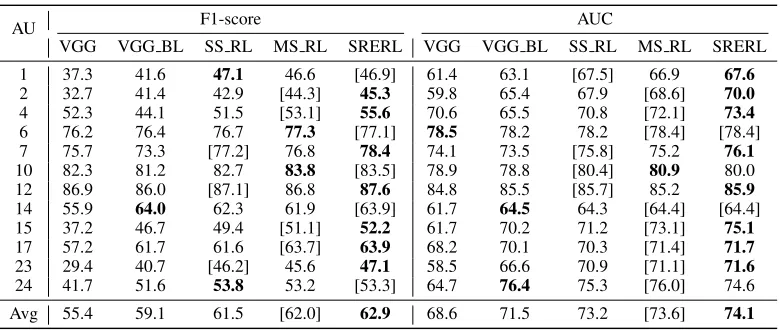
Effectiveness of Multiscale CNN To verify the effective-ness of multiscale feature learning and cropping, we re-move the GGNN part of our framework and directly per-form multi-label classification on the extracted regional fea-tures, we call this variant multiscale representation learning framework (MS RL). We have also implemented a single-scale version for comparison (SS RL). We trained the two variants with the same setting, using our proposed balanced loss function. We have also listed the result of the orig-inal VGG network and that trained using balanced loss function (VGG BL) for comparison. As shown in Table 2, SS RL achieved higher F1 score and AUC in most of AUs when compared with VGG BL, especially in AU1, 4, 23. Overall, it outperforms VGG BL by 2.4% and 1.7% in terms of average F1-score and AUC on the BP4D dataset, respec-tively. We believe that the reason for its higher performance lies in the application of independent regional feature rep-resentation, which avoids the feature interference in differ-ent AU regions. When compared with SS RL, MS RL gains 0.50% and 0.40% performance improvement w.r.t F1-score and AUC, which evidences the effectiveness of the multi-scale setting.
AU 1 2 4 6 7 10 12 14 15 17 23 24
positive samples ratio 0.21 0.17 0.20 0.46 0.55 0.59 0.56 0.47 0.17 0.34 0.17 0.15
Table 1: Data distribution of BP4D dataset
AU F1-score AUC
VGG VGG BL SS RL MS RL SRERL VGG VGG BL SS RL MS RL SRERL 1 37.3 41.6 47.1 46.6 [46.9] 61.4 63.1 [67.5] 66.9 67.6
2 32.7 41.4 42.9 [44.3] 45.3 59.8 65.4 67.9 [68.6] 70.0
4 52.3 44.1 51.5 [53.1] 55.6 70.6 65.5 70.8 [72.1] 73.4
6 76.2 76.4 76.7 77.3 [77.1] 78.5 78.2 78.2 [78.4] [78.4] 7 75.7 73.3 [77.2] 76.8 78.4 74.1 73.5 [75.8] 75.2 76.1
10 82.3 81.2 82.7 83.8 [83.5] 78.9 78.8 [80.4] 80.9 80.0 12 86.9 86.0 [87.1] 86.8 87.6 84.8 85.5 [85.7] 85.2 85.9
14 55.9 64.0 62.3 61.9 [63.9] 61.7 64.5 64.3 [64.4] [64.4] 15 37.2 46.7 49.4 [51.1] 52.2 61.7 70.2 71.2 [73.1] 75.1
17 57.2 61.7 61.6 [63.7] 63.9 68.2 70.1 70.3 [71.4] 71.7
23 29.4 40.7 [46.2] 45.6 47.1 58.5 66.6 70.9 [71.1] 71.6
24 41.7 51.6 53.8 53.2 [53.3] 64.7 76.4 75.3 [76.0] 74.6 Avg 55.4 59.1 61.5 [62.0] 62.9 68.6 71.5 73.2 [73.6] 74.1
Table 2: Ablation study on the BP4D dataset. It demonstrates the effectiveness of balanced loss design, multiscale CNN as well as relationship-embed feature representation
AU F1-score AUC
MS RL SRERL MS RL SRERL
1 39.7 45.7 76.4 76.2
2 44.5 47.8 80.8 80.9
4 52.4 59.6 74.9 79.1
6 44.7 47.1 77.8 80.4
9 44.7 45.6 76.8 76.5
12 69.0 73.5 87.7 87.9
25 86.3 84.3 91.9 90.9
26 42.7 43.6 75.3 73.4
Avg 53.0 55.9 80.2 80.7
Table 3: The effectiveness of relationship-embedded feature enhancement on DISFA dataset.
3.3% higher F1-score in DISFA dataset for AU1 and AU2. On the other side, AU12 and AU15 are negatively corre-lated. In BP4D dataset, AU12 and AU15 increased by 0.8% and 1.1% in F1-scroce, and increased by 0.7% and 2.0% in AUC. The experimental results well demonstrate that the relationship-embedded representation learning can greatly enhance the regional facial feature by fully exploiting the structural collaboration between AUs.
Effectiveness of Balance Loss Table 1 illustrates the data distribution of the BP4D data set. We can clearly see that the occurrence rate of AU2, 15, 23, 24 are less than 20% while that of AU10 is close to 60%. From Table 2, we can find that the AUs which are of higher occurrence rate achieve higher performance in VGG method. For example, the oc-currence rate of AU12 is 56% in the dataset, and the F1-score and AUC of AU12 are 86.9% and 84.8% respectively.
While the occurrence rate of AU23 is 17%, its correspond-ing accuracy is relatively lower, which is 29.4% and 58.5% respectively.
As shown in table 2, VGG with balance loss (VGG BL) outperforms the original VGG on many AUs, especially in those with lower occurrence rate. For example, it increases AU2 and AU15 by 8.7% and 9.5% w.r.t F1-score, and 5.6% and 8.5% in terms of AUC, respectively. Compared to orig-inal VGG, VGG BL achieved about 4% and 3% higher F1-score and AUC in average.
Comparison with the State of the Art
We compare our method to alternative methods, includ-ing linear SVM(LSVM) (Fan et al. 2008), Joint Patch and Multi-label Learning(JPML) (Zhao et al. 2015), ConvNet with locally connected layer(LCN) (Taigman et al. 2014), Deep Region and Multi-label Learning(DRML) (Zhao, Chu, and Zhang 2016), Region Adaptation, Multi-label Learn-ing(ROI) (Li, Abtahi, and Zhu 2017) and Deep Structure Inference Network(DSIN) (Corneanu, Madadi, and Escalera 2018).
AU F1-score AUC
LSVM JPML LCN DRML ROI DSIN Ours LSVM JPML LCN DRML Ours 1 23.2 32.6 45.0 36.4 36.2 51.7 [46.9] 20.7 40.7 51.9 [55.7] 67.6
2 22.8 25.6 41.2 [41.8] 31.6 40.4 45.3 17.7 42.1 50.9 [54.5] 70.0
4 23.1 37.4 42.3 43.0 43.4 56.0 [55.6] 22.9 46.2 53.6 [58.8] 73.4
6 27.2 42.3 58.6 55.0 77.1 76.1 77.1 20.3 40.0 53.2 [56.6] 78.4
7 47.1 50.5 52.8 67.0 [73.7] 73.5 78.4 44.8 50.0 [63.7] 61.0 76.1
10 77.2 72.2 54.0 66.3 85.0 79.9 [83.5] 73.4 [75.2] 62.4 53.6 80.0
12 63.7 74.1 54.7 65.8 [87.0] 85.4 87.6 55.3 60.5 [61.6] 60.8 85.9
14 [64.3] 65.7 59.9 54.1 62.6 62.7 63.9 46.8 53.6 [58.8] 57.0 64.4
15 18.4 38.1 36.1 33.2 [45.7] 37.3 52.2 18.3 50.1 49.9 [56.2] 75.1
17 33.0 40.0 46.6 48.0 58.0 [62.9] 63.9 36.4 42.5 48.4 [50.0] 71.7
23 19.4 30.4 33.2 31.7 38.3 [38.8] 47.1 19.2 51.9 50.3 [53.9] 71.6
24 20.7 [42.3] 35.3 30.0 37.4 41.6 53.3 11.7 53.2 47.7 [53.9] 74.6
Avg 35.3 45.9 46.6 48.3 56.4 [58.9] 62.9 32.2 50.5 54.4 [56.0] 74.1
Table 4: Comparison of quantitative results on the BP4D dataset. Our proposed SRERL achieves the best performance, which outperforms the second best method by 4.0% and 18.1% in terms of F1-score and AUC respectively.
AU F1-score AUC
LSVM LCN DRML ROI DSIN Ours LSVM LCN DRML Ours
1 10.8 12.8 17.3 41.5 [42.4] 45.7 21.6 44.1 [53.3] 76.2
2 10.0 12.0 17.7 26.4 [39.0] 47.8 15.8 52.4 [53.2] 80.9
4 21.8 29.7 37.4 [66.4] 68.4 59.6 17.2 47.7 [60.0] 79.1
6 15.7 23.1 29.0 50.7 28.6 [47.1] 8.7 39.7 [54.9] 80.4
9 11.5 12.4 10.7 8.5 46.8 [45.6] 15.0 40.2 [51.5] 76.5
12 70.4 26.4 37.7 89.3 70.8 [73.5] 93.8 54.7 54.6 [87.9]
25 12.0 46.2 38.5 [88.9] 90.4 84.3 3.4 [48.6] 45.6 90.9
26 22.1 30.0 20.1 15.6 [42.2] 43.6 20.1 [47.0] 45.3 73.4
Avg 21.8 24.0 26.7 48.5 [53.6] 55.9 27.5 46.8 [52.3] 80.7
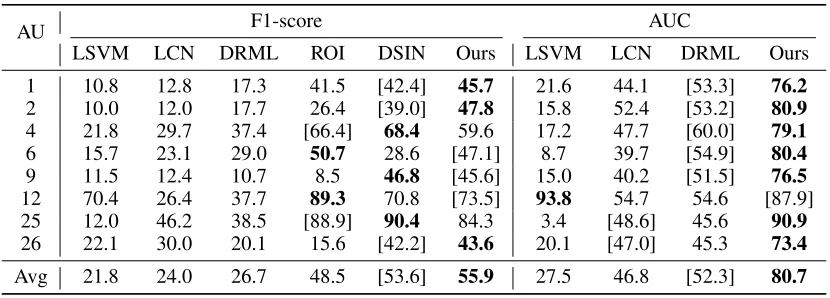
Table 5: Comparison of quantitative results on the DISFA dataset. Our proposed SRERL achieves the best performance, which outperforms the second best method by 2.3% and 28.4% in terms of F1-score and AUC respectively.
feature learning and multi-label classification. Compared to LCN, our method reaches higher F1-frame and AUC in all AUs on BP4D and DISFA dataset. DRML proposed to di-vide feature map into 8*8 patches and use region learning for each patch. ROI used facial landmarks to crop the fea-ture and maps to 20 patch, which also applied region learn-ing for each patch. Compared with DRML and ROI, our model achieves 14.6% and 6.5% higher performance in F1-score on BP4D while achieves 29.2% and 7.4% higher w.r.t F1-score on DISFA. More impressively, our proposed SR-ERL greatly outperforms DSIN by 4% and 2.3% in terms of F1-score on BP4D and DISFA respectively. Noted that DSIN also simultaneously modeled the deep feature learning and the structured AU relationship in an unified framework. However, the relationship inference part of DSIN works as a post-processing step at label level and is being isolated with the feature representation. Compared with DSIN, our per-formance gain well proves the significance of the joint op-timization of feature expression and semantic relationship modeling for face action unit classification, and on the other hand evidences the effectiveness of graph neural network in exploiting more thorough relationship in facial AU represen-tation.
Conclusion
In this paper, we have proposed a semantic relationship em-bedded representation learning framework to well incorpo-rate our constructed AU relationship knowledge-graph as extra guidance information for end-to-end feature represen-tation learning in a deep learning framework. Specifically, the SRERL framework is composed of a multiscale feature learning and cropping module followed by a gated graph neural network for node feature propagation across the de-fined knowledge-graph. To the best of our knowledge, we are the first to explore the AU relationship based on a differ-entiable graph neural network module in a feature represen-tation level. Experimental results on the widely used BP4D and DISFA datasets have demonstrated the superiority of the proposed SRERL framework over the state-of-the-art meth-ods.
References
International Conference and Workshops on Automatic Face and Gesture Recognition, volume 6, 1–6.
Bishay, M., and Patras, I. 2017. Fusing multilabel deep networks for facial action unit detection. In Proceedings of the IEEE International Conference on Automatic Face & Gesture Recognition, 681–688.
Chu, W.-S.; De la Torre, F.; and Cohn, J. F. 2016. Modeling spatial and temporal cues for multi-label facial action unit detection.arXiv preprint arXiv:1608.00911.
Corneanu, C. A.; Madadi, M.; and Escalera, S. 2018. Deep structure inference network for facial action unit recogni-tion.arXiv preprint arXiv:1803.05873.
Fan, R.-E.; Chang, K.-W.; Hsieh, C.-J.; Wang, X.-R.; and Lin, C.-J. 2008. Liblinear: A library for large linear classi-fication. Journal of machine learning research9(8):1871– 1874.
Friesen, E., and Ekman, P. 1978. Facial action coding sys-tem: a technique for the measurement of facial movement. Palo Alto.
Ginosar, S.; Rakelly, K.; Sachs, S.; Yin, B.; and Efros, A. A. 2015. A century of portraits: A visual historical record of american high school yearbooks. InProceedings of the IEEE International Conference on Computer Vision Workshops, 1–7.
He, K.; Zhang, X.; Ren, S.; and Sun, J. 2016. Deep residual learning for image recognition. InProceedings of the IEEE Conference on Computer Vision and Pattern Recognition, 770–778.
Jiang, B.; Valstar, M. F.; and Pantic, M. 2011. Action unit detection using sparse appearance descriptors in space-time video volumes. InProceedings of the IEEE International Conference on Automatic Face & Gesture Recognition and Workshops, 314–321.
Li, W.; Abtahi, F.; and Zhu, Z. 2017. Action unit detection with region adaptation, multi-labeling learning and optimal temporal fusing. In Proceedings of the IEEE Conference on Computer Vision and Pattern Recognition, 6766–6775. IEEE.
Li, G., and Yu, Y. 2018. Contrast-oriented deep neural net-works for salient object detection. IEEE Transactions on Neural Networks and Learning Systems.
Li, Y.; Tarlow, D.; Brockschmidt, M.; and Zemel, R. 2015. Gated graph sequence neural networks. arXiv preprint arXiv:1511.05493.
Li, G.; Xie, Y.; Lin, L.; and Yu, Y. 2017a. Instance-level salient object segmentation. InProceedings of IEEE Con-ference on Computer Vision and Pattern Recognition, 247– 256.
Li, W.; Abtahi, F.; Zhu, Z.; and Yin, L. 2017b. Eac-net: A region-based deep enhancing and cropping approach for fa-cial action unit detection.arXiv preprint arXiv:1702.02925.
Liu, L.; Li, G.; Xie, Y.; Lin, L.; and Yu, Y. 2018. Fa-cial landmark localization in the wild by backbone-branches representation learning. In2018 IEEE Fourth International Conference on Multimedia Big Data (BigMM), 1–8. IEEE.
Mavadati, S. M.; Mahoor, M. H.; Bartlett, K.; Trinh, P.; and Cohn, J. F. 2013. Disfa: A spontaneous facial action inten-sity database. IEEE Transactions on Affective Computing 4(2):151–160.
Paszke, A.; Gross, S.; Chintala, S.; Chanan, G.; Yang, E.; DeVito, Z.; Lin, Z.; Desmaison, A.; Antiga, L.; and Lerer, A. 2017. Automatic differentiation in pytorch.
Simonyan, K., and Zisserman, A. 2014. Very deep convo-lutional networks for large-scale image recognition. arXiv preprint arXiv:1409.1556.
Taigman, Y.; Yang, M.; Ranzato, M.; and Wolf, L. 2014. Deepface: Closing the gap to human-level performance in face verification. InProceedings of the IEEE Conference on Computer Vision and Pattern Recognition, 1701–1708. Tong, Y.; Liao, W.; and Ji, Q. 2007. Facial action unit recog-nition by exploiting their dynamic and semantic relation-ships. IEEE Transactions on Pattern Analysis and Machine Intelligence29(10).
Valstar, M., and Pantic, M. 2006. Fully automatic facial ac-tion unit detecac-tion and temporal analysis. In Proceedings of the IEEE Conference on Computer Vision and Pattern Recognition Workshop, 149–149.
Wang, Z.; Li, Y.; Wang, S.; and Ji, Q. 2013. Capturing global semantic relationships for facial action unit recogni-tion. InProceedings of the IEEE International Conference on Computer Vision, 3304–3311.
Wu, S.; Wang, S.; and Ji, Q. 2016. Multiple facial action unit recognition by learning joint features and label relations. In Proceedings of the IEEE International Conference on Pat-tern Recognition, 2246–2251.
Zhang, X.; Yin, L.; Cohn, J. F.; Canavan, S.; Reale, M.; Horowitz, A.; and Liu, P. 2013. A high-resolution spon-taneous 3d dynamic facial expression database. InIEEE In-ternational Conference and Workshops on Automatic Face and Gesture Recognition, 1–6.
Zhang, Y.; Dong, W.; Hu, B.-G.; and Ji, Q. 2018. Classifier learning with prior probabilities for facial action unit recog-nition. InProceedings of the IEEE Conference on Computer Vision and Pattern Recognition, 5108–5116.