The Thirty-Third AAAI Conference on Artificial Intelligence (AAAI-19)
Learning to Localize Objects with Noisy Labeled Instances
Xiaopeng Zhang,
1Yang Yang,
2Jiashi Feng
11National University of Singapore
2Center for Future Media and School of Computer Science and Engineering,
University of Electronic Science and Technology of China {elezxi,elefjia}@nus.edu.sg, [email protected]
Abstract
This paper addresses Weakly Supervised Object Localization (WSOL) with only image-level supervision. We model the missing object locations as latent variables, and contribute a novel self-directed optimization strategy to infer them. With the strategy, our developed Self-Directed Localization Net-work (SD-LocNet) is able to localize object instance whose initial location is noisy. The self-directed inference hinges on an adaptive sampling method to identify reliable object in-stance via measuring its localization stability score. In this way, the resulted model is robust to noisy initialized object locations which we find is important in WSOL. Furthermore, we introduce a reliability induced prior propagation strategy to transfer object priors of the reliable instances to those un-reliable ones by promoting their feature similarity, which ef-fectively refines the unreliable object instances for better lo-calization. The proposed SD-LocNet achieves 70.9% Cor-Loc and51.3%mAP on PASCAL VOC 2007, surpassing the state-of-the-arts by a large margin.
1
Introduction
Weakly Supervised Object Localization (WSOL) refers to localizing objects with only image-level labels that indicate presence of an object, and has been extensively studied (Cin-bis, Verbeek, and Schmid 2014), (Song et al. 2014b), (Wang et al. 2014). However, WSOL still remains challenging due to the gap between classification and localization. Success-ful classification may only need to grasp some discrimina-tive details of an object (e.g.,the face of a human instance), while localization is more demanding and requires to pre-dict accurate spatial extent of the whole object. To mitigate this gap, current approaches (Jie et al. 2017), (Li et al. 2016), (Tang et al. 2017) usually model the missing object locations as latent variables, and alternate between updating the la-tent variables and learning a classifier based on current lala-tent variables. Nevertheless, learning the parameters of a model with latent variables often requires solving a non-convex op-timization problem, and is prone to get stuck in local minima if the latent variables were not properly initialized.
In this work, we take the object location as latent vari-able (whose initial value can be estimated from off-the-shelf WSOL models) and consider how to address the learning
Copyright c2019, Association for the Advancement of Artificial Intelligence (www.aaai.org). All rights reserved.
(a) Self-DirectedLocalization (b)
Figure 1: Given a collection of noisy labeled instances, our goal is to automatically discover those well localized in-stances (a) and propagate such priors to those noisy labeled instances (b) for better localization.
difficulties caused by noisy initialized latent variables. Intu-itively, different images present different levels of difficulty in object localization due to the variational viewpoints, oc-clusions and backgrounds. The model is able to successfully localize objects in some easy images, even it is trained from noisy labeled instances. The localizations on these easy im-ages provide valuable information and can be exploited as priors that are easily obtained. Therefore we propose to use such prior knowledge to assist latent variable inference on difficult images. Motivated by such progressive inference strategy, we develop a Self-Directed Localization Network (SD-LocNet), which is able to automatically figure out the easy images during network training and harness the corre-sponding localizations for latent variable update. Since the latent variables are updated automatically from the easy im-ages to those difficult ones, we refer this process as self directed localization. As illustrated in Fig. 1, SD-LocNet makes use of the localizations from easy images as object priors to direct the discovery of the corresponding category in difficult images, thus improves the localization perfor-mance on the whole image set.
Our proposed SD-LocNet consists of two core modules. The first one is the adaptive sampling module, which tar-gets at mining reliable object instances1, taken as reliable latent variables, for network training. We propose an effec-tive criterion, namedLocalization Stability Score (LSS), to measure the reliability of a candidate positive sample being
1
If an object is easy to localize, we term the object as the
reli-able instanceand the corresponding image as theeasy image.
the ground truth object, and update the latent variables with samples having the highest LSS. Meanwhile, we use LSS to reweight each instance during network training. In this way, we can put more emphasis on the reliable instances and decrease the contributions of those unreliable ones, making the model robust to noisy labeled instances. As the train-ing process proceeds, the model gains increastrain-ingly stronger localization ability, and is able to better discover reliable in-stances, which in turn improves the localization model.
Our adaptive sampling is reminiscent of self-paced learn-ing (Kumar, Packer, and Koller 2010), (Ouyang et al. 2018) and curriculum learning (Bengio et al. 2009) in which easier images are first selected for training. However, self-paced learning usually treats samples with lower loss on current model as easier ones. Comparatively, our adaptive sam-pling is based on the proposed Localization Stability Score measuring the reliability of candidate positive samples by inspecting the states among consecutive training epoches, which is based on the localization stability instead of the classification loss. Besides, the instances are mined from im-ages and updated during each iteration, which differs from self-paced learning where the used images are kept fixed.
The second module of SD-LocNet is the reliability in-duced prior propagation, which targets at directing the lo-calization on difficult images. We find that emphasizing too much on reliable instances usually slows down the train-ing process because they provide smaller gradients. Further-more, decreasing weights of unreliable instances would lead to sampling bias, resulting in poor localization on difficult images. To mitigate this issue, we incorporate unreliable in-stances into model training via propagating object priors of the reliable instances. The intuition is that for instances from the same category, their visual representations should be similar. Instead of penalizing the unreliable instances with smaller decision loss, we enforce them to be similar to the representative clusters dominated by the reliable instances. In this way, the mined instances are encouraged to have large intra-class similarity, which can relieve overfitting and better guide the localization on difficult images.
To sum up, this paper contributes a novel learning strategy for WSOL, which intentionally selects reliable instances for model training, and propagates the object priors of the reli-able instances to the unrelireli-able ones for better localization. This strategy is further instantiated to a Self-Directed Lo-calization Network (SD-LocNet) based on fast RCNN (Gir-shick 2015). Its effectiveness has been validated experimen-tally. Notably, we achieve 70.9% localization CorLoc and
51.3%detection mAP on PASCAL VOC 2007 benchmark, which surpasses the state-of-the-arts by a large margin.
2
Related Work
Most previous works formulate WSOL as a Multiple In-stance Learning (MIL) (Dietterich, Lathrop, and Lozano-P´erez 1997) task, in which labels are assigned to bags (a group of instances) instead of an individual instance. These methods typically alternate between learning a discrimina-tive representation of the object and selecting the object samples based on this representation (Cinbis, Verbeek, and Schmid 2014), (Nguyen et al. 2009), (Vijayanarasimhan and
Grauman 2008). However, MIL is sensitive to initialization and easy to get stuck in local minima. To solve this issue, many efforts have been devoted to improving the initializa-tions (Li et al. 2016), (Song et al. 2014b), (Wang et al. 2014), or designing robust optimization methods to alleviate the de-pendency on the initially mined object instances (Bilen, Ped-ersoli, and Tuytelaars 2015), (Cinbis, Verbeek, and Schmid 2014), (Joulin and Bach 2012), (Song et al. 2014a). How-ever, these methods treat each image equally important and do not consider the intrinsic properties of images.
Another line of research in WSOL develops new CNN ar-chitectures and learns to localize objects in an end-to-end manner. These approaches are based on the principle of ag-gregating pixel-level confidences for image-level loss mod-eling (Oquab et al. 2015), (Zhou et al. 2016), (Zhu et al. 2017), and gets the final localization from the heatmap de-rived from the network. However, they tend to emphasize the discriminative details and fail to distinguish multiple ob-jects from the same category. Notably, (Bilen and Vedaldi 2016) proposes a WSDDN model which directly aggregates region-level scores for image-level loss and conveniently en-ables localization based on the region scores. Based on this WSDDN model, some works exploit context information (Kantorov et al. 2016) and MIL refinement (Tang et al. 2017) to further improve the localization.
3
Self-Directed Localization Network
This section provides details of our proposed Self-Directed Localization Network (Sec. 3.1), as well as the associated training methodology (Sec. 3.2).
3.1
Model Design
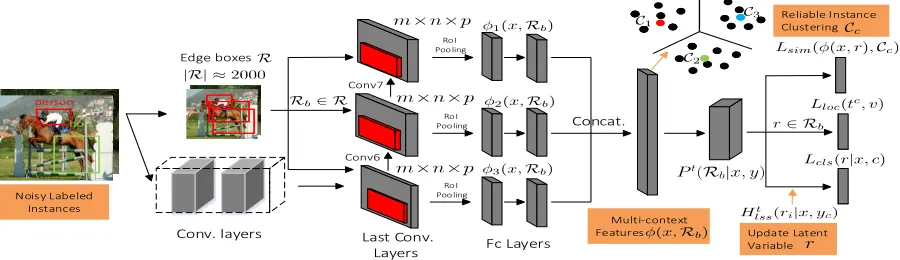
A high-level overview of the proposed SD-LocNet model is shown in Fig. 2. The model is built on the fast RCNN (Girshick 2015) architecture. We present the following novel designs to enable the learning of a localization model from noisy labeled object instances.
Latent Variable Initialization Since the object-level an-notations are not available in WSOL, we treat the missing annotations as latent variables and formulate the localiza-tion model learning as inferring the latent variables. With-out loss of generality, we choose the With-outputs of WSDDN (Bilen and Vedaldi 2016) for latent variable initialization. Given an image x with a set of region proposals R and image-level labely ∈ {1,−1}C, wherey
c= 1indicates the
presence of an object from classc, WSDDN explicitly com-putes image-level classification loss Lcls(φc(x, wcls), yc)
via aggregating region proposal classification scoresxr c,i.e., φc(x, wcls) = P|R|
r=1x
r
c. Herewcls denotes parameters of
the non-linear mapping from inputxto classification output
φc(x, wcls), and xr
c represents the probability score of
re-gionrbelonging to categoryc. For an imagexwithyc= 1,
we choose instancerc that scores highest amongxrc as the
Edge boxes
Last Conv. Layers
Ro I Poo ling
Fc Layers Conv. layers
Ro I Poo ling
Ro I Poo ling
Concat.
Conv6 Conv7
hors e person
Noisy Labeled Instances
Update Latent Variable
Reliable Instance Clustering
Multi-context Features
Figure 2: An overview of SD-LocNet. It starts from noisy labeled instances whose object bounding boxes (latent variables) are not accurate, and updates the latent variables with reliable instances discovered by adaptive sampling. These reliable instances are used to direct the localization on difficult images via optimizing similarity lossLsimof instances from the same category.
Adaptive Sampling The initial latent variables inevitably include noisy labeled instances. Our proposed model aims at improving their localizations by latent variable update along with model training. As noisy labeled instances are detri-mental for network learning, they should be expelled and emphasis should be placed on the clean and reliably labeled ones for robust model learning. To this end, we define a Lo-calization Stability Score (LSS) to effectively measure the reliability (whether it is well localized) of the mined object instance online along with network training. If a candidate positive sample scores consistently high among consecutive training epoches, it is regarded as containing the object of interest with a high probability.
Specifically, given a training imagexwith labelyc= 1,
and the candidate positive samplesRp, whereRp⊂ R. For
each regionr∈ Rp, denote the model probability outputs at
current iteration during epochtasPt(r|x, yc). We compute the LSSHt
lss(r|x, yc)as follows. Instead of relying on static
scores at current iteration (Kumar, Packer, and Koller 2010), we utilize the probability scores{Pt−ti(r|x, yc)}t0
ti=1 pre-dicted among continuoust0epoches for reliability compu-tation.Ht
lss(r|x, yc) is estimated by the ratio of the mean
probabilities{Pt−ti(r|x, yc)}t0
ti=1 and their standard vari-ance, as follows:
Hlsst (r|x, yc) = P t−ti
(r|x, yc) p
var[Pt−ti(r|x, yc)] +V , (1)
wherevar[Pt−ti(r|x, yc)]is the variance of predicted prob-abilities for instancerover the pastt0consecutive epoches, and V is a constant (set as 1) to restrict the scores
within range (0,1). Note that the overhead of computing
Ht
lss(r|x, yc)is very small since we need not do any extra
forward or backward propagation in the neural network. The probabilityPt(r|x, y
c)is computed online by forward
prop-agation and we update the latent variable for the following back propagation at current iteration. Specifically, the sam-plerp with the highestHlsst is chosen as the newly
discov-ered object instance for back propagation:
Lcls(rp|x, yc) =−logPt(rp|x, yc). (2)
Reliability Induced Prior Propagation Giving larger weights to reliable instances enables the network robust to noisy labeled instances, but unfavorably discards instances from difficult images and harms sample diversity. We empir-ically find that simply relying on the classifier model does not work well on transferring the object priors of reliable instances to help discover objects in difficult images. This would make the network overfit reliable instances from easy images and underperform in localization on difficult images. In order to effectively localize objects in difficult images, we propagate object priors from reliable instances to guide the discovery of the same category objects in the difficult im-ages. Towards this goal, we devise a reliability induced prior propagation module that explicitly imposes similarity con-straint among the reliable instances and the mined instances from difficult images. Specifically, for a categoryc, suppose we have the mined object instances rip for image xi with
image labelyic = 1and reliability scoresHlss(rip|xi, yic).
The category specific priors are obtained by a weighted k-means clustering performed on featuresφ(xi, rip), weighted
by Hlss(rip|xi, yic). In this way, we obtain K
representa-tive clustersCc={C1, ...,CK}for categoryc. The similarity
constraint is represented as the minimal Euclidean distance between the mined new instanceφ(x, rp)and the represen-tative clustersCc:
Lsim(φ(x, rp),Cc) = min
k=1,...,K||φ(x, rp)− C k
c||2. (3)
Multi-context Features Context information plays an im-port role in object localization. In fast RCNN, RoI pool-ing is performed on a fixed layer (conv5 layer), which can be treated as covering a fixed range of context informa-tion. However, the optimal context information varies w.r.t. different scenes. To enrich varying context representation, we add two extra convolutional layers (conv6 and conv7 layer, as shown in Fig. 2) to the end of the last convolu-tional layer (conv5layer) with parameters3×3×pI×pO,
where pI and pO denote the number of input and output
con-Algorithm 1SD-LocNet for WSOL
Input: Training setxi∈ X with image-level labelsyi∈ Y,
training epochT, latent variable update starting epochT0, and number of clustersK;
Latent Variable Initialization: For each imagexwith labelyc = 1, and region proposalsR, initialize the latent
variable withrc, whererc∈ R; Forepocht= 1toTdo
Forward Propagation: For each imagex∈ X, forward
xand its sampled region proposalsRbto produce region
probability scoresP(Rb|x, y); ift >=T0
Update Latent Variable:
1). Compute Localization Stability Score
Hlsst (r|x, yc)forr∈ Rpandyc= 1as Eq. (1);
2). Update latent variable with region rp, rp = arg max
ri∈Rp
Hlsst (ri|x, yc);
end if
Back Propagation: For each proposal r ∈ Rb, back
propagate the loss L(Cc, tc, v|x, c, r) defined in Eq. (4)
based on current latent variables;
Update Clusters:For each category c, computing clus-tering centers Cc = {C1, ...,CK} based on current
net-work and latent variables;
end for
Output: Localization modelM.
nected layers independently, producing fixed length vec-tors φi(x, r), i = 1,2,3 for each region r ∈ R. The vectors are concatenated to form the final representation
φ(x, r) = [φ1(x, r)φ2(x, r)φ3(x, r]. In this way,φ(x, r) covers context with different ranges, which we refers to as multi-context features. At below, we will investigate its ef-fectiveness in improving object localization.
3.2
Training
We develop SD-LocNet by integrating the above novel de-signs. Training SD-LocNet requires appropriately designing latent variable update and category prior update strategies. The whole training procedure is summarized in Algorithm 1, and is introduced below.
Multi-task Loss Putting the above different modules to-gether gives a multi-task loss objective for model training. Given an image x, each sampled region r is labeled with a class c, a similarity constraint priorCc, and a bounding
box regression targetvbased on current latent variables (We treat the mined instancerp in Eq. (2) as ground truth, and
follow the positive/negetive sample definitions as in (Gir-shick 2015)). We use the following multi-task loss L to jointly train classification and cluster similarity, as well as the bounding-box regressor:
L(Cc, tc, v|x, c, r) =Hlss{Lcls(r|x, c) + [c≥1]Lloc(tc, v)} + [c≥1]λ(1−Hlss)Lsim(φ(x, r),Cc),
(4)
where Lcls and Lsim are the classification and
similar-ity losses defined in Eq. (2) and Eq. (3), and Hlss is the
LSS score defined in Eq. (1). The localization regression
term Lloc is a robust smoothL1 loss between the tuple of pseudo ground truth bounding-box regression targetsv, and the predicted tupletc for classc(Girshick 2015). The
Iver-son bracket indicator function[c ≥ 1]evaluates to 1 when
c ≥ 1and 0 otherwise. We only impose similarity and re-gression constraints upon foreground classes with c ≥ 1, where c = 0 means the background class. The parame-tersλcontrol the relative contributions of each component. By default, we setλ = 1e−4, and thus all loss terms are roughly equally weighted. The classification loss Lcls (as
well as bounding box regression loss Lloc) and similarity
lossLsimare scaled with weight factorHlssand1−Hlss,
spectively, such that the similarity loss penalizes less on re-liable instances and more on unrere-liable instances (vice versa for the lossLcls). The classification term aims to distinguish
the positive class from the others, while the similarity con-straint term promotes intra-class similarity. The parameter
Hlss adapts the contribution of each term in updating the
latent variables.
Updating Latent Variables A key component of using
Hlss as reliability measurement is to avoid network
over-fitting, since overfitting may result in trivial solution that al-ways chooses the initial regions as the mined objects, and makes the latent variable update ineffective. To solve this issue, we fix the order of training images fed into the net-work in each epoch, thus ensuring adequate training samples from other images during the latent variable update. Fur-thermore, we intentionally process images at different scales during the pastt0epoches, which ensures that the network never sees identical samples during reliability measurement. Meanwhile, it is not necessary to store the prediction history of all previous epoches for reliability measurement. In prac-tice we set t0 as 4, and the overhead memory is constant. In order to avoid bad latent variable update, we exclude the first few epoches when measuring sample reliability and do not update the latent variables for these epoches.
Updating Clusters and Regression Targets Since the re-gion features vary along with the network training, an ideal clustering strategy should be recomputing the features of the mined instances and running k-means clustering during each iteration. However, it is time-consuming and infeasible for network training. For trade-off, we only update the clusters after each epoch, as well as the bounding-box regression tar-gets. We experimentally find that such approximate updating strategy works well in improving localization performance.
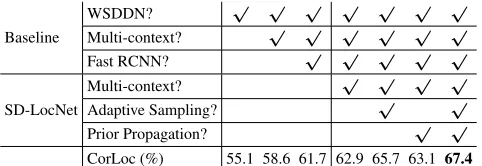
Table 1: Effects of various design modules for Localization.
Baseline
WSDDN? √ √ √ √ √ √ √
Multi-context? √ √ √ √ √ √
Fast RCNN? √ √ √ √ √
SD-LocNet
Multi-context? √ √ √ √
Adaptive Sampling? √ √
Prior Propagation? √ √
CorLoc (%) 55.1 58.6 61.7 62.9 65.7 63.167.4
we select the candidate positive regions based on the WS-DDN (Bilen and Vedaldi 2016) outputs, and only retrain the topRpregions based on the probability scores of the
corre-sponding category. These regions are fixed during each mini-batch sampling and forwarded for latent variable update.
4
Experiments
We choose two pretrained models for experiments: 1) VGG-CNN-M (Chatfield et al. 2014), denoted as model M, for “medium”; 2) VGG-VD (Simonyan and Zisserman 2014) (the16-layer model), denoted as modelL, for “large”. Our model contains multi-branch features, which nearly triples the network parameters. For efficiency, we reduce the pa-rameters on the fully connected fc layers via a truncated SVD decomposition (Girshick 2015). Specifically, each fc
layer with parametersW ∈d×4096(dis the dimension of input features) is decomposed into two sub-layersfc-1and
fc-2, with weightsW1∈d×1024andW2 ∈1024×4096. We copy the parameters of the reducedfclayers to each path for network initialization. This leads to roughly the same number of parameters as the original network. All experi-ments choose edge boxes (Zitnick and Doll´ar 2014) to gen-erate |R| ≈2000 region proposals per image on average, and choose five-scales withs={384,512,640,768,896} for training and testing. We denote the length of its shortest side as the scalesof an image, and cap the longest side at 1,500 pixels to avoid exceeding GPU memory. During net-work training, each SGD is constructed fromN = 1images with mini-batch sizeRb= 256, whereRp= 100proposals
are fixed and the others are randomly sampled.
4.1
Experiments on PASCAL VOC 2007 and 2012
We perform experiments on two PASCAL VOC bench-marks: PASCAL VOC 2007 (Everingham et al. 2010) and VOC 2012 (Everingham et al. 2015), which are widely used for WSOL evaluation. PASCAL VOC 2007 contains 9,963 images spanning 20 object classes, with 5,011 images used fortrainvaland the rest 4,952 fortest. PASCAL VOC 2012 contains 11,540 images fortrainvaland 10,991 fortest. We usetrainvalsplit for training andtestsplit for test. For per-formance evaluation, two kinds of measurements are used: 1) localization protocol CorLoc (Deselaers, Alexe, and Fer-rari 2012) evaluated on the training set; 2) PASCAL style detection protocol (AP) evaluated on the test set.
Model Analysis We first conduct comparative experi-ments with different configurations to reveal how each mod-ule affects the localization performance. The ablation exper-iments are performed on PASCAL VOC 2007 with model
M, and the results are shown in Table 1. For fair compar-isons, we set up another baseline by using WSDDN for ini-tialization, and simply training a fast-RCNN model to refine the localization, which is similar with (Tang et al. 2017). From the table we make the following observations:
• Multi-context features help. We empirically demon-strate that introducing multi-context features improves lo-calization performance of both WSDDN and our SD-LocNet model consistently. For WSDDN, the performance increases by 3.5% (55.1% → 58.6%), while the gain is 1.2%
(61.7% → 62.9%) when we train a fast-RCNN model us-ing multi-context features. The reason is that multi-context features represent object proposals with mixed context in-formation, and are helpful in improving localization.
•Adaptive sampling is crucial.Adding the adaptive sam-pling module brings another 2.8%(62.9% → 65.7%) im-provement in localization. Adaptive sampling is able to au-tomatically figure out the well localized instances for latent variable update, and assign each instance a reliable weight for network optimization. Thus the network is robust to those noisy labeled instances.
• Prior propagation improves localization. Introducing object prior propagation brings another 1.7% (65.7% →
67.4%) improvement. Note, the reliability of object priors is important for performance improvement. For comparison, we simply add similarity constraints by penalizing the dif-ferences between mined objects and representative clusters, which are obtained from all instances mined from the previ-ous epoch, without discriminating their reliability. The per-formance decreases to 63.1%, proving the necessity of se-lecting trusted instances for prior propagation.
Parameter Analysis We now analyze the influences of three parameters,i.e.,the number of clustersKfor each cat-egory, the start update epoch T0, and the number of can-didate positivesRp. For simplicity, the default settings for
three parameters areK= 3,T0= 5, andRp = 100, and the
other two parameters are fixed during inspecting the target parameter. The localization results w.r.t. different parameters are shown in Fig. 3. We empirically find that: 1) The perfor-mance improves by around 1%when K increases from 1 to 3, and is stable with largerKvalue. 2) The start update epochT0is robust as the training process goes, as long as we exclude the prediction history near the beginning epoches (T0= 3,4). It is intuitive since the network has not learned object priors during the initial few epoches. 3) Our method achieves comparable results when only retain Rp = 100
(retaining over99%probability contributions for classifica-tion) samples on average, which excludes the majority of negative samples for positive instance mining, and acceler-ates the network training without sacrificing performance. We compute the recall ofRp with respect to ground truth
re-Figure 3: Localization results on PASCAL VOC 2007 versus (a) number of clustersK, (b) start updating epochT0, and (c) number of candidate positivesRp. In (d), we compute the recall ofRpat different overlapping thresholds.
Table 2: Localization precision (%) comparisons on PASCAL VOC 2007trainvalsplit
method aer bik brd boa btl bus car cat cha cow tbl dog hrs mbk prs plt shp sfa trn tv mean
WSDDN(Bilen and Vedaldi 2016) 65.1 58.8 58.5 33.1 39.8 68.3 60.2 59.6 34.8 64.5 30.5 43.0 56.8 82.4 25.5 41.6 61.5 55.9 65.9 63.7 53.5 ConLocNet(Kantorov et al. 2016) 83.3 68.6 54.7 23.4 18.3 73.6 74.1 54.1 8.6 65.1 47.1 59.5 67.0 83.5 35.3 39.9 67.0 49.7 63.5 65.2 55.1
ODGA(Diba et al. 2017b) 85.5 75.0 66.9 47.5 43.6 67.4 83.6 61.7 36.8 75.1 29.8 55.9 70.4 80.6 29.0 52.9 71.0 31.2 66.9 58.1 59.4 OICR(Tang et al. 2017) 81.7 80.4 48.7 49.5 32.8 81.7 85.4 40.1 40.6 79.5 35.7 33.7 60.5 88.8 21.8 57.9 76.3 59.9 75.3 81.4 60.6
OICREns.(Tang et al. 2017) 85.8 82.7 62.8 45.2 43.5 84.8 87.0 46.8 15.7 82.2 51.0 45.6 83.7 91.2 22.2 59.7 75.3 65.1 76.8 78.1 64.3
SD-LocNet-M 76.6 78.0 66.2 47.4 51.8 81.7 86.7 79.6 36.7 72.6 60.0 61.6 80.4 88.8 43.4 54.0 73.9 64.3 78.4 65.1 67.4
SD-LocNet-L 81.5 83.5 70.0 46.4 52.9 80.1 89.1 73.6 37.3 75.2 73.0 62.5 85.0 91.4 51.3 63.7 79.2 72.9 80.5 68.8 70.9
Table 3: Detection precision (%) comparisons on PASCAL VOC 2007testsplit
method aer bik brd boa btl bus car cat cha cow tbl dog hrs mbk prs plt shp sfa trn tv mAP
WSDDN(Bilen and Vedaldi 2016) 39.4 50.1 31.5 16.3 12.6 64.5 42.8 42.6 10.1 35.7 24.9 38.2 34.4 55.6 9.4 14.7 30.2 40.7 54.7 46.9 34.8 ConLocNet(Kantorov et al. 2016) 57.1 52.0 31.5 7.6 11.5 55.0 53.1 34.1 1.7 33.1 49.2 42.0 47.3 56.6 15.3 12.8 24.8 48.9 44.4 47.8 36.3
OICR(Tang et al. 2017) 58.0 62.4 31.1 19.4 13.0 65.1 62.2 28.4 24.8 44.7 30.6 25.3 37.8 65.5 15.7 24.1 41.7 46.9 64.3 62.6 41.2 ODGA(Diba et al. 2017b) 50.9 61.2 40.5 31.4 21.1 71.6 58.1 42.9 11.7 46.4 30.7 44.5 48.3 64.9 16.8 24.8 47.1 55.7 61.7 55.8 44.3
OICREns.(Tang et al. 2017) 65.5 67.2 47.2 21.6 22.1 68.0 68.5 35.9 5.7 63.1 49.5 30.3 64.7 66.1 13.0 25.6 50.0 57.1 60.2 59.0 47.0
SD-LocNet-M 59.2 67.2 46.1 29.6 21.6 65.7 68.0 61.4 17.3 53.1 50.6 38.3 67.7 69.1 26.8 25.1 49.2 52.2 60.9 39.6 48.4
SD-LocNet-L 65.1 72.5 50.3 31.3 24.2 68.3 70.9 65.1 19.0 51.0 53.4 47.5 70.2 69.9 25.9 25.6 45.8 57.9 71.2 40.9 51.3
Fast-RCNN(Girshick 2015) 74.5 78.3 69.2 53.2 36.6 77.3 78.2 82.0 40.7 72.7 67.9 79.6 79.2 73.0 69.0 30.1 65.4 70.2 75.8 65.8 66.9
Table 4: Comparisons on PASCAL VOC 2012.
Method CorLoc mAP
ConLocNet(Kantorov et al. 2016) 54.8 35.3
DSD(Jie et al. 2017) 58.8 38.3
OICR(Tang et al. 2017) 62.1 37.9
ZLDN (Zhang et al. 2018) 61.5 42.9
SD-LocNet 69.1 49.2
Fast-RCNN (Girshick 2015) - 65.7
Table 5: Comparisons on MS COCO 2014.
Methods CorLoc mAP
@.5 @[.5,.95] WSDDN(Bilen and Vedaldi 2016) 26.1 11.5 4.3
WCCN (Diba et al. 2017a) - 12.3
-ODGA (Diba et al. 2017b) - 12.8
-SD-LocNet 40.3 21.6 9.7
Fast-RCNN (Girshick 2015) - 38.6 18.9
gion proposal with overlap at least 0.5 and 0.75, respectively. As shown in Fig. 3 (d), the recall is over95% at threshold 0.5 whenRp = 100, which demonstrates that the candidate
positives contain the object with high probability.
Comparisons with State-of-the-arts We compare our re-sults with state-of-the-arts for both localization and detec-tion. Unless specified, all other results choose modelL.
• CorLoc evaluation.Table 2 shows the localization re-sults on PASCAL VOC 2007 trainval split in terms of
CorLoc (Deselaers, Alexe, and Ferrari 2012). Our method achieves an accuracy of67.4%with modelM, which already outperforms the state-of-the-art (Tang et al. 2017) (60.6%) with a deeper model. Moreover, replacing with modelL, we achieve a CorLoc of70.9%,6.6%better than previous best-performing result (Tang et al. 2017) (64.3%) using model ensemble. We also report localization results on PASCAL VOC 2012, shown in Table 4. SD-LocNet achieves69.1%
Figure 4: Per-class frequency of error modes on PASCAL VOC 2007 with WSDDN (Bilen and Vedaldi 2016) (left col-umn in each group) and SD-LocNet (right colcol-umn).
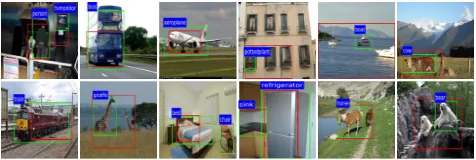
In order to better understand the localization errors, we categorize each of our predicted bounding boxes (object hy-potheses) into the following five cases: 1) correct localiza-tion, i.e., IoU overlap is greater than 0.5 with the ground truth. 2) hypothesis completely inside the ground truth, 3) ground truth completely inside the hypothesis, 4) no overlap, IoU equals to zero, and 5) low overlap, none of the above. Fig. 4 illustrates the error distribution of WSDDN (Bilen and Vedaldi 2016) and the proposed SD-LocNet across 20 cat-egories on Pascal VOC 2007 trainval set. It can be shown that SD-LocNet improves localization for all classes, but the error modes vary according to different classes. For deformable objects such as cat and person, the main er-ror comes from localizing object parts (hypotheses in g.t.), while for classes such asboatandchair, the majority of er-ror is localizing too large region (g.t. in hypotheses), since it is difficult to localize the object or object parts due to the cluttered background or the small scale target. Some exam-ple localizations are shown in Fig. 5 (top row). The results of SD-LocNet are shown in green bounding boxes, and the initial localization results returned by WSDDN are in red bounding boxes. It can be seen that SD-LocNet is able to refine the localizations that are noisily labeled.
•AP evaluation.Table 3 shows the detection performance on VOC 2007 testsplit. Just using model M, our method achieves an accuracy of48.4%,4.1%higher than the best-performing method (Diba et al. 2017b) (44.3%) using a sin-gle model. When switching to modelL, the detection accu-racy increases to51.3%, which is about4.3%better than the best-performing result (Tang et al. 2017) (47.0%). For PAS-CAL VOC 2012, the result is49.2%with model L,6.3%
more accurate than (Zhang et al. 2018) (42.9%).
•Comparisons with fully supervised fast-RCNN.It is in-teresting to compare our weakly supervised detections with the fast-RCNN (Girshick 2015) which uses ground truth bounding box annotations for training. As shown in Table 3, the performance of SD-LocNet is around15%lower than fast-RCNN. However, for vehicles likemotorbikeandtrain, the performance approaches (within5% gap) the fully su-pervised one (69.9%vs73.0%formotorbike, and71.2%vs
75.8%fortrain). This implies that it is possible to train cor-responding detection models on these classes without requir-ing object annotations. However, for classes such aschair
andperson, the performance gap is still large. It remains a further research orientation to correctly localize these ob-jects for detection model training.
Figure 5: Example localization comparisons of WSDDN (Bilen and Vedaldi 2016) (red bounding boxes) and SD-LocNet (green bounding boxes) on PASCAL VOC 2007 (top tow) and MS COCO 2014 (bottom row). SD-LocNet is able to update the noisy labeled instances for better localization.
4.2
Experiments on MS COCO
To further validate the effectiveness of SD-LocNet, we eval-uate it on a much larger dataset MS COCO 2014 (Lin et al. 2014) with over 135k images spanning 80 categories, of which around 80k images are used fortrainand around 40k forval. We choose thetrainsplit for training and thevalsplit for test. Compared with PASCAL VOC 2012, MS COCO is more challenging: it includes more images (135k vs 22k), more categories (80 vs 20), more complex scenes (7.7 in-stances per image vs 2.3 inin-stances per image, averagely), and more images with smaller objects. To our best knowl-edge, few works have reported results on MS COCO under weakly supervised paradigms.
Table 5 shows localization and detection results on MS COCO 2014. We obtain 40.3%localization accuracy, im-proving the baseline WSDDN (Bilen and Vedaldi 2016) by
14.2%. For detection, the PASCAL style evaluation (mAP
@.5) result is 21.6%,8.8%better than (Diba et al. 2017b) (12.8%). Some example localization results are shown in Fig. 5 (bottom row). We also report the new COCO-style criterion (mAP@[.5, .95]). Our method achieves9.7%mAP under the weakly supervised paradigm. For comparisons, the last row shows results of fast-RCNN using ground truth ob-ject annotations for training. Our results are promising con-sidering the challenges of this dataset.
5
Conclusions
This paper proposed a robust optimization strategy to im-prove localization accuracy in WSOL, which first selects re-liable instances for model training, and then propagates ob-ject priors of the reliable instances to the unreliable ones for better localization. With our effective Localization Stability Score measuring the reliability of candidate positive sam-ples, we emphasize the reliable instances that are well local-ized for robust learning. Then, we propagate object priors of reliable instances to direct localization on difficult images by explicitly imposing intra-similarity. An SD-LocNet is in-stantiated from the proposed optimization strategy. Experi-ments on benchmark datasets well confirm the effectiveness of our proposed method.
to Yang Yang by NSFC under Project 61572108 and Project 61632007.
References
Bengio, Y.; Louradour, J.; Collobert, R.; and Weston, J. 2009. Curriculum learning. InICML, 41–48. ACM. Bilen, H., and Vedaldi, A. 2016. Weakly supervised deep detection networks. InCVPR, 2846–2854.
Bilen, H.; Pedersoli, M.; and Tuytelaars, T. 2015. Weakly supervised object detection with convex clustering. In
CVPR, 1081–1089.
Chatfield, K.; Simonyan, K.; Vedaldi, A.; and Zisserman, A. 2014. Return of the devil in the details: Delving deep into convolutional nets.BMVC.
Cinbis, R. G.; Verbeek, J.; and Schmid, C. 2014. Multi-fold mil training for weakly supervised object localization. In
CVPR, 2409–2416.
Deselaers, T.; Alexe, B.; and Ferrari, V. 2012. Weakly su-pervised localization and learning with generic knowledge.
IJCV100(3):275–293.
Diba, A.; Sharma, V.; Pazandeh, A.; Pirsiavash, H.; and Van Gool, L. 2017a. Weakly supervised cascaded convo-lutional networks.CVPR914–922.
Diba, A.; Sharma, V.; Stiefelhagen, R.; and Van Gool, L. 2017b. Object discovery by generative adversarial & ranking networks. arXiv preprint arXiv:1711.08174.
Dietterich, T. G.; Lathrop, R. H.; and Lozano-P´erez, T. 1997. Solving the multiple instance problem with axis-parallel rectangles. Artifi. Intell.89(1):31–71.
Everingham, M.; Van Gool, L.; Williams, C. K.; Winn, J.; and Zisserman, A. 2010. The pascal visual object classes (voc) challenge.IJCV88(2):303–338.
Everingham, M.; Eslami, S. A.; Van Gool, L.; Williams, C. K.; Winn, J.; and Zisserman, A. 2015. The pascal visual object classes challenge: A retrospective. IJCV111(1):98– 136.
Girshick, R. 2015. Fast r-cnn. InICCV, 1440–1448. Jie, Z.; Wei, Y.; Jin, X.; Feng, J.; and Liu, W. 2017. Deep self-taught learning for weakly supervised object localiza-tion.CVPR.
Joulin, A., and Bach, F. 2012. A convex relaxation for weakly supervised classifiers. ICML.
Kantorov, V.; Oquab, M.; Cho, M.; and Laptev, I. 2016. Con-textlocnet: Context-aware deep network models for weakly supervised localization. InECCV, 350–365. Springer. Kumar, M. P.; Packer, B.; and Koller, D. 2010. Self-paced learning for latent variable models. InNIPS, 1189–1197. Li, D.; Huang, J.-B.; Li, Y.; Wang, S.; and Yang, M.-H. 2016. Weakly supervised object localization with progres-sive domain adaptation. InCVPR, 3512–3520.
Lin, T.-Y.; Maire, M.; Belongie, S.; Hays, J.; Perona, P.; Ramanan, D.; Doll´ar, P.; and Zitnick, C. L. 2014. Mi-crosoft coco: Common objects in context. InECCV, 740– 755. Springer.
Nguyen, M. H.; Torresani, L.; de la Torre, F.; and Rother, C. 2009. Weakly supervised discriminative localization and classification: a joint learning process. In Proc. Int. Conf. Comput. Vis., 1925–1932.
Oquab, M.; Bottou, L.; Laptev, I.; and Sivic, J. 2015. Is ob-ject localization for free?-weakly-supervised learning with convolutional neural networks. InCVPR, 685–694. Ouyang, D.; Shao, J.; Zhang, Y.; Yang, Y.; and Shen, H. T. 2018. Video-based person re-identification via self-paced learning and deep reinforcement learning framework. In
ACM Multimedia, 1562–1570.
Shrivastava, A.; Gupta, A.; and Girshick, R. 2016. Train-ing region-based object detectors with online hard example mining. InCVPR, 761–769.
Simonyan, K., and Zisserman, A. 2014. Very deep convo-lutional networks for large-scale image recognition. CoRR
abs/1409.1556.
Song, H. O.; Girshick, R. B.; Jegelka, S.; Mairal, J.; Har-chaoui, Z.; Darrell, T.; et al. 2014a. On learning to localize objects with minimal supervision. InICML, 1611–1619. Song, H. O.; Lee, Y. J.; Jegelka, S.; and Darrell, T. 2014b. Weakly-supervised discovery of visual pattern configura-tions. InNIPS, 1637–1645.
Tang, P.; Wang, X.; Bai, X.; and Liu, W. 2017. Multiple instance detection network with online instance classifier re-finement. InCVPR.
Vijayanarasimhan, S., and Grauman, K. 2008. Keywords to visual categories: Multiple-instance learning forweakly su-pervised object categorization. InCVPR, 1–8. IEEE. Wang, C.; Ren, W.; Huang, K.; and Tan, T. 2014. Weakly supervised object localization with latent category learning. InECCV. 431–445.
Zhang, X.; Feng, J.; Xiong, H.; and Tian, Q. 2018. Zigzag learning for weakly supervised object detection. InCVPR. Zhou, B.; Khosla, A.; Lapedriza, A.; Oliva, A.; and Torralba, A. 2016. Learning deep features for discriminative localiza-tion. InCVPR, 2921–2929. IEEE.
Zhu, Y.; Zhou, Y.; Ye, Q.; Qiu, Q.; and Jiao, J. 2017. Soft proposal networks for weakly supervised object localization.
arXiv preprint arXiv:1709.01829.