133
Original article
Phytochemical analysis and comparative study of in vitro
free radical scavenging activity of different extracts
of leaves of Abrus precatorius L.
Chirag M. Modi, Vipul C. Ladumor, Urvesh D. Patel, Harshad B. Patel, Shivani L. Solanki and Dixita H . Bhadarka Department of Pharmacology and Toxicology, College of Veterinary Science and Animal Husbandry,
Junagadh Agricultural University, Junagadh-362 001, Gujarat, India
Received September 14, 2018: Revised October 30, 2018: Accepted November 5, 2018: Published online December 30, 2018 Abstract
The present study was carried out to evaluate and find the extracts having potential in vitro antioxidant property of leaves of Abrus precatorius L. (Family: Fabaceae). The free radical’s scavenging effect was determined by in vitro antioxidant assays, using 2, 2-diphenyl-2-picryl-hydrazyl free radical (DPPH) method. The extract was obtained by maceration process using three solvents, namely; water, methanol and chloroform. The phytochemical analysis of the leaves revealed the pr esence of alkaloids, saponin, ta nnin and several polyphenols. The differ ent concentrations of extracts (g/ml) were prepared and used to evaluate antioxidant activity as a percentage inhibition. The results showed that per centage inhibition of DPPH by methanol, chloroform and aqueous extracts were 75.16, 72.09 and 62.22% at 300 g/ml, respectively. Methanolic extract of A. preca torius showed good inhibition as compa red to ascorbic acid (p<0.05) due to high phenolic content in the leaf extract. It was concluded that methanolic extract of leaves of A. precatorius plant exhibited potent in vitro free radical scavenging activity.
Key words: Abrus precatorius L., phytochemical analysis, antioxidant activity
Copyright @ 2018 Ukaaz Publications. All rights reserved. Email: [email protected]; Website: www.ukaazpublications.com
1. Introduction
Abrus precatorius L. is commonly found in the tropical and sub-tropical regions of the World. It is native to India. It belongs to Febaceae family, commonly known as Gunja or Jequirity (John et al., 2012). The stem, bark, leaves and roots of this plant have medicinal potential to cure and prevent various disease conditions. The different parts of the plant are also used as a traditional medicine to treat scratches, sores and wounds caused by animals and mechanical injury (Attal et al., 2010). The leaves of A. precatorius have laxative, expectorant and aphrodisiac properties and are used to cure fever, cough and cold (Pade, 1957). Several active compounds have been isolated and identified from the leaves of A. precatorius including abrine, trigonelline, abruslactone A, hemiphloin, abrusoside A, abrusoside B, abrusoside C, abrusoside
D, arabinose, galactose, xylose, choline, hypaphorine, precatorine (Garaniya and Bapodra, 2014).
Free radicals or reactive oxygen species (ROS) are produced by xenobiotics in living organism which may destroy the physiological process at cellular level (Madhavi et al., 1996). Oxidative stress produced by increasing of reactive oxygen species is associated with various disease conditions. Oxidative stress causes the loss of physiological functions of tissues and organs (Fang et al., 2002).
Annals of Phytomedicine 7(2): 133-137, 2018
DOI: 10.21276/ap.2018.7.2.21; Print ISSN : 2278-9839 and Online ISSN : 2393-9885 7(2):133-137 (2018)
Ann. Phytomed.,
Author for correspondence: Dr. Chirag M. Modi
Assistant Professor, Department of Pharmacology and Toxicology, College of Veterinary Science and Animal Husbandry, Junagadh Agricultural University, Junagadh-362 001, Gujarat, India E-mail: [email protected]
Tel.: +91-9428757409
There is crucial role of medicinal plants in human society and animal well being to combat diseases (Nostro et al., 2000). India is commonly found of huge of herbal plants. Nowadays, various diseases have been treated by medicinal plants (Raghavendra et al.,
2013). Medicinal plants are widely used for the treatment of various diseases du e to presen ce of active ph ytoconstitu en ts. Phytoconstituents of plants having antioxidant properties which can prevent various biochemical processes. Antioxidant properties are also used for potential therapeutic effect. Natural antioxidant effects of compounds derived from medicinal plants are most popular nowadays (Pal et al., 2009; Rajeshwari et al., 2013; Manoharachary and Nagaraju, 2016). There have many unknown chemical substances in medicinal plants which are produced therapeutic effects. The leaves extract of A. precatorius have been shown to possess antibacterial, antifungal (Prashith et al., 2010), antitumor, immunopotentiating (Ghosh and Maiti, 2007) and anti-inflammatory activities (Anam, 2001). Based on the traditional uses and pharmacological properties of A. precatorius, the present study was conducted to investigate in vitro antioxidant activity of the different extracts of leaves of A. precatorius.
2. Materials and Methods
2.1 Plant material
The leaves powder was made using mixture grinder and stored in air tight container.
2.2 Preparation of extract
Different extracts of the plant were prepared by maceration process. 10 g of plant material was uniformly soaked in 100 ml. chloroform, water and methanol for 72 h, followed by filtration of extracts with the help of filter paper (Whatman No. 1). The solvent was evaporated in a rotary evaporator. The dried extracts were used to evaluate in vitro antioxidant activity.
2.3 Chemicals and reagents
Chemical such as 2, 2-diphenyl-1-picryhydrazyl (DPPH) was procured from Sigma Aldrich, Bengaluru, India. L-ascorbic acid and solvents of analytical grade were procured from Merck Ltd. Mumbai, India.
2.4 Phytochemical screening of leaves of A. precatorius
Chemical tests were performed for different extracts according to standard methods to detect major phytochemicals like alkaloids, glycosides, saponins, phenol, tannins, etc., in the extract (Evans, 2002).
2.4.1 Detection of alkaloids
Methanolic extract was diluted in acidic solution like 1-5% HCL. This test solution was used for detection of alkaloid using various reagents.
Dragendorff’s test: 1 ml of test solution was mixed with Dragen-dorff’s reagent. Formation of bright orange precipitates confirmed presence of alkaloid in the sample.
Mayer’s test: 1 ml of test solution was mixed with Mayer’s reagent. Formation of white or buff precipitates confirmed presence of alkaloid in the sample.
Wagner’s test: 1 ml of test solution was mixed with Wagner’s reagent. Formation of brown precipitates confirmed presence of alkaloid in the sample.
Hager’s test: 1 ml of test solution was mixed with Hager’s reagent. Formation of yellow precipitates confirmed presence of alkaloid in the sample.
2.4.2 Detection of flavonoids
Extract dissolved in methanol solvent can be used as test solution.
Shinoda test: 1 ml of test solution was mixed with magnesium powder and a few drops of concen trated HCL was added. Development of orange, pink, red to purple color which showed the presence of flavonoid. By using zinc instead of magnesium, only development of deep-red to magenta color or weak pink to magenta color or no color which indicates presence of flavonoid.
Sulfuric acid test: 1 ml of test solution was mixed with few drops of concentrated H2SO4. Flavones or flavonols, chalcones or aurones
and flavanones produced a deep yellow, red bluish and orange to red colors solution, respectively.
2.4.3 Detection of sterol
Extract dissolved in chloroform solvent can be used as test solution.
Salkowaski test: 2 ml of concentrated H2SO4was added into 1 ml
of test solution along the side of the test tube, forming two phases and development of red color which indicates the presence of sterol.
2.4.4 Detection of phenols
Ferric chloride test: Test solution was mixed with 1 ml of 5%
FeCl3 in 90% methanol. It was observed for blue, blue-black, or blue-green color which indicates the presence of polyphenols.
2.4.5 Detection of saponins
Pinch of extract was dissolved in water and shaken well. Formation of foam indicated the presence of saponin in the test sample. Foam which was stable for 15 min or more, then it was considered as positive.
2.4.6 Detection of sugars
Extract dissolved in polar solvent like water can be used as test solution.
Molisch’s test: 1 ml test solution was mixed with 1 ml of 10 % methanolic -napthol solution and then 4 to 5 drops of concentrated
H2SO4 was added along the side of the test tube. It was observed for
violet ring which indicates the presence of glycoside or sugar.
2.5 Determination of antioxidant activity
The scavenging activity of various extracts of A. precatorius leaves was determined using DPPH assay (Senguttuvan et al., 2014). One mg per ml solution was prepared by dissolving 30 mg extract in 30 ml Milli-Q water. Suitable dilutions were made from this stock solution with Milli-Q water only. All the dilutions were taken in test tubes up to 3 ml of sample solution of different concentrations (15, 30, 75, 150, 225, 300 g/ml). 4 mg of DPPH was dissolved into 100 ml methanol to prepare 0.1 mM DPPH solution. Then 3 ml of sample solution was mixed with 1 ml of 0.1 mM DPPH. The reaction mixture was incubated for 20 min at 28°C in the dark. The control containing 3 ml water and 1 ml 0.1 mM DPPH was used as blank. Then, absorbance of sample solution of varying concentrations was taken. The DPPH radical scavenging activity was determined by measuring the absorbance at 517 nm, using a spectrophotometer (UV-2900). Standard ascorbic acid of various concentrations like 15, 30, 75, 150, 225, 300 g/ml were prepared into water and served as a positive control. The assay was performed in triplicate. The antioxidant activity of plant extracts were calculated using the following equation which expressed as percent inhibition.
%inhibition = (Absorbance of control – Absorbance of control)/ Absorbance of control ×100
Statistical analysis: All data were expressed in Mean ± S.E. (n=3). Data were analyzed by one-way ANOVA followed by Duncan Multiple Range Test (DMRT) to compare difference in means.
3. Results and Discussion
3.1 Phytochemical analysis of leaf extracts of A. precatorius
compounds. In the present study, phytochemical analysis has been performed in chloroform, water and meth an ol extracts of
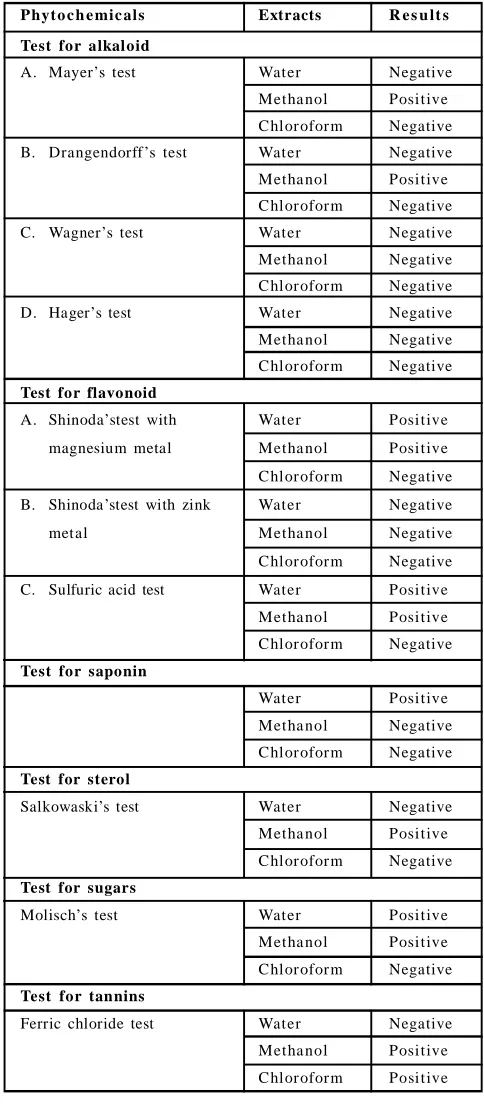
A. precatorius leaf which revealed the presence of alkaloids, saponin, tannin and flavonoids. Methanolic extracts of leaf have been observed major phytochemicals like, alkaloids, tannin and flavonoids as compared to chloroform and water extracts. Methonolic solvent has subjected to extract major phytochemicals due to the soluble of the wide range of polar substances. This result supported with previous reported studies on methanolic extract of leaf of A. precatorius (Georgewill and Georgewill, 2009; Kuo et al., 2009). Presence of flavonoids in Nyctanthes arbortristis L. (leaf) (Ladumor
et al., 2017) and Argyreia osyrensis (leaves and fruits) (Mahendra
et al., 2016) and Aegle marmelos (Tiwari et al., 2016) are reported earlier. Many flavonoid and other secondary metabolites from crude extract of plant showed effective hepatoprotective, antifungal, antipyretic, antibacterial, anti-inflammatory and antioxidant activities. These results agreed with Taur and Patil (2005) and Gnanavel and Mary (2013) who have observed that the ethanolic and petroleum ether extracts of A. precatorius leaves showed presence of steroids, saponins, alkaloids, flavonoids and glycoside.
Test for alkaloids: Samples were tested with Wagner’s test, Hager’s test, Mayer’s test and Drangendorff’s test for detection of alkaloids. Chloroform and water extracts did not produce in color in all tests which indicate of absence of alkaloids. However, methanol extract showed change in colors in Mayer’s test and Drangendorff’s test which indicates that methanol extract of plant contains alkaloids.
Test for flavonoid: Shinoda test with magnesium metal, Shinoda test with zink metal and Sulfuric acid test for flavonoid were detected in extract samples. Water and methanol extracts were observed color in Shinoda test with magnesium metal and Sulfuric acid test which showed presence of flavonoid in samples, while chloroform did not produce in color in all tests which indicated of absence of flavonoid. Flavonoids exhibits numerous pharmacological properties like gastroprotective, antisecretary, cytoprotective and antioxidant activities (Narayana et al., 2001). Likewise, the fraction of the flavonoid extract proved gastric protection (Kuhnau, 1976).
Test for saponin: Water extract was observed the stabilize foaming up to 10 min, which was an indication of presence of positive in samples. When chloroform and methanol extracts were not showed foam.
Test for sterol: Salkowaski’s test showed brown color in methanol extracts, while chloroform and methanol extracts were observed colorless which indicated the absence of sterol in samples.
Test for sugars: Red brown ring was observed in water and methanol extracts treated with Molisch’s test while chloroform extract has no color change which indicated the negative result of samples
Test for tannins: All extracts treated with ferric chloride test were observed color change which was indicated the positive result of samples.
3.2 Antioxidant activity of leaf of A. precatorius
Preliminary free radical activity of the plant extract was evaluated by DPPH scavenging activity (Bhuiyan et al., 2009). The DPPH
assay is rapid, reliable and reproducible which is commonly used for the evaluation of in vitro antioxidative properties of pure compounds as well as plant extracts (Koleva et al., 2002). The
reducing capacity of test compounds can serve as indicator of potential antioxidant property (Meir et al., 1995). Plant extracts acts as electrons donor, were determined by in vitro antioxidant assays, using 2, 2-diphenyl-2-picryl-hydrazyl free radical (DPPH)
scavenging because of their content in phenolic compounds (Braca
et al., 2002).
Table 1:Phytochemical scr eening of various extra cts of A. precatorius leaves
Phyt o c h e mic als Extracts R e s u lt s Test for alkaloid
A. Mayer’s test Water Negative
Metha nol Positive Chlor ofor m Negative
B. Drangendorff ’s test Water Negative
Metha nol Positive Chlor ofor m Negative
C. Wagner’s test Water Negative
Metha nol Negative
Chlor ofor m Negative
D. Hager’s test Water Negative
Metha nol Negative
Chlor ofor m Negative Test for flavonoid
A. Shinoda’stest with Water Positive
magnesium metal Metha nol Positive
Chlor ofor m Negative B. Shinoda’stest with zink Water Negative
metal Metha nol Negative
Chlor ofor m Negative
C. Sulfuric acid test Water Positive
Metha nol Positive Chlor ofor m Negative Test for saponin
Water Positive
Metha nol Negative
Chlor ofor m Negative Test for sterol
Salkowaski’s test Water Negative
Metha nol Positive Chlor ofor m Negative Test for sugars
Molisch’s test Water Positive
Metha nol Positive Chlor ofor m Negative Test for tannins
Ferric chloride test Water Negative
Table 2: DPPH scavenging activity of various extracts of A. precatorius leaves
62.22 ±7.45a 72.09 ±7.53b
75.16 ±3.39b 65.45 ±1.86a
300
58.25 ±10.23a 64.64 ±6.41ab
71.28 ±5.19b 64.56 ±1.85ab
225
59.63 ±9.44a 60.03 ±6.73a
64.81 ±4.95a 63.83 ±2.16a
150
53.88 ±8.96a 52.99 ±5.68a
55.18 ±5.30a 59.55 ±2.14a
75
50.73 ±10.50ab 47.65 ±6.54a
51.05 ±5.66ab 58.33 ±2.25b
30
43.53 ±7.55a 43.85 ±5.50a
47.49 ±5.27a 57.44 ±1.89b
15
Water Chloroform
Methanol Ascorbic acid
Percent inhibition (mean ±SE) Concentrations
(µg/ml)
62.22 ±7.45a 72.09 ±7.53b
75.16 ±3.39b 65.45 ±1.86a
300
58.25 ±10.23a 64.64 ±6.41ab
71.28 ±5.19b 64.56 ±1.85ab
225
59.63 ±9.44a 60.03 ±6.73a
64.81 ±4.95a 63.83 ±2.16a
150
53.88 ±8.96a 52.99 ±5.68a
55.18 ±5.30a 59.55 ±2.14a
75
50.73 ±10.50ab 47.65 ±6.54a
51.05 ±5.66ab 58.33 ±2.25b
30
43.53 ±7.55a 43.85 ±5.50a
47.49 ±5.27a 57.44 ±1.89b
15
Water Chloroform
Methanol Ascorbic acid
Percent inhibition (mean ±SE) Concentrations
(µg/ml)
Values in the same row with different superscripts are significantly (p<0.05) different.
Figure 1: Percent inhibition of different extracts of A. precatorius leaves.
The antioxidant potential of various extracts of A. precatorius was determined by their ability to reduce the DPPH. Antioxidant activity was investigated by applying different concentrations (15, 30, 75,
150, 225 and 300 µg/ml) of leaves extracts of A. precatorius. The antioxidant activity of the different extracts is represented in Table 2.
In the present study, the percentage of scavenging effect was concomitantly increased with the increasing concentrations (15 to 300 g/ml) of leaves extracts of A. precatorius. This result supports with previous study which demonstrated antioxidant properties of extracts from leaves of A. precatorius increased with increasing concentrations (Mir et al., 2013). The inhibition ranges were from 47.49 to 75.16, 43.85 to 72.09 and 43.53 to 62.22 % for the methanol, chloroform and water extracts, respectively as compared to 57.44 to 65.45 % for the ascorbic acid. The methanol extract from the leaves of A. precatorius produced significantly (p<0.05) higher inhibition of DPPH at 225 µg/ml concentration as compared
to the chloroform and water extracts. Moreover, it was observed that chloroform extract has produce marked scavenging activity
equivalent with methanolic extract at 300 µg/ml concentration.
This effect might be due to effective hydrogen donating capability of methanolic extract leaves of A. precatorius, which indicates good source of antioxidants (Michalak, 2006). These results were in accordance with Repetto and Liesuy (2002) who had observed that the antioxidant activity of flavonoids is efficient in trapping super-oxide anion, hydroxyl, peroxyl and alcohoxyl radicals. Flavonoids have been reported as strong antioxidant bioactive compounds against free radicals which act on number of hydroxyl substitutions (Pandey and Rizvi, 2009). In our study, leaf extracts of A. precatorius showed significant scavenging activity against free radicals which may be due to the presence of phenolic compounds. Present finding is supported by Mahendra et al. (2016) and Kuntal
et al. (2017) who have reported that the presence of phenolic compoun ds in cluding flavon oids which are responsible for antioxidants activities and reducing power of plant extract.
4. Conclusion
to present from the methanolic extract of the leaves of A. precatorius
by chemical meth ods analysis. T he presence of secon dary metabolites having pharmacological properties can be used of the leaves of A. precatorius for various ailments by traditional practitioners. The leaves of A. precatorius showed radical scavenging activity in all the solvent (chloroform, water and methanol) extracts. Out of them, methanolic extract from A. precatorius leaves produced very good inhibition against free radicals which might be due to high phenolic content. Therefore, it can be used as a source of natural antioxidants.
Conflict of interest
We declare that we have no conflict of interest.
References
Anam, E. (2001). Anti-inflammatory activity of compounds isolated from the aerial parts of Abrus precatorius (Fabaceae). Phyto-medicine, pp:24-27.
Attal, A. R.; Otari, K. V.; Shete, R. V.; Upasani, C. D. and Nandgude, T. D. (2010). Abrus precatorius Linnaeus: A phytopharmacological review. J. Pharm. Res., 3(11):2585-2587.
Bhuiyan, M. A. R.; Hoque, M. Z. and Hossain, S. J. (2009). Free radical scavenging activities of Zizyphus mauritiana. World J. Agr. Sci., 5:31 8-32 2.
Braca, A.; Sortino, C. and Politi, M. (2002). Antioxidant activity of flavonoids from Licania licaniae flora. J. Ethnopharmacol., 79:379-381. Evan s, W. C . (200 2). Trea se and Evans Phar macognosy, 1 5th Edn.
Philadelphia, Pa: W. B. Saunders.
Fang, Y.; Yang, S. and Wu, G. (2002). Free radicals, antioxidants, and nutrition. Nutrition., 8:872-879.
Georgewill, O. A. and Georgewill U. O. (2009). Evaluation of the anti-inflammatory activity of extract of Abrus precatorius. Eastern J. Med., 14:23-25.
Garaniya, N, and B apodra, A. (2014). Ethnobotanical and phytophr-macological potential of Abrus precatorius L.: A review. Asian Pac. J. Trop. Biomed., 4(1):S27-S34
Ghosh, D. and Maiti, K. (2007). Immunomodulatory and anti-tumor activities of native and heat denatu red Ab rus agg lutinin. Immunobiology, pp:589-599.
Gnanavel,V. and Mary, S.A. (2013). GC-MS analysis of petroleum ether and ethanol leaf extracts from Abrus pre catorius Linn. Int. J. Pharm. Bio. Sci., 4(3):37-44.
John, D.B.; Benjamin, P. J.; Rathna, K. and Herin, D.S. (2012). Abrus precatorius L.: A medicinal plant with potential as antibacterial agent. J. Pharm. Res., 5:1207-1209.
Koleva, I.I.; Van Beek, T.A.; Linssen, J.P.H.;Root A. D. G. and Evstatieva, L. N. (200 2). Screening of plant extr acts for antioxidant a ctivity: acomparative study on three testing methods. Phytochem. Anal., 13:8-17.
K uhnau, J. (1976). The flavonoids: A class of semi-essential food components: Their role in human nutrition. World Res. Nut. Diet, pp:187 -19 1.
Kuntal, D.; Rekha,R.; Ibrahim,M.A.; Yahya Ahmed, S. and Raman, D. (2017). Effect of demographic location on Ph leb odium d ecu man um (Willd.) J. Sm.for its phytoconstituents and establishment of antioxidant and novelanthelmintic a ctivity of its a queous a nd methanolic leaf extracts. Ann. Phytomed., 6(1):101-106. Kuo, S. C.; Chen, S. C.; Chen, L. H.; Wu, J. B.; Wang, J. P. and Teng, C.M. (2009).
Potent antiplatelet, anti-inflammatory and allergic is of lavoqui-nones from the roots of Abrus precatorius. Planta Med., 61 :307-31 2.
Ladumor, V. C.; Shrisha, R. S.; Makwana, C. N.; Modi, C. M.; Patel H. B., Patel, U. D. and Bhatt, P.R. (2017).In vitro free radical scavenging activity of Nyctanthes arbortristis L. leaf extracts. The Pharma Innovation Journal, 6(10):391-393.
Madhavi, D. L.; Deshpande, S. S. and Sulunkhe, D. K. (1996). Food antioxidant: technological, toxicological and health perspectives; New york: Marcel dekker.
Manoharachary, C. and Nagaraju, D. (2016). Medicinal plants for human health and welfare. Ann. Phytomed., 5(1):24-34.
Mahendra, G. M.; Murali, M.; Amruthesh, K.N.; Sudarshana, M.S. and Lingaraju, D.P. (2016). Antibacterial and antioxidant properties of Argyreia osyrensis Roth. Ann. Phytomed. 5(1):110-115.
Meir, S.; Kanner, J.; Akiri, B. and Hada, S. P. (1995). Determination and involvement of aqueous reducing compounds in oxidative defense systemof various senescing leaf. J. Agri. Food chem., 43 :1813-1819.
Mich alak, A. (200 6). Phenolic compounds a nd their antioxida nt activityin pla nts gr owing under hea vy metal str ess. Polish J. Environ.Stud., 15:523-530.
Mir, Z. G.; Farhan, A.; Anand, K. K.; Insaf, A. Q. and Irfan, A. G. (2013). Antioxidant and antiproliferative activities of Abrus precatorius leaf extracts: An in vitro study. Complementary and Alternative Medicine, 13(53):1472-6882.
Narayana, K .; Reddy, M. and Chaluvadi, M. (2001). Biofla vonoids classification, pharmacological, biochemical effects and therapeutic potential. Indian Journal of Pharmacology, pp:2-16.
Nostro, A. M. P.; Germano, V.; Angelo, A.; Marino, and Cannatelli, M.A. (2000). Extraction methods and bioautography forevaluation of medicinal plant antimicrobial activity. Letters in Applied Microbiology. 30: 3 79 -3 48 .
Pade, S. D. (1957). Arya-Bhishekh, Sasty Sahitya, Ahmedabad, pp:232-23 3.
Pal, R.S.; Ariharasiva, G.; Girhepunje, K. and Upadhyay, A. (2009). In vitro antioxidant activity of phenolic and flavonoids compounds extracted from seeds of Abrus precatorius. Int. J. Pharm. Pharm. Sci., 1:136-140.
Pandey, K.B. and Rizvi, S.I. (2009). Plant polyphenols as dietaryantioxidants in human health and disease. Oxid. Med. Cell. Longev., 2:270-278. Prashith, R.; Vinayaka, S. and Soumya, V. (2010). Antibacterial and antifungal activity of methanolic extract of Abrus pulchellus Wall and Abrus precatorius Linn: A comparative study. International Journal of Toxicological and Pharmacological Research. pp:26-29. Rajeshwari, C.U.; Shobha R.I. and Andallu, B. (2013).Oxidative stress and
antioxidant effects of herbs and spices in diabetes. Ann. Phytomed., 2(2):1 3-27.
Raghavendra, M.; Reddy, A. M.; Yadav, P. R.; Sudharshan, R. A. and Siva K. (2013). Compar ative studies on the in vitr o a ntioxidant pr operties of methenolic leafy extracts from six edible leafy vegetables of India. Asian J. Pharmaceutic Clinicl. Res., 6(3):96-99.
Repetto, M. and Liesuy, S. (2002). Antioxidant properties of natural compound used in popular medicine for gastric ulcers. Brazilian Journal of Medical and Biological Research, pp:523-534. Senguttuvan, J.; Paulsamy, S. and Karthika, K. (2014). Phytochemical analysis
and evaluation of lea f a nd root parts of the medicinal her b, Hypochaeris radicata L.for in vitro antioxidant activities. Asia Pacific J. Trop. Biomed., 4(1):S359-S367.
Taur, J. and Patil, Y. (2005). Mast cell stabilizing and antiallergic activity of Abrus precatorius in the management of asthma. Asian Pacific Journal of Tropical Medicine, pp:46-49.