R E V I E W
Open Access
Current state and recent developments of child
psychiatry in China
Yi Zheng
1,2,3*and Xixi Zheng
4Abstract
China has a population of 1.3 billion, of which 238 million are children under age 15. The rapid economic development and social reforms that have taken place in recent years all had a great influence on child and adolescent mental health. Though a nationwide prevalence study for child and adolescent mental disorders in China is lacking, several regional studies have shown the prevalence of mental disorders in children to be close to the worldwide prevalence of 20%. This article reviews the current status of Chinese child psychiatry, the prevalence of specific disorders in China and the influence of culture on the diagnosis and treatment of child and adolescent mental disorders. Several important social issues are also explored in detail, including the one child policy and left-behind children of migrating workers. Changes in family structures along with the growing competitions in life have weakened the traditional social support system. As a result childhood behavioral problems, mood disorders in young college students, substance abuse and youth suicide are all increasing in China. Many who suffer from mental disorders are not adequately cared for because the scarcity of qualified service providers and pathways to care. This article also lists some challenges and possible solutions, including the multidisciplinary and culture sensitive service model for child mental health. Relevant laws, policies and regulations are also introduced.
Keywords:Child mental health, Culture, China, Psychiatry
China has a large population of children. The social re-forms that have taken place in recent years and the rapid economic development have had a great influence on child and adolescent mental health. Increasing social stress, the growing migration of workers and the one child policy have changed the traditional family struc-tures and social support systems. This review aims to provide an up-to-date description of child and adoles-cent psychiatry in China focusing on how this young subspecialty faces the challenges of contemporary Chinese society.
Prevalence of child mental disorders
China has a population of 1.3 billion; of which 238 mil-lion are children under 15 years old [1]. Though a nation-wide prevalence study is lacking, some regional epidemiological studies show that the prevalence of
mental disorders in children is close to the worldwide prevalence of 20% (See Table 1) [2-6]. Studies from dif-ferent time periods demonstrate an increasing trend in the overall prevalence of child mental disorders. The preliminary results of a nationwide epidemiological study suggest that 15% of Chinese children suffer from mental health problems and the prevalence of some dis-orders, such as anxiety disdis-orders, are increasing [7].
There are regional epidemiological studies for some specific childhood mental disorders, such as autism spectrum disorders (ASD), attention deficit hyperactivity disorders (ADHD) and Tourette disorder (TD).
Autism spectrum disorder (ASD)
ASD is a relatively new disorder in China, with the first few cases reported by Guotai Tao in 1986 [8]. Because of the low prevalence of ASD, a large population has to be sur-veyed when conducting prevalence studies. The Chinese versions of the Clancy Autism Behavior Scale (CABS) which was available in Chinese in the late 90s has been widely used in epidemiological studies of ASD [9]. Table 2 * Correspondence:[email protected]
1Beijing Anding Hospital, Capital Medical University, 100088 Beijing, PR China 2
The Chinese Society of Child and Adolescent Psychiatry, 100088 Beijing, PR China
Full list of author information is available at the end of the article
summarized some major studies on the prevalence of ASD in China [10-18].
A meta-analysis of 18 studies showed the pooled prevalence of childhood autism to be 11.8 per 10,000 in-dividuals (95% confidence interval (CI): 8.2, 15.3) in Mainland China and 26.6 per 10,000 (95% CI: 18.5, 34.6) in Mainland, Hong Kong and Taiwan [19]. This is lower than the prevalence rate of 6-10‰for ASD reported in developed countries [20,21]. In 2006 the second survey of disabled people included ASD children [22]. In this survey, the prevalence of ASD in children aged 0–6 years is 11 per 10,000. Of which 36.9% are disabled ac-cording to WHO International Classification of Func-tioning, Disability, and Health (WHO-ICF) [23]. ASD is more prevalent in boys than in girls, but ethnicity, social economic levels have no effect on the prevalence of this disorder.
Some speculations have been made as for why China has a relatively low prevalence of ASD. First, the meth-odology of prevalence studies can affect results. Analysis of these studies shows that the prevalence of ASD are most strongly associated with the choice of screening in-strument [19]. Most studies in China used CABS as the screening instrument and Childhood Autism Rating Scale (CARS) as the diagnostic tool. This may be related to the wider availability of the Chinese version of CABS, which is a 14-item instrument developed in the 1969 with little revision and update in recent years [24]. The administration of CABS takes less time than other
instruments such as Autism Behavior Checklist (ABC). But, studies have shown a weaker consistency of CABS with the diagnostic criteria in DSM-IV [25]. Addition-ally, in most studies the children who had negative screen results were not given a diagnostic assessment, which can also lead to under diagnosis of ASDs. The age group of the studies can also affect the results; most studies in China were done in the 2–6 years age group while in developed countries the trend was toward early recognition and screening and the concept of adult aut-ism is also been increasingly accepted [26]. Secondly, the awareness of ASD among the public is an important fac-tor in epidemiological studies since parents or other caregivers are the one who filled out the screening and diagnostic questionnaires. Chinese parents, in particular, are reported to face higher parenting stress and stigma with autistic children and experience more internaliza-tion and self-blame [27]. This may explain the unwilling-ness to identify autistic children among Chinese parents.
Attention Deficit Hyperactive Disorder (ADHD)
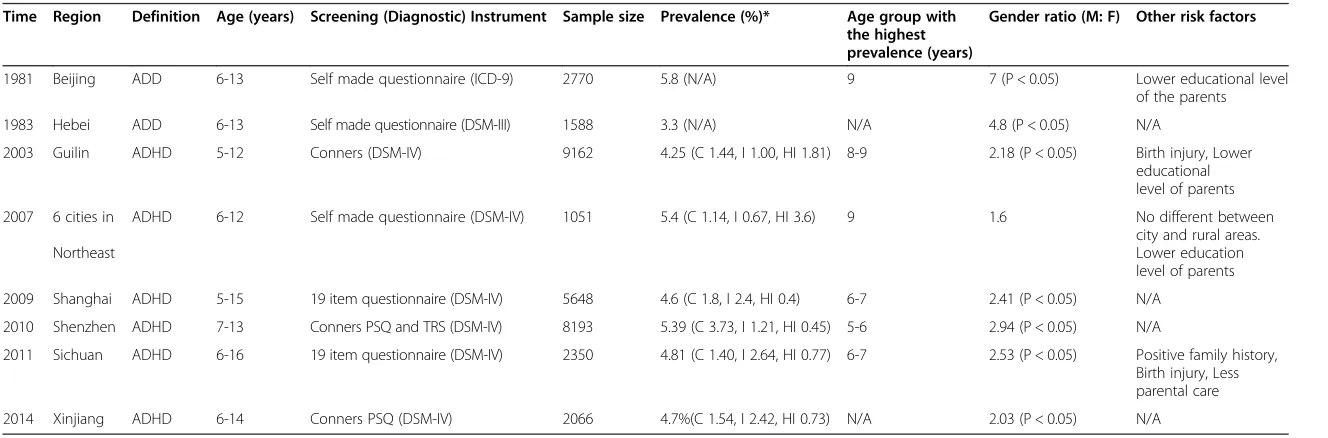
The prevalence studies of Attention Deficit Hyperactivity Disorder (ADHD) in China began in the early 1980s. Since then, more than 30 studies put the prevalence of ADHD between 0.73% and 14.8%. Table 3 summarized some epidemiological studies [28-34] highlighting their screening and diagnosing criteria and the prevalence of each subtype of ADHD as defined in the Diagnostic and Statistical Manual of Mental Disorders (DSM).
Table 1 Prevalence of child mental disorders in selected regions of China
Authors Time Cities Age, years Sample size Tools Prevalence
Wang YF, Chen YC et al. 1988 Beijing 7-14 2432 CBQ 8.3%
Xi RE, Xu TY et al. 1992 22 cities 4-16 24013 CBCL 12.97%
Yang ZW, Li XR et al. 1997 Hunan 4-16 8644 CBCL, DMS-IV 14.89%
Tang GZ, Guo LT et al. 2005 Chengdu 11-18 1740 CBCL 15.1%
Guan BQ, Luo XR et al. 2009 Hunan 5-17 9495 DSM-IV 16.22%
CBQ: Children Behavior Questionnaire, Rutter; CBCL: Child Behavior Checklist, Achenbach; DSM-IV: Diagnostic and Statistical Manual of Mental Disorder-IV, American Psychiatric Association.
Table 2 Studies on prevalence of autism in China
Time Region Definition Age
(years)
Screening (diagnose) instrument
Sample size
Prevalence (per 10,000)
Gender ratio (M: F)
Urban/rural ratio
2000 Fujian ASD 0-14 ABC (CCMD-2, DSM-III-R) 10802 2.80 1.77 (P > 0.05) 0.50 (P > 0.05)
2002 Changzhou ASD 2-6 CABS (CARS, CCMD-2-R) 3978 17.89 2.00 N/A
2003 Zunyi, Guizhou ASD 3-12 ABC (DSM-IV) 10412 5.76 N/A N/A
2004 Beijing PDD 2-6 CABS (CARS, DSM-IV) 21866 15.30 1.08 (P > 0.05) 1.38 (P > 0.05)
2004 Tianjin ASD 2-6 CABS (CARS, DSM-IV) 7316 11.00 6.00 (P < 0.05) 1.75 (P > 0.05)
2006 National based survey ASD associated disability 0-17 Screen for disability first (ICD-10)
77301 2.38 2.09 (P < 0.05) 1.03 (P > 0.05)
2010 Tianjin ASD 1.5-3 CHAT (CARS, DSM-IV) 8428 26.60 4.15 (P < 0.05) 0.61 (P > 0.05)
2014 Changchun ASD 0-6 ABC (CARS, CCMD-3) 9714 15.44 N/A N/A
Table 3 Selected studies on prevalence of ADHD in China
Time Region Definition Age (years) Screening (Diagnostic) Instrument Sample size Prevalence (%)* Age group with the highest prevalence (years)
Gender ratio (M: F) Other risk factors
1981 Beijing ADD 6-13 Self made questionnaire (ICD-9) 2770 5.8 (N/A) 9 7 (P < 0.05) Lower educational level of the parents
1983 Hebei ADD 6-13 Self made questionnaire (DSM-III) 1588 3.3 (N/A) N/A 4.8 (P < 0.05) N/A
2003 Guilin ADHD 5-12 Conners (DSM-IV) 9162 4.25 (C 1.44, I 1.00, HI 1.81) 8-9 2.18 (P < 0.05) Birth injury, Lower educational level of parents
2007 6 cities in
Northeast
ADHD 6-12 Self made questionnaire (DSM-IV) 1051 5.4 (C 1.14, I 0.67, HI 3.6) 9 1.6 No different between city and rural areas. Lower education level of parents
2009 Shanghai ADHD 5-15 19 item questionnaire (DSM-IV) 5648 4.6 (C 1.8, I 2.4, HI 0.4) 6-7 2.41 (P < 0.05) N/A
2010 Shenzhen ADHD 7-13 Conners PSQ and TRS (DSM-IV) 8193 5.39 (C 3.73, I 1.21, HI 0.45) 5-6 2.94 (P < 0.05) N/A
2011 Sichuan ADHD 6-16 19 item questionnaire (DSM-IV) 2350 4.81 (C 1.40, I 2.64, HI 0.77) 6-7 2.53 (P < 0.05) Positive family history, Birth injury, Less parental care
2014 Xinjiang ADHD 6-14 Conners PSQ (DSM-IV) 2066 4.7%(C 1.54, I 2.42, HI 0.73) N/A 2.03 (P < 0.05) N/A
*(Subtype, C = combined, I = Inattentive, HI = Hyperactivity).
Child
and
Adolescent
Psychiatr
y
and
Mental
Health
(2015) 9:10
Page
3
of
A Meta analysis [35] pooled the prevalence data from 33 studies done in China from 1980 to 2011 and found the prevalence of ADHD to be increasing over the years, from 3.7% in 1980–1989 to 4.3% in 1990–1999 and 6.2% in 2000–2011 (P < 0.05). The most important factor af-fecting prevalence rate is the diagnostic instrument used, with the highest prevalence rate in studies using DSM-IV, the lowest in studies using Chinese Classification of Mental Disorders (CCMD). But the overall prevalence in China (5.7%) is slightly higher than the worldwide-pooled prevalence of 5.29% [36]. Some important mod-erators for prevalence includes the diagnostic criteria used, the method used in screening ADHD symptoms and the incorporation of functional impairment as part of the definition of ADHD. Some researchers believe that since no subjective diagnostic method exists for ADHD, the objective evaluation of the rater plays an im-portant role in diagnosis. Cultural difference between China and western countries may result in inter-rater differences [37].
Tourette syndrome
Tourette syndrome (TS) is introduced to China in the early 1980s. The worldwide prevalence of TS is around 1% [38]. A study done in 1983 screened 17727 children and diagnosed 43 cases of TS. The reported prevalence of TS in China is 0.24% with higher prevalence in urban areas [39]. More recent epidemiological study of 9742 school-aged children in Wenzhou [40] showed a preva-lence of 0.43% in with no significant difference between urban and rural areas. Study of children between 6 and 16 years in Beijing showed similar prevalence for Tourette disorder (TD) (2.26% for TD, 0.47% for TS). This means that at least 2 million children in China are suffering from this condition. The male to female ratio is between 5–8:1 [41]. The diagnosis of TS is made clinically with no sub-jective tests to help confirm the diagnosis. Affected chil-dren usually suppress the tic in public places and clinics, this is specially so in China where children are expected to behave themselves in public. This posed a cultural prob-lem in epidemiological studies and may lead to an under-estimation of the true prevalence of this condition.
Diagnosis and treatment for child mental disorders
Diagnosis of mental disorders
The diagnosis of mental disorder is different from that of most other medical conditions. It relies on subjective reporting of symptoms and the level of functional im-pairment. In the field of child psychiatry, problems that parents or teachers perceive as being serious and war-ranting attention are shaped by prevailing cultural beliefs and values. Thus the recognition of certain symptoms and the labeling of impairment depend on behavioral
norms accepted by a particular culture. A study by Mann et al. [42] compared the ratings of mental health professionals in four different countries including Mainland China on hyperactive-disruptive behaviors. The results indicated that the definition of and attitudes to-wards hyperactivity are subject to cultural variation. It was found that Chinese and Indonesian clinicians provided higher ratings of hyperactivity than the clinicians from Japan and the United States. In China there is a Chinese diagnostic classification for mental disorders, but the DSM-IV is often used in clinical studies and research. More comparative data and intercultural studies are needed to justify the use of DSM in China and facilitate multicenter international collaboration.
The Chinese Classification of Mental Disorders (CCMD), published by the Chinese Society of Psychiatry, is a clinical guide used in China for the diagnosis of mental disorders. The current version of CCMD-3 was published in 2001. Broad similarities exist between the ICD-10 and CCMD-3. But CCMD-3 also included some variations on the main diagnoses from ICD, and around 40 culturally related diagnoses were added [43]. A sur-vey among 380 psychiatrists in Beijing showed that CCMD-3 is the most commonly used diagnostic system in China (63.8%), followed by the ICD-10 (28.5%) and DSM-IV (7.7%) [44].
Mental disorders for adult and child/adolescent were listed under different categories in CCMD-3. Ten disor-ders with onset usually occurring in childhood were in-cluded in CCMD-3 and were divided into two main categories, namely ‘Mental retardation, and disorders of psychological development with onset usually occurring in childhood and adolescence’ and ‘Hyperkinetic, Conduct, and Emotional disorders with onset usually occurring in childhood and adolescence’. Because of the only-child pol-icy and the family structure in China, the drafting commit-tee of CCMD-3 found that some disorders, e.g. sibling rivalry disorder, scarcely occur in China and the diagnosis would be more aptly called “companion rivalry dis-order”[45]. With the release of the new DSM in 2013, Chinese child psychiatrists are trying to update their diag-nostic criteria by issuing a series of new guidelines for dis-orders like ASD and ADHD [46,47].
Normalization of instrument is often done in regional centers; as a result the application of these instruments in a nationwide scale can be problematic. Liu and col-leagues reviewed more than 500 hundred studies on the mental health of Chinese children aging 0 to 6 years [49]. They found that 67.7% of the studies are cross sec-tional and only one third of the studies are longitudinal. The instrument used in these studies is mostly translated versions of CBCL, Conner’s Children’s Behavior Scale and ABC. However, after 2001, more locally developed instrument started to gain clinical relevance. Some of the well established locally developed instruments in-clude Screening Checklist for Childhood Autism [50], Screening Checklist for Delayed Language development in Age 1-3 [51]. More culturally relevant and locally de-veloped instruments are needed for the screening and treatment monitoring of child and adolescent mental disorders in China.
The Chinese culture and the help seeking behavioral of patients
In traditional Chinese culture, the mind is in harmony with the body, and the mind-body dichotomy is not widely accepted. In China, many still view mental disor-ders with disdain. The stigma associated with mental disorder prevented children from expressing their trou-bled feelings and seeking help. In a study examining help seeking behaviors among different ethnic groups of col-lege students in Hong Kong, Mak et al. find that Chinese Americans and Europeans are more likely to seek help than Hong Kong and Mainland Chinese [52]. A study done in 1993–1994 comparing the help-seeking pattern of Chinese Americans and European Americans found that Chinese people are more likely to turn to non-professionals (relatives, family and pastors) for help [53]. This is validated in another study on suicidal attempts. This study showed that the help-seeking patterns in middle school students with depression and suicidal ideation are mostly turning to friends and parents, with very low levels of professional help-seeking (around 1%). In fact, 30% of students did not seek help at all in face of psychological problems [54].
In a study [37] surveying Chinese and American teachers on the understanding of ADHD, the Chinese samples were more likely to endorse items indicating that ADHD is a reflection of failed parenting or poor ef-fort on the part of the children. The American samples, on the other hand, were less likely to take such a view. This reflects that in Chinese culture mental, illness can be blamed on the family and the individual. A more open and non-judgmental environment should be cre-ated for children with mental disorders, especially in China.
Treatment of mental disorders
Similar to the treatment for mental disorders in devel-oped countries, there is an increased usage of medica-tions in China, perhaps even more so. In the mid to late 1990s, the pharmaceutical industry introduced new psy-chotropic drugs to the Chinese market. Almost all the psychotropic medications in different therapeutic classes are now available at most tertiary mental health-care centers. Large pharmaceutical companies sponsor most drug-related studies in child psychiatry but randomized double blind controlled trials are still lacking. Compared to adult patients, child and adolescent patients are more likely to receive psychotherapy. Family therapy, group therapy, individual therapy and play therapy are recom-mended for children and adolescents in China. Cognitive and behavioral therapy and dynamic therapy are also available [32]. For example, for ADHD patients, 77% were treated with central nervous system stimulants, but the proportion of behavioral treatments (either solely on in combination with medications) increased significantly over time [55].
Traditional Chinese medicine (TCM) has been used in treating children with mental disorders. Because the basic diagnostic and treatment philosophy are different in TCM and western medicine, it may be hard to under-stand the differential diagnostic process of TCM for mental disorders. TCM consider the mind and the body as a functional whole and it views mental disorder as originating from imbalance of the internal organs. Thus, the treatment of mental disorders relies mostly on a psy-chosomatic approach with the restoration of physio-logical function and balance as the primary goal. The most widely used methods including acupuncture and TCM medication.
Acupuncture, which involves the use of needles or pressure to specific points on the body, is used widely in TCM and has been used to treat ASD in China. A re-view included 10 randomized and quasi-randomized controlled trials involving 390 children with ASD. There are no significant differences in the primary outcome measures in the acupuncture group and controlled group, but results suggested acupuncture might be asso-ciated with improvement in some aspects of the second-ary outcomes of communication and linguistic ability, cognitive function and global functioning [56].
5-Ling Granule (5-LGr) (a patented poly-herbal product manufactured from 11 herbal materials) has also under-gone a multi-centered, randomized, double blinded, con-trolled trial with a relative large sample size to treat tic disorder. The result of this trial showed that 5-LGr had similar efficacy in treating tics in Tourette syndrome as Tiapride, a first line tic-suppressing drug used in TS (Zheng et al. in process, trial registration: NCT01501695, detailed herbal name and pharmacological function can be found in the paper).
In China, TCM is a common form of alternative medi-cine. To some people TCM’s emphasis on harmony and balance between different elements appeal more readily to their notion of a healthy body and mind. And it’s eas-ier for both parents and children to be diagnosed with imbalance of humors than to be labeled with a mental disorder. But in an era of scientific research and evidence-based medicine, TCM has to undergo more rigorous trials to really gain its place in the treatment of mental disorder.
Problems in the modern Chinese society One child policy
The Family Planning Policy, otherwise known as the One Child Policy was introduced in 1979. The Chinese government introduced this policy as a response to the growing social, economic, and environmental issues caused by over-population. The policy, which rewards couples that agree to have just one child, has proved so successful that the birth rate has fallen to only 1.4 chil-dren per woman, which is below the replenishment rate (2.1 children per woman) needed to maintain a stable population [58].
However, this successful birth control measure has re-sulted in new problems, center of which is the problem of an aging population and a skewed sex ratio at birth. From a mental health perspective, the one child policy meant that children do not have to compete with siblings for attention. This could partially explain why overprotection or lack of autonomy was not viewed negatively in most studies with Chinese samples. An-other common phenomenon for the only child is the overemphasis on school performance. This is reflected in research showing that while interpersonal conflicts are the primary stressors for “Western” adolescents, poor aca-demic performance prospectively predicts higher levels of depression in Chinese children as young as 8 years of age [59]. In addition, poor academic performance predicts sui-cidal ideation in Chinese adolescent samples [54]. This could partly be explained by the high expectation families have on the only child.
As the first ‘only child’ generation was born in the 1980s, more and more people are concerned with the way these children were raised. The 4, 2 and 1 family
structure is also seen as a potential problem (4 refers to the grandparents, 2 to the parents, and 1 to the child). In 1984, a research was conducted in 6 kindergartens in Beijing with 138 only children and 127 children with sib-lings focusing on the personality trend of these two groups. The result showed no significant differences in empathic, supportive and aggressive behaviors, but chil-dren with siblings scored slightly higher in those do-mains. Another study lead by Tao et al. studied the impact of one-child policy on child development in 697 preschool children using CBCL [60]. Girls who were only children scored slightly higher on the factors of de-pression, moody, and temper. Zheng and colleagues con-ducted several studies on the development of personality and psychological problems of only children. One study of 911 only children in Beijing aged 6 to 12 years showed that the prevalence of social adaption problems was 23%—similar to the average in developed countries [61]. A 6-year multicenter controlled trial of psycho-social development tried to explore the effect of early systemic intervention on psychosocial development in only children. The behavior problems of intervention group were significantly lower than that of control group (P < 0.01). The tendency of psychosocial development, the average IQ, the temperament and the adaptability of intervention group were significantly better than control group (P < 0.05 or 0.01) [62]. This study showed that early systemic intervention benefits the psychosocial de-velopment of the only child.
The one child policy is now undergoing a review. Ex-perts are concerned that China’s low birth rate, com-bined with its aging population, will damage its future economic development. As a result the once strict birth control policy is starting to loosen up. In 2011, if both parents have no siblings, they are allowed to have two children. As of November 2014, the policy also allowed for a family to have two children if either one of the par-ents have no siblings. As can be expected, the long-term effect of these changes on the psychological wellbeing of children will become a new focus of studies in the coming years.
Migration workers and left behind children
children are often left behind to live in their rural hometowns. This results in the ‘left-behind’ children phenomenon. Left-behind children are defined as chil-dren living in their rural home with one or both of their parents working outside their registered resident area [63].
According to a national survey in 2012, the total num-ber of left-behind children has reached 58 million, mak-ing up nearly 30% of rural children population [64]. More than half of these left-behind children have both parents working in other cities. A lot of left-behind chil-dren (32.67%) are raised by their grandparents. Others (20.70%) are left with other relatives and a small number of them (3.37%) do not have any designated guardian. Compared to 2005, the number of left-behind children in 2012 has grown by 2.4 million. The left-behind chil-dren phenomenon and the fast growing number of this special group have raised concerns about their physical and mental wellbeing. Though rural–urban migration is not a phenomenon unique to Chinese society, the scale of migration is unprecedented and the social and eco-nomic implications of this phenomenon warrant more attention and research.
In a study assessing the overall quality of life in left-behind children, the mean scores of Pediatric Quality of Life Inventory were lower in the left-behind children than the non-left-behind. While mean physical subscale scores did not differ significantly, the psychosocial sum-mary, emotional functioning, social functioning and school performance scores of left-behind children were lower [65]. Results of the majority of existing studies show that left-behind children are prone to psycho-logical stresses and have more mental health problems. A meta-analysis including 6 controlled studies compared 1465 left behind children and 1401 children in normal family environment. The findings from this and several other studies suggest that left behind children have sig-nificantly higher scores in anxiety, loneliness, fear and self-blame [66,67,68]. Other studies found that although no significant differences in the overall mental outcomes between the left behind children and other children existed, certain subgroups of left-behind children were at potential risk [69]. Being raised by grandparents, and go-ing to boardgo-ing schools are two independent risk factors for psychological problems while higher education levels of mothers is a protective factor [70]. More psychological problems are seen in boys aged 12–16 years, with oppos-itional defiant disorder, hyperactivity disorder and poor social interaction being the most troubling problems. A study focused on the left-behind adolescents revealed a higher level of Internet addiction, suicide ideation and thoughts of running away from home along with other social behavioral issues such as smoking and binge drinking [71].
Current state of Chinese child and adolescent psychiatry: challenges and possible solutions Scarcity of child psychiatrists
In China, child psychiatry is a discipline in its nascent stages. Dr. Guotai Tao, the founding father of Chinese child psychiatry, was trained in the USA in 1950s. In 1984, he started the first child psychiatry center in China in Nanjing. Today, in spite of considerable effort, chil-dren with mental disorders still lack access to treatment due to the dearth of service providers and a lack of child psychiatrists.
The total number of qualified child psychiatrists in China is less than 500. This small group of doctors cer-tainly cannot provide adequate service for more than 200 million children, and most of these doctors practice in big cities. In China medical students usually receive approximately 20 hours of lecture on clinical psychiatry and practical training in psychiatry wards for approxi-mately two weeks. Child and adolescent psychiatry is hardly taught in medical school. This means that pri-mary care physicians do not have adequate training in child psychiatry. Tertiary care centers usually do not have child psychiatric clinic and even specialized mental hospitals do not have a child psychiatric ward. For chil-dren with mental disorders, only 5.8% sought help in a child psychiatric clinic, 9.1% went to pediatrics clinic [72]. Outpatient clinics are the most common form of service for children with mental disorders. A survey done in a mental health center in Shanghai analyzed outpatient data from 1985 to 1999, the result shown that children 6–12 years old are more likely to seek help. But the trend is toward having younger patients (0–3 years). Among the disorders seen in outpatient clinics, ADHD, mental retardation, learning disability and emotional problems are the most common [73].
for signs of developmental disorders such as ‘Does the three-month-old baby’s eyes follow moving objects?’ or ‘At 18 months, can she make eye contact?’
The financial burden of mental disorders
Children with mental disorder bring much burden both financially and emotionally to the family. Families of dis-abled children received more economic assistance than families of normal children. The burden of raising chil-dren with disabilities is the highest in chilchil-dren with ASD. Such families have a heavier burden and they need more help in many aspects [74]. Prior to 2005, China’s mental health services were provided in the same man-ner as all health services in the country. The hospital was the center of the service delivery network and there was little continuity between hospital services and com-munity services. From the beginning of this century, China has invested much in building an effective and functional public health system which was launched as the‘Central Government Support for the Local Manage-ment and TreatManage-ment of Severe Mental Illnesses Project’ (also referred to as the‘686 Project’) [75].
The components of the intervention included patient registration and initial assessment, free medication, regular follow-up in the community, management for community emergencies, and free emergency hospitalization for cer-tain mental disorders. By the end of 2010 a total of 280 000 persons with serious mental disorders had been regis-tered in the system, 200 000 follow-up visits of regisregis-tered patients had been conducted, free medication was pro-vided 94000 times and free treatment had been propro-vided 12400 times [76].
For other child mental disorders, most are paid by na-tional medical insurance for registered residents of the area. Some children’s medical insurance is covered by their parents’ insurance. Additional commercial medical insurance is also available.
The mental health law
In 1985, a committee consisted of five senior psychia-trists started to draft a national mental health law. Sev-eral key government departments were involved in the process. The draft was revised and released for public con-sultation only in 2011. Further amendments were made and the Mental Health Law of the People’s Republic of China (referred to as the Mental Health Law below) was finally enacted on May 2013.
Despite its limitations, the Mental Health Law is a great step forward in the protection of psychiatric pa-tients’civil rights. It aims to promote mental health, im-prove the quality of mental health services, and protect the human rights of patients with mental disorders dur-ing the process of hospital admission, treatment, and discharge. In the newly implemented Mental Health
Law, many items are added concerning child mental health. Because China has implemented a nine-year compulsory education program for all school aged chil-dren, primary schools have become important functional entity for advocating and improving child mental health and the ideal place to provide related services. Research has shown programs promoting mental health are among the most effective of health promoting school ef-forts [77]. The mental health law mandates that all levels of school be equipped with psychologists and counseling teachers for mental disorders and psychological prob-lems. Preschool educational institutions must carry out relevant forms of mental health education. In face of traumatic and other stressful events, the school must gather specialists and provide psychological counseling and mental health rescue immediately.
With the implementation of Work Plan for Mental Health in China (2011–2020) [78], China is further pro-moting the mental health and wellbeing of children and adolescent. The mental health plan requires that by 2015, mental health education in primary school reach 85% of schools in the city and 70% in rural areas. Preva-lence of mental disorders should be managed while the awareness of child and adolescent mental health should be further promoted (from 30-40% of awareness in 2005 to 80% in 2015). The plan also emphasizes that relevant information on the prevention and screening of mental disorders be accessible and distributed by primary care physicians. The Developing Outline for Chinese women and Children in 2010 [79] also emphasized the import-ance of child mental health and that multiple forms of psychological counseling and treatment programs be provided to the public.
Conclusions and future perspectives
Despite all the new laws and regulations, the dearth of child psychiatrists in China is expected to continue for some time. In order to address this problem, a new form of multilevel collaboration is being implemented. Pedia-tricians and primary care physicians are being trained in child psychiatry. Officials have also enlisted foreign psy-chotherapists to help train psychiatrists and increase awareness. China is now exploring all possible ways to enforce the multilevel collaboration to promote the physical and psychological wellbeing of children.
Allied Professions (IACAPAP). Hopefully, with the effort of the government, society and a strengthened inter-national collaboration, a public mental health framework with appropriate policies and programs, to educate and advocate for change, and to provide systemic and targeted solutions can be achieved.
Abbreviations
ABC:Autism behavior checklist; ASD: Autistic spectrum disorders;
ADHD: Attention deficit hyperactivity Disorders; ASCAPAP: The Asian society for child and adolescent psychiatry and allied professions; CABS: Clancy autism behavior scale; CARS: Childhood autism rating scale; CBCL: Child behavior checklist; CCMD: Chinese classification of mental disorders; CHAT: Checklist for autism in toddlers; DSM: Diagnostic and statistical manual of mental disorder; IACAPAP: International association for child and adolescent psychiatry and allied professions; ICD: International classification of diseases; TCM: Traditional Chinese medicine; TD: Tourette disorder.
Competing interests
The authors declare that they have no competing interests.
Authors’contributions
YZ and XXZ participated in the literature review and writing of the manuscript. Both authors contributed equally to the manuscript. All authors read and approved the final manuscript.
Author details
1Beijing Anding Hospital, Capital Medical University, 100088 Beijing, PR China. 2
The Chinese Society of Child and Adolescent Psychiatry, 100088 Beijing, PR China.3Beijing Institute for Brain Disorders, 100069 Beijing, PR China.4Peking
Union Medical College Hospital, No.1 Shuaifuyuan Dongcheng, 100730 Beijing, PR China.
Received: 7 October 2014 Accepted: 16 March 2015
References
1. National Bureau of Statistics of China. http://data.stats.gov.cn. 2. Belfer ML. Child and adolescent mental disorders: the magnitude of the
problem across the globe. J Child Psychol Psychiatry. 2008;49(3):226–36. doi:10.1111/j.1469-7610.2007.01855.x.
3. Wang YF, Shen YC, Gu BM. The behavior problems investigation in Beijing urban area. Chinese J Mental Health. 1988;2(3):114–7.
4. Xi RE, Tang HQ, Zhang ZX. Epidemiological Investigation on mental problems in child and adolescents in 22 Cities in China. Shanghai Archives Psychiatry. 1992;4(1):47–55.
5. Tang GZ G, Huang XZ. An epidemiological study on mental problems in adolescents in ChengDu, China. Chinese J Epidemiol. 2005;26(11):878–81. 6. Guan BQ, Luo XR, Deng YL, Wei Z, Ye HS, Yuan XH, et al. Prevalence of
psychiatric disorders in primary and middle school students in Hunan Province. Zhongguo dang dai er ke za zhi = Chinese J Contemporary Pediatrics. 2010;12(2):123–7.
7. Zhao YX, Zheng Y. Recent progress in epidemiological studies of child mental disorders. Chinese J Psychiatry. 2014;47(3):186–9.
doi:10.3760/cma.j.issn. 1006-7884.2014.03.022.
8. Tao KT. Infantile autism in China. J Autism Dev Disord. 1987;17(2):289–96. 9. Chen Y, Chen ZM, Hu RL, Xu N. Clinical application of Clancy autism
behavior scale. Guangdong Med J. 2007;28(3):375–7.
10. Luo WW, Lin L, Chen R, Ruan M. Epidemiological investigation on autistic disorder in Fujian province. Shuanghai Arch Psychiatry.
2000;12(1):3–5. doi:10.3969/j.issn. 1002-0829.2000.01.002.
11. Wang W, Zai L, Zhen L. An epidemiological investigation on autistic disorder in Changzhou Province. J Clin Psychological Med. 2002;12:148–9. 12. Liu J, Yang X, Jia M, Qu C, Shi J, Liu G, et al. Epidemiological survey of the
pervasive developmental disorder of 2–6 years old children in Beijing. Chinese J Mental Health. 2007;2:290–3.
13. Li N, Chen G, Song X, Du W, Zheng X. Prevalence of autism-caused disability among Chinese children: a national population-based survey. Epilepsy Behav. 2011;22(4):786–9. doi:10.1016/j.yebeh.2011.10.002.
14. Wan YM, Hu Q, Li T, Jiang LJ, Du Y, Feng L, et al. Prevalence of autism spectrum disorders among children in China: a systematic review. Shanghai Arch Psychiatry. 2013;25(2):70–80. doi:10.3969/j.issn. 1002-0829.2013.02.003. 15. Li AY, Zhang X, Lv CC, Zhu Y, Li YM, Liu GS. Analysis of behavioral
characteristics of children with autism aged 1.5 ~ 3 years old. Chinese Mental Health. J Mar Sci. 2010;24(3):215–8. doi:10.3969/j.issn. 1000-6729.2010.03011.
16. Li H, Du L, Shan L, Feng J, Jia F. Current study on epidemiology of autism spectrum disorder. Chinese J Clin. 2014;24:4471–4. doi:10.3877/cma.j.issn. 1674-0785.2014.24.034.
17. Yang SG, Hu YZ, Han Y. Prevalence investigation of Autism in children. J Applied Clin Pediatrics. 2007;22(24):1872–3. doi:10.3969/j.issn. 1003-515X.2007.24.014.
18. Guo R. Epidemiological investigation analysis of 5 000 children between 0–6 years old with childhood autism in Tianjin City. Chinese J Clin Rehabil. 2004;8(6):1122–3. doi:10.3321/j.issn:1673–8225.2004.06.074.
19. Sun X, Allison C, Matthews FE, Sharp SJ, Auyeung B, Baron-Cohen S, et al. Prevalence of autism in mainland China, Hong Kong and Taiwan: a systematic review and meta-analysis. Mol Autism. 2013;4(1):7. doi:10.1186/2040-2392-4-7. 20. Autism, Developmental Disabilities Monitoring Network Surveillance Year
Principal I, Centers for Disease C, Prevention. Prevalence of autism spectrum disorders–autism and developmental disabilities monitoring network, 14 sites, United States, 2008. Morb Mortal Wkly Rep Surveill Summ. 2012;61(3):1–19.
21. Elsabbagh M, Divan G, Koh YJ, Kim YS, Kauchali S, Marcin C, et al. Global prevalence of autism and other pervasive developmental disorders. Autism Res Official J Int Soc Autism Res. 2012;5(3):160–79. doi:10.1002/aur.239. 22. The second survey of disabled people, China Disabled Persons’Federation.
http://www.cdpf.org.cn/sjzx/cjrgk/200711/t20071121_387540.shtml. 23. Leading Group of the Second China National Sample Survey on Disability
NBoSotPsRoC. Communiqué on Major Statistics of the Second China National Sample Survey on Disability. Chinese Journal of rehabilitation theory and practice. 2006;12 (12):1013. doi:10.3969/j.issn.1006-9771.2006.12.001. 24. Clancy H, Dugdale A, Rendle-Short J. The diagnosis of infantile autism.
Dev Med Child Neurol. 1969;11(4):432–42.
25. Li JH, Zhong JM, Cai LY, Chen Y, Zhou MZ. Comparison of clinical application of three autism rating scale. Chinese J Contemporary Pediatrics. 2005;7(1):59–62.
26. Matson JL, Kozlowski AM. The increasing prevalence of autism spectrum disorders. Res Autism Spec Dis. 2011;5(1):418–25. doi:10.1016/j. rasd.2010.06.004.
27. Mak WW, Kwok YT. Internalization of stigma for parents of children with autism spectrum disorder in Hong Kong. Soc Sci Med. 2010;70(12):2045–51. doi:10.1016/j.socscimed.2010.02.023.
28. Shen YC, Wang YF XLY. An epidemiological investigation of minimal brain dysfunction in six elementary schools in Beijing. J Child Psychol Psychiatry. 1985;26(5):777–87.
29. Jin W, Du YS, Zhong X, David C. Prevalence and contributing factors to attention deficit hyperactivity disorder: A study of five- to fifteen-year-old children in Zhabei District, Shanghai. Asia-Pacific Psychiatry Official J Pacific Rim College Psychiatrists. 2014;6(4):397–404. doi:10.1111/appy.12114. 30. Zhou KY, Gao MH, Yang CH, Zhang JN, Chen YZ, Song JZ, et al. An
epidemiological survey of attention deficit hyperactivity disorder in school-age children in Shenzhen. Chinese J Contemporary Pediatrics. 2012;14(09):689–92. 31. Zhang WLX. An epidemiological investigation of ADHD in six cities. Chinese
J Clin Psyc. 2007;1(1):23–5.
32. Chen SZ, Zeng F, Li QC. Incidence and Related Factors of ADHD in Children of Guilin City. Chinese J Clin Psych. 2004;12(4):386–770. doi:10.3969/j.issn. 1005-3611.2004.04.022.
33. Fang M, Yang Y, Wang XR, Tang Y, Zhang XL. Diagnosis of Puerile attention deficit hyperactivity disorder in Xichang City, Liangshan Yi autonomous prefecture, Sichuan province. Chinese J Obstet Gynecol Pediatrics. 2012;8 (6):610–3. doi:10.3877/cma.j.issn. 1673-5250.2012.06.012.
34. Dusi Kong AK, Cadilia Wumar. A study of ADHD and related factors. Maternal Child Health Care China. 2012;27(34):5510–2.
35. Tong L, Shi HJ, Zang JJ. Prevalence of ADHD in children of China: a systematic review and meta analysis. Chinese J Pub Health. 2013;29(9):1279–83. doi:10.11847/zgggws2013-29-09-10.
37. Norvilitis JM, Fang P. Perceptions of ADHD in China and the United States: a preliminary study. J Atten Disord. 2005;9(2):413–24. doi:10.1177/
1087054705281123.
38. Robertson MM. The prevalence and epidemiology of Gilles de la Tourette syndrome. Part 1: the epidemiological and prevalence studies. J Psychosom Res. 2008;65(5):461–72. doi:10.1016/j.jpsychores.2008.03.006.
39. Gao QY, Yang ZQ, Han YZ PYL. Prevalence study of Tourette syndrome in children. J Clin Pediatrics. 1984;2(6):357–9.
40. Jin R, Zheng RY, Huang WW, Xu HQ, Shao B, Chen H, et al. Epidemiological survey of Tourette syndrome in children and adolescents in Wenzhou of P. R. China. Eur J Epidemiol. 2005;20(11):925–7. doi:10.1007/s10654-005-2953-z. 41. Zheng Y, Chui YH. Epidemiological review of Tics in China. Chinese J Mental
Health. 2008;22(7):505–7.
42. Mann EM, Ikeda Y, Mueller CW, Takahashi A, Tao KT, Humris E, et al. Cross-cultural differences in rating hyperactive-disruptive behaviors in children. Am J Psychiatry. 1992;149(11):1539–42.
43. Chen YF. Chinese classification of mental disorders (CCMD-3): towards integration in international classification. Psychopathology. 2002;35(2–3):171–5. doi:65140.
44. Zou YZ, Cui JF, Han B, Ma AL, Li MY, Fan HZ. Chinese psychiatrists views on global features of CCMD-III, ICD-10 and DSM-IV. Asian J Psychiatry. 2008;1(2):56–9. doi:10.1016/j.ajp.2008.09.007.
45. Li XR, Su LY, Luo XR. Field trail of the revised criteria of mental disorders diagnosed in childhood or adolescence in CCMD 3. Chinese Mental Health J. 2002;16(4):230–3.
46. Chinese Guideline for Autism Diagnosis, Treatment and Rehabilitation. http://www.gov.cn/zwgk/2010-08/16/content_1680727.htm.
47. Association CM. Guideline for the diagnosis and treatment of ADHD. 1 ed. Peking University Medical Press. 2007.
48. Li XR, Su LY, Townes BD, Varley CK. Diagnosis of attention deficit disorder with hyperactivity in Chinese boys. J Am Acad Child Adolesc Psychiatry. 1989;28(4):497–500. doi:10.1097/00004583-198907000-00005. 49. Liu YY. A review on the psychological health of Chinese children aging
from 0 to 6 years. Studies Preschool Educ. 2009;6:10–5.
50. Liu J, Wang YF. The development of a screening checklist for childhood autism. Chinese Mental Health J. 2004;18(6):400–3.
51. Wang XL. A screeing table for 1–3 years children on language developing delay in Beijing. Chinese Scientific J Hearing Speech Rehabil. 2003;2(1):22–3. 52. Chen SX, Mak WW. Seeking professional help: etiology beliefs about mental
illness across cultures. J Couns Psychol. 2008;55(4):442–50. doi:10.1037/a0012898.
53. Abe-Kim J, Takeuchi D, Hwang WC. Predictors of help seeking for emotional distress among Chinese Americans: family matters. J Consult Clin Psychol. 2002;70(5):1186–90.
54. Hesketh T, Ding QJ, Jenkins R. Suicide ideation in Chinese adolescents. Soc Psychiatry Psychiatr Epidemiol. 2002;37(5):230–5. doi:10.1007/s00127-002-0536-9. 55. Jiang L, Li Y, Zhang X, Jiang W, Yang C, Hao N, et al. Twelve-year retrospective analysis of outpatients with attention-deficit/hyperactivity disorder in Shanghai. Shanghai Arch Psychiatry. 2013;25(4):236–42.
doi:10.3969/j.issn. 1002-0829.2013.04.005.
56. Lee MS, Choi TY, Shin BC, Ernst E. Acupuncture for children with autism spectrum disorders: a systematic review of randomized clinical trials. J Autism Dev Disord. 2012;42(8):1671–83. doi:10.1007/s10803-011-1409-4. 57. Kim YH, Son CG, Ku BC, Lee HW, Lim HS, Lee MS. Herbal medicines for
treating tic disorders: a systematic review of randomised controlled trials. Chinese Med. 2014;9(1):6. doi:10.1186/1749-8546-9-6.
58. Zheng Y. One-child Policy and Child Mental Health. Increasing Awareness of Child and Adolescent Mental Health. Increasing Awareness of Child and Adolescent Mental Health. Jason Aronson Press. 2010. p. a49–70. 59. Chen X, Rubin KH, Li BS. Depressed mood in Chinese children: relations
with school performance and family environment. J Consult Clin Psychol. 1995;63(6):938–47.
60. Tseng WS, Kuotai T, Hsu J, Chiu JH, Yu L, Kameoka V. Family planning and child mental health in China: the Nanjing survey. Am J Psychiatry. 1988;145(11):1396–403.
61. Zheng Y, Chen XS. Analysis of social adaptive behavior and correlative factors in Chinese children. Chinese J Health Educ. 2001;2(17):392–6. 62. Chen XS, Zheng Y. Multi-center study of early systemic intervention on
psychosocial development in non-sibling children. Chinese J Behav Med Sci. 2006;2(12):1126–8.
63. Duan CR, Zhou FL. Studies on“left behind”children in rural China. Popul Res. 2005;29(1):29–36. doi:10.3969/j.issn. 1000-6087.2005.01.004.
64. China Women’s Federation. National survey of left-behind children in rural areas and migrant children in urban and rural areas. http://acwf.people.com. cn/n/2013/0510/c99013-21437965.html.
65. Jia Z, Shi L, Cao Y, Delancey J, Tian W. Health-related quality of life of
“left-behind children”: a cross-sectional survey in rural China. Qual Life rRes Int J Qual Life Aspec Treatment, CareRehabil. 2010;19(6):775–80. doi:10.1007/s11136-010-9638-0.
66. Liu Z, Zhang YB, Song AQ, Shi JQ. Meta analysis of mental health in left behind children. Chinese J Child Health Care. 2013;21(1):68–70.
67. Zhao X, Chen J, Chen MC, Lv XL, Jiang YH, Sun YH. Left-behind children in rural China experience higher levels of anxiety and poorer living conditions. Acta Paediatr. 2014;103(6):665–70. doi:10.1111/apa.12602.
68. Jia Z, Tian W. Loneliness of left-behind children: a cross-sectional survey in a sample of rural China. Child Care Health Dev. 2010;36(6):812–7.
doi:10.1111/j.1365-2214.2010.01110.x.
69. Tao XW, Guan HY, Zhao YR, Fan ZY. Mental health among left-behind preschool-aged children: preliminary survey of its status and associated risk factors in rural China. J Int Med Res. 2014;42(1):120–9. doi:10.1177/0300060513503922. 70. Wu Q, Lu D, Kang M. Social capital and the mental health of children in
rural China with different experiences of parental migration. Social science & medicine. 2014. doi:10.1016/j.socscimed.2014.10.050
71. Gao Y, Li LP, Kim JH, Congdon N, Lau J, Griffiths S. The impact of parental migration on health status and health behaviours among left behind adolescent school children in China. BMC Public Health. 2010;10:56. doi:10.1186/1471-2458-10-56.
72. Tao G. Challenges of Chinese Child Psychiatry. Chinese J Child Health Care. 2006;14(2):109–11. doi:10.3969/j.issn. 1008-6579.2006.02.001.
73. Du YS, Xu TY, Ren CB. Development of child and adolescent psychiatry during the last 15 years in Shanghai. Shanghai Arch Psychiatry. 2001;13(1):8–11. doi:10.3969/j.issn. 1002-0829.2001.01.003.
74. Xiong N, Yang L, Yu Y, Hou J, Li J, Li Y, et al. Investigation of raising burden of children with autism, physical disability and mental disability in China. Res Dev Disabil. 2011;32(1):306–11. doi:10.1016/j.ridd.2010.10.003. 75. Ministry of Health of the People’s Republic of China. Notice to implement
National Continuing Management and Intervention Program for Psychoses in 2006. http://www.moh.gov.cn/publicfiles/business/htmlfiles/mohjbyfkzj/ pgzdt/200804/19191.htm.
76. Ma H, Liu J, Yu X. Important mental health policy ducuments and speeches in recent years in China. Chinese Mental Health J. 2009;23(12):840–3. 77. Whitman CV, Aldinger C, Zhang XW, Magner E. Strategies to address mental
health through schools with examples from China. Int Rev Psychiatry. 2008;20(3):237–49. doi:10.1080/09540260801994649.
78. National Health and Family Committee of the People’s Republic of China http://www.nhfpc.gov.cn/jkj/s5888/200805/81047a30f3c34141b12 481de35930d78.shtml.
79. The Developing Outline for Chinese women and Children in 2010, National Health and Family Committee of the People’s Republic of China http://www.nhfpc.gov.cn/zhuzhan/wsbmgz/201304/c08b60d54ca44dd 68e180926be1ef6a8.shtml
Submit your next manuscript to BioMed Central and take full advantage of:
• Convenient online submission
• Thorough peer review
• No space constraints or color figure charges
• Immediate publication on acceptance
• Inclusion in PubMed, CAS, Scopus and Google Scholar
• Research which is freely available for redistribution
Submit your manuscript at www.biomedcentral.com/submit