PEAK SIGNAL-TO-NOISE RATIO BASED ON THRESHOLD
METHOD FOR IMAGE SEGMENTATION
1FARSHID PIRAHANSIAH, 2SITI NORUL HUDA SHEIKH ABDULLAH, 3SHAHNORBANUN
SAHRAN
1,2,3 Pattern Recognition Research Group (PR), Center for Artificial Intelligence Technology (CAIT),
Faculty of Information Science and Technology (FTSM), University Kebangsaan Malaysia (UKM) 43600 Bangi, Selangor Darul Ehsan, Malaysia.
E-mail: [email protected], [email protected], [email protected] * Corresponding author: Siti Norul Huda Sheikh Abdullah
ABSTRACT
Binarization or thresholding is one problem that must be solved in pattern recognition and it has a very important influence on the sequent steps in imaging applications. Thresholding is used to separate objects from the background, and diminish the amount of data alter the computational speed. Recently, interest in multilevel thresholding has been altered. However, when the levels are altered, the computation time alters so single threshold methods are accelerated than multilevel methods. Moreover, for every new application, new methods are is acquired. In this work, a new algorithm which used the gain signal-to-noise ratio method as an indicator to segment the image is aimed. The algorithm which is used the DIBCO 2011 in printed and a handwritten image was tested. This method has a better performance than new methods, such as Kittler and Illingworth's Minimum Error Thresholding, potential difference and Otsu.
Keywords: PSNR, Single Thresholding, Image Processing, Image Segmentation, Optical Character Recognition
1.
INTRODUCTIONOne of the important stages of pre-processing in any application is Thresholding in image processing[1]. Thresholding can be used as a method to separate the foreground from the background of an image. This paper compares six thresholding methods: Otsu [2], Kittler and Illingworth [3], potential difference[4] , max entropy[5], multilevel threshold[6] and the unprecedented method aimed in this paper. Thresholding is one of the faultfinding steps in pattern recognition and has an important role on the consequent steps in image applications. The significant accusatives of thresholding are separating objects from the background; lessen the number of data and increasing computational speed. There are two types of thresholding: single and multilevel. Single can produce binary images (0, 1) and modifying the amount of the data, causing to alter in computational speed. Multilevel thresholding can produce an image with a range between 0 and 255 of pixel value [7-10]. Single thresholding requires be investigating and improving to find out the best way for to isolate the object, diminish the amount of data and alter the
wide range of pattern recognition applications. Some methods applied in real-time applications produce better results with controlled environments. This motivates the improvement of a different way to investigate global image thresholding. This method can be able to adapt to some way in another aim to illuminate such as day, night, sun, shadow, variable background intensity, shadows, smear, smudge, low contrast, bleed-through or show-through[7-10].In addition, some important things may be considered like handwriting recognition , which useful be useful in applications which can be used in mobile devices. One of the methods the high signal-to-noise ratio is used to measure the quality of images. The high signal-to-noise ratio (PSNR) is as a different for the segment in image. Some researches conclusion shows some good things of the aimed way compare to existing solutions. The algorithm can be the best alter the way of this work.
As a previous way we can name single thresholding and it was mentioned before the multilevel thresholding. After working the single thresholding we will have a black-and-white image (0 and 1 pixel values). consequently, the storage requirements are less than those required for multilevel thresholding [8] , and multilevel thresholding uses a wide range of pixel values. Second, To improve the speed of image processing a limited amount of data is compulsory to work with it. At last, single thresholding will isolate the foreground and background of images contrast to the multilevel thresholding and the object detection is quicker than multilevel thresholding[6]. Nowadays, some more topics have been considered in multilevel thresholding method. However, it has some significant point during the multilevel thresholding, one time thresholding warrants can cause better development. In fact, a new image-processing application in mobile devices is going to be significant, such as cell phones. In these devices, lack for a better algorithm for image processing is the cause and some limitations such as low storage capacity, battery life, and limited processes are another problem for this method. [9, 10].
2.
THRESHOLDING TECHNIQUESThresholding is the step preceding the segmentation phase of image processing. Usually embedded in the blob-labeling process, thresholding has a very important role in this step because it segregates the significant objects from the background and directly influences the
achievement rate in object-recognition applications. We sort thresholding methods into three techniques: single, multilevel and multi thresholding. Kittler and Illingworth’s Minimum Entropy Threshold (MET)[2] and potential difference [3] are examples of single thresholding methods. Multilevel threshold methods, example of Arora et al.[5], apart object based on gray values. Multi- threshold [7] techniques decided on a selection of threshold values based on certain orderly such as number objects inside the image after threshold. the Consideration of some state-of-the-art methods in the following subsections is mentioned.
2.1 Single Thresholding
The usage of the single thresholding means one threshold value, t, change the image to black and white. The thresholding process is a very important step through the segmentation phase. It is also a very significant part of image processing and pattern recognition. Thresholding is carried out for distinctive reasons, for example to increase the computational fast or to reduce the storage space. The segmentation accuracy can be maximized by an appropriately chosen threshold value. The single threshold condition is given as:
𝑓
′(
𝑖
,
𝑗
)
�
1
0
𝑖𝑓𝑓
𝑖𝑓𝑓
(
(
𝑖
𝑖
,
,
𝑗
𝑗
) >
)
≤ 𝑡
𝑡
(1)
Different approaches are used to automatically determine the threshold value. Methods such as local entropy, Kittler and Illingworth’s MET [2], and potential difference [3] often use a gray level co-occurrence matrix as the population set to determine the appropriate threshold value.
2.2 Multilevel Threshold [6]
Algorithm 1: The Multilevel Thresholding Algorithm by Arora et al. [6]
1 while increasing PSNR> 0.1 is true do
2 r=[a, b]. (in the first step a=0 and b=255)
3 Find the mean and standard deviation for all of the
pixels in the image range r
4 t1=mean – k1* standard deviation; (k1 is a random
number)
5 t2=mean + k2* standard deviation; (k2 is a random
number)
6 The mean value of range (a, t1] is set as the threshold
value of the partial range.
7 The mean value of range [t2, b) is set as the threshold
value of the partial range.
8 a=t1+1
9 b=t2-1
10 end while
11 t1=mean
12 t2= mean+1
13 repeat step 6
14 Obtain new image with multilevel thresholding
2.3. Multi-Threshold[8]
Another approach is multi threshold that applies multiple threshold values[8]. This method uses a series of threshold values and computes the total number of blobs or objects in an image for each threshold. The peak threshold values are those with the highest total number of blobs as compared to their threshold neighbors. The Heuristic threshold algorithm is described in Algorithm 2.
Algorithm 2: The Multi Threshold Algorithm by Abdullah et al. [8]
Input: License plate images.
Output: Threshold values.
1 Start.
2 Obtain the histogram distribution.
3 Calculate the total number of gray-scale pixels according to three levels.
4 4.1 For (0< t < 256) step 10 is true do
4.2 Obtain the total number of objects, numt, in the source image when the threshold value t is used.
4.3 end for
5 Search for and select the peak values
from num ( 1 … 255 ) .
6 Choose the selected threshold values if the number of objects is maximum.
7 Execute the character segmentation module.
2.4. OTSU’S Method For Thresholding
Otsu, in 1979, presented an unsupervised and nonparametric method of automatic threshold selection for image segmentation[2]. Bounding boxes of fragments are used as local areas for local threshold searching. The mean (μ), and variance ( σ2 ) , of the pixel distribution, Pi= (P1, P2,…PMax), are used to select the optimal thresholds by maximizing the between-class variance.
2.5. Proposed Method For Thresholding
In the same spirit as[6, 8-10], proposed algorithm uses a gray-scale histogram, thresholding range and the Peak Signal-to-Noise Ratio (PSNR). Based on our experience, the mean value of the gray scale histogram is strongly connected to pixel intensity. We use the PSNR quality measure proposed by [6] because it can measure the similarities between the original image and the binarized image. A higher PSNR indicates more similarity between the two images. The PSNR value is defined as follows:
𝑃𝑆𝑁𝑅
= 10
∗
log
10�
𝑀𝑎𝑥2 ∑𝑚−1𝑖=0 ∑𝑛−1𝑗=0[ 𝐼(𝑖,𝑗)−𝐾(𝑖,𝑗)]2
𝑀∗𝑁
�
(2)In equation 2, Max is a maximum value in the image (for example, in a gray-scale image, Max is 255) while m and n are the height and weight of the image, respectively. I(i,j) is the original value of the image, and K(i,j) is the value after a change. Based on[8], we calculate PSNRs for every threshold
value, in increments of 5, in the range between [1,256]. We calculate the difference between PSNR(t) and PSNR(original image). In this
algorithm we calculate PSNR by using original image and each threshold value. K1=16 and k2=10 based on experiments.
Input: column gray scale images, img.
Output: The selected threshold values, t.
1 For (0<t<256) where (t = t +5) then find PSNRt of imgt by compare with the original image
2 If ( (mean value/k1< PSNRt< mean value/k2))
3 then threshold=t
4 end for
3. RESULTS AND DISCUSSION
We have tested our proposed method using four image datasets: DIBCO 2011[12] (handwritten and printed images), standard images and. DIBCO 2011 data sets contain handwritten and printed images. The F-measure denotes the percentage of the binary image classification as shown below:
F
−
measure =
2∗recall∗precisionrecall+precision, (3)
Where recall = TP
TP+FNandprecision = TP
TN+FP. TP is the true-positive value, FN is the false-negative value, and FP is the false-positive value. The PSNR measurement denotes the similarity between two images. A high PSNR value denotes high similarity between two images as defined by Equation 2.
The figure 1 below shows images after each threshold value and PSNR its corresponding.
Mean value 175.773 result PSNR value 11.7518 threshold value
PR1.PNG 65
Threshold
value=5 Threshold
value=10
Threshold value=15
Threshold
value=20 Threshold
value=25
Threshold value=30 PSNR value = 52.2892
Threshold
value= 35 Threshold
value=40
Threshold value=45
PSNR value = 41.3784
PSNR value = 32.246
PSNR value = 24.6976
Threshold value=50
Threshold value=55
Threshold value=60
PSNR value = 19.3453
PSNR value = 15.6695
Threshold value=65
Threshold value=70
Threshold value=75
PSNR value = 11.7518
PSNR value = 10.9214
PSNR value = 10.4143
Threshold
value=80 Threshold
value=85
Threshold value=90
PSNR value = 10.0387
PSNR value = 9.72186
PSNR value = 9.45483
Threshold value=95
Threshold value=100
Threshold value=105
PSNR value = 9.22359
PSNR value = 9.0035
PSNR value = 8.8189
Threshold
value=110 Threshold
value=115
Threshold value=120
PSNR value = 8.65271
PSNR value = 8.49826
PSNR value = 8.3486
Threshold value=125
Threshold value=130
Threshold value=135
PSNR value = 8.20234
PSNR value = 8.04932
PSNR value = 7.89351
Threshold
value=140 Threshold
value=145
Threshold value=150
PSNR value = 7.7219
PSNR value = 7.5307
PSNR value = 7.31507
Threshold value=155
Threshold value=160
Threshold value=165
PSNR value = 7.05096
PSNR value = 6.7327
PSNR value = 6.34752
Threshold
value=170 Threshold
value=175
Threshold value=180
PSNR value = 5.8873
PSNR value = 5.35598
PSNR value = 4.74236
Threshold
value=185 Threshold
value=190
PSNR value = 4.06663
PSNR value = 3.37452
PSNR value = 2.67619
Threshold
value=200 Threshold
value=205
Threshold value=210
PSNR value = 2.01077
PSNR value = 1.3863
PSNR value = 0.82966
Threshold
value=215 Threshold
value=220
Threshold value=225
PSNR value = 0.374459
PSNR value = 0.0925976
PSNR value = 0.00777491
Threshold
value=230 Threshold
value=235
Threshold value=240
PSNR value = 0.000111094
PSNR value = 0 PSNR value = 0
Figure 1: Each Images After Each Threshold Value And PSNR Its Corresponding.
Figure 2: Compare Threshold Value And PSNR Value For One Image
[image:6.612.87.531.64.601.2]Proposed algorithm Table 1 shows the F-measure and PSNR results for all approaches. In the printed category, the proposed method has the highest PSNR and an acceptable F-measure. For both the handwritten and standard images, results obtained using the proposed method. Figure 2 shows a bar chart in order to compare threshold value and PSNR value for one image.
Table 1: F-Measure And PSNR Results For Proposed Method And Pervious[9, 10] Method
N a me o f Im age s
Proposed method Pervious method f
measur e
PSNR NRM f measur e
PSNR NRM
hw1 55.209 11.01 1
30.79 4
68.244 9.417 7.854
hw2 84.044 17.64 7
1.758 92.22 21.30 2
2.617
hw3 80.542 14.98 5
7.68 18.183 1.689 36.7
hw4 60.491 10.22 9
15.12 3
64.412 11.25 3
16.33 1 hw5 72.491 13.14
6 21.55
7
89.387 16.05 9
4.55
hw6 62.777 11.39 6
11.56 2
37.042 11.98 6
37.75 1 hw7 60.19 12.96
2
6.064 60.19 12.96 2
6.064
hw8 45.988 9.576 6.403 46.144 14.78 9
35.00 3
Averag e
65.2 12.61 12.61 59.47 12.43 18.35
Table 1 shows the performance of the proposed method; using f-measure similarity between achieved image and the original one is significant. In the three images the performances are higher than 70% that contend an acceptable method for binarization. Table 1 also shows the result of previous version of proposed method. Obviously improved version of the proposed method gains the
0 50 100 150 200 250
1 4 7 10 13 16 19 22 25 28 31 34 37 40 Threshold Value
better result in thresholding. The performance of proposed method has been evaluated on the hand written images and printed images in the table 3 and 4 that results show a reliable and acceptable method for thresholding. Table 2 shows results for f-measure, PSNR, and NRM of pervious [9, 10] method in order to compare with old one. The result shows overall f-measure in pervious [9, 10] method is 59.47 compare to 65.21 in new approaches in hand written images (DIBCO 211)
Table 2: Compare Proposed Method And Pervious [9, 10] Method For Printed Images.
N
a
me
o
f
Im
age
s
Proposed method Pervious method f
measur e
PSNR NRM f measur e
PSNR NRM
pr1 56.814 9.946 30.15 9
74.076 11.59 9
20.57 8 pr2 82.693 13.87
5
9.447 62.051 8.455 8.251
pr3 24.167 8.001 43.12 8
77.126 11.63 8
18.60 7 pr4 93.038 18.17
8
5.304 93.211 18.16 1
4.103
pr5 84.059 13.56 5
9.251 25.839 1.012 45.94 7 pr6 33.898 7.149 10.30
3
19.394 3.852 21.69 8 pr7 47.584 12.77
6
4.307 81.52 21.08 7
15.26
pr8 68.469 11.80 1
23.94 9
41.512 9.938 36.90 4
Averag e
61.34 11.91 16.98 59.34 10.71 21.4
Table 2 shows results for f-measure, PSNR, and NRM of pervious [9, 10] method in order to compare with old one. The result shows overall f-measure in pervious [9, 10] method is 59.34 compare to 61.34 in new approaches in printed images (DIBCO 211) .Table 3 shows mean value and PSNR and proposed threshold value for all images in standard images, handwritten and printed images in DIBCO 2011 dataset for OCR system.
Table 3: Mean Value And PSNR And Proposed Threshold Value For All Images
mean PSNR Old
threshold value
Proposed method threshold value
lake 122 3.14 145 40
Lena 110 3.79 165 65
Pepper 104 3.76 165 55
airplane 181 8.53 80 95
baboon 125 5.73 145 75
hw1 183 10.02 65 40
hw2 188 13.33 135 175
hw3 156 11.62 50 140
hw4 134 9.56 80 90
hw5 188 10.37 140 80
hw6 143 9.88 115 120
hw7 163 15.16 120 135
hw8 119 14.02 160 115
pr1 175 8.2 405 65
pr2 145 11.64 90 105
pr3 195 8.19 95 80
pr4 153 9.99 145 115
pr5 134 10 165 95
pr6 103 16.27 165 95
pr7 127 16.5 80 115
pr8 182 9.27 145 125
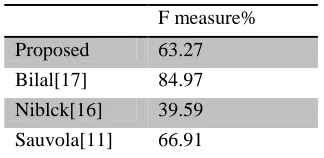
[image:7.612.337.499.559.638.2]Table 4 shows comparison f-measurebetween proposed method and Bilal[17] and Niblck[16], Sauvola[11], method for DIBCO 2011
Table 4: Compare F-Measure Form Proposed With Other Methods
F measure%
Proposed 63.27
Bilal[17] 84.97
Niblck[16] 39.59
Sauvola[11] 66.91
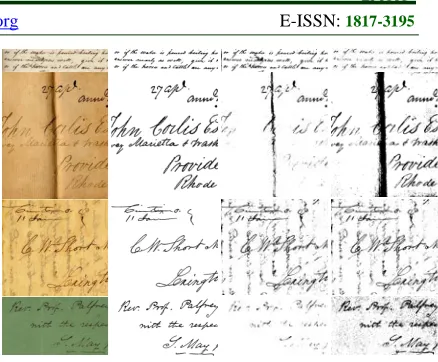
original image, since the image has able to remove noise from the background of the object. But when it compared to column 2, column 2 still produce better image because it has very clear result / text image and it able to distinguish between the object (text) and any other noise background. The suggestion is try to improve the result by applying dilation to the main object to make the text of the object become clearer. Also try to remove any noise which is not needed as a background of the image. In the row 2 column3 is succeed to show the text image clearly compared from the original image which is the text on the original image shown a bit slightly maybe it because the column of the background image give influence to the text of the object image. In the row 3 is same explanation as above and in row 4 since the original image has defect background, so the result in column 3 shows good enough result since it could preserve the main object (text) from the original image. A little bit work in removing the unnecessary noise is necessary.
Figure 3: Result Of All Images In Handwritten Dataset Of DIBCO 2011
Figure 4: Result Of All Images In Printed Dataset Of DIBCO 2011
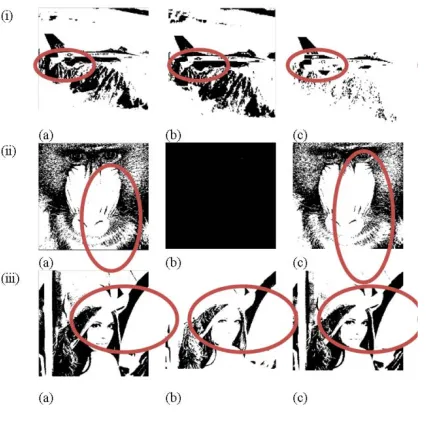
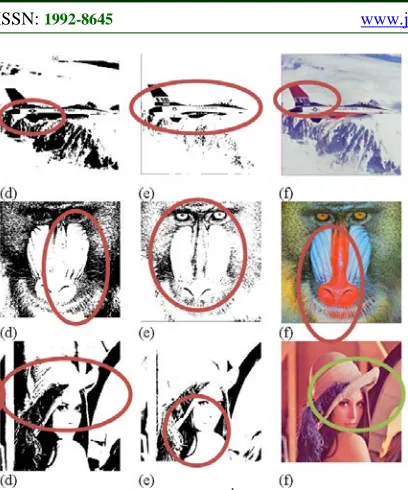
In the figure 1 and 2 show that; the last column is proposed method and explain result: Row 1: Column 3 has shown a bit blur text compare from the original image, maybe it because the original image has light column background of the paper, so column 3 tried to remove the noise from the original image with light background column but in the same time try to preserve / maintain the text of the image. Row 2: Column 3 tried to remove the background noise from the original image, since the original image has double text between the main text and the noise text from the background paper, but at least column 3 succeed to remove some part of the noise even couldn’t remove it completely. Row 3: Column 3 it’s not being able to show the clear result of the original text of the image, maybe cause the original image has very light column of the background. Row 4: Column 3 has succeeded to get better result from the original of image, since it could maintain the text of the image clearly. Row 5: Again column 3 succeed to get better result from the original of image since it could remove the background noise from the original image also still preserve the text clearly. Row 6: Column 3 still needs work to remove the noise from the background, since the original image has a lot of noise which is similar to the main text of the object. Row 7: Column 3 has shown clear the text of the image, but the problem from the original image since it has some texture on the paper so it give effect to the result .Row 8: Column 3 need a little bit work to make the text on the image become more clearer since the column of the background from the original image which is lightly is affect to the processing the result of the text. Figure 5 and 6 discuss the result of all the five methods which are Otsu [2], Kittler and Illingworth [3], potential difference[4] , max entropy[5], multilevel threshold[6], and proposed thresholding methods based on the results for (a) all the methods used except the proposed could not detect clearly words without noise. However, the proposed method could detect the all words and it can be read clearly. Using the proposed method, the (b) can be recognized clearly it can show the words clearly. For (c), the proposed methods can recognize more words than other methods and hat clearer than other methods. For (d) the proposed method has noise. For (e) the proposed method has very clear
[image:9.612.335.507.258.355.2]manuscript compare to other methods .Finally, we can conclude the proposed thresholding algorithm showed good to be applied for printed images. The proposed method can be solved different size fonts; a spotted, love quality image; thin pen stroke; low contrast and small size; a poor quality and very low contrast image; a uniform illumination; a non-uniform illumination with thin pen stroke ; low quality images but it has problem in local binarization where the stroke and small size pen in part of images.
[image:9.612.313.526.459.673.2]Figure 5: Example To The Result Of Proposed Threshold Algorithm
Figure 6: Compare The Result Of Proposed Threshold Method With Other Methods
Airplane in terms of (i) is segmented from mountain based on proposed method. In additional, the all parts of monkey face were detected especially manner of nose that segmented obviously in (ii) image. The segmentation was done properly on (iii) as some parts of eyes, hat and hair have were detected. Finally all images were segmented using proposed method better than other methods. Figure 4 shows; In comparison with other methods, the different regions of airplane were segmented properly. The F16 text on image was detected appropriately. In additional, the all parts of monkey face were detected clearly and, the eyes, nose and so on segmented obviously. Especially, the eyes on image was detected entirely clear than others obtained results. Furthermore, the various region of Lena image were detected in proposed method. The segmentation as one of important steps on image processing was implemented properly on this image as some parts of hat and hair has were detected better than other methods. We discuss three types of images: i) air plane ii) Baboon iii) Lena. Figure 6 discuss the result of my all the five methods which are Otsu [2], Kittler and Illingworth [3], potential difference[4] , max entropy[5], multilevel threshold[6], and proposed thresholding methods based on the results for Air plane all the methods used except the proposed could not detect the air plane number (F16). However, the proposed method could detect the number and it can be read clearly. Using the proposed method, the Baboon face can be recognized clearly it can show the nose
and lips clearly, unfortunately, all the other methods showed unclear face of Baboon. For Lena, the proposed methods can recognize face and hat clearer than other methods. Finally, we can conclude the proposed thresholding algorithm showed good to be applied for standard images.
4. CONCLUSION
The proposed adaptive threshold method, based on the peak signal-to-noise ratio (PSNR), has the potential to be applied in OCR. Based on the experiments, the proposed algorithm achieves competitive results in standard, printed, and handwritten images. The proposed algorithms achieve better results compared with previous methods. However it produced slightly worse results compared to newer methods, such as multi-level thresholding. Recently, PSNR has been widely used as a stopping criterion in multilevel threshold methods for segmenting images. Alternatively, we have applied the PSNR as a criterion to determine the most suitable threshold value. We evaluated the proposed method with the license-plate recognition system. At the same time, we compared the proposed method with state-of-the-art multilevel and multi-threshold methods. The proposed method produced acceptable results in all conditions, such as different contrast or brightness.
ACKNOWLEDGEMENTS
This research was funded by the FRGS/1/2012/SG05/UKM/02/8 grant entitled “Generic Object Localization Algorithm for Image Segmentation” and the FRGS UKM-TT-03-FRG0129-2010 grant entitled "Determining adaptive threshold for image segmentation.”
REFRENCES:
[1]. 1. Tanjung, G., T.-F. Lu, and P. Lozo, A Method for Detecting Breaches and New Objects in Multiple Outdoor Images. International Journal of Advanced Robotic Systems, 2010. 7(1): p. 39-54.
[2]. 2. Otsu, N., A Threshold Selection Method from Gray-Level Histograms. Systems, Man and Cybernetics, IEEE Transactions on, 1979. 9(1): p. 62-66.
[4]. 4. Acharya, J. and G. Sreechakra, Potential Difference Based on Electrostatic Binarization Method. 1999.
[5]. 5. Pun, T., A new method for grey-level picture thresholding using the entropy of the histogram. Signal Processing, 1980. 2(3): p. 223-237.
[6]. 6. Arora, S., et al., Multilevel thresholding for image segmentation through a fast statistical recursive algorithm. Pattern Recognition Letters, 2008. 29(2): p. 119-125. [7]. 7. Abdullah, S.N.H.S., et al., An evaluation
of classification techniques using enhanced Geometrical Topological Feature Analysis, in 2nd Malaysian Joint Conference on Artificial Intelligence (MJCAI 2010). 2010: Malaysia. p. 12- 22.
[8]. 8. Abdullah, S.N.H.S., et al., Multi-threshold approach for license plate recognition system, in International Conference on Signal and Image Processing WASET Singapore August 25-27, 2010 ICSIP 2010. 2010. p. 1046-1050. [9]. 9. PirahanSiah, F., S.N.H.S. Abdullah, and S.
Sahran. Adaptive image segmentation based on peak signal-to-noise ratio for a license plate recognition system. in Computer Applications and Industrial Electronics (ICCAIE), 2010 International Conference on. 2010.
[10]. 10. PirahanSiah, F., S.N.H.S.
Abdullah, and S. Sahran. Comparison single thresholding method for handwritten images segmentation. in Pattern Analysis and Intelligent Robotics (ICPAIR), 2011 International Conference on. 2011.
[11]. 11. Hashim, H.S., S.N.H.S. Abdullah, and A.S. Prabuwono. Automated visual inspection for metal parts based on morphology and fuzzy rules. in Computer Applications and Industrial Electronics (ICCAIE), 2010 International Conference on. 2010.
[12]. 12. Akbar, H. and A.S. Prabuwono. The Design and Development of Automated Visual Inspection System for Press Part Sorting. in Computer Science and Information Technology, 2008. ICCSIT '08. International Conference on. 2008.
[13]. 13. Guo, y.-y., g.-q. Yang, and l.-h. Jiang, Adaptive Weighted Morphology Detection Algorithm of Plane Object in Docking Guidance System. International Journal of Advanced Robotic Systems, 2010. 7(2): p. 99-104.
[14]. 14. Guo, F., Q. Cao, and N.
Masateru, Fruit Detachment and Classification for Strawberry Harvesting Robot. International Journal of Advanced Robotic Systems, 2008. 5(1): p. 41-48.
[15]. 15. Prabuwono, A.S. and A. Idris. A Study of Car Park Control System Using Optical Character Recognition. in Computer and Electrical Engineering, 2008. ICCEE 2008. International Conference on. 2008. [16]. 16. Aghamohammadi, A.H., et al.
Solar cell panel crack detection using Particle Swarm Optimization algorithm. in Pattern Analysis and Intelligent Robotics (ICPAIR), 2011 International Conference on. 2011. [17]. 17. Bataineh, B., S.N.H.S. Abdullah,
![Table 1: F-Measure And PSNR Results For Proposed Method And Pervious[9, 10] Method](https://thumb-us.123doks.com/thumbv2/123dok_us/8914402.960996/6.612.87.531.64.601/table-measure-psnr-results-proposed-method-pervious-method.webp)