R E S E A R C H A R T I C L E
Open Access
Confidence intervals construction for
difference of two means with incomplete
correlated data
Hui-Qiong Li
1*, Nian-Sheng Tang
1and Jie-Yi Yi
2Abstract
Background:
Incomplete data often arise in various clinical trials such as crossover trials, equivalence trials, and pre
and post-test comparative studies. Various methods have been developed to construct confidence interval (CI) of risk
difference or risk ratio for incomplete paired binary data. But, there is little works done on incomplete continuous
correlated data. To this end, this manuscript aims to develop several approaches to construct CI of the difference of
two means for incomplete continuous correlated data.
Methods:
Large sample method, hybrid method, simple Bootstrap-resampling method based on the maximum
likelihood estimates (
B
1) and Ekbohm’s unbiased estimator (
B
2), and percentile Bootstrap-resampling method based
on the maximum likelihood estimates (
B
3) and Ekbohm’s unbiased estimator (
B
4) are presented to construct CI of the
difference of two means for incomplete continuous correlated data. Simulation studies are conducted to evaluate the
performance of the proposed CIs in terms of empirical coverage probability, expected interval width, and mesial and
distal non-coverage probabilities.
Results:
Empirical results show that the Bootstrap-resampling-based CIs
B
1,
B
2,
B
4behave satisfactorily for small to
moderate sample sizes in the sense that their coverage probabilities could be well controlled around the
pre-specified nominal confidence level and the ratio of their mesial non-coverage probabilities to the non-coverage
probabilities could be well controlled in the interval [0.4, 0.6].
Conclusions:
If one would like a CI with the shortest interval width, the Bootstrap-resampling-based CIs
B
1is the
optimal choice.
Keywords:
Bootstrap, Confidence interval, Correlated data, Incomplete data
Background
Incomplete data often arise in various research fields
such as crossover trials, equivalence trials, and pre and
post-test comparative studies. For instance, ([1] pp. 212)
designed a crossover clinical trial to measure the onset
of action of two doses of formoterol solution aerosol:
12 ug and 24 ug. In this study, twenty-four patients were
randomly allocated in equal numbers to one of the six
pos-sible sequences of two treatments at a time. Each patient
was received two aerosols at each of visits 2 and 4. After
four weeks, researchers measured the forced expiratory
*Correspondence: [email protected]
1Department of Statistics, Yunnan University, No.2 Cuihu North Road, 650091 Kunming, China
Full list of author information is available at the end of the article
volume of a second (FEV
1) indicators for twenty-four
patients. Due to the fact that researches did not
con-sider all possible combinations of three treatments (e.g.,
placebo, 12 ug and 24 ug aerosols), which indicates that
the missing data mechanism is missing completely at
ran-dom (MCAR) thus FEV
1was only observed for 7 patients
under both treatments (e.g., 12 ug and 24 ug aerosols), 9
patients only for 12 ug aerosol, and 8 patients only for 24
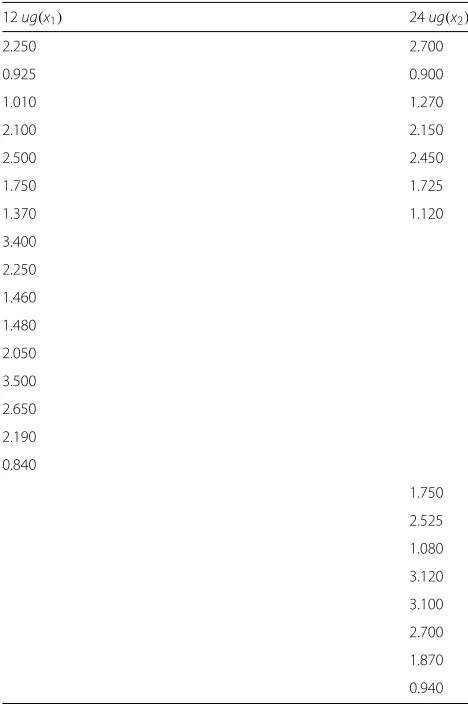
ug aerosol. The resultant data are shown in Table 1, which
consist of two parts: the complete observations and the
incomplete observations.
For the above crossover clinical trial, our main
interest is to test the equivalence between 12 ug
and 24 ug formoterol solution aerosols with respect
to the FEV
1value. To this end, we can
con-struct a
(
1
−
α)
100 % confidence interval for the
Table 1FEV1indicators of patients for 12 ug and 24 ug formoterol solution aerosol
12ug(x1) 24ug(x2)
2.250 2.700
0.925 0.900
1.010 1.270
2.100 2.150
2.500 2.450
1.750 1.725
1.370 1.120
3.400
2.250
1.460
1.480
2.050
3.500
2.650
2.190
0.840
1.750
2.525
1.080
3.120
3.100
2.700
1.870
0.940
difference of two FEV
1values. If the resultant
confidence interval (CI) lies entirely in the interval
(
−
δ
0,
δ
0)
with
δ
0(>
0
)
being some pre-specified clinical
acceptable threshold, we thus could conclude the
equiva-lence between two doses of formoterol solution aerosol at
the
α
significance level. As a result, reliable CIs for the
diff-erence in the presence of incomplete data are necessary.
The problem of testing the equality and constructing
CI for the difference of two correlated proportions in the
presence of incomplete paired binary data has received
considerable attention in past years. For example, ones
can refer to [2–6] for the large sample method, and [7]
for the corrected profile likelihood method. When
sam-ple size is small, [8] proposed the exact unconditional test
procedure for testing equality of two correlated
propor-tions with incomplete correlated data. Tang, Ling and Tian
[9] developed the exact unconditional and approximate
unconditional CIs for proportion difference in the
pres-ence of incomplete paired binary data. Lin et al. [10]
presented a Bayesian method to test equality of two
correlated proportions with incomplete correlated data.
Li et al. [11] discussed the confidence interval
con-struction for rate ratio in matched-pair studies with
incomplete data. However, all the aforementioned
meth-ods were developed for incomplete paired binary data.
Statistical inference on the difference of two means
with incomplete correlated data has received a limited
attention. For example, [12] discussed the problem of
test-ing the equality of two means with misstest-ing data on one
response and recommended [13] statistic when the
vari-ances were not too different. Lin and Stivers [14] also gave
a similar comparison. Lin and Stivers [15] and [12]
sug-gested some test statistics for testing the equality of two
means with incomplete data on both response. However,
to our knowledge, little work has been done on CI
con-struction for the difference of two means with incomplete
correlated data under the MCAR assumption.
Inspired by [16–19], we develop several CIs for the
dif-ference of two means with incomplete correlated data
under the MCAR assumption based on the large
sam-ple method, hybrid method and Bootstrap-resampling
method. The presented Bootstrap-resampling CIs have
not been considered in the literature related to missing
observations.
The rest of this article is organized as follows. Several
methods are presented to construct CIs for the
differ-ence of the two means with incomplete correlated data
in Section “Methods”. Simulation studies and an example
are conducted to evaluate the finite performance of the
proposed CIs in terms of coverage probability, expected
interval width, and mesial and distal non-coverage
prob-abilities in Section “Results”. A brief discussion is given in
Section “Discussion”. Some concluding remarks are given
in Section “Conclusion”.
Methods
Suppose that
x
=
(
x1
,
x2
)
is a 2
×
1 vector of random
variables, and follows a distribution with mean
μ
and
covariance matrix
given by
μ
=
μ
1μ
2and
=
σ
21
ρσ
1σ
2ρσ
1σ
2σ
22,
respectively. Let
{
(
x
1m,
x
2m)
:
m
=
1,
· · ·
,
n
}
be
n
paired
observations on
x
1and
x
2,
x
1,n+1,
· · ·
,
x
1,n+n1be
n
1additional observations on
x
1,
x
2,n+1,
· · ·
,
x
2,n+n2be
n
2additional observations on
x
2. Thus, there are
n
1missing
observations on
x2, and
n2
missing observations on
x1.
Without loss of generality, the data may be presented as
follows:
x11,
· · ·
,
x1
n,
x1,
n+1,· · ·
,
x1,
n+n1,
x21,
· · ·
,
x2
n,
x2,
n+1,· · ·
,
x2,
n+n2,
is MCAR (i.e., independent of treatment and outcome).
Based on these observations, we here want to construct
reliable explicit CIs for the difference of two means
δ
=
μ
1−
μ
2under MCAR assumption.
Confidence interval based on the large sample method
To make a comparison with the following proposed
methods, we assume that
x
follows a bivariate normal
dis-tribution in this subsection. In this case, if only variable
x
1or
x
2is subject to missingness (i.e.,
n
1=
0 or
n
2=
0), one
can obtain the closed forms of the maximum likelihood
estimates (MLEs) of
μ
and
[22]. However, there are no
closed forms of the MLEs for
μ
and
when variables
x
1and
x
2are simultaneously subject to missingness (i.e.,
n
1=
0 and
n
2=
0), though one can find the MLEs of
μ
and
using an iterative algorithm [23]. To get the closed
forms of MLEs for
μ
and
, [15] proposed the modified
MLEs using a non-iterative procedure and provided
sev-eral test statistics based on the obtained estimators of
μ
and
.
(i) Confidence interval based on Lin and Stivers’s test
statistics
Let
δ
ˆ
= ˆ
μ
1− ˆ
μ
2be the MLE of
δ
under the bivariate
nor-mal assumption of
x
. When
is known, it follows from
[15] that the MLE of
δ
is
ˆ
δ
=
ax
(1n)+
(
1
−
a
)
x
(n1)1
−
bx
( n)2
−
(
1
−
b
)
x
( n2)2
,
and the asymptotic variance of
δ
ˆ
can be expressed as
Var
(
δ)
ˆ
=
h
n
+
n
2(
1
−
ρ)
2σ
21
−
2n
ρσ
1σ
2+
n
+
n1
1
−
ρ
2σ
22,
respectively, where
x
(1n)=
1nnj=1x
1j,
x
(2n)=
1n nj=1
x
2j,
x
(n1)1
=
n11 n1j=1
x1,
n+j,
x
(n2)2
=
n12 n2k=1
x
2,n+k,
a
=
nh
(
n
+
n2
+
n1
β
21)
,
b
=
nh
(
n
+
n1
+
n2
β
12)
,
β
21=
ρσ
2/σ
1,
β
12=
ρσ
1/σ
2,
h
=
1
/
{
(
n
+
n
1)(
n
+
n
2)
−
n
1n
2ρ
2}
. An approximate 100
(
1
−
α)
% CI of
δ
is given by
ˆ
δ
−
z
α/2Var
(
δ)
ˆ
,
δ
ˆ
+
z
α/2Var
(
δ)
ˆ
, which is denoted as
T
w1-CI.
Following [15], when
is unknown, the statistic for
testing
H
0:
δ
=
δ
0versus
H
1:
δ
=
δ
0is given by
T
1=
A
x
(1n)−
x
(n1)1
−
B
x
(2n)−
x
(n2)2
+
x
(n1)1
−
x
(n2)
2
−
δ
0√
V
1,
which is asymptotically distributed as
t-distribution
with
n
degrees of freedom under
H
0, where
V
1=
{
A
2/
n
+
(
1
−
A
)
2/
n
1
}
m
1+ {
B
2/
n
+
(
1
−
B
)
2/
n
2}
m
2−
2ABm
12/
n]
/(
n
−
1
)
,
A
= {
n
(
n
+
n
2+
n
1m
12/
m
1}
/
(
n
+
n
1)(
n
+
n
2)
−
n
1n
2r
2 −1,
B
= {
n
(
n
+
n
1+
n
2m
12/
m
2}
/
(
n
+
n
1)(
n
+
n
2)
−
n
1n
2r
2 −1,
m
1=
nj=1x
1j−
x
(1n) 2,
m
2=
nj=1x
2j−
x
(2n) 2,
m
12=
nj=1x
1j−x
(1n)x
2j−
x
(2n),
r
=
m
12/
√
m
1m
2. Therefore, the
approximate 100
(
1
−
α)
% CI on the basis of
T
1is given
by (L,
U), where
L
=
A
x
1(n)−
x
(n1)1
−
B
x
(2n)−
x
(n2)2
+
x
(n1)1
−
x
(n2)
2
−
t
α/2(
n
)
√
V
1, and
U
=
A
x
(1n)−
x
(n1)1
−
B
x
(2n)−
x
(n2)2
+
x
(n1)1
−
x
(n2)
2
+
t
α/2(
n
)
√
V
1, which is
denoted as
T
1-CI.
Another test statistic defined by [15] for testing
H
0:
δ
=
δ
0versus
H
1:
δ
=
δ
0, which is a generalization of [24] test
statistic for two independent samples, is given by
T
2=
¯
x
(n+n1)1
− ¯
x
( n+n2)2
−
δ
0√
h
1+
h
2+
h
3,
which is asymptotically distributed as
t
distribu-tion with degrees
ν
of freedom, where
x
¯
(n+n1)1
=
(
n
+
n
1)
−1jn=+1n1x
1j,
x
¯
2(n+n2)=
(
n
+
n
2)
−1jn=+1n2x
2j,
h
1=
n
{
(
n
+
n
2)
m
1/(
n
+
n
1)
+
(
n
+
n
1)
m
2/(
n
+
n
2)
−
2m
12}
/
{
(
n
−
1
)(
n
+
n
1)(
n
+
n
2)
}
,
h
2=
n
1b
1/
{
(
n
1−
1
) (
n
+
n
1)
2}
,
h3
=
n2b2
/
{
(
n2
−
1
)(
n
+
n2
)
2}
,
b1
=
n+n1j=n+1
x
1j−
x
(1n1) 2,
b
2=
nj=+nn+21x
2j−
x
(2n1) 2, and
ν
=
(
h1
+
h2
+
h3
)
2/
{
h
21/(
n
−
1
)
+
h
22/(
n1
−
1
)
+
h
23/(
n2
−
1
)
}
.
Therefore, the approximate 100
(
1
−
α)
% CI of
δ
for
statistic
T
2is denoted as
T
2-CI.
When
σ
1=
σ
2, it follows from [15] that the statistic for
testing
H
0:
δ
=
δ
0versus
H
1:
δ
=
δ
0can be expressed as
T3=
¯
x(n+n1)
1 − ¯x(
n+n2)
2 −δ0
(n+n1+n2−2)(n+n1)(n+n2)
(b1+c2)(2n−2nr+n1+n2) ,
which is asymptotically distribution as
t-distribution with
degrees
n
+
n
1+
n
2−
4 of freedom. Note that when
n2
>
n1,
b1
+
c2
should be replaced by
b2
+
c1. Thus,
the approximate 100
(
1
−
α)
% CI of
δ
for
T3
is denoted as
T
3-CI, where
c
1=
nj=+1n1x
1j−
n
+
n
1jn=+1n1x
1j 2, and
c
2=
nj=+1n2x
2j−
n+1n2 jn=+1n2x
2j 2.
Also, [12] presented the similar but simpler test
statis-tics for testing the mean difference
δ
=
μ
1−
μ
2, which are
adopted to construct CIs of
δ
as follows.
(ii) Confidence interval based on Ekbohm’s test statistics
Following [12], an unbiased estimator of
δ
is given
by
δ
ˆ
=
x
¯
(n+n1)1
− ¯
x
(n+n2)
2
, and its variance is
given by Var
(
δ)
ˆ
=
Var
(
μ)
ˆ
=
(
n
+
n
2)σ
12+
(
n
+
n
2)σ
22−
2n
ρσ
1σ
2}
/
{
(
n
+
n1
)(
n
+
n2
)
}
. An approximate 100
(
1
−
α)
% CI of
δ
can be obtained by
ˆ
δ
−
z
α/2Var
(
δ)
ˆ
,
δ
ˆ
+
z
α/2Var
(
δ)
ˆ
When
σ
1=
σ
2, Ekbothm (1976) proposed the following statistic for testing
H
0:
T
4=
(
δ
˜
−
δ
0)
(
n
+
n
1)(
n
+
n
2)
−
n
1n
2λ
2/
ˆ
σ
2n
(
1
−
λ)
+
(
n1
+
n2
)(
1
−
λ
2)
, where
δ
˜
=
n
(
n
+
n2
+
n1
λ)
x
(n)1
−
n
(
n
+
n1
+
n2
λ)
x
(n) 2+
n1
n
+
n2
1
−
λ
2−
n
λ
}
x
(n1)1
−
n2
n
+
n1
(
1
−
λ)
2−
n
λ
x
(n2)2
(
n
+
n1
)(
n
+
n2
)
−
n1n2
λ
2,
σ
ˆ
2=
m1
+
m2
+
(
1
+
λ
2)(
b1
+
b2
)
/
{
2
(
n
−
1
)
+
(
1
+
λ
2)(
n
1+
n
2−
2
)
, and
λ
=
2m
12/(
m
1+
m
2)
. Under
H
0,
T
4is asymptotically distributed as
t-distribution with degrees
n
of freedom. Therefore, the approximate 100
(
1
−
α)
% CI is denoted as
T
4-CI.
Following [12], when
σ
1=
σ
2, another statistic for testingH0
can be expressed as
T5
=
¯
x
(n+n1)1
− ¯
x
(n+n2)
2
−
δ
0√
(
n
+
n
1)(
n
+
n
2)/(
R
1+
R
2)
, which is asymptotically distributed as
t
distribution with degrees
ν
σof freedom under
H
0, where
R
1=
n
(
m
1+
m
2−
2m
12) / (
n
−
1
)
,
R
2=
(
n
1+
n
2)(
b
1+
b
2)/(
n
1+
n
2−
2
)
, and
ν
σ=
(
R
1+
R
2)
2/
R
21/(
n
+
1
)
+
R
22/(
n
1+
n
2)
−
2. Thus, an approximate 100
(
1
−
α)
% CI of
δ
for
T
5is denoted as
T
5-CI.
Confidence interval based on the generalized estimating equations(GEEs)
To relax the bivariate normality assumption of
x
, the method of the generalized estimating equations (GEEs) with
exchangeable working correlation structure (e.g., [25]) can be adopted to make statistical inference on
δ
in the
incom-plete correlated data because the GEE approach have become one of the most widely used methods in dealing with
correlated response data [26, 27]. Following [28], the GEEs with exchangeable working correlation structure can be
used to estimate parameter vector
μ
; the so-called sandwich variance estimator can be used to consistently estimate the
covariance matrix of
μ
; and the ML method under a bivariate normal assumption via available paired observations is
used to estimate the correlation parameter. Thus, an approximate 100
(
1
−
α)
% CI of
δ
based on GEE method is denoted
as
T
g-CI.
Confidence interval based on the hybrid method
When the distribution function of
x
is unknown, a hybrid method is developed to construct CI of
δ
in this subsection.
We first introduce the general concept of hybrid method. Let
θ
1and
θ
2be two parameters of interest. Now our main
interest is to construct a 100
(
1
−
α)
% two-sided CI
(
L,
U
)
of
θ
1−
θ
2via hybrid method. Let
θ
ˆ
1and
θ
ˆ
2be two estimates of
θ
1and
θ
2, respectively; and let
(
l
1,
u
1)
and
(
l
2,
u
2)
denote two approximate 100
(
1
−
α)
% CIs for
θ
1and
θ
2, respectively.
Under the dependent assumption on
θ
ˆ
1and
θ
ˆ
2, it follows from the central limit theorem that the approximate two-sided
100
(
1
−
α)
% CI of
θ
1−
θ
2is given by
(
L,
U
)
, where
L
= ˆ
θ
1− ˆ
θ
2−
z
α/2Var
(
θ
ˆ
1)
+
Var
(
θ
ˆ
2)
−
2Cov
(
θ
ˆ
1,
θ
ˆ
2)
,
U
= ˆ
θ
1− ˆ
θ
2+
z
α/2Var
(
θ
ˆ
1)
+
Var
(
θ
ˆ
2)
−
2Cov
(
θ
ˆ
1,
θ
ˆ
2)
.
Because Cov
(
θ
ˆ
1,
θ
ˆ
2)
=
corr
(
θ
ˆ
1,
θ
ˆ
2)
Var
(
θ
ˆ
1)
Var
(
θ
ˆ
2)
1/2, the lower limit
L
and the upper limit
U
can be rewritten as
L
= ˆ
θ
1− ˆ
θ
2−
z
α/2Var
(
θ
ˆ
1)
+
Var
(
θ
ˆ
2)
−
2corr
(
θ
ˆ
1,
θ
ˆ
2)
Var
(
θ
ˆ
1)
Var
(
θ
ˆ
2)
1/2U
= ˆ
θ
1− ˆ
θ
2+
z
α/2Var
(
θ
ˆ
1)
+
Var
(
θ
ˆ
2)
−
2corr
(
θ
ˆ
1,θ
ˆ
2)
Var
(
θ
ˆ
1)
Var
(
θ
ˆ
2)
1/2,
respectively. Note that
(
l
1,
u
1)
contains the plausible parameter values of
θ
1, and
(
l
2,
u
2)
contains the plausible parameter
values for
θ
2. Among these plausible values for
θ
1and
θ
2, the values closest to the minimum
L
and maximum
U
are
respectively
l
1−
u
2and
u
1−
l
2in spirit of the score-type CI [29]. From the central limit theorem, the variance estimates
can now be recovered from
θ
1=
l1
as
Var
(
θ
ˆ
1)
=
(
θ
ˆ
1−
l1
)
2/
z
2α/2and from
θ
2=
u2
as
Var
(
θ
ˆ
2)
=
u2
− ˆ
θ
2 2z
2α/2for
setting
L. As a result, the lower limit
L
for
θ
1−
θ
2is
L
= ˆ
θ
1− ˆ
θ
2−
ˆ
θ
1−
l1
2+
u2
− ˆ
θ
2 2−
2
corr
ˆ
θ
1,θ
ˆ
2ˆ
θ
1−
l1
u2
− ˆ
θ
2(1)
Similarly, we can obtain
U
= ˆ
θ
1− ˆ
θ
2+
u
1− ˆ
θ
1 2+
θ
ˆ
2−
l
2 2−
2
corr
θ
ˆ
1,
θ
ˆ
2u
1− ˆ
θ
1ˆ
θ
2−
l
2(2)
(i)
The Wilson score method
l
i= ˜
θ
i−
z
α/2N
i+
z
2α/2n
n
−
1
nj=1
x
ij− ˆ
θ
i 2+
z
2 α/24
,
u
i= ˜
θ
i+
z
α/2N
i+
z
2α/2n
n
−
1
nj=1
x
ij− ˆ
θ
i 2+
z
2 α/2
4
,
where
N
i=
n
+
n
iand
θ
ˆ
i=
N1i Nij=1
x
ijfor
i
=
1, 2.
(ii)The Agresti-coull method
li= ˜θi−zα/2
n
j=1(xij− ˆθi)2
Ni+zα/22
(n−1)
,
ui= ˜θi+zα/2
n
j=1(xij− ˆθi)2
Ni+z2α/2
(n−1)
,
where
N
i=
n
+
n
iand
θ
˜
i=
Nj=i1x
ij+
0.5z
2α/2/
N
i+
z
2α/2for
i
=
1, 2.
To construct CI for
δ
=
μ
1−
μ
2via the above described
hybrid method, we can simply set
θ
1=
μ
1and
θ
2=
μ
2. If
is known, the estimated correlation coefficient
corr
(
μ
ˆ
1,
μ
ˆ
2)
of
μ
ˆ
1and
μ
ˆ
2is given by
corr
(
μ
ˆ
1,
μ
ˆ
2)
=
2n
ρ/
√
(
n
+
n
1)(
n
+
n
2)
. If
is unknown,
corr
(
μ
ˆ
1,
μ
ˆ
2)
is
given by
corr
(
μ
ˆ
1,μ
ˆ
2)
=
nr
/
(
n
+
n1
)(
n
+
n2
)
−
n1n2r
2,
where
r
=
m
12/
√
m
1m
2,
m
1=
nj=1x
1j−
x
(1n) 2and
m
2=
nj=1x
2j−
x
(2n) 2. Thus, using Eqs. (1) and (2)
yields CIs of
δ
=
μ
1−
μ
2. When
l
iand
u
iare estimated by
the Wilson score method, we denote the corresponding CI
as
W
s-CI; when
l
iand
u
iare estimated by the Agresti-coull
method, the corresponding CI is denoted as
W
a-CI.
Bootstrap-resampling-based confidence intervals
When the distribution of
x
is known, one can obtain
the approximate CIs of
δ
based on the asymptotic
distri-butions of the constructed test statistics under the null
hypotheses
H
0:
δ
=
δ
0. However, when the
distribu-tion of
x
is unknown, the asymptotic distributions of the
constructed test statistics may not be reliable, especially
with small sample size. On the other hand, estimators
of some nuisance parameters have not the closed-form
solutions even if the approximate distribution is reliable,
and they must be obtained by using some iterative
algo-rithms, which are computationally intensive. In this case,
the Bootstrap method is often adopted to construct CIs
of parameter of interest. The Bootstrap CIs can be
con-structed via the following steps.
Step 1.
Given the paired observations and incomplete
observations
D
=
x11,
· · ·
,
x1
n,
x1,
n+1,· · ·
,
x1,
n+n1,
x
21,
· · ·
,
x
2n,
x
2,n+1,
· · ·
,
x
2,n+n2we draw
n
paired observations
(
x
∗1m,
x
∗2m)
:
m
=
1,
· · ·
,
n
with replacement from
n
paired observations
{
(
x
11,
x
21)
,
· · ·
,
(
x
1n,
x
2n)
}
, generate
n
1observations
{
x
∗1,n+j:
j
=
1,
· · ·
,
n
1}
with replacement from
x
1,n+1,
· · ·
,
x
1,n+n1,
and sample
n
2observations
x
∗2,n+k:
k
=
1,
· · ·
,
n
2with
replacement from
x
2,n+1,
· · ·
,
x
2,n+n1. Thus, we obtain
the following Bootstrap resampling sample
D
∗b=
x∗11,· · ·,x∗1n, x1,∗n+1,· · ·,x∗1,n+n 1,
x∗21,· · ·,x∗2n, ,x2,∗n+1,· · ·,x∗2,n+n2
.
Step 2.
For the above generated Bootstrap resampling
sample
D
∗b, we first compute
μ
ˆ
∗1=
(
n
+
n1
)
−1n+n1j=1
x
∗1jand
μ
ˆ
∗2=
(
n
+
n
2)
−1nj=+1n2x
∗2j, and then calculate the
estimated value
δ
ˆ
∗of
δ
via
δ
ˆ
∗= ˆ
μ
∗1− ˆ
μ
∗2.
Step 3.
Repeating the above steps 1 and 2 for a total of
G
times yields
G
Bootstrap estimates
δ
ˆ
∗g:
g
=
1, 2,
· · ·
,
G
of
δ
. Let
δ
ˆ
(1)∗<
δ
ˆ
(2)<
· · ·
<
δ
ˆ
(∗G)be the ordered values of
ˆ
δ
∗g
:
g
=
1, 2,
· · ·
,
G
.
Step 4.
Based on the bootstrap estimates
δ
ˆ
∗g,
g
=
1, 2,
. . .
,
G
, Bootstrap-resampling-based CIs for
δ
can be
constructed as follows.
Generally, the standard error se
(
δ)
ˆ
of
δ
ˆ
can be estimated
by the sample standard deviation of the
G
replications,
i.e.,
se
ˆ
(
δ)
ˆ
=
(
G
−
1
)
−1G g=1ˆ
δ
∗g
− ¯
δ
∗B 2, where
δ¯∗B =
ˆ
δ∗
1+ · · · + ˆδG∗
/G
. If
δˆ∗g :g=1,· · ·,G
is approximately
normally distributed, an approximate 100
(
1
−
α)
%
Boot-strap CI for
δ
is given by
δ
ˆ
−
z
α/2se
ˆ
(
δ)
ˆ
,
δ
ˆ
+
z
α/2se
ˆ
(
δ)
ˆ
,
where
z
α/2is the upper
α/
2-percentile of the standard
normal distribution, which is referred as the simple
Boot-strap confidence interval. When
δ
ˆ
=
ax
(1n)+
(
1
−
a
)
x
(n1)1
−
bx
(2n)−
(
1
−
b
)
x
(n2)2
, the corresponding simple Bootstrap
CI is denoted as
B
1. When
δ
ˆ
= ¯
x
1(n+n1)− ¯
x
(2n+n2), the
corresponding simple Bootstrap CI is denoted as
B
2.
Alternatively, if
δ
ˆ
g∗:
g
=
1,
· · ·
,
G
is not normally
dis-tributed, it follows from ([16] p.132) that the approximate
100
(
1
−
α)
% Bootstrap-resampling-based percentile CI
for
δ
is
δˆ∗([Gα/2]),δˆ(∗[G(1−α/2)])
, where [a] represents the
integer part of
a, which is referred as the percentile
Boot-strap CI. When
δ
ˆ
=
ax
(1n)+
(
1
−
a
)
x
(n1)1
−
bx
(n)
2
−
(
1
−
b
)
x
(n2)2
, the corresponding percentile Bootstrap CI is
denoted as
B
3. When
δ
ˆ
= ¯
x
1(n+n1)− ¯
x
(n+n2)
2
, the
corre-sponding percentile Bootstrap CI is denoted as
B
4.
Results
Simulation studies
(ECP), empirical confidence widths (ECW), and distal
and mesial non-coverage probabilities (DNP and MNP)
in various parameter settings via Monte Carlo simulation
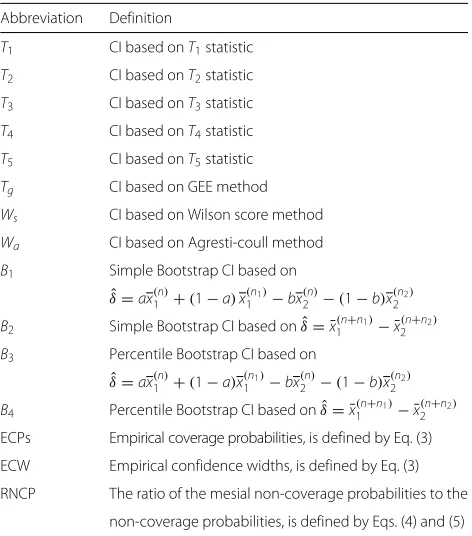
studies. A summary of abbreviation for various confidence
intervals is presented in Table 2.
In the first simulation study, we consider the
follow-ing case that
(
n,
n
1,
n
2)
is set to be
(
5, 2, 2
)
;
μ
1=
0, 1, 2;
μ
2=
0.25, 1, 1.5;
ρ
= −
0.9,
−
0.5,
−
0.1, 0, 0.1, 0.5, 0.9;
δ
=
μ
1−
μ
2= −
0.25, 0, 0.5;
σ
22=
4;
σ
12=
1, 8 and
α
=
0.05. For a given combination
(
n,
n1,
n2,
μ
1,μ
2,ρ
,
σ
1,σ
2)
,
we generate
n
+
n1
+
n2
random samples of
(
x1,
x2
)
from
a bivariate normal distribution with
μ
=
(μ
1,μ
2)
and
=
σ
21
ρσ
1σ
2ρσ
1σ
2σ
22.
Then, for the generated
n
+
n
1+
n
2random samples,
the
n
1observations on
x
2are deleted randomly. For the
remaining paired
n
+
n
2random samples, the
n
2obser-vations on
x
1are deleted randomly. Thus,
(
x
1m,
x
2m)
(
m
=
1,
· · ·
,
n
)
are
n
pairs observations on
(
x
1,
x
2)
;
x
1,n+j(
j
=
1,
· · ·
,
n
1)
are
n
1additional observations on
x
1;
x
2,n+k(
k
=
1,
· · ·
,
n2
)
are
n2
additional observations on
x2. Based on the observation
{
(
x1
j,
x2
j)
:
m
=
1,
· · ·
,
n
}
,
{
x1,
n+j:
j
=
1,
· · ·
,
n1
}
,
{
x
2,n+k:
k
=
1,
· · ·
,
n2
}
, we can
draw 5000 bootstrap resampling samples. Independently
repeating the above process
M
=
10000 times, we can
compute their corresponding ECP, ECW, MNP and DNP
values. The ECP, ECW, MNP and DNP are defined by
Table 2Summary of various abbreviations
Abbreviation Definition
T1 CI based onT1statistic
T2 CI based onT2statistic
T3 CI based onT3statistic
T4 CI based onT4statistic
T5 CI based onT5statistic
Tg CI based on GEE method
Ws CI based on Wilson score method
Wa CI based on Agresti-coull method
B1 Simple Bootstrap CI based on
ˆ
δ=ax(1n)+(1−a)x(n1)
1 −bx( n)
2 −(1−b)x( n2)
2 B2 Simple Bootstrap CI based onδˆ= ¯x1(n+n1)− ¯x(
n+n2)
2 B3 Percentile Bootstrap CI based on
ˆ
δ=ax(1n)+(1−a)x(n1)
1 −bx( n)
2 −(1−b)x( n2)
2 B4 Percentile Bootstrap CI based onδˆ= ¯x1(n+n1)− ¯x(
n+n2)
2 ECPs Empirical coverage probabilities, is defined by Eq. (3)
ECW Empirical confidence widths, is defined by Eq. (3)
RNCP The ratio of the mesial non-coverage probabilities to the
non-coverage probabilities, is defined by Eqs. (4) and (5)
ECP
=
1
M
Mm=1
I
δ
∈
L
x
(m),
U
x
(m),
ECW
=
1
M
Mm=1
U
x
(m))
−
L
x
(m),
(3)
MNP
=
1
M
Mm=1
I
δ
∈
−∞
,
L
x
(m),
DNP
=
1
M
Mm=1
I
δ
∈
U
x
(m),
+∞
,
(4)
respectively, where
I
{
δ
∈
A
}
is an indicator function,
which is 1 if
δ
∈
A
and 0 otherwise. The
ratio of the MNP
to the non-coverage probability (NCP) is defined as
RNCP
=
MNP
NCP
=
MNP
1.0
−
ECP
.
(5)
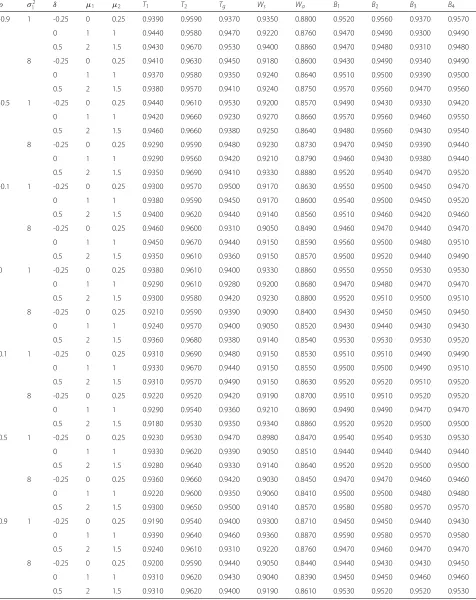
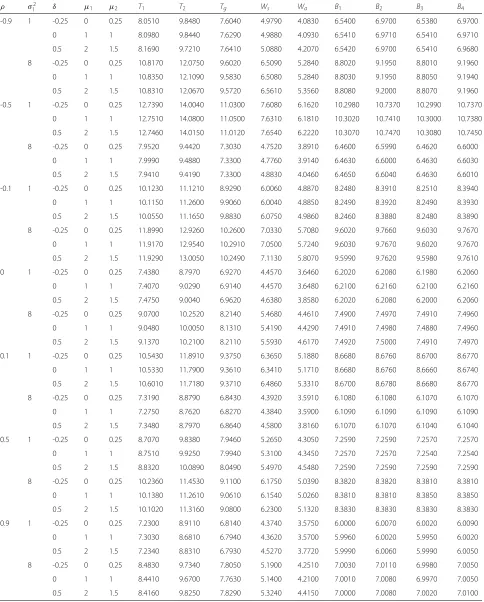
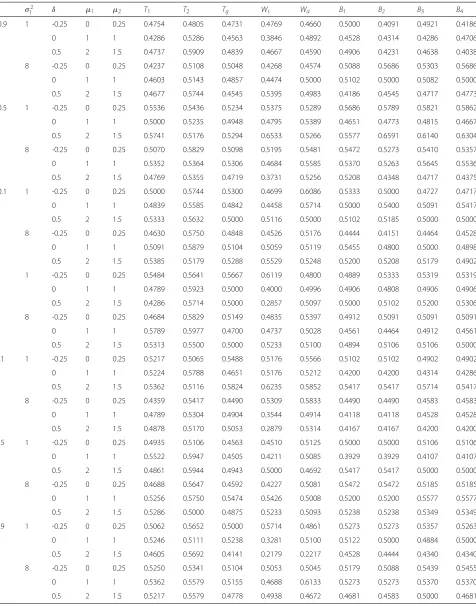
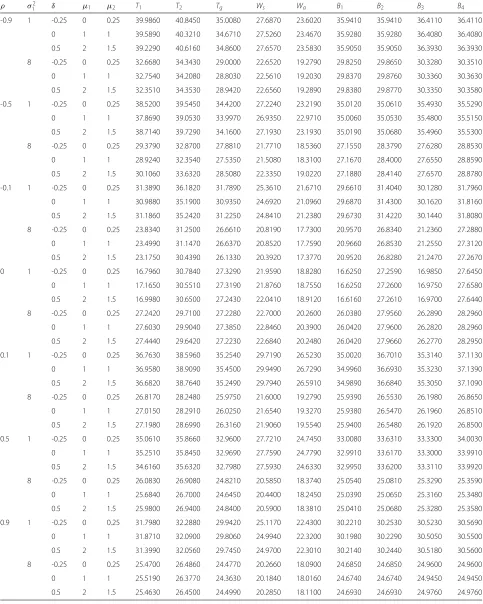
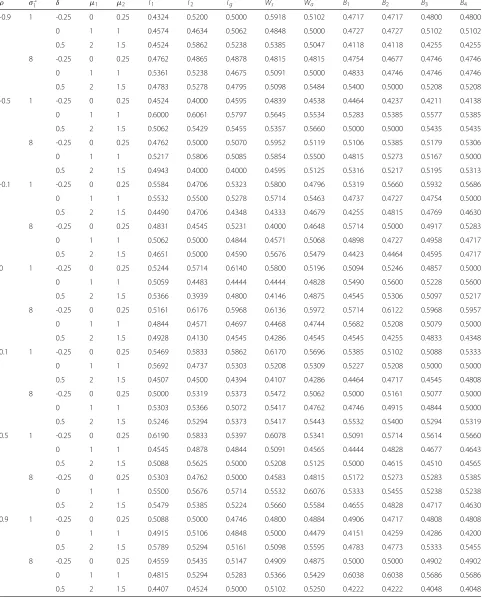
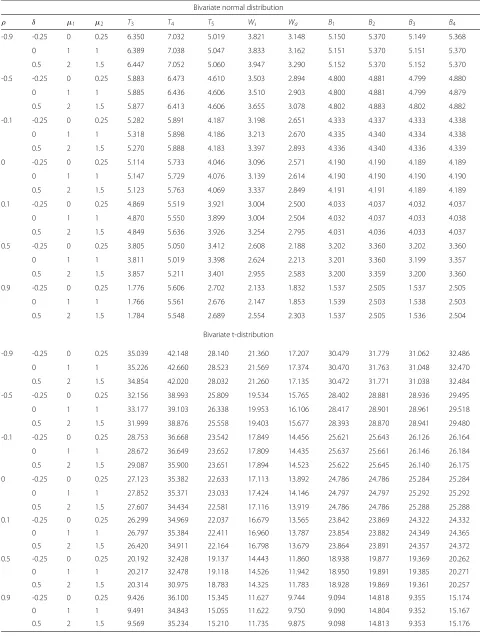
Results are presented in Tables 3, 4 and 5. Also, to
investigate the performance of the proposed CIs under
the assumption
σ
12=
σ
22=
σ
2, we calculate the
cor-responding results for
T
3,
T
4,
T
5, hybrid CIs,
Bootstrap-resampling-based CIs when
σ
2=
4 and
(
n,
n
1
,
n
2)
=
(
5, 5, 2
)
, which are given in Tables 9, 10 and 11.
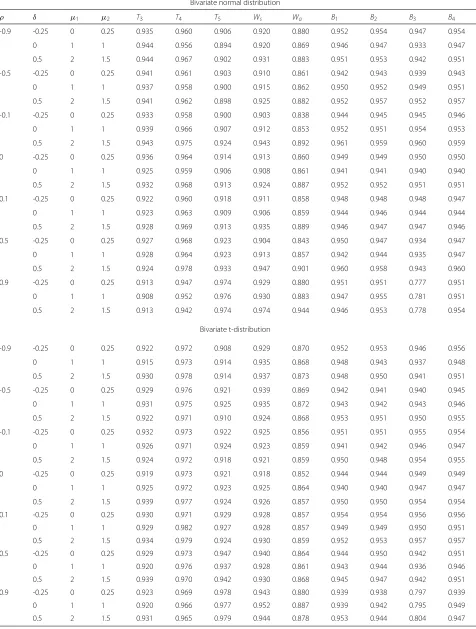
Following [17, 30], an interval can be regarded as
sat-isfactory if (i) its ECP is close to the pre-specified 95 %
confidence level, (ii) it possesses shorter interval width,
and (iii) its RNCP lies in the interval [ 0.4, 0.6];
too mesially
located
if its RNCP is less than 0.4; and
too distally
if its
RNCP is greater than 0.6.
In the second Monte Carlo simulation study, we assume
that the random samples of bivariate variables
x1
and
x2
are generated from a bivariate
t-distribution with five
degrees of freedom, and mean
μ
and scale parameter
specified in the first simulation study. The corresponding
results with
(
n,
n
1,
n
2)
=
(
5, 5, 5
)
are given in Tables 6, 7
and 8. Similarly, we calculate the corresponding results for
T
3,
T
4,
T
5, hybrid CIs, Bootstrap-resampling-based CIs
when
σ
2=
4 and
(
n,
n
1,
n
2)
=
(
5, 5, 2
)
, which are given in
Tables 9, 10 and 11.
To investigate powers for the proposed CIs, we
calcu-lated the power in both the first and second simulation
study. The results are shown in Tables 12 and 13. There is
very little power in both the first and second simulation
study to exclude a difference of zero.
Results of simulation studies
Table 3ECPs of various confidence intervals under bivariate normal distribution with differentρandδ,μ1,μ2σ12and(n,n1,n2)= (5, 2, 2)andσ2
2 =4
ρ σ2
1 δ μ1 μ2 T1 T2 Tg Ws Wa B1 B2 B3 B4
-0.9 1 -0.25 0 0.25 0.9390 0.9590 0.9370 0.9350 0.8800 0.9520 0.9560 0.9370 0.9570
0 1 1 0.9440 0.9580 0.9470 0.9220 0.8760 0.9470 0.9490 0.9300 0.9490
0.5 2 1.5 0.9430 0.9670 0.9530 0.9400 0.8860 0.9470 0.9480 0.9310 0.9480
8 -0.25 0 0.25 0.9410 0.9630 0.9450 0.9180 0.8600 0.9430 0.9490 0.9340 0.9490
0 1 1 0.9370 0.9580 0.9350 0.9240 0.8640 0.9510 0.9500 0.9390 0.9500
0.5 2 1.5 0.9380 0.9570 0.9410 0.9240 0.8750 0.9570 0.9560 0.9470 0.9560
-0.5 1 -0.25 0 0.25 0.9440 0.9610 0.9530 0.9200 0.8570 0.9490 0.9430 0.9330 0.9420
0 1 1 0.9420 0.9660 0.9230 0.9270 0.8660 0.9570 0.9560 0.9460 0.9550
0.5 2 1.5 0.9460 0.9660 0.9380 0.9250 0.8640 0.9480 0.9560 0.9430 0.9540
8 -0.25 0 0.25 0.9290 0.9590 0.9480 0.9230 0.8730 0.9470 0.9450 0.9390 0.9440
0 1 1 0.9290 0.9560 0.9420 0.9210 0.8790 0.9460 0.9430 0.9380 0.9440
0.5 2 1.5 0.9350 0.9690 0.9410 0.9330 0.8880 0.9520 0.9540 0.9470 0.9520
-0.1 1 -0.25 0 0.25 0.9300 0.9570 0.9500 0.9170 0.8630 0.9550 0.9500 0.9450 0.9470
0 1 1 0.9380 0.9590 0.9450 0.9170 0.8600 0.9540 0.9500 0.9450 0.9520
0.5 2 1.5 0.9400 0.9620 0.9440 0.9140 0.8560 0.9510 0.9460 0.9420 0.9460
8 -0.25 0 0.25 0.9460 0.9600 0.9310 0.9050 0.8490 0.9460 0.9470 0.9440 0.9470
0 1 1 0.9450 0.9670 0.9440 0.9150 0.8590 0.9560 0.9500 0.9480 0.9510
0.5 2 1.5 0.9350 0.9610 0.9360 0.9150 0.8570 0.9500 0.9520 0.9440 0.9490
0 1 -0.25 0 0.25 0.9380 0.9610 0.9400 0.9330 0.8860 0.9550 0.9550 0.9530 0.9530
0 1 1 0.9290 0.9610 0.9280 0.9200 0.8680 0.9470 0.9480 0.9470 0.9470
0.5 2 1.5 0.9300 0.9580 0.9420 0.9230 0.8800 0.9520 0.9510 0.9500 0.9510
8 -0.25 0 0.25 0.9210 0.9590 0.9390 0.9090 0.8400 0.9430 0.9450 0.9450 0.9450
0 1 1 0.9240 0.9570 0.9400 0.9050 0.8520 0.9430 0.9440 0.9430 0.9430
0.5 2 1.5 0.9360 0.9680 0.9380 0.9140 0.8540 0.9530 0.9530 0.9530 0.9520
0.1 1 -0.25 0 0.25 0.9310 0.9690 0.9480 0.9150 0.8530 0.9510 0.9510 0.9490 0.9490
0 1 1 0.9330 0.9670 0.9440 0.9150 0.8550 0.9500 0.9500 0.9490 0.9510
0.5 2 1.5 0.9310 0.9570 0.9490 0.9150 0.8630 0.9520 0.9520 0.9510 0.9520
8 -0.25 0 0.25 0.9220 0.9520 0.9420 0.9190 0.8700 0.9510 0.9510 0.9520 0.9520
0 1 1 0.9290 0.9540 0.9360 0.9210 0.8690 0.9490 0.9490 0.9470 0.9470
0.5 2 1.5 0.9180 0.9530 0.9350 0.9340 0.8860 0.9520 0.9520 0.9500 0.9500
0.5 1 -0.25 0 0.25 0.9230 0.9530 0.9470 0.8980 0.8470 0.9540 0.9540 0.9530 0.9530
0 1 1 0.9330 0.9620 0.9390 0.9050 0.8510 0.9440 0.9440 0.9440 0.9440
0.5 2 1.5 0.9280 0.9640 0.9330 0.9140 0.8640 0.9520 0.9520 0.9500 0.9500
8 -0.25 0 0.25 0.9360 0.9660 0.9420 0.9030 0.8450 0.9470 0.9470 0.9460 0.9460
0 1 1 0.9220 0.9600 0.9350 0.9060 0.8410 0.9500 0.9500 0.9480 0.9480
0.5 2 1.5 0.9300 0.9650 0.9500 0.9140 0.8570 0.9580 0.9580 0.9570 0.9570
0.9 1 -0.25 0 0.25 0.9190 0.9540 0.9400 0.9300 0.8710 0.9450 0.9450 0.9440 0.9430
0 1 1 0.9390 0.9640 0.9460 0.9360 0.8870 0.9590 0.9580 0.9570 0.9580
0.5 2 1.5 0.9240 0.9610 0.9310 0.9220 0.8760 0.9470 0.9460 0.9470 0.9470
8 -0.25 0 0.25 0.9200 0.9590 0.9440 0.9050 0.8440 0.9440 0.9430 0.9430 0.9450
0 1 1 0.9310 0.9620 0.9430 0.9040 0.8390 0.9450 0.9450 0.9460 0.9460
Table 4ECW of various confidence intervals under bivariate normal distribution with differentρandδ,μ1,μ2,σ12and(n,n1,n2)= (5, 2, 2)andσ2
2 =4
ρ σ2
1 δ μ1 μ2 T1 T2 Tg Ws Wa B1 B2 B3 B4
-0.9 1 -0.25 0 0.25 8.0510 9.8480 7.6040 4.9790 4.0830 6.5400 6.9700 6.5380 6.9700
0 1 1 8.0980 9.8440 7.6290 4.9880 4.0930 6.5410 6.9710 6.5410 6.9710
0.5 2 1.5 8.1690 9.7210 7.6410 5.0880 4.2070 6.5420 6.9700 6.5410 6.9680
8 -0.25 0 0.25 10.8170 12.0750 9.6020 6.5090 5.2840 8.8020 9.1950 8.8010 9.1960
0 1 1 10.8350 12.1090 9.5830 6.5080 5.2840 8.8030 9.1950 8.8050 9.1940
0.5 2 1.5 10.8310 12.0670 9.5720 6.5610 5.3560 8.8080 9.2000 8.8070 9.1960
-0.5 1 -0.25 0 0.25 12.7390 14.0040 11.0300 7.6080 6.1620 10.2980 10.7370 10.2990 10.7370
0 1 1 12.7510 14.0800 11.0500 7.6310 6.1810 10.3020 10.7410 10.3000 10.7380
0.5 2 1.5 12.7460 14.0150 11.0120 7.6540 6.2220 10.3070 10.7470 10.3080 10.7450
8 -0.25 0 0.25 7.9520 9.4420 7.3030 4.7520 3.8910 6.4600 6.5990 6.4620 6.6000
0 1 1 7.9990 9.4880 7.3300 4.7760 3.9140 6.4630 6.6000 6.4630 6.6030
0.5 2 1.5 7.9410 9.4190 7.3300 4.8830 4.0460 6.4650 6.6040 6.4630 6.6010
-0.1 1 -0.25 0 0.25 10.1230 11.1210 8.9290 6.0060 4.8870 8.2480 8.3910 8.2510 8.3940
0 1 1 10.1150 11.2600 9.9060 6.0040 4.8850 8.2490 8.3920 8.2490 8.3930
0.5 2 1.5 10.0550 11.1650 9.8830 6.0750 4.9860 8.2460 8.3880 8.2480 8.3890
8 -0.25 0 0.25 11.8990 12.9260 10.2600 7.0330 5.7080 9.6020 9.7660 9.6030 9.7670
0 1 1 11.9170 12.9540 10.2910 7.0500 5.7240 9.6030 9.7670 9.6020 9.7670
0.5 2 1.5 11.9290 13.0050 10.2490 7.1130 5.8070 9.5990 9.7620 9.5980 9.7610
0 1 -0.25 0 0.25 7.4380 8.7970 6.9270 4.4570 3.6460 6.2020 6.2080 6.1980 6.2060
0 1 1 7.4070 9.0290 6.9140 4.4570 3.6480 6.2100 6.2160 6.2100 6.2160
0.5 2 1.5 7.4750 9.0040 6.9620 4.6380 3.8580 6.2020 6.2080 6.2000 6.2060
8 -0.25 0 0.25 9.0700 10.2520 8.2140 5.4680 4.4610 7.4900 7.4970 7.4910 7.4960
0 1 1 9.0480 10.0050 8.1310 5.4190 4.4290 7.4910 7.4980 7.4880 7.4960
0.5 2 1.5 9.1370 10.2100 8.2110 5.5930 4.6170 7.4920 7.5000 7.4910 7.4970
0.1 1 -0.25 0 0.25 10.5430 11.8910 9.3750 6.3650 5.1880 8.6680 8.6760 8.6700 8.6770
0 1 1 10.5330 11.7900 9.3610 6.3410 5.1710 8.6680 8.6760 8.6660 8.6740
0.5 2 1.5 10.6010 11.7180 9.3710 6.4860 5.3310 8.6700 8.6780 8.6680 8.6770
8 -0.25 0 0.25 7.3190 8.8790 6.8430 4.3920 3.5910 6.1080 6.1080 6.1070 6.1070
0 1 1 7.2750 8.7620 6.8270 4.3840 3.5900 6.1090 6.1090 6.1090 6.1090
0.5 2 1.5 7.3480 8.7970 6.8640 4.5800 3.8160 6.1070 6.1070 6.1040 6.1040
0.5 1 -0.25 0 0.25 8.7070 9.8380 7.9460 5.2650 4.3050 7.2590 7.2590 7.2570 7.2570
0 1 1 8.7510 9.9250 7.9940 5.3100 4.3450 7.2570 7.2570 7.2540 7.2540
0.5 2 1.5 8.8320 10.0890 8.0490 5.4970 4.5480 7.2590 7.2590 7.2590 7.2590
8 -0.25 0 0.25 10.2360 11.4530 9.1100 6.1750 5.0390 8.3820 8.3820 8.3810 8.3810
0 1 1 10.1380 11.2610 9.0610 6.1540 5.0260 8.3810 8.3810 8.3850 8.3850
0.5 2 1.5 10.1020 11.3160 9.0800 6.2300 5.1320 8.3830 8.3830 8.3830 8.3830
0.9 1 -0.25 0 0.25 7.2300 8.9110 6.8140 4.3740 3.5750 6.0000 6.0070 6.0020 6.0090
0 1 1 7.3030 8.6810 6.7940 4.3620 3.5700 5.9960 6.0020 5.9950 6.0020
0.5 2 1.5 7.2340 8.8310 6.7930 4.5270 3.7720 5.9990 6.0060 5.9990 6.0050
8 -0.25 0 0.25 8.4830 9.7340 7.8050 5.1900 4.2510 7.0030 7.0110 6.9980 7.0050
0 1 1 8.4410 9.6700 7.7630 5.1400 4.2100 7.0010 7.0080 6.9970 7.0050