Abstract
Leptin or obesity receptor (ob-r) is a member of class i cytokine receptor family. ob-r, expressed in six isoforms, is the product of alternative rnA splicing of db gene. According to its structural differences, the receptor’s isoforms are divided into three classes: long, short, and secretory isoforms. A long, fully active iso-form of ob-rb is expressed mainly in the hypothala-mus, where it takes part in energy homeostasis and in the regulation of secretory organs’ activity. ob-rb is also present on all types of immune cells, involved in innate and adaptive immunity. Short leptin isoforms (ob-ra, ob-rc, ob-rd, and ob-re) that contain box 1 motif are able to bind JAK kinases (Janus kinases) as well as to activate some other signal transduction cas-cades. A soluble isoform (ob-re) can regulate serum leptin concentration and serve as a carrier protein de-livering the hormone to its membrane receptors and is able to transduce the signal into the cell. JAK/StAt pathway plays the major role in leptin signal transduc-tion through membrane receptors. Among all ob-r isoforms, only full-length isoform (ob-rb) is able to fully transduce activation signal into the cell.
Key words: leptin, leptin receptor, leptin receptor iso-forms
i
ntrodUCtionA search for the biological factor responsible for ener-gy balance and signal transduction to the hypothala-mus was initiated by studies on animal models. in 1994, a molecular defect in the obese gene (ob), a gene responsible for the obesity phenotype in ob/ob mice was identified using a positive cloning method. Ob gene has found on chromosome 6 in mice and on chromosome 7q31.3 in humans and has been shown to encode 4.5 kb-long mrnA. the protein encoded by the ob gene has been isolated and named leptin -from the Greek "leptos" meaning thin [1]. it has been demonstrated that leptin biological activity strongly depends on its proper interactions with ob-r recep-tors [2].
t
heS
trUCtUre ofL
ePtinr
eCePtorSob-r receptor, encoded by db gene has been identi-fied for the first time in a murine vascular plexus using a cloning technique. it is a member of class i cytokine receptors family that, apart from, ob-r consist of
gp130 subunit of iL-2r, iL-3, iL-4, iL-6, iL-7, Lif (leukemia inhibitory factor), G-CSf (granulocyte-colony stimulating factor), growth hormone, prolactin, and erythropoietin receptors [3, 4]. ob-r expressed in six isoforms, is the product of alternative rnA splic-ing of db gene (diabetes gen) [5, 6]. Accordsplic-ing to its structural differences, the receptor’s isoforms were di-vided into three classes: long, short and secretory.
All ob-r isoforms have a similar, extracellular lig-and-binding domain located in n-terminus of the pro-tein. the domain is constituted by 816 amino acids and contains four cysteine residues, WSXWS motif (trp-Ser-X-trp-Ser) and a different number of fi-bronectin iii domains. five isoforms, including the long isoform ob-rb and short ones - ob-ra, ob-rc, ob-rd, and ob-rf, have a transmembrane domain consisting of 34 amino acids. the intracellular do-main of the long isoform consists of 303 amino acids at carboxyl terminus, while intracellular domains of short isoforms are shorter and consists of 32-40 amino acids. Apart from identical extracellular and transmembrane domains, ob-r isoforms (short and long) have the same sequence of the first intracellular 29 amino acids. this sequence contains a constant box 1 motif and JAK tyrosine kinase. the length of the further intracellular amino acid sequences depends on the alternative mrnA splicing. ob-rb isoform con-tain additional box 2 and SoCS (suppressor of cy-tokine signaling) motifs. SoCS expression is induced by cytokines [7]. A sixth, secreted ob-re isoform, does not contain intracellular and cytoplasmic do-mains and is secreted to the bloodstream as a soluble receptor (fig. 1) [6, 8-10].
A long, fully active isoform of ob-rb is expressed mainly in the hypothalamus, where it takes part in en-ergy homeostasis and in the regulation of secretory organs’ activity. ob-rb is also present in all types of immune cells, involved in innate and adaptive immuni-ty (fig. 2) [7, 9, 11, 12-14].
Lack of a full-length ob-rb receptor is responsible for the development of the early obesity phenotype in db/db mice and in obese rats. in db/db mice, a short ob-ra isoform with limited activity is synthesized. the condition leads to diabetes, morbid obesity, and pubertal development disorders. the mice strain is also characterized by cold intolerance and elevated concentration of glucosteroid hormones. Moreover, db/dbmice phenotype includes a significantly elevated leptin concentration, with no ability to respond to lep-tin signal [15].
eur J Med res (2010) 15(Suppl. ii): 50-54 © i. holzapfel Publishers 2010
review
L
ePtin
r
eCePtorS
e. Gorska1, K. Popko1, A. Stelmaszczyk-emmel1, o. Ciepiela1, A. Kucharska2, M. Wasik1
Short leptin isoforms that contain box 1 motif are able to bind JAK kinases (Janus kinases) and to acti-vate some signal transduction cascades. however, the effect of short isoform activation differs from that of long isoform activation [16, 17]. their main function is presumably connected with leptin internalization and degradation [18]. A short isoform, ob-ra, is the most common ob-r isoform that can be found in many various cells and tissues, including kidney, lungs, liver, spleen, and macrophages [6].
A soluble isoform of the receptor, ob-re, is proba-bly a result of alternative transcript splicing of db
gene or a consequence of transmembrane ob-r re-ceptor destruction. Circulating ob-re is able to bind serum leptin and to inhibit signal transduction path-ways. on the other hand, the receptor can regulate serum leptin concentration and serve as a carrier pro-tein delivering the hormone to its membrane receptors able to transduct the signal into the cell [19].
in normal conditions, only 5-25% of all ob-r iso-forms are present on the cell surface, whereas the ma-jority of receptors are localized within the cell. After ligand binding, the receptors are internalized into early endosomes via clathrin-coated vesicles. next, the re-ceptor is degraded or effectively recycled to the cell membrane. the process concerns mainly ob-ra and ob-rb isoforms. A decrease in ob-rb expression is much higher than changes in ob-ra expression, and short isoform ob-ra is much faster recycled to the cell membrane. relatively weak signal transduction through long ob-rb isoform observed in obese, hy-perleptinemic patients is related to delayed receptor expression on the cell surface, which may explain lep-tin resistance in these patients [8, 20, 21].
S
iGnALt
rAnSdUCtionP
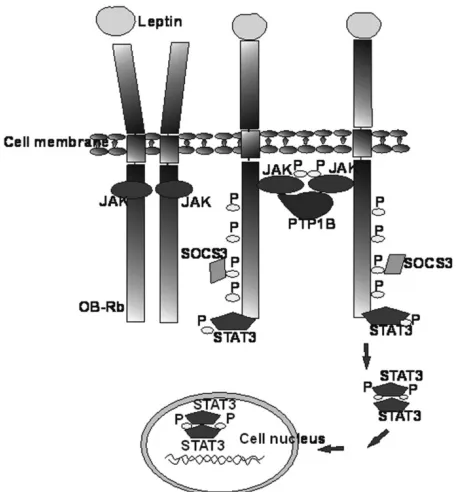
AthWAySthe major role in leptin signal transduction through membrane receptors is mediated through JAK/StAt (signal transduction and activation of transcription) pathway. Among all ob-r isoforms, only the full-length isoform ob-rb is able to fully transduce an ac-tivation signal into the cell. ob-rb is considered a ful-ly active receptor, because it contains 3 intracellular motifs necessary to activate the JAK/StAt pathway. the described motifs are the following: box 1 and box 2 that bind JAK tyrosine kinase, and box 3 motif that binds StAt transcription factor [6, 15]. Additionally, in intracellular domain, ob-rb contains four tyrosine residues (tyr974, tyr985, tyr1077 and tyr1138) that activate intracellular signal transduction pathways (fig. 2) [22]. After ligand binding to the ob-rb receptor, a cytoplasmic tyrosine kinase JAK2 binds to box-1 and
Fig. 1. Leptin receptor (ob-r) isoforms. Cr cytokine receptor domain, fiii -type iii fibronectin domains, Box 1, 2, 3 – constant, intracellular motifs [according to 7, 8].
box-2 motifs [23]. the activated kinase is autophos-phorylated and activates specific tyrosine residues (tyr 985 and tyr1138) in the receptor molecule. next, after tyr1138 phosphorylation, StAt proteins bind to box-3 motif. StAt proteins (StAt1, StAtbox-3, StAt5, StAt6), including the key signal transduction mole-cule StAt3, are phosphorylated on tyrosine residues by JAK2 kinases. the process leads to the dissociation of proteins from the receptor, homo- or hetero-dimerization and translocation of the proteins to the nucleus. in the nucleus, the described proteins serve as transcription factors activating the expression of a suppressor of cytokine signaling 3 (SoCS-3) or pro-tein tyrosine phosphatase 1B (fig. 3) [17, 24-26].
StAt proteins are activated by leptin and depend-ing on the target tissue; the type of activated protein may differ between various types of target cells [24]. JAK/StAt pathway activation also requires SoCS proteins, mainly SoCS3. SoCS proteins serve as a negative regulator of cytokines’ activity. Leptin in-duces SoCS3 expression by binding to the SoCS3 Sh2 domain with tyr985 or through the inhibition of SoCS3 dependent JAK2 phosphorylation activity [21, 27]. in addition, PtP1B (protein tyrosine phosphatase 1B) is another negative leptin signal transduction mod-ulator that regulates signal transduction through phosphorylation of JAK2. PtPB1 overexpression
de-creases JAK2 phosphorylation and inhibits leptin-in-duced SoCS3 and c-fos (proto-oncogene) transcrip-tion [28].
Apart from the above described, leptin signaling also is mediated by other pathways. MAPK kinases (mitogen-activated protein kinase), irS1 (insulin re-ceptor substrate-1), and phosphatidylinositol kinase (Pi3K) are important pathways responsible for ob-rb receptor activation by leptin in various cells, e.g., t-cells [28, 29]. the MAPK kinase signal transduction pathway is mediated by erK (estrogen receptor) and p38 kinases. it has been demonstrated in osteoblasts that leptin, after activation of ob-rb, induces apopto-sis through the activation of MAPK, erK1/2-de-pendent activation of cytoplasmic phospholipase A, and subsequent cytochrome c release and activation of caspases 3 and 9 [30]. osmotic stress, heat shock, and cytokines are able to activate another MAPK family protein, namely p38. in mononuclear cells, after bind-ing to ob-rb, leptin increases the level of p38MAPK phosphorylation. in LPS (lipopolysaccharide)-stimu-lated Kupffer cells, leptin significantly increases tnfa secretion through the activation of p38 and JnK/MAPK (c-Jun n-terminal kinase), whereas in smooth muscle cells it is able to induce hypertrophy through the activation of p38 MAPK [31].
the majority of insulin-mediated biological effects are caused by Pi3K activation. Pi3K is believed to constitute an important common element for signal transduction pathways activated by insulin and leptin and its receptor. in the central nervous system, adi-pose tissue, liver, and pancreas, leptin induces a similar pathway to that activated by insulin, including Pi3K-dependent activation of Pde3B (phosphodiesterase 3B) and cAMP (cyclic adenosine monophosphate) re-duction [32]. it seems that Pi3K/Pde3B/cAMP pathway cooperates with the JAK2/StAt cascade and is an important element of leptin signal transduction pathways in the hypothalamus [28].
L
ePtinr
eCePtorG
eneP
oLyMorPhiSMLePr gene (leptin receptor gene) mutations are ex-tremely rare in human and animals. A single nucleotide substitution (G to A) in exon 6 leads to a deficiency in intracellular and transmembrane domain of the recep-tor [33]. the mutation caused by premature stop codon insertion at the 3’ terminus of LePrb mrnA was found in db/db mice [15], whereas in Zucker rats, the mutation was caused by amino acid substitution (Gln to Pro) at position 269 of the extracellular do-main of the receptor. the described mutation resulted in a severe reduction of ob-r expression on the cell surface and limitation in the leptin-receptor binding. obese Koletsky rats had a point mutation at 763 posi-tion resulting in premature stop codon introducposi-tion in the intracellular domain of the receptor that led to a total deficiency in all ob-r isoforms on the cell sur-face. Both Zucker and Koletsky rats are characterized by morbid obesity, hyperphagia, hyperlipidemia, and numerous hormonal disorders [34, 35]. in humans, a rare mutation caused by a single substitution of G to A in exon 16 was identified. it leads to an abnormal expression of transmembrane and intracellular
mains of receptors. As in case of laboratory animals, humans with LePr gene defects demonstrate obesity, hyperphagia, pubertal development disorders, and en-docrine system abnormalities [33].
LePr gene polymorphisms seem to be much better described. it has been demonstrated that the polymor-phisms may lead to the impairment of signal transduc-tion from the receptor into the cell through premature ob-ra, instead of ob-rb isoform production, or through a decrease in ob-r expression on the cell sur-face and limitation in leptin-receptor interactions. LePr gene defects influence the development of hy-perphagia, obesity, pubertal development disorders, neuroendocrine system regulation impairment, and di-abetes caused by β-cell apoptosis in the pancreas [8, 15, 33, 36]. the most commonly seen polymorphism is Gln223Arg, encoding the extracellular domain of the receptor responsible for leptin binding. Glutamine to arginine change may be responsible for an impaired signal transducing capacity of the leptin receptor [36]. A connection between Gln223Arg polymorphism and breast cancer development and progression has been suggested [37]. Genetic interactions between leptin and Gln223Arg polymorphisms of LePr gene can in-crease the risk of the development of non-hodgkin lymphoma in obese patients [38]. it also is suggested that the discussed polymorphisms are related to hemo-dynamic and metabolic disorders found in obese pa-tients [39]. overweight and obesity commonly ob-served after the management of childhood acute lym-phoblastic leukemia also may have to do with the Gln223Arg polymorphism of LePr gene [40].
Conflicts of interest: the authors declare no conflicts of in-terest in relation to this article.
r
eferenCeS1. Zhang y, Proenca r, Maffei M, Barone M, Leopold L, friedman JM. Positional cloning of the mouse obese gene and its human homologue. nature 1994; 372: 425-32. 2. Brunner i, nick hP, Cumin f, Chiesi M, Baum h-P, Whitebread S, Stricker-Krongrad A, Levens n. Leptin is a physiologically important regulator of food intake. int J obesity 1997; 21: 1152-60.
3. Bazan Jf. A novel family of growth factor receptors: a common binding domain in the growth hormone, pro-lactin, erythropoietin and iL-6 receptors, and the p75 iL-2 receptor β-chain. Biochem Biophys res Commun 1989; 164: 788-95.
4. hegyi K, fulop K, Kovacs K, toth S, falus A. Leptin in-duced signal transduction pathways. Cell Biol int 2004; 28: 159-69.
5. Ahima rS, Saper CB, flier JS, elmquist JK. Leptin regula-tion of neuroendocrine systems. front neuroendocrinol 2000; 21: 263-307.
6. tartaglia LA, dembski M, Wang X, deng n, Culpepper J, devos r, richards GJ, Campfield LA, Clark ft, deeds J, Muir C, Sanker S, Moriarty A, Moore KJ, Smutko JS, Mays GG, Wool eA, Monroe CA, tepper ri. identifica-tion and expression cloning of a leptin receptor, ob-r. Cell 1995; 83: 1263-71.
7. Sweeney G. Leptin signaling. Cell Signal 2002; 14: 655-63. 8. Ahima rS, osei Sy. Leptin signaling. Physiol Behav 2004;
81: 223-41.
9. Bjorbak C, Uotani S, da Silva B, flier JS. divergent signal-ing capacities of the long and short isoforms of the lep-tin receptor. J Biol Chem 1997; 272: 32686-95.
10. Cioffi JA, Shafer AW, Zupancic tJ, Smith-Gbur J, Mikhail A, Platika d, Snodgrass hr. novel B219/ob receptor isoforms: Possible role of leptin in hematopoiesis and re-production. nat Med 1996; 2: 585-9.
11. Barr VA, Lane K, taylor S. Subcellular localization and internalization of the four human leptin receptor iso-forms. J Biol Chem 1999; 274: 21416-24.
12. Caldefie-Chezer f, Poulin A, tridon A, Sion B, Vasson MP. Leptin: a potential regulator of polymorphonuclear neutrophil bactericidal action? J Leukoc Biol 2001; 69: 414-18.
13. Li Q, Li Jy, Li y, Zhang JC. expression of long isoform leptin receptor and shortest membrane bound variant in peripheral blood mononuclear cells from the obese and normal individuals. Zhonghua yi Xue Za Zhi 2007; 87: 3288-99.
14. Martin-romero C, Santoz-Alvarez J, Goberna r, Sanchez-Margalet V. human leptin enhances activation and proliferation of human circulating t lymphocytes. Cell immunol 2000; 199: 15-24.
15. tartaglia LA. the leptin receptor. J Biol Chem 1997; 272: 6093-6.
16. Burguera B, Couce Me, Long J, Lamsam J, Laakso K, Jensen Md, Parisi Je, Lloyd rV. the long form of the leptin receptor (ob-rb) is widely expressed in the human brain. neuroendocrinology 2000; 71: 187-95.
17. frühbeck G. intracellular signaling pathways activated by leptin. Biochem J 2006; 393: 7-20.
18. Uotani S, Bjorbaek C, tornoe J, flier JS. functional prop-erties of leptin receptor isoforms: internalization and degradation of leptin and ligand-induced receptor down-regulation. diabetes 1999; 96: 279-86.
19. Chan JL, Blüher S, yannakouris n, Suchard MA, Kratzsch J, Mantzoros CS. regulation of circulating solu-ble leptin receptor levels by gender, adiposity, sex steroids, and leptin: observational and interventional studies in humans. diabetes 2002; 51: 2105-12.
20. Münzberg h, Björnholm M, Bates Sh, Myers Jr MG. Leptin receptor action and mechanisms of leptin resist-ance. Cell Mol Life Sci 2005; 62: 642-65.
21. Münzberg h, Myers Jr MG. Molecular and anatomical de-terminants of central leptin resistance. nat neurosci 2005; 5: 566-70.
22. hekerman P, Zeidler J, Bamberg-Lemper S, Knobelspies h, Lavens d, tavernier J, Joost G-h, Becker W. Pleiotropy of leptin receptor signalling is defined by dis-tinct roles of the intracellular tyrosines. feBS J 2005; 272: 109-19.
23. Kloek C, haq AK, dunn SL, Lavery hJ, Banks AS, Myers MG. regulation of Jak kinases by intracellular lep-tin receptor sequences. J Biol Chem 2002; 277: 41547-55.
24. Bendinelli P, Maroni P, Pecori-Giraldi f, Piccoletti r. Lep-tin activates Stat3, Stat1 and AP-1 in mouse adipose tis-sue. Mol Cell endocrinol 2000; 168: 11-20.
25. Cheng A, Uetani n, Simoncic Pd, Chaubery VP, Lee-Loy A, McGlade CJ, Kennedy BP, tremblay ML. Attenuation of leptin action and regulation of obesity by protein tyro-sine phosphatase 1B. dev Cell 2002; 2: 497-503.
26. Muraoka o, Xu B, tsurumaki t, Akira S, yamaguchi t, higuchi h. Leptin–induced transactivation of nPy gene promoter mediated by JAK1, JAK2 and StAt3 in the neural cell lines. neurochem int 2003; 42: 591-601. 27. dunn S, Björnholm M, Bates Sh, Chen Z, Seifert M,
My-ers Jr MG. feedback inhibition of leptin receptor /Jak2 signaling via tyr1138 of the leptin receptor and suppres-sor of cytokine signaling 3. Mol endocrinol 2005; 19: 925-38.
29. Martin-romero C, Sanchez-Margarel V. human leptin ac-tivates Pi3K and MAPK pathways in human peripheral blood mononuclear cells: possible role of Sam 68. Cell immunol 2001; 212: 83-91.
30. Kim GS, hong JS, Kim SW, Koh JM, An CS, Choi Jy, Cheng SL. Leptin induces apoptosis via erK/cPLA2/cy-tochrome c pathway in human bone morrow stromal cells. J Biol Chem 2003; 278: 21920-29.
31. Sweeney G. Leptin signalling. Cell Signal 2002; 14: 655-63.
32. Zhao AZ, huan Jn, Gupta S, Pal r, Sahu A. A phos-phatidylinositol 3-kinase-phosphodiesterase 3B-cyclic AMP pathway in hypothalamic action of leptin on feed-ing. nat neurosci 2002; 5: 727-8.
33. Clement K, Vaisse C, Lahlou n, Cabrol S, Pelloux V, Cas-suto d, Gourmelen M, dina C, Chambaz J, Lacorte J-M, Basdevant A, Bougneres P, Lebouc y, froguel P, Guy-Grand B. A mutation in the human leptin receptor gene causes obesity and pituitary dysfunction. nature 1998; 392: 398-401.
34. White dW, Wang d, Chua Jr SC, Morgenstern JP, Leibel ri, Bauman h, tArtAGLiA LA. Constitutive and im-paired signaling of leptin receptors containing the GlnÆPro extracellular domain fatty mutation. Proc natl Acad Sci USA 1997; 94: 10657-62.
35. Wu-Peng XS, Chua Jr SC, okada n, Liu SM, nicolson M, Leibel rL. Phenotype of the obese Koletsky (f) rat due to tyr763Stop mutation in the extracellular domain of the leptin receptor (Lepr): evidence for deficient plasma-to-CSf transport of leptin in both the Zucker and Koletsky obese rat. diabetes 1997; 46: 513-8.
36. yiannakouris n, yannakoulia M, Melistas L, Chan JL, Klimis-Zacas d, Mantzoros CS. the Q223r polymor-phism of the leptin receptor gene is significantly associat-ed wit obesity and prassociat-edicts a small percentage of body weight and body composition variability. J Clin en-docrinol Metab 2001; 86: 4434-9.
37. Snoussi K, Strosberg Ad, Bouaouina n, Ben Ahmed S, helal An, Chouchane L. Leptin and leptin receptor poly-morphism are associated with increased risk and poor prognosis of breast carcinoma. BMC Cancer 2006; 6: 2407-17.
38. Skibola Cf, holly eA, forrest MS, hubbard A, Bracci PM, Skibola dr, hegedus C, Smith Mt. Body mass in-dex, leptin and leptin receptor polymorphism, and non-hodgkin lymphoma. Cancer epidemiol Biomarkers Prev 2004; 13: 779-86.
39. Guizar-Mendoza JM, Amador-Licona n, flores-Martinez Se, Lopez-Gardona MG, Ahuatzin-tremary r, Sanchez-Corona J. Association analysis of the Gln223Arg poly-morphism in the human leptin receptor gene, and traits related to obesity in Mexican adolescents. J hum hyper-tens 2005; 19: 341-6.
40. ross JA, Kevin C, oeffinger KC, davies SM, Mertens AC, Langer eK, Kiffmeyer Wr, Sklar CA, Stovall M, ya-sui y, robison LL. Genetic variation in the leptin recep-tor gene and obesity in survivors of childhood acute lym-phoblastic leukemia: A report from the childhood cancer survivor study. J Clin oncol 2004; 22: 3558-62.
Address for correspondence:
elzbieta Gorska 24 Marszalkowska St. 00-576 Warsaw Poland
Phone: +48 22 6296517 fax +48 22 6296517
![Fig. 2. ob-rb, long isoform of leptin receptor: JAK-tyrosinekinases, StAt-signal transducer and activator of transcrip-- phosphate residues, Cr - cytokine receptor domain, f-iii-tion, SoCS proteins-cytokine signal transduction inhibitors, Ptype iii fibronectin domains [according to 7, 17].](https://thumb-us.123doks.com/thumbv2/123dok_us/9463296.1929383/2.598.60.354.67.562/tyrosinekinases-transducer-activator-transcrip-transduction-inhibitors-fibronectin-according.webp)