Modeling and Performance Analysis of
Microgrid Using Fuzzy Logic Controller
D.M.Chandwadkar1, Tanvi Sonawane2
Professor, Dr, H.O.D, Dept. of VLSI & Embedded Engineering, KKWIEER, Nashik, Maharashtra, India1
PG Student [VLSI], Dept. of VLSI & Embedded Engineering, KKWIEER, Nashik, Maharashtra, India2
ABSTRACT: Fuzzy logic based voltage controller is proposed for hybrid generation scheme. It uses solar and wind
energy for isolated applications. Microgrid involves different energy systems or energy sources. Here we are using solar energy system and wind energy system. To improve the generating performance & implementation of power utilization, we are using the hybrid PV-wind system. It gives better result as compare to individual sources. On the contrary side, PV-wind hybrid system has environmental benefits such as reduction of carbon emission due to use of renewable energy resources. Fuzzy logic control based maximum power point tracking(MPPT) approach is used to improve the efficiency and robustness of the solar photovoltaic (PV) power generation and establishes a model of grid-connected PV system by Matlab/Simulink environment which reflect the characteristics of the system accurately. We are using battery for energy storage purpose. It gives continuous power, compelling use of renewable energy resources. It enhances life time of battery, minimized utilization of diesel and reduces the emission of CO2.
KEYWORDS: Maximum power point tracking , Fuzzy Logic Controller
I.INTRODUCTION
During the past few decades the advanced technological nation of the world has brought us to the position of energy crisis. Many developing countries have also been engaged in this race during last two decades. It is now widely recognized that the fossil fuels and other conventional resources, which are used in generation of electrical energy, may not be sufficient to keep pace with ever increasing world demand for electrical energy. For meeting this demand and avoiding crises in supply would be improved if new and alternative energy source could be developed. Fortunately many such sources exist. Undoubtedly many of these resources would be exploited more and more in future. Solar energy is the most abundant and constant source of energy. It is available in the form of solar radiation. Especially in countries like India where the government is facing oil crunch, PV energy which is available in abundance throughout the year will be very important. Sun radiates 1.74 x 10 17 W of power per hour to the earth .Wind energy is also a significant energy source which is used in power generation programs of many countries including India.
Because of the various advantages such as simplicity of allocation, high dependability, absence of fuel cost, low maintenance and lack of noise the photovoltaic (PV) generation is assuming increased importance as a renewable energy sources application.
The working principle of solar panel is when light radiation falls on a p-n junction, a voltage is generated. The primary power comes from the striking photons. Solar radiation is used to generate electricity. As the world electricity demand is increasing, the use of photovoltaic system is attracting more and more attention of power planners.
Among the renewable energy sources, wind energy also seems to be prominent and quite promising for electric power generation. Wind energy conversion has been found economic as compared to the cost of fossil fuels which are rising at a much faster rate. Therefore, the study of induction generators has regained importance, as they are particularly suitable for wind and small hydro power plants.
II.SYSTEM MODEL AND DISCUSSION
time. Therefore , to store the energy so as to use it during peak demand hours we are using battery system as energy storage system. We are using fuzzy logic controller to improve the power utilization. Figure 1 shows the block diagram of the system.
Fig. 1 Microgrid including solar and wind plant
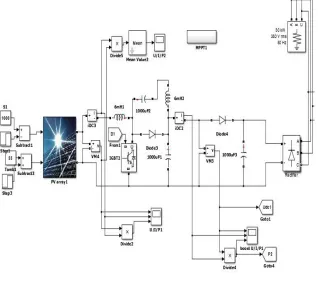
Fig 2 shows the simulation diagram for solar plant. For solar plant we are considering temperature and radiation as inputs. We are using MPPT to get maximum power from the solar module under particular conditions. Maximum power varies with the solar radiance and ambient temperature.
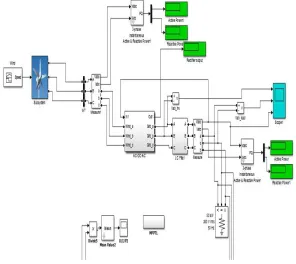
Fig 3 shows the simulation for wind plant. For wind plant we are using wind speed as an input. The output is taken at scope 1 shown in below fig. Pitch angle and generator speed are important things to be considered while simulating wind plant.
Fig. 3 Circuit diagram of wind plant
Below fig shows the complete simulation of a system. It includes solar and wind simulation. FLC is used at the output in order to get stabilization.
III. RESULT AND DISCUSSION
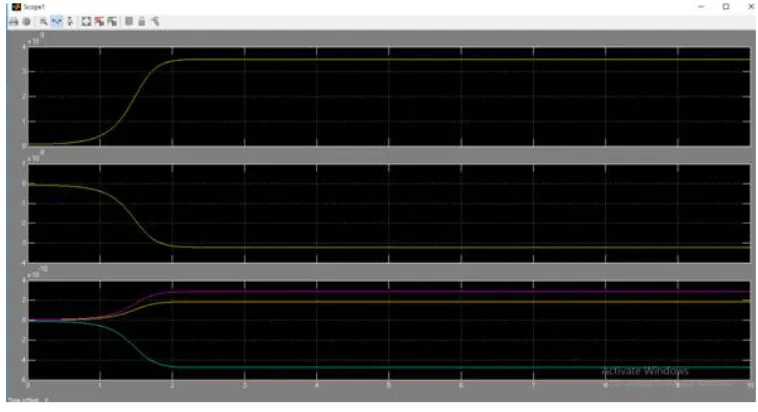
Fig 5 shows the output waveforms of wind plant. This is the output which we are getting at scope 1 shown in fig 3. This is the output when wind speed is 20 m/s.
Fig. 5 Output waveforms of wind plant
Fig 6 shows the output waveforms of complete simulation including solar and wind plant. We are using FLC to stabilize the output waveforms. This is the output which we are getting at scope 2.
Fig. 6 Output of hybrid system (solar and wind)
IV.CONCLUSION
wind speed is achieved with the proposed fuzzy logic controller with optimized rule base. Hybrid power system supplies AC load and DC load so it is suitable for all applications like remote areas, villages and hill stations.The output results shows that the using Fuzzy logic based system is more effective, energy management controller controls hybrid power system to provide uninterrupted power, minimizing usage of diesel, effective utilization of sources. Since the usage of diesel generator is minimized emission of harmful gases from it is minimized.
V.FUTURE SCOPE
It is almost impossible to have an algorithm suitable for all situations. It is, therefore, important to consider some of the situations for which the further study is required. Suggested below are the few areas which can be further explored to improve the microgrid operation and energy storage schemes to evaluate the practicality of the proposed (i) Wind-Diesel and (ii) PV-Wind-Wind-Diesel hybrid systems in isolated and grid connected modes, a number of pragmatic issues such as control and grid integration aspects can be taken into consideration for the microgrid and energy storage schemes. Microgrids can meet the needs of a wide range of applications in commercial, industrial, and institutional fields. Larger microgrid applications include communities ranging from neighbourhoods to the small towns to military bases. Conventional grids can be replaced by microgrid in future because of its advantages.
REFERENCES
[1] Pooja Patel, Dr. Jyoti Shrivastava, “Modelling and Performance Analysis of Hybrid Renewable Energy Resources Using Fuzzy Logic Controller”, International Journal of Science, Engineering and Technology Research (IJSETR),Volume 5, Issue 5, May 2016
[2] A.Kwasinski, “ Identification of feasible topologies for multiple-input DC-DC converters”, IEEE Transactions Power Electron., vol. 24, no. 3, pp. 856 861, Mar. 2009.
[3] Chen et al., “Multi-Input Inverter for Grid-Connected Hybrid PV/Wind Power System”, IEEE Transactions on Power Electronics, vol. 22, May 2007.
[4] Lin Xu; XinboRuan; Chengxiong Mao; Buhan Zhang; Yi Luo, “An Improved Optimal Sizing Method for Wind-Solar-Battery Hybrid Power System”, Sustainable Energy,IEEE 2013.
[5] B. G. Dobbs and P. L. Chapman, “A multiple-input DC-DC converter topology”,IEEE Power Electron. Lett., vol. 1, no. 1, pp. 69, Mar. 2003. [6] S.Meenakshi, K.Rajambal, C.Chellamuthu, S.Elangovan, “Intelligent Controller for Stand- Alone Hybrid Generation System”, Power India
Conference IEEE, pp 8-15,Oct.2006.
[7] Doaa M. Atia1, Faten H. Fahmy1, Ninet M. Ahmed1 “Modeling and Control PV-Wind Hybrid System Based On Fuzzy Logic Control Technique” , Telkomnika, Vol.10, No.3, pp. 431-441, September 2012