Chapter 6a
Communication,
Integration,
About this Chapter
•
Cell-to-cell communication
•
Signal pathways
•
Novel signal molecules
•
Modulation of signal pathways
•
Control pathways
•
Response loops
Cell-to-Cell Communication: Overview
•
Physiological signals
•
Electrical
signals
•
Changes in the membrane potential of a cell
•
Chemical
signals
•
Secreted by cells into ECF
•
Responsible for most communication within the
body
•
Target cells, or targets, receive signals
Figure 6-1a
Cell-to-Cell Communication: Methods
•
Direct contact and
local cell-to-cell
communication
•
Gap junctions
•
Transfer both
chemical and
electrical signals
•
Form direct
cytoplasmic
connections between
adjacent cells.
•
Protein connexins
Cell-to-Cell Communication: Methods
•
CAMs
, cell adhesion
molecules, transfer
signals in both
directions
•
Common in Immune
system
•
Contact-dependent
signals
require
Cell-to-Cell Communication: Methods
•
Direct contact and local cell-to-cell
communication
•
Autocrine signals
act on the same cell that
secreted them.
Paracrine signals
are
secreted by one cell and diffuse to adjacent
cells.
Figure 6-1c
(c) Autocrine signals and paracrine
signals
Cell-to-Cell Communication: Methods
•
Paracrine
and
autocrine
are chemical
signals
•
Hormones are secreted by endocrine glands
or cells into the blood. Only target cells with
receptors for the hormone will respond to the
signal.
Endocrine
cell
Cell
without
receptor
Cell
with
receptor
No response
Cell-to-Cell Communication: Methods
•
Long distance cell-to-cell communication
•
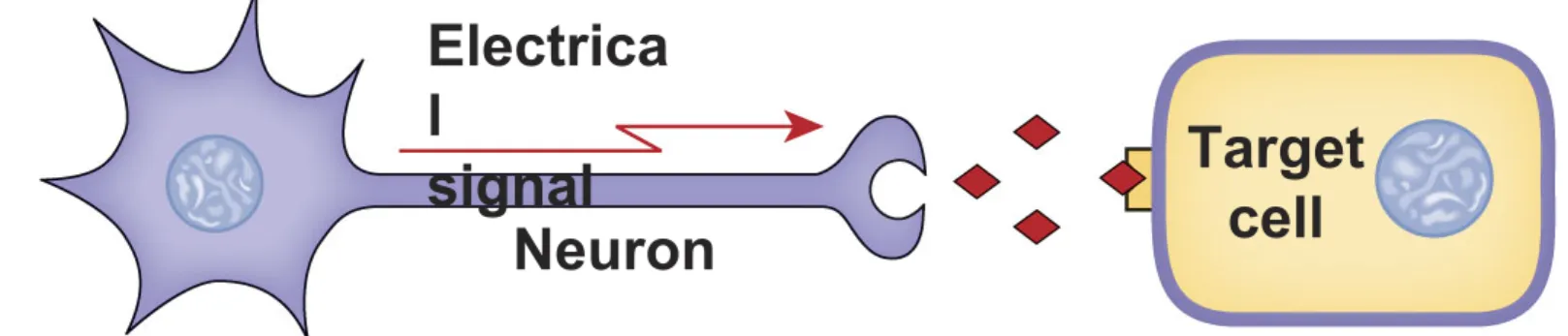
Neurotransmitters are chemicals secreted by
neurons that diffuse across a small gap to the
target cell. Neurons use electrical signals as
well.
•
Neurotransmitters have a rapid effect
Figure 6-2b
(b) Neurotransmitters
Neuron
Electrica
l
signal
Target
Cell-to-Cell Communication: Methods
•
Neurohormones are chemicals released by
neurons into the blood for action at distant
targets.
Cell
without
receptor
Cell
with
receptor
No response
(c)
Neurohormones
Neuron
Cell-to-Cell Communication: Methods
•
Cytokines
may act as both local and
long-distance signals
•
All nucleated cells synthesize and secrete
cytokines in response to stimuli
•
In development and differentiation, cytokines
usually function as autocrine or paracrine
signals
•
In stress and inflammation, some cytokines
Signal Pathways: Overview
Receptor
protein
Intracellular
signal
molecules
Signal
molecule
Target
proteins
Response
binds to
activate s
alter s
Signal Pathways: Receptor locations
•
Target cell receptors
•
Lipophilic vs lipophobic
Figure 6-4 (1 of 2)
Slower responses
related to changes
in gene activity
Receptor
in cytosol
Recepto
r
in nucleus
Lipophilic
signal
molecules
Signal Pathways: Receptor locations
Lipophobic signal
molecule
Recepto
r
Ligand-receptor complex
Rapid cellular
responses
Extracellular
fluid
Intracellular fluid
Signal Pathways: Membrane Receptors
•
Four categories of membrane receptors
Figure 6-5
Cell membran
e
ECF
ICF
G protein Recepto
r Channe
l
Extracellula r signal molecules
Integrin Recepto
r
Enzym e
Anchor protein
Cytoskeleto n
Receptor -channel
Receptor-enzym e
Integrin receptor G protein-coupled
receptor
Signal molecul e Recepto r
Intracellula r
Signal Transduction
Radio
Radio
waves
Recepto
r
Transduce
r
Amplifie
r
Respons
External
signal
Signal Pathways: Signal Amplification
•
Transducers
convert extracellular signals
into intracellular messages which create a
response
Figure 6-7
Extracellula
r
fluid
Intracellula
r
fluid
Cell
membran
e
Receptor-ligand complex
activates an
amplifier enzyme (AE).
Signal molecul e
Recepto r
Intracellula r
Signal Pathway: Biological Signal Transduction
•
Biological
signal
transduction
converts
chemical
signals into
cellular
responses
Figure 6-8
alte r Signal molecul e Membrane receptor Signal transduction by proteins Amplifier enzymes Second messenger molecules Protein kinases Increase intracellular Ca2+Phosphorylate d proteins Calcium-binding proteins Extracellula r fluid Intracellula r fluid Cell response initiate s binds to
Signal Pathway: Signal Transduction
•
Steps of signal transduction pathway form a
cascade
Inactive
A
Inactive
B
Inactive
C
Substrat
Active
A
Active
B
Active
C
Initial
stimulu
Signal Pathway: Receptor Enzymes
•
Tyrosine kinase, an example of
receptor-enzyme
Figure 6-10
+
Protein
Active binding
site
+ ADP
ECF
IC
F
Signal molecule binds
to surface receptor
Phosphorylate
d
protein
Tyrosine kinase
on
cytoplasmic side
Cell
membrane
activates
Protei
n
Signal molecul e
Recepto r
Intracellula r
signal molecules
Signal Pathway: GPCR
•
Membrane-spanning proteins
•
Cytoplasmic tail linked to G protein, a
three-part transducer molecule
•
When G proteins are activated, they
•
Open ion channels in the membrane
•
Alter enzyme activity on the cytoplasmic side of
GPCR: Adenylyl Cyclase-cAMP
Figure 6-11
1
One signal
molecule Adenylyl cyclase
ATP
cAMP G
protein
Protein kinase A
Phosphorylated protein
Cell response
Signal molecule binds to G protein-linked receptor, which activates the G protein.
Protein kinase A phosphorylates other proteins, leading
ultimately
to a cellular response. G protein turns on adenylyl cyclase, an amplifier enzyme.
Adenylyl cyclase converts ATP to cyclic AMP.
cAMP activates protein
kinase A. 2
3
4
5
1
2
3
4
GPCR: Adenylyl Cyclase-cAMP
1
One signal molecule
G protein
Signal molecule binds to G protein-linked receptor, which activates the G protein.
GPCR: Adenylyl Cyclase-cAMP
Figure 6-11, steps 1–2
1
One signal
molecule Adenylyl cyclase
G protein
Signal molecule binds to G protein-linked receptor, which activates the G protein.
G protein turns on adenylyl cyclase, an amplifier enzyme.
2
1
GPCR: Adenylyl Cyclase-cAMP
1
One signal
molecule Adenylyl cyclase
ATP
cAMP G
protein
Signal molecule binds to G protein-linked receptor, which activates the G protein.
G protein turns on adenylyl cyclase, an amplifier enzyme.
Adenylyl cyclase converts ATP to cyclic AMP.
2
3
1
2
GPCR: Adenylyl Cyclase-cAMP
Figure 6-11, steps 1–4
1
One signal
molecule Adenylyl cyclase
ATP
cAMP G
protein
Protein kinase A
Signal molecule binds to G protein-linked receptor, which activates the G protein.
G protein turns on adenylyl cyclase, an amplifier enzyme.
Adenylyl cyclase converts ATP to cyclic AMP.
cAMP activates protein
kinase A. 2
3
4
1
2
3
GPCR: Adenylyl Cyclase-cAMP
1
One signal
molecule Adenylyl cyclase
ATP
cAMP G
protein
Protein kinase A
Phosphorylated protein
Cell response
Signal molecule binds to G protein-linked receptor, which activates the G protein.
Protein kinase A phosphorylates other proteins, leading
ultimately
to a cellular response. G protein turns on adenylyl cyclase, an amplifier enzyme.
Adenylyl cyclase converts ATP to cyclic AMP.
cAMP activates protein
kinase A. 2
3
4
5
1
2
3
4
GPCR: The Phospholipase C System
Figure 6-12
1
Membrane phospholipid
Protein + Pi
Cell membran e Extracellula r fluid Intracellula r fluid DAG Phosphorylate d protein PL-C DAG PK-C IP3 E R = = = = = phospholipase C diacylglycero lprotein kinase C inositol trisphosphate endoplasmic reticulum E R Recepto r G protein Cellula r respons e Signal molecul e Signal molecule activates receptor and associated G protein.
G protein activates phospholipase C (PL-C), an amplifier enzyme.
PL-C converts membrane phospholipids into diacylglycerol (DAG) which
remains in the membrane, and IP3, which diffuses into the cytoplasm.
DAG activates protein kinase C (PK-C), which
phosphorylates proteins.
IP3 causes release of Ca2+ from
organelles, creating a Ca2+ signal.
KEY PL-C
IP
3
PK-C
Ca2+ stores Ca2+
2 3 4
5
GPCR: The Phospholipase C System
1
Cell membran
e
Extracellula r fluid
Intracellula r fluid
PL-C DAG PK-C IP3 E R
= = = = =
phospholipase C
diacylglycero lprotein kinase C
inositol trisphosphate endoplasmic reticulum Recepto
r G
protein Signal
molecul e
Signal molecule activates receptor and associated G protein.
KEY
GPCR: The Phospholipase C System
Figure 6-12, steps 1–2
1 Cell membran e Extracellula r fluid Intracellula r fluid PL-C DAG PK-C IP3 E R = = = = = phospholipase C diacylglycero lprotein kinase C inositol trisphosphate endoplasmic reticulum Recepto r G protein Signal molecul e Signal molecule activates receptor and associated G protein.
G protein activates phospholipase C (PL-C), an amplifier enzyme.
KEY PL-C
2
GPCR: The Phospholipase C System
1 Membrane phospholipid Cell membran e Extracellula r fluid Intracellula r fluid DAG PL-C DAG PK-C IP3 E R = = = = = phospholipase C diacylglycero lprotein kinase C inositol trisphosphate endoplasmic reticulum Recepto r G protein Signal molecul e Signal molecule activates receptor and associated G protein.G protein activates phospholipase C (PL-C), an amplifier enzyme.
PL-C converts membrane phospholipids into diacylglycerol (DAG) which
remains in the membrane, and IP3, which diffuses into the cytoplasm.
KEY PL-C
IP
3
2 3
GPCR: The Phospholipase C System
Figure 6-12, steps 1–4
1
Membrane phospholipid
Protein + Pi
Cell membran e Extracellula r fluid Intracellula r fluid DAG Phosphorylate d protein PL-C DAG PK-C IP3 E R = = = = = phospholipase C diacylglycero lprotein kinase C inositol trisphosphate endoplasmic reticulum Recepto r G protein Cellula r respons e Signal molecul e Signal molecule activates receptor and associated G protein.
G protein activates phospholipase C (PL-C), an amplifier enzyme.
PL-C converts membrane phospholipids into diacylglycerol (DAG) which
remains in the membrane, and IP3, which diffuses into the cytoplasm.
DAG activates protein kinase C (PK-C), which phosphorylates proteins. KEY PL-C IP 3 PK-C
2 3 4
GPCR: The Phospholipase C System
1
Membrane phospholipid
Protein + Pi
Cell membran e Extracellula r fluid Intracellula r fluid DAG Phosphorylate d protein PL-C DAG PK-C IP3 E R = = = = = phospholipase C diacylglycero lprotein kinase C inositol trisphosphate endoplasmic reticulum E R Recepto r G protein Cellula r respons e Signal molecul e Signal molecule activates receptor and associated G protein.
G protein activates phospholipase C (PL-C), an amplifier enzyme.
PL-C converts membrane phospholipids into diacylglycerol (DAG) which
remains in the membrane, and IP3, which diffuses into the cytoplasm.
DAG activates protein kinase C (PK-C), which
phosphorylates proteins.
IP3 causes release of Ca2+ from
organelles, creating a Ca2+ signal.
KEY PL-C
IP
3
PK-C
Ca2+ stores
Ca2+
2 3 4
5
Signal Pathway: Receptor-Channel
•
Some second messengers create electrical
signals
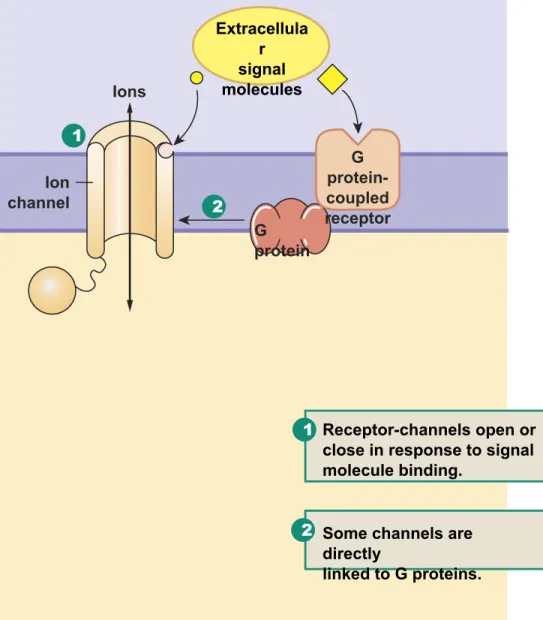
Figure 6-13
1
Receptor-channels open or close in response to signal molecule binding.
Some channels are directly linked to G proteins.
Other ligand-gated channels respond to intracellular second messengers. Extracellular
signal molecules
Ions
Ion channel
G protein
Change in membrane permeability to
Na+, K+, Cl–
Creates electrical signal
Voltage-sensitive protein
Cellular response
G protein-coupled receptor
Intracellular signal molecules 2
3
2
Signal Pathway: Receptor-Channel
1
Receptor-channels open or close in response to signal molecule binding.
Extracellula r signal molecules
Ions
Ion channel
Signal Pathway: Receptor-Channel
Figure 6-13, steps 1–2
1
Receptor-channels open or close in response to signal molecule binding.
Some channels are directly
linked to G proteins. Extracellula
r signal molecules
Ions
Ion channel
G protein
G protein-coupled receptor
2
Signal Pathway: Receptor-Channel
1
Receptor-channels open or close in response to signal molecule binding.
Some channels are directly
linked to G proteins.
Other ligand-gated channels
respond to intracellular Extracellula
r signal molecules
Ions
Ion channel
G protein
G protein-coupled receptor
Intracellular signal molecules
2
3
2
Signal Pathway: Receptor-Channel
Figure 6-13
1
Receptor-channels open or close in response to signal molecule binding.
Some channels are directly
linked to G proteins.
Other ligand-gated channels
respond to intracellular second messengers. Extracellula r signal molecules Ions Ion channel G protein
Change in membrane permeability to
Na+, K+, Cl–
Signal Pathway: Signal Transduction
•
Summary map of signal transduction systems
Ion s Gated ion channel alters alter create s produce s activate phosphorylat e
will be a change in
phosphorylate s Extracellular fluid Intracellular fluid Cell membrane Protein kinases Altered proteins Change in ion concentratio n Electrical signal Ions move into or out of cell
Membrane Gene activity
Activates or inhibits amplifier enzyme Second messenger molecules Triggers release of Ca2+ from