http://www.sciencepublishinggroup.com/j/ijimse doi: 10.11648/j.ijimse.20170202.12
Case Report
Improvement of Control System Responses Using GAs PID
Controller
Santosh Kumar Suman
Department of Electrical Engineering, Rajkiya Engineering College, Kannauj, Uttar Pradesh, India
Email address:
[email protected]To cite this article:
Santosh Kumar Suman. Improvement of Control System Responses Using GAs PID Controller. International Journal of Industrial and Manufacturing Systems Engineering. Vol. 2, No. 2, 2017, pp. 11-18. doi: 10.11648/j.ijimse.20170202.12
Received: March 6, 2017; Accepted: March 24, 2017; Published: April 10, 2017
Abstract:
Enhance system performance of the controller using genetic algorithm.
This paper introduces Genetic algorithms which is a part of evolutionary computing techniques. It is specially invented for development of natural selection and genetic evaluation. Genetic algorithms are an emerging technology for basic algorithms used to generate solution and one of the most efficient tools for solving optimization problem. The purpose of this paper is to provide solution and improve result of system. The aim of this paper is to complete parameters tuning of a PID controller using GAs). This is a significant feature to achieve optimal controller parameters which give fulfilled results and improve the control system response.Keywords: Genetic Algorithms, Fitness Function, Genetic Operators
, Flow Diagram, PID Controller1.
Introduction
This paper introduces the elements of Genetic algorithms (GAs) and their application on general problem, genetic algorithms belong to the larger class of evolutionary algorithms (EA), which generate solutions to optimization problems using techniques inspired by natural evolution, such as inheritance, mutation, selection, and crossover [1]. The GAs were first proposed by John Holland in 1970 [2]. As a means to find good solutions to problems that were otherwise computationally intractable. Holland’s schema theorem, this theorem is also called the fundamental theorem of genetic algorithms, is widely taken to be the foundation for explanations of the power of genetic algorithms. It says that short, low order schemata with above-average fitness increase exponentially in successive generations [3]. The GAs are emerging technology for basic algorithms used to generate solutions and one of most efficient tools for solving of optimization problems. The Genetic encoding instigates as a general model for adaptive process but has become effective in optimization [4]. In the early 1960s Rechenburge (1965) conducted studies at the technical university of Berlin on evolutionary strategy to minimize drag on a steel plate [7]. Goldberg (1983) used genetic algorithms to optimize the design of gas pipeline system.
important requirement is the stability of the whole system.
2.
Basic Concepts of Genetic Algoriths
Genetic algorithms are good at taking larger, potentially huge, search space and navigating them looking for optimal combinations of things and solutions which we might not find in a life time [10]. The GAs is very different from most of the traditional optimization methods it need design space to be converted into genetic space. The algorithm can be easily implemented on a parallel computational architecture [9]. So genetic algorithms work is based on a coding of variables.
Three most important aspects of using GAs are: a) Definition of objective function.
b) Definition and implementation of genetic representation.
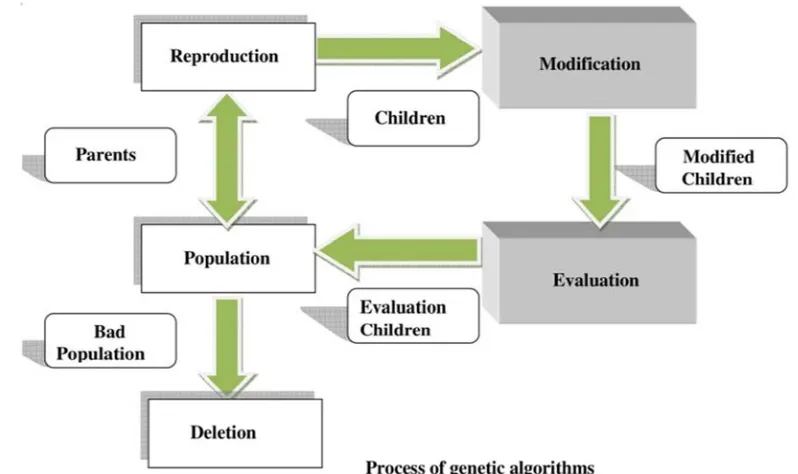
c) Definition and implementation of genetic operators. The GAs are heuristic search algorithms [11]. The GA is a programming technique which forms its basis from the biological evolution [12]. It is basically used as a problem solving strategy in order to provide with a optimal solution. The Genetic Algorithm (GA) is computerized search and optimization algorithms based on the mechanics of natural genetics and natural selection, fig1: shows the working of basic genetic algorithms. It is used for minimizing a function called the objective function or the fitness function [13]. Once these three have been defined, the GAs should work fairly well beyond doubt. We can, by different variations, improve the performance, find multiple optima or parallelize the algorithms.
Figure 1. Working of Genetic algorithms.
3. Genetic Algorithms
The genetic algorithm is a method for solving both constrained and unconstrained optimization problems that is based on natural selection.
A genetic algorithm (GA) is a search and optimization method which works by mimicking the evolutionary principles and chromosomal processing in natural genetics. A GA begins its search with a random set of solutions usually coded in binary strings. Every solution is assigned a fitness which is directly related to the objective function of the search and optimization problem. The Genetic algorithm is generally composed of two processes. First process is selection of individual for the production of next generation and second process is manipulation of the selected individual to form the next generation by crossover and mutation techniques [5]. The GA is applied to any search or optimization algorithm that is based on Darwinian principles "survival of the fittest" as driving forces behind the biological evolution of natural
selection. Genetic Algorithm is a population-based search and optimization method which mimics the process of natural evolution [14], Fig. 5 shows the Flow diagram of Genetic algorithms.
3.1. Fitness Function
Genetic algorithms are used for minimizing a function called fitness function, Fitness function is also known as objective function. It is used in genetic algorithms in each iteration of the algorithm to evaluate the solution in the current population, the objective function of a problem is main source providing the mechanism for evaluating the location of each chromosomes.
3.2. Genetic Operators
basic components.
a) Selection (or Reproduction). b) Crossover (or Recombination). c) Mutation.
3.3. Selection
Reproduction (or selection) is usually the first operator applied to a population. Reproduction selects good strings in a population and forms a mating pool. Parents used to create new individual are selected randomly. All individuals in the population have the same possibility to be selected for mating, except individual with the least fitness which will be removed from the population and replaced with the newly created individual [16]. The commonly used reproduction operator is the impartial selection operator, where a string in the current population is selected with probability proportional to the string’s fitness, selection is a process of keeping the best fit individual and eliminating rest one [6]. It select the two parent chromosome from a population according to their fitness better the fitness greater the chance to be selected [2]. Widespread Methods of Selection are [17]:
a) Roulette Wheel Method. b) Tournament Selection.
c) Stochastic Remainder Selection. d) Elitism Selection.
e) Boltzmann Selection.
3.4. Crossover
Once the individuals have been selected the next thing is to produce the offspring [18]. The most common solution for this is something called crossover, and there are many different kinds of crossover Techniques:
a) One -point crossover. b) Two -point crossover. c) Uniform crossover.
3.4.1. One-Point Crossover
It is simplest among all method. A crossover point in the parent chromosomes is randomly chosen, and then the two different portions of each chromosome are swapped with other portion of chromosomes to from two new chromosomes.
Figure 2. One –point crossover.
3.4.2. Two-Point Crossover
In this method we select two random point for crossover such that offspring adopt middle portion of parent 2 and rest from parent 1, Similar for offspring 2, Fig 3 show of two-point crossover.
Figure 3. Two-point crossover.
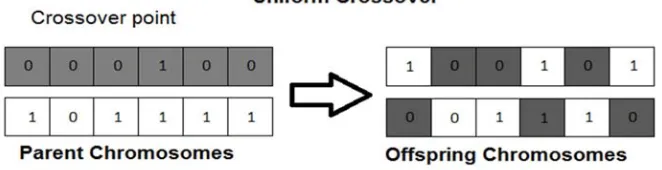
3.4.3. Uniform Crossover
In this crossover is done at multiple site but these are uniformly spread across the chromosomes that is either even or odd ordering, Fig 4 show in the below of uniform crossover.
3.5. Mutation
Mutation is performed after the crossover is done [19]. Mutation is a genetic operator used to maintain genetic diversity in chromosomes from one generation to the next generation of a population [20]. Mutation changes randomly in the new offspring, for binary encoding we can a few randomly chosen bit from 0 or 1 [20, 21]. It is analogous to biological mutation,it is applied to each child independently after crossover. It arbitrarily alters each gene with a small probability. The next diagram shows the fifth gene of a chromosome being mutated; chance of variation in the solution is very low. So, the mutation probability should be kept as low as possible usually in range of 0.01 to 0.05[6]. This is to prevent falling of all solutions in a population for local optimum of the problem [21].
Before Crossover: 1101101001101110 After Crossover: 1101100001101110
3.6. Process
Genetic algorithms are a part of evolutionary computing and they are inspired by nature of evolution. When they are applied to solve a problem, the first step is to define a representation that describes the problem states. An initial population is then defined, and genetic operators are used to generate the next generation. This procedure is repeated until the termination criteria are satisfied. This basic principle of genetic algorithm is outlined [20]. Figure 5 shows the flow diagram of the Genetic algorithms process.
4. Control System Design Using Genetic
Algorithm
4.1. Genetic Controller Algorithm
1. [Start] Generate random population of n chromosomes (suitable solution).
2. [Fitness] Evaluate the fitness f(x) of each chromosome x in the population.
4. [Selection] Select two parent chromosomes from a population according to their fitness (the better fitness, the better chance to be selected).
5. [Crossover] with a crossover probability cross over the parents to form a new offspring. If no crossover was performed, offspring (children) is the exact copy of parents.
6. [Mutation] with a mutation probability mutate new offspring’s at each locus (position in chromosome).
7. [Accepting] Place new offspring’s in the new population. 8. [Replace] Use new generated population for the further run of the algorithm.
9. [Test] If the end condition is satisfied, stop, and return the best solution in current population.
10. [Loop] Go to step 2.
There are many parameters and settings that can be implemented differently in various problems:
a)Identify good (above-average) solution in a population. b)Make multiple copies of the good solutions.
c)Eliminate bad solutions from the population so that multiple copies of good solutions can be placed in the population.
4.2. Design and Tuning Rules of PID Controllers
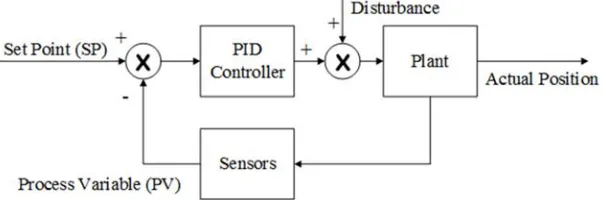
The Design Procedure for determining parameters of the PID controller is a trail and error approach. After obtaining a mathematical model of the control system and adjust the parameters of a compensator to improve system performance. Once a satisfactory mathematical model has been obtained, the designer must construct a prototype and test the open loop system. If the absolute stability of the closed loop is assured, the designer closes the loop and tests the performance of the resulting closed loop system. Because of the neglected loading effects among the components, nonlinearities. The controller tuning greatly affects the control system properties, such as robustness to disturbances and noise, performance and robustness to delays For example, figure 5 shows a block diagram of a simple cascade PID control of a plant.
Figure 5. Diagram of a simple cascade PID control of a plant.
In this paper, GA is utilized to decide the ideal estimations of the PID controller parameters that fulfill the required element execution qualities of the system. Figure 6 demonstrates the steps of procedure GA based tuning of PID controller parameters. In the primary, GA is introduced. At that point, it makes a starting populace of PID controller
and the dynamic execution attributes of the system are resolved for every chromosome. At that point, the wellness esteem for every chromosome is assessed utilizing the objective function. In light of the wellness estimations of the original, a gathering of best chromosomes is chosen to make the following populace. After choice, hybrid and change are connected to this surviving populace so as to enhance the following generation [13]. The procedure proceeds until the
end standard is accomplished or the quantity of eras is come to its greatest worth. Hereditary calculation is likewise talked about in part 3 the stream graph of GA is appeared in figure (4.4). Creating the beginning populace is the initial step of GAs. The populace is made out of the chromosomes that are parallel piece string. The relating assessment of a populace is known as the (wellness work) the wellness quality is greater and the execution is better [14-17]
Figure 6. Tuning genetic PID Controller.
5. Simulation and Results
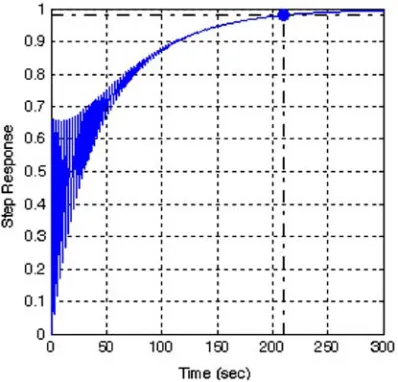
Figure 7. Step Response of the uncompensated closed loop system.
At that point it is wanted to enhance the framework reaction by utilizing hereditary PD controller to enhance the transient reaction, or utilizing PID controller to improve both transient and relentless state shut circle framework reaction. Give us a chance to attempt to apply the calculation in segment (IV-A) well ordered to demonstrate to you the action of the proposed algorithm. In addition the genetic algorithms which are presented in this section utilizes roulette wheel choice strategy and the wellness work characterized before (20). it is craved to find genetically the parameters of the PD controller, yet this need to characterize first the accompanying genetic input parameters in Table 1.
Table 1. Settings of GA Parameters Values.
Input Parameter Value
Lower bound [Kp Kd] [-500,-500] Upper bound [Kp Kd] [500 500]
Populations 200
Generations 50
Ranges of PID parameters -500 to-500 Crossover fraction 0.8 Mutation rate 0.01
the best and average fitness during generations. Note that an optimal solution is achieved after the 10th generation as it is clear in Figure 8 (a). Furthermore Figure 9(a) shows the closed loop step response with genetic PD controller of the system defined in system it is clear that the system response is
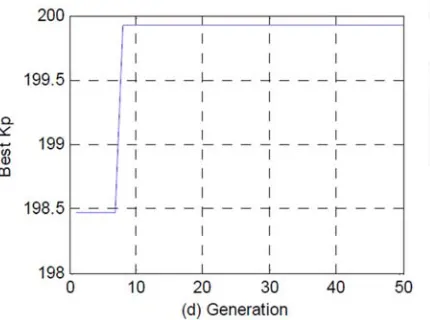
improved and achieved better performance by using genetic PD controller. Figure 9(b) shows the control signal of the system. Finally Figure 9(c) and (d) illustrate the variations of the best values of the controller gains Kd, and Kp respectively in each generation.
Figure 8. Variation of fitness during generations. (a) Best fitness.
Figure 9. Variation of fitness during generations. (b) Average fitness.
Figure 12. Variation of best value Kd in each generation.
Figure 13. Variation of best value Kp in each generation.
6. Conclusion
This paper in study the some basic concepts and technology of genetic. It is basically used as problem solving technique in order to present with optimal solutions of given problems. in this paper in design a control system with implement the genetic algorithm. PID controllers are widely used in manufacturing and engineering control applications outstanding to their modest arrangements, intelligible control algorithms and reduce expenses. In this chapter a new design method to determine PID controller parameters using genetic algorithms is presented. The aim of this paper is to complete parameters tuning of a PID controller using GAs). This is an significant feature to achieve optimal controller parameters which give fulfilled results and improve the control system response. Maximization of such a fitness function by genetic algorithms causes a satisfactory steady state error and maximum over shoot as well as less control energy in comparison with conventional control methods.
References
[1] Pushpendra Kumar Yadav,and N. L. Prajapati, “An Overview of Genetic Algorithm and Modeling,” International Journal of Scientific and Research Publications, vol. 2, September 2012.
[2] Richa Garg and Saurabh mittal, “Optimization by Genetic Algorithm,” International Journal of Advanced Research in Computer Science and Software Engineering, vol. 4, April 2014.
[3] J. H. Halland, “Adaptation in Natural and Artificial system,” The University of Michigan Press, Ann Arbor, MI, 1975.
[4] An Introduction to Genetic Algorithms and Evolution Strategies Mehrdad Dianati, Insop Song, and 3Mark Treiber,200 Univ. Ave. West, University of Waterloo, Ontario, N2L 3G1, Canada.
[5] Noraini Mohd Razali, and John Geraghty, “A genetic algorithm performance with different selection strategies,” Proceedings of the World Congress on Engineering Vol II, 2011.
[6] Gopesh Joshi, “Review of Genetic Algorithm: An Optimization Technique,”International Journal of Advanced Research in Computer Science and Software Engineering, Volume 4, Issue 4, April 2014.
[7] D. E. Goldberg, Genetic Algorithms is Search, Optimization, and Machine learning Reading MA: Addison-Wesley, 1989.
[8] M. Srinivas, and Latit M. Patnaik, “Genetic Algorithms: A Survey,’’ IEEE Computer,, pp 17-26, June 1994.
[9] Atulya,Shivam, and Shree Avinash Bhattarmakki, and Vikas Kumar Singh, “Application of Genetic Algorithms for Optimization,” Jan, 2014 - Apr, 2014.
[10] S. Rajasekaran, and G. A. Vijayalaksmi Pai. “Neural Networks, Fuzzy Logic and Genetic Algorithms: Synthesis and Applications,” New Delhi, Prentice -Hall of India Private Ltd., 2003.
[11] K. F. Man, K. S. Tang, and S. Kwong, “Genetic Algorithms: Concepts and Applications”, IEEE Transaction on Industrial Electronics, vol. 43, no. 5, October 1996.
[12] Mitchell and Melanie, “An Introduction to Genetic AlgorithmsMIT Press, 1996.
[13] D. Goldberg, “Genetic Algorithms in Search, Optimization and Machine learning,” Addison-Wesley, 1989.
[14] Anshul Sharma and Anuj Mehta, “Review Paper of Various Selection Methods in Genetic Algorithm,” International Journal of Advanced Research in Computer Science and Software Engineering, vol. 3, July 2013.
[15] K. Jayavani and G. M. Kadhar Nawaz, “Study of Genetic Algorithm, an Evolutionary Approach,” International Journal on Recent and Innovation Trends in Computing and Communication, vol.2 Issue: 8.
[16] Santosh Kumar Suman and Vinod Kumar Giri, “Genetic Algorithms: Basic Concepts and Real World Applications,” International Journal of Electrical, Electronics and Computer Systems (IJEECS), Vol -3, Issue-12 pp.116-123, 2015.
[17] Usage of Partial Genome Fitness Evaluation Mechanism to Get Faster Results in Genetic Algorithms. 25th DAAAM International Symposium on Intelligent Manufacturing and Automation, DAAAM (2014)-ELSEVIER.
[19] Andre, David and Astro Teller. "Evolving team Darwin United." In RoboCup-98: Robot Soccer World Cup II, Minoru Asada and Hiroaki Kitano (eds). Lecture Notes in Computer Science, vol.1604, pp.346-352. Springer-Verlag, 1999.
[20] K. F. Man, K. S. and Tang, S. Kwong, “Genetic Algorithms: Concept and Designs”, Springer, Chapter 1-10, pp 1-348.
[21] M. Mahalakshmi, P. Kalaivani and E. Kiruba Nesamalar, “A Review on Genetic Algorithm and its Applications,” International Journal of Computing Algorithm, vol. 02, pp. 415-423, December 2013.
[22] Santosh Kumar Suman and Vinod Kumar Giri, “Genetic Algorithms Techniques Based Optimal PID Tuning For Speed Control of DC Motor, American Journal of Engineering and Technology Management,Vol-1, No. 4, 2016, pp. 59-64.