http://www.sciencepublishinggroup.com/j/ijaaa doi: 10.11648/j.ijaaa.20180404.11
ISSN: 2472-1107 (Print); ISSN: 2472-1131 (Online)
Implementable "Micro-redevelopment": A Strategy for
Activating Historic Districts
Zhang Xiaoyang, Wang Shifu, Fei Yan
*State Key Laboratory of Subtropical Building Science, School of Architecture, South China University of Technology, Guangzhou, China
Email address:
*
Corresponding author
To cite this article:
Zhang Xiaoyang, Wang Shifu, Fei Yan. Implementable "Micro-redevelopment": A Strategy for Activating Historic Districts. International Journal of Architecture, Arts and Applications. Vol. 4, No. 4, 2018, pp. 60-68. doi: 10.11648/j.ijaaa.20180404.11
Received: October 24, 2018; Accepted: November 20, 2018; Published: January 3, 2019
Abstract:
As an important part of urban heritage, historic districts are the core elements for shaping the city’s characteristics and showing its unique features, as well as the important support torelease development potential and enhance urban quality. In the era of inventory planning, the preservation and redevelopment of historic districts have received widely social attention. In China, there has been plenty of theoretical and practical researches on the development of urban historic districts in the past three decades, but still some constraints existed in the process. Taking the activation of historic districts as a clue and summarizing the practical cases, this paper analyzes the roots and logic of the activation methods and driving forces of historic districts in the context of dual attributes, and further takes the Guangzhou city as an example, expounds that the current development of historic districts is facing the dilemmas of material obsolescence, complex property rights, and lack of motivation. Finally, guided by implementation and combined with "micro-redevelopment" method, this paper puts forwards some strategies that the activation of historic districts should be based on preservation, supported by the participation of multi-subjects, equipped by property rights through some micro-redevelopment projects. This paper aims to improve the living environment for the residents and to provide some suggestions for future practices.Keywords:
Historic Districts, Activation, Micro-Redevelopment, Multi-Subject, Property Rights1. Introduction
As an important part of urban heritage, historic districts are the important carrier to nurture the city's human environment, sense of place, diversity of culture and society, and the main driving force to promote the development of the city's connotation [1]. As urbanization has proceeded, historic districts face pressure for development. On the one hand, the traditional spatial and residential pattern of historic districts no longer satisfy the changing demands of modern society, and their own dilemmas also hinder the development, such as material obsolescence, outdated function, etc. On the other hand, the large-scale emergence and growth of the real estate industry also poses a further threat to the preservation of historic districts in recent years, the activation and regeneration of historic districts has become the key issue in urban construction [2]. In this development context, and facing a large number of historic districts in urban areas, it is
important to consider which redevelopment strategies should be adopted and how they should be implemented.
2. Reviews of the Theories and Practices
for Activating Historic Districts
2.1. Small-Scale, Gradual Activation of Historic District
destruction happened in the 1980s and 1990s, the theorization of preservation and regeneration has also begun. Professor Wu Liangyong proposed the idea of "Organic Renewal"(“有机更 新”), and advocated the principle of small-scale and “step and
step” regulation to promote the overall preservation and construction of human living environment in historic urban area [5]. Other experts and scholars in related fields also agree with the "small-scale, gradual" redevelopment, which is considered to be a small-scale social economy and construction activity to solve the residents’ actual problems with the original residents as the subject [6]. Furthermore, it is an activation path adapted to the nature of "diversity" of historic districts with the characteristics of economically feasible and participatory [2] [7].
From the theoretical perspectives of welfare economics and "The Production of Space", some scholars also discuss the essence for activating historic districts. It is believed that the essence of activation is to redistribute the spillover part of the land value through coordinating the interest demands of the stakeholders, including the government, the developers and the residents, so as to achieve Pareto optimality. “Only when the expected return of changing urban spatial form is greater than the expected cost, can the behavior of space production be possible” [8]. Therefore, the key point of promoting the activation of historic districts is to let all subjects have expectations for future interests and gain "profits" from the process.
To sum up, we believe that the literature displays a profound theoretical understanding of the activation of historic districts, but the key difficulties are actually in the sources of economic power and the coordination with original residents in the practical implementation of redevelopment. In this paper, we investigate some historic districts that have been completed or are facing activation.
Starting from the premise, driving force, tool and purpose of these projects, we try to construct a basic method that can be implemented to guide the activation of historic urban districts.
2.2. Summary of the Practice for Activating Historic Districts
Historic districts, as a component of the city’s cultural heritage, have the attributes of both public goods and productive elements. They can be categorized by their dominant attributes and primary functions, including cultural historic districts, commercial historic districts and residential historic districts [9]. In a market economy, government, developers and residents often choose different historic districts to preserve and develop based on their own needs.
The government usually chooses to lead redevelopment of major urban landmarks. Guided by the preservation of history and culture, the government aims to create the city’s cultural brand and highlights the public goods attributes of the historic districts. The preservation dominated by local governments is effective, but requires a lot of stable capital investment, such as the Guangzhou Lychee Creek, Chengdu Kuanzhai Alleys, et cetera.
Developers, on the other hand, usually choose areas with potential value for business and tourism. They take the development of land value aa the guidance, using historic district as productive elements to obtain economic benefits, such as the “Xin Tian Di” series of the Shui On Group, Zumiao Donghuali conservation district in Foshan, et cetera. These historic districts are prosperous in business and have high public recognition, but the changes developers make to the original historical context and social structure have been criticized by academics (See Figure 1).
Figure 1. The renewal process of historic districts led by developers.
The activation of residents' self-organization is mainly concentrated in the historic districts dominated by the life elements. The original residents organize collectively to improve the physical environment and perform the functional regeneration and activation. There is no significant change in social structure and housing property rights during the
process of activation. However, due to the limited capacity of original residents, the process and results are difficult to predict. Except for some historic districts such as Tianzifang in Shanghai and Xinhepu in Guangzhou, there are few successful cases of this type. (See Table 1)
Table 1. Comparison of the practice for activating historic districts.
Prime Mover Key Goal Dynamic Selection Object TypicalCases
“Government” Historical and cultural
preservation Top-down Urban landmark
Chengdu Kuanzhai Alleys Guangzhou Lychee Creek
Fuzhou Three Lanes and Seven Alleys
Prime Mover Key Goal Dynamic Selection Object TypicalCases
“Developer” Commercial development
profit Top-down
Areas of commercial development value
Shanghai Xintiandi Lingnan Tiandi of Foshan Sino-Ocean Taikoo Li Chengdu
“Resident” Improvement of living
conditions Bottom-up Residential Communities
Shanghai Tianzifang Guangzhou Xinhepu Quanzhou Zhongshan Road
Table 1. Continued.
Experiences Lessons
Government invests funds to build a city cultural brand with historical context value as a catalyst.
The reform of single subject requires a large amount of government investment, which needs to achieve economic balance through land development.
Developers tap the value of urban business and tourism, with great economic benefits.
The pressure of economic equilibrium can easily cause the overall spatial form and the surrounding development intensity out of control.
Residents self-organizing and gradual activation, continuing the
original style and maintaining social structure. The process is slow and the range is limited.
Generally speaking, certain aspects of historic districts make them more likely to be subject to one or the other type of redevelopment (See Figure 2). At the same time, it is evident that any simple preservation or development undertaken by only one of the three actors identified above
has limitations and is contrary to the actual needs of the historic districts development. Therefore, the activation of historic districts requires the joint participation of multiple subjects to cope with the "diversified" needs of historic districts.
Figure 2. Attribute value, goal orientation and subject of historic districts.
3. Difficulties Faced by the Development
of Historic Districts
3.1. The Preservation Status of Historic Districts in Guangzhou
With the development of the city, historic districts present challenges related to traffic congestion, outdated housing and lack of public space, making the government and residents eager to activate them. As a state-list famous historical and cultural city, Guangzhou has designated 23 historic-cultural districts in the historic downtown area, covering a total area of 530 hectares. Except for the cultural historic districts such as Shameen and Lychee Creek (See Figures 3 and 4) and the
commercial historic districts such as Shangxiajiu Pedestrian Street (See Figures 5), the remaining proportion are mainly
Figure 4. Lychee Creek historic districts in Guangzhou. Figure 5. Shangxiajiu historic districts in Guangzhou.
Figure 6. Historic-cultural districts in the historic downtown area of Guangzhou.
For practical reasons, government-funded implementation can only focus on a small number of landmark areas with particular significance. Likewise, it is difficult for the development led by developers to avoid the destruction of historical texture in the spatial form and changes to social structure wrought by the expulsion of the original residents by real estate. The complex problems existing in the residential historic district itself lead to the lack of external and endogenous power for its activation [10]. In the context of the government's inability to manage the whole process and its
concerns about allowing developers to manage it, if the residents themselves are not fully stimulated to participate in the activation of their neighborhood, the historic districts that have long been under-maintained will inevitably decline.
3.2. Multiple Difficulties Faced by the Development of Historic Districts
3.2.1. Poor Material Environment and Low Living Standards
widespread problems such as rundown buildings and inadequate modern amenities, including the lack of in-unit kitchen and toilet facilities. Moreover, the density of historic districts in urban areas is generally high, with less per capita living space. For example, some public housing units can reach more than twenty households in peak periods. If such housing units are to be improved and residents are allocated a more appropriate amount of space per capita, many residents will have to be resettled, dramatically increasing the cost of development.
3.2.2. The Complexity and Dispersion of Property Rights Lead to High Transaction Costs
Due to historical issues, the housing property rights in historic districts are very complicated. In the investigation of historic districts, we found that many houses are private houses, but the property rights are owned by many households, and the property owners have scattered across the region, the country, and abroad. Therefore, unclear and fragmented property rights leads to higher transaction costs and restrict the preservation and activation of historic buildings. Besides, it is worth noting that there are a lot of illegal construction and additions in historic districts, including the construction of walls and the addition of top floors, which further lead to the increase of additional demolition costs.
3.2.3. Low Income Level of Original Residents
As public goods, the activation of the residential historic districts does not easily produce concentrated economic benefits for developers, and hence it needs to be paid for by the public finance. For the wide range of historic districts, the external investment funds are often limited, while the historic districts are mostly inhabited by middle- and low-income original residents and floating tenants, who cannot afford the high remediation costs. The insufficient capital investment has affected the enthusiasm of residents to participate. In the process of activating historic districts, most of the residents are involved in low enthusiasm and even negative attitudes, often leading to disagreement and opposition. Therefore, the disunity of residents' opinions is another obstacle for activating historic districts.
It is certain that residential historic districts in different cities face different problems. Although the manifestations of contradictions are diverse, in essence, the high investment costs and lack of driving forces are the fundamental reasons why it is difficult to implement redevelopment.
4. "Micro-Redevelopment": A Strategy
for Activating Historic Districts
In view of the importance of the preservation and development of historic districts, government departments have increased their emphasis on it, actively guiding the activation of historic districts. In 2016, Guangzhou promulgated the "Guangzhou Urban Renewal Methods" and proposed the "micro-redevelopment" method, aiming to
promote and standardize the renewal work in historic urban areas. Building on these dilemmas and the municipal government’s existing policies, we propose that the activation of historic districts should be implemented based on preservation, supported by the participation of multiple actors, and equipped with property rights, all with the aims of improving the living environment for residents.
4.1. The Micro-Redevelopment of "Acting According to Actual Circumstances"
Micro-redevelopment refers to “the regeneration method on the premise of maintaining the basic structure of the current situation, and implemented by means of partial demolition, replacement of buildings, maintenance and repair, renovation, preservation, activation, and improvement of infrastructure, etc.”1 This is a major departure from the method of comprehensive reconstruction often used in the past.
Starting with the goal of preserving existing resources, the micro-redevelopment method emphasizes the priority of preservation, and carries out protective renovation of historical and cultural elements. In terms of spatial form, the micro-redevelopment method pays attention to the overall style of the neighborhood, maintaining the street pattern and public space, it also activates the historic districts characterized by small-scale and gradual, reduce the buildings density to optimize environmental quality properly, which does not spend too much on demolition and resettlement. In terms of social structure, the micro-redevelopment maintains the original social structure and property rights, and activates historical buildings and other residential buildings through functional replacement.
The micro-development can be understood as problem-oriented, focusing on limited forces to solve the most important problems, but also goal-oriented, taking both operability and fairness into account. The micro-redevelopment method has a benign response to the overall style, social structure, and resident's livelihood issues, which can not only preserves the "objects", but also respects the "subjects" in the historic districts.
4.2. The Micro-Redevelopment of "Multi-Participation"
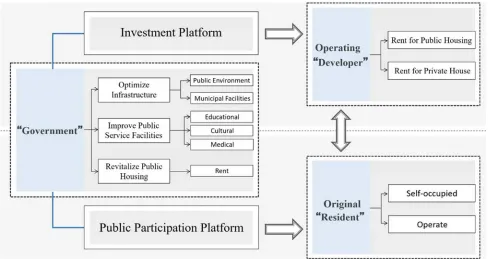
The micro-redevelopment method is supported by the participation of multiple subjects, and encourages the combination of "top-down" and "bottom-up" approaches. Through the platform established by the government, the three key classes of actors—government, developers and residents—are involved in the activation process (See Figure 7). First, the government uses limited funds to optimize infrastructure, improves public service facilities, revitalizes public housing in the historic district, and builds an investment and public participation platform to
encourage market and social forces to participate. Then, the operating developers intervene timely relied on the platform as mentioned above, use the public housing provided by the
government and the private houses rent from the residents as carrier for commercial operations to activate historic districts.
Figure 7. The multi-subject of "government, developer and resident" participate in the micro-redevelopment.
As the subject of the historic districts, the original residents have the right to make their own choices. They can choose to reuse the private houses or to operate them, convert their assets into cash by renting out their house, and further re-invest in the activation of other private housing to form a virtuous circle. In this process, the government’s role changes form unilateral leadership to guidance of the multi-subjects, making the profit concession reasonably and taking the interests of all parties into account, while the operating developers and original residents can actively participate in redevelopment according to their own situation and expectations. The three subject's status is relatively equal and all can benefit from it.
In response to the original residents’ rights and interests, which are most frequently neglected in the process of traditional development, the micro-redevelopment method fully respects the original residents, makes the resident’s livelihood issue a key concern, and improves various living facilities and the environment. Public participation at all stages helps increase awareness of the resident’s interests. As such, it is necessary to establish a consultation system for issues involving residents’ livelihood to ensure that residents' rights to know and participate2.
2 For the establishment of the consultation system, please refer to Article 18 of the “Guangzhou Municipal People's Government Order No. 134.Guangzhou Urban
Renewal Methods”.
4.3. The Micro-Reform of "Orderly Propulsion"
Coase's second theorem shows that different rights definitions will lead to different efficient resource allocations in the world if transaction costs are more than zero [11]. Only clear property rights boundaries can effectively reduce transaction costs. Property rights are powerful tools to depict the relationship of rights between people [12], the interests or "profits" generated by economic activities are all based on it. Therefore, it is necessary to formulate a strategy based on property ownership to solve the dilemmas of high investment costs and insufficient forces in activating historic districts.
4.3.1. Improve Private Ownership by Optimizing the Public Ownership
Historic districts are home to properties of both public and private ownership. Publicly owned properties include public roads, municipal facilities, and public housing. Private property rights sometimes exist for housing owned by individual residents.
In order to avoid the difficulties of coordinating private ownership, the implementable "micro-redevelopment" method should start by focusing on publicly owned properties, using these to encourage improvements to privately owned properties. Taking a historic district as an example, the process of activating physical space can be divided into three steps:
the micro-redevelopment method distinguishes the public and private ownership category. The government collects the demands of residents and listen to their opinions through the public
participation platform, further prioritizes solving the most urgent problems, adhere to “seek advice, needs and comments for administration from the public” (See Figure 8).
Figure 8. Distinguish the category of public and private ownership.
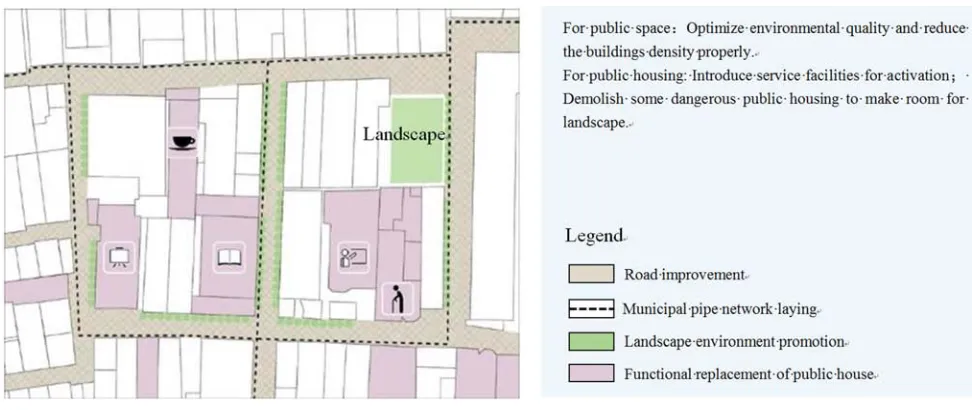
ii. Using publicly owned properties, the micro-redevelopment method improves public spaces and overall living environment of historic districts through the construction of infrastructure, including municipal pipe networks and municipal roads, etc. At the same time, the government activates public housing by introducing public and commercial service facilities, and demolishes some old and dangerous public housing properly to make room for landscape, so as to meet the living demands of residents (See Figure 9).
Figure 9. Optimize the public ownership in historic district.
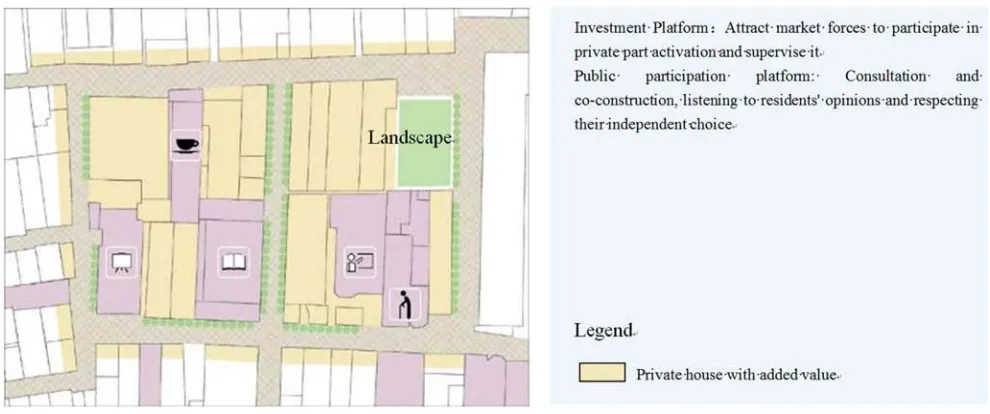
Figure 10. Increase the value-added of the private ownership in historic district.
4.3.2. Formulate Incentive and Restriction Strategies to Encourage Residents to Participate Actively
As one of us has argued elsewhere, "when the transaction mechanism is conducive to triggering the incentive effect of subjects based on property rights, it is easy to reach a collective cooperative behavior with external positive benefits" [13]. Because there are a lot of illegal constructions and negative participation of the residents in historic districts, we suggest to formulating the incentive and restriction strategies for the property rights owners. On the one hand, the government designs the reciprocal transaction mechanism to improve the enthusiasm of residents, encouraging residents to self-organize and to renovate their private houses by the means of financial subsidies, such as deferred loan repayment, and low interest loan subsidies, etc. [14] On the other hand, relevant restrictions and penalties should be formulated to prevent residents from freely demolishing buildings, infringing on publicly owned land and destroying the overall of the historic district.
4.3.3. Design Institutional Paths to Encourage the Restoration of Public Interest
The insufficiencies of supporting facilities and open space are always shortcomings in the development of historic districts [15]. For the large-scale and massive historic districts in the urban area, public facilities provided by the government are only a drop in the bucket. Therefore, it is necessary to design the public interest restoration path to redistribute the rent increment obtained by the private ownerships, and use it to pay for maintaining the public environment of the community. The government should give policy support and incentives for the restoration of public interests. For example, if the private ownership provides public welfare facilities such as community nursing homes and toilets or sets aside public open spaces for the neighborhood’s original residents, the government can increase the permitted floor
area for the project.
5. Conclusion
This paper emphasizes the necessity of multi-subject participation in the activation of large numbers of historic districts in the urban area, and proposes the implementable path of micro-redevelopment historic districts in an orderly method equipped by property rights. The “micro-redevelopment” method aims to improve residents’ livelihood and enhance the living environment, with the core elements of preserving the style of building, maintaining the original social structure, and respecting the rights and interests of original residents in the historic districts. The “micro-redevelopment” method is supported by multiple subjects and encourages the “residents, government, and developers” to participate in the activation of historic districts. It can fully mobilize the enthusiasm of all parties, and achieve benefits sharing and win-win outcomes. Equipped by property rights, the“micro-redevelopment” method clarifies
the current status of property rights relationships and interests, and formulates strategies to improve properties under private ownership by optimizing those under public ownership. Further, the government should enact incentives and restrictive strategies for property owners to regulate the activation of historic districts, encourage private owner to restore public interests and “regurgitation-feeding” historic districts finally.
Acknowledgements
The research underpinning this paper was sponsored by the National Natural Science Foundation of China (51308220). The authors appreciate the assistance provided by the Guangzhou Urban Renewal Bureau. Many thanks go to the residents in Guangzhou’s historic districts for sharing so many of their experiences. The authors are grateful to the editor and reviewers for their very constructive comments and assistance.
References
[1] "Forum on planning thinking from space expansion to connotation development"[J]. Urban planning forum, 2016 (2): 1-9.
[2] Chen Xiaoyue. Study on small scale-gradualness-tiny cycle rebuilding mode in Beichizi historical district [D]. Beijing: Beijing University Of Technology, 2007.
[3] Jacobs J. The death and life of great American cities [M]. Random House, 1961, P279.
[4] Mumford L. The city in history: its origins, its transformations, and its prospects [J]. American journal of sociology, 1961 (2): 5.
[5] Wu Liangyong. The old city of Beijing and its Juer Hutong neighborhood [M]. Beijing: China Architecture & Building Press, 1994: 68.
[6] Wu Lijia. Small scale gradual renewal for the historical residential district [D]. Chongqing: Chongqing University, 2005.
[7] Hou ning. Small-scale incremental activation historic district: taking Shengli street in Jingzhou city as an example [D]. Jingzhou: Yangtze University, 2012.
[8] Jiang Hong. Transaction costs, property rights and urban spatial morphology——an analysis through the perspective of new institutional economics [J]. Urban planning forum, 2015 (6): 63-69.
[9] Lin Xiang. Research of conservation and renewal of resident historic district in the course of urbanism [D]. Quanzhou: Huaqiao University, 2003.
[10] Shi Ying, Wang Yong. Market approach of historical district preservation and renovation from property right viewpoint [J]. Planners, 2016 (5): 111-116.
[11] R. H. Coase. The problem of social cost [J]. Journal of law and economics, 1960, 3 (10): 1-44.
[12] Hui Xiaoming. Research on the regeneration of the historic district of the city from the perspective of property rights [D]. Chongqing: Chongqing University, 2015.
[13] Wang Shifu. For the implementation of urban design [M]. Beijing: China Architecture & Building Press, 2005.
[14] Yan Ruogu, Yan Xiaopei, Zhou Suhong. Urban renewal unit plan of Taiwan and its enlightenment [J]. Urban planning international, 2012 (1): 99-105.