http://www.sciencepublishinggroup.com/j/ellc doi: 10.11648/j.ellc.20170205.14
ISSN: 2575-2367 (Print); ISSN: 2575-2413 (Online)
The Role of Age and Gender Differences in Language
Learning: A Case Study on Kurdish EFL Learners
Areen Ahmed Muhammed
Department of English Language, School of Foreign Languages, Central China Normal University, Wuhan, China
Email address:
[email protected]To cite this article:
Areen Ahmed Muhammed. The Role of Age and Gender Differences in Language Learning: A Case Study on Kurdish EFL Learners.
English Language, Literature & Culture. Vol. 2, No. 5, 2017, pp. 74-84. doi: 10.11648/j.ellc.20170205.14
Received: April 11, 2017; Accepted: April 27, 2017; Published: October 23, 2017
Abstract:
Learning another language, apart from your mother tongue, becomes an influential part of life; however, it will be affected by many non-linguistic factors. Moreover, there is no doubt that language acquisition is a complex process which involves several factors, and that this process is highly influenced due to the plasticity of the brain. Furthermore, the types of memory systems involved in females and males also have a pivotal role that makes the genders distinct. Additionally, age and gender are among the factors that run in parallel with other factors and deeply influence language acquisition process. The study aims to investigate the role of age and gender problems and their influences, as it tries to differentiate between all ages and genders, in learning English as a foreign language. The participants in this research are students at different basic and secondary schools, and English department students at the University of Sulaimani; besides, several teachers were asked too. Mixed methods of data collection were used in this study (questionnaire and interview). The questionnaire section consists of ten questions and five for background information, which all were about age and gender. Moreover, twenty-eight students participated in the questionnaire section; and two teachers and one student participated in the interview section, which was consisted of five questions. The results of this research show the problems according to different ages and genders, and difficulties that faced Kurdish students through learning English; in which, it helps instructors to select their instructional strategies more effectively related to gender and age of students.Keywords:
Gender, Age, Language Learning, Critical Period, Foreign Language1. Introduction
Two of the evident concepts that pose difficulties for Kurdish learners of English are genders and age variations. These problems have not been widely covered by researchers, though it has usually passed unnoticed, leave a tremendous negative impact on the learning process. The research is expected to be of academic and scientific value for teachers involved in teaching English as a foreign language to learners of different ages and genders. The research, also, highlights the positive and negative aspects and factors of such differentiation on learning English in Kurdistan. The paper aims at raising the awareness of various learners of English at universities, schools and language learning centres in Kurdistan region. Besides, it aims at finding out problems and difficulties in learning the English language. Moreover, the study was carried out at four separate educational places to gather enough data concerning
the issue; it was conducted in Department of English (School of Education / University of Sulaimani) in Chamchamal District, Sara High School, Harem Secondary School in Said-Sadiq, and Sarcham Primary School in Dukan. The questionnaires and interviews have all been conducted in those places, in which both teachers and students participated voluntarily. In addition, large amounts of information were collected on the topic through an efficient literature review of previous related works. Later, the collected data underwent argumentation and discussion. In this applied work, each of updated Qualitative and Quantitative data collection method (questionnaire and interview) were used. Finally, the results of the data collection methods were studied and rich conclusions were reached. Additionally, the main research questions that this paper attempts to answer will be:
better?
(2) What age is convenient for learning English as a foreign language?
2. Literature Review
The purpose of this section is to review the literature, which is related to the current research. The section is about past studies that are done by previous researchers. It starts with the definition of the term “gender”. In the general sense, the notions “sex” or/and “gender” are perceived to be synonymous and in some studies, they are used interchangeably. The definition of sex or/and gender in Cobuild's English Dictionary (1995) is as follows: Sex (excluding other meanings) is considered as the groups of male and female, into which people and animals are divided according to the function they achieve in producing young. Moreover, the sex of a person or animal is the characteristic of their being either a male or a female. However, gender is explained as the fact that they are male or female, and one can refer to all male and female people as a particular gender. Additionally, in grammar, the gender of a noun, pronoun or adjective is whether masculine, feminine or neuter. Furthermore, the term "gender" is given to distinguish people by their socio-cultural behaviour and the term "sex" refers to the biological differentiation among male and female (Ford, 1995; Holmes, 2001; and Sunderland, 1994). There are some past studies about gender, that left a trace on learning the English language; as Boyle (1987) performed his study on 490 Chinese university students (257 male and 233 female) in Hong Kong. He found that females have more ability in learning the second language than males. In addition, Burstall (1975) believed that female is better than male in learning English. He proved this through performing a study on (6,000) children in England who studying English in their primary schools. In contrast, there are other studies by Ford et al. (1988), which have largely proven that no important difference exists among male and female in terms of their oral ability. Conversely, Ehrman and Oxford (1995) discovered that female learners use a number of strategies in learning a foreign language; as previously, Oxford and Nyikos (1989) have reached the same conclusion as well; as this could be an obvious reason behind their flexibility toward any new language they are learning. Additionally, Block (2002:53) argued that "in this model, women are perceived to perform their 'women-ness' in an ethnomethodological from as they continually negotiate their position of relative powerlessness Vis a Vis men".
Age is considered as another dimension of the research paper; a variable age of the learner is constantly considered in relation to target language; Ellis (1985), Harley (2000), Singleton and Lengyel (1995), and Todd et al. (2000) explained that how age has effect on learning target language. Moreover, Ellis investigated variable of ages into two factors; one is the apparent ease with which variable could be measured as opposed to another variable, and other
is the need to reinforcement that commonly held belief that young learners are better than adults in learning the English language. According to many researchers; however, held belief may not be supported by experimental studies, each of Cook (1986) (1996), Ellis (1985), Mrinova Todd et al. (2000), and Marshal and Snow (2001) illustrated the case. According to some linguists, the advocators of the critical period hypothesis are continual claims that children are better than adults in learning a foreign language (Cook, 1996 and Mrinova Todd et al., 2000).
Recently, Moyer (2004) identified that biological age is one of the most significant approaches to learning language acquisition. Furthermore, biological age should be related to social and psychological elements, which the learners have experienced. Additionally, she obtained this data in her study on the accent of (25) immigrants to Germany. Moreover, Fathman (1975) in his study found that (11-15) years old are better in learning English than (6-10) years old in respect to (pronunciation, morphology, and syntax). By contrast, in their studies, Light Brown and Spada (2006) assert that elder children and youthful ones make more improvements than younger learners. Likewise, Singleton (1978) has some proofs on age effects on learning a second language. Singleton supposed that the elder the child is the more effective s/he will be engaged in learning. On the other hand, Snow et al. (1994) believed that teenagers are generally the best learners. In contrast, after nine months of instructing in French, Ervin-Tripp (1994) found that (7-9) years old are better than (4-6) years old in regard to (comprehension, imitation, and conversation).
In previous studies concerning the issue, it had been concluded that psychological type seems to have a powerful effect on the way the learners use language learning strategies and Nationality also has influences in learning a language (Oxford, 1990). Lately, it had been found out that European students can perform better in learning a language than students of other nationalities, particularly in concern to strategies that relate to vocabulary, reading, interaction with others, and the learner's ambiguity (Griffiths and Parr, 2000). Furthermore, the study had been conducted on (15) European students, their competence toward a new language worked at way higher than students of other nationalities.
3. Methodology
in the questionnaire can be limited to an extent which could be one of the weak points of the method. However, interview solved this issue for the researcher (Cohen et al., 2007).
3.1. Questionnaire
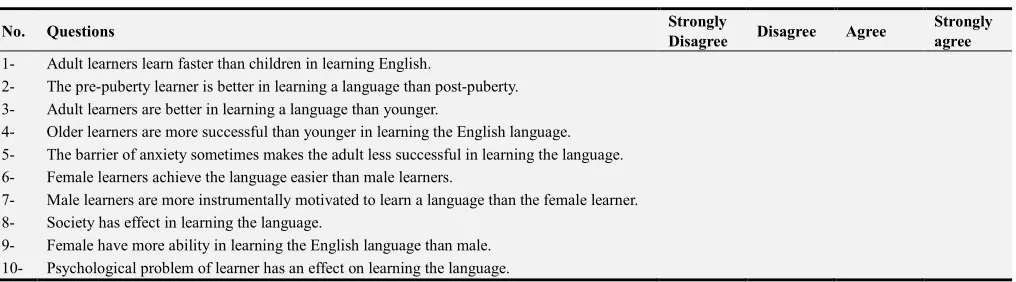
Questionnaires were given to Sara high school, Sarcham basic school in Dukan, Harem basic students in Said Sadiq, English department students at the University of Sulaimani, and School of Education in Chamchamal (n=28); equally divided by both genders (n=14). All the questions are written by researcher and approved by department staff and the head of school. The questionnaire is divided into two parts. The first part requires background information from the participants such as (gender and age). The second part consists of ten questions, which all ask about related aspects (age and gender problems and difficulties in learning the English language as the foreign language) see appendix (1). All of the questions had four choices that the participants had to tick; which followed “Likert scale” method. The four options were "strongly agree, agree, disagree, and strongly disagree". However, "neutral" could have been put, but it was excluded. Since; some of the participants prefer to stick it than the other options.
3.2. Interview
This kind of data collection is known as a qualitative method. Using this type of method is to fill the gaps that the questionnaire might have left empty. Interviews have been collected among English teachers and students (n=3). During the interviews, the response has space and give freedom to the interviewees to answer questions and express their feelings freely. All the questions are written by the researcher and approved by department and school. Moreover, the interview consisted of five questions (see appendix two) the questions were constructed simply and without ambiguity so that the interviewee would not be confused. Following Dornyei’s opinion, it was shown how interested the researchers are on their topic. The interviews took (10-15) minutes for each teacher. They were done in a quiet atmosphere and on different genders and age groups.
3.3. Sample
In the questionnaire, twenty-eight participants took part; and three participants took part in the interview. The participants were in different levels of education. However, all the participants were from the same educational system and similar cultural background. All the participants were of Kurdish origin.
4. Results and Findings: Presentation,
Analysis, and Discussion of the Data
This chapter is presented and discussed the gathered information about age and gender problems and difficulties in learning the English language as a foreign language. The
chapter includes the results and findings of the questionnaire, background questions and problem sections, and interview. Lately, comparisons being made with previous studies’ findings; the findings will be discussed in relation to each research question. This section contains the analysis of the data collection which was indicated from both questionnaire and interview section. Quantitative data were collected from the questionnaire survey. Furthermore, qualitative data were gathered through the face-to-face interview.
4.1. Background Questionnaire Results and Discussion
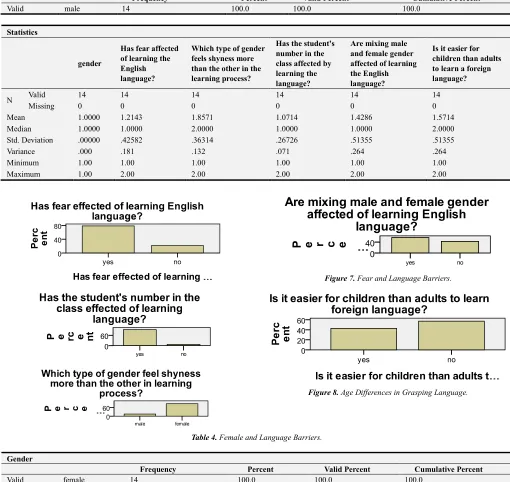
According to the result of the first question about the effect of fear on learning the English language; roughly two third, (%78.6), of the male participants, believed that fear has an effect, but (%21.4) of them think differently. For the female participants, (%42.9) answered as “yes” and (%7.1) answered as “no”. This can be believed that the female participants agreed with the idea more than the male participants (see fig. 10).
Regarding question two, (%14.3) of the male participants thought that “male are shyer than female learner”, but (%8.5) of the participants thought the opposite. In the case of the female participants, (%42.4) of them thought that female are shyer than male (see fig. 10).
Concerning question three, the vast majority of the male participants (%42.9) answered as “yes” to the question that the students’ number in the class has an effect on language learning. On the other hand, (%85.7) of the female participants answered as “yes”, whilst only (%14.3) replied as “no” (see fig. 10).
Lately, for question four, most of the male participants, (%57.1), thought that mixing male and female genders on the same group has affected the language learning; and almost the other half, (%42.4), thought that there is no side effect. On the hand, (64.3) percent of the female participants answered as “yes” and (35.7) percent answered as “no”. As this shows that the most of the participants thought that mixing both genders have an impact on learning a language (see fig. 10).
Finally, the question five is about the easiness of learning a language for children in compare to adults, (%57.1) of the male participants answered as “no”; by contrast, (%42.4) of them answered as “yes”. Moreover, the majority of the female participants (%71.4) answered the question as “yes” and only (%28.6) of them replied with “no”. It can be said that the majority of the females thought that it is easier for children to learn a language (see fig. 11).
4.2. Main Questionnaire Results and Discussion
different levels of education (n=28), as they answered the questions; in which their numbers were equally divided between both genders (n=14).
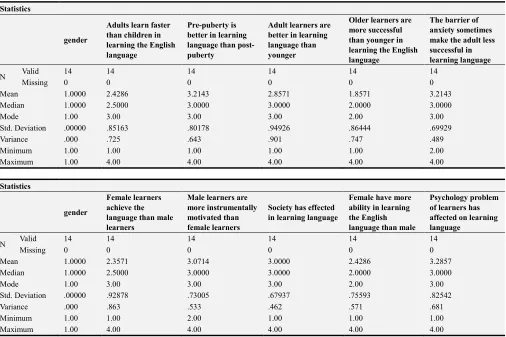
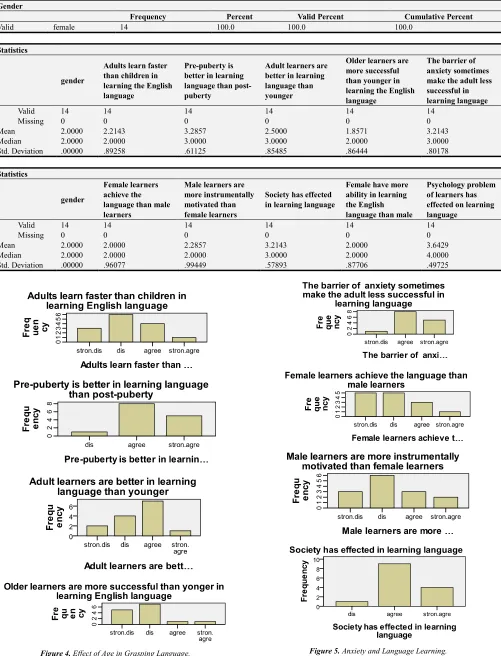
Regarding the first question, adults learn faster than children in learning the English language as for female gender their answers rated as (%42.9) disagreed, (%28.6)agreed, (%21.4)strongly disagreed, and (%7.1)strongly agreed. On the other hand, male participants strongly agreed and agreed by the range of (%7.1) and (%42.9) on the same point respectively; however, only (%35) disagreed and (%14.3) strongly disagreed with the argument. Moreover, this finding can be supported by the studies of Cook (1996), as he found that children are better than an adult in learning the language (see fig. 2 and fig. 6).
Concerning question two that was asked about pre-puberty age, whether they are better in learning the language than post-puberty or not; most of the female and the male participants (%57.1) agreed and (%35.7) strongly agreed upon the issue. Furthermore, it shows that most of the participants thought that pre-puberty are better than post-puberty. As Fathman (1975) found that (11-15) years old learners are better than (6-10) years old in learning English language (LEL), which means that puberty age is better than pre-puberty in learning a language (see fig. 2 and fig. 6).
The third question was asked about adult learners, whether they will learn the language better than younger; half of the female participants (%50) agreed and (%28.6) disagreed on the discussion that adult learners will learn the language better in LEL, but both of Ellis (1985) and Morinova Tod et al. (2000) supposed that younger learners are better than adult in learning language, as they had the opposite opinion (see fig. 2 and fig. 6).
Regarding the fourth question, whether older learners are more successful than younger in LEL or not. The majority of the female and the male participants (%50) disagreed, (%35.7) strongly disagreed, (%7.1) agreed, and (%7.1) strongly agreed on the idea respectively. So it can be stated that most of the participants disagreed with the idea that the older learners are successful than younger learners (see fig. 2 and fig. 6).
Concerning the fifth question, it was about the barrier of anxiety and its effects on adults in learning a language, more than half of the female participants (%57.1) agreed, but (%35.7) strongly agreed. Additionally, half of the male participants (%50) agreed, (%35.7) strongly agreed, and (%14.3) disagreed respectively. This shows that the majority of participants agreed on the same point (see fig. 3 and fig. 7).
Question six, which was about whether female learners achieve the language better than male learners or not; as for female genders answered as (%35.7), (%35.7), and (%21.4) for each of strongly disagree, disagree and agree prospectively. But, the male participants had the opposite idea; as they answered the question as (%42.9), (%28.6) and (%21.4) for each of agree, disagree and strongly agree respectively (see fig. 3 and fig. 7).
In the seventh question, the participants were asked about that male learners are more instrumentally motivated than female learners, analysing the results made it clear that (%42.9) of the female participants disagreed; in contrast, only (%21.4) agreed. Meanwhile, the male participants (%50) agreed and (%21.4) disagreed. It can be stated that the majority of the male participants agreed with that male learners are motivated more than female learners (see fig. 3 and fig. 7).
Regarding question eight, the researchers were interested in knowing whether society has affected the learning of the language or not; as a majority, (%64.3), of the female participants, agreed with the idea and only (%7.1) disagreed. In addition, the male participants agreed by the range of (%78.6) and strongly agreed by the percentage of (14.3) with the same point (see fig. 3 and fig. 7).
Question nine asked about which gender has more ability in learning a language; as (35.7%) of the female participants strongly disagreed, (%28.6) disagreed, and (%35.7) agreed. Furthermore, (%7.1) of the male participants strongly disagreed, (%50.0) disagreed, (%35.7) agreed and (%7.1) strongly agreed with the notion. Further evidence can be found in the work of Boyle (1987), as he found that female have more ability in learning a language than male. So, it can be found that the result that researcher found is different to what Boyle found (see fig. 4 and fig. 8); such different ideas could be created due to different education systems and background knowledge of the language. However, different societies and cultures may influence this phenomenon indirectly.
As for question ten, psychological problems of learners have been revealed on learning the language. Almost one-third, (%35.7), of the female participants agreed and (%64.3), strongly agreed. On the other hand, (%7.1) of the female participants strongly agreed, (%50.0) agreed and (%42.9) strongly agreed. This idea can be supported by the work of Oxford (1990) as he said that psychology has a powerful effect on learning the language (see fig. 4 and fig. 8).
4.3. Interview Results and Discussions
Three participants were interviewed; all of them were at the University of Sulaimani / College of Education – Chamchamal / English Department. There were five questions, (see appendix two), to be asked. During the interview, the participants felt free to give the opinions. Additionally, the teachers were asked about the necessity of learning cultures to speak in English. Moreover, they were also questioned about the impact of genders in learning the English language. Another question for the teachers was about the gender differences in learning the language sooner. Later, another question was asked to identify whether children are better in learning or not. Finally, the last question was about the parents` motivation toward their daughter(s) or son(s).
that all of the participants had the same idea that learning a culture means learning that language. Furthermore, mixing with other cultures is very important to learn the second language, because practising and sharing knowledge and ideas in everyday conversation is not like someone who lives in the native country without any background information of English language. So, mixing with different cultures and learning different cultures have a very important role in learning a language.
As for question two, two of the participants said that gender of the teacher has a side effect on learning. However, it is different from one culture to another and it is still debatable. While, in our country (Iraq), if the teacher is female the message to female students can be conveyed quite easier; and the same with the male genders, because of boundaries between both genders and some psychological issues. However, the interviewee who said gender does not make any difference. What can be concluded from this is that having experience is important.
Regarding the third question, the interviewees had different opinions on gender concerning learning. One of them thought that male is better in expressing ideas wider than female since female had some kind of shyness. And, another interviewee believed that it depends on the IQ of the person whether the person is of any gender. The result is similar to the work of Ford et al. (1988), they said that there
are no differences between male and female genders in learning as it depends on the person`s intelligence. Whilst, the third interviewee supported the notion that female is better in achieving and acquiring a language because the female is more social and make more conversation than male; as this could be found in the works of Boyle (1987) and Burstall (1975).
Concerning the fourth question, two of the interviewees thought that children can acquire the language better and faster than any other ages. Since children have strong and sharp memories and they can learn a language subconsciously. Furthermore, the time they hear about a single word, it will automatically be transferred to back a memory. This result is similar to the work of Mrinova Todd et al. (2000). Another interviewee thought that younger is better in achieving a language and this notion is similar to the finding of Marshall and Snow (2000).
The last question, question five, has been answered with different opinions, as one of them believed that in our country, Iraq, there is a kind of misunderstanding that female genders should speak less in most of the times and another interviewee thought that family has a great role in motivating their children to learn a language. The last interviewee believed that mothers are the one to be supportive persons for their children to succeed and learn a new language.
Table 1. The Role of Different Ages and Genders in Learning Language.
Statistics
gender
Adults learn faster than children in learning the English language
Pre-puberty is better in learning language than post-puberty
Adult learners are better in learning language than younger
Older learners are more successful than younger in learning the English language
The barrier of anxiety sometimes make the adult less successful in learning language
N Valid 14 14 14 14 14 14
Missing 0 0 0 0 0 0
Mean 1.0000 2.4286 3.2143 2.8571 1.8571 3.2143
Median 1.0000 2.5000 3.0000 3.0000 2.0000 3.0000
Mode 1.00 3.00 3.00 3.00 2.00 3.00
Std. Deviation .00000 .85163 .80178 .94926 .86444 .69929
Variance .000 .725 .643 .901 .747 .489
Minimum 1.00 1.00 1.00 1.00 1.00 2.00
Maximum 1.00 4.00 4.00 4.00 4.00 4.00
Statistics
gender
Female learners achieve the language than male learners
Male learners are more instrumentally motivated than female learners
Society has effected in learning language
Female have more ability in learning the English language than male
Psychology problem of learners has affected on learning language
N Valid 14 14 14 14 14 14
Missing 0 0 0 0 0 0
Mean 1.0000 2.3571 3.0714 3.0000 2.4286 3.2857
Median 1.0000 2.5000 3.0000 3.0000 2.0000 3.0000
Mode 1.00 3.00 3.00 3.00 2.00 3.00
Std. Deviation .00000 .92878 .73005 .67937 .75593 .82542
Variance .000 .863 .533 .462 .571 .681
Minimum 1.00 1.00 2.00 1.00 1.00 1.00
Figure 1. Effect of Age on Learning Process.
Figure 2. Gender Differences and Social Problems in Learning Language.
Table 2. Gender Frequency (Female) in Language Learning.
Gender
Frequency Percent Valid Percent Cumulative Percent
Valid female 14 100.0 100.0 100.0
Statistics
gender
Adults learn faster than children in learning the English language
Pre-puberty is better in learning language than post-puberty
Adult learners are better in learning language than younger
Older learners are more successful than younger in learning the English language
The barrier of anxiety sometimes make the adult less successful in learning language
Valid 14 14 14 14 14 14
Missing 0 0 0 0 0 0
Mean 2.0000 2.2143 3.2857 2.5000 1.8571 3.2143
Median 2.0000 2.0000 3.0000 3.0000 2.0000 3.0000
Std. Deviation .00000 .89258 .61125 .85485 .86444 .80178
Statistics
gender
Female learners achieve the language than male learners
Male learners are more instrumentally motivated than female learners
Society has effected in learning language
Female have more ability in learning the English language than male
Psychology problem of learners has effected on learning language
Valid 14 14 14 14 14 14
Missing 0 0 0 0 0 0
Mean 2.0000 2.0000 2.2857 3.2143 2.0000 3.6429
Median 2.0000 2.0000 2.0000 3.0000 2.0000 4.0000
Std. Deviation .00000 .96077 .99449 .57893 .87706 .49725
Figure 6. Psychological Factor in Language Learning.
Table 3. Psychological Barriers in Acquiring English Adequately for both Genders.
Gender
Frequency Percent Valid Percent Cumulative Percent
Valid male 14 100.0 100.0 100.0
Statistics
gender
Has fear affected of learning the English language?
Which type of gender feels shyness more than the other in the learning process?
Has the student's number in the class affected by learning the language?
Are mixing male and female gender affected of learning the English language?
Is it easier for children than adults to learn a foreign language?
N Valid 14 14 14 14 14 14
Missing 0 0 0 0 0 0
Mean 1.0000 1.2143 1.8571 1.0714 1.4286 1.5714
Median 1.0000 1.0000 2.0000 1.0000 1.0000 2.0000
Std. Deviation .00000 .42582 .36314 .26726 .51355 .51355
Variance .000 .181 .132 .071 .264 .264
Minimum 1.00 1.00 1.00 1.00 1.00 1.00
Maximum 1.00 2.00 2.00 2.00 2.00 2.00
Figure 7. Fear and Language Barriers.
Figure 8. Age Differences in Grasping Language.
Table 4. Female and Language Barriers.
Gender
Frequency Percent Valid Percent Cumulative Percent
Statistics
gender
Has fear affected of learning the English language?
Which type of gender feels shyness more than the other in the learning process?
Has the student's number in the class affected by learning the language?
Are mixing male and female gender affected of learning the English language?
Is it easier for children than adults to learn a foreign language?
N Valid 14 14 14 14 14 14
Missing 0 0 0 0 0 0
Mean 2.0000 1.0714 1.9286 1.1429 1.6429 1.2857
Median 2.0000 1.0000 2.0000 1.0000 2.0000 1.0000
Std. Deviation .00000 .26726 .26726 .36314 .49725 .46881
Minimum 2.00 1.00 1.00 1.00 1.00 1.00
Maximum 2.00 2.00 2.00 2.00 2.00 2.00
5.
Research Questions` Discussions
This section will explain the main answers to the research questions; precisely, through the questionnaire data and interview section`s main findings the answer to each research question is reached.
5.1. Whether Male or Female can Acquire the Language Better?
As the data were illustrated adequately previously; hence, male gender can do better in learning the English language than female. The result of this research question may differ and will alter from one society to another. Regardless, in most of the Middle Eastern countries, the similar data can be found since they share almost the same or similar backgrounds and educational systems. The consequence of this result may relate to different gender`s phenomenon in the following countries, as complete freedom of speech and idea release have given to male rather than female. As a result, females will shy to utter what they have even in their own language, and such depression will let them to not utter what they think of not losing face.
5.2. What Age is Convenient for Learning English as a Foreign Language?
Regarding second research question and under the light of previous data the result showed that children are better than any other age groups in learning the language. Education system may have an indirect effect on this issue; since the classes are more teachers oriented and centred then fewer opportunities are given to students to share their knowledge and utter what they have learned in the classes. Moreover, they have no opportunity to practice their language outside the class and Kurdish is the only language which is spoken by them. In contrast, children have a fresher mind and they speak without any hesitation and without caring about the mistakes they will make. Such phenomenon of not afraid of losing face will help them to speak much more natural; in addition, due to their age, the teacher will not be furious once they did a mistake and they will be corrected.
6. Conclusion
This research studied the age and gender problems and difficulties in learning a language as a foreign language. Lately, how each of age and gender has impacts on LL (Language Learning). The findings of this study answered the research questions, as this research intended to find out the problems and difficulties; and some solutions and recommendations were given. The answer to the first research questions, “Which gender is better in acquiring the language?", the result of the questionnaire shows that male learners are better than female. As for the second question, “What age is convenient for learning English as a foreign language?”; the result of the questionnaire found that children are better as they have more ability in learning the English language than adults.
What is recommended for future researchers, to take care about, is the purpose behind each individual’s learning of a language? Whether they want to learn just to pass exams and achieve a degree, they want to communicate with that language, or they want to learn it for a particular business. Moreover, psychological and social barriers should be taken into consideration in foreign language classes for a better result. And finally, individual differences should be accounted and should be respected, as each thinks differently.
It is highly recommended that these kinds of studies should be conducted in other Middle Eastern countries and especially on mixed gender classes. Moreover, different ways and methods of teaching should be developed to remove the barriers between students in the field of learning. Besides, further workshops and seminars should be done to help students psychologically and avoid that archaic thinking which female should speak less. At last but not least, it is very important to work on parents` role to follow-up and evaluate the level of their children in English.
limited in regard of time and place due to economic and political obstacles. The further limitation can be described as the use of further researches and further studies and journals for the paper. Moreover, the lack of Kurdish and neighbouring countries` resources on the issue was not helpful and was a resistance to mention several Middle Eastern studies on the problem. The researcher hopes that these limitations will be studied on and for future works and these limitations will be worked on to provide readers with much more data and precise numbers all around Iraq, Iran, Turkey and neighbouring Arabian countries as they share similar obstacles and educational properties.
Appendices
Appendix 1
Dear participant:
The researcher is going to conduct a research about age and gender problems and difficulties in learning the English language as their foreign language under the title of “The Role of Age and Gender differences in Language Learning: A Case Study on Kurdish EFL Learners”. The researcher will be grateful if you would fill in the questionnaire voluntarily. The result of this questionnaire will only be used for the academic purposes and will not be disclosed to any other parties.
Table A1. Background of the Age Group.
Gender: Age:
Male: Female: 10-12 12-15 15-18 18-22 22-above
Table A2. Questionnaire Sample and Questions.
No. Questions Strongly
Disagree Disagree Agree
Strongly agree 1- Adult learners learn faster than children in learning English.
2- The pre-puberty learner is better in learning a language than post-puberty. 3- Adult learners are better in learning a language than younger.
4- Older learners are more successful than younger in learning the English language. 5- The barrier of anxiety sometimes makes the adult less successful in learning the language. 6- Female learners achieve the language easier than male learners.
7- Male learners are more instrumentally motivated to learn a language than the female learner. 8- Society has effect in learning the language.
9- Female have more ability in learning the English language than male. 10- Psychological problem of learner has an effect on learning the language.
Appendix 2
Interview questions about “The Role of Age and Gender differences in Language Learning: A Case Study on Kurdish EFL Learners”:
(1) Is it necessary to learn about English cultures to speak English?
(2) Does gender of the teacher have an effect on learning the English language? If so how?
(3) Which type of gender is better in learning the English language? And why?
(4) Do you believe that children are better in learning the English language? And why?
(5) Do parents motivate their daughter(s) or son(s) to learn the English language?
References
[1] Abdul Settar, R., Daghir, A. and Ridha, A. (2010) Investigating the Relationship between Learner's Gender, Proficiency and Language Learning Strategies: The Case of EFL Iraqi Learners, Journal of the College of Arts, 53, 32-56.
[2] Aslan, O. (2009) The Role of Gender and Language Learning Strategies in Learning English, Thesis submitted to the
graduate school of social sciences of the middle east technical university.
[3] Bernat, E. and Lloyd, R. (2007) Exploring the Gender Effect on EFL Learners’ Beliefs about Language Learning, Australian Journal of Educational & Developmental Psychology, 7, 79-91.
[4] Bista, B. (2009). Age as an Affective Factor in Second Language Acquisition. Retrieved in 2016, from http://www.scribd.com/doc/7753203/Age-as-an-Affective-Factor-in-Second-Language-Acquisition.
[5] Bley‐Vroman, R. (1989). What is the Logical Problem of Foreign Language Learning? In S. Gass& J. Schachter (eds.), Linguistic Perspectives on Second Language Acquisition (pp. 41–68). Cambridge: Cambridge University Press.
[6] Block, D. (2002). Language & Gender and SLA. [Electronic version]. Quaderns de Filologia. Estudis Linguistics, 7, 49-73.
[7] Brown, H. D. (2000) Principle of Language Learning and Teaching (4th ed.); San Francisco State University: Longman.
[8] Cameron, D. (1995). Verbal Hygiene. New York: Routledge.
[9] Cohen et al. (2007) Research Methods in Education (6th ed.); New York: Routledge.
[11] Ehrman, M. E. and Oxford, R. L. (1995). Cognition Plus: Correlates of Language Learning Success, The Modern Language Journal, 79, 67-89.
[12] Ellis, R. (1985) Understating Second Language Acquisition. Oxford University Press: UK.
[13] Ellis, R. (1994). The Study of Second Language Acquisition. Oxford: Oxford University Press.
[14] Ellis, R. (2008) The Study of Second Language Acquisition (2nd ed.). Oxford University Press: UK.
[15] Flege, J. (1999) Age Constraints on Second-Language Acquisition. University of Alabama: Birmingham.
[16] Gascoigne, C. (2002). The Role of Gender in L2 Interaction: Socialisation via L2 Materials, Encuentro Revista de Investigación e Innovación en la Clase de idi, 13 (14), 81- 89.
[17] Genesee, F. (1987). Learning Through Two Languages: Studies of Immersion and Bilingual Education. New York: Newbury House.
[18] Hagen, L. K. (2008). The Bilingual Brain: Human Evolution and Second Language Acquisition, Evolutionary Psychology, 6 (1), 43-63.
[19] Harley, B. (1986). Age in Second Language Acquisition, Toronto: Multilingual Matters Lt.
[20] Holmes, J. (1995). Women, Men, and Politeness. New York: Longman.
[21] Huang, B. and Jun, S. (2015) Age Effect on the Acquisition of Second Language Prosody. Online Supplement to Proceedings of the 33rd Boston University Conference on Language Development, University of California, Los Angeles, 1-26.
[22] Johnstone, R. (2002). Addressing the Age Factor: Some Implications for Languages Study. Stransbourg: Council of Europe.
[23] Kaushanskaya, M.; Marian, V.; and Yoo, J. (2011). Gender Differences in Adult Word Learning, ActaPsychologica1, 37, 24–35.
[24] Kissau, S. (2015) Gender differences in second language motivation: An investigation of micro and macro level influences, RCLA: CJAL, 9(1), 73-96.
[25] Krashen, S. D. (1981). Second Language Acquisition and Second Language Learning (pp. 265-279). Oxford: Pergamon.
[26] Liu, S. and Yeni-Komshian, G. (1999) Age Constraints on Second-Language Acquisition, 4(1), 78-104.
[27] Marshall, B. (2000). Is there a Child Advantage in Learning Languages, Education Week, 19, 39-41.
[28] Molfese, D. (1977). Theonogeny of Cerebral Asymmetry in Man: Auditory Evoked Potentials to Linguistic and
Non-linguistic Stimuli. In J. Desmedt (Ed.). Progress in Clinical Neurophysiology 3, Basel: Karger.
[29] Morillas, M. D. P. E. (2011). An Overview of the Age Factor and its Pedagogical Implications for Vocabulary Acquisition.
Retrieved in 2016, from
http://digibug.ugr.es/bitstream4Tacquisition.pdf.
[30] Muñoz, C. (2006). Age and the Rate of Foreign Language Learning. Clevedon, Buffalo, Toronto: Multilingual Matters.
[31] Newport, E. (n.d.). Language Development, Critical Periods
in. Retrieved in 2016 from
www.bcs.rochester3T4T.edu/people/.../Newport-ECS-A0506.P3T.
[32] Piasecka, L. (2010). Gender Differences in L1 and L2 Reading. In J. Arabski& A. Wojtaszek, Neurolinguistic and Psycholinguistic Perspectives on SLA (pp. 145-158). Toronto: Multilingual Matters.
[33] Salehi, M., Lari, Z., and Rezanejad, A. (2014) The effects of gender and genre on language learners’ reading comprehension ability, Education Journal, 3(5), 266-271.
[34] Saligheh, M. and Shakouri, N. ( 2012) Revisiting Age and Gender Influence in Second Language Acquisition, Kooshyar Higher Education institute, Department of Foreign Languages and Literature, Science and Research, Tehran.
[35] Scovel, T. (1988). A Time to Speak: A Psycholinguistic Inquiry into the Critical Period for Human Language. Rowley, MA: Newbury House.
[36] Shakouri, N. and Saligheh, M. (2012) Revisiting Age and Gender Influence in Second Language Acquisition; Department of Foreign Languages and Literature, Science and Research, Tehran, Advances in English Linguistics (AEL) 1(1), 1-6.
[37] Smith, M. S. (1994). Second Language Learning: Theoretical Foundations. London: Longman.
[38] Snow, C. E. and Hoefnage-Hoehle, M. (1978). The Critical Period for Language Acquisition: Evidence from Second Language Learning, Child Development, 49, 1114-1118.
[39] Stern H. H. (1976). Optimum Age: Myth or Reality?, Canadian Modern Language Review, 32.
[40] Zeynali, S. (2012) Exploring the gender effect on EFL learner's learning strategies, University of Tabriz, Aras International Campus, Tabriz, Iran.
[41] Zeynali, S. (2012) Exploring the Gender Effect on EFL Learners’ Learning Strategies Theory and Practice in Language Studies, ACADEMY PUBLISHER, 2(8), 1614-1620.