Dynamic Analysis of Separate Foundation for
Low Frequency Machine With Soil Interaction
Hardik A. Patel¹, Hitesh K. Dhameliya², Yati R.Tank³
1M. Tech Student,Civil Engineering Department, Chhotubhai Gopalbhai Patel Institute of Technology 2,3Assistant Prof, Civil Engineering Department, Chhotubhai Gopalbhai Patel Institute of Technology
Uka Tarsadia University, Bardoli, Gujarat, INDIA
Abstract:— In the industry heavy machinery is used as operate low frequency to high frequency. To get more production the speed of machinery has been increased for low speed to high speed. With the development of high speed machinery the problem of vibration arises. The vibration creates problems to foundation or its supporting structure and it may cause failure of the structure. Because of these problems static and dynamic analysis of machine foundation with different type of soil is necessary. For the economical design of structure provided separate foundation for the machine. It dicusses the load cases to applied and find out the displacement and stress in structure. The results will be compare and check the frequency ratio and displacement as per the range of IS Code of machine foundation. An attempt is made in the study to carry out an observation on machine foundation by using software SAP 2000 Vs.14. The analysis for foundation is also described in this paper and an attempt has been made to study the dynamic behaviour of a foundation structure for LESSAR machine which is used in cloth industry. Two different types of foundations for Reciprocating type Machine that is LESSAR have been studied in this paper.
Keywords:— Dynamic Effect, Structural Element,
Footing, Frequency, Amplitude, Resonance, soil interaction.
I. INTRODUCTION
Generally three types of machine are use in industry. Reciprocating machines operating speeds are usually less than 600r/min. Impact machines speeds of operation usually vary from 60 to 150 blows per minute. Rotary machines have speeds of more than 3,000r/min and up to 12,000r/min[1]. Foundation parameters that influence the vibrations of a machine-foundation system are mainly (i) overall foundation size, (ii) depth of embedment, (iii) sizes of the foundation members like columns, beam, deck slab, cantilever projections, etc., (iv) dynamic soil parameters or dynamic soil-pile properties, and (v) dynamic forces, both internally generated as well as externally applied[2]. A suitable foundation is selected, depending upon the type of machine. For compressors and reciprocating machines, a block foundation is generally provided. A block foundation has a large mass and, therefore, a smaller natural
frequency. However, if a relatively lighter foundation is desired, a box or a caisson type foundation may be provided. The mass of the foundation is reduced and its natural frequency increases[1] . Foundations under low-frequency machines should be designed so that their natural frequencies are much higher than the operational frequencies of the machines[3]. . When fundamental natural frequency is below the operating speed of machine that foundation design as Under tuned fondation and fundamental natural frequency is much higher then the operating speed of machine that foundation design as overtuned foundation to avoid the reasonance[4] .The fundamental natural frequency (fn) shall be at least 20 perccnt away from
the machine operating speed(fm). There should be no
resonance, i.e. the natural frequency of the machine foundation-soil system should not coincide with the operating frequency of the machine. Frequency ratio should not be within 0.8 to 1.2. The amplitudes of motion at operating frequencies should not exceed the limiting amplitudes, which are generally specified by machine manufacturers[5].
II. METHODOLOGY
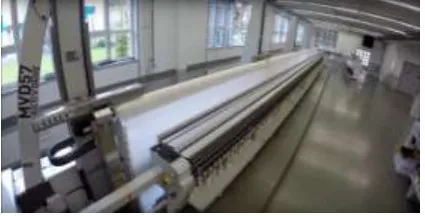
For lasser machine, frequency of the machine is only 8.66 Hz that very small compare to high speed machine but the self weight of the machine is very large compare to machine frequency therefore machine in only one placed at the ground level if the machine is placed at first floor the displacement is increase of the structure therefore necessary to dynamic analysis of foundation required.
Figure 1 Lesser machine at industry
CAD Software, Modelling of R.C.C Frame of Ground + One Storey structure using sap 2000. From size of machine and vibration of motor maximum two machine should be placed on each floor that total four machine place in building. To reduce the effect of vibration in the structure to destroy the slab below the machine makes separate foundation for machine on ground floor. To study all possible types of foundations such as block type foundation, box type foundation. To compare different type of structure with each other to stress, displacement, economic condition.
III. MODELLING OF FOUNDATION
Model 1: Block foundation
The block foundation is of dimension 35m x 1.6m x 0.5m. Block foundation is made of small solid block of dimension 0.5m x 0.1m x 0.1m in sap 2000. Material property of the solid block is assign as concrete M 30 grade. Then load is assign as machine and harmonic load as point load on block foundation and also earthquake force applied in X and Y direction. This foundation is designed as such that block is 0.2m in depth in ground so that support condition is assign as soil spring at bottom of block and around 0.2m in depth of block foundation. Response spectrum analysis also performs on foundation.
figure 2 3D view of Block foundation with soil stiffness
Model 2: Box foundation
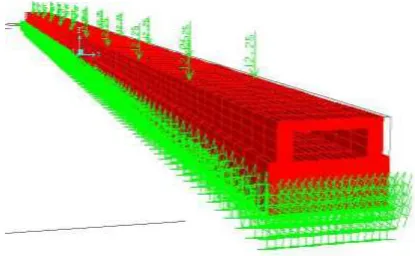
In the box foundation the block provided same as block foundation. In this foundation the changes are that we provide box in the upper portion of block. Dimension of the box is top slab portion is 0.1m thick and side leg portion is 0.2m thick and 0.4m in height. Material property of the solid block is assign as concrete M 30 grade. Then load is assign as machine and harmonic load as point load on box foundation also earthquake force applied in X and Y direction. This foundation is designed as such that block is 0.3m in depth in ground so that support condition is assign as soil spring at bottom of block and around 0.3m in depth of block foundation. Response spectrum analysis also performs on foundation.
Figure 3 3D view of Box type foundation with soil stiffness
IV. SOIL INTERACTION THEORY
Dynamic shear modulus G is the most important soil parameter influencing the dynamic behaviour of the soil-foundation system. The dynamic shear modulus represents the slope of the shear stress versus shear strain curve. Most soils do not respond elastically to shear strains; they respond with a combination of elastic and plastic strain. For that reason, plotting shear stress versus shear strain results in a curve not a straight line. The value of G varies based on the strain considered. The lower the strain, the higher the dynamics hear modulus.
Table 1 Wave velocity in different types of soil
Type of
soil
Vs (m/sec) Vc(m/sec) Vs/Vc
Soft soil 50.819 3344.93 0.015
Medium
soil
88.02 3344.93 0.025
Hard soil 160.70 3344.93 0.047
Dynamic stiffness is change with the change the dynamic behavior of soil. If the shear modulus of soil is increase that the shear wave velocity also increased than the dynamic stiffness is increased with the dynamic shear modulus of soil.
Chart 2 Horizontal stiffness in Y direction Vs Different types of soil
Chart 3 Vertical stiffness Vs Different types of soil
From chart 1,2,3 it has been observed that as stiffness is change with different in various type of soil. If the shear modulus of soil is increase with stiffness also increase. From soft soil to medium and medium to hard soil stiffness is increased.
V. RESULTS
Results of block foundation
Chart 4 Frequency Vs different soil for Block foundation
From the above chart 4 frequency is various in different type of soil. For block type foundation frequency of the block is increase around 170% from soft soil to medium and medium to hard soil that means foundation is very stiff in hard soil.
Chart 5 Top node displacement Vs Different type of soil for Block foundation & different direction
From the chart 5 it is clearly visible that for block foundation top node displacement in Z direction is more than the X and Y direction in all type soil and displacement in soft soil is larger than the medium and hard soil that more settlement produce in soft soil then medium and hard soil.
Chart 6 Bottom node displacement Vs Different type of soil for Block foundation & different direction
From the chart 6 it is clearly visible that for block foundation bottom node displacement in Z direction is more than the X and Y direction in all type soil because bottom node is very stiff than to top node to provide dynamic stiffness at base of foundation. Displacement in soft soil is larger than the medium and hard soil that more settlement produces in soft soil then medium and hard soil.
Results of box foundation
Chart 7 Frequency Vs different soil for Box foundation
From the above chart 7 frequency is various in different type of soil. For box type foundation frequency of the box foundation is increase around 170% from soft soil to medium and medium to hard soil.
From the chart 8 it is clearly visible that for box foundation top node displacement in Z direction is grater than the X direction and displacement in X direction is grater than in Y direction in all type soil. Displacement in soft soil is larger than the medium and hard soil that more settlement produces in soft soil then medium and hard soil.
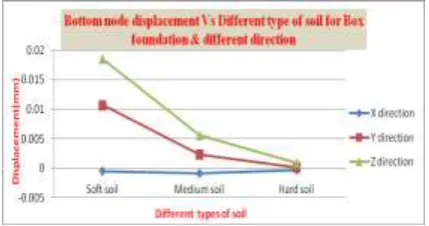
Chart 9 Bottom node displacement Vs Different type of soil for Box foundation & different direction
From the chart 9 it is clearly visible that for box foundation bottom node displacement in Z direction is larger than and in X and Y direction in all type soil. As shown in chart displacement in X direction is some negative because of dynamic stiffness provide at base of foundation and bottom node is very stiff than top node
Comparision of both foundation
Chart 10 Frequency Vs different types of soil
As shown in chart 10 minimum frequency of foundation occurs in box and some more frequency occurs in block type foundation
Chart 11 Top node displacement Vs different direction for both foundation
As shown in chart 11 displacement in Z direction is more than in X and Y direction in all type model. Displacement in all direction maximum occurs in box foundation
Chart 12 Bottom node displacement Vs different direction for both foundation
As shown in chart 12 displacement in Z direction is more than in X and Y direction in all type model. Displacement in all direction maximum occurs in box foundation
Figure 4 Maximum stress distribution in block foundation
Figure 5 Maximum stress distribution in box foundation
VI. CONCLUSION
1. From soft soil to medium and medium to hard soil horizontal stiffness in X, Y and Z direction is increased around 300% in variation.
2. Applied frequency of machine is 8.66 Hz and frequency of foundation according to mode shape is higher than that applied frequency so that frequency ratio is less than 0.8 and foundation act as over tuned foundation. 3. The larger the foundation contact area, the
smaller the reduced pressure on the soil and the higher the natural frequencies of the foundation. 4. Many cases have been observed in which
vibrations underwent vibrations at smaller amplitudes than those cited above, but induced strong vibrations of structures located at a distance of several meters.
5. For block and Box type foundation frequency of the foundation is increase around 170% from soft soil to medium and medium to hard soil that means foundation is very stiff in hard soil. 6. Displacement in Z direction is more than in X
and Y direction in all type model. Displacement in all direction maximum occurs in box foundation than Block foundation.
7. For Block foundation maximum stress occurs at the leg point of machine and reduces it to base of foundation. Minimum stress occurs at the middle portion of the foundation.
8. For box foundation maximum stress occur at the two side portion of the box and in this foundation total stress absorb by top portion of box foundation such that minimum stress produce in block of foundation
ACKNOWLEDGMENT
I would like to take this opportunity to express our profound debt of gratitude toward to Prof. Hitesh. K. Dhameliya for his valuable guidance, helpful comment and cooperation with kind and encouraging attitude, at all the stages of the work, without which this work could not have been completed. I would like to show my greatest appreciation to Prof. Yati R. Tank. I can’t say thank you enough for your tremendous support and help. Akash Shah and Vihar Desai my friends and my classmate have played significant role as moral boosters and have extended all possible help and co-operation. I express my deepest feeling of reverence to my parents for being pillars of strength that encouraged me to elevate myself academically.
REFERENCES
1. Shamsher Prakash, V. K. Puri ( April-May 2006). ―Foundations for Vibrating Machines‖ . Journal of Structural Engineering, SERC, Madras. INDIA , 39. 2. Bhatia, K. (March-June 2008). ―Foundations for Industrial
Machines And Earthquake Effects‖ . ISET Journal of Earthquake Technology , 17.
3. D.D.Barkan. (1957). ―Dynamics of Bases and Foundations‖. New York: Mcgraw-Hill Book Company, Inc.
4. Srinivasulu,P.and Vaidyanathan, C.V.,―Handbook of Machine Fundations‖, Tata McGraw Hill , New Delhi, 1976.
5. Indian Standard 2974 (Part I to V) Code of Practice for Design And Construction of Machine Foundations . (n.d.). 6. Hamid Eskandari, M. G. (2016). ―Foundation Analyzing of
Centrifugal ID Fans‖. ELSEVIER , 10.
7. Swain, A., IIT Kanpur, G. P., & Indian Institute of Technology, K. (25-Apr-2015 ). ―Experimental study on dynamic interference effect of two closely spaced machine foundations‖ . Canadian Geotechnical Journal , 42.
8. Peter Nawrotzki, G. H. (2008). ―Static and dynamic analysis of concrete turbine foundation‖. structural engineering international , 265-270.
9. Phipps, J. N. (2013). ―Experimental and numerical investigation of dynamic rocking foundation behavior‖. Iowa State University .
10. Sarthi B. Bhavsar, Y. D. ( May-Jun 2013). ―Dynamic Analysis of R.C.C. Frame Structure for Looms Industry‖ . International Journal of Engineering Research and Applications (IJERA) , 21.
11. Piyush K. Bhandari, A. S. (April 2014 ). ―Dynamic Analysis of Machine Foundation‖ . International Journal of Innovative Research in Science, Engineering and Technology , 8.