2017 | VOLUME 13 |71 © ARCHIVES OF BUDO | SCIENCE OF MARTIAL ARTS
This is an open-access article distributed under the terms of the Creative Commons Attribution-NonCommercial 4.0 International (http://creativecommons.org/licenses/by-nc/4.0), which permits use, distribution, and reproduction in any medium, provided the original work is properly cited, the use is non-commercial and is otherwise in compliance with the license.
Changes in expression of selected cellular stress
response genes after passive body overheating in
sauna and moderate exercise in judo athletes and
untrained people
Małgorzata Żychowska
Department of Life Sciences, University of Physical Education and Sport, Gdansk, Poland
Received:
07 February 2016;
Accepted:
28 February 2017;
Published online:
07 March 2017
AoBID:
11521
Abstract
Background and Study Aim: Passive overheating and exercises influence the genes expression, especially encoding heat shock protein and interleukin. The aim was the effect of one-time sauna and moderate exercise on selected genes expression in judo athletes and untrained people.
Material and Methods: Ten athletes trained judo (JA group aged 21.5 ±0.43 years) and 10 untrained (CON group aged 20 ±0.7 years) were subjected to 30 min cycling with load 80% maximal oxygen consumption (VO2max). and 30 min one-time sauna (temperature of 98.2°C and humidity 10 ±2%). Venous blood samples were collected before and immediately after exercise or sauna to measured express of genes related to cellular stress response using quantitative real-time PCR (qPCR).
Results: Sauna induced higher changes in genes expression than exercise in both groups. After passive overheating HSPA1A and HSPB1 mRNA increased significantly in both groups (p˂0.05), while IL6 mRNA only in CON and IL10 mRNA only in JA. Exercise significantly affected HSPA1A in both groups. HSPB1 and IL6 mRNA significantly increased only in CON (p = 0.03 for HSPB1 and p = 0.02 for IL6) but in JA these changes were not significant. Generally in JA the expression of tested genes was lower both after exercise and sauna compared to CON.
Conclusion: Applied exercise caused lower (but insignificant) changes in the expression of tested genes than passive over-heating in the sauna. Sauna induced similar changes to exercise and can be used in maintain adaptive chang-es to physical effort in judo training or can be useful during forced breaks in training, e.g. due to injury. Keywords: genes expression • heat shock protein • interleukin
Copyright: © 2017 the Author. Published by Archives of Budo Conflict of interest: Author has declared that no competing interest exists
Ethical approval: This study was approved by the Bioethics Committee for Clinical Research (KB14/14) Provenance & peer review: Not commissioned; externally peer reviewed
Source of support: This scientific work was funded under the program of Polish Ministry of Science and Higher Education under the name “Development of Academic Sport”, Project no. N RSA4 06754.
Author’s address: Małgorzata Żychowska, Department of Life Sciences, Gdansk University of Physical Education and Sport, Gorskiego Street 1, 80-336 Gdansk, Poland; e-mail: [email protected]
72| VOLUME 13 | 2017 www.archbudo.com Original Article
INTRODUCTION
The popularity of sauna bathing as a wellness treatment in sport and relaxation has led to an interest among researches regarding changes within the body appear after the application of external heat. It is well known that sauna expo-sure has significant influences many aspects of the human body, including relaxation of skeletal muscle [1], reduction of body fat [2], reduction of oxidative stress [3], stimulation the immune sys-tem [4], and activation of the hormonal syssys-tem, especially in secretion of adrenocorticotropic hormone (ACTH) [5].
Although the sauna is most commonly used as a relaxation treatment, some of the changes caused by such external heat stress are similar to those obtained after exercise-associated internal stress. For instance, increased body temperature resulting from environmental heat stress or exer-cise can result in oxidative stress [6], mobilization of the immune and hormonal systems [7], sweat activity [2], and heat shock protein [8], interleu-kin, and others.
Overheating and dehydration are stressors that activate homeostatic mechanisms, especially on the cellular level, such as the expression of stress-related genes. After sauna exposure or exercise, genes associated with apoptosis, such
HSPA1A or HSPB1, are overexpressed [9-11].
These genes are easily induced by physiologi-cal stress, changes in temperature, or oxidative stress [12-14]. Furthermore, many reports show that the cellular response to stress is indepen-dent of the stressor and involves the produc-tion of pro- and anti-inflammatory proteins [15]. According to Ziemann et al. [16], changes in heat shock protein and interleukin levels are crucial for training adaptation. These adaptive changes in transcription levels result in a decrease in basal HSPA1A mRNA, lower expression of IL6 mRNA, and higher IL10 mRNA compared to sed-entary people [17, 18].
Numerous studies of judo athletes in the litera-ture examine a variety of factors, such as reduc-tion of body mass in individuals that participate in combat sports [19], testing fights in a verti-cal posture as a criterion of talent for combat sports [20], as well as physiological possibili-ties, kind of training, etc. However, there are no many data associated with genes expression so
after exercise as the overheating during biologi-cal regeneration.
Physiological requirements in judo include both anaerobic and anaerobic possibilities. Judo ath-letes must demonstrate skills in accordance with technical, tactical, or conditioning improve-ments [21]. Development of these skills is asso-ciated with lower and upper body exercise [22, 23]. Training programs that feature high-inten-sity intermittent training (HIIT) are often used in judo training sessions [21]. Given the potential for the intensity of training and participation of direct combat to result in injury, judo is one of the more traumatic sports. Therefore, whether sauna baths can be useful to maintain adaptive changes during forced breaks in training for judo athletes is an important question. Unfortunately, there is currently only one study in the literature that examines changes caused by sauna expo-sure compared to those obtained by exercise [6]. The authors found that both sauna and exercise influence the pro-oxidant-antioxidant balance and that oxidative stress was lower after exer-cise compared to sauna. Oxidative stress and changes in temperature are important factors that affect the cellular stress response, including changes in the expression of heat shock proteins and interleukins.
The aim was the effect of one-time sauna and moderate exercise on selected genes expression in judo athletes and untrained people.
For practical purposes, the main question addressed was whether probable changes in the expression of some genes in the sauna are similar to changes observed after exercise, and whether such changes may be useful for maintaining adap-tive changes to exercise.
MATERIAL AND METHODS
Ethics Statement
This study was approved by the Bioethics Committee for Clinical Research (KB14/14). The authors are obliged to respect the princi-ples of the Helsinki Declaration. All participants gave written informed consent to participate in the study. All participants were informed that they could withdraw consent at any time for any reason.
JA – judo athletes
CON – control group
VO2max – maximal oxygen consumption
qPCR – quantitative real time PCR (polymerase chain reaction)
HSP 70 – heat shock protein 70
HSPA1A – gene encoding heat shock protein 70 kDa
HSP 27 – heat shock protein 27 kDa
HSPB1 – gene encoding heat shock protein 27 kDa
IL6 – interleukin 6
Il6 – gene encoding IL6
IL10 – interleukin 10
IL10 – gene encoding IL10
TBP – gene encoding TATA box protein
TUBB – gene encoding tubulin B
BMI – body mass index
mRNA – messenger ribonucleic acid
© ARCHIVES OF BUDO | SCIENCE OF MARTIAL ARTS
PROOF ©
ARCHIVES OF BUDO
2017 | VOLUME 13 |73
Participants
A total of 20 healthy males took part in the experiment. The volunteers were divided into two groups, including 10 athletes trained in judo with an average of 8 years’ experience (JA group) and 10 physically active men without judo train-ing as a control group (CON group). There were no significant differences between the groups in body mass, body mass index (BMI), and maximal
oxygen consumption (VO2 max) (Table 1).
The experiment took place in the end of May and volunteers were asked to avoid using a sauna for at least one month before the experimental sauna bath. Physically active men making up the control group (CON) reported regular recreational participation in sports such as running, swim-ming, soccer, and other team sports on average 2-3 times a week for a duration of 45 minutes/. All participants had a normal life style and did not have any injuries to the bone or muscle tis-sue; reported no intake of drugs, nicotine, or alco-hol during the study, and had no other diseases that might directly affect the results. The partic-ipants were informed of the nature and possible inconveniences associated with the experiment.
Experimental Overview
During the experiment, participants were exposed to 30 min in the sauna and 30 min of cycling on a cycle ergometer with an individually
selected load at 80% VO2 max (Monark 894E,
Peak Bike from Sweden) to assess genes expres-sion. Each activity was performed on Saturday with one week break in between. The judo ath-letes (JA) and the control group (CON) were sub-jected to a one time of exposure to the dry sauna. The subjects remained in the Finnish sauna room at a temperature of 98.2°C and humidity 10 ±2% twice for 15 minutes during the same ses-sion with a 5 minute break for cooling under the
shower (water temperature was 18-20oC). The
total time spent in the sauna was 30 minutes (2 x 15 minutes). Before and after the sauna expo-sure, blood samples were collected to determine
genes expression. One week later, participants in both groups returned at the same time of day (morning) to perform 30 min of cycling on a cycle ergometer with individually selected load at 80%
VO2 max (Monark 894E, Peak Bike from Sweden).
The saddle height was adjusted for each partic-ipant and toe clips were used to ensure stabil-ity of the feet. Before and up to 5 min after the test, blood samples were collected to determine gene expression.
RNA extraction, qRT–PCR
Erythrocytes were eliminated from 2 ml of venous blood using red blood cell buffer (RBCL, A&A Biotechnology, Gdynia, Poland). The remain-ing white blood cells were lysed usremain-ing Fenozol (A & A Biotechnology, Gdynia, Poland). Further isolation of RNA was carried out by a chemical method as described by Chomczyński and Sacchi [24]. Purity and concentration of the isolated RNA was determined by spectrophotometry (Eppendorf BioPhotometer Plus, Germany). cDNA synthesis from 2 μg RNA was performed using TranscriptMe Kit, containing oligo dT and random hexam-ers (Blirt, Gdańsk, Poland). Obtained cDNA was diluted 10 times and 2µl was used to qPCR.
Quantitative polymerase chain reaction
(q-PCR) assay to determine gene
expression
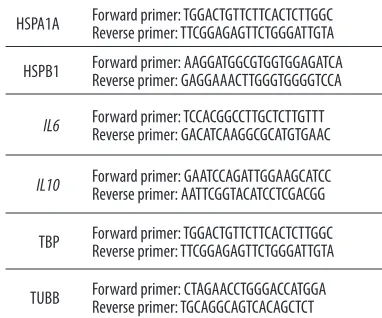
For the analysis of gene expression, Real-Time PCR (LightCycler 480II, Roche, Poland) was applied twice in triplicate for the same sample using a LightCycler polymerase (Roche, Poland). The temperature-time profile of the reaction was in accordance with the manufacturer’s instruc-tions. For each reaction, melt curve analysis was performed. The TATA box protein (TBP) and B-tubulin (TUBB) were used as housekeeping genes. To amplify the genes, the following primer sequences were applied (Table 2).
Statistical Analysis
Data were collected and relative gene expres-sion was analyzed in Microsoft Excel 2017.
Table 1. Age, anthropometric and physiological characteristics of the study groups (mean and standard deviation).
Group (years)Age Height(cm) (kg/mBMI2) % body fat VO(ml/min/kg)2max
JA 21.5 ± 0.43 181.5 ±7.45 20.5 ±1.64 9.21 ±2.24 44.25 ±1.86
74| VOLUME 13 | 2017 www.archbudo.com Original Article
In order to calculate the level of gene expres-sion, the Schmigtten and Livak method [25] was applied. The results of relative expression were analyzed in GraphPad Prism 5.0 (www.graph-pad.com). Data were transformed to linear and then the normality of distribution was checked with Shapiro-Wilk’s test and a paired t-test was applied to determine p-value. To calculate the differences between groups after sauna and exercise as well as within the groups (sauna vs. exercise) two-way and one-way ANOVAs were performed, respectively. Additionally, a paired t-test was performed to check for differences within each group and an unpaired t-test was performed to check for differences between groups. A p-value of less than 0.05 was consid-ered significant.
RESULTS
Exposure to 30 min of sauna bathing caused a sig-nificant increase in HSPA1A and HSPB1 mRNA in both groups. HSPA1A increased 2^1.6-fold in JA (p = 0.003) and 2^2.8-fold in CON (p = 0.001).
HSPB1 increased 2^1.3-fold in JA (p = 0.02) and
2^1.5-fold in CON (p = 0.001) (Fig. 1A). The increase in IL6 mRNA was not significant in JA, but was significant in CON (2^1.7-fold, p = 0.02). A significant increase in IL10 mRNA was observed only in athletes (2^2.1-fold, p = 0.003).
After 30 min of exercise, a significant increase in both groups was observed only for HSPA1A mRNA (2^1.4-fold, p = 0.001 in JA; 2^2.2-fold, p = 0.002 in CON, Fig. 1B). Significant increases in HSPB1 and IL10 mRNA were noted only in CON (2^1.2-fold, p = 0.03 for HSPB1; 2^1.6-fold, p = 0.02 for IL6). Overexpression at a level greater than 2-fold (clinically significant) was observed for HSPA1A in CON after both sauna and exer-cise and for IL10 after sauna in JA.
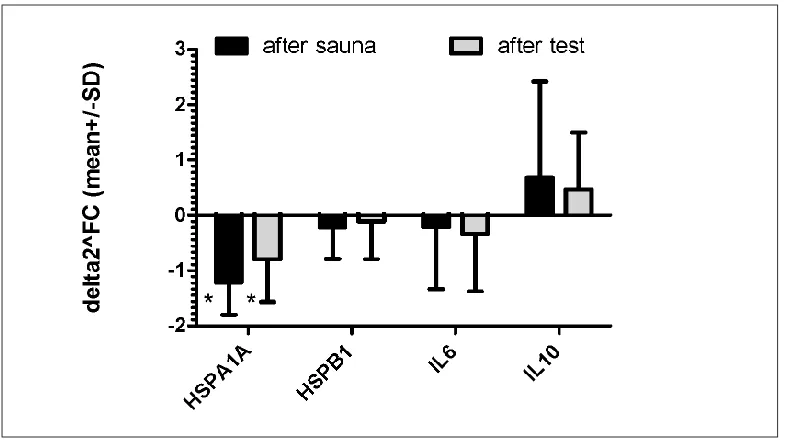
To better explain the differences observed in the experiment between groups and between stressors, Figure 2 displays differences in 2^-fold change in the response of the JA vs. the CON to sauna exposure (black bars) and 30 min exercise (gray bars).
Lower and significant changes in expression were observed in JA for HSPA1A (2^-1.2-fold,
Table 2. Primers used for real-time PCR (designed by the
author).
HSPA1A Forward primer: TGGACTGTTCTTCACTCTTGGCReverse primer: TTCGGAGAGTTCTGGGATTGTA
HSPB1 Forward primer: AAGGATGGCGTGGTGGAGATCAReverse primer: GAGGAAACTTGGGTGGGGTCCA
IL6 Forward primer: TCCACGGCCTTGCTCTTGTTTReverse primer: GACATCAAGGCGCATGTGAAC
IL10 Forward primer: GAATCCAGATTGGAAGCATCCReverse primer: AATTCGGTACATCCTCGACGG
TBP Forward primer: TGGACTGTTCTTCACTCTTGGCReverse primer: TTCGGAGAGTTCTGGGATTGTA
TUBB Forward primer: CTAGAACCTGGGACCATGGA Reverse primer: TGCAGGCAGTCACAGCTCT
Data were collected and relative gene expression was analyzed in Microsoft Excel 2017. In order to calculate the level of gene expression, the Schmigtten and Livak method [25] was applied. The results of relative expression were analyzed in GraphPad Prism 5.0 (www.graphpad.com). Data were transformed to linear and then the normality of distribution
was checked with Shapiro-Wilk’s test and a paired t-test was applied to determine p-value. To
calculate the differences between groups after sauna and exercise as well as within the groups (sauna vs. exercise) two-way and one-way ANOVAs were performed, respectively. Additionally, a paired t-test was performed to check for differences within each group and an unpaired t-test was performed to check for differences between groups. A p-value of less than 0.05 was considered significant.
RESULTS
Exposure to 30 min of sauna bathing caused a significant increase in HSPA1A and HSPB1
mRNA in both groups. HSPA1A increased 2^1.6-fold in JA (p = 0.003) and 2^2.8-fold in CON
(p = 0.001). HSPB1 increased 2^1.3-fold in JA (p = 0.02) and 2^1.5-fold in CON (p = 0.001)
(Fig. 1A). The increase in IL6 mRNA was not significant in JA, but was significant in CON
(2^1.7-fold, p = 0.02). A significant increase in IL10 mRNA was observed only in athletes
(2^2.1-fold, p = 0.003).
After 30 min of exercise, a significant increase in both groups was observed only for HSPA1A
mRNA (2^1.4-fold, p = 0.001 in JA; 2^2.2-fold, p = 0.002 in CON, Fig. 1B). Significant
increases in HSPB1 and IL10 mRNA were noted only in CON (2^1.2-fold, p = 0.03 for HSPB1;
2^1.6-fold, p = 0.02 for IL6). Overexpression at a level greater than 2-fold (clinically
significant) was observed for HSPA1A in CON after both sauna and exercise and for IL10 after
sauna in JA.
Figure 1. 2^-fold changes in relative expression after (A) sauna and (B) exercise in JA (gray
bars) and CON (black bars).
*significant increase in expression p˂0.05.
Figure 1. 2^-fold changes in relative expression after (A) sauna and (B) exercise in JA (gray bars) and CON (black bars).
Żychowska M. – Changes in expression of selected cellular stress response genes after passive body...
© ARCHIVES OF BUDO | SCIENCE OF MARTIAL ARTS
PROOF ©
ARCHIVES OF BUDO
2017 | VOLUME 13 |75
p = 0.0001 after sauna; 2^-0.8-fold, p = 0.01 after exercise compare to CON). For HSPB1 m-RNA the lower expression in JA was observed, but this difference was not significant (2^-0.2-fold after sauna; 2^-0.1-fold after exercise)as well as for IL6 (2^-0.2-fold after sauna; 2^-0.3-fold after exer-cise). Higher expression in JA for IL10 mRNA was observed after sauna and after exercise (2^0.68-fold; p = 0.01 after sauna, 2^0.67-fold, not sig-nificant after exercise).
The expression of all genes was higher after sauna exposure compared to exercise in both groups. For HSPA1A mRNA in JA and CON, 2^-fold changes were 0.15-fold and 0.57-fold, respectively. For HSPB1 mRNA, the 2^-fold dif-ferences were 0.2-fold and 0.1-fold for the JA and CON groups, respectively. For IL10 mRNA, the 2^-fold differences were 0.7-fold and 0.9-fold. None of these differences were significant.
To better explain the differences observed in the experiment between groups and between stressors, Figure 2 displays differences in 2^-fold change in the response of the JA vs. the CON to sauna exposure (black bars) and 30 min exercise (gray bars).
Figure 2. Delta 2^fold changes in genes expression between judo vs control group after sauna
(dark bars) and exercise (gray bars). Delta 2^-fold changes were calculated as: 2^-fold changes after sauna in the judo/ 2^-fold changes in the control group.
*significant decrease in expression p˂0.05.
Lower and significant changes in expression were observed in JA for HSPA1A (2^-1.2-fold, p
= 0.0001 after sauna; 2^-0.8-fold, p = 0.01 after exercise compare to CON). For HSPB1
m-RNA the lower expression in JA was observed, but this difference was not significant
(2^-0.2-fold after sauna; 2^-0.1-(2^-0.2-fold after exercise)as well as for IL6 (2^-0.2-fold after sauna;
2^-0.3-fold after exercise). Higher expression in JA for IL10 mRNA was observed after sauna and after
exercise (2^0.68-fold; p = 0.01 after sauna, 2^0.67-fold, not significant after exercise).
Figure 2. Delta 2^fold changes in genes expression between judo vs control group after sauna (dark bars) and exercise
(gray bars). Delta 2^-fold changes were calculated as: 2^-fold changes after sauna in the judo/ 2^-fold changes in the control group.
*significant decrease in expression p<0.05.
Figure 3. Delta 2^-fold changes in genes expression between sauna vs exercise in judo athlete
group (dark bars) and control group (gray bars). Delta 2^fold changes were calculated as: 2^-fold changes after sauna / 2^-2^-fold changes after exercise in the judo and control group, respectively.
The expression of all genes was higher after sauna exposure compared to exercise in both
groups. For HSPA1A mRNA in JA and CON, 2^-fold changes were 0.15-fold and 0.57-fold,
respectively. For HSPB1 mRNA, the 2^-fold differences were 0.2-fold and 0.1-fold for the JA
and CON groups, respectively. For IL10 mRNA, the 2^-fold differences were 0.7-fold and
0.9-fold. None of these differences were significant.
DISCUSSION
To my knowledge, this is the first study in which the effects of one time sauna bath exposure and physical exercise on transcript levels was assessed. Judo athletes and control group
participating in the experiment had a similar mean VO2 max and internal load applied on the
test and external in sauna was the same.
According to Pałka et al. [26], the effect of many years of specific training in judo is
characterized by marked changes in anaerobic indicators, but report no significant difference
in VO2 max between judo athletes and a control group (40.8 ml/kg/min in judo athletes; 42.6
ml/kg/min in control group). Results obtained in this experiment are in accordance to cited data.
Judo athletes had VO2 max. on mean level 44.25 ±1.86 ml/kg/min and control group VO2 max.
44.44 ±1.78 ml/kg/min. Despite minor differences, all participants performed a 30 min
ergometer test in normal humidity (40%) and room temperature with individually selected load (80% max). The training load during exercise and time spent in the sauna room were the same for all subjects.
The changes in HSPA1A mRNA were significantly lower in JA after both sauna bath and
exercise exposure. Initially, there was a difference in the basal level of HSPA1A mRNA, which
was lower, but not significantly so, in judo athletes. Lower basal expression in athletes was reported by Buttner [18] and Neubauer [27] and could be an adaptive effect caused by long-Figure 3. Delta 2^-fold changes in genes expression between sauna vs exercise in judo athlete group (dark bars) and
76| VOLUME 13 | 2017 www.archbudo.com Original Article
DISCUSSION
To my knowledge, this is the first study in which the effects of one time sauna bath exposure and physical exercise on transcript levels was assessed. Judo athletes and control group par-ticipating in the experiment had a similar mean
VO2 max and internal load applied on the test and
external in sauna was the same.
According to Pałka et al. [26], the effect of many years of specific training in judo is character-ized by marked changes in anaerobic
indica-tors, but report no significant difference in VO2
max between judo athletes and a control group (40.8 ml/kg/min in judo athletes; 42.6 ml/kg/min in control group). Results obtained in this experi-ment are in accordance to cited data. Judo
ath-letes had VO2 max. on mean level 44.25 ±1.86
ml/kg/min and control group VO2 max. 44.44
±1.78 ml/kg/min. Despite minor differences, all participants performed a 30 min ergometer test in normal humidity (40%) and room temperature with individually selected load (80% max). The training load during exercise and time spent in the sauna room were the same for all subjects.
The changes in HSPA1A mRNA were significantly lower in JA after both sauna bath and exercise exposure. Initially, there was a difference in the basal level of HSPA1A mRNA, which was lower, but not significantly so, in judo athletes. Lower basal expression in athletes was reported by Buttner [18] and Neubauer [27] and could be an adaptive effect caused by long-term training. Changes in three other genes: HSPB1, IL6, and
IL10 mRNA for exercise and sauna were observed
in judo athletes and controls for decreases in
HSPB1 and IL6 mRNA and increases in IL10
mRNA. According to Rutkowski et al. [28] and Szołtysek et al. [15], regardless of the stressor, the cellular stress response is the result of activ-ity in three pathways, two of which are depen-dent on the influence of HSF1 and NF-kB on the expression of genes examined in this study. In judo athletes, the stress load after both exercise and sauna bath was lower than in controls and there difference in HSPA1A and HSPB1 expres-sion after exercise and sauna within the judo group were very low. On the other hand the changes in expression after exercise were clearly lower than after sauna in this group. These dif-ferences suggest specific adaptive mechanisms not only to exercise, but also to external stress.
Evidence suggests that the level of expression of
HSPA1A and HSPB1 is associated with
tempera-ture [8, 12, 13] and oxidative stress [29, 30] and these indicators are changing under the condi-tions of sauna and exercise. Pilch et al. [6] exam-ined the association of the tested genes with oxidative stress and antioxidant status, report-ing that athletes had higher antioxidant levels than sedentary people, which may be a reason for lower expression of stress-related genes in this group. Furthermore, in a study performed in sauna conditions and during exercise, the authors observed that oxidative stress was dif-ferent depending on thermal stressor [6]. Smaller changes in expression in the judo athletes may be associated with high heat tolerance and a bet-ter functioning thermoregulatory system [31-33].
Stimulation of the synthesis of heat shock protein and interleukin in leukocytes after heat stress was studied by Pizurki et al. [34], Polla et al. [35] and Jacquier-Sarlin et al. [36]. The authors reported a 10-fold increase in the expression heat shock protein after in vitro studies of leukocytes in 41°C [34-36].
© ARCHIVES OF BUDO | SCIENCE OF MARTIAL ARTS
PROOF ©
ARCHIVES OF BUDO
2017 | VOLUME 13 |77
and IL6 levels, these differences between groups may also affect genes expression [44].
CONCLUSIONS
In conclusion, the judo athletes were characterized by lower expression of HSPA1A at rest and lower expression of tested genes after exercise or sauna exposure compared to the control group. In both groups, physical exercise caused lower changes in the expression of tested genes compared to
passive overheating in the sauna. Therefore, because of similar changes after sauna and exer-cise it seems, that sauna can be used not only for biological regeneration but also to maintain adap-tive changes to physical effort in judo training or during forced breaks in training, e.g. due to injury.
ACNOWLEDGEMENTS
I gratefully acknowledge all the participants involved in the tests.
REFERENCES
1. Hannuksela ML, Ellahham S. Benefits and risks of sauna bathing. Am J Med 2001; 110(2): 118-126
2. Podstawski R, Boraczyński T, Boraczyński M et al. Sauna-Induced Body Mass Loss in Young Sedentary Women and Men. Sci World J 2014; 1-7
3. Sutkowy P, Woźniak A, Boraczyński T et al. The effect of a single Finnish sauna bath after aero-bic exercise on the oxidative status in healthy men. Scand. J Clin Lab Invest 2014; 74(2): 89-94
4. Pilch W, Pokora I, Szyguła Z et. al. Effect of a single finnish sauna session on white blood cell profile and cortisol levels in athletes and non-athletes. J Hum Kinet 2013; 39: 127-135
5. Pilch W, Szygula Z, Żychowska M et al. The Influence of sauna training on the hormonal system of young women. J Hum Kinet 2003; 19: 103-108
6. Pilch W, Szyguła Z, Tyka AK et al. Disturbances in pro-oxidant-antioxidant balance after passive body overheating and after exercise in elevated ambient temperatures in athletes and untrained men. PLoS One 2014; 20: 9(1): e85320
7. Kukkonen-Harjula K, Kauppinen K. Health effects and risks of sauna bathing. Int J Circumpolar Health2006; 65(3): 195-205
8. Morimoto RI. Regulation of the heat shock transcriptional response; cross talk between a family of heat shock factors, molecular chap-erones, and negative regulators. Genes Dev 1998; 12: 3788-3796
9. Feng X, Bonni S, Riabowol K. HSP70 induction by ING proteins sensitizes cells to tumor necro-sis factor alpha receptor-mediated apoptonecro-sis. Mol Cell Biol 2006; 24: 9244-9245
10. Dudeja V, Vickers SM, Saluja AK. The role of heat shock proteins in gastrointestinal diseases. Gut. BMR J 2009; 58: 1000-1009
11. Żychowska M, Półrola P, Chruściński G et al. Effects of sauna bathing on stress-related genes expression in athletes and non-athletes. Ann Agr Env Med. Forthcoming 2017
12. Kregel KCJ. Heat shock proteins: modifying factors in physiological stress responses and acquired thermotolerance. J Appl Physiol 2002; 2: 2177-2186
13. Radák Z, Naito H, Kaneko T et al. Exercise training decreases DNA damage and increases DNA repair and resistance against oxidative stress of proteins in aged rat skeletal muscle. Pflugers Arch 2002; 445(2): 273-278
14. Arya R, Mallik M, Lakhotia SC. Heat shock genes-integrating cell survival and death. J Biosc 2007; 32: 595-610
15. Szołtysek K, Janus P and Widłak P. The NFkB dependent cellular signaling pathway and its interference with p53 and HSF-1 depentent pathways. Adv Cell Biol 2011; 38: 159-164
16. Ziemann E, Zembroñ-Lacny A, Kasperska A et. al. Exercise training-induced changes in inflammatory mediators and heat shock pro-teins in young tennis players. J Sports Sci Med. 2013; 12: 282-289
17. Zeibig J, Karlic H, Lohninger A et al. Do blood cells mimic gene expression pro ile alterations known to occur in muscular adaptation to endurance training? Eur J Appl Physiol. 2005; 95(1): 96-104
18. Büttner P, Mosig S, Lechtermann A et al. Exercise affects the gene expression profiles of human white blood cells. J Appl Physiol 2006; 102(1): 26-36
19. Coufalová K, Prokešová E , Malý T et al. Body weight reduction in combat sports. Arch Budo, 2013; 4: 267-272
20. Kalina RM, Jagiełło W, Chodała A. The result of “testing fights in a vertical posture” as
a criterion of talent for combat sports and self-defence – secondary validation (part I: the reliability). Arch Budo Sci Martial Art Extreme Sport 2015; 11: 229-238
21. Franchini E, Julio UF, Gonçalves Panissa VL et al. Short-term low-volume high-intensity intermittent training improves judo-specific performance. Arch Budo 2016; 12: 219-229
22. Lira FS, Panissa VL, Julio UF, Franchini E. Differences in metabolic and inflammatory responses in lower and upper body high-inten-sity intermittent exercise. Eur J Appl Physiol. 2015; 115(7): 1467-1474
23. Franchini E, Julio UF, Panissa VL et al. High-Intensity Intermittent Training Positively Affects Aerobic and Anaerobic Performance in Judo Athletes Independently of Exercise Mode. Frontiers in physiology. 2016; 7: 268
24. Chomczynski P, Sacchi N. Single-step method of RNA isolation by acid guanidinium thiocya-nate-phenol-chloroform extraction. Analytical biochemistry. 1987; 162(1): 156-159
25. Schmittgen TD, Livak KJ. Analyzing real-time PCR data by the comparative C(T) method. Nature protocols. 2008; 3(6): 1101-1108
26. Pałka T, Lech G, Tyka A et al. Wydolność Fizyczna i Morfologiczna Budowa Ciała Profesjonalnych Judoków i Nietrenujących Mężczyzn. Antropomotoryka 2015; 50: 85-89 [in Polish]
27. Neubauer O, Sabapathy S, Lazarus R et al. Transcriptome analysis of neutrophils after endurance exercise reveals novel signaling mechanisms in the immune response to phys-iological stress. J Appl Physiol 2013; 114(12): 1677-1688
78| VOLUME 13 | 2017 www.archbudo.com Original Article
29. Żychowska M, Kemerytė-Riaubienė E, Gocentas A et al. Changes in leukocyte HSPA1A, HSPB1 mRNA in basketball players after plyomet-ric training. Balt J Health Phys Act. 2016;8 (1): 18-24
30. Kochanowicz A, Sawczyn S, Niespodziński B et al. Cellular Stress Response Gene Expression During Upper and Lower Body High Intensity Exercise. Plos ONE 2017 2017; 12(1): e0171247
31. Gonzales–Alonzo J, Teller C, Andersen SL et al. Influence of body temperature in the develop-ment of fatigue during prolonged exercise in the heat. J ApplPhysiol 1999; 86(3): 1032-1039
32. Garrett AT, Goossens NG, Rehrer NJ. Induction and decay of short-term heat acclimation. Eur J ApplPhysiol 2009; 107(6): 659-671
33. Wright HE, Selkirk GA, McLellan TM. HPA and SAS responses to increasing core tempera-ture during uncompensableexertional heat stress in trained and untrained males. Eur J ApplPhysiol 2010; 108(5): 987-997
34. Pizurki L, Polla BS. cAMP modulates stress protein synthesis in human monocytes-mac-rophages. J Cell Physiol 1994; 161: 169-177
35. Polla BS, Cossarizza A. Stress proteins in inflam-mation. EXS 1994; 77: 375-391
36. Jacquier-Sarlin MR, Jornot L, Polla BS. Differential expression and regulation of hsp70 and hsp90 by phorbol esters and heat shock. J Biol Chem 1995; 270: 14094-14099
37. Gjevestad GO, Holven KB, Ulven SM. Effects of Exercise on Gene Expression of Inflammatory Markers in Human Peripheral Blood Cells: A Systematic Review. Current cardiovascular risk reports. 2015; 9(7): 34
38. Fehrenbach E, Northoff H. Free radical, exer-cise, apoptosis and heat shock proteins. Exerc Immunol Rev 2001; 7: 66-89
39. Wang P, Wu P, Siegel MI et al. Interleukin (IL)-10 inhibits nuclear factor kappa B (NF kappa B) activation in human monocytes. IL-10 and IL-4 suppress cytokine synthesis by differ-ent mechanisms. J Biol Chem 1995; 270(16): 9558-9563
40. Driessler F, Venstrom K, Sabat R, Asadullah K, Schottelius AJ. Molecular mechanisms of inter-leukin-10-mediated inhibition of NF-kappaB activity: a role for p50. Clinical and experimen-tal immunology. 2004; 135(1): 64-73
41. Hovsepian E, Penas F, Siffo S et al. IL-10 inhib-its the NF-kappaB and ERK/MAPK-mediated production of pro-inflammatory mediators by up-regulation of SOCS-3 in Trypanosoma cruzi-infected cardiomyocytes. PloS one. 2013; 8(11): e79445
42. Farzad B, Gharakhanlou R, Agha-Alinejad H et al. Physiological and performance changes from the addition of a sprint interval program to wrestling training. Journal of strength and conditioning research / National Strength & Conditioning Association. 2011; 25(9): 2392-2399
43. Fuqua JS, Rogol AD. Neuroendocrine altera-tions in the exercising human: implicaaltera-tions for energy homeostasis. Metab Clin Exp 2013; 62(7): 911-921
44. Ravier G, Dugue B, Grappe F et al. Impressive anaerobic adaptations in elite karate athletes due to few intensive intermittent sessions added to regular karate training. Scand J Med Sci Sports 2009; 19(5): 687-694
Cite this article as: Żychowska M. Changes in expression of selected cellular stress response genes after passive body overheating in sauna and moderate