A Comparative Study Of Three Revision
Methods In EFL Writing
Napaporn Srichanyachon, Bangkok University, Thailand
ABSTRACT
In an attemptto explore effective instruction in the English as a Foreign Language (EFL) setting, this study investigated language errors identified by students and teachers in three different revision stages: self-revision, peer revision, and teacher revision. It gave the focus to the effects of the three different methods on learners’ writing quality, revision behavior, and perception of revisions. The subjects were 10 students in Bangkok University who shared the similar English learning experiences. The data were collected from a writing task, a peer response sheet, and a semi-structured interview. Error numbers and error types identified in the revision stages were compared to show the differences among the three methods. This study was an attempt to analyze learners’ revision behavior, and the results showed that they focused more on surface errors instead of semantic or textual ones. The study also showed that teacher revision was indispensable in learners’ language output modification. It did a great help to the learners’ acquisition of linguistic forms which were hard-recognized errors by themselves. Also, teacher comments were perceived as significantly more effective than peer comments. However, the students showed that peer revision had roles to play that couldn’t be filled by teacher revision. The post-task interview results revealed learners’ positive perceptions toward peer revision, indicating its usefulness in the EFL context.
Keywords: Self-Revision; Peer Revision; Teacher Revision; Writing
INTRODUCTION AND THEORETICAL FRAMEWORK
evision is an important final step in polishing your work. The process includes proofreading and editing. It is a chance for you to look critically at what you have written to see if it is understandable and effective. It can also leads to improvement in writing. Learners profit from mistakes by obtaining feedback to make new attempts to improve their writing. However, Huang (2002: 20) argues that “sometimes the feedback from an error can be so strongly negative that the learner would give up making new attempts and the learning would end up in failure” as shown in the following diagram.
give up failure
try error feedback new attempt desired goal
Figure 1 The effects of feedback on language learning (Huang, 2002: 20)
Revision has been widely acknowledged as a crucial component in the writing process in both L1 (a first language) and L2 (a second language). In L1 writing, some found that peer comments were as effective as teacher comments (Pfeiffer, 1981; Putz, 1970). On the other hand, in L2 writing, some researchers consider peer revision ineffective and claim that students are not able to spot weaknesses in their colleagues‟ essays as they are weak themselves (Allaei and Connor, 1990). L2 students may not trust their peers' responses to their writings because they are not native speakers of English. In Lockhart and Ng's (1993) survey of 56 L2 students' perception of peer
comments, while students agreed that peer feedback enabled them to gain an awareness of the audience and improve their writing, they were unsure of their strength as competent readers. L2 students have general preference for teachers‟ feedback over peer-editing. Nelson and Carson's (1998) interview of four L2 university students showed that students preferred teacher comments to peer comments and that they incorporated teacher comments in their revisions more frequently than peer comments. Similarly, Zhang (1995) found out that students preferred teacher feedback to peer or self-feedback. Teacher feedback was significantly more preferred than peer or self-feedback whereas there was no significant difference between the latter two.
While the above findings show that teacher revision was more effective than peer revision, the beneficial effects of peer revision have been outlined by a number of researchers in L2 writing. Rollinson (2005) studied college level students of EFL in Spain and found that peer feedback was effective with 80% of peer feedback comments considered valid and 65% acted on. Saito and Fujita (2004) investigated feedback provided to EFL students in a Japanese university and found that teachers and peers rated students‟ writing in broadly similar ways. Cault (1994), in a comparison of L2 written peer responses, teacher comments, and students' self-analysis of their own papers, found that 89 percent of students were able to give advice considered valid by the teacher and 60 percent made appropriate suggestions not mentioned by the teacher. They also made more specific and localized comments than the teacher. Other researchers have recommended the use of peer revision in the ESL writing classroom and argued that it may well complement the role that teacher revision plays in revision. For example, it helps students experience less writing anxiety (Stanley, 1992), gain confidence and language skills (Min, 2006), and become more supportive of each other (Schmid, 1999).
The above review of language studies highlights two issues: students‟ ability to edit and reduce specific language errors and their attitudes toward revision methods. Basically, it seems that teacher revision is more valued than student revision, including peer revision and self-revision. However, in some cases, students believe that peer revision can be effective and their attitudes are variable. Therefore, this study examined students‟ ability to edit their own essays and their partners‟ essays. It also analyzed students‟ errors because they can “provide to the researcher evidence of how language is learned or acquired, what strategies or procedures the learner is employing in the discovery of the language.” (Corder, 1967: 167) In addition, it studied students‟ perception of three different revisions: self-revision, peer revision, and teacher revision. Despite the limitations in terms of a small number of subjects, the study has certain implications for the teaching of writing. This research will provide useful insights as to how to implement revision methods, particularly the use of feedback sheets.
PURPOSES OF THE STUDY
The objectives of this study were to identify errors made by the students in their writings, compare the mean scores of the identified errors in the three revision stages, and study students‟ perception of revisions
RESEARCH METHODOLOGY
Participants
The participants in this study were 10 students enrolled in Advanced English course at Bangkok University. These 10 students were randomly chosen from two parallel classes of the same year of study. They consisted of 5 girls and 5 boys with the average age of 19. They all shared the similar educational backgrounds of studying English as their EFL. These students had passed three English courses in Bangkok University. When this study was carried out, they had learned how to write a five-paragraph essay and give feedback.
Research Instruments
1. Writing task: The students were asked to write an essay named “My Three Main Goals for the Next Five Years.” The reason for choosing this topic was that the students were familiar with this topic in their reading class.
3. Post-task interview: The students were asked about their opinions on the three revision methods.
Procedures
Stage1: Draft Writing
The students were called together to study about the task they would be demanded to do. The students were given the topic “My Three Main Goals for the Next Five Years” to write a five-paragraph essay of not less than 250 words. Time allowed for the writing task was 60 minutes.
Stage2: Revising
After collecting all the papers, the author typed them out with double space between each line. In this way, the author hoped that enough space can be left for students‟ revision. A week after the writing activity, the author handed out the typed essays to the students. Then the students were asked to mark the errors in the essays with different signs as follows:
∧ for adding words / for deleting words
﹏ (the curved underline) for wrongly-spelt words
__ (the straight underline) for grammatically wrong words, phrases, clauses or sentences
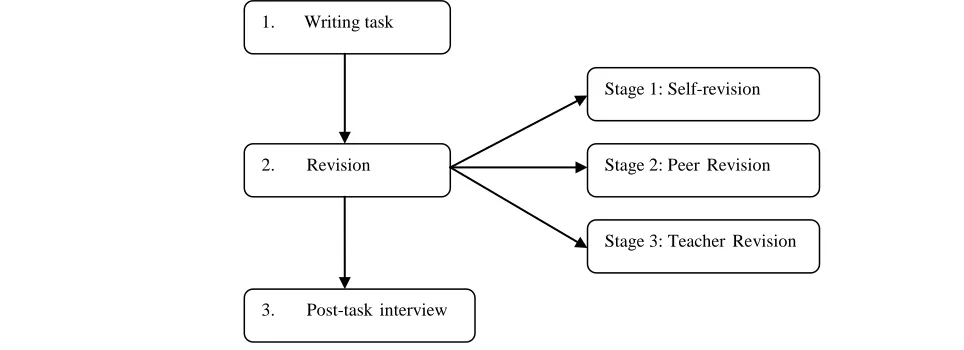
After showed the correction signs, the students began to revise their own essays. After they have finished their revision, the essays were collected. The students were given the original essays again. This time the essay they got was any of the participants‟ essays randomly. When they finished the revision, the peer response sheets were collected. They were given their own original essays again with the teacher revision on it. The post-task interview was then conducted after class. The whole procedure of the study can be indicated by the following scheme.
Figure 2 The process of doing this study
Stage 3: Data Collection
After the whole research has been done, the author gathered 10 drafts, 30 revised essays. The data was collected by the author and the reading teacher. After that, the data obtained from the essays was analyzed quantitatively. The data from the post-task interview was presented in table form.
1. Writing task
2. Revision
Stage 1: Self-revision
Stage 2: PeerRevision
Stage 3: TeacherRevision
Results
Research Question 1: What kind of errors did the students make in their writings?
To be able to produce a piece of writing, students should be able to write a connected series of words and sentences which are grammatically and logically linked so that the purpose they have in their mind will suit the intended readers. However, the errors in the students‟ papers revealed that they encountered difficulties in producing the target language. There was a gap between what they wanted to say and what they could say.
Misspellings were one of the most frequent errors made by the students. During the revisions, misspellings were the problems that could be noticed and corrected most easily by the students. They could confirm the spelling of words through looking it up in a dictionary. Unfortunately, unlike misspellings which could be easily corrected, errors in grammar and coherence were often more difficult for them to handle, especially the use of tenses and sentence structures. They also paid no attention to avoid errors in article, capitalization, punctuation, and so on. The main types of students‟ errors in writing can be seen in the following examples.
1. Spelling
Incorrect: I want to know about culcure.
Correct: I want to know about culture. 2. Capitalization
Incorrect: My three main goals (Title)
Correct: My Three Main Goals (Title) 3. Lexical choice
Incorrect: I can successful.
Correct: I can succeed. 4. Preposition
Incorrect: I need finish my three main goals to the five years.
Correct: I need to finish my three main goals in the next five years. 5. Verb usage
Incorrect: Next, I will good job.
Correct: Next, I will get a good job. 6. Tense
Incorrect: When I graduated, I will open an accounting company.
Correct: When I graduate, I will open an accounting company. 7. Sentence structures
Incorrect: And a successful businessman in the end.
Correct: I want to be a successful businessman in the future. 8. Article
Incorrect: I will begin to travel around the Thailand in the next five years.
Correct: I will begin to travel around Thailand in the next five years. 9. Number of nouns
Incorrect: I will look forward to achieving all these goal in the next five year.
Correct: I will look forward to achieving all these goals in the next five years. 10. Punctuation
Incorrect: When I graduate. I will get a job.
Correct: When I graduate, I will get a job.
Research Question 2: How many errors could the students identify in their revisions?
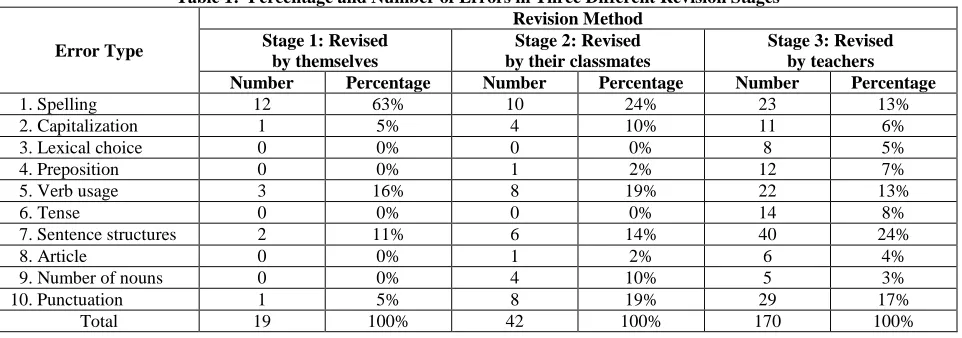
could find out the problems in their own writings at a certain low degree. However, the errors identified in the stage of peer revision were comparatively more than the stage of self-revision. The results were presented in Table 1.
Table 1: Percentage and Number of Errors in Three Different Revision Stages
Error Type
Revision Method Stage 1: Revised
by themselves
Stage 2: Revised by their classmates
Stage 3: Revised by teachers
Number Percentage Number Percentage Number Percentage
1. Spelling 12 63% 10 24% 23 13%
2. Capitalization 1 5% 4 10% 11 6%
3. Lexical choice 0 0% 0 0% 8 5%
4. Preposition 0 0% 1 2% 12 7%
5. Verb usage 3 16% 8 19% 22 13%
6. Tense 0 0% 0 0% 14 8%
7. Sentence structures 2 11% 6 14% 40 24%
8. Article 0 0% 1 2% 6 4%
9. Number of nouns 0 0% 4 10% 5 3%
10. Punctuation 1 5% 8 19% 29 17%
Total 19 100% 42 100% 170 100%
Table 1 shows the total number of language errors in the essays identified by the students themselves, their companions and the teachers respectively. It also shows the percentage of different error types in the three revision stages. Spelling mistakes were easily to be recognized by the students themselves; they identified 12 misspellings (63%) in the self-revision process and 10 misspellings (24%) in the peer revision stage. They also focused on the errors of verb usage (16%) and sentence structures (11%) in the self-revision process. When they corrected their partners‟ writings, they also paid attention to the errors of verb usage (19%), punctuation (19%), and sentence structures (14%). However, the numbers of errors they found in the two stages were much fewer than those of the teachers. For example, the teachers found 23 misspellings while the students could find only 12 misspellings in the first stage and 10 misspellings in the second stage. The students‟ most frequent type of error found by the teachers was a sentence structure error (40 errors, 24%). The students could find only 2 errors (11%) in the first stage and 6 errors (14%) in the second stage.
The total number of errors in student revision was very different from teacher revision: self-revision (19 errors), peer revision (42 errors), and teacher revision (170 errors). This showed that the students had linguistic problems, especially problems in dealing with sentence structures (24%), punctuation (17%), verb usage (13%), and spelling (13%) respectively. They did not even identify half of the errors in these aspects. Moreover, the teachers found some errors that the students could not notice in both stages such as the errors in lexical choice and tense. They couldn‟t find the errors in preposition, article, and number of nouns when they corrected their own papers, but they could find some of these errors when they corrected their partners‟ papers: preposition (1 error), article (1 error), and number of nouns (4 errors). Still, the numbers of errors they found were much fewer than those of the teachers: preposition (12 errors), article (6 errors), and number of nouns (5 errors).
The students were asked to look at the content of their own papers and their partners‟ papers using a fresh, critical perspective and give comments and suggestions to improve them. When they read their own papers again, they knew that there were some mistakes in their papers because they didn‟t make sense. However, most of them couldn‟t think about a possible alternative to make their own works better. When they revised their partners‟ papers, they could give some suggestions. However, not many comments in their peer response sheets were considered effective to help improve their writing skills. Their comments were about something in general:
The title should be moved to the center of the page. The author always forgets to put a period after a sentence.
More vivid examples and details should be added to support the main idea. There are too unnecessary words.
Research Question 3: How did the students respond to the use of three different revision methods?
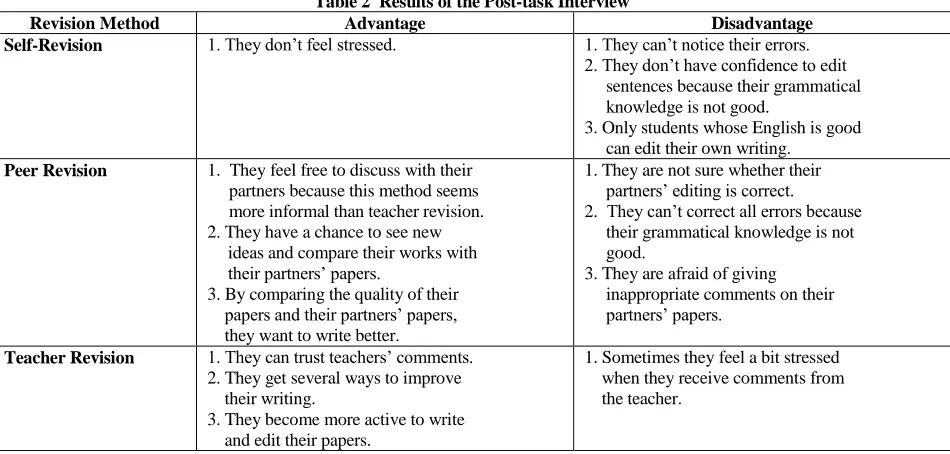
When the students were asked to choose the most effective method, 7 students chose teacher revision. However, when they were asked to choose the method they would like to do in the future, the number of students who chose teacher revision and those who chose peer revision were quite similar: 5 students chose teacher revision, 4 students chose peer revision, and only one student chose self-revision. The interview data showed that the students realized both advantages and disadvantages of the three different revision methods. The results were presented in Table 2.
Table 2 Results of the Post-task Interview
Revision Method Advantage Disadvantage
Self-Revision 1. They don‟t feel stressed. 1. They can‟t notice their errors.
2. They don‟t have confidence to edit sentences because their grammatical knowledge is not good.
3. Only students whose English is good can edit their own writing.
Peer Revision 1. They feel free to discuss with their
partners because this method seems more informal than teacher revision. 2. They have a chance to see new
ideas and compare their works with their partners‟ papers.
3. By comparing the quality of their papers and their partners‟ papers, they want to write better.
1. They are not sure whether their partners‟ editing is correct.
2. They can‟t correct all errors because their grammatical knowledge is not good.
3. They are afraid of giving inappropriate comments on their partners‟ papers.
Teacher Revision 1. They can trust teachers‟ comments.
2. They get several ways to improve their writing.
3. They become more active to write and edit their papers.
1. Sometimes they feel a bit stressed when they receive comments from the teacher.
The interview results indicate that the major disadvantages of self-revision and peer revision included lack of language knowledge and confidence in giving comments and suggestions. The students regarded teacher revision as the most successful revision method because they could gain more knowledge from the teacher to improve their writing. They also needed a teacher to help in their revision. Nevertheless, they felt threatened by this method because it looked formal; they felt more comfortable with self-revision and peer revision. In the peer revision stage, the students showed great interests in the contents of their companions‟ essays rather than the grammatical forms. Not many errors were identified in this stage, but they gained more idea and motivation from peer-reviewing. Their suggestions for future peer feedback use in a classroom highlighted the teacher‟s role of providing a proper classroom environment, task training exercises, and task materials.
DISCUSSION AND CONCLUSIONS
The findings stress the number of errors identified by students which revealed what they did not know or knew only partially. They had great difficulties in making grammatical appropriate sentences. The students also had difficulties in correcting errors during the revision stages. They could correct few mistakes in spelling and capitalization even if these mistakes are easy to be identified. It might be concluded that they may not get sufficient insights into their errors. It may be partly caused by the students‟ deficiency of writing knowledge. They did not learn writing as a subject systematically, so they did not know how to use correct words and make correct sentences. Therefore, to enhance the ability of writing and noticing errors in revision processes, teachers should help them to think about language as they are producing it and correcting errors in revision stages.
The self-revision method seems the least useful for leading to successful revisions. In contrast to the findings of peer revision, it has less impact on the students‟ motivation and language skills. The students recognize the importance of peer revision. It gives students a chance to see new ideas and gain more motivation to improve their writing, indicating its usefulness in the EFL context. Such a finding echoes Tsui and Ng‟s (2000) result that learners see teacher comments as more authoritative but value peer comments. So, peer revision, regardless of its accuracy, can be seen as a useful adjunct to teacher revision. Villamil and De Guerrero (1998: 491) explicitly state that „„peer revision should be seen as an important complementary source of feedback in the ESL classroom.‟‟ Also, Silva (1990: 15) points out that the writing classroom is no longer one that gives absolute control to the teacher but rather is ``a positive, encouraging, and collaborative workshop environment within which students . . . can work through their composing processes.'' Peer revision can arouse students‟ interests in writing. So, it would be interesting to examine whether or not longer peer-editing time and more peer-editing sessions may result in student reduction of these errors in their revised essays.
ACKNOWLEDGEMENTS
This research was sponsored by Bangkok University.
AUTHOR INFORMATION
Asst. Prof. Napaporn Srichanyachon received her M.A. (Theater: Text and Production) from University of East Anglia in England and B.A. (English) with 1st class honors from Silpakorn University in Thailand. She is currently a full-time lecturer of Language Institute, Bangkok University. She has written a textbook for ESP program and a number of instructional materials. Her area of interest in research is English teaching. She has presented her research at several international conferences. E-mail: [email protected]
REFERENCES
1. Allaei, S. K., & Connor, U. (1990). Using performative assessment instruments with ESL student writers. In Hamp-Lyons, L. (Ed.), Assessing Second Language Writing in Academic Contexts (pp. 227–240). Norwood, NJ: Ablex.
2. Cault, N. (1994). Comparing teacher and student responses to written work. TESOL Quarterly, 28(1), 181-188.
3. Corder, S. P. (1967). The significance of learners‟ errors. IRAL, 5(4)
4. Huang, J. (2002). Error analysis in English teaching: A review of studies. Journal of Chung-San Girls’ Senior High School, 1(2), 19–34.
5. Lockhart, C., & Ng, P. (1993). How useful is peer response? Perspectives 5(1), 17-29.
6. Min, H. (2006). The effects of trained peer review on EFL students‟ revision types and writing quality.
Journal of Second Language Writing, 15, 118–141.
7. Nelson, G. L., & Carson, J. G. (1998). ESL students' perceptions of effectiveness in peer response groups.
Journal of Second Language Writing, 7(2), 113-131.
8. Pfeiffer, K. (1981). The effects of peer evaluation and personality on writing anxiety and writing performance in college freshmen. Ed. D. Dissertation, Texas Tech University.
9. Putz, J. M. (1970). When the teacher stops teaching: Dan experiment with freshman English. College English, 34(1), 50-57.
10. Rollinson, P. (2005). Using peer feedback in the ESL writing class. ELT Journal, 59(1), 23–30.
11. Saito, H., & Fujita, T. (2004). Characteristics and user acceptance of peer rating in EFL writing classrooms.
Language Teaching Research, 8(1), 31–54.
12. Schmid, L. M. (1999). The effects of peer response on essay drafts. Unpublished MA Thesis in TESOL. Department of English, California State University, Sacramento.
13. Silva, T. (1990). Second language composition instruction: Developments, issues and directions in ESL. In B. Kroll (Ed.), Second Language Writing: Research Insights for the Classroom (pp. 11-23). Cambridge: Cambridge University.
15. Tsui, B. M. & Ng, M. (2000). Do secondary Lb writers benefit from peer comments? Journal of Second Language Writing, 9(2), 147-170.
16. Villamil, O. S., de Guerrero, M. C. M. (1996). Peer revision in the L2 classroom: social–cognitive activities, mediating strategies, and aspects of social behavior. Journal of Second Language Writing,
17. 5(1), 51–76.