80
Online Integrated Information System For
Demography In Nigeria Based On
Browser-Server Structure
Usman Waziri, Jia Dan, Sani Danjuma, Mohammed Joda Usman, Ahmed Aliyu
Abstract: An online integrated information system for Demography is a web-based application that provides inputs and outputs information support to admin/users in order to update their demographic information. Nigeria is the most populous country in Africa. The absence of virtually any reliable current demographic data has not prevented national and international bodies from generating estimates and projections of population and population growth in Nigeria. Papers and pens is the usual method use in sourcing demographic information which is time consuming and waste of resources. In view of the availability of new technologies, this paper mainly concentrates on improving the manual methods in adopting a Browser Server structure to design an online integrated information system for demography. MyEclipse was used as an integrated environment for development of web-base application and JSP, were served as the programming language. Microsoft SQL server (2005) served as a relational data base management application for handling the data used.
Index Terms: Application, Demography, Information, population, programming, Server, Web browser,
————————————————————
1
I
NTRODUCTIONNowadays information technology is a wonderful finding of present day’s technological development. This in fact affects even day to day activities. The approached of web-base system really globalizes the world to the easiest life such as e-commence, e-health, e-books, e-banking and so on. An online integrated information system for Demography is a web-based application that provides inputs and outputs information support to users in order to update their demographic information. By being online it means it is available and free of charge to anyone, user friendlier and widely accessible across the world. The term Demography is the scientific study of human populations, including their sizes, compositions, distributions, densities, growth, and other characteristics, as well as the causes and consequences of changes in these factors [1]. Nigeria is the most populous country in Africa. It is on the West of the Continent and shares borders with the Republic of Benin in the west, Chad and Cameroon in the east, Niger in the north, and with the Atlantic Ocean on the south. Over 200 languages are spoken in Nigeria but the most popular are Hausa in the north, Igbo in the east and Yoruba in the west.
The official language of education and communication is English. This is because Nigeria was under British colonial rule from 1852 to 1960 when it regained independence. Nigeria consists of 36 states and the federal capital territory[2]. With today’s advancement in information technology and the mass development of computers which has caused the dramatic decrease in the price, many agencies are now employing the services of computer information systems to process demographic data into meaningful, useful and relevant information than can made as basis for wise decisions[3].In fact, it is now a lot easier to get demographic data that can cover the whole planet while data users can drill down deep into the database to get more demographic data pertaining to very specific geographical area. With the popularity of the internet, looking for demographic data with corresponding analyses has become a lot easier and faster.
2
AN
O
VERVIEW 2.1 Current SituationThe absence of virtually any reliable current demographic data has not prevented national and international bodies from generating estimates and projections of population and population growth in Nigeria [4]. Several approaches have been applied toward solving demographic data. A computational and statistical approach was recently applied to leverage any possible errors associated with census data, this method used a demographic approach to fine tune census figures, to obtain a more statistically sound and viable estimate. A recent research demonstrated the feasibility of fingerprint-based individual identification for population-based research in developing countries, as applied to health and health related facility data. Another work discussed the putting of census information on the web for access, by applying the internet as an information dissemination tool [5]. An online internet based application for census counting was presented in another work. Biometrics has been applied and integrated into information systems in some studies [6]. Another study reinforced the need for an efficient land use planning, and represented the first approach integrating satellite imagery with population census data for studying the human environment in the Caribbean. The processes put in place to _________________________
Usman Waziri is currently pursuing masters degree
program in Computer Science, Liaoning University of
Tech. China. E-mail: [email protected]
Jia Dan She is associate professor at school of electrical
and information engineering Liaoning University of Tech.
China E-mail: [email protected]
Sani Danjuma, Mohammed Joda Usman and Ahmed
Aliyu are currently pursuing their masters degree program in Computer Science, Liaoning University of
Technology , China. E-mail: [email protected],
81 provide an internet option to the Australian public at the 2006
Census, was briefly outlined in another work . Another work described Canada’s first attempt to making census questionnaires available online, this system employs the use of internet as an alternative to the paper mailing method of the census questionnaires [7]. However, most of these approaches are yet to success in providing an update demographic data. This Paper aim at developing an Online Integrated Information System for Demography in Nigeria, user- friendlier and widely accessible to users, taking advantage of new technologies to better meet the purpose. In this paper, it was suggested that every effort be made to reduce the number of inaccuracy and manual method in the area of Demographic data collections.
2.2 Existing System
Now a day’s Nigeria having a many controversies with demographic data sources, this because Census data have become a valuable data resource for monitoring demographic data. In Nigeria census data collection, generally these steps are to be followed. Identifying the houses i.e., dwelling places and places that are usually used for living like sheds that are used by nomads. This is the first step. Then the enumerator prepares the house list. Once the house list is prepared the enumerator prepares sketches of blocks of houses that give the primary information about the type of houses and facilities that are being enjoyed by the population in that area. The house list acts as the frame work for the next step of enumeration. Enumerator reports to supervisor and supervisor reports to the charge officer and charge officer reports to the area officer, area officer reports to zonal officer and zonal officer to state commissioner. The state commissioner report to the chairman NPC of Nigeria. The above system is a very traditional method and involves many difficulties. Now-a-days in this fast world of technology it is very important to complete a work in a speedy manner. In the above mentioned method collecting data takes a long time, because enumerator has to manually fill in the census form then again sort out the data. With this fact, population census in Nigeria is inaccurate and unreliable [8].
3
D
ESIGNM
ETHODIn order to observe the effectiveness of our system, we have conducted a test on data set. We compared the accuracy of the proposed system based on user demography information with the traditional system and the result is promising. We use SQL Server 2005 as the backend.
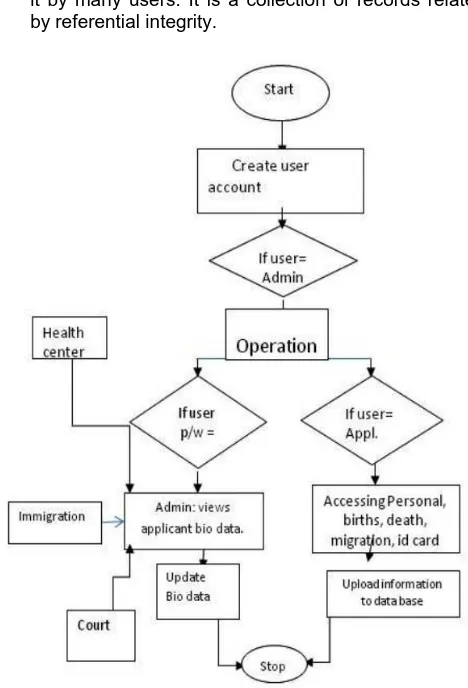
Figure 3.1 System Model
The above diagram gives system architecture of the process that is involved in demographic data collection. Both admin and users can access the database in the internet, and have full access to the information available for him/her. And both can be able to update certain information that is available for him and then the updated data is transferred to the central database system.
3.1SYSTEM ARCHITECTURE
The tier structure for this system is the 3-tier structure. That means, the three code layers exist on two severs, the Presentation server and the Database server. Since this is a large scale distributed web application, the tiers are bounded by firewalls. One just right in front presentation tier and the other firewall before application tier.
Tier 1 - Presentation tier, it interacts closely with the user and Administrator.
Tier 2 - Application tier, it holds the business logic and the data access logic.
Tier 3 - Database tier, this is the most critical aspect of the application; it is where the user data, operational data and meta data are stored for easy access and retrieval. All database logic and entity relationships will be defined here. It consists of Database servers. A database implies a persistent and integrated storage allowing concurrent access to it by many users. It is a collection of records related by referential integrity.82
4
R
ESULT AND DISCUSSIONA web-based Demographic system helps to ensure the conduct of a good and credible Demographic data collections program. There are two (2) primary modules contained in this system. The integration and systematic combination of the module. The modules are as follows:
1. Administrator Module 2. User Module
4.1 ADMINISTRATOR MODULE
The Administrators module is one who has privilege to create, update or delete a user account of an applicant. The administrator is the one who fills or changes the bio data form. The administrator is the superior of this management system [8].
Administrator/User Login Page
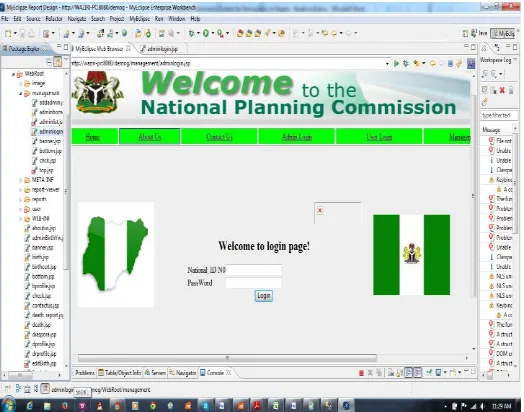
This is the Login page through which the admin or users specifies a valid National Identification number and password for him/her to be granted access into the system. Both admin and users access is denied until he enters a valid ID number and password. Figure 4.1 shows this.
Figure 4.1 Welcome to login page
Admin would have access to choose registration categories such as personal registration, birth registration, death registration, Diaspora registration and foreigner registration. While users would have access to the view his individual’s records, or edit his details, or even view his Birth Certificate or Death Certificate of his relatives if access granted, As shown in Figure 4.2.
Figure 4.2 Home page after user Login.
4.2 ONLINE PERSONAL REGISTRATION FORM
After a category has been selected from admin home page, for instance personal registration, the personal registration page becomes displayed, Admin has access to register a new applicant and generate national registration number serially according to state.
4.3 ONLINE BIRTH REGISTRATION FORM
Online Birth registration form is another category been selected from admin home page. Admin has access to register a new born baby, also generate national Birth registration number serially according to their state. Figure 4.3 below shows online birth registration form page.
Figure 4.3 Online Birth Registration form page.
4.4 ONLINE DEATH REGISTRATION FORM
83 Figure 4.4 Online Death Registration form page.
4.5 ONLINE DIASPORA REGISTRATION FORM
Diaspora registration form is another category from admin home for instance the Diaspora category, the new category becomes displayed; there is a constraint that accepts only visa number and international passport. Any violation will trigger a prompt requesting for the appropriate age range. Admin enable to register all nationality went abroad.
4.6 Online Foreigner Registration form
Foreigner registration form is another category from admin home for instance the foreigner category, the new category becomes displayed as shown in Figure 4.5 In the foreigner category below, there is a constraint that accepts only visa number and international passport. Admin enable to register all foreigners arrived to the nation.
Figure 4.5 Online Diaspora Registration form page
4.6 REPORT CAPABILITIES
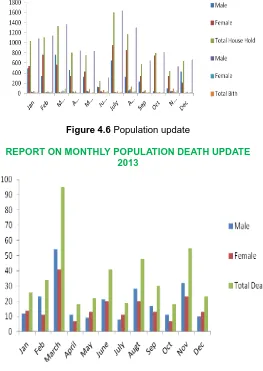
The system we design is capable of generating a report based on the data collected and these could help the economic policies makers to have an efficient data that can be used in the country in implementation of budget by different organization. Figure 4.6 and 4.7 below shows the sample report generated by the system with the sample data we used to test the capability of the system.
REPORT ON MONTHLY POPULATION UPDATE 2013
Figure 4.6 Population update
REPORT ON MONTHLY POPULATION DEATH UPDATE 2013
Figure 4.7 Population death update
5 CONCLUSIONS
An online integrated information system for Demography is a web-based application that provides inputs and outputs information support to users in order to update their demographic information. By being online it means it is available and free of charge to anyone, user friendlier and widely accessible across the world. In this paper we develop a system prototype that that can predict demographics attributes that does not rely on any personal and behavioral information and it is our believe that with the adoption of this system the National Planning Commission of Nigeria will find it easier in successful planning of economic policies as well as National Population Commission of Nigeria.
6 Acknowledgments
84
R
EFERENCES[1]. Glossary of Demographic Terms:
http://www.prb.org/Publications/Lesson-Plans/Glossary.aspx
[2]. Patrick C. Okafor: A Case Study: Factors Contributing To The Academic Achievement Of Low-Socio Economic Status Students In Anambra South County, Anambra State Nigeria. April 2007.
[3]. Demographic Data
http://www.learn.geekinterview.com/data-warehouse/data-types/demographic-data.html
[4]. Mongabay, 2013 “Nigeria Population Estimates and the Demographic Transition”
http://www.mongabay.com/history/nigerianpopulation estimatesand demographictransition.htm
[5]. D. Martin,J. Harris, J. Sadlert, N tate, 1998, putting the census on the web: lessons from two case studies, area, interscience Wiley, 1998, vol. 30, no. 4 pp. 311-320.
[6]. D. weibel, E. schelling, B. bonfoh, j utzinger, J. hattendorf, M. abdoulaye, t madjiade, j zinsstag, (2008), demographic and health surveillance of mobile pastoralists in chad: integration of biometric fingerprint identification into a geographical information system, (2008), geospatial health vol.3, issue 1,pp. 113-124.
[7]. Olugbenga oluwagbemi, Maria keshinro and charles k. ayo, “design and implementation of a secured census information management system”. Egyptian computer science journal vol. 35 no.1 jan2011. pp. 2-10.