© 2018 IJSRST | Volume 4 | Issue 2 | Print ISSN: 2395-6011 | Online ISSN: 2395-602X Themed Section: Science and Technology
Review on Traffic Density Estimation Using Computer Vision
Technique
Sonali D. Choudhari1, Dr. V. T. Gaikwad2
1M.E Scholar, Department of Electronics & Telecommunication Engineering, Sipna College of Engineering and
Technology, Amravati, Maharashtra, India
2Professor, Department of Information Technology, Sipna College of Engineering and Technology, Amravati,
Maharashtra, India
ABSTRACT
The activity on the streets is builds step by step. The need of creating framework that can oversee and control the movement on street . The movement of numerous vehicle on streets is additionally critical for taking different choices identified with activity. The framework brings an activity picture from a CCTV camera to process in the framework as an information. From that point onward, the framework finds for movement clog and gets the outcomes in three rush hour gridlock conditions as Flow, Heavy, and Jammed. At long last, a client can utilize the framework for a transportation arranging or a convergence movement control. For execution, the framework utilizes a picture preparing system to dissect for a movement condition. It recognizes what number of items or autos out and about. And after that, the framework associates a movement condition result with a database for a transportation arranging.
Keywords : Image Processing, Image Segmentation, CCTV camera, Traffic Density Estimation
I.
INTRODUCTION
A movement clog issue increments particularly in a capital city, for example, Bangkok in light of a populace expanding. In outcome, it sets aside greater opportunity to transport and a voyager feels focused. To defeat this issue there are innovation to clarify a movement condition and recommend for a way to transport. The accompanying strategies are utilized to check for movement blockage. An auto amount and speed locator on a roadside. This technique consumes a great deal of cash and hard to break a trail. Since, every indicator has one sensor for an auto tallying and the other two for auto speed discovery. Another technique is utilizing a CCTV camera to take photos of activity. From that point forward, a police breaks down a movement condition from those photos. At that point, the scientists have a plan to make the
Congestion Investigating System by Image preparing from CCTV camera.
PC vision is an imperative field of computerized reasoning. The means utilized as a part of this procedure are getting, handling and breaking down the picture and change over it into numerical or representative form. The numerical or emblematic data of a scene depends on the model that helps of question geometry, material science, measurement, and learning hypothesis. The scene is changed over into the image(s) or the video(s), including numerous pictures, utilizing camera(s) concentrated from various areas on a scene. The vision territories, for example, seen recreation, occasion discovery, video following, protest acknowledgment, question posture estimation and picture reclamation are subareas of PC vision.
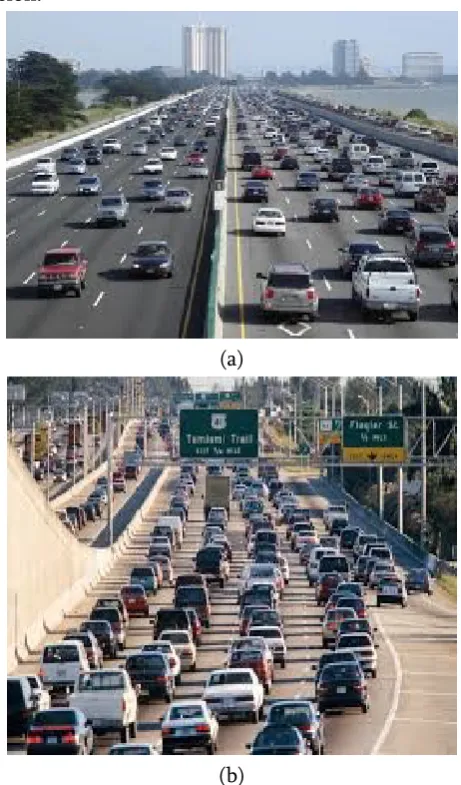
(a)
(b)
Fig 1: Traffic Images out and about
whereas picture handling, picture investigation and machine vision are likewise firmly identified with PC vision. Picture preparing and picture examination the two manages 2D pictures. In picture preparing a picture is changed into another by applying a few tasks, for example, differentiate upgrade, edge identification, commotion evacuation and geometrical changes. The numerous effective PCs inside the general reconnaissance framework has empowered the required expanded robotization, with the utilization of 'PC insight' to distinguish and investigate critical occasions and ready human
eyewitnesses. Identification edges should be
supportive of false positives, since these can typically be immediately perceived and ignored by a human eyewitness, while missing genuine episodes could be a genuine inadequacy.
II.
LITERATURE REVIEW
Many research and authors have been done work on traffic analysis using image processing techniques are as follow.
P. Mishra, M. Athiq, A. Nandoriya and S. Chaudhuri, “Video based Vehicle Detection and Classification in Traffic Conditions using a Novel Kernel Classifier” IETE journal of research vol 2013.
C. Zhao, J. Wang, C. Xie and H. Lu,” A Coarse-to-fine logo recognition method in video streams” National Laboratory of Pattern Recognition, Casia, Beijing China.
recognizes logos in video stream in real-time. A new technique is developed that combines both coarse template matching approach and pair wise that combines both coarse template matching approach and pair wise learning method together. The logo recognition becomes effective and efficient by eliminating the false alarms and further refines the recognition results. Image alignment for template matching improves the stability of the coarse stage. Experimental results show that this approach outperform the DOT matching approach and traditional multiple classifiers combination.
P. M. Daigavane and M. B. Daigavane, ”Vehicle Detection and Neural Network Application for Vehicle Classification” International Conference on Computational Intelligence and Communication Systems 2011.
They developed an application based on neural network for vehicle detection and classification. This system identifies and classifies the vehicles with their success rate 90%. Vehicle are tracked by using blob tracking method and neural networks classify these vehicles on the basis of length and height There have been cases where the system is unable to do the classification correctly. When multiple vehicles move together, with approximately the same velocity, they tend to get grouped together as one vehicle. Also, the presence of shadows can cause the system to classify vehicles incorrectly.
Z. Chen and T. Ellis,” Multi-shape Descriptor Vehicle Classification for Urban Traffic” International Conference on Digital Image Computing: Techniques and Applications 2011S.
They proposed the effectiveness of state-of-the-art classification algorithms to categerise road vehicles for
an urban traffic monitoring system using a multi-shape descriptor. The analysis is applied to monocular video acquired from a static pole-mounted road side CCTV camera on a busy street. These are used to classify the objects into four main vehicle categories i.e. car, van, bus and motorcycle. Image analysis for vehicle classification can be generally categorized into three principle approaches: model-based classification, Feature based classification and Measurement based classification. A number of experiments have been conducted to compare support vector machines (SVM) and random forests (RF) classifiers. 10- fold cross validation has been used to evaluate the performance of the classification methods. The results demonstrate that all methods achieve a recognition rate above 95% on the dataset, with SVM consistently outperforming RF. A combination of MBF and IPHOG features give the best performance of 99.78%.
Messelodi, M. Modena, and M. Zanin ,“A computer vision system for the detection and classification of vehicles at urban road intersections” Springer-Verlag 2005 London Limited.
K. Deb and K. Nathr “Vehicle Detection Based on Video for Traffic Surveillance on road”. Int. JComp Sci. Emerging Tech Vol-3 No 4 August, 2012.
They developed an automatic driver assistance system to alert a driver about driving environment. The most common approach used to vehicle detection is active sensor such as radar based system, laird (“Light Detection and Ranging”) and acoustic based. Radar based system can see 150 meter ahead in fog or rain. To find the location of vehicles, the three approaches are used i.e. knowledge based, stereo based and motion based. The vehicle identification are done on the basis of symmetry, colour, shadow, corners, vertical and horizontal edges, texture, and vehicle light. In stereo vision system, the three methods used are disparity map, inverse perspective mapping and motion based and the location are find by using template based and appearance based.
NASA K. Dhanya, M. Manime kalai, B.Asmin and G. Vani, “Tracking and Identification of Multiple Vehicles”
They developed a computer vision system for detecting and tracking the moving vehicle at day time and night time. First the videos are converted into frames and background and foreground of the image are detected. The headlight and the taillight of the vehicle is used for detecting and identifying the vehicle, after that image segmentation and pattern analysis techniques are applied.
III.
PROPOSED WORK
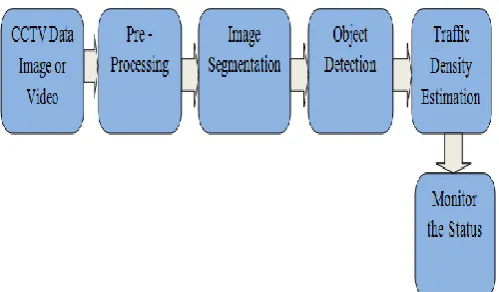
In order to manage traffic density estimation the high level architecture is proposed, consisting of the process are as follows.
A. CCTV Data Image or Video
CCTV camera will be located at common congestion point on highways, freeways, tunnel. It captures image or videos of the traffic coming from a particular
direction on the road. It may be also used to show traffic condition on the road.
Fig 2: Overview Processes of the Traffic Congestion Investigating system
B. Image Pre-processing
Image pre-processing is an improvement of the image data that suppress undesired distortion or enhance some image features important for further processing. Examples images features include contrast and edge
enhancement, pseudo-coloring ,noise filtering
sharping and modifying. It may also be used Brightness value of pixels.
C. Image Segmentation
Image segmentation is defined as the partitioning a digital image into multiple segment (sets of pixels, also know as super pixel).The goal of segmentation is to simplify or change the representation of an image into something that is more meaningful and easier to analyze. . Image segmentation is typically used to locate object and boundaries (line and curves) in images.
D. Object Detection
It is used to detect how many objects or cars on the road. And then, the system connects a traffic condition result with a database for a transportation planning. For example, a car quantity and velocity detector on a roadside.
Traffic density estimation estimate the density and velocity of the car. It will also be used to provide important information for road planning, road traffic control traffic scheduling, routing and dissemination. It depicts the ratio between the area occupied by the vehicle and the total surface of the road.
F. Monitor the Status
Monitor will show the video or images of the traffic on the road. It may be used to show the traffic information on the road. It is used to show output of the traffic on the road. Traffic information of a particular placed will be shown as to count that described density of traffic that count be monitor or density over internet using IOT analytic software like as Thing Speak may be used in our case.
IV.
CONCLUSION
Activity thickness evaluated utilizing Image preparing utilizing camera pictures caught from the expressway and recordings taken are changed over to the picture grouping. Each picture is handled independently and the quantity of autos has been tallied. In the event that the quantity of autos surpasses a particular edge, cautioning of substantial activity will be indicated consequently. This issue can be overwhelmed by utilizing particular channel amid Image preparing or changes in matlab code. Our framework incorporates picture catching, picture preparing, clog estimation and data dispatching as a conveying handling framework utilizing Internet. We have demonstrated that it is even conceivable to dispatch ongoing data from preparing semi-moving pictures. The continuous data gave by our framework is intended to be seen utilizing cell phones that are ending up most well known terminals which everyone convey each day.
V.
REFERENCES
[1] P. Mishra, M. Athiq, A. Nandoriya and S. Chaudhuri,
“Video based Vehicle Detection and Classification in Traffic Conditions using a Novel Kernel Classifier” IETE journal of research vol 2013.
[2] C. Zhao, J. Wang, C. Xie and H. Lu,” A
Coarse-to-fine logo recognition method in video streams” National Laboratory of Pattern Recognition, Casia, Beijing China.
[3] P.M. Daigavane and M.B. Daigavane,” Vehicle
Detection and Neural Network Application for Vehicle Classification” International Conference on Computational Intelligence and Communication Systems 2011.
[4] Z. Chen and T. Ellis,” Multi-shape Descriptor Vehicle
Classification for Urban Traffic” International Conference on Digital Image Computing: Techniques and Applications 2011S.
[5] Messelodi, M. Modena, and M. Zanin ,“A computer
vision system for the detection and classification of vehicles at urban road intersections” Springer-Verlag 2005 London Limited.
[6] K. Deb and K. Nathr “Vehicle Detection Based on
Video for Traffic Surveillance on road”. Int. JComp Sci. Emerging Tech Vol-3 No 4 August, 2012.
[7] NASA K. Dhanya, M. Manime kalai, B. Asmin and G.
Vani, “Tracking and Identification of Multiple Vehicles”.
[8] A. Suryatali and V. B. Dharmadhikari, “Computer
Vision Based Vehicle Detection for Toll Collection System Using Embedded Linux”. International Conference on Circuit, Power and Computing Technologies2015
[9] S. Kumar and N.Sivanandam,” Object Detection and
Tracking in Video using particle filter “ICCCNT'12 IEEE-2012 Coimbatore, India.
[10] B. Changalasetty , A. Badawy, W. Ghribi, H.
Ashwi ,A.Mohammed , A.Shehri , S. Thota and R.Medisetty, “Identification and Classification of
Moving Vehicles on Road” Computer
Engineeringand Intelligent Systems pp 2222-2863 Vol.4, No.8, 2013
[11] M. Shaoqing and L. Zhengguang, “Real-time Vehicle
Classification Method for Multilane Roads” ICIEA 2009.
[12] M. Osman and A.Bakar, “Classification of Moving
Objects Using Active Vision Computer
Vision”Computer Vision, Video, and Image