Student Worksheets Design To Improve
Problem-Solving Ability With Problem-Based Learning
Diasty Ponjen, Suparman
Abstract: Problem-solving ability is an attempt to reach a goal or find a way out using the knowledge he already has. Problem-based learning is a learning approach where students work together to find solutions to complex problems. The purpose of this study is to design teaching materials in the form of student worksheets that contain activities according to the steps of problem-based learning and indicators of students' problem-solving abilities. This research uses research and development methods, with the ADDIE development model. The procedure in the ADDIE model consists of five stages, namely, Analysis, Design, Development, Implementation, and Evaluation. The subjects of the study were students of class VII at SMPN 12 Yogyakarta. The object of this research is the ability of problem-solving, problem-based learning methods, and teaching materials in the form of student worksheets. Data collection instruments used interview guidelines, observation sheets, and validation sheets. This study produced an analysis of the Student Worksheet design consisting of cover, preface, table of contents, Core Competencies, Basic Competencies, and Competency Achievement Indicators (GPA), usability instructions, concept maps, student worksheets activities, and evaluations. Student worksheets have validated by two validators and have been categorized as feasible with some improvements previously.
Index Terms: Problem-solving Ability, Student Worksheets, Problem Based Learning.
—————————— ——————————
1 INTRODUCTION
Mathematics is one of the critical subjects, many activities related to mathematics [1]. Mathematic also have a crucial role for students in developing the ability to think and act logically [2]. Although mathematics has a central role in the mastery of science and technology, mathematics has not become a subject of interest to learners in general [3].In the present 21st Century Skills are needed in learning. Learning objectives in the 21st century have criteria 4c, namely communication, collaboration, critical thinking and problem solving, creativity, and innovation [4] [5]. In line with the ha l according to the National Council of Teachers of Mathematics (NCTM) 2000 states that the primary standard in mathematics learning is communication skills, problem-solving, reasoning ability, the ability of connections, and the ability of representation [6]. Based on the description above, it can conclude that Problem Solving becomes the primary standard in mathematics learning and also becomes one of the abilities needed in learning. According to Polya 1973, problem-solving is an attempt to find a way out or achieve a goal that has not achieved [6] [7]. Mathematical problem-solving ability is the ability or strategic competence shown by students in understanding, choosing approaches, and completing strategies and completing models to solve problems [8]. Based on the understanding of problem-solving above, it can conclude that problem-solving is an attempt to reach the goal or find a way out with the knowledge he already has.Problem-solving skills are needed by students so that they
become good problem solvers who can deal with problems in daily life [8]. Because, through problem-solving, students can learn their understanding of mathematical concepts through the use of problems related to real problems [9]. In general, problem-solving is an indicator of several countries in determining the ability of students to understand learning concepts and ideas [8]. Problem-solving is the necessary capabilities that can help learners to develop the ability to think analytically, critically, and creatively [7]. It can say that problem-solving abilities can be developed through the use of real problems. Problem-solving abilities are not only an objective in mathematics learning, but problem skills can also help students develop analytical, critical, and creative thinking skills.The ability to solve problems is crucial in education [10]. The ability to solve problems is one of the crucial aspects of making students learn mathematics. The community highly needs this ability. It is the essential thing in Indonesian mathematics, not only by those who will study mathematics as their specialty but also for those who will apply it in other disciplines and everyday life [11]. According to Polya, the problem-solving indicators consist of understanding the problem, making a plan, implementing the plan, and looking back [7] [12] [13]. The mathematics teacher must teach students not only to solve problems but also to learn about mathematics through problem-solving. It creates new challenges for teachers [8]. To stimulate students' problem-solving abilities can be done using real problems [9] [15]. PBL described as student-centered learning [16], where students construct their own and work collaboratively to solve problems in the learning process of learning [17]. During the PBL process, students define and identify learning problems under the assistance of a facilitator [16] [18]. PBL leads to higher problem-solving skills and increases students' factual knowledge [3] [19]. PBL is a learning method where relevant problems are introduced early in the instruction cycle and are used to provide context and motivation for learning that follows [20].
————————————————
Diasty Ponjen , master's degree program in mathematics education at Ahmad Dahlan University, Indonesia, PH-08985243494. E-mail: [email protected]
4701 IJSTR©2020
PBL is a learning approach that allows students to conduct research, integrate theory and practice, and apply knowledge and skills to develop solutions to problems that are defined [21]. According to Barrows (2002), PBL keywords are (1) structural problems that will give thought about the causes and how the solutions are, (2) student-centered approaches, where students determine what they need to learn, (3) teachers as facilitator and tutor, (4) the problem is authentic and reflects professional practice. Barrows also points out that learning in the PBL environment must be combined with several sciences, so students can learn and integrate information from several sciences that connected with understanding and problem-solving. PBL is a learning approach where students work together to find solutions to complex problems [22].In addition to improving students' problem-solving abilities, teaching materials needed. Teaching materials used can facilitate students' problem-solving abilities [23] and also relate to everyday life problems [24]. in this study, the teaching material to developed is the Student Worksheet From the results of the validation of the worksheets of students who already exist in the school found several deficiencies, including:
1. The cover design does not represent material
2. The existing illustrations are not following the material
3. The images contained in the worksheet of students are not related to the material so that they are less attractive to students in learning
4. The completeness of information in the form of instructions for use is not found in the worksheet of students, making it difficult for students to use it.
2.
METHOD
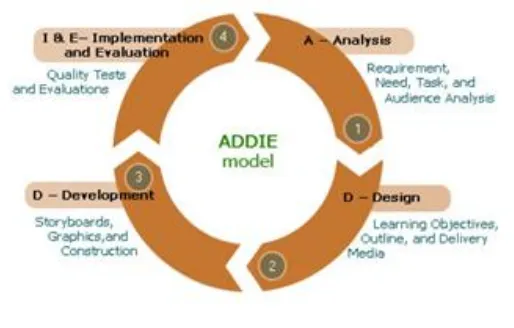
This research uses research and development methods, with the ADDIE development model. ADDIE development model consists of five stages: analysis, design, development, implementation, and evaluation [25] [26][27][28][29].The product developed in this study will be used to improve problem-solving skills in 7th-grade students, namely designing students based on problem-based learning (PBL) worksheets). The analysis stage in this study consisted of performance analysis and needs analysis. Performance analysis is done by observing mathematics learning in class and interviewing the mathematics teacher. The results of the performance analysis will be used as a needs analysis. A needs analysis is carried out to determine the mathematics subject matter to be included in the teaching material, which includes the SD (basic competency), target learning outcomes, and the design to be used. Furthermore, at the design stage, this research was carried out through the preparation of a teaching material framework. The experts will validate the product in the form of teaching material design. Design validation was carried out to determine expert judgment and input as revised material so that the model for developing suitable quality teaching materials The subjects in this study were 7th-grade students of state 12 Yogyakarta 2019/2020 academic year. Data collection instruments include guidelines for observation and interviews.
3 RESULT
AND
DISCUSSION
3.1 Performance Analysis
This analysis is part of the background of why these materials were developed. At this stage, there are two stages, namely performance analysis and needs analysis. Based on observations and interviews, there is some information, namely:
1) The curriculum used is the 2013 curriculum. The teaching materials used are textbooks from schools and also the Student Worksheet).
2) Student worksheets that used still uses conventional learning models, which only contains a summary of the material, finished formulas, sample questions, and practice questions; most of the questions are routine problems. Few questions connected with daily life. 3) Learners find it difficult when dealing with contextual
issues related to daily life.
4) The teacher only uses the lecture method and the learning process.
5) Students find it difficult when the material is flat in solving problems around and the width of the flat. The researcher concludes that students and teachers need teaching materials in the form of student worksheets to help and facilitate mathematics learning activities to improve problem-solving skills in students so that learning can take place effectively and efficiently.
3.2 Design stage
The second step in this stage design. Teaching material design is based on the results of needs analysis. The teaching material used is student worksheets based on problem-based learning. Student worksheet design consists of several components, namely: cover, student worksheet identity, preface, table of contents, introduction, basic competencies, core competency, instructions for use, concept maps, learning activities using problem-based learning. the design of student worksheets can be seen in the following image.
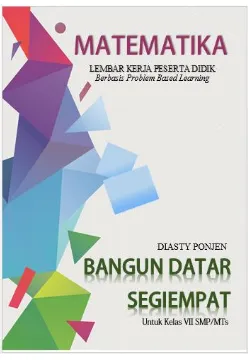
3.2.1 Design Cover
3.2.2 Preface
For introductory notes containing the author's thanks to the parties involved can be seen in Figure 2
3.2.3 Basic Competency and Core Competency.
Describe core competencies, basic competencies, and achievement indicators, as objectives in learning. Basic competency and core competency can be seen in Figure 3.
3.2.4 Instruction For Use
Student worksheets usage guidelines contain steps for the use of student worksheets, and icons that show indicators of problem-based learning and problem-solving. Directions for use can be seen in figure 4.
3.2.5 Concept Map
The concept map presented in student worksheeTS aims to make it easier for users to know the outline of the mapping of material to be studied. The concept map can be seen in Figure 5.
3.2.6 Student Worksheet Activities
Figure 6 follows the activities related to the material. The activities presented are following the syntax of problem-based learning and indicators of problem-solving
fig 1. Cover
Fig 2. Preface
Fig 4. Instruction For Use
Fig 5. Concept Map
4703 IJSTR©2020
3.2.7 Evaluation
Evaluations in student worksheets are presented in the form of essay questions. The evaluation aims to find out the results of the activities that have been carried out previously. Evaluation can be seen in Figure 7.
Before developing the design student worksheets, it must have good quality. Therefore the student worksheets design is validated by experts for its feasibility. The teaching material in the form of student worksheets has been assessed as feasible by two mathematics teachers. the results of module evaluations by experts can be seen in the table.
TABLE 1
Evaluation Results of Student Worksheets by Validator
No Aspect Score Information
1 Content Feasibility 4 Worthy
2 Presentation
Feasibility 3,9 Worthy
3 Feasibility of Graphic 3,67 Worthy
Based on the table above, we can conclude that student worksheets fit for use. However, there have been several revisions. Some input and suggestions from material and media experts that have been summarized can be seen in table 2.
Tabel 2
Feedback and Suggestions from Validators
No Feedback and Suggestions Perbaikan 1 The indicator icons are less
clear, so it is difficult to distinguish from the background of student worksheets.
Already repaired
2 Layout and background colors are almost the same, so it is less attractive and less appropriate.
Already repaired
3 Fonts and combinations of letters are almost the same..
Already repaired
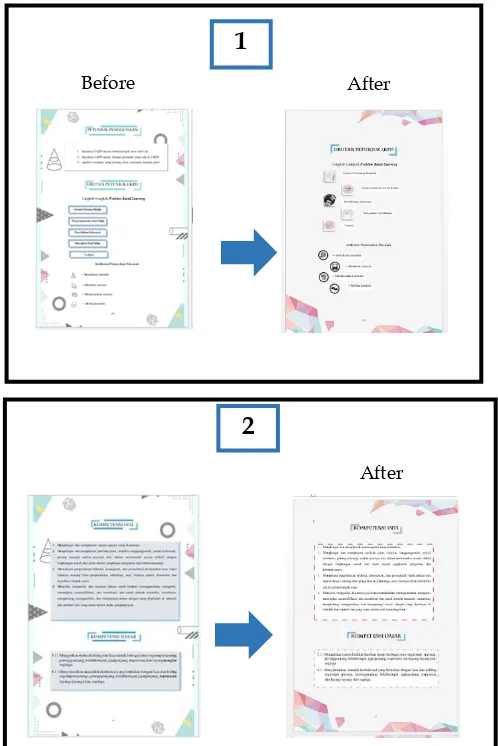
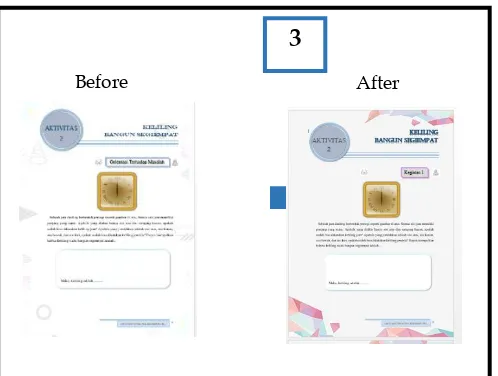
Some parts of student worksheets that have been corrected after receiving input and suggestions from the validator are shown in the following figure
Before After
1
Before
After
2
Fig 6. Student Worksheet Activities
The results of improvements are given back to the validator for validation and assessment. Table 2 below is the result of the calculation of the teacher questionnaire regarding the developed design. After entering and suggestions from the validators, it has been revised. The results of improvements are given back to the validator for validation and assessment. The results of the teacher questionnaire calculation regarding the developed design can be seen in table 3.
TABLE 3
Design assessment results
No Validator score Category
1 Eli Susilawati, S.Pd 78 Worthy
2 Nindi Marsita, S.Pd 80 Worthy
Total Score 158
Average score 78,5 Worthy
Based on Table 3 above. Validator 1 gives a score of 78, and validator 2 gives a score of 80. From both validators, it is found that the average validation result is 78.5, or it can be said that the student worksheets design has a decent category, so that the student worksheets design has good quality to be developed as material teach..
4
CONCLUSION
From the results and discussion above, it can be concluded that the design of student worksheets based on Problem Based Learning to improve problem-solving skills using ADDIE development methods. Components in student worksheets consist of a cover, preface, table of contents, Core Competencies, Basic Competencies, and Competency Achievement Indicators, usability instructions, concept maps, student worksheets activities, evaluations, author profiles. In the student worksheets, the activities section contains the steps of based learning and indicators of problem-solving ability.Furthermore, the student worksheets design was validated by two different validators, which were then revised according to the input and suggestions from the validator. After being corrected by the authors, the two validators gave an assessment and obtained an average with
a decent category so that the student worksheets design has good quality to be developed as teaching material
ACKNOWLEDGMENT
1. Ahmad Dahlan University which has provided encouragement and facilitation in researchers conducting and completing this research
2. The principal of SMP 12 Yogyakarta 12 who gave permission and place to researchers to carry out research. 3. The two validators who have validated the student
worksheets design and provided constructive input and suggestions to produce a student worksheets design with a feasible category were later developed into teaching.
REFERENCES
[1] N. Astriani, E. Surya, and E. Syahputra, ―the Effect of Problem Based Learning To Students ’ Mathematical the Effect of Problem Based Learning To Students ’ Mathematical Problem Solving,‖ Int. J. Adv. Res. Innov. Ideas Educ., vol. 3, no. February, pp. 3441– 3446, 2017.
[2] R. D. E. Prismana, T. A. Kusmayadi, and I. Pramudya, ―Analysis of difficulties in mathematics problem solving based on revised Bloom’s Taxonomy viewed from high self-efficacy,‖ J. Phys. Conf. Ser., vol. 1008, no. 1, 2018.
[3] S. Rustam E, D. R. Sidabutar, and S. Edy, ―Improving Learning Activity and Students ’ Problem Solving Skill through Problem Based Learning ( PBL ) in Junior High School,‖ Int. J. Sci. Basic Appl. Res., vol. 33, no. 2, pp. 321–331, 2017.
[4] Z. Arifin, ―Mengembangkan Instrumen Pengukur Critical Thinking Skills Siswa pada Pembelajaran Matematika Abad 21,‖ J. Theorems, vol. 1, no. 2, pp. 92–100, 2017.
[5] B. Brown, ―Twenty first century skills: a Bermuda college perspective,‖ Voices Educ. J. Bermuda Coll., vol. 1, no. June, pp. 58–64, 2015.
[6] M. Putra and R. Novita, ―Profile of secondary school students with high mathematics ability in solving shape and space problem,‖ J. Math. Educ., vol. 6, no. 1, pp. 20–30, 2015.
[7] H. Hendriana, T. Johanto, and U. Sumarmo, ―The role of problem-based learning to improve students’ mathematical problem-solving ability and self confidence,‖ J. Math. Educ., vol. 9, no. 2, pp. 291– 299, 2018.
[8] E. Amalia, E. Surya, and E. Syahputra, ―The Effectiveness Of Using Problem Based Learning (Pbl) In Mathematics Problem Solving Ability For Junior High School Students,‖ Ijariie-Issn(O)-2395-4396, vol. 3, no. 2, pp. 3402–3406, 2017.
[9] E. Surya, F. A. Putri, and Mukhtar, ―Improving mathematical problem-solving ability and self-confidence of high school students through contextual learning model,‖ J. Math. Educ., vol. 8, no. 1, pp. 85– 94, 2017.
3
4705 IJSTR©2020
[10] M. Nurdyansyah, S. Masitoh, and B. Bachri, ―Problem Solving Model with Integration Pattern: Student’s Problem Solving Capability,‖ vol. 173, no. Icei 2017, pp. 258–261, 2018.
[11] I. K. Darma, I. M. Candiasa, I. W. Sadia, and N. Dantes, ―The effect of problem based learning model and authentic assessment on mathematical problem solving ability by using numeric ability as the covariable,‖ J. Phys. Conf. Ser., vol. 1040, no. 1, 2018.
[12] A. Sanwidi, ―Students’ Representation in Solving Word Problem,‖ Infin. J., vol. 7, no. 2, p. 147, 2018.
[13] S. A. Widodo, ―Development of Teaching Materials Algebraic Equation To Improve Problem Solving,‖ Infin. J., vol. 6, no. 1, p. 59, 2017.
[14] P. OECD, ―No Title,‖ Result Focus 2015, 2016. [15] K. B. Hartman, C. R. Moberg, and J. M. Lambert,
―Effectiveness of problem-based learning in introductory business courses,‖ J. Instr. Pedagog., pp. 1–14, 2013.
[16] D. Jonassen, ―Supporting Problem Solving in PBL,‖ Interdiscip. J. Probl. Learn., vol. 5, no. 2, pp. 9–27, 2011.
[17] S. N. S. H. Ahamad, H. C. Li, M. Shahrill, and R. C. I. Prahmana, ―Implementation of problem-based learning in geometry lessons,‖ J. Phys. Conf. Ser., vol. 943, no. 1, 2018.
[18] A. Saleh et al., ―Assessing collaborative problem solving in the context of a game-based learning environment,‖ Comput. Collab. Learn. Conf. CSCL, vol. 2, pp. 893–894, 2019.
[19] A. Yadav, D. Subedi, M. A. Lundeberg, and C. F. Bunting, ―No Title,‖ Probl. Learn. Influ. Students Learn. An Electr. Eng. course. J. Eng. Educ., vol. 2, p. 100, 2011.
[20] MICHAEL PRINCE, ―Does Active Learning Work ? A Review of the Research,‖ J. Eng. Educ., vol. 93, no. July, pp. 223–231, 2004.
[21] S. J.R, ―Overview Of Problem-based Learning : Devinition and Distinction Interdisciplinary,‖ J. Probl. Learn., vol. 1, no. 1, pp. 9–20, 2006.
[22] M. Ferreira and A. Trudel, ―Tje Impsct of Problem Based Learning (PBL) on Student Attitudes Toward Science, Problem-Solving Skills, and Sense of Community in the Classroom,‖ J. Classr. Interact., vol. 47, no. 1, pp. 23–30, 2012.
[23] P. Barniol and G. Zavala, ―A tutorial worksheet to help students develop the ability to interpret the dot product as a projection,‖ Eurasia J. Math. Sci. Technol. Educ., vol. 12, no. 9, pp. 2387–2398, 2016. [24] D. Zulyadaini, ―A Development of Students’
Worksheet Based on Contextual Teaching and Learning,‖ IOSR J. Math., vol. 13, no. 01, pp. 30–38, 2017.
[25] B. P. Syafina and Suparman, ―Designing student worksheets to improve critical thinking ability based on problem based learning,‖ Int. J. Sci. Technol. Res.,
vol. 8, no. 10, pp. 1194–1199, 2019.
[26] F. Marian and Suparman, ―Design of Student Worksheet Based On Discovery Learning to Improve the Ability of Mathematics Reasoning Students of Class VII Junior High Design of Student Worksheet Based On Discovery Learning to Improve the Ability of Mathematics Reasoning Students of C,‖ J. Phys. Conf. Ser. Pap., 2019.
[27] L. Anggraeni and Suparman, "Design Of Mathematics Module Based On Guided Discovery To Train Student Creativity", International Journal of Scientific and Technology Research Vol. 8, Issue 11, pp. 3896-3899, 2019.
[28] S. Suprotun and Suparman, "Development Learning Design Lift Material Flap With Character Education To Improve Problem Solving Abilities", International Journal of Scientific and Technology Research Vol. 8, Issue 12, pp. 2806-2810, 2019.