Aidentification Of Effect Of Fly Ash Addition As
An Alternative Binder In The Treatment Process
Of Polluted Waste
Ernesto SilitongaAbstract: Due to the high demand of the management of waste sediment from industrial port in France. The reuse of this particular material is urgently needed to realize. The stabilization is one of the methods proposed. The high content of heavy metal in this waste makes it difficult to stabilize it just only with normal hydraulic binders. Fly ash utilized in this study is a byproduct of from local coalmines. The main idea is to maximize the utilization of waste material by stabilizing waste with a waste material. The application of the reuse of the waste sediment is as material in road construction work. First step is identifying the initial characteristics of waste sediment and binders used in this study. The chemical test is implemented as well to find out the heavy metal content in the waste. The next step is formulating the ideal composition of the binders in the mixtures. In order to verify the capabilities of stabilization process (with fly ash) to meet de needs on road construction is done by realizing several geotechnical tests. The result shows that the heavy metal content of the waste sediment is categorized in a medium level (non hazardous waste). The mixture with highest strength value is not exactly with the highest content of fly ash. The water sensitivity test confirmed that the mixture without any fly ash content couldn’t survive to mouillage-sechage cyclic test. . The Unconfined compressive strength and tensile test shows that the addition of fly ash clearly provides an additional performance especially at long term of curing age. The fly ash addition helps to improve the engineering properties and the result confirmed that the waste sediment stabilized with fly ash could and safe to be used as replacement material in sub base course in road pavement.
Index Terms: Waste sediment, fly ash, stabilization, engineering performances, replacement material, and road construction. ——————————◆——————————
1.
I
NTRODUCTIONThe important increase of volume of waste material from dredging work is making the port authority overwhelmed in finding solution. The classical technique, such as rejecting the waste material after is not an option anymore. Rejecting the waste in to the sea is categorized as illegal action. Precedent research stated that rejecting action could affect and harm the surrounding environment [1]. Especially after the European regulation concerning this particular waste material has been established. According to this regulation all the waste material dredged is considered as a polluted material, and should be dispose to the special area and stabilize until the heavy metal content categorized as an inert waste, then the waste material is considered safe to be reused again. The disposal site method already realized in several countries. The problem with this method is the high cost; the disposal site method almost cost 75% from the total cost of management waste material. [2]. Disposal site method is not suitable for Medium– large level port. Beside the disposal site method, a method of reusing this sediment is one of the most recommended solutions to solve the waste problem. In France road construction consumed almost 50% of the recycled material [3]. This is the reason why this domain application is very popular. The waste sediment from dredging material normally composed of high percentage of heavy metal [4]. Due to its high content of heavy metal, the chemical treatment such as stabilization with usual hydraulic binders is not satisfying the necessity on improving the engineering properties on the road pavement work [5, 6]. The present of heavy metal in the waste sediment obstruct the cement or lime hydration, and directly effect the strength gained of the sample [7].
The previous study shows that the evolution of strength on sample stabilized with only hydraulic binders shows an insignificant increase [8]. To improve a waste material with high content of heavy metal, it required a binder with a high active reaction. Several researches already tried to stabilize waste sediment with high content of heavy metal. Silica fume is one of the most reactive Pozzolanic binders. This binder is commonly used in concrete to produce a high performance concrete. A research conducted by Silitonga, working on waste sediment with high percentage of heavy metal especially the content of Cadmium (cd) and Zinc (Zn) [9]. The result of the sample with silica fumes content show an important increase of the compressive strength value. This increase started since 7 days of curing age and up until 180 days of curing age, the strength evolution still shows an significant increase, if compared to sample mixed only with cement. The addition of Silica fume clearly shows an additional strength on the sample and achieves the requirement needed in road structure pavement.
2.
INITIAL
CHARACTERISTICS
OF
MATERIAL
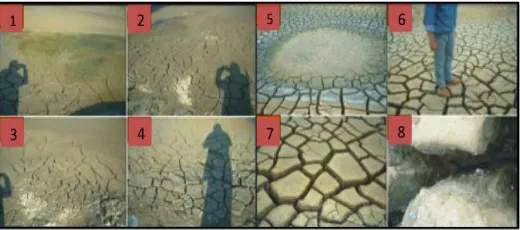
Port of Cherbourg is considered as one of the biggest Industrial Port in Basse Normandie Port. Due to its high industrial activities, the waste sediments from dredging work is assumed as material contaminated with heavy metal. The sediment is taken from four sampling locations along Port of Cherbourg (see Figure 1). These locations are PoC_1, PoC_2, PoC_3 and PoC_4. These locations are assumed as the locations with highest heavy metal content. After being dredged the sediment will be disposed in a designed area to prevent the micro pollutant dispersed in surrounding environment. The hydraulic binders (cement and lime) utilized in this paper are the common binders used in soil stabilization work. The Pozzolanic binder used in this study is fly ash. Two types of fly ash are used; namely Sode and Sop are a waste from by product from two local mining. This means that initial characteristic of Sode and Sop is different. These two type of fly ashes (Sode and Sop) is pure waste, its have never been treated by any treatment, the idea is to treat waste with a __________________________________
• Ernesto Silitonga, Lecturer at Faculty of Engineering of Universitas Negeri Medan, Indonesia, ering in University, Country, PH- (+6261 6613365)
waste, to maximize the reutilization of waste material. .
Figure. 1 Sampling locations on Port of Cherbourg
2.1 Particle Size Distribution
Particle size distribution is well known has an important role in engineering characteristics of a material. The waste sediments consists of fine particle, due to this reason, the particle size distribution test is realized using Laser Granulometric Diffracto meter (LGD), because LGD can identify the particle size to <2 µm. The particle size distribution of Fly ashes (Sode and Sop) is identified using LGD. The result from LGD is shown in table 1.
Table 1. Particle size distribution of waste sediment and fly
ashes utilized
Parameters PoC1 PoC2 PoC3 PoC4 Sode SOP
D10 (µm) 9 10.1 8.5 11.2 3.2 2.1
D50 (µm) 11.2 8 7.6 9.6 19.2 17.5
D90 (µm) 51.4 47.8 60.9 55.3 83 68
<2 µm (%) 6.1 4 3 1.9 17 24
2 - 63 µm
(%) 76 68 77 79.8 75 72.7
> 63 µm (%) 17.2 28 18.9 18,4 8 3.3
As shown in table 1, the particle size distribution of waste sediment from dredging work content of fins particle. The particle size of waste sediment from four different sampling locations shows almost similar pattern. This result shows the homogeneity of the waste sediment taken from 4 different sampling locations. The majority of particle size of waste sediment is in range of 2 – 63 µm, this means that majority of the particle of waste sediment classified as silt loam size. Several researchers already identified the waste of different locations in France. Colin [10] both are working on dredged sediment of Port Le Havre. Their result stated that the dredged waste sediment of Port le Havre is in range of 2 - 63 µm (silt class). A previous study worked on waste sludge in to brick shows the same range of particle size [11]. Zhibo identified the particle size distribution of waste dredged sediment of Port of Cherbourg [7] (in other side ot Port) find out that the Majority particle size distribution of waste sediment is around 2 - 63 µm. Silitonga in his study worked with waste sediment from dredging project of Port en Bessin, the result show almost the same trend, the majority particle size of the dredged sediment is 2 - 63 µm [12]. This result confirmed that the majority
particle size of waste dredged sediment in France is in range of 2 - 63 µm. The Pozzolanic binder used in this study is Fly ash, which divided in to two different types; Fly ash type 1 (Sode) and Fly ash type 2 (Sopo). The particle size of the two types of fly ashes is presented in Table 1. The majority of particle size of fly ashes is in range of 2 - 63 µm. from this point of view, we can say that the majority of particle size of fly ash is in the same size with waste sediment. Contrary to this result, the common fly ash that usually used in soil stabilization is much finer. This result is because the fly ash used in this study is the fly ash that taken directly from local mine. These two fly ashes has never been subjected to any test. From table 1, the fly ash possesses almost 2-3 times (17%-24%) of finest size of particle (<2 µm) than waste sediment. According to Silitonga [13], in his study stated that the particle size in range of 2 - 63 µm, plays an important role on strength gained process, especially for binder (hydraulics or Pozzolanic) the binder with more percentage of particle with size of < 2 - µm, will be more reactive than others.
2.3 Chemical characteristic
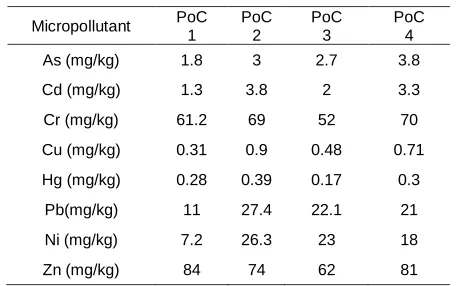
In order to identify the content of micro pollutant of heavy metal in waste sediment, the chemical characterization is realized using Leaching test. The leaching test result for waste sediment is presented in table 2. In order to the help categorizing the waste sediment, the researchers use reference limit from Decision of Council of European Union [14]. According to this classification, all the dredged material is automatically considered as a waste material and harmful for the environment and human, so after the dredging process, the waste should be disposed in special area, to prevent the disperse of the micro pollutant in to the environment surround. After being disposed the waste sediment subjected to stabilization process and after the content of micro pollutant categorized as inert waste, then it considered safe to be reused. The Council of European Union classification is divided in three categorizes; inert waste, non hazardous waste and Hazardous waste. This classification is presented in Table 3. It shows the result of chemical test.
Table 2. Percentage of Micro pollutants content in the waste
sediment
Micropollutant PoC 1
PoC 2
PoC 3
PoC 4
As (mg/kg) 1.8 3 2.7 3.8
Cd (mg/kg) 1.3 3.8 2 3.3
Cr (mg/kg) 61.2 69 52 70
Cu (mg/kg) 0.31 0.9 0.48 0.71
Hg (mg/kg) 0.28 0.39 0.17 0.3
Pb(mg/kg) 11 27.4 22.1 21
Ni (mg/kg) 7.2 26.3 23 18
Zn (mg/kg) 84 74 62 81
strength than sample mixed with Sode. Table 3. According to ASTM C-618-98 [16], one of the most important factors to identify the reactivity of the Pozzolanic binder is the total amount of SiO2, Fe2O3 and Al2O3.
Table 3. The Mineralogical characteristics of Fly ashes
Name SiO(%) 2 Fe(%) 2O3 Al(%) 2O3 MgO (%) CaOt
otal (%)
CaOf ree (%)
SO3 (%)
Sode 47.3 7.09 21.63 3.32 8.52 0.9 4.02
SOP 20.3 1.91 11.7 1.07 35.3 13.3 17.1
If the percentage of fly ash content in the mixture is equal or more than 70%, then that particular Pozzolanic binder assumed would reacts stronger than other. In table 4 we can observe that the total amount of SiO2, Fe2O3 and Al2O3, is 76% contrary, the SOP only posses From this result we can concluded that the Sode assumed will be more reactive than SOP.
2.4 Methodology
The water content of waste sediment is very high, after the dredging process, the sediment is disposed disposal area. The dewatering process is realized in order to reduce the high water content of waste sediment. The dewatering process realized in normal temperature at open room. The dewatering process finish is when the water content reaches the desired point. The evolution of water content can be observed in figure 2. Due to its low water content the waste sediment is solved in to a smaller size and sieve it with 2 mm sieve size.
Figure 2. The dewatering process of waste sediment.
The sieved sediment then mixed with the other binders (cement, lime and fly ash). The mixed composition with different quantities of binders realized, then after the material is well mixed (in dry condition) the water introduced in to the admixture then again mixed with mixer moving machine at a speed of 1-8 mm/s for 5-8 minutes. The admixture subjected in to the mold sample and keep in the normal room temperature (26o) and after sample maker and the water content will be determined with proctor test for each composition.
3.
M
IXTURE COMPOSITIONThe mixture composition is designed to identify the effect of the binders on the sample performance. For example with the sample content only with cement, it is realized to identify the effect of cement and as a comparison to other sample with different binder.
Table 4. Mixture composition of sample
Name Cement Lime Sode Sop
US x x x x
757Sode 7% 5% 7% x
7514Sode 7% 5% 14% x
7521Sode 7% 5% 21% x
757Sop 7% 5% x 7%
7514Sop 7% 5% x 14%
7521Sop 7% 5% x 21%
Cement 7 5 x x
The sample with untreated waste sediment is realized as a initial performance of the sample without any binders. The sample with 21% of fly ash is realized to identify the effect of fly ash in big volume, this composition is not recommended to be applied in a real in situ project, because in economical point of view this volume of fly ash (21) cost to much and very difficult to mixed. The mix composition of sample is presented in table 4.
4.
R
ESULTS AND ANALYSISThe test realized in this study is the common test that normally done in stabilization soil or road construction work. the aim of this realization of this test is to verify the engineering performance of waste sediment stabilized with hydraulic binders or Pozzolanic binder (fly ash).
4.1. Unconfined Compressive Strength
This unconfined compressive strength test is performed to identify the strength of the sample on simple compressive. The unconfined compressive strength is performed with sample at curing age of 7, 14, 28, 56 and 90 days. According to previous study the minimum unconfined compressive strength value for parking area is 1 MPa at 28 days of curing age [17]. The result of unconfined compressive strength is showed in Table 5. The sample without any binders (US) shows insignificant increase of unconfined compressive strength, the unconfined compressive strength value of this sample cannot the minimum requirement of 1 MPa at 28 days of curing age. This result confirmed that without any binders the waste sediment of dredging work is not safe to be directly reused as a material even in parking area. The sample with only cement content performs the highest strength, since 7 days to 28 days of curing age compared to other samples
Table 5. The result of Unconfined Compressive Test.
Name
7 days (MPa)
14 days (MPa)
28 days (MPa)
60 days (MPa)
90 days (MPa)
US 0.45 0.62 0.7 0.75 0.8
757
Sode 0.75 0.82 0.95 1.8 2.3
7514
Sode 0.8 0.9 1.5 2.1 2.8
7521
Sode 0.76 0.87 1.4 2 2.7
757
7514
Sop 0.78 0.88 1.4 2.03 2.4
7521
Sop 0.68 0.8 1.6 2.1 2.5
Cement 0.87 1.05 1.7 1.84 1.91
This result is produced because the fast cement hydration. The cement hydration directly started when H2O is presented in to the mixture. In summary, this reaction produced Calcium Aluminate hydrate and Calcium Silicate hydrate, which known that the Calcium Silicate hydrate and Calcium Aluminate hydrate have a significant role on providing additional strength. The different percentage of fly ash in the samples (7%, 14% and 21%) shows an important effect on strength of compressive strength. As shown in table 5, the increase of the volume of fly ash (7%, 14% and 21%) directly increase the strength gained. Even though the strength value at 7-28 days is not as high as sample with cement content only, but the evolution of strength still detected. This result because at teen-age days of curing period (7 days) the Pozzolanic reaction is still not started yet. At this period of time, the cement hydration of cement and the filler effect of fly ash is the most dominant to provide strength. Contrary after 28 days of curing age, the sample started to show an significant evolution of strength. The Pozzolanic reaction starts to react and provide the additional strength. The strength value of samples with fly ash at 180 days show an significant different of strength value compared to sample with only cement content. The sample mixed with 14% and 21% of fly ash type 1 (7514Sode and 7521Sode) show the highest unconfined compressive strength at 180 days of curing ages. The difference percentage of fly ash (7%) doesn’t show any effect to the strength. Start from 7 days curing age, the unconfined compressive strength between these samples (7514Sode and 7521Sode) didn’t show any significant on unconfined compressive strength. This result happened because there is the excess of fly ash volume in the mixtures. According to this result we can concluded that insignificant strength evolution although the percentage of fly ash increase the volume of 21% of fly ash content in the mixtures considered as an excess case. The same pattern happened with fly ash type 2 (Sop), the sample with 14% and 21% of fly ash type 2 (7514Sop and 7521Sop) posses insignificant compressive strength at 180 days curing ages. The different type of fly ash clearly show has an important role in providing compressive strength. The samples treated with fly ash type 1 (Sode) present a highest compressive strength at 60 days up to 90 days of curing age. The sample with fly ash type 1 (Sode) can reach up to 2.8 MPa at 90 days of curing age, the samples with fly ash type 2 (Sopo) posses 14% less at the same days curing age. This unconfined compressive strength confirmed that fly ash type 1 (Sode) is more reactive than fly ash type 2. Because according to ASTM C-618-98 [6], one of the most important factors to identify the reactivity of the Pozzolanic binder is the total amount of SiO2, Fe2O3 and Al2O3. If the percentage of fly ash content in the mixture is equal or more than 70%, then that particular Pozzolanic binder assumed would reacts stronger than other and this result confirmed this theory. Table 4 shows that the total amount of SiO2, Fe2O3 and Al2O3 of fly ash type 1 (Sode) is 76% and fly ash type 3 only posses 33%,
4.2. Mouillage-Sechage Test
This test is realized to determine the sensibility of the sample to the water. The sensibility to the water is very important,
because if it is weak then the sample could not resists and the water can penetrates enter in to the micro structure of the sample and could bring the micro pollutants out and disperse it in to the environment surround and can harm the environment and the human. This is why we need to know how strong the bonding between the particles to resists the water penetrates in to the microstructure. The mouillage-sechage test is realize by subjecting the samples in to 10 cycles of mouillage-sechage test. The first cycle of the test will be the mouillage-sechage condition where the sample will be put in to the oven with normal room temperature (270) for 24 hours straight. After the mouillage condition finish the second cycle is the mouillage cycle started. This cycle performed by drowning the samples in to the water for 24 hours I cycle of mouillage –sechage test consists of 24 hours of sechage condition and continue with 24 hours mouillage condition. This cycle will be repeated for 10 times, then the mouillage-sechage considered accomplished. After treated by Mouillage-sechage test for 10
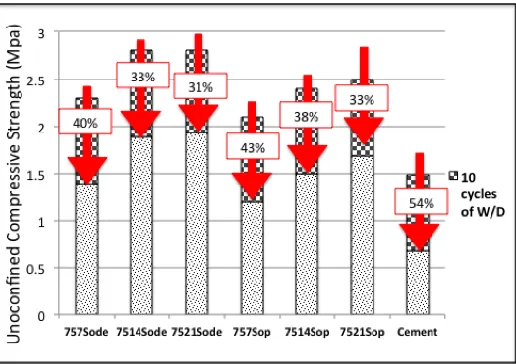
cycles, the sample subjected to unconfined compressive strength test, this test is realized with sample with 90 days of curing age. As presented in Figure 3, the result of mouillage-sechage show a important degradation of the sample, and initiates e decrease on compressive strength. After treated with 10 cycles of mouillage-sechage test, the sample visually shows a significant degradation on its surface. This clearly shows an indication of the increase on strength. As shown in figure 3, sample with cement content only has the lowest compressive strength (0.68 MPa) after subjected to mouillage-sechage test, beside that, the sample with cement content show a highest reduction of compressive strength (54%). At 28 days we can assume that the cement hydration process already reach its maximum reaction. Unfortunately even at 90 days of curing age, it shows that the water still can penetrate in to the structure and weaken the bonding between the particles by fill the empty space in the microstructure. The samples with fly ash show less significant reduction of compressive strength after the mouillage-sechage test.
Figure 3. Evolution of compressive strength after
mouillage-sechage test.
filled with fly ash increase the specific surface of the sample and makes the bonding between particles stronger. This is why the sample treated with fly ash is not very sensitive with the water. The increase of the percentage of fly ash makes a important remark on strength evolution. As we can observe in Figure 3, the sample with the highest percentage of fly ash (21%) for fly ash type1 (7521Sode) and for type 2 (7521Sop), present the highest compressive strength after mouillage-sechage test. The fly ash addition in this result of mouillage sechage test is clearly give a positive effect on sensitivity to water.
4
C
ONCLUSIONThe problematic of the stabilization of sediment polluted is the common hydraulic binder is not strong enough to increase the characteristic of the waste sediment to be reuse as a new material. In this study, the binder Pozzolanic such as fly ash is used as an alternative binder to stabilize this waste sediment. The majority of particle size distribution of waste sediment of Port of Cherbourg is in range of 2 - 63 µm. From four different locations of the sampling, the result is similar, this show the homogeneity of the waste sediment. Even though the majority of particle size distribution of fly ash is in the same range 2 - 63 µm but the percentage of <2 µm is almost three times than waste sediment. The chemical test presents the micro pollutant content in the waste sediment. According to Council of European Union classification, the waste sediment is classified as a non-hazardous waste; this means the waste sediment should be treated. The result of unconfined compressive strength shows the sample with the highest compressible strength at 28 days is the sample with cement content only, contrary to this result after 90 days of curing age, the sample with 14% and 21% of fly ash type 1. In this result, the addition of fly ash clearly shows increase on the unconfined compressive strength, especially after 60 days of curing age. The addition of fly ash is proven to increase the sensibility of the sample to water. The sample becomes more resistant to water. This sensibility of the water is important to prevent the dispersionof the micro pollutant in to the surrounding area, harm the environment and human.
R
EFERENCES[1] D. Wang, Wiltshire “Land reclamation and enhancement of soft marine sediment for road building” Marine Georesource and Geotechnology, vol.36, pp. 419-428, March 2014.
[2] J. Behmanesh , “Etude de la durabilite d’un sediment traitee au ciment et l’additifs” Ph.D dissertation, Universite de Caen Basse Normandie, France, 2008
[3] E. Silitonga, “Impact of Pozzolanic binder addition on stabilization of polluted dredged sediment on its potential reuse as a new resource material for road construction in Basse Normandie, France” IOP conf. series: material, science and engineering, vol 309, pp. 1-6, 2018.
[4] D. Wang, N. E. Abriak, “Compressibility behavior of Dunkirk structured and reconstituted marine soil.” Marine Geo resource and Geotechnology, vol. 33, pp. 419-428, Oct, 2014.
[5] D. Wang, R., Zentar, N. E. Abriak, S. Di “Long term mechanical performance sediment solidified by cement, lime and fly ash” Marine Georesource and Geotechnology, vol. 36, pp 123-130, 2018.
[6] E. M. Silitonga, “Experimental research of stabilization of polluted marine dredged sediment by using Silica Fume ” Matec Web of Conf, vol. 136, pp. 50-58, 2017.
[7] D. Zhibo,“ Caracterisation, stabilisation et solidification de sediment marine” Ph.D dissertation, Universite de Caen Basse Normandie, France 2008
[8] Z. Shahri, C. M. Chan, “Assement of metal concentration in dredged marine sediment: contamination indices” ARPN journal of engineering and applied sciences, vol. 11 no.8, pp. 5336-5341, April 2017.
[9] E. Silitonga, “Stabilization and solidification of polluted marine dredged sediment of port en bessin, France” IOP conf. series: material, science and engineering, vol. 5, no. 6, 2016.
[10] D. Colin, “Valorisation des sediments fins de dragage en technique routiere” Ph.D dissertation, Universite de Caen Basse Normandie, France, 2003.
[11] P. Velmurugan, “utilization of textile effluent waste sludge in brick production” International journal of science: basic and applied research, vol. 4, pp 1-10, 2011
[12] E. M. Silitonga, “Reutulisasi sedimen hasil pekerjaan sebagai material baru dalam pekerjaan pembangunan jalan,” Journal of Educational Building, II (1), pp. 94-103, 2016
[13] E. M. Silitonga, “Stabilisasi dan identifikasi sedimen hasil pekerjaan pengerukan pelabuhan,” Journal of Educational Building, II (2), pp. 50-58, 2016.
[14] Decision of Council of European Union. Decision no.2003/33/CE du 19/12/02 d’etablissant des critere et des procedures d’admision des dechets dans le dechagres, conformement a l’article 16 et a l’annexe II de la directive 1999/31/ 2003, France, 2003.
[15] E. M. Silitonga, “Identifikasi jumlah CaOfree dalam campuran beton dengan mempergunakan agen pozzolanik” Jurnal Penelitian Saintika, vol. 18, pp. 107-112, 2017.
[16] ASTM International “Standard Specification for Coal Fly Ash and Raw or Calcined Natural Pozzolan for Use in Concrete” ASTM International, West Conshohocken, PA, 2017