www.orientjchem.org
An International Open Free Access, Peer Reviewed Research Journal
2016, Vol. 32, No. (5): Pg. 2327-2345
A Study of Fe
3O
4@ Si
18O
27Catalyst through
Statistical-Nucleus Independent Chemical Shifts
(S-NICS) Method
NEdA SAMIEI SOOFI and MAJId MONAJJEMI*
Department of Chemistry, Science and Research Branch, Islamic Azad University, Tehran, Iran. *Corresponding author E-mail:[email protected]
http://dx.doi.org/10.13005/ojc/320504
(Received: September 23, 2016; Accepted: October 16, 2016)
AbSTRACT
There are no theoretical or mathematical reports of a statistical approach in NMR shielding and nucleus independent chemical shifts, while the asymmetry (η)and skew (κ) parameters are fluctuated in short distances and are alternative in long distances. In the case of axially symmetric tensor, σ22 equals either σ11 or σ33, skew is κ= ±1 and by changing asymmetry between 0 ≤η≤ +1 skew will be changed between -1 ≤ κ ≤ +1 , meanwhile the parameter “κ” is zero when σ22 = σiso. In
this work, we have investigated a statistical method by computing of Nucleus-Independent Chemical Shifts (S-NICS) in point of probes motions in a sphere of shielding and deshielding spaces of SiO2 rings. Monajjemi in the previous work24, has investigated a new method as the name “ S-NICS”
which this method is suitable for calculation the aromaticity in the non-benzene rings such as SiO2 rings which is a famous catalyst for organic chemical synthesize and reaction. Although S-NICS values for some molecules such as benzene, borazine and naphthalene can be indicated as the aromaticity criterion, for other cases such as BnNnHx and their hydrogenated derivatives, these values indicate electromagnetic index. Finally, we have introduced a schematic diagram of statistical-nucleus independent chemical shifts for ab-initio calculations in Gaussian program, Games or other software.
Keywords: Catalyst, Independent Chemical, NMR shielding.
INTROdUCTION
Electronic towards the structural aspects have proved to be an important key in physical organic chemistry in the explanation of structures, reactivity and stabilities of various organic compounds and
natural product molecules1 .
The chemical shift of a nucleus in molecular rings occurs from the nuclear shielding effect of an applied magnetic field. The magnitude of such an induced magnetic field is commensurate with the
stability of the applied external magnetic field (B0).
Thus the effective field (Beff) at the nucleus is given
si is the second-rank nuclear shielding matrix. In
ordinary NMR experiments B0is a uniform field along
the z-axis and the resonance NMR frequency, vi, of a
given nucleus in a molecule is therefore dependent to
its gyromagnetic ratio, gi, as specified by vi = (gii/2p)
B0(1 - si)2
The nucleus-independent chemical shift (NICS) is a computational method that calculates the absolute magnetic shielding at the center of the ring taken with reversed sign. Negative NICS values indicate aromaticity and positive values
antiaromaticity3-5 .
For further investigation of aromaticity, another method called the harmonic oscillator
model of aromaticity (HOMA)6 has been applied,
and is distinguished as a normalized sum of the squared deviations of bond length from the normal
value7. An aromatic compound has a HOMA value
of one whereas a non-aromatic compound has the value 0.
Several criteria for explanation of aromaticity can be considered and may divided into five categories, which are: (1) the energetic approach to aromaticity (2) geometrical considerations (3) reactivity of aromatic compounds (4) magnetic
parameters of aromaticity8-10, and the (5)
Statistical-Nucleus-Independent Chemical Shifts approach (S-NICS) which is the subject of this work.
In using the energetic criterion for establishing the aromaticity of a compound, it is evident that the excess of stability of the structure is due to cyclic electron delocalization relative to
suitable references systems11-12 . Moreover, Cooper,
Gerratt, and Raimondi13 have developed some
appropriate reference systems for calculation of the resonance energy. In using structural considerations, the geometry should show a decrease in aromaticity of bond alternation which have been reported by Julg and Kruszewski in several quantitative
measurements14 . Monajjemi and Boggs have
shown the low aromaticity of borazine in the rings
of B18N18 and B15N15 by the non-bonded interaction
method15-18.
Regarding NMR chemical shifts and diamagnetic susceptibilities, protons attached to
aromatic rings typically undergo a downfield shift from the olefin region; therefore, an up-field shift appears
in the proton NMR spectrum19 . So aromaticity can
be defined as the ability of a compound to sustain an induced ring current, these compounds are then called dia-tropic and antiaromatic compounds are called Para-tropic. NMR chemical shifts and diamagnetic susceptibilities , anisotropy is important
when measuring a compound’s aromaticity 20.
Recently aromaticity in terms of nucleus-independent chemical shifts in long distances of NICS (1, 2.5, 3, and 3.5) Å, around the ring center, NICS (0), at the center of ring plane and aromatic ring current shielding (ARCS) were compared in several studies. In short range of distances (r<0.3) there are no theoretical or mathematical reports of statistical approach in nucleus independent chemical shift
calculations, while the asymmetry (ç)and skew (ê)
parameters fluctuate in behavior around the center of rings.
For further discussion of statistical approach in nucleus independent chemical shift calculations, especially in short range of distances, we have focused in relaxations of CAS, dipole-dipole and
contribution 21. We have shown that the asymmetry
(h)and skew (k) parameters fluctuate in behavior
around the center of rings due to minimum isotropy in the center. The most fluctuations are appearing around the minimum or maximum functions mathematically.
Nuclear spin relaxation studies in the gas
phase had started in 198722. Spin-relaxation data
in the gas phase provide a stringent test of the anisotropy of an existing intermolecular potential. In some cases, spin-relaxation data is a powerful test of the anisotropic part of the intermolecular interaction. There are other observables such as the Beenakker effects, depolarized Rayleigh scattering, sound absorption, and pressure broadening of rotational lines in the IR, which are also sensitive to
the anisotropy of the potential23.
purpose of random displacement of various probes inside of shielding and deshielding spaces are for understanding of mechanism and consequences of anisotropic spin–spin interactions in short ranges, Although the relaxation of proton and hydrogen probes are much less, than the large ion probes
such as Li+.
In CSA, relaxation Chemical shift anisotropy (CSA) originates from the orientation dependence of the chemical shift, and hence changes under rotation of the molecule and induces minor variations in the magnetic ûeld at the site of the nucleus.
The time dependence of anisotropic interactions does however contribute to relaxation but the average amount can be time independent.
In this study, the major components of Haeberlen parameters, and chemical shift anisotropy (CSA) tensors have been calculated for borazine,
benzene, naphthalene, BnNnHx rings (n=12, 15, 18)
and B3N3Hn (n = 0, 2, 4, 6, 8,). The numerous random
points around the center of those molecules have been produced by generation of pseudo-random numbers, which are distributed in a Gaussian function in the interval [0, 1).
The hydrogenated and dehydrogenated
structures of borazine and BnNn rings have been
investigated to understand more about the unknown parameters of those rings in point of electromagnetic, aromaticity, delocalization mechanism, conjugated system and hyperactive conjugation in BN alternate systems. Therefore, the hydrogenation and dehydrogenation of borazine has moved gradually
in two directions toward cyclotriborazane (B3N3H12)
and B3N3 respectively .
Our result has been compared by the energy decomposition analysis (EDA) method . The
total p bonding energy and the p conjugation between
three B-N p bonds in borazine is signiûcantly smaller
than that for benzene and magnetically properties
shows a singular behavior in borazine and B3N3Hx
rings .
Fowler and Steiner computed the total current density induced by a magnetic ûeld perpendicular to the molecular plane of borazine.
They found that the p currents are localized in three
islands of circulation on the nitrogen atoms and concluded that borazine is moderately aromatic .
Nucleus-independent chemical shift values (NICS) show a little and no evidence of ring currents, indicating with no aromaticity for borazine due to the polar B–N bond .In contrast, the S-NICS data shows a weak but stable aromaticity for borazine according to the 1999 deûnition provided by IUPAC deûnition of aromaticity.
We have optimized various isomers of B3N3
and B4N4 to understand which members of each
group are more stable. Scheme 1 shows that in both
groups the planar ring isomer of B3N3 and B4N4 with
B and N alternate are more stable than the others.
We have discussed the electronic properties in their structures to find the reason for relative stability in these rings in point of isotropy and
anisotropy. Finally the electronic structures of BnNn
rings of (B3N3) N for (N= 4, 5, 6) of B12N12, B15N15 and
B18N18 has been studied by S-NICS method 24.
Magnetite (Fe3O4) is the earliest discovered
magnet which crystallizes in the inverse cubic spinel structure. Each cubic spinel cell contains eight interpenetrating oxygen and the tetrahedral sites, occupied by one-third of the iron atoms, form a diamond structure. The remaining Fe atoms are located at the octahedral sites with the nearest-neighbor atoms lined up as strings along six different
[110] directions. In other words Fe3O4 consists of
a cubic close packed array of oxide ions where all
of the Fe2+ ions occupy half of the octahedral sites
and the Fe3+ are split evenly across the remaining
octahedral sites and the tetrahedral sites .
Both FeO and g-Fe2O3 have a similar cubic
close packed array of oxide ions and this accounts for the ready interchangeability between the three compounds on oxidation and reduction as these reactions entail a relatively small change to the
overall structure therefore, Fe3O4 samples can be
non-stoichiometric25 .
Fe3O4 is ferromagnetic with a curie
temperature of 858 K and The ferromagnetism of
and FeIII ions in the octahedral sites are coupled and
the spins of the FeIII ions in the tetrahedral sites are
coupled but anti-parallel to the former.
Fe3O4 is used as a catalyst in the Haber
process and in the water gas shift reaction .
The latter uses an HTS (high temperature shift catalyst) of iron oxide stabilized by chromium oxide. This iron-chrome catalyst is reduced at
reactor start up to generate Fe3O4 from a-Fe2O3 and
Cr2O3 to CrO3 . Fe3O4 is an electrical conductor with
conductivity significantly higher than Fe2O3, and this
is ascribed to electron exchange between the FeII
and FeIII centers25.
Magnetite particles are of interests in bioscience applications such as in magnetic resonance imaging (MRI) since iron oxide magnetite nanoparticles represent a non-toxic alternative to currently employed gadolinium-based contrast agents. However, due to lack of control over the specific transformations involved in the formation of the particles, truly superparamagnetic particles have not yet been prepared from magnetite, i.e. magnetite nanoparticles that completely lose their permanent magnetic characteristic in the absence of an external magnetic field .
As a half-metallic material, Fe3O4 shows
normal metallic behavior in the minority spin, while at the same time there is a gap of ~ 0.5 eV in the majority spin at the Fermi level. From an itinerant
point of view, the high conductivity (~250 W-1 cm-1) of
the high-temperature phase is a natural consequence
of the partially filled 3 d band of the octahedral -site
Fe atoms .
Production of nano-particles can be performed chemically by taking for example mixtures
of FeII and FeIII salts and mixing them with alkali to
precipitate colloidal Fe3O4. The reaction conditions
are critical to the process and determine the particle
size .Nano particles of Fe3O4 are used as contrast
agents in MRI scanning .Magnetic nanoparticles
have attracted much interest not only in the field of magnetic recording but also in the areas of medical field of magnetic sensing. Especially, nanoparticles of iron oxide are reported to be applicable as a material
for use in drug delivery systems, cancer therapy and MRI.
On the other hand, most of the applications require magnetic particles to disperse in a non-magnetic matrix. The matrixes play an important role in determining physical properties of the composite nanoparticle in addition to providing a means of particle dispersion .
Another important characteristic of the matrix is to act as the protection of magnetic nanoparticles against corrosion or oxidation especially in the case of metallic nanoparticles . Among carbon-based or oxide matrixes such as silica, alumina, titanic oxide or zeolite, silica can be a most suitable material for the matrix because of its non-toxicity, inertness to magnetic field and easiness to form cross-lined network structure .
Silica surfaces are chemically stable, biocompatible and can be easily functionalized for bio conjugation purpose. Hence silica-coated magnetite
composite nanoparticles (Fe3O4@SiO2) have been
synthesized by many groups . Recently, silica coated magnetite functionalized with ã-mercapto-propyl-trimethoxy-silane have been successfully applied
to extract Cd2+, Cu2+, Hg2+, and Pb2+ from water in a
wide pH range .
Catalysts play a very important role in modern science and technology as they improve reaction yields; reduce temperatures of chemical
processes in synthesis.There are two main types
of catalysis, heterogeneous, where the catalyst is in the solid phase with the reaction occurring on the surface and homogeneous, where the catalyst is in the same phase as the reactants .
Scheme1: (a) Some optimized isomers of b3N3, and their point groups, (a' ) some optimized
isomers of b4N4, and their point groups, in both of them, the rings with alternation of b and N
are more stable and the arrangements of stability are shown. (b) The sphere region of S-NICS in optimized structures of b12N12, b15N15 and b18N18 Rings .all molecules are optimized with b3LYP/
EPR-II level. (C) The sphere region of S-NICS in optimized structures of Si18O27
for reuse. The bridge between heterogeneous and homogeneous catalysts can be achieved through
the use of Fe3O4 nanoparticles. Fe3O4 particularly is
useful and important group of nanoparticles in the magnetic nanoparticles (MNPs) groups which show strong magnetic moments that are rarely retained outside of the presence of an external magnetic field. These nanoparticles may be composed of a series of materials such as metals like cobalt and nickel, alloys like iron/platinum and metal oxides
like iron oxides26 and ferrites27. Fe
3O4 Nanoparticles
of silica catalytic material provide the benefit of increased surface area which allows for an increased
reaction rate28 . Moreover, nanoparticles can permit
additional catalytic functionalities due to their unique
properties29 .As instance, the MNPs being used to
extract selected cells from biological samples and
cultures30.
organic molecules. These molecules show a large degree of specificity for their reactions and may allow a more successful reaction than conventional chemistry. Overall, the binding of catalysts to magnetic nanoparticles allows the retention of these materials after the end of the reaction for reuse.
Theoretical background NMR Shielding
The reduced anisotropy [z = (szz - siso)
= (s33 - siso)] (1) and anisotropy (Ds) with relation
of z including shielding asymmetry (h) can
be defined as:
...(2)
...(3) In some cases of an axially symmetric
tensor, (syy - sxx ) will be zero and hence h = 0.
However, the asymmetry (h) parameter indicates
that how much the line figure deviates from an axially
symmetric tensor, therefore, (0 ≤h≤ +1).
The shielding tensor can be expressed as the sum of a symmetric, an anti-symmetric, and a scalar terms, which are rank 2, rank 1 and rank zero
tensors respectively as: W = W(0) + W(1) + W(2).
The total chemical shielding tensor “r” is a non-symmetric tensor that can be decomposed into three independent tensors as: (1), an isotropic component, (2) a traceless symmetric component, and (3) a traceless anti-symmetric component . In spherical tensor representation, as Haeberlen have pointed out, at a fundamental level tensors are better represented in spherical fashion, such that a
general second-order property “s” may be written
as s=siso(0))+santi(1)+ ssym(2) (4), where the number in
brackets refers to tensor rank. Spherical tensors are intrinsically involved in considering the effects of tensor quantities on density matrix evolution, so the use of this representation is inevitable for such work. It is worth noting that:
And
...(5) The proportionalities in these equations indicate that shielding anisotropy and asymmetry can readily be related to spherical tensor components, thus facilitating theoretical interpretation, whereas the relation between spherical tensor components and span/skew is more obscure. The isotropic tensor can be represented by a scalar average as :
...(6) The symmetric component of the shielding
tensor has tensor elements with rij = rji. This tensor
is responsible for the CSA relaxation most often described in the literature and can be diagonalized by rotation into the shielding tensor principal coordinate system.The anti-symmetric tensor also induces CSA relaxation but this is almost impossible to measure because the induced effects are close to parallel to the external magnetic ûeld which cannot be diagonalized.
By this work, in a statistical calculation we
have shown that a time independent average of (W*)
can be replaced of all above sum of asymmetric, an anti-symmetric, and a scalar terms, which are rank 2, rank 1 and rank zero tensors respectively. This method is based on random motions of probes in the shielding and deshielding spaces of aromatic and antiaromatic molecules to consider maximum abundant of relaxations points in due to dipole– dipole and spin –dipole interactions.
The magnetic environment of a spin is seldom isotropic. Therefore, is represented by a
tensor of Span (W) = s33 - s11 (7) and
...(8)
In the Herzfeld-Berger notation, tensors have explained by three parameters, which they are combination of the major components in the standard
notation. Those are including, the span (W), which
Tab
le1:
The NMR P
arameter s f or b Q=0/09(3) b 3L
YP/6-31G NMR=GIA
O 0/09(3)
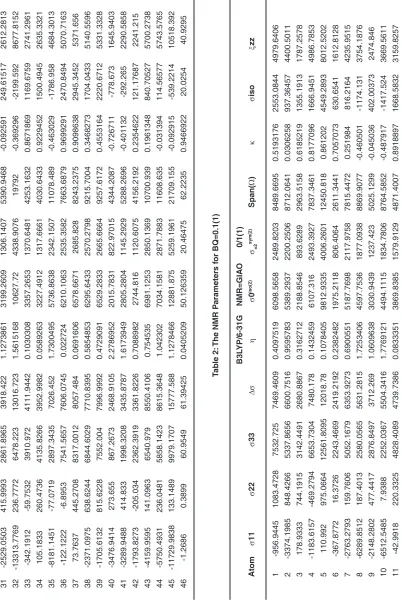
31 -2529.0503 415.9993 2861.8965 3918.422 1.1273861 3199.2609 1306.1407 5390.9468 -0.092591 249.61517 2612.2813 32 -13313.7769 236.7772 6478.223 13016.723 1.5615168 10627.72 4338.9076 19792 -0.369296 -2199.592 8677.8152 33 -342.1912 -59.7532 3910.972 4111.9442 0.1030308 3357.2653 1370.6481 4253.1632 0.8671869 1169.6759 2741.2961 34 105.1833 260.4736 4135.8266 3952.9982 0.0589263 3227.4912 1317.6661 4030.6433 0.9229452 1500.4945 2635.3321 35 -8181.1451 -77.0719 2897.3435 7026.452 1.7300495 5736.8638 2342.1507 11078.489 -0.463029 -1786.958 4684.3013 36 -122.1222 -6.8953 7541.5657 7606.0745 0.022724 6210.1063 2535.3582 7663.6879 0.9699291 2470.8494 5070.7163 37 73.7637 445.2708 8317.0012 8057.484 0.0691606 6578.6671 2685.828 8243.2375 0.9098638 2945.3452 5371.656 38 -2371.0975 638.6244 6844.6029 7710.8395 0.5854853 6295.6433 2570.2798 9215.7004 0.3468273 1704.0433 5140.5596 39 -1705.6132 815.6228 7552.004 7996.9992 0.4729091 6529.2833 2665.6664 9257.6172 0.4553164 2220.6712 5331.3328 40 -3476.9414 273.655 867.2673 2468.9105 2.2786952 2015.7831 822.97015 4344.2087 -0.726711 -778.673 1645.9403 41 -3289.9488 414.833 1998.3208 3435.8787 1.6173949 2805.2804 1145.2929 5288.2696 -0.401132 -292.265 2290.5858 42 -1793.8273 -205.034 2362.3919 3361.8226 0.7088982 2744.816 1120.6075 4156.2192 0.2354622 121.17687 2241.215 43 -4159.9595 141.0963 6540.979 8550.4106 0.754535 6981.1253 2850.1369 10700.939 0.1961348 840.70527 5700.2738 44 -5750.4931 236.0481 5858.1423 8615.3648 1.042302 7034.1581 2871.7883 11608.635 -0.031394 114.56577 5743.5765 45 -11729.9838 133.1489 9979.1707 15777.588 1.1278466 12881.875 5259.1961 21709.155 -0.092915 -539.2214 10518.392 46 -1.2686 0.3899 60.9549 61.39425 0.0405209 50.126359 20.46475 62.2235 0.9466922 20.0254 40.9295 Tab le 2:
The NMR P
arameter s f or b Q=0.1(1) b 3L
YP/6-31G NMR=GIA
O 0/1(1)
Tab
le 3:
The NMR P
arameter f or b Q=0/1(2) b 3L
YP/6-31G NMR=GIA
O 0/1(2)
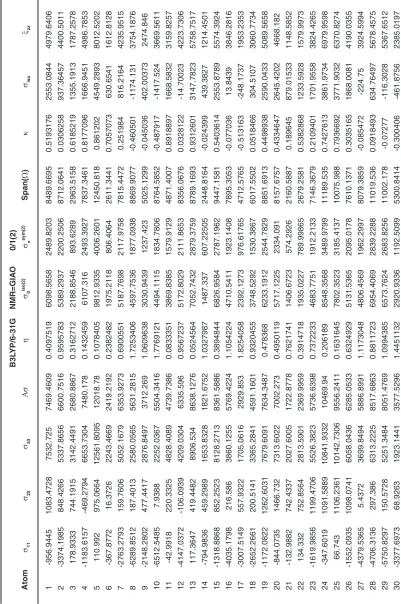
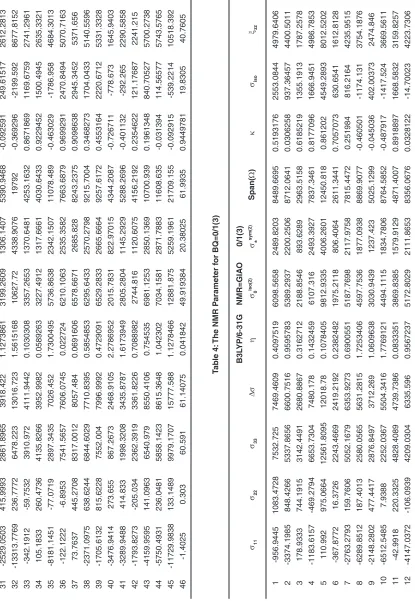
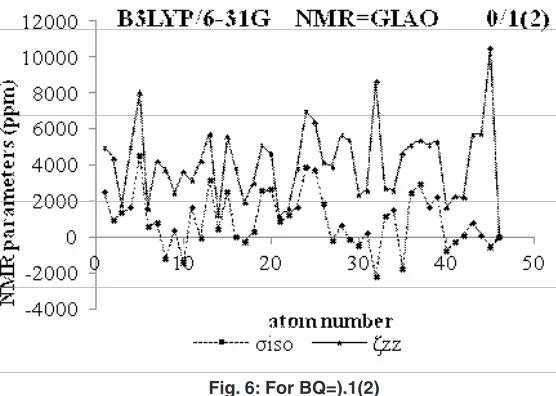
31 -2529.0503 415.9993 2861.8965 3918.422 1.1273861 3199.2609 1306.1407 5390.9468 -0.092591 249.61517 2612.2813 32 -13313.7769 236.7772 6478.223 13016.723 1.5615168 10627.72 4338.9076 19792 -0.369296 -2199.592 8677.8152 33 -342.1912 -59.7532 3910.972 4111.9442 0.1030308 3357.2653 1370.6481 4253.1632 0.8671869 1169.6759 2741.2961 34 105.1833 260.4736 4135.8266 3952.9982 0.0589263 3227.4912 1317.6661 4030.6433 0.9229452 1500.4945 2635.3321 35 -8181.1451 -77.0719 2897.3435 7026.452 1.7300495 5736.8638 2342.1507 11078.489 -0.463029 -1786.958 4684.3013 36 -122.1222 -6.8953 7541.5657 7606.0745 0.022724 6210.1063 2535.3582 7663.6879 0.9699291 2470.8494 5070.7163 37 73.7637 445.2708 8317.0012 8057.484 0.0691606 6578.6671 2685.828 8243.2375 0.9098638 2945.3452 5371.656 38 -2371.0975 638.6244 6844.6029 7710.8395 0.5854853 6295.6433 2570.2798 9215.7004 0.3468273 1704.0433 5140.5596 39 -1705.6132 815.6228 7552.004 7996.9992 0.4729091 6529.2833 2665.6664 9257.6172 0.4553164 2220.6712 5331.3328 40 -3476.9414 273.655 867.2673 2468.9105 2.2786952 2015.7831 822.97015 4344.2087 -0.726711 -778.673 1645.9403 41 -3289.9488 414.833 1998.3208 3435.8787 1.6173949 2805.2804 1145.2929 5288.2696 -0.401132 -292.265 2290.5858 42 -1793.8273 -205.034 2362.3919 3361.8226 0.7088982 2744.816 1120.6075 4156.2192 0.2354622 121.17687 2241.215 43 -4159.9595 141.0963 6540.979 8550.4106 0.754535 6981.1253 2850.1369 10700.939 0.1961348 840.70527 5700.2738 44 -5750.4931 236.0481 5858.1423 8615.3648 1.042302 7034.1581 2871.7883 11608.635 -0.031394 114.56577 5743.5765 45 -11729.9838 133.1489 9979.1707 15777.588 1.1278466 12881.875 5259.1961 21709.155 -0.092915 -539.2214 10518.392 46 -1.4025 0.303 60.591 61.14075 0.041842 49.919384 20.38025 61.9935 0.9449781 19.8305 40.7605 Tab le 4:
The NMR P
arameter f or b Q=0/1(3) b 3L
YP/6-31G NMR=GIA
O 0/1(3)
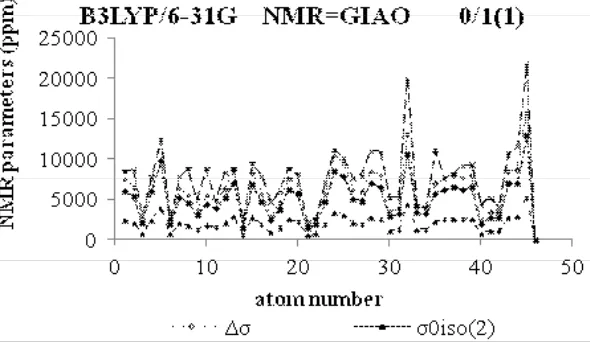
Fig.1: NMR Parameter (ppm) of span, Iso and Aniso versus atomic number
Fig. 2: NMR Parameter versus atomic number for Giao and bQ=0.03
Fig. 4: NMR Versus atomic number for iso and ZZ in GIAO methods and bQ=0.1
Fig. 5: NMR Parameter versus atomic number for Span
Fig. 7: ppm of NMR data versus atomic number
Fig. 8: Zigma Iso for the Giao=0.1(3)
and the skew (k) of the tensor which is a magnitude
of the values.
The accurate formulation of the span (W),
including the factor of (1-sref) has been described by
W = (s33- s11) (1-sref) (9). In the
Haeberlen-Mehring-Spiess notation, different combinations of the major components are used to explain the line figure, and is needed the major components become orderly according to their segregation from the isotropic value in this convention
The CSA relaxation rates depend on the anisotropy parameter in the standard parameters,
of the shielding tensor, (s11, s22, s33), are labeled
according to the IUPAC rules, and they formalized and adopt the high frequency-positive order.
Therefore, s33 corresponds to the direction of
minimum shielding, with the highest frequency,
whenever s11 corresponds to the direction of
maximum shielding, with the lowest frequency .
Moreover the orientation of asymmetry tensor is given by
and the skew is ; (-1 ≤
k ≤ 6 +1), and related on the position of s22 with
consideration of siso, the sign of k is either positive
or negative.
Based on our calculations especially
various BnNn Rings, Benzene and naphthalene,
(k) is mostly positive31-40, and the negative values
are belong to some critical or boundary points. In
the case of an axially symmetric tensor, s22 equals
either s11 or s33 and k=±1 thereforea = W/3, and
the parameter “a” and “k” are zero when s22 = siso
and the parameter “m” used with the Herzfeld-Berger
is related to the span of a tensor. Meanwhile, the
spinning rate is given by m = W*vref,
For a non-zero anti-symmetric tensor44 give
the relaxation rates
...(10)
...(11)
...(12)
Where tr,1 and tr,2 correspond to the
correlation times for isotropic tumbling and small-step molecular rotation, respectively and in the case
of axial symmetry (h=0) or for isotropic tumbling
tr,1 = 3tr, 2.
Based on recent works41-66, in this study,
we consider a model of SiO2 rings as a molecule
for Fe3O4@SIO2 catalyst using ab initio calculations
within the density functional theory (DFT) for calculating the aromaticity of rings for organic calculations.
RESULTS ANd dISCUSSION
Total shielding constants, orientations of the principal axes such as standard components, Haeberlen-Mehring, and Herzfeld-Berger parameters
for Fe3O4@Si18O27in various statistical situations
have been calculated by DFT methods and the data are listed in tables1-5.
In short distances of region around the
molecular centers, the asymmetric parameter (h),
and the skew (k), exhibited Gaussian distribution
based on their fluctuation behavior, which is dependent on their distances from the center of the molecular rings. In contrast, of those parameters, the isotropy does not have a fluctuating behavior and it increased by increasing its distance from the center of the rings with a linear relationship. The slopes of these lines are changed, and among the
levels of various distances for isolated Si18O27 and
Fe3O4@ Si18O27 (less than 0.2 Å and more than 0.2
Å for SiO2 ring, less than 0.25 Å and more than 0.25
Å for Fe3O4@ Si18O27) (Fig.1).
The isotropy during the replacing of
Fe3O4@SiO2 are positive which indicates negative
values for aromaticity,but the slopes are decreased from the replacing from 0.1 to center (Fig.1).
As we have shown in Fig. 1-7, the slopes of aromaticity curves versus distances to the center of
the Fe3O4@SiO2 ring are decreased by decreasing
the distances gradually which indicates distortion of aromatic electronic structures, and on the other hand these slopes are increased by increasing the distance, emphasizing a special electronic structure
in Fe3O4@SiO2. Therefore, S-NICS has an increased
ability to identify exact points in the area of shielding space by aromaticity criterion in such compounds via Monte Carlo stochastic calculation.
In all previous works3,10, different basis
sets yielded isotropies of various magnitude, and the criterion of aromaticity cannot be certain by using different methods, because in multiple calculations the numerous basis sets can evaluate different isotropies for two situations of one aromatic molecule.
It is acceptable that the difference between isotropies in NICS values can express the quality of the distinct aromaticity for a few molecules, but these differences between isotropies are not able to express the mechanism of aromaticity as well as S-NICS.
In the S-NICS method via the statistical calculations, the best point of the shielding space around the center of symmetric or non-symmetric aromatic molecules can evaluated as an aromaticity criterion. and in this method the expectation of
the (h*) and (k*) have been calculated as the
Gaussian curve functions versus one , two or three
dimensional distances around the center of the SiO2
(Tables 1-4and Fig.1-7).
The isotropy (siso*) which is related to all of
(h*) and (k*) and (W*) and (z*) is the best criterion for
various aromatic molecules by the S-NICS method, which can express both qualitative and quantitative magnitudes for symmetric or non-symmetric aromatic molecules (table 3).
So “k” can be calculated in two ways, the
first one by the expectation value of the Gaussian
Such as stochastic rules in the Monte Carlo
calculation for p = 3.14 in a circle, it is evident, that
the value of the Monte Carlo calculation will be more accurate by increasing the random numbers of the stochastic test, and it is significant that
|k*- k |→0.0 by addition of random numbers in the
S-NICS method.
Similar to the NICS method, in S-NICS, negative nucleus-independent chemical shifts denote aromaticity and positive values denote antiaromaticity. In S-NICS methods, the shielding and deshielding spaces are significant to discuss the mechanism of the aromatic molecules in point of ring currents, which are the circulating ð electrons in an aromatic molecule produce opposite to the applied magnetics field.
The stability of the isotropy criterion is highly affected on the best places in the shielding area spaces and it is dependent on the structures of the aromatic rings. So by using this method, a suitable and stable magnitude of isotropy can calculated as an aromaticity criterion. It is obvious that structural factors cause changes in the magnetic field experienced by the nuclei and change the resonant frequency. Therefore the chemical shielding and many other factors such as electronegativity, hydrogen bonding, and magnetic anisotropy of ð-systems will be changed because of the electrons around the proton which produce a magnetic field, countering the applied field. This reduces the field experienced at the nucleus. The electrons are said to shield the proton, an effect that is exactly dependent on the distance of the center. In addition, S-NICS can find the most accurate places for effective points for calculation of isotropy as an aromaticity criterion. The chemical shielding is a vector orientation function for all of the shielding parameters that can change in various places inside the shielding area of the rings for aromatic compounds.
The asymmetric (h),skew(k)parameters
have frequent changing or fluctuating values which have been modeled by a Gaussian distribution. And the shielding space around the center of benzene, naphthalene and borazine are canonical , where the (+) denotes the shielding and (–) indicates deshielding areas, and anisotropy as an orientation function has a fluctuating behavior and their values have been changed statistically in a Gaussian distribution.
On the other hand, the nearby protons will experience three fields: the applied field, the shielding field of the valence electrons and
the field due to the p systems. So field lines
opposed to the applied field cause a reduced field in this area equivalent to shielding, anisotropic induced magnetic field lines due to the induced
circulation of the p electron in the ring area of
benzene, naphthalene and borazine.S-NICS has
been investigated by the Monte Carlo model by computation of nucleus-independent chemical shifts in many points of shielding areas around the rings of borazine, benzene and naphthalene, by choosing specified and suitable distances (Scheme 3). The statistical simulation by the Monte Carlo method is the generation of pseudo-random numbers that are distributed in a Gaussian distribution, and the algorithm is based on a pseudorandom number
generator that produces numbers x that are uniformly
distributed in the interval [0, 1).
These random varieties x are then
transformed via some algorithm to create a new random variate having the required probability
distribution, (Tables 1, 2). The asymmetry (h), and
skew (k) parameters fluctuate by the changing of
tensors, while in the case of an axially symmetric
tensor, s22 equals either s11 or s33 and a = W/3, the
span is k= ±1 by changing asymmetry between
0 ≤h≤ +1.
REFERENCES
1. Minkin, V. J. ; Glukhovtsev, M. N. ; Simkin, B.Y. ;
Electronic and Structural Aspects, Wiley, New York, 1984.
2. Mason, J. ; Solid State Nucl. Magn.
Reson.1993, 2, 285.
3. Schleyer, P. v. R. ; Jiao, H. ; van Eikema
Hommes, N. J. R. ; Malkin, V. G. ; Malkina, O. L. ; J. Am. Chem. Soc. 1997, 119, 12669.
4. Schleyer, P. v. R. ; Maerker, C. ; Dransfeld, A.
Am. Chem.Soc.1996, 118, 6317.
5. Schleyer, P. v. R. ; Jiao, H. ; Pure. Appl. Chem.
1996, 68, 209.
6. Kruszewski, J .; Krygowski, T. M. ; Tetrahedron
Letters,1972, 36, 3839.
7. Stepien, B.T. ; Krygowski, T.M. ; Cyranski,
M.K. ; Mlochowski, J.; Orioli, P. ; Abbate, F.
ARKIVOC, 2004, 3,185.
8. Katritzky, A. R. ; Barczynski, P.; Musumarra,
G. ; Pisano, D. ; Szafran, M. J. Am. Chem.
Soc. 1989, 111, 7.
9. Feixas, F. ; Matito, E. ; Poater, J. ; Solà, M.
Journal of Computational Chemistry.2008,
29, 543.
10. Katritzky, A. R.; Karelson, M.; Sild, S.;
Krygowski, T. M.; Jug. K. J. Org. Chem.1998,
63, 5228.
11. Fias, S.; Van Damme, S.; Bultinck,P.; Journal
of Computational Chemistry. 2008, 29, 358.
12. Hehre, W. J. R.; Ditchfield, Radom, L.; Pople,
J. A. J. Am. Chem. Soc.1970, 92, 4796.
13. Cooper, D. L.; Gerratt, J.; Raimondi, M.
Nature,1986,323, 699.
14. Julg, A. Francois, Ph.; Theor. Chim. Acta.1967,
7, 249.
15. Monajjemi, M.; Struct. Chem.2012, 23, 551.
16. Monajjemi, M.; Lee, V. S.; Khaleghian, M.;
Honarparvar, B.; Mollaamin. F.; J. Phys.
Chem. C.2010 114, 15315.
17. Monajjemi, M.; Khaleghian, M.; J. Cluster
Sci.2011, 22, 673.
18. Monajjemi, M.; Boggs, J.E, J. Phys. Chem.
A,20133 .
19. Frueh, D.; Nucl.P.; Reson.M, Spectrosc.2002,
41, 305.
20. Jiao, H.; . Schleyer, P. v. R, J. Am. Chem. Soc.
1995, 117, 11529.
21. Martin, N. H.; Nance, K.H.; Journal of
Molecular Graphics and Modelling.2002,21, 51.
22. Luginbhl, P.; Wuthrich , K.; Progress in Nuclear
Magnetic Resonance Spectroscopy.2002, 40, 199.
23. Magn. R. L.; Reson. Rev.1987, 12, 91.
24. Monajjemi,M.; Mohammadian,T.N.; J. Comput.
Theor. Nanosci.2015, 12, 4895-4914.
25. Greenwood, Nor man N.; Ear nshaw,
Alan Chemistry of the Elements (2nd ed.). Butterwor th-Heinemann. (1997). ISBN 0080379419.
26. Laurent, S.; Forge, D.; Port, M.; Roch, A.;
Robic, C.; Vander Elst, L.; Muller, R.N. Chem.
Rev. 2008, 108, 2064–2110.
27. Kodama, R.H. Magnetic nanoparticles. J.
Magn. Magn. Mater. 1999, 200, 359–372.
28. Chang, L.L.; Erathodiyil, N.; Ying, J.Y. Acc.
Chem. Res. 2012, 46, 1825–1837.
29. Fujishima, A.; Zhang, X.; Tryk, D.A. Surf. Sci.
Rep. 2008, 63, 515–582.
30. Wang, X.; Starz-Gaiano, M.; Bridges, T.;
Montell, D. Protoc, Exch,2008, 28.
31. Mahdavian, L.; Monajjemi, M. Microelectronics
Journal. 2010,41(2-3), 142-149
32. Ali R. Ilkhani .; Majid Monajjemi, Computational
and Theoretical Chemistry.2015, 1074
19–25
33. Monajjemi,M *.; Bagheri,S.; Moosavi,M.S..;
Moradiyeh,N.; Zakeri,M.; Attarikhasraghi,N.; S a g h ay i m a r o u f, N . ; N i ya t z a d e h , G . ; Shekarkhand,M.; Mohammad S. Khalilimofrad,
Ahmadin,H.; Ahadi,M.; Molecules 2015, 20,
21636–21657;
34. Monajjemi, M., Chahkandi, B. Journal of
Molecular Structure: THEOCHEM, 2005, 714
(1), 28, 43-60.
35. Monajjemi, M.; Rajaeian, E.; Mollaamin, F.;
Naderi, F.; Saki, S. Physics and Chemistry of
Liquids. 2008, 46 (3), 299-306
36. Monajjemi, M.; Razavian, M.H.; Mollaamin,F.;
Naderi,F.; Honarparvar,B.; Russian Journal of
Physical Chemistry A , 2008 , 82 (13), 2277-2285
37. Monajjemi, M. Chemical Physics. 2013, 425,
29-45
38. Monajjemi, M.; Ketabi, S.; Amiri, A. Russian
Journal of Physical Chemistry, 2006, 80 (1), S55-S62
39. Monajjemi, M.; Wayne Jr, Robert. Boggs, J.E.
Chemical Physics.2014, 433, 1-11
40. Monajjemi, M.; Honarparvar, B.; Nasseri,
S. M. .; Khaleghian M. Journal of Structural
Chemistry. 2009, 50, 1, 67-77
41. Ardalan, T.; Ardalan, P.; Monajjemi, M.
Fullerenes, Nanotubes, and Carbon Nanostructures, 2014, 22: 687–708
42. Monajjemi, M.; Karachi, N.; Mollaamin,
F. Fullerenes, Nanotubes, and Carbon
Nanostructures, 2014, 22: 643–662
43. Yahyaei, H.; Monajjemi, M. Fullerenes,
22(4), 346–361
44. Monajjemi, M. Falahati, M.; Mollaamin, F.;
Ionics, 2013, 19, 155–164
45. Monajjemi, M.; Mollaamin, F. Journal of
Cluster Science, 2012, 23(2), 259-272
46. Tahan, A.; Monajjemi, M. Acta Biotheor,2011,
59, 291–312
47. Lee, V.S.; Nimmanpipug, P.; Mollaamin,
F.; Kungwan, N.; Thanasanvorakun, S..;
Monajjemi, M. Russian Journal of Physical
Chemistry A, 2009, 83, 13, 2288–2296
48. Monajjemi, M.; Heshmat, M.; Haeri, HH,
Biochemistry (Moscow), 2006, 71 (1), S113-S122
49. Monajjemi, M.; Jafari Azan, M.; Mollaamin,
F. Fullerenes, Nanotubes, and Carbon Nanostructures.2013, 21(6), 503–515
50. Mollaamin, F.; Monajjemi, M. Physics and
Chemistry of Liquids .2012, 50, 5, 2012, 596–604
51. Monajjemi, M.; Khosravi, M.; Honarparvar,
B.; Mollaamin, F.; International Journal of
Quantum Chemistry, 2011, 111, 2771– 2777
52. Monajjemi, M.; Baheri, H.; Mollaamin, F.
Journal of Structural Chemistry.201152(1), 54-59
53. Mahdavian, L.; Monajjemi, M.; Mangkorntong,
N. Fullerenes, Nanotubes and Carbon
Nanostructures, 2009, 17 (5), 484-495
54. Monajjemi, M.; Farahani, N.; Mollaamin, F.
Physics and Chemistry of Liquids, 2012, 50(2)
161–172
55. Monajjemi, M. Theor Chem Acc, 2015, 134:77
DOI 10.1007/s00214-015-1668-9
56. Monajjemi, M. Journal of Molecular Modeling
, 2014, 20, 2507
57. Monajjemi , M.; Honarparvar, B.; Monajemi,
H.;. Journal of the Mexican Chemical Society,
2006, 50 (4), 143-148
58. Monajjemi, M.; Khaleghian, M.; Mollaamin, F.
Molecular Simulation. 2010, 36, 11, 865–
59. Monajjemi, M. Biophysical Chemistry. 2015
207,114 –127
60. Sarasia, E.M.; Afsharnezhad, S.; Honarparvar,
B.; Mollaamin, F.; Monajjemi, M. Physics and
Chemistry of Liquids. 2011, 49 (5), 561-571
61. Amiri, A.; Babaeie, F.; Monajjemi, M. Physics
and Chemistry of Liquids. 2008, 46, 4, 379-389
62. Jalilian,H.; Monajjemi, M. Japanese Journal
of Applied Physics. 2015,54, 8, 08510
63. Naghsh,F, orient. j chem, 2015, 31(1)
465-478
64. Chitsazan, A, orient. j chem, 2015, 31(1) 393-
408
65. Barmaki, Z, orient. j chem, 2015, 31(3)
1723-1733
66. Bonsakhteh, B.; Rustaiyan, A.H, orient. j