Licensed under Creative Common Page 1
http://ijecm.co.uk/
ISSN 2348 0386
THE EFFECT OF INTERNAL AUDIT FUNCTION ON THE
FINANCIAL PERFORMANCE OF TERTIARY
INSTITUTIONS IN NIGERIA
Ejoh, Ndifon Ojong
Department of Accountancy, Cross River University of Technology, Calabar, Nigeria
Ejom, Patrick Ekponta
Cross River State College of education, Akamkpa, Nigeria
Abstract
The study sought to establish the relationship between internal audit function and financial
performance in Tertiary Institutions in Nigeria with particular reference to Cross River State
College of Education, Akamkpa. Data was collected using questionnaires and interview guide
as well as review of available documents and records. The method of analysis employed was
survey design while the stratified sampling procedure was adopted in administering the
questionnaires. The data were analyzed using simple percentages, tables, correlation
coefficient and z-scores. The study revealed that all activities of the College are initiated by the
top management. On the effectiveness of internal audit, the study found that the internal audit
department of the College is not sufficiently staffed, does not perform their duties with greater
degree of autonomy and independence from management. Also, the study found that there is a
flaw of audit model in the College. The study further revealed that internal audit function has n o
significant effect on the financial performance of Cross River State College of Education. The
investigation recommends competence profiling in the internal audit unit of the Institution which
should be based on what the College expects the internal audit to do and what appropriate
number of staff would be required to do the job. It also recommends that the head of the Internal
Audit Department should be a professional or a member of any professional Accountancy body
in Nigeria for ethical justification.
Keywords: Internal audit, internal control system, financial performance, financial and non
Licensed under Creative Common Page 2
INTRODUCTION
Internal auditing serves as an important link in the business and financial reporting processes of
corporations and not-for-profit organizations. Internal auditors play a key role in monitoring a company’s risk profile and identifying areas to improve risk management. The aim of internal
auditing is to improve organizational efficiency and effectiveness through constructive criticism.
Internal Auditing has four main components: viz; verification of written records, analysis of
policy, evaluation of the logic and completeness of procedures, internal services and staffing to assure they are efficient and appropriate for the organisation’s policies; and reporting
recommendations for improvements to management. The subject is worthy of attention because
internal auditors are important, even crucial, in an economy that relies upon independently
produced information.
Indeed, Internal Audit has become an indispensable management tool for achieving
effective control in both public and private organisations. Control mechanisms are those
processes set up to monitor and to direct, promote or restrain the various activities of an
enterprise for the purpose of seeing that enterprise objectives are met. By detecting
weaknesses in management operations, Internal Auditing provides a basis for correcting
deficiencies that have eluded the first line of defense before these deficiencies become uncontrollable or are exposed in the external auditor’s report.
In Cross River State College of Education, Akamkpa, financial performance is one
aspect that has not been given the attention it deserves. College staff has in a number of cases
been given College resources and have failed to account for the resources entrusted to them or
have not made the necessary accountabilities on time. College auditors (internal and external)
have noted cases where funds are advance to staff but six months elapse without the
responsible officer providing necessary accountability. When an organization suddenly collapses, the often resounding question is “what went wrong”? A breakdown in the internal
controls system is the usual cause. Internal control is a process that guides an organization
towards achieving its objectives. These objectives includes; operational efficiency and
effectiveness, reliability of financial reporting and compliance with relevant laws and regulation
(COSO 1992). Absence of these variables often creates problems in organizations and
eventually leads to poor financial performance.
Research Hypothesis
Ho: Internal audit function has no significant effect on financial performance of tertiary
Licensed under Creative Common Page 3
THEORETICAL FRAMEWORK & LITERATURE REVIEW
Theoretical Framework
Agency theory and the internal audit as propounded by Adams (1994) is one of the theoretical
framework that guided this study. Agency theory is extensively employed in the accounting
literature to explain and predict the appointment and performance of external auditors and
financial consultants. He argued that, agency theory also provides a useful theoretical
framework for the study of internal auditing function. He also proposed that agency theory not
only helps to explain and predict the existence of internal audit but that is also helps to explain
the role and responsibilities assigned to internal auditors by the organization and that agency
theory predicts how the internal audit function is likely to be affected by organizational change.
He concludes that agency theory provides a basis for rich research, which can benefit both the
academic community and internal auditing profession. This theory no doubt relates to this study
as it helps to explain the role and responsibilities of internal auditors which if methodically
applied would help to improve financial performance in tertiary institutions in Nigeria.
According to Anderson, Francis & Stokes (1993), Agency theory describes firms as
necessary structures to maintain contracts, and through firms, it is possible to exercise control
which minimizes opportunistic behaviour of agents. In order to harmonize the interest of the
agent and the principal, a comprehensive contract is written to address the interest of both the
agent and the principal; they further explain that the relationship is further strengthened by the
principal employing an expert to monitor the agent.
Other related reviews include the Sarbanes-Oxley act of 2002 (SOX) which requires
companies to report on the effectiveness as part of an overall effort to reduce fraud and restore
integrity to the financial reporting process.
Morris, J.J. (2011) assert that software vendors that market enterprise resource planning
(ERP) system have taken advantage of this new focus on internal controls by emphasizing that a key feature of ERP system is the in-built controls that mirror a firm’s infrastructure. They
emphasized these feature in their marketing literature, asserting that these systems will help firm’s improve the effectiveness of their controls as required by Sarbanes-Oxley Act.
Evaluation of Internal Control System
Aguolu (2002) while commenting on the evaluation of internal control stated that it is almost
impossible to study auditing or to be able to perform any meaningful audit in practice without
having a perfect grasp of the concept of internal control. According to him, internal control
system forms the bedrock of auditing both from the point of view of management and the
Licensed under Creative Common Page 4
Udu (2006) while examining the financial control and accountability in local government opined
that one of the ways by which management can discharge the responsibility of detecting and
preventing fraud, waste, abuse and errors is by instituting an effective internal control system.
He went further to submit that internal control could be in any of the following form, viz: Preventive – to prevent undesirable events from happening.
Detective – to indicate and manage undesirable events which may threaten that organization and or which have happened.
Directive – to cause or encourage a desirable event to occur.
Oshisami (2004) while evaluating Government Accounting and financial controls said that
internal control can do much to protect against both errors and irregularities and ensure the
reliability of accounting data. He went further to categorize control in the following areas: Financial Control
Internal Audit
Administrative control
Accounting control (which includes; control techniques, internal deck, supervision and checking and resolution of audit queries).
Budgeting control
O’ Relly, Winogard and Jacnicke (1999), quoting Auditing standards section 319 stated as follows; “A sufficient understanding of internal control is to be obtained to plan the audit and to
determine the nature, timing and to determine the nature, timing and extent of tests to be performed”.
Financial and Non Financial Procedures
Subomi (2010) opined that financial controls in an organization focus on the key transaction
areas, with emphasis being on the safeguarding of assets and the maintenance of proper
accounting records and reliable financial information. He went further to submit that
non-financial controls tend to concentrate on wider performance issue; of which some are
quantitative and some are qualitative. Quantitative non-financial according to him include
controls like performance indicators, score card and qualitative control include things like
organizational structure, rules and guideline, strategic plant etc. He concluded by grouping
financial control procedure into the following category.
Management control: - The management of any organization is the control that established other controls.
Organizational control: - These are controls as a result of well spelt out organizational structure.
Licensed under Creative Common Page 5 Physical Control: Necessary to protect and safeguard financial records and assets. Authorization Control: To ensure that only properly authorized transactions are
processed.
Supervision Control: Controls exercise by the organization hierarchy.
Personal Control: Personal controls are established starting from the recruitment point. Arithmetic and Accounting Controls: These are exercise when the work of a
subordinate is expose to the cross examination of a superior.
Acknowledgement of Performance: Individuals that execute a particular action acknowledge being the doer.
Internal Control system and Financial Performance
The Institute of Chartered Accountants in England and Wales (ICAEW) statement of Auditing
defines internal controls as not only internal check and internal audit, but the whole system of
control, financial and otherwise, established by management of an organization in order to carry
on the business of the entity in an orderly manner, safeguard its assets and secure as far as
possible the accuracy and reliability of its records. It is therefore worth noting from the above,
that properly instituted systems of internal control will enhance better financial performance. It will ensure; completeness of all transactions undertaken by an entity, that the entity’s assets are
safeguard from theft and misuse, that transactions in the financial statements are stated at the
appropriate amounts, that all assets in the financial statement of a company do exist, that all the assets presented in the company’s financial statements are recoverable and that the entity’s
transactions are presented in the appropriate manner according to the applicable reporting
framework.
The American Institute of Certified Public Accountants (AICPA) adopted as its definition of internal control the following statements; “Internal Control comprise the plan of the
organization and all the coordinate methods and means adopted within the business to
safeguard its assets, check the accuracy and reliability of its accounting data, promote
operational efficiency and encourage adherence to prescribed managerial policies: According to
AICPA, internal control is the term generally used to describe how management assures that an
organization does meet its financial and other objectives. Thus, internal control system not only
contributes to managerial effectiveness but is also important duties of corporate Board of
Directors. Internal Control has been defined by the Committee of Sponsoring Organization of the Tradeway Commission (COSO 1992) in internal control integrated framework, as; “A process effected by an entity’s board of directors, management and other personnel designed to
provide reasonable assurance regarding the achievement of objectives in the following
Licensed under Creative Common Page 6
performance goals and safeguarding resources); reliability of financial reporting; compliance with applicable laws and regulation”.
The commission further added that internal control is a management tool used to provide reasonable assurance that the public sector organization’s objectives are being achieved
efficiently. Internal control covers the whole system of controls, policies and procedure
established by management to meet their targets and objectives.
The three major categories of management objectives comprise; effective operations,
financial reporting and compliance. Effective operations are about safeguarding the assets of
the organization. The physical assets like cash, non physical assets like receivable, important
documents and records of the organization can be stolen, misused or accidentally destroyed
unless they are protected by adequate controls. The goal of financial control requires accurate
information for internal decision because management has a legal and professional
responsibility to ensure that information is prepared fairly in accordance with applicable
accounting standard e.g. International Financial Reporting Standards (IFRS) and International
Public Sector Accounting Standards (IPSAS). Organizations are equally required to comply with
many laws and regulations including company laws, tax laws and environment protection laws.
Literature Review
Recent case studies on internal auditing in Belgium illustrate the importance of the control
environment when studying internal auditing practices. Saren & De Belde (2006) assumed that
when an organization pursues integrity and clear ethical values reflected in a formal code of
conduct/ethics, the internal audit function will take a greater importance. Internal control
systems not only contribute to managerial effectiveness but are also important duties of
corporate board of directors. Accounting literature likewise emphasizes the importance of an organization’s integrity and ethical values in maintaining an effective control.
A focus on integrity and ethical values was the principal contribution of internal control –
integrated framework published by COSO on fraudulent financial reporting. To trigger
independence and integrity of Auditors and Accountants, the Accountancy profession globally
has a document called the code of Ethics issued by the International Federation of Accountants
(IFAC). In the case of Nigeria, there is a code of conducts issued by the Institute of Chartered
Accountants of Nigeria (ICAN). This code contains some ethical standards which members are
expected to comply (Kalu 2011). Performance refers to the ability to operate eff iciently,
profitability, survive growth and react to the environmental opportunities and threats (Mawanda
2008). Thus, performance is measured by how efficient an organization is in use of resources in
Licensed under Creative Common Page 7
institution or process. Hitt, et al (1996) believes that many firms low performance is the result of
poorly performing assets.
However, appropriate performance measures are those which enable organizations to
direct their actions towards achieving their strategic objectives. Verschor (1999) however,
mentioned other financial measures and include value of long term investment, financial
soundness, and use of corporate assets. He also talks of non financial performance measures
and include; innovation, ability to attract, develop and keep talented people, quality of
management, quality of products or services and community and environmental responsibility.
Hitt, el al (1996) mention accounting based performance using three indicators; Return on
Assets (ROA), Return on Equity (ROE), and Return on Sales (ROS). Each measure was
computed by dividing net income by total assets, total common (ordinary) equity, and total net
sales, respectively. Mawanda (2008) also identified other measures of financial performance to
include;
Reporting: Whittington and Pany (2001), talk about the comprehensiveness of internal controls
in addressing the achievement of objectives in the areas of financial reporting, operations and
compliance with laws and regulations. They further noted that, internal control also includes the
program for preparing, verifying and distributing to the various levels of management those
current reports and analyses that enable executive management to maintain control over the
variety of activities and functions that are performed in an organization. They mentioned internal
control devices to include; use of budgetary techniques, production standards, employee
training, among others. According to Morris, J. J. (2011), enterprise resource planning systems
provide a mechanism to deliver fast, accurate financial reporting with built-in controls that are
designed to ensure the accuracy and reliability of the financial information being reported to
owners.
Accountability: Bakibinga (2001) believed that corporate law requires a divorce between
ownership and managements of an entity. Owners normally entrust their resources in the hands
of managers. Managers are required to use the resources entrusted to them in the furtherance of the entity’s objectives. Managers normally report to the owners on the result of their
stewardship for the resources entrusted to them through a medium called financial statement.
It is these financial statements that reveal the financial performance of an entity. For the
purpose of this research, the owners of the College are the government and the people of Cross
River State where as the managers are the College Governing Council and Management.
Accountability can be political, social or financial accountability. According to Hayes, et
al (2005), reporting is one way through which managers make accountability for resources
Licensed under Creative Common Page 8
RESEARCH METHODOLOGY
Based on the nature and variability of the phenomena under study, the cross sectional survey
design approach was justified on the account of its economy, rapid data collection and ability to
understand a population from a part. The researcher designed, developed and administered
close ended questionnaires to top management staff, academic and non – academic staff of
Cross River State College of Education, Akamkpa. This was used for the purpose of obtaining
data to test the hypothesis.
However, greater emphasis was laid on capturing members in finance and finance
related offices. The stratified sampling procedure was adopted in administering the
questionnaires to guide the study. The sampling technique used for the study is the judgment
(purposive) sampling. Purposive sampling is where the researcher consciously decides who to
include in the sample. Data was collected using both primary and secondary data collection
technique. Primary data was gathered basically through structured questionnaires and interviews with “key informant members”. Secondary data was gathered through College
publications, text books, journal, etc.
The data collected were synthesized and analyzed to give meaning to the specific
objective of the study. The data were tabulated and presented using such statistical tools like
percentages, tables and correlation coefficient. The entire hypotheses formulated were tested
using the z-score. Correlation was used as a way of assessing the relationship between internal
audit function and financial performance. Narrative analysis was used to explain the qualitative
results of the survey.
ANALYSIS AND DISCUSSION OF FINDINGS
Data Presentation
The data collected for the study are presented using tables:
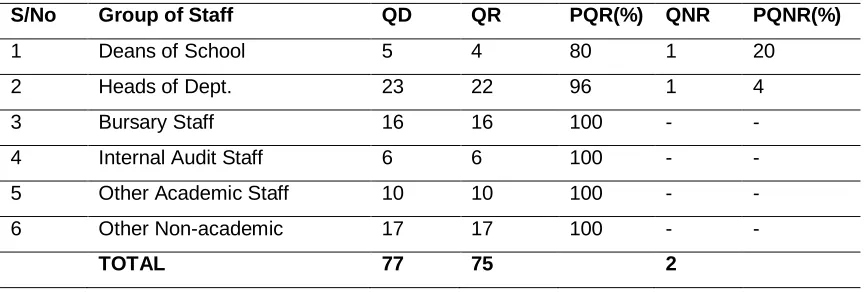
Table 4.1: Questionnaire Distributed and Received
S/No Group of Staff QD QR PQR(%) QNR PQNR(%)
1 Deans of School 5 4 80 1 20
2 Heads of Dept. 23 22 96 1 4
3 Bursary Staff 16 16 100 - -
4 Internal Audit Staff 6 6 100 - -
5 Other Academic Staff 10 10 100 - -
6 Other Non-academic 17 17 100 - -
Licensed under Creative Common Page 9
In the Table 1;
QD = Questionnaire distributed QR = Questionnaire received
PQR = Percentage of questionnaire received QNR = Questionnaire not received
PQNR = Percentage of questionnaire not received
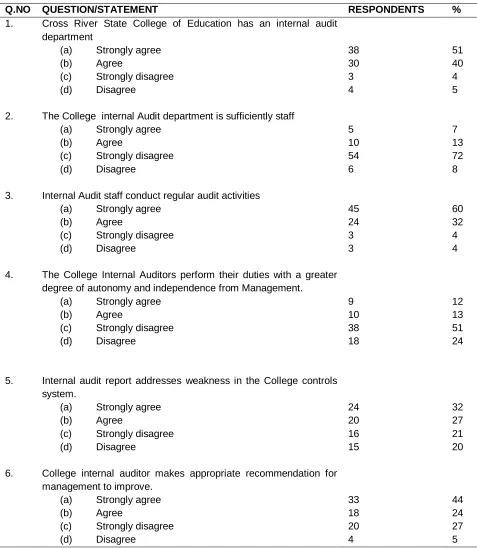
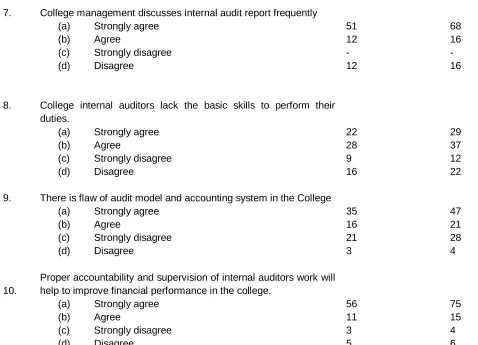
Table 2: Collation of Responses on whether Internal Audit Function has any significant effect on Financial Performance.
Q.NO QUESTION/STATEMENT RESPONDENTS %
1. 2. 3. 4. 5. 6.
Cross River State College of Education has an internal audit department
(a) Strongly agree (b) Agree
(c) Strongly disagree (d) Disagree
The College internal Audit department is sufficiently staff (a) Strongly agree
(b) Agree
(c) Strongly disagree (d) Disagree
Internal Audit staff conduct regular audit activities (a) Strongly agree
(b) Agree
(c) Strongly disagree (d) Disagree
The College Internal Auditors perform their duties with a greater degree of autonomy and independence from Management.
(a) Strongly agree (b) Agree
(c) Strongly disagree (d) Disagree
Internal audit report addresses weakness in the College controls system.
(a) Strongly agree (b) Agree
(c) Strongly disagree (d) Disagree
College internal auditor makes appropriate recommendation for management to improve.
(a) Strongly agree (b) Agree
(c) Strongly disagree (d) Disagree
Licensed under Creative Common Page 10 7.
8.
9.
10.
College management discusses internal audit report frequently (a) Strongly agree
(b) Agree
(c) Strongly disagree (d) Disagree
College internal auditors lack the basic skills to perform their duties.
(a) Strongly agree (b) Agree
(c) Strongly disagree (d) Disagree
There is flaw of audit model and accounting system in the College (a) Strongly agree
(b) Agree
(c) Strongly disagree (d) Disagree
Proper accountability and supervision of internal auditors work will help to improve financial performance in the college.
(a) Strongly agree (b) Agree
(c) Strongly disagree (d) Disagree
51 12 - 12 22 28 9 16 35 16 21 3 56 11 3 5 68 16 - 16 29 37 12 22 47 21 28 4 75 15 4 6
Analysis of the Data
Table 1 shows that the total number of questionnaire distributed to the selected staff is 77 with
75 of them representing 97 percent completed and returned. Only 2 or 3 percent of the
questionnaire were not returned. Therefore, completed and returned questionnaire have been
used for the analysis and evaluation of the reasons for the effect of internal controls system on
Financial Performance of Tertiary Institution, with Cross River State College of Education,
Akamkpa as case study.
Table 2 shows responses on the quality of internal audit function. 38 respondents or 51
percent of the staff strongly agreed that the College has an internal audit department. Also, 3 or
4% of the staff strongly disagreed to this. 4 or 5% of the respondents disagreed to this view.
Again, 5 or 7% of the respondents strongly agreed that the internal audit department is
sufficiently staff, 10 or 13% also agreed this view whereas, 54 or 72% of the respondents
strongly disagreed that the audit department is sufficiently staff. Also 45 or 60% of the
respondents strongly agreed that internal auditors conduct regular audit activities. 24 or 32% of
Licensed under Creative Common Page 11
the staff strongly agreed that there is flaw of audit model and accounting systems. 16 or 21% of
the respondents agreed to this.
Test of Hypothesis
Ho: Internal audit function has no significant effect on financial performance of tertiary
institutions in Nigeria
Decision Rule:
Reject Ho: if z > za or if z < -za
Accept HO: if z < za or if z > -za
Where; z = test statistic (value)
Za = critical (table) value.
Level of significance used is 5%
The critical value is z = 0.05 = 1.96
The statistical test z = Ø - Øo
S Ø
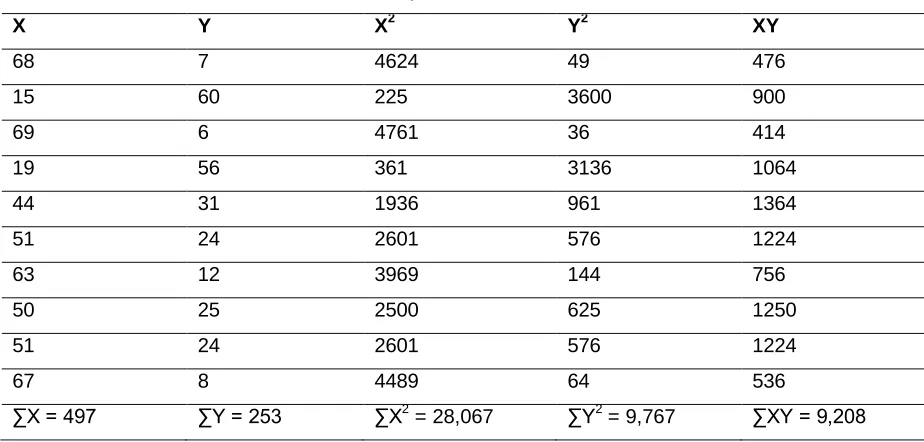
Table 3: Computation of z-test statistic
X Y X2 Y2 XY
68 7 4624 49 476
15 60 225 3600 900
69 6 4761 36 414
19 56 361 3136 1064
44 31 1936 961 1364
51 24 2601 576 1224
63 12 3969 144 756
50 25 2500 625 1250
51 24 2601 576 1224
67 8 4489 64 536
∑X = 497 ∑Y = 253 ∑X2
= 28,067 ∑Y2 = 9,767 ∑XY = 9,208
∑X ∑Y = 125,741, (∑X)2 = 247,009, (∑Y)2 = 64,009
Substituting these values in the formula r = N (∑XY) - (∑X) (∑Y)
√N∑X2 - (∑X)2 N∑Y2 - (∑Y)2
Licensed under Creative Common Page 12
r = 10 (9208) – (497) (253) = -1
√(10 x 28067 – (247009) (10 x 9767 – (64009)
Comparing the critical value with the test statistics = -1.0000 >- 1.96
Decision: since the negative value of the z statistic is higher than the critical or table value and falls outside the acceptable region. Therefore, the alternative hypothesis Hᵢ is rejected. The null
hypothesis Ho is then accepted that internal audit function has no significant effect on the
financial performance of tertiary institutions
Discussion of Findings
Internal Audit Function: Effects on financial performance
The quality of internal auditors work is expected to ensure the internal auditors have an
independent mental attitude to the performance of their work. And also to ensure that internal
auditors have an honest belief in their work product and that no significant quality compromise is
made.
Unfortunately, in Cross River State College of Education, internal auditors do not
perform their duties with greater degree of autonomy and independence from management.
The internal audit control system is only as effective as the personnel who implement
and perform the controls. Thus the responses show in table 4.2 and the result of the test
statistic revealed that independence of internal auditors is not enough; the internal audit
department is in dearth of staff, lack of basic skills to perform their duties as well as flaw of audit
model and accounting systems.
These results collaborate with the views of Chen, Hua and Zhao, (2006) that
independence is the key to ensure audit quality. The table also showed that internal audit
department report weaknesses in the system and makes appropriate recommendation to
management, thereby proving as valid the hypothesis that internal audit function has no
significant effect on financial performance of Cross River State College of Education.
CONCLUSION AND RECOMMENDATIONS
Based on the findings of the study, it is concluded that the College has an effective internal
controls system as supported by the study findings and responses to questionnaire on clear
separation of roles, supervision and management commitment to control activities. However,
there are challenges in the area of staff training, flaw of audit model and accounting system, auditors’ independence and staffing; which clearly affected their efficiency as revealed by this
Licensed under Creative Common Page 13
Since it was evident in the study, that the staffing level in the internal audit department is not
adequate to cover the entire College set up, the study therefore recommends competence
profiling which should be based on what the College expects the internal audit to do and what
appropriate number of staff would be required to do the job.
The study also recommends that Management should establish and implement periodic
review of internal audit performance to ensure that its performance and value to the Institution is
maximized and to ensure compliance with appropriate standards and guidance. The study
further recommends that the head of Internal Audit department should be a professional
accountant and registered with any of the professional accountancy body in Nigeria to ensure
ethical righteousness.
REFERENCES
ACCA (2009/2010). Advance Audit and Assurance. Kaplan Publishing.
Adams, M.B. (1994). Agency Theory and the Internal Audit, Managerial Auditing Journal, On-line http://www.emeraldinsight.com.
Aguola, O. (2002). Fundamentals of Auditing, 2nd ed. Meridian Associates. Enugu.
Anderson, D; Francis, J.R. & Stokes, D.J. (1993).’Auditing, directorship and the demand for monitoring:
Journal of Accounting and PublicPolicy.
Bakibinga, D.J. (2001). Company Law in Uganda. fountain Publishers Kampala, Uganda.
Committee of Sponsoring Organization (COSO) (1992). Internal Control Integrated Framework: Executive Summary. www.coso.org.
COSO Definition of Internal Control (on-line: http://www.coso.org
Cross River State College of Education (2010). College handbook
Cross River State College of Education (2012). Rules and Regulations for employees.
Hayes, R. et al. (2005) Principles of Auditing. Pearson Education Ltd.
Hitt, M. A; Hoskisson, R. E, et al (1996) The Market for Corporate Control and Firm Innovation.
ICAN (2009). Advance Auditing and Assurance: PE1 Study Pack. VI Publishers. Lagos. Institute of Internal Auditors Research Foundation (1994). System Audibility and Control.
Mawanda, S. P. (2008). Effects of Internal Control System on Financial Performance in Uganda’s Institution of Higher Learning. Dissertation for award of MBA in Uganda Martyrs University.
Kalu, U. (2011). ICAN Financial Reporting and Ethics Manual. Kalma Associates. Lagos.
Morris, J. J. (2011). The Impact of Enterprise Resource Planning (ERP) Systems on the Effectiveness of Internal Controls over Financial Reporting.
Oshisami, K. (2004). Government Accounting and Financial Control: Principles and Practices. 6th ed. Spectrum Books Limited. Ibadan.
O’Relly, V. M; Winograd, B. N; and Jacnicke, H. C. (1999). Montgomery’s Auditing: Continuing Professional Education. Version12th ed. John Wiley & Sons Inc. New York.
Licensed under Creative Common Page 14 Subomi, O. (2010). Principles of Auditing and other Assurance Services Nature Print. Lagos
Uka, N. E. (2011). Effective Internal Audit Control System as Penacea for audit failure in Ebonyi State University Teaching Hospital. Thesisfor the award of Master of Science (M.Sc) Degree in Accounting: Ebonyi State University.
Udu, U. S. An Overview of Financial Controls & Accountability in Local Government System: A Workshop organized by Local Government Civil Service Commission: 16th October, 2006.
Verschoor, C. C. (1999). Corporate Performance: Link to strong ethical commitment.