Licensed under Creative Common Page 1
http://ijecm.co.uk/
ISSN 2348 0386
THE INFLUENCE OF CUSTOMER CENTRIC STRATEGIC
APPROACH FOR COMPETITIVE ADVANTAGE ON CUSTOMER
SATISFACTION IN CFC STANBIC BANK KENYA LIMITED
Bii, Maureen E
School of Human Resource Development
Jomo Kenyatta University of Agriculture and Technology, Kenya [email protected]
Wanyoike, Daniel M
School of Human Resource Development
Jomo Kenyatta University of Agriculture and Technology, Kenya [email protected]
Abstract
Businesses are losing money through missed business opportunities because they are unable
to quickly and effectively profile customer and prospect data quality issues. This study aimed at
finding out the influence of enterprise technology on customer satisfaction at CFC Stanbic bank
in Kenya. The study employed a descriptive study design and a target population of 100 staff
members of the five branches of this bank in Nairobi Kenya. Data was processed and analyzed
using SPSS 21. Descriptive statistics such as frequency counts, and percentages and inferential
statistics such as Correlation analysis presented in tables were used to show the relationship
between the different variables. The researcher found enterprise technology to be an important
predictor of customer satisfaction. It was concluded that the enterprise technology was
considerably important to the bank in tracking the performance of all its products and services
and to monitor the traffic of knowledge in its set up. It was recommended that the bank’s needs
to regularly train employees on technology application to customers as most of the time
technology was outpacing the capability of staff to handle it and this could cause delays in the
system and inconvenience the customers.
Licensed under Creative Common Page 2 INTRODUCTION
Licensed under Creative Common Page 3 on customer behaviors, and increase all-channel management performance. The high growth witnessed in CRM worldwide undoubtedly demonstrates that the customer is the central focus in modern business models. Yu, (2001) notes that one of the most achievements of CRM implementation is an increase in customer centricity. A senior executive in best buy said “If we understand our customers better than our competitors do, and if we can inspire our employees to have richer interactions with customers, then we can more effectively compete,” Customer relationship management (CRM) is a business strategy that aims to understand, anticipate and manage the needs of an organization‟s and potential customers. It is a journey of strategic, process, organization and technical change whereby a company seeks to better manage its own enterprise around customer behaviors. It entails acquiring and deploying knowledge about one‟s customers and using this information across the various touch points to balance revenue profits with maximum customer satisfaction.
Customer satisfaction is a measure of how products and services supplied by a company meet or surpass customer expectation. Customer satisfaction is defined as extent to which a product‟s perceived performance matches a buyer‟s expectations and it depends on the product‟s perceived performance relative to a customer‟s expectations (Zeithaml & Bitner, 2001). Attracting customers and nurturing their loyalty has become a huge issue for business of all kind. Increasing competitive pressures to maintain profitability while delivering superior value, makes every customer transaction increasingly precious to an organization. Terms such as market-oriented, customer-focused, market-driven and customer-centric have become synonymous with proactive business strategy in firms worldwide (Deshpande, 1999). The rapid growth of the internet and its associated technologies has greatly increased the opportunities for marketing and has transformed the way relationship between companies and their customers are managed (Bauer et al, 2002).
According to Ndungu (2013) Information Technology has emerged to be a strategic resource for attaining efficiency, controls, productivity and profitability and this has caused banks to utilize technology to meet the ever increasing customer expectations. The need to improve customer satisfaction forces financial institutions to introduce a unique technology platform that integrates information flows from other existing channels.
Commercial banks in Kenya
Licensed under Creative Common Page 4 laws and regulations. CBK (2008) distinguishes that competition in the banking sector in Kenya has recently intensified as Pan-African banking groups from South and West Africa target Kenya as their East and Central African regional hub. Diversification into other financial services such as insurance, securities and financial advisory services has currently been witnessed as more customers increasingly seek „one-stop financial supermarkets‟ Thuo et al.,(2009). Kenya currently has 46 licensed commercial banks and one mortgage finance company. Of these 46 institutions, 31 are locally owned and 15 are foreign owned. Citibank, Habib Bank CFC Stanbic Bank and Barclays Bank are among the foreign-owned financial institutions in Kenya. The government of Kenya has a substantial stake in three of Kenya's commercial banks. The remaining local commercial banks are largely family owned. Commercial banks in Kenya accept deposits from individuals and turn a profit by using the deposits to offer loans to businesses with a high interest rate. Kenya is hailed as having the most resilient financial system of its neighbors and a mature private sector that welcomes foreign investors. Kenya's commercial banks play a crucial role in ensuring Kenya's economic progress. In 1986, Kenya's financial sector experienced a crisis that resulted in 37 failed banks. Loans in default were at the center of the financial crisis. To protect Kenya's commercial banks from undergoing a similar crisis, the Parliament passed a series of regulations to govern the banking industry, and the Central Bank of Kenya strengthened its regulatory role. The Banking Act was amended in 1999, and installed a capital requirement (a minimum amount of liquidity available at all times) at commercial banks. Risk assessment and credit rating agencies were also created in Kenya to govern the distribution of loans.
CFC Stanbic Bank Kenya Limited
CFC Stanbic Bank, which is part of the Standard Bank Group, is now the fourth largest bank in Kenya measured by total assets. The Standard Bank Group, which has its head office in South Africa, is Africa‟s largest bank by market capitalization and assets. At the end of 2007, the Standard Bank Group had total assets of over R 1,191 billion (approximately USD175.0 billion) and employed over 40,000 people worldwide. The Bank‟s market capitalization as at 3rd April
2008 was R145 billion (approximately USD18.6 billion). CFC Stanbic Bank was formed in June 2008 out of a deal that brought together Stanbic Bank Kenya Ltd and CFC Bank Ltd, which includes CFC Bank, CFC Life, CFC Financial Services, Heritage Insurance and Heritage Insurance Tanzania. CFC Stanbic Bank is a corporate and retail bank licensed by the Central Bank of Kenya to provide banking services in the Kenyan economy.
Licensed under Creative Common Page 5 over the years built a formidable reputation in the corporate and investment banking space and has structured some of the East Africa Region‟s largest and most important financial transactions. Leveraging its regional, continental and global network, CFC Stanbic Bank is the premier service provider of international corporate and investment banking services and takes pride in providing innovative financial solutions for Kenya‟s growing retail banking population. CFC Stanbic Bank is listed on the Nairobi Stock Exchange (NSE) and currently has a market capitalization of Sh11.7 billion (USD 129 Million) at November 28th 2011.
Today's business world continues to change and has become more volatile in nature. Weinstein and Johnson (2003) recommend that at least 70% of an organization's strategic effort should be focused on customer retention, by building and maintaining strong relationships with customers through provision of goods and services that meet their expectations. Past and current customer behavior is the best predictor of future customer behavior. The longer customers are retained by a business, the more profitable it becomes as a result of predictable customer purchasing behavior, decreased business operation costs, customer referrals, willingness of customers to pay price premiums, and reduced customer acquisition costs for the organization. This can only be attained if customers are satisfied meaning that their expectations have been met. Competitive advantage today is all about delivering the ultimate customer experience.
Statement of the Problem
A survey by the CFC Stanbic bank (2013) on customer satisfaction revealed that many customers preferred continued service with the Bank as opposed to switch to other commercial banks. The found services offered by the Bank to be responsive to their financial services needs hence did not find reason to change banks. However, a few areas of improvement were noted if the Bank is to delight its customers. The bank needed to keep its innovations and service delivery in line with customer needs and expectations. The banking environment as a whole is changing. Customers are now in search of reliable, convenient and affordable banking services customized to their unique needs. In order to satisfy these needs, it was apparent that the Bank develops different strategies geared towards satisfying customers.
Licensed under Creative Common Page 6 means of enhancing service quality and customer satisfaction: a case study of the University of Nairobi library. To date, there are limited studies that have been conducted to establish the influence of customer centric strategies on customer satisfaction at CFC Stanbic Bank. This study sought to fill this research gap by investigating the influence of customer centric strategies on customer satisfaction among commercial banks in Kenya using a case study of CFC Stanbic Bank Kenya Limited.
Research Objective & Research Question
To establish the influence of enterprise technology application on customer satisfaction at CFC Stanbic Bank Kenya Limited
How does Enterprise technology application influence customer satisfaction at CFC Stanbic Bank Kenya Limited?
Conceptual Framework
The study conceptualized a framework consisting of an independent variable and a dependent variable. Enterprise technology was the independent variable while customer satisfaction was the dependent variable. The study conceptualized that enterprise technology influences customer satisfaction. The framework is as in the figure below;
Figure 1: Conceptual framework
LITERATURE REVIEW
Theoretical Review
This study was anchored on two theories namely Diffusion of innovation theory and Hertzberg Motivation Theory.
Diffusion of Innovation (DOI) Theory
DOI theory is defined as the process by which an innovation is communicated through certain channels over time among the members of a social system (Rogers, 1995). An innovation is defined as any idea, practice, or object that is perceived as being new by an individual or other unit of adoption. Diffusion is achieved through user adoption, which is the acceptance into use
Enterprise technology
Customer Satisfaction
Licensed under Creative Common Page 7 and the continued use of an idea. The stages include knowledge, decision leading to the actual adoption decision on implementation and confirmation.
Rogers‟ Diffusion of Innovation (DOI) theory examines a wide variety of innovations in different contexts and provides a rich foundation for studies on adoption of IT. It has served well as the underlying theoretical framework for most research on the DOI (Tan et al., 2003). Thus, by viewing the adoption of CRM as an innovation, a research model could be constructed to explain the intention to adopt CRM. Since CRM is a new and emerging technology, it can be recognized as a type of technology innovation in organizations (Swanson and Ramiller, 1997). Factors that affect the DOI include innovation, social systems, communication channels and interaction over time (Rogers, 1995).
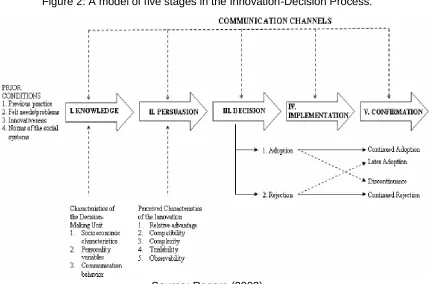
The innovation-Decision process
Rogers (2003) described the innovation-decision process as “an information-seeking and information-processing activity, where an individual is motivated to reduce uncertainty about the advantages and disadvantages of an innovation” (p.172). For Rogers (2003), the innovation-decision process involves five steps: (1) knowledge, (2) persuasion, (3) innovation-decision, (4) implementation, and (5) confirmation. These stages typically follow each other in a time-ordered manner.
Figure 2: A model of five stages in the Innovation-Decision Process.
Licensed under Creative Common Page 8
The Knowledge Stage
The innovation-decision process starts with the knowledge stage where an individual learns about the existence of innovation and seeks information about the innovation. “What?” “How?” and “why?” constitute the critical questions in the knowledge stage. During this phase, the individual attempts to determine “what the innovation is and how and why it works” (Rogers, 2003, p. 21). According to Rogers, the question forms three types of knowledge: (1) awareness-knowledge, (2) how-to-awareness-knowledge, and (3) principles-knowledge.
Awareness-knowledge represents the knowledge of the innovation‟s existence. This type of knowledge can motivate the individual to learn more about the innovation and, eventually, to adopt it. Also, it may encourage an individual to learn about other type of knowledge: How-to-knowledge which is contains information about how to use an innovation correctly. Thus, technology is not used at an expected level, since they need help in how to use the technology effectively in teaching (Spotts, 1999). Rogers saw this knowledge as an essential variable in the innovation-decision process. To increase the adoption chance of an innovation, an individual should have a sufficient level of how-to-knowledge prior to the trial of this innovation. Thus, this knowledge becomes more critical for relatively complex innovations.
The Persuasion Stage
The persuasion step occurs when the individual has a negative or positive attitude toward the innovation, but “the formation of a favorable or unfavorable attitude toward an innovation does not always lead directly or indirectly to an adoption or rejection” (Rogers, 2003, p. 176). The individual shapes his or her attitude after he or she knows about the innovation, so the persuasion stage follows the knowledge stage in the innovation-decision process. Furthermore, Rogers states that while the knowledge stage is more cognitive- (or knowing-) centered, the persuasion stage is more affective-(or feeling-) centered. Thus, the individual is involved more sensitively with the innovation at the persuasion stage.
Licensed under Creative Common Page 9 Rogers (2003) stated that “compatibility is the degree to which an innovation is perceived as consistent with the existing values, past experiences, and needs of potential adopters” (p. 15). A lack of compatibility in IT with individual needs may negatively affect the individual‟s IT use (McKenzie, 2001; Sherry, 1997). Rogers (2003) defined complexity as “the degree to which an innovation is perceived as relatively difficult to understand and use” (p. 15). As Rogers stated, opposite to the other attributes, complexity is negatively correlated with the rate of adoption. Thus, excessive complexity of an innovation is an important obstacle in its adoption.
The Decision Stage
At the decision stage in the innovation-decision process, the individual chooses to adopt or reject the innovation. While adoption refers to “full use of an innovation as the best course of action available,” rejection means “not to adopt an innovation” (Rogers, 2003, p. 177). If an innovation has a partial trial basis, it is usually adopted more quickly, since most individuals first want to try the innovation in their own situation and then come to an adoption decision.
Licensed under Creative Common Page 10 Rogers (2003) stated that “compatibility is the degree to which an innovation is perceived as consistent with the existing values, past experiences, and needs of potential adopters” (p. 15). A lack of compatibility in IT with individual needs may negatively affect the individual‟s IT use (McKenzie, 2001; Sherry, 1997). Rogers (2003) defined complexity as “the degree to which an innovation is perceived as relatively difficult to understand and use” (p. 15). As Rogers stated, opposite to the other attributes, complexity is negatively correlated with the rate of adoption. Thus, excessive complexity of an innovation is an important obstacle in its adoption. According to Rogers (2003), “trial ability is the degree to which an innovation may be experimented with, on a limited basis.” (p. 16). Also, trial ability is positively correlated with the rate of adoption. The more an innovation is tried, the faster its adoption is.
Motivational Theory
The three aspects of action that motivation can affect are direction (choice), intensity (effort), and duration (persistence). Motivation is repeatedly described as being „‟intrinsic‟‟ or „„extrinsic‟‟ in nature (Sansone, & Harackiewicz, 2000). Over three decades of research has shown that the quality of experience and performance can be very different when one is behaving for intrinsic versus extrinsic reasons (Ryan, & Deci, 2000). Intrinsic motivation is defined as the undertaking of an activity for its inherent satisfaction rather than for some separable consequence. When intrinsically motivated, a person is moved to act for the fun or challenge entailed rather than because of external pushes, pressures or rewards (Ryan, & Deci, 2000).
Licensed under Creative Common Page 11 Empirical Review
This section will review what other previous writers have contributed to the area under study as per the study objectives.
Enterprise Technology Integration
IT-Enabled Resource Operation Capability (IT-ROC)
O‟Brien and Maracas (2009) claimed that IT has become an important aspect of everyday business. It is potentially a key element in enhancing customer satisfaction Penrose (1959) submitted that the firm could be viewed as a bundle of physical, labor, and intangible resources for operation and growth. From the perspective of resource lifecycle process, innovation activity is recombination between currently used resources and new or unused resources (Penrose 1959).
To increase the efficiency of resource deployment in operation, innovative combination of resources is often targeted to derive resource synergy from multiple resources (Nevo and Wade 2010). To derive resource synergy from complimentary resources requires a firm to develop efficient coordination mechanisms in its operation with multiple resources (Bharadwaj et al. 2007). This leads to a firm‟s ability of using IT to increase the efficiency of resource coordination in internal operation. IT-ROC can facilitate resource synergy arising from resource recombination through three mechanisms. First it helps to identify potential complementarity of resources in resource recombination. A firm can use IT for the purposes of automating, informating, and transforming internal operation based on various resources (Dedrick et al. 2003).
Licensed under Creative Common Page 12 To build an integrated view of the customer, all the value-generating processes need to be integrated and streamlined, which lead to issues of technology integration (Chen & Popvich, 2003). Potential IT benefits appear in employee‟s developing a shared vision for customers of the organization and in better communication among people, which in turn improves mutual understanding. In addition, through the integrated decision-making process, better consensus may be created for subsequent actions. (Clement, 1994)
Integration technology allows organizations to develop better relationship with customers by providing a wider view of the customer behavior (Thompson et al., 2006). Thus, organizations are required to integrate IT to improve the capabilities of understanding customer behavior, develop predictive models, build effective communications with customers and respond to those customers with real time and accurate information (Chen & Popovich, 2003).
Customer Satisfaction
A number of researches have shown that service performance has a direct impact on customer satisfaction, particularly in the high-involvement situation (Churchill & Surprenant, 1982; Patterson, 1993). Sometimes also much satisfaction (or dissatisfaction) is with the service encounter, as services are partly defined by the encounter, so that the service provider influences satisfaction. Salespeople are some of the key front line employees, so understanding the performance of salespeople is important in understanding customer satisfaction. Salespeople‟s interaction with their customers plays a key role in organizational success or failure (Schultz and Good, 2000), and customer satisfaction is a critical performance indicator (Adsit et al., 1996). Piercy (1992), states that many organizations have increasingly recognized the need to view service personnel as customers, and to focus on both internal and external customer satisfaction. Thus, the front-line service employees would be viewed as internal customers in order to enhance efficient customer contact. The attitude of the employee is a crucial factor in the performance of the customer-oriented company, not only in offering the basic product but also in offering all extra services (Vranesevic et al., 2002). Keillor et al. (1997) found positive attitudes among salespeople toward using technology, which were measured and compared with level of experience and sales productivity. Both less and more experienced salespeople agreed that using computers as a part of their jobs made them more competitive and productive, and they perceived that computers are a viable means of interacting with customers.
Licensed under Creative Common Page 13 found that technology, if it helps employees interact more effectively with their customers, can have an impact on customer relationships and external customer satisfaction. Customer satisfaction, customer loyalty and customer retention are important intermediate goals for financial service providers on their way to superior economic success in the liberalized markets. As market growth slows or as the markets become more competitive, companies will more likely attempt to maintain their market share by focusing on retaining existing customers, rather than attempting to attract new customers. Speed and Smith (1992) advocate the use of segmentation as a way to improve customer satisfaction, customer loyalty and customer retention.
RESEARCH METHODOLOGY
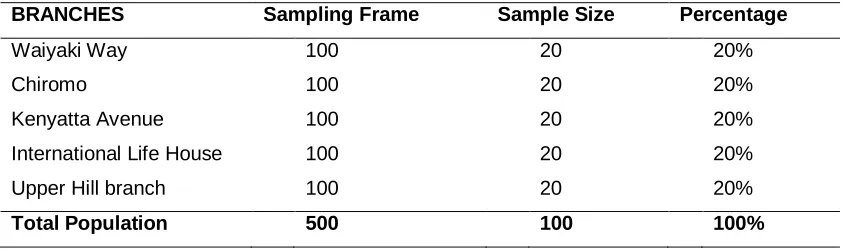
The research methodology provides a detailed discussion of the research design, location of the study, population, and data collection procedure and data analysis. Kothari (2004) defines research design as the arrangement of conditions for collection and analysis of data in a manner that aims to combine relevance to the research purpose with economy in procedure. This study adopted a descriptive research design. According to Cooper & Schindler (2003), a descriptive study is concerned with finding out the what, where and how of a phenomenon. The target population for this study was 5 selected CFC Stanbic bank branches in Nairobi and targeted the top and junior staff members of the bank. The sample frame consisted of the staff from the 5 branches based in Nairobi.
Sample and Sampling Techniques
Sampling involves any procedure that draws conclusions based on measurements of a portion of the entire population (Ethridge, 2004). According to Connaway & Powell (2010) a sample is usually drawn because it is less costly and less time consuming to survey than the population, or it may be impossible to survey the entire population. Megenda & Mugenda (2003) indicate that a sample of 10-30% of the target population is considered adequate provided it is scientifically determined.
Licensed under Creative Common Page 14 Table 1: Sample procedure
BRANCHES Sampling Frame Sample Size Percentage
Waiyaki Way 100 20 20%
Chiromo 100 20 20%
Kenyatta Avenue 100 20 20%
International Life House 100 20 20%
Upper Hill branch 100 20 20%
Total Population 500 100 100%
Data Analysis and Presentation
The data collected was cleaned, coded and systematically organized. Statistical package for social sciences (SPSS) version 20 for windows was used to calculate descriptive statistics such as frequency counts, and percentages and inferential statistics such as Correlation analysis was also be used to show the relationship between the different variables. The findings was presented using tables and charts, percentages, tabulations, frequencies, means and other measures of central tendency.
ANALYSIS & FINDINGS
Table 2: Response Rate
No. of questionnaires Returned Target No. of respondents Response Rate (%)
100 91
91
The high questionnaire response rate (91%) shown in Table 2 resulted from the method of administration of the instrument, which in this case the researcher administered. This method also ensured that the respondents‟ queries concerning clarity were addressed at the point of data collection; however, caution was exercised so as not to introduce bias in the process. 9 out of the 100 questionnaires were found to be unusable for the study; hence, their results were not included in the findings.
Enterprise technology application & Customer satisfaction
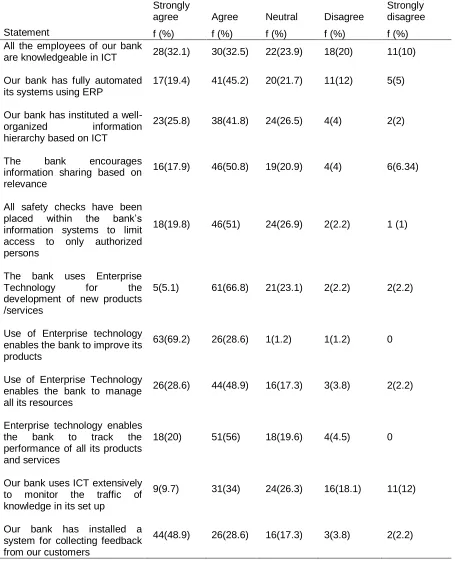
Licensed under Creative Common Page 15 This variable „status of enterprise technology‟ was rated on a 5 point Likert scale ranging from; 5 = strongly agree to 1 = strongly disagree. The results on this are summarized in Table 3.
Table 3: Enterprise technology application and customer satisfaction
Statement
Strongly
agree Agree Neutral Disagree
Strongly disagree f (%) f (%) f (%) f (%) f (%) All the employees of our bank
are knowledgeable in ICT 28(32.1) 30(32.5) 22(23.9) 18(20) 11(10)
Our bank has fully automated its systems using ERP
17(19.4) 41(45.2) 20(21.7) 11(12) 5(5)
Our bank has instituted a well-organized information hierarchy based on ICT
23(25.8) 38(41.8) 24(26.5) 4(4) 2(2)
The bank encourages information sharing based on relevance
16(17.9) 46(50.8) 19(20.9) 4(4) 6(6.34)
All safety checks have been placed within the bank‟s information systems to limit access to only authorized persons
18(19.8) 46(51) 24(26.9) 2(2.2) 1 (1)
The bank uses Enterprise Technology for the development of new products /services
5(5.1) 61(66.8) 21(23.1) 2(2.2) 2(2.2)
Use of Enterprise technology enables the bank to improve its products
63(69.2) 26(28.6) 1(1.2) 1(1.2) 0
Use of Enterprise Technology enables the bank to manage all its resources
26(28.6) 44(48.9) 16(17.3) 3(3.8) 2(2.2)
Enterprise technology enables the bank to track the performance of all its products and services
18(20) 51(56) 18(19.6) 4(4.5) 0
Our bank uses ICT extensively to monitor the traffic of knowledge in its set up
9(9.7) 31(34) 24(26.3) 16(18.1) 11(12)
Our bank has installed a system for collecting feedback from our customers
Licensed under Creative Common Page 16 The findings in Table 3 indicate that most of the employees of the bank are knowledgeable in ICT according to majority (32.5%) of the respondents. The bank had also fully automated its systems using ERP (45.2%) and had instituted a well-organized information hierarchy based on ICT (41.8%). The results also indicate that the bank encouraged information sharing based on relevance (50.8%), however, most of this information was shared internally and consequently safety checks were placed within the bank‟s information systems to limit access to only authorized persons (51%). It was also established that the bank uses enterprise technology for the development of new products /services (66.8%) and that the technology enabled the bank to improve its products (69.2%) and to manage all its resources (48.9%). In addition, enterprise technology enabled the bank to track the performance of all its products and services (56%) and to monitor the traffic of knowledge in its set up (34%). The technology had also come with an inbuilt system for collecting feedback from our customers (48.9%).
These findings imply that the bank was already gaining from the application of enterprise technology although much still needed to be done to improve the customer‟s experience at the bank. These findings agreed with the views of O‟Brien & Maracas (2009) who claimed that IT has become an important aspect of everyday business. It is potentially a key element in enhancing customer satisfaction. The findings also imply that with more integrity in the systems, the bank could well share more information both internally and externally and consequently gain knowledge. Furthermore, the ability of using IT such as ERP systems as exhibited by the bank in the current study can also facilitate managers to deploy and realize potential complementarity in a coordinative and just-in-time manner (Rai et al. 2006).
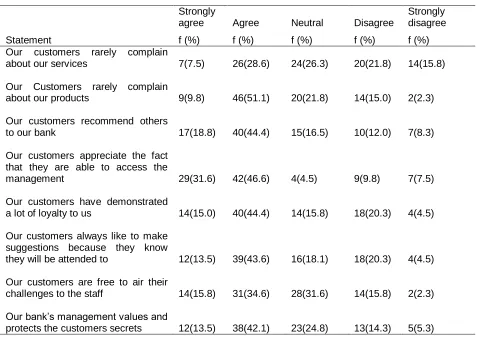
Customer Satisfaction
Licensed under Creative Common Page 17 (43.6%). The customers also felt free to air their challenges to the staff (34.6%) since the bank‟s management valued and protected the customers‟ secrets (42.1%).
Table 4: Customer Satisfaction
Statement
Strongly
agree Agree Neutral Disagree
Strongly disagree f (%) f (%) f (%) f (%) f (%) Our customers rarely complain
about our services 7(7.5) 26(28.6) 24(26.3) 20(21.8) 14(15.8)
Our Customers rarely complain
about our products 9(9.8) 46(51.1) 20(21.8) 14(15.0) 2(2.3)
Our customers recommend others
to our bank 17(18.8) 40(44.4) 15(16.5) 10(12.0) 7(8.3)
Our customers appreciate the fact that they are able to access the
management 29(31.6) 42(46.6) 4(4.5) 9(9.8) 7(7.5)
Our customers have demonstrated
a lot of loyalty to us 14(15.0) 40(44.4) 14(15.8) 18(20.3) 4(4.5)
Our customers always like to make suggestions because they know
they will be attended to 12(13.5) 39(43.6) 16(18.1) 18(20.3) 4(4.5)
Our customers are free to air their
challenges to the staff 14(15.8) 31(34.6) 28(31.6) 14(15.8) 2(2.3)
Our bank‟s management values and
protects the customers secrets 12(13.5) 38(42.1) 23(24.8) 13(14.3) 5(5.3)
Licensed under Creative Common Page 18 Relationship between enterprise technology and Customer satisfaction
A correlation analysis to determine whether the Enterprise Technology Integration had influence on customer satisfaction at CFC Stanbic Bank Kenya Limited shows a relationship exists (r = 0.504, α = 0.05). The Karl Pearson‟s product moment coefficient of correlation r = 0.504 is average and suggests that a strong relationship existed between the two variables. This suggests that although enterprise technology were an important aspect in improving enhancing customer satisfaction in the bank, it still needed to be strengthened especially with regard to priorities the officials put on spending.
Table 5: Enterprise technology and customer satisfaction
Enterprise technology
Customer satisfaction Pearson's Correlation 0.504
Correlation significant at the 0.05 level (2-tailed)
The correlation summary shown above indicates that the association between the independent variable and the dependent variable is significant at the 95% confidence level. This means that the inter-variable correlation between the independent variable was not strong enough to affect the relationship with the dependent variable.
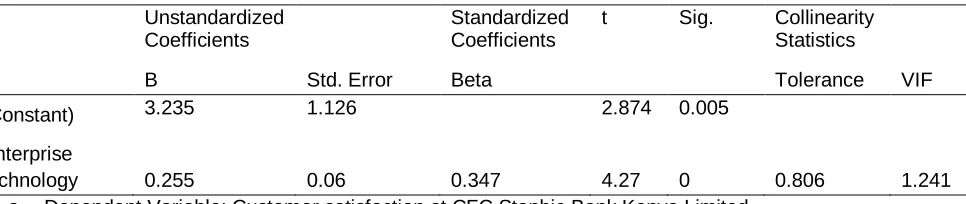
Table 6: Multiple linear regression results
Unstandardized
Coefficients
Standardized Coefficients
t Sig. Collinearity Statistics
B Std. Error Beta Tolerance VIF
(Constant) 3.235 1.126 2.874 0.005
Enterprise
technology 0.255 0.06 0.347 4.27 0 0.806 1.241
a. Dependent Variable: Customer satisfaction at CFC Stanbic Bank Kenya Limited
Licensed under Creative Common Page 19 Summary of the Findings
The objective of this study was to determine the influence of Enterprise Technology Integration on customer satisfaction at CFC Stanbic Bank Kenya Limited. Data analysis and interpretation of questionnaire responses from the bank employees in the area revealed that the bank had fully automated its systems using ERP and had instituted a well-organized information hierarchy based on ICT. The results also indicated that the bank encouraged information sharing based on relevance, however, most of this information was shared internally and consequently safety checks were placed within the bank‟s information systems to limit access to only authorized persons. In addition, enterprise technology was found to be of considerable assistance to the bank in enabling it to track the performance of all its products and services and to monitor the traffic of knowledge in its set up.
Correlation and regression analysis also revealed that a strong relationship between enterprise technology and customer satisfaction, hence, suggesting that it was an important factor in customer satisfaction both from the point of view of the customer in improved service and also from the perspective of employee motivation. Keillor et al. (1997) found positive attitudes among sales people toward using technology, which were measured and compared with level of experience and sales productivity. Both less and more experienced sales people agreed that using computers as a part of their jobs made them more competitive and productive, and they perceived that computers are a viable means of interacting with customers. In a highly competitive environment, the ability to retain satisfied customers represents a tremendous competitive advantage for any sales organization. Sales effort which emphasizes relationship building is more likely to generate satisfied customers (Kelley, 1992). He further found that technology, if it helps employees interact more effectively with their customers, can have an impact on customer relationships and external customer satisfaction.
CONCLUSIONS
Licensed under Creative Common Page 20 REFERENCES
Adsit, J.D., London, M., Crom, S. & Jones, D. (1996). Relationships between employee attitudes, customer satisfaction and departmental performance. Journal of Management Development.15(1), 62-75. Alderfer, C. (1969). An Empirical Test of a New Theory of Human Needs. Organizational Behavior and Human Performance, vol. 4, pp. 142 - 175.
Ali, Pervaiz ,Sankaran,Sudha (2010). „Online Shopping‟ Customer Satisfaction and Loyalty in Norway. Bateman, T. S., & Crant, J. M. (1999). Proactive behavior: Meanings, impact, and recommendations. Business Horizons, 42 (3), 63–70.
Bauer, H. H., Grether, M., & Leach. M. (2002). Building customer relations over the Internet. Industrial Marketing Management, 31(2), 155-163.
Bharadwaj, S., Bharadwaj, A., and Bendoly, E. (2007). The performance effects of complementarities between information systems, marketing, manufacturing, and supply chain processes. Information Systems Research, 18(4), 437-453.
Caselli, S., (2005). Corporate banking strategies: products, markets and channels. In Strategy and Organization of Corporate Banking, Springer Berlin Heidelberg, 37-62
Central Bank of Kenya (2011) Bank Supervision Annual Report, Kenya. CfC Stanbic Holdings Limited Annual report 2013
Chen, I., & Popovich, K., (2003). Understanding customer relationship management (CRM) People, process and technology. Business Process Management Journal, 9(5) 672-688
Clement, A. (1994), Computing at Work: Empowering Action by Low-level Users, Communications of ACM, V.37, No.1, pp. 53-63.
Connaway, LS & Powell, RP, (2010). Basic Research Methods for Librarians, ABC-CLIO
Cooper, R. & Schindler, S. (2003). Business Research Methods (8th edn), McGraw-Hill: New York Day (2000), “Managing Market Relationships,” Academy of Marketing Science Journal, 28 (1), 24-30
Dedrick, J, Gurbaxani, V. and Kraemer, K.L. (2003). Information technology and economic performance: a critical review of the empirical evidence, Computing Surveys, 35(1): 1-28.
Deshpandé, R. (1999). Developing a Market Orientation. Thousand Oaks, CA: Sage Publications. Drucker, P. (1954). The Practice of Management, Harper & Row Publishers, New York, NY
Ethridge, D. (2004). Research methodology in applied economics: organizing, planning, and conducting economic research. Oxford: Blackwell.
Fichman, R. G., (2004) “Going Beyond the Dominant Paradigm for IT Innovation Research: Emerging Concepts and Methods”, Journal of the Association for Information Systems, 5(8).
Hackman, J.R., Oldham, G.R. (1980). Work redesign. Reading, MA: Addison-Wesley. Herzberg, F.B. (1966). Work and the nature of man. New York: World Publishing.
Kothari, C. R. (2004). Research methodology: Methods and techniques. (2nd ed) New Delhi: New Age. Kumbhar Vijay M. (2011). Determinants of Internet Banking Adoption: An Empirical Evidences From Indian Banking” Indian Journal of Commerce & Management Studies, Volume II, Issue – 4, pp-15-25. Levitt,T., (1960). “Marketing Myopia” Harvard Business Review38: 57-66
Marcus, C., & Kimberly C., (2003). “Top-10 Marketing Processes for the 21st Century,” Gartner Group Report SP-20-0671. http://www.gartner.com
Maslow, Abraham (1954). Motivation and Personality. New York: Harper. pp. Å236.
Licensed under Creative Common Page 21 Mugenda,O.M and Mugenda, A.G. (2003). Research Methods, Quantitative & Qualitative Approaches, African Centre For Technology Studies, ACTS press, Nairobi, Kenya
Nevo, S. and Wade, M.R. (2010). The Formation and Value of IT-Enabled Resources: Antecedents and Consequences of Synergistic Relationships, MIS Quarterly, 34(1), 163-183.
O‟Brien, J. A., & Maracas, G. M. (2009). Management information systems (8th ed.). Boston, MA: McGraw-Hill/Irwin.
Otando R., (2007). An evaluation of the use of the marketing mix variables as means of enhancing service quality and customer satisfaction, Nairobi, Kenyatta University
Patterson, T. 1993. Out of Order. New York: Knopf.
Penrose ET. 1959. The Theory of the Growth of the Firm. Oxford University Press: New York. Piercy F., (1992). Market-led Strategic Change, Butterworth-Heinemann, Oxford.
Rai, A., Patnayakuni, R., and Seth, N., (2006). "Firm Performance Impacts of Digitally Enabled Supply Chain Integration Capabilities," MIS Quarterly (30:2), pp 225-246.
Rogers, E. M., (1995). Diffusion of Innovations, 4th Edition, New York: The Free Press. Rogers, E.M. (2003). Diffusion of innovations (5th ed.). New York: Free Press.
Ryan, R. M. & Deci, E. L. (2000). Self-determination theory and the facilitation of intrinsic motivation, social development and well-being. American Psychologist, 55, 68-78.
Sambamurthy, V., Bharadwaj, V., (2003). Shaping agility through digital options: Reconceptualizing the role of information technology in contemporary firms. MIS Quart. 27(2) 237–263.
Sansone, C., & Harackiewicz, J. M. (Eds.). (2000). Intrinsic and extrinsic motivation: The search for optimal motivation and performance. SanDiego, CA: Academic Press.
Sherry, L. (1997). The boulder valley internet project: Lessons learned. THE (Technological Horizons in Education) Journal, 25(2), 68-73.
Sheth, Jagdish N., Rajendra S. Sisodia, and A. Sharma (2000). “The antecedents and consequences of customer-centric marketing,” Academy of Marketing Science, 28 (1), 55-66.
Spotts, T.H. (1999). Discriminating factors in faculty use of instructional technology in higher Education. Educational Technology & Society, 2(4), 92-99.
Swanson, E. B., & Ramiller, N. C. (1997). The organizing vision in information systems innovation.Organization Science, 8 (5), 458–474
Tan, M., Teo, T. and Wong, K. (2003). A Contingency Model of Internet Adoption in Singapore, International Journal of Electronic Commerce, 2(2), 95-118.
Thompson S.H Teo , Paul Devadoss , Shan L. Pan. (2006). Towards a holistic perspective of customer relationship management (CRM) implementation: A case CRM Success Factors Taxonomy Mohammad Thuo et al., (2009). Customer Relationship Management and Competitiveness of Commercial Banks in Kenya Nairobi: unpublished doctoral Thesis
Tseng, Mitchell; Piller, Frank (2003). The customer centric enterprise, M. Tseng and F. Piller (eds.), The customer centric enterprise: Advances in mass customization and personalization, NY: Springer: 1-18. Vranesevic, T., Vignali, C., & Vignali, D. (2002). Culture in defining consumer satisfaction in marketing. European Business Review, 14(5), 364-374.
White, R., (1959). Motivation reconsidered: The concept of competence. Psychological review, 66:297– 333.
Yu, L. (2001). Successful Customer-Relationship Management. MIT Sloan Management Review, 42(4), 81-87.