MARIA GRAZIA GUIDO
Thesis submitted for the Degree of PhD
University of London
Institute of Education
July 1994
.
DRAMATIC DISCOURSE IN POETRY
This thesis is a theoretical and philosophical discussion of the nature of poetic discourse, with a subsequent discussion of pedagogic practice arising from the views expressed, whose effectiveness is illustrated by a subjective selection of protocols. The central claim is that the peculiar nature of poetic discourse is inherently dramatic, since it internalizes 'voices'. Therefore, to achieve a total experience of poetry the reader needs to engage his own schemata in their body/thought entirety. This implies that he has not to limit himself to the 'sounding' of the 'voices' he achieves in the text just within his 'inward ear', but he has to 'embody' them, 'inhabit' them within a 'physical space of representation', letting them inter-act with other readers' embodiments. In so doing, the reader becomes an Acting Reader.
The contribution this thesis offers to research on Discourse Analysis and Literary Stylistics consists in recognizing the vocal, 'physical' dimension of poetic texts (a dimension which is often neglected) as a way of achieving a more thorough personal awareness of the poetic experience. Accordingly, I elaborate a principled pedagogic approach to poetic language through the reader's use of drama techniques with the aim to demonstrate how it can be relevant in the teaching of poetry to either Ll or L2 students at both High School and University levels.
So that in the theoretical part (Chapters 1-4) I place my rationale against a context of 'new-critic', semiotic, and deconstructionist approaches to literary theory and teaching methodology to demonstrate how they imply only a one-way communication of a pre-established interpretation (Chapters 1-2). Then I describe the first 'two phases' of the reader's activation of 'familiarizing' top-down and 'defamiliarizing' bottom-up strategies in his attempt to authenticate the peculiar structural and semantic arrangement of the poetic text (Chapter 3). Eventually, these two top-down/bottom-up phases come to merge during the final interactive phase (Chapter 4) in which I postulate a group of acting readers' multiple 'embodied' poetic discourses -controlled by the same poetic text - inter-acting in a representational 'physical' space to recreate selves, schemata, and iconic contexts.
This theory systematically informs the practical part of my research (Chapters 5-9) consisting in 'dialogic' classroom operationalizations of each of the three phases. I pragmatically demonstrate (through protocol analysis) that to be conceptually receptive to poetic language the student/acting-reader needs to be physically prepared to be receptive to it. Stylistics, thus, is meant as the analysis of the acting reader's own responses, not as the analysis of the text (Chapter 5). I first provide 'top-down' affective
I wish to express my deepest gratitude and affection to my supervisor Professor Henry G. Widdowson, i1 mio Sublime Maestro, magnificent and highly inspirational. This thesis is dedicated to him. My mind has simply rejoiced at the privilege of being enriched by the excellence of his thought. He has been extraordinary generous in devoting his time, effort and insight in enlightening me, and most caring in encouraging and trusting my views. His creative enthusiasm and intellectual passion have not only kindled and set in motion my imagination in my discovery of the grand liberating power of words, but they have also been fervidly transferred to all my other relationships with those people who have contributed to the development of my research, and they are:
first of all, Sir Derek Jacobi, who has introduced me into the magical, fascinating dimension of theatrical representation and into the mysteries of the 'changing self', thanks to his superb acting expertise which he has been generously willing to share with me over the whole period of my research;
Mrs. Freda O'Byrne, physical-theatre director, who has enhanced my apprehension of the 'alchemy of body-interactions' by allowing me to observe the making of her mesmerizing productions;
Dr. Guy Cook and Dr. Roger Flavell who, with their scholarly comments and helpful suggestions on an earlier draft of this thesis, provided me with significant 'external' views on my work; Dr. Gianluigi Guido, my brother, who made me gain a deeper insight into the domains of cognitive psychology;
Dr. Mick Short who, with his inflexible, unconditional positions, so in contrast with my own, provided me with the necessary indignation to define, specify, and passionately assert my rationale.
And, then, my students, who absorbed and amplified my enthusiasm by enjoying the pleasure of artistic creation and aesthetic appreciation in our poetry classes.
I also wish to thank:
Prof. Nicola Paparella and Prof. Bernard Hickey, Heads of the Departments of Pedagogy and English/Social-Sciences of the University of Lecce, for their encouragement and support;
Prof. Vito Papa, Head of the Liceo Classico of Maglie, for his consideration and understanding;
Prof. Mario Domenichelli and Dr. Steven Connor for their most useful orientations into the post-modern literary theory;
Dr. Luigi Negro, for his 'hypertextual' concerns.
Abstract 2
Acknowledgements 3
Table of contents 4
Table of figures 18
CHAPTER 1: INTRODUCTION 20
1.1. Poetic discourse as a dramatic use of language: 'setting
the scene' 20
1.1.1. Research plan 20
- Areas of enquiry 20
- Rationale 20
- Thesis design 21
1.1.2. The structure 22
- Part One on Theory 22
- Part Two on Practice 23
- The protocol analysis 24
1.2. Motivations and research operationalization 26
1.2.1. The work of art as an imaginative poetic representation of 'virtual realities'
prompt - The 26
1.2.2. Poetic dramatization in the classroom 27
1.2.3. Spoken discourse 29
1.2.4. General objectives 31
1.3. Practical implications: Ambivalence in poetry-teaching programs and the 'new dramatic model' 33
1.3.1. The target readership 33
1.3.2. Traditional trends in literature teaching 34
1.3.3. The new dramatic model 35
1.3.4. Summary 39
1.4. Research development - The Chapters 40
PART ONE: THEORY - POETIC DISCOURSE 43
CHAPTER 2: THE READER IN RELATION TO THE TEXT 44
2.1. Introduction 44
2.2. Literature as a 'social discourse': Communication limits 45
2.2.1. The establishment of a socio-cultural identity 45
2.2.2. Pragmatic issues in interpretation 46
2.3. Poetry reading and schema theory 48
2.3.1. The ordering function of schemata on memory 48
2.3.2. Poetry as schema-activator 50
2.4. The interactive approach to poetry reading 52
2.4.1. From 'decoding' to 'interacting' 52
2.4.2. Linear models and PDP models 55
2.5. Poetic discourse 57
2.5.2. Authentications by estrangement 58
2.5.3. Poetic divergencies and transactional texts 60
2.6. The reader, the writer, and the poetic text 63
2.6.1. 'Location' of meaning 63
2.6.2. The authority of the critic's interpretation 64
2.6.3. The critic's construct of the 'ideal reader' 66
2.6.4. The pragmatic nature of the work of art 67
2.7. Reader-Response Theory 72
2.7.1. The empirical reader's 'total' involvement in poetic
language 72
2.7.2. Top-down approaches to literary reading 73
2.8. The meaning of the text 76
2.8.1. Limits of closely text-based reading processes 76
2.8.2. Theories against interpretative subjectivity 78
2.8.3. Intentional and affective fallacies 79
2.8.4. Reference, force, and effect 82
2.9. Writer's meanings 84
2.9.1. Approximating poet's intentions and messages 84
2.9.2. Poet's guidance and reader's cooperation 86
2.9.3. The untenable certainty of poet's meanings 88
CHAPTER 3: READING POETRY 92
3.1. Introduction 92
3.2. Multiple and individual 'voices' - Textual control 94
3.2.1. Reinstating the physical 'voice' and 'presence' in
poetry 94
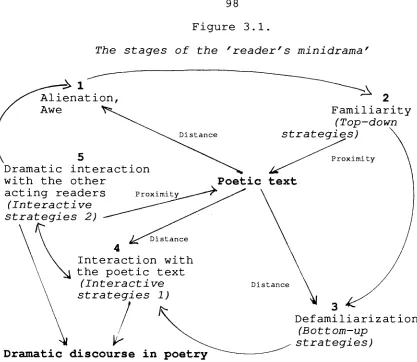
3.2.2. Familiarity within alienation: The three phases of
a reader's 'minidrama' 96
3.3. First phase: Deconstructive, 'top-down' reading strategies 100
3.3.1. Linguistic differentiation and deferment of meaning 100 3.3.2. Referentiality to reader's schemata: Getting
familiar with the poetic language 104
3.3.3. The interpretative determinacy of a poetic text 106 3.3.4. Deconstruction as self-reflection 109
3.4. Second phase: Reconstructive, 'bottom-up' reading
strategies 112
3.4.1. The pragmatization of semantics: Sound/sign non-
arbitrariness in poetry 112
3.4.2. Imaginative discoursal re-constructions 115
3.4.3. The 'fantastic pair' process 117
3.4.4. Experience of estrangement and intimacy in poetry
reading 120
3.4.5. Semantics of metaphor and psychology of imagination:
The reader's 'divided reference' 123
CHAPTER 4: THE ACTING READER 127
4.1. Third phase: 'Interactive' dramatic interpretation -
Introduction 127
4.1.1. Summary of the previous two phases 127
4.1.2. Third phase: Poetic embodiment 128
4.1.3. Development of the chapter 130
4.2. Metaphors of space and dramatic communication in poetry 131
4.2.1. The physical space of poetry 131
4.2.2. Mental/physical schemata in 'poetic action' 134
4.2.3. Dimensions of dramatic communication in poetry 136
- Ambiguity 136
- Embodiment of discourse 'poetentialities' 137
- Collective dramatic interpretation 138
4.2.4. Internalization and externalization of poetry 139
4.3. The authorial role of the acting reader 142
4.3.1. The acting reader's appropriation of the
Sender/Addresser's 'voices' 142
4.3.2. Authentication of poetry through 'physicality' 145
4.3.3. Summary 146
4.4. Acting poetry as 'self' creation 147
4.4.1. The three 'stages' of dramatic embodiment of poetic
language: A phenomenological enquiry 147
4.4.2. Stage A - Artistic detachment: Estrangement by
'suspension of belief' 149
4.4.3. Stage B - Aesthetic involvement: Intimacy by
- Imaginative involvement 'in action' 151
- Empathic absorption of the 'self' in the 'they-self'151
4.4.4. Stage C - Reconciliation of contrasting feelings:
Intimacy and estrangement 153
- The return of the 'self' to itself through 'the other' 153 - Self-expressivity in poetry dramatization 154
4.5. Summary 155
PART TWO: PRACTICE - POETIC DISCOURSE IN ACTION 157
CHAPTER 5: A PRINCIPLED PEDAGOGIC APPROACH 158
5.1. Introduction - Objectives, pedagogic rationale, and
operationalization design 158
- Objectives 158
- The pedagogic rationale 158
- Operationalization design 159
5.2. How theory relates to practice 160
5.2.1. The lack of a univocal interpretative path 160
5.2.2. Reconciling public and private domains 161
5.2.3. The students/acting-readers' multiple positioning
in poetic performance 163
5.2.4. Cognitive/affective awareness in discoursal imaginative incorporation of textual organization 167
5.3. Applied Dialogism 170
5.3.1. 'Dialogic imagination' justified by 'otherness' - Relative time and space of interaction 170
- Internal and external chronotopes 174
- Relevance of some 'standards of textuality' in the
dialogic poetry-c4ssroom 175
5.4. Applied Dramatology: Setting the scene of the dialogic
classroom 178
5.4.1. Active production of meaning 178
5.4.2. The role of the teacher 179
5.5. Research tools and procedures 181
5.5.1. Protocol analysis 181
- Parameters of 'reflective judgements' 183
5.5.2. Data collection in the physical-theatre workshop 183 5.5.3. Descriptive phenomenological research 184
5.6. Summary 185
CHAPTER 6: APPLICATIONS - THE TOP-DOWN PHASE 187
6.1. Introduction 187
6.2. Accessing poetry through body/thought creativity - A
cognitive method of enquiry 188
6.2.1. The traditional body/thought dichotomy: A brief
philosophical survey 188
6.2.2. 'Propositional' expression versus 'analogue' 189
6.2.3. Discovering body schemata 190
6.2.4. The individual quality of embodied schemata 192
- a. Non-universality of gestalt structures 193
- b. Embodied schemata accessed by the 'real body' 194
- d. Embodied metaphors and embodied objective
correlatives 195
- e. Ideational and interpersonal poetic communication 195
6.3. The top-down phase: activities and protocol analysis 197
6.3.1. General operational objectives 198
6.3.2. First step: Accessing individual embodied schemata
through the Psychological Gesture 200
- Objectives 200
- Operationalization of the classroom activity 202
- Protocol analysis and discussion 203
6.3.3. Second step: Accessing poetry through individual
embodied schemata 208
- Objective 1: Body dislocation 208
- Objective 2: Poetic embodiment 209
- Operationalization of the classroom activity 213
- Applied deconstruction on S.Plath's poem 'Metaphors':
Protocol analysis and discussion 214
6.4. Summary 216
CHAPTER 7: APPLICATIONS - THE BOTTOM-UP PHASE 218
7.1. Introduction: Bottom-up imaginative embodiments in macro-
and micro-communication 218
7.2. Appropriating the Sender's and the Addresser's 'voices' through figurative language - Cognitive/affective enquiry 222
7.2.1. Appropriating the Sender's voice through 'figures
of speech' 222
7.2.2. Appropriating the Addresser's voice through 'figures
7.2.3. The acting reader's embodiment of speakers' voices
in dramatic and lyric poetry 226
7.3. The pragmatic process of language embodiment: Achieving the Addresser's intentions, objectives, and characters within metrical pattern and figurative language - activities and
protocol analysis 230
7.3.1. General operational objectives 230
7.3.2. Activity 1: Shakespeare's Henry V 233
- Objectives 233
- Protocol analysis 234
7.3.3. Activity 2: Coleridge's The Rime of the Ancient
Mariner 236
- Objectives 236
- Protocol analysis 237
7.4. Summary 239
CHAPTER 8: APPLICATIONS - THE INTERACTIVE PHASE 240
8.1. Introduction: The interactive phase in the context of the dramatic-discourse process of poetry interpretation 240
8.2. Establishing a 'presence' within poetic language: from
top-down
andbottom-up
tointeractive
embodiments -Cognitive/affective enquiry 241
8.2.1. Top-down embodiment 242
8.2.2. Bottom-up embodiment 243
- The state of 'I am' 243
- The poetic 'presence' of the past 245
8.3. Interactive embodiment and the
positive capability
- Educational goals of the 'interactive' phase 249
8.4. Protocol analysis 250
8.4.1. General objectives of the protocol analysis 250
8.4.2. Method of analysis 252
- 'Top-down' and 'bottom-up' Moves: Basic points 252
- 'Interactive' Moves 253
- Moves in the Kantian categorization of protocols 254
8.4.3. The three areas of application 255
8.5. Area A: Poetic drama - The acting reader's transfer of identity into other human dimensions of being: Protocols on
Hamlet as a 'voice/view shifter' 258
8.5.1. Objectives 258
- The choice of the text - Motivations 259
8.5.2. The interpretative context of the analysis 259
8.5.3. Protocol analysis on Hamlet 260
8.5.4. Verification of the objectives - Discussion 263
- Long-term effects 265
- Summary 267
8.6. Area B: Dramatic poetry and poetic drama - The acting readers' transfer of identity into other non-human dimensions of being: Protocols on the Ancient Mariner and King Lear 268
8.6.1. The interpretative context of the analysis 268
8.6.2. Objectives 269
- The choice of the texts - Motivations 270
8.6.3. Protocol analysis on The Rime of the Ancient Mariner 271 8.6.4. A parallel dramatic discourse: Objectives 274
8.6.6. Retrospective reflections upon the process of dramatic personification - Verification of the objectives and
discussion 278
8.7. Area C: Lyric poetry - The acting reader's metaleptic transfer of discourse level and identity into macro/micro-communicative perspectives and possible 'imagistic' worlds:
Protocols on The Waste Land 280
8.7.1. The interpretative context of the analysis 1:
Background 281
- The background of stylistic analysis 281
- The background of macro/micro-communicative interaction
in dramatic discourse analysis 282
8.7.2. The interpretative context of the analysis 2: Dramatic discourse analysis 'in action' on multiple perspectives
and possible iconic worlds 284
- 'Metaleptic' macro/micro-communicative interaction 284
- The 'unlimited semiosis' of the possible virtual worlds 286 8.7.3. Objectives of the protocol analysis 288
- The choice of the text - Motivations 289
8.7.4. Protocol analysis on The Waste Land 291
8.7.5. The representational dissemination of the self - Verification of the objectives and discussion 293
8.8. Summary 295
CHAPTER 9 - CONCLUSION 297
9.1. Introduction 297
9.2. Theoretical line of enquiry - Retrospect 298
9.3. Practical implications and difficulties 300
9.4.1. Theoretical developments 302
9.4.2. Practical developments 305
9.5. Summary 307
NOTES 310
APPENDICES 340
APPENDIX A: The workshop atmosphere 340
A.1. Use of drama techniques - the initial phase 340 A.2. Discovering a new dimension of the classroom: warm-up
exercises 341
APPENDIX B: Poetic body and poetic space 343
B.1. Discovering the 'poetic body' 343
- Objectives 343
- Activities 344
B.2. Discovering the 'poetic space' 345
- Objectives 345
- Activities 345
B.3. Exploring meanings in the words through vocal metaphors:
the 'auditory imagination' 347
- Objectives 347
- Activities 348
APPENDIX C: John Milton's Paradise Lost: Protocols of a
physical hypertext 351
C.2. Methodology and protocols 353
C.3. Warm-up activity 354
- Method 354
- Protocol 355
C.4. First Phase 356
- A: Method 356
- B: The text 357
- C: Protocol 358
C.5. Second Phase 360
- A: Method 360
- B: Protocol 361
C.6. Third Phase 362
- A: Method 362
- B: Protocol 363
C.7. Summary 365
APPENDIX D: Ideational/interpersonal inter-play of antithetical voices in John Donne's Holy Sonnet X 366
D.1. Objectives 366
D.2. Step 1.: First reading - Tone, register, and style
367 D.3. Step 2.: Ideational realizations - Movements of thought
368 D.4. Step 3.: Interpersonal realizations - Different
interacting 'voices' 371
APPENDIX E: Drama methods in interactive micro- communication dynamics: Protocols on Othello 374
E.1. Shifting-and-sharing perspectives through rhythmical
discourse in poetic drama 374
E.3. Rhytmical dynamics 376
- a: Thought-fusion 377
- b: Thought-manipulation 379
BIBLIOGRAPHY 381
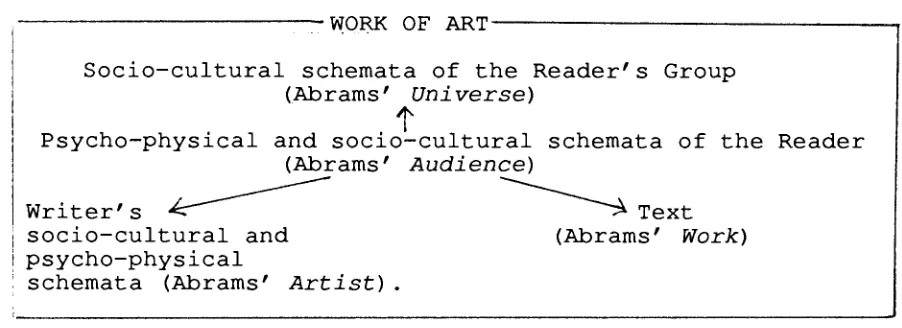
Figure 2.1. The reader-centred process of artistic creation 69
Figure 3.1. The stages of the 'reader's minidrama' 98
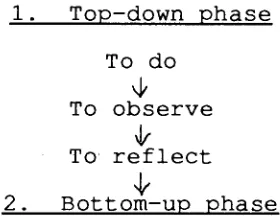
Figure 3.2. Cognitive steps from top-down to bottom-up phases 110
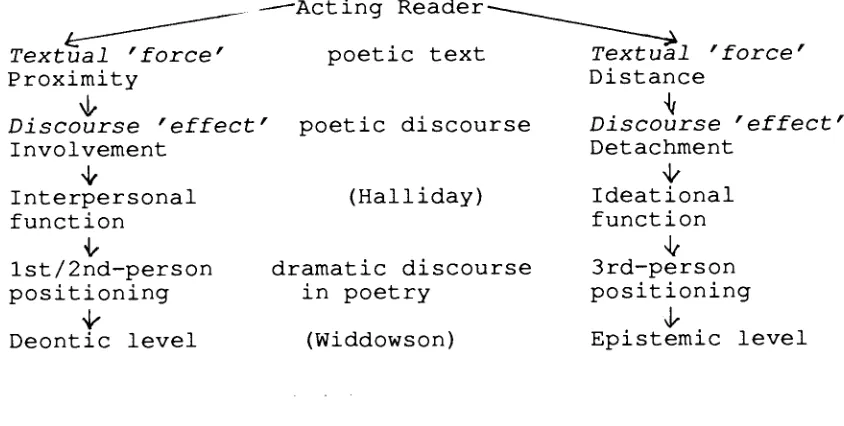
Figure 4.1. The Acting Reader's 'voices' and 'choices' 143
Figure 5.1. Pedagogic action 161
Figure 5.2. Phases of the pedagogic action (chronological
dynamics) 162
Figure 5.3. The acting readers' simultaneous 'positioning' levels in dramatic discourse creation 165
Figure 5.4. Dramatic interpretation (psychological dynamics) 166
Figure 5.5. Acting readers' improvisation process on 'given'
texts and 'new' poetic discourses 168
Figure 6.1. Body/language top-down/bottom-up processes 194
Figure 6.2. Metaphorical projections 195
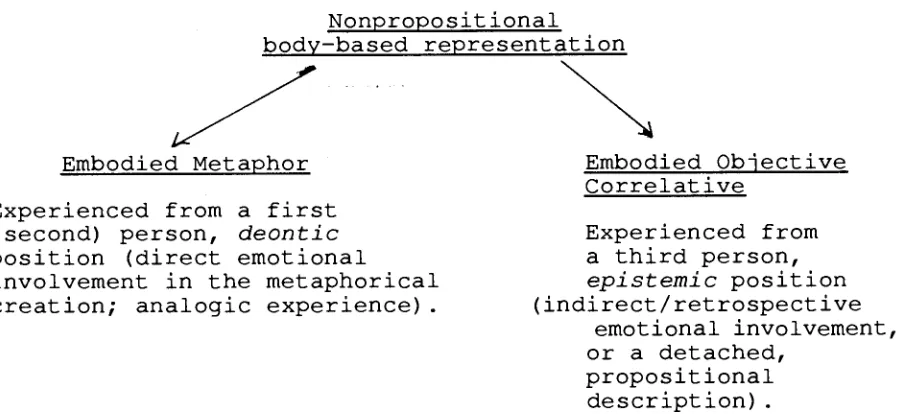
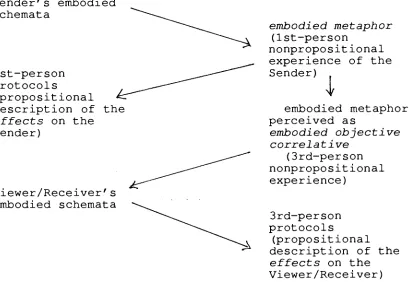
Figure 6.3. Embodied metaphors and objective correlatives: The
creative process 196
Figure 6.4. The cognitive/affective process of accessing embodied schemata through the 'Psychological Gesture' 202
Figure 6.5. Divergent logic in individual embodied schemata 204
Figure 6.6. Non-correspondence between 'force' and 'effect' 205
Figure 6.7. Shifting 1st/3rd-person perspectives in accessing
Figure 6.8. The original creative process of metaphorical
representation 211
Figure 6.9. The top-down process of metaphorical authentication 212
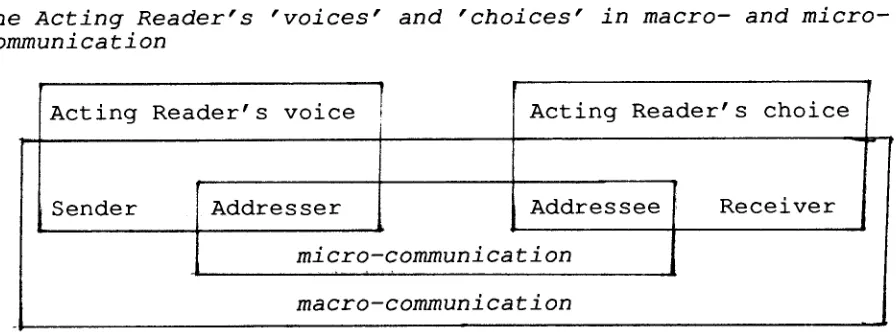
Figure 7.1. The Acting Reader's 'voices' and 'choices' in macro-
and micro-communication 220
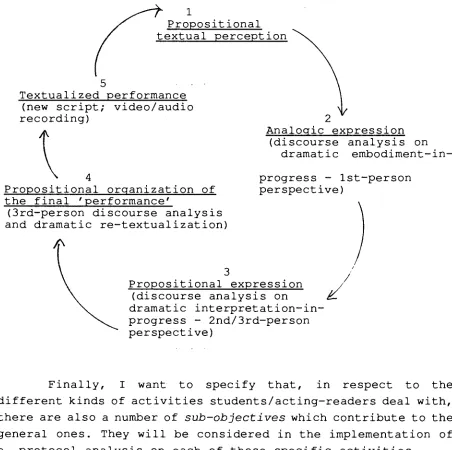
Figure 8.1. The circular process of dramatic discourse analysis
of poetry 251
Figure 8.2. Interactive Moves: Cognitive/affective dynamics 254
Figure 8.3. The acting reader's split consciousness in role-
playing 266
Figure 8.4. The interactive process of dramatic discourse in
poetry 269
Figure 1.(note). The acting reader's discoursal processing of
poetry 334
1.1. Poetic discourse as a dramatic use of language: 'setting the scene'
1.1.1. Research plan
Areas of enquiry. This research intends to elaborate a
principled approach to poetic language through the reader's use
of drama techniques based on physical and vocal improvisation and
on creative-writing retextualizations. The aim is to demonstrate
how such an approach can be relevant in the teaching of poetry
to either Ll or L2 students at both High School and University
levels.
The thesis seeks to locate a pedagogic problem of the
teaching of poetry within current theories of Discourse Analysis,
Applied Linguistics and Stylistics, Literary and Linguistic
Description, Cognitive Psychology and Schema Theory, Applied
Phenomenology, and Drama Methods.
Rationale. The rationale underlying this research is that
to be conceptually receptive to poetic language the reader needs
to be physically prepared to be receptive to it. For this
purpose, he has to free himself from his customary silent
position, by giving poetry a context in space and 'inhabiting'
it physically as well as vocally. In so doing, the reader becomes
an Acting Reader.
It follows that reading poetry involves two processes:
acting it out and analyzing its effects. This implies that the
acting reader creates his own dramatic discourse and its effects
which are followed by his own reflection upon them. Stylistics,
in this way, is meant as the analysis of the acting reader's own
Thesis design. In the development of my argument I consider
three phases which will be systematically analyzed and justified from both theoretical and practical perspectives:
1. The acting reader tries to overcome the initial sense
of estrangement felt towards poetry by imposing 'his own voice'
upon it through a top-down, deconstructive approach based on
dramatic improvisation. In this way, he tries to familiarize with
the unfamiliar linguistic mode of poetic expression.
2. The acting reader returns to the text for a close linguistic scrutiny, thus activating bottom-up reading strategies which allow him to discoursally achieve 'dramatic voices within
the text'. This estranges and distances him again from the
metaphorical mode of poetic expression.
3. The acting reader's physical and emotional 'embodiment' of 'the voices he achieves in the text' - by having them interact
with 'his own voice' - gradually enables him to reconcile the
opposing sensations of intimacy and estrangement within his own
self and to communicate his interpretative discourse to the other
acting readers interacting with him.
In the context of these three phases, poetic language will
be explored within the two genres of lyric/dramatic poetry and poetic drama, and always from the point of view of the reader, who has to cope with different degrees of textual
contextualization (from the well-defined situation in poetic
drama to the apparent lack of context in lyric poetry) as well
as with the challenges poetic language poses to him.
The purpose of this approach is to allow the reader to make
the poetic text his own through his own dramatic interpretation,
and, in this way, to access, authenticate, and appreciate it
better. Therefore, the crucial link I shall try to get across is
between the concept of poetic discourse which presupposes in some
sense the 'voice', and the way in which 'performance' is
1.1.2. The structure
So the structure of my thesis is very straightforward:
A. In Part One on Theory (Chapters 2-4), I shall discuss
the nature of literary discourse - and particularly the nature
of poetic discourse - by focusing, above all, on the reader's
place in relation to the poetic text, providing, at the same
time, a survey of the relevant theoretical assumptions on this
topic. Then, I shall postulate that poetic discourse is
intrinsically dramatic in the sense that it deals with 'voices'.
My notion of 'voice', in this theoretical context, is to be
related neither to that concept of 'voice' typical of traditional
theory of dramatization (meant as the sounding out of the words
with 'appropriate' intonation, pronunciation, gesture etc.), nor
to the more abstract concept of 'voice' common to literary
commentary. My notion of 'voice', on the contrary, relies
essentially on a continual, vital interaction between the acting
reader's 'inner voice' which takes its origin from his own
experience and personality (that is, from his own schemata), and
the 'textual voices' he achieves within the text by dramatically
accessing poetic language through his own 'inner voice' (/). This
implies a discoursal interplay between two cognitive/affective
strategies:
1. A top-down one, which presupposes the acknowledgement
of only a low degree of textual constraint so as to allow the
acting reader to impose his own 'voice' on the initial
'affective', dramatic discourse he achieves from the poetic text.
2. A bottom-up one, which takes into account textual
constraints allowing the acting reader to 'cognitively' identify
'voices' within the text.
This leads him to the physical and emotional authentication
of those 'textual voices' by means of 'his own voice'.
On the basis of these interactive assumptions, I then
advocate the need for an acting reader who does not just look at
the performance. On the contrary, he has to 'internalize' poetry
by 'acting it out' in order to sharpen his perception as to what
the features are in the text which allow him to assume the ways
he interprets it. Therefore, he first performs the poem by
creating his own discourse and its effects - on himself and on
his listeners/observers as well - and then he goes on reflecting
on his own performance and analyzing those effects.
Of course, a poetry reading of this kind cannot be an
activity carried out silently and in isolation; actually, it
involves groups of acting readers who, together, set up a
workshop where imaginative, emotional and physical energies, in
relation to the poetic language they explore, are constantly
communicated. One of the most suitable situations for realizing
all this is certainly the classroom which, under such
circumstances, rather resembles the rehearsal room.
B. In Part Two on Practice (Chapters 5-9), then, I shall
illustrate how this discourse principle of poetry leads the
teacher/researcher to certain activities which enable students
to feel the voice and, therefore, to develop a sense of identity
with the poetic texts - both lyric and dramatic ones - by
creating their own interpretation, their own dramatic discourse,
out of them. Moreover, I will also demonstrate, through the use
of samples of protocols from my students, that, although
students/acting-readers act within imaginary, virtual contexts,
they share true feelings, thoughts, actions and re-actions to the
poetic language: this is considered as an integral part of the
communicative situations generated by the interaction between the
students' imagination and the poetic text.
The pragmatic investigation will be carried out in an
Italian High School (with intermediate/advanced students of
English Language and Literature - age: sixteen/eighteen), and an
Italian University (with advanced/proficient students from a
Faculty of Foreign Languages and Literature - age: early
twenties), and it will be based on the exploration of how the
same poetic text, informed by different physical, emotional and
intellectual stances activated by the students/acting-readers,
can produce different kinds of discourse interpretations.
The guidance given to students in interpreting poetry
activities involving physical-theatre methods, creative-writing retextualizations, and stylistic/discourse analysis.
The question which will be raised in this pragmatic part of
my thesis concerns, above all, the imaginative relationship
between poetic text and the reader's vocal, verbal and physical
improvisation/response to it. Thus, the connection between words,
sounds, physical expressions and meaning will be explored in
order to enable analysis to confront the issue that the very
nature of poetic discourse is necessarily dramatic since it
internalises 'voices' and finds its realization in spatial
dimensions. The student/acting-reader, then, in the process of
creating his own discourse from the poetic text, can identify
himself directly with the voice/s in the poem by appropriating
and authenticating the text through dramatization: the emotional
and the physical context in which he puts the text will influence
his own interpretation.
Such a process of authentication can be explored through the
analysis of the students' protocols, which are transcriptions of
students' tape-recorded simultaneous/retrospective propositional
verbalizations of their analogic experience of poetic
dramatization.
The protocol analysis will especially focus on the vocal and
physical qualities of the acting readers' interpretations in a
relationship with the poetic text. The aim is to find out how the
reader's cognitive/affective process of 'acting poetry out' can
be influenced by:
a. The text itself (through the reader's activation of
purely bottom-up reading strategies);
b. The author's 'meanings' (through the reader's prevailing
attitude of 'submission' to what he believes the author's
psycho-cultural schemata are);
c. External factors:
1. Different actual contexts and situations in which
2. Virtual situations created by the group of
students/acting-readers while interacting with the language of
the text. (This can be a way to explore how that same poetic
language would work in a context which is different from the one
suggested in the text, thus creating parallel texts to the
original one);
3. Actual and virtual contexts dependent on individual
psycho-cultural schemata;
d. External ideas (through the acting reader's top-down
'public' activation of his cognitive/affective schemata while
physically interacting with the poetic text as well as with the
other acting readers' interpretation of it. In such collective
context, his first/second/third-person positioning in relation
to the dramatic representation of poetic language is crucial to
the establishment of degrees of detachment and involvement in the
stances he alternatively - or simultaneously - takes during the
group interaction);
e. Internal motivations of the acting reader (the top-down 'private' physical/emotional/intellectual investment of his own
individual personality).
In this context, a number of theoretical questions, such as
the experiential relativity of the dramatic representation of
poetry, as well as the non-arbitrariness of the sign in poetic
language (to mention only two among the issues I shall explore
here), will be systematically considered in the light of recent
theories of language and interpretation. Then, they will be
1.2. Motivations and research operationalization
1.2.1. The work of art as an imaginative prompt - The
poetic representation of 'virtual realities'
The main pedagogical motivation for the classroom approach
to poetry I am suggesting here consists in giving students the
possibility of creating their own 'sound virtual realities' (2). Very often, young people desire to evade, to escape a dull
reality which obliges them to conform to precise social codes,
by trying to find imaginary, parallel realities. A poetic
representation of this yearning for escaping the clutches of a
limiting and unimaginative real world, taking refuge into
fantastic, virtual situations can be considered, for example,
Keats's Ode on a Grecian Urn (3). Unfortunately, very rarely young people today are educated to use a work of art in the same
way as Keats uses it, that is, as an imaginative 'prompt' to
their own creative powers; very often, on the contrary, they
prefer to escape by using alcohol, drugs, all means that, in the
long run, far from stimulating their imaginative powers, dull and annihilate them.
The student-centred approach to poetry I am proposing here
intends to help students believe in their own imagination and
trust their own creative, fantastic often unconscious
-responses to the poetic language which, in itself, has got the
power of encouraging divergency and imaginary flights (4). I shall demonstrate how poetry itself encourages the creation of
imaginary contexts that cannot be located in the student's
present situation, because they are only a representation of an event dislocated from the normal context of life, with no
reference to any normal speech act. In this respect, Widdowson's
(1992) distinction between reference (language dependent on external and actual context) and representation (the context being internal, taking shape in the verbal pattern of the poem)
is crucial. Widdowson asserts that "the reading of a poem is
itself the representation of a renewal of our own experience of
(p.32); it also allows "the expression of apprehension beyond
comprehension ... (it extends) awareness beyond the limits of
accepted logic, ... it can free the individual from the
constraints of conventional thinking." (Widdowson 1987, p.241).
Poetry, I believe, has got the same all-involving power as
music: like music, it 'prompts' overt and subjective
'performances' which are, nevertheless, always relatable to a
pre-determined frame (the text as a 'score').
1.2.2. Poetic dramatization in the classroom
Promoting poetic dramatization in the classroom will aim to
favour students' total involvement in poetry, thus activating a
sort of psychodrama which helps them create and experience worlds
through words, virtual realities through poetry and - in the case
with L2 students - through a new language which estranges and
renews their own experience. By acting poetry out, the student
frees it from the authority of its author, thus creating, in
Blanchot's (1955) terms, a 'literary space' different from the
empirical reality; a virtual space, we may add, were he can enact
his conscious and unconscious fantasies in relation to the
language in the poetic text. In fact, according to Blanchot, the
poetic experience implies:
"the shift from a world where everything more or less has meaning, where there is darkness and light, to a realm where, literary speaking, nothing yet has meaning, toward which, nevertheless, everything that has meaning reaches back, as towards its origin." (p.260).
Nevertheless, I also agree with Sartre (1948) when he
asserts that the author has not to be completely discarded by the
reader, but, rather, the reader has to collaborate freely with
the author in the production of the work of art (p.59). This
interaction would allow the reader to broaden his understanding
of situations he has never lived first-hand.
The educational purpose of all this is to enable students
perceptive sensitivity.
The elaboration of a principled methodological approach to
the study of poetry through the use of drama and creative writing
techniques, then, intends, first of all, to focus on the
investment of the students' vocal, physical and psychological
personality in poetry; therefore this study will be about readers
'inhabiting' poetry, belonging to it, assuming roles in it,
giving life to the words of the text in order to create their own
interpretation, their own discourse on which it is possible to
carry out the stylistic analysis. All this is based on the
assumption that the text allows the readers a range of different
discourses, so that they textualize in the manner in which they
perform a particular discourse interpretation. The reader
'inhabits' the person into the poem, he speaks with the person's
voice, and this is the contribution this study intends to bring
to the debate on literary discourse and stylistic analysis.
Then I shall demonstrate how the pedagogical implications
and the various activities as applied in the classroom will be
consistent with the theoretical background based on some
developments in Post-Structuralism and Reader-Response Theory.
Students will be allowed possibilities of embodying the voice
into the text. This, as I shall demonstrate, has parallels with
theatrical performance and also, to a certain extent, with the
process of translation as a rendering a particular
interpretation.
I would argue that the customary practice of reading and
analyzing poetic texts silently has eliminated the possibility
of fully experiencing poetry, of turning a text into a poetic
discourse truly meaningful to the reader at every level of
perception. A sound, a rhythm, in fact, can evoke a meaning, an
analogy, a metaphor, a particular gesture or movement to a
certain reader who, then, transforms that poetic text into his
own poetic discourse, thus involving both his psychological
1.2.3. Spoken discourse
Differently from the dramatic-discourse approach to poetry
I am advocating here, Formalist literary-stylistic analysis
generally considers discoursal actualizations as beyond the text
itself; for the Formalists, in fact, language is inherent in the
text, and independent from its uses and contextual functions. In
spite of this trend, my position is that discourse analysis is
to be regarded as the analysis of language used in context. This
essentially involves an interaction between written and spoken
language and its realization as subjective discourse
interpretations. Actually, there is a tendency among some
scholars not to consider written and spoken discourse separately
(see Edmonson 1981): so that most of them mainly develop an
objectivist-oriented approach to the analysis of 'meanings' as
they are generated directly by the semantic structures of the
text. In so doing, however, they focus their attention on a kind
of discourse realization which is almost exclusively written.
Seen under this light, reading is not usually meant as an oral
activity: Benton (1988), for instance, maintains that the
reader's interaction with the written poetic text produces a
"mental performance" (p.18), so that, "if we read well, we cannot
stop ourselves sounding the words in the head" (p.21, my italics).
On the other hand, however, there is a number of scholars
who maintain that discourse analysis is necessarily concerned
with spoken discourse. I take this particular position as the
basic theoretical principle which will support my argument that
the very nature of poetry requires discourse interpretations in
the form of dramatic (physical as well as vocal) performance,
and, consequently, reading poetry aloud, and acting it out in
space is fundamental. However, most of the scholars who share the
line of enquiry concerning spoken discourse, restrict the scope
of their argumentation by asserting that, particularly in
literary discourse, analysis is made of an implicit, more or less
covert dialogue: Fowler (1981), for instance, focuses on
literature as an interpersonal discourse, an idea already
expressed by Bakhtin (1981) who bases his analysis of the
only in the interaction between characters, but also between real
and implicit authors and their real and implicit readers, as well
as between real and implicit authors/readers and the characters'
voices they realize in the text.
My own position in this theoretical context is that I
certainly agree with Bakhtin's general assumptions; nevertheless,
the point I will make is that all these real and fictitious
people interacting within the representational world created by
the poetic language have to 'speak aloud' both their own
conscious motivations and feelings (that is, those ones
explicitly and denotatively achievable from the poetic language
in the text - which the reader realizes by activating bottom-up
reading strategies) as well as their own unconscious ones (their
own most personal reactions, responses and connotations
associated to the poetic text - which the reader realizes by
activating top-down reading strategies. During the first phase
of reading, this 'conscious/unconscious' interaction can be
operationalized through the creation of parallel texts to the
original one. Such parallel texts are meant as re-textualizations
of the students' own discourse interpretations).
Therefore I maintain that it is the acting reader, through his own interpretation, the one who has to 'give voice and body'
to different views, emotions and personalities as they emerge in
the linguistic interaction. Such interpretation has to take place
within a context which is the result of the interaction between
the reader's, the poet's and the characters' psycho-physical and
cultural schemata, thus it has to be necessarily subjective and
many-sided. Foucault (1972) comes very close to this multiplicity
of points of view when he argues against a single universal
perspective on the world: for him, epistemic (knowledge),
doxastic (belief), deontic (obligation) and boulomaeic (want)
stances take origin always from discourse interactions. Yet, he
limits the scope of his argumentation when he excludes the whole
psychological, individual, and 'bodily' area of the unconscious,
of the creative expression (the oneiric and imaginative stances),
by asserting that knowledge, beliefs, hopes, and actions are
originated only by a particular socio-cultural and semiotic
1.2.4. General objectives
With this research, therefore, I will try to demonstrate
that:
a. The context in which the literary interpretation takes
shape can also be an individual, emotional, highly elusive one,
to the extent that it is almost impossible to be defined and
controlled, but only explored.
b. The exploration of the emotional context produced by the
interaction between the poetic text and the reader's
psycho-physical and imaginative schemata brings to the creation of
original metaphors - mental images (analogic figures of thought
and their physical realizations in space) and their vocal,
dramatic representations (propositional figures of speech)
-which allow for fresh insight into the nature of poetic
discourse. In this way, the reader can feel free to escape from
the limitations and conventions of any actual context.
c. The conscious recognition and experience of the
subjective effects produced by the poetic language gradually set
the grounds for each individual discourse interpretation and
stylistic analysis of a poetic text.
d. The use of voice and movement is a way of either
thoroughly experiencing poetic discourse, or affecting and
controlling its dramatic realization-in-progress.
1.2.5. Summary
To sum up, the contribution this study intends to offer to
the current research on Discourse Analysis and Literary
Stylistics consists, therefore, in recognizing the vocal,
often neglected) as a way of achieving a more thorough personal
awareness of the poetic experience. This acquires a further
significance when it is seen in terms of classroom dramatic
exploration of poetic texts.
The rationale behind this study is designed to focus on
those techniques of physical theatre and creative writing as
means in the hands of the students to realize the presence of a
dramatic 'voice' within poetic discourse. This provides a further
depth to their stylistic analysis. Students are to be given the
opportunity of identifying directly with the voice in the poem,
and not just in order to experience subjectively the poet's own
journey within the poetic use of the language of his text, but
first of all to find 'their own voice', their own poetic
discourse. Getting the students to take a poem off the page, to
give it a context in space and also to improvise on it, creating
parallel texts out of it, allows them to perform it and then to
reflect on their own performance. This is a fundamental
pre-condition of their stylistic analysis.
This approach to the analysis of the poetic text aims,
therefore, to bring together areas of enquiry which, so far, have
been occasionally connected with one another, but not justified
in any explicit and systematic way. These areas are: Literary
Stylistics, Discourse Analysis, Cognitive Psychology and
Semantics, Drama Techniques, and some recent developments in
Literary Theory and Post-Modern philosophical enquiry. It will
be demonstrated how theoretical assumptions will be relevant in
1.3. Practical implications: Ambivalence in poetry-teaching programs and the 'new dramatic model'
1.3.1. The target readership
As I have stated in the previous two sections of this
introductory chapter, this study is designed for formulating a
principled methodology of poetry teaching. It aims, therefore,
at meeting the interests of High School and University teachers
of English Literature (dealing with both native and non-native
students), and also of Drama teachers (in Britain the two
subjects are often linked together) who seek to avoid those
traditional 'one-way' classroom approaches to the literary text.
Literature teachers may find that the principled methodology
I propose essentially tries to overcome the purely mentalistic
approach to poetry which 'stiffens' rather than liberating
-students' bodies and imagination, and, consequently, also their
capability of developing independent critical thought and
aesthetic sensitivity.
Drama teachers and students, on the other hand, may find in
this study a solid theoretical basis which systematically
justifies each methodological choice in the field of drama
technique. A principled drama methodology of this kind - and also
specifically applied to poetry - is actually lacking in this
particular discipline, since almost every drama method (even the
classical ones, i.e. Stanislayski, Chekhov etc.) is mainly
grounded on a type of whole-person humanistic approach with very
little theoretical rationale and a quite limited pragmatic
enquiry into the cognitive/affective dynamics which lead to
1.3.2. Traditional trends in literature teaching
To justify the practical purpose of this research, I would
like to consider the fact that not until quite recent times,
literature teaching, especially in L2 classes, was an activity
whose aim was supposed to be obvious. And, in many cases, this
is still true: the study of certain classical, literary texts is
considered as a 'conditio sine qua non' for the true cultural
formation of the individual. In such cases, the classroom
approach to the literary texts is often completely non-existent,
because the text is read and considered simply as an
'illustration' either of the historical period which produced it,
or of the life and thought of its author, who is, again, set in
that same historical period. Apart from the traditional activity
of translation which almost always corresponds to this
traditional method, the literary text is no longer used for
further linguistic and creative activities.
In more recent times, especially during the last fifteen
years, the emphasis on the spoken, rather than on the written,
language has strongly put under discussion the place of
literature within the curriculum, especially in L2 contexts.
During the eighties, however, the situation seemed to have
changed, in fact literature gained a wider re-consideration also
within the language-teaching context. Yet, the new approaches
turned out to be deeply rooted into semiotic and structuralistic
bases, so that, the didactics of literature ended up with being
a simple identification of the figures of speech and thought used
by the author. Therefore, in both the traditional and the
semiotic approaches, there is only a one-way communication which
is generally expressed through the conventional scene of the
teacher who explains something students have to note down in
order to memorize and then repeat.
In his work entitled On the Future of our Educational Institutions, Nietzsche (1964) describes the scene of the classroom in this way:
half as many writing hands. There you have, to all appearances, the external academic apparatus; there you have the University culture machine in action. The proprietor of the one mouth is severed from and independent of the owners of the many ears; and this double autonomy is enthusiastically called 'academic freedom'." (p.27).
On the contrary, what should happen in the classroom
-especially when dealing with poetry - is to allow a plurality of
ears. If, in fact, the traditional approach to literature assumed
a classroom situation focused on the authority of the teacher
-or of the text of literary criticism - and the semiotic approach
was centred on the authority of the text and its author - always
filtered, however, through the teacher's view, or the critical
text - recently the emphasis has shifted on the student's
interpretation. In his essay The Ear of the Other, Derrida (1983) supports this position by asserting that the same words
can be read from totally opposed views, depending on the
plurality of the kind of relationship which is established
between the empirical readers and, we may say, the 'voice' of the
written text. In this way - as McDonald (1988) asserts in the
Preface to an edition of Derrida's book - "the autos, the self as the subject of biography is displaced into the otos, the structure of the ear as perceiving organ" (p.ix). This implies
that it is almost impossible for the text to be in total control
of its discoursal interpretations. However, I do not agree with
McDonald when she asserts that "both the text and its
interpretations remain plural", since the text is only one, an
object which allows readers a plurality of interpretations that
are - at least to a certain extent - controlled by its language.
1.3.3. The new dramatic model
This research intends, therefore, to place itself within the
context of the student-centred, communicative approach to
literature and to develop it further through the formulation of
of the poetic language in a text can enhance their subjective
stylistic analysis.
I assert that students have to find out the speaker's role
in poetry, or, rather, the different roles and
psycho-physical/intellectual 'positionings' of the speaker: they have
to trace evidence of who the speaker is and what, in their
opinion, he is trying to communicate to them, and what sort of
devices he is using to communicate this to the listener. This can
produce different interpretations of the same poem, but each
interpretation - both of the speaker and of the listener - adds
a further depth to the poetic text. A poem, in normal
circumstances, is an utterance coming from an Addresser and an
Addressee which are contemporary, and even though a poem is
decontextualized, nevertheless, it has got to be an assumption
of the first person speaker: who is the first person speaker? And
what evidence is there in the poem for identifying the first
person speakers or, indeed, the second person hearers, or the
shift from one person to another if there is an interaction
within the poem? Or, rather, if we take the line that since
poetry always has the implication of utterance, there is always
an implied speaker and an implied hearer, so can students
identify who these speakers are, who the first person is and how
the first person role is enacted in the poem? there are, in fact,
fairly clear clues within the text which make students identify
a particular supposed Addresser whose voice is being represented
in it.
However, there are two sides to this question: one is the
identification of the roles within the poem, of the role of the
Addresser or of the Addressee; secondly, how far can students
perform a poem so as to impose a particular Addresser; there are
poetic works, in fact, which do not allow for a free
interpretation of what the voice is, as it happens, for instance,
in poetic drama, even when it is presented under the form of
excerpts.
In spite of this apparent limitation on the students'
imaginative faculties, the concept of authentication - as it will be explored in Chapter 2 - can involve, in terms of classroom
practice, the possibility of having verse-speaking characters put
into different physical and psychological contexts by students,
Berkoff (1980) - do, in order to create new plays out of
classical poetic drama (6). Students themselves can create
parallel plays by deconstructing poetic dramas through
improvisation, or by devising poems through creative writing,
turning them into new plays by making, for instance, poetic
voices present in different poems written in the same period (the
Romantics, the Moderns) become characters of a new play:
Stoppard's (1975) play
Travesties,
for example, could beconsidered an experiment of this kind (7). It is also possible
to put them to music, as, for instance, in more recent times,
Lloyd Webber (1980) did with T.S.Eliot's (1939b) poems (8); or,
rather, they can also be seen in connection with other forms of
visual art, as, for instance, Stoppard (1971) does in
After
Magritte
(9). In this way, students can not only explore various kinds of theatre through creative writing and dramaticimprovisation, but they can also reflect on how they come to
those new scripts, and eventually to those performances, by
carefully examining the poetic language of the original texts,
what kind of 'voice' they employ, what kind of 'voice' is in the
text they are interpreting, where the stresses
will
come in thesentence to give a certain emphasis to the discourse, what kind
of gestures, postures and facial expressions will be more
appropriate to render a particular interpretation, and so on.
In this context, therefore, the analysis of the language
structures within the text will be in function of a particular
discoursal interpretation, so, for instance, looking at a
structure that happens to be a passive and deciding why, in that
text, there is a passive construction and not an active
construction is a useful thing to do because it enables readers
to respond more sensitively to the text, and at the same time,
it helps them use their grammar in function of understanding and
interpreting a certain 'voice' in the text.
And then, again, if in a poem students consider the
viewpoint which could change all the time through the text, by
staging the poem they have to create a deixis, and the speech and
thought presentation has to be interpreted accordingly. This will
make them more sensitive to features of the language which are
important to the understanding of the Addressers' viewpoints.
Then they can re-textualize the play after some physical,
this way, students can find some kind of further depth to the
text which, if it were just filtered through the mind, it could
remain flat. Actually, students should try to achieve a
metaphysical effect based - in Eliot's (1953a) words - on the
union of 'sense and thought', by finding new metaphors (based on
a semiotics which extends the written and oral language into the
physical dimension) capable of creating and stimulating new
sensibilities in the students/acting-readers as well as in the
students/observers. In fact, the written text is constituted only
by a series of signs; the point is to associate meanings to these
signs by interpreting them through the voice and the body.
The important issue is to concentrate on the emotional
linguistic choice: why it is that it has been chosen this way of
saying it, rather than using another way of saying it, perhaps
the issue active versus passive, or this synonym versus this
other synonym, or, rather, this rhythmical actualization of the
metre versus another one, all alternative possibilities the
reader has to be allowed to experiment in improvisation sessions,
to see how they can influence not only the poetic effect of the
language on the reader, but also his own interpretation as well,
and the way the listener receives the interpretation. It is also
important that the student/acting-reader motivates his choices
and is able to explain the reasons for his choosing a word rather
than another with the same meaning, or a particular tone of
voice, rather than another; which is the effect produced on him,
and then also on the members of his 'audience'. I define a
poetic-dramatization practice of this kind as a physical hypertext, in reference to those computer 'open works' where the
readers can determine the point of view in a story through a
series of choices he can develop creatively and originally,
though always under the control of the text. Dramatic
improvisation on poetry - if carried out in a 'hypertextually'
controlled way - can even overcome the multimedial limits which
confine the hypertextual experience to 'sight' and 'hearing'
only, by adding also the contribution of the other senses.
1.3.4. Summary
So that, what I have been argued so far implies a
distinction between two different kinds of approach to
literature:
1) a traditional approach which aims at supplying students
with a critical metalanguage in order to enable them to speak and
write 'about' literature, its semiotic conventions, its history
and its authors. This approach represents what Nietzsche (1964) -
in his already mentioned book on education - considers as 'a crime against life':
"The historical method has become so universal in our time, that even the living body of language is sacrificed to its anatomical study. But this is precisely where culture begins -namely, in understanding how to treat the living as living and it is here too that the mission of the master of culture begins: in suppressing 'historical interest' which tries to impose itself there where one must above all else act correctly rather than know correctly. Our mother tongue is a domain in which the pupil must learn to act correctly." (p.22).
2) An interactive approach - the one I am advocating here -
which aims to help students, in Nietzsche's words, 'to act' upon
literary texts, rather than 'to know them correctly'. This
implies a methodological model that regards literature as a
resource for the growth of the student's personality and for the
enhancement of his imaginative power, with the purpose of
developing in him a deeper sensitivity and awareness of himself,
of the others, and of the world around him.
Moreover, such an approach guarantees many opportunities to
use the foreign language in L2 classes, since it is based on a
kind of linguistic material - poetry - capable of generating
great interest and involvement. In addition, the poetic text can
be used as an excellent prompt for an oral and written creative
work. An approach to poetry of this kind represents an advantage
for the development of all the four fundamental skills for the
foreign language acquisition. At the same time, the students
learn either how to appreciate the richness and the variety of
in wholly personal ways.
Besides, the students' imaginative involvement with the
poetic text will enable them to go beyond the mere structural
aspect of the language: as a result, they will start inhabiting
the text, feeling totally involved in it at an emotional as well
as physical level, thus establishing a creative relationship with
the text. The assumption, here, is that the poetic function of
the language can be introduced in the L2 classroom very early,
without waiting for a good level of proficiency in the foreign
language. After all, students are already familiar with the
effects of poetry in Ll, even though they are still unaware as
to how consciously personalize and authenticate them. To achieve
this purpose, the 'ego-dynamic level' - according to Titone's
(1985) definition - has to be privileged, because it pervades the
communicative-relational sphere and, in our case, it can
encourage an in-depth exploration of the students within
themselves and the others through the poetic language.
The effect poetic language is expected to have on students
'internalizing' it, is one that resembles a 'process of
estrangement' which allows a sort of displacing of the self
-their voice becoming disembodied and then re-embodied - and makes
them see words and their connotations as something new, allowing
for the interpretations of new metaphors which are not just
written, but also evoked by voice, sound, gesture etc. The
peculiar effect of poetry is, in fact, a sense of bewilderment
at the renewed sense of the language which becomes estranged and
intimate at the same time.
1.4. Research development - The Chapters
The development of this research on a 'principled dramatic
model' to be applied to the classroom approach to poetry will be
organized according the following plan:
1. Part One will elaborate a theoretical statement -
through the confrontation with other parallel critical positions
a 'performance'. This theory of poetic performance as poetic
discourse will lead to the formulation of the theory of the
acting reader assuming the voices within the poem as a way to
realize the particular discourse potentials of the poetic text.
So that, Chapter 2 will survey current theories of literary
discourse, particularly focusing on the roles of the reader and
the writer in poetic text.
Chapter 3 starts an enquiry into the imaginative procedures
employed by readers while dealing with poetry: it begins from the
very first meeting between the reader and the text (marked by a
sense of 'estrangement' towards the poetic mode of expression),
to proceed to the achievement of an 'intimacy' with poetry during
the first deconstructive 'top-down' phase, and 'estrangement'
again, during the second, text-based 'bottom-up' phase.
Chapter 4 will then describe the third and final
'interactive' phase, which postulates the presence of a group of
empirical acting readers imaginatively 'embodying' poetic
language by inter-acting with both the poetic text and with their
own diverse discoursal interpretations of it. The theory of the
acting reader will be supported by a background of philosophical
enquiries into a phenomenology of the private 'self' and its
public dramatization.
2. Part Two will propose a principled pedagogic approach
for the achievement of a dramatic discourse in poetry, by
proceeding from the previous establishment of the theoretical
position.
So that Chapter 5 will focus on the pragmatic relevance of
theory to classroom practice, particularly in the light of
Bakhtin's notion of 'dialogism' applied to poetry dramatization.
It will also state the research tools and procedures to be
implemented in the dialogic poetry classroom, by advocating the
use of a protocol analysis which takes into account a
'multi-angulation' of first/second/third-person perspectives, depending
on the students/acting-readers' different positionings.
Then, Chapter 6 will deal with the pedagogic applications
of the top-down phase by systematically justifying students'
responses to classroom activities in reference to the peculiarly
'physical' nature of the cognitive, affective, and imaginative