1
Object Motion Detection System Using Passive
UHF RFID Technology For A Trauma Bay
Young Ho Lee, Ivan Marsic
Abstract: There has been demands of context-aware systems in a hospital domain and several types of sensors have been applied as sources of medical activities. Unlike the previous passive RFID use of simply identifying objects, this paper presents a system for motion detection of medical objects in a trauma bay by ranging the received signal strength indication (RSSI), using UHF passive RFID tags as one of those sensors that provide information on medical activities. To use passive RFID RSSI for motion detection, Three different types of RSSI estimators are evaluated to process noisy RSSI and the adaptive threshold is proposed in the system to improve the resolution of detecting motion. Our system has been tested with recorded RSSI values in a laboratory and an actual trauma bay during simulated resuscitations performed by trauma teams. The proposed system has achieved 85.9 - 92.1% accuracies for most passive items that are used in a trauma bay.
Index Terms: UHF RFID system, RSSI estimator, Object motion detection.
————————————————————
1 Introduction
The passive RFID tag is one of the sensors that has been used in a hospital environment for monitoring medical objects [1] [2]. Our study focuses on motion detection of medical objects as a basis for activity recognition in a trauma bay. The fast-paced, high-risk environment of trauma resuscitation can benefit from a context-aware system. While most active devices and instruments in a trauma bay provide valuable information [1], passive devices and tools such as laryngoscope, IV subbing and thermometer need additional sensors to provide information for the context-aware system [3]. Detecting the motion and identifications of passive objects in the bay can serve as reliable information sources for current tasks and team activities because most medical objects are uniquely associated with different tasks [3]. In this paper, we present a motion detection system for passive medical objects being used on a patient bed of a trauma bay using passive ultra-high frequency (UHF) RFID technology. Our system is nonintrusive to trauma teams. Because UHF RFID systems have a long working rage, up to 11 meters, RFID reader antennas can be mounted onto the ceiling above the bed. The maximum range of 11 meters allows to interrogate tags from the reader antenna on the ceiling. To detect medical object motion, the received signal strength indication (RSSI) of the tag is used. RSSI is RFID reader measurement of the power present in received radio signals from a RFID tag. Since the strength of the received power varies with the location and orientation of the tag [4], RSSI is a good indicator for detecting movement of tagged objects. When a tag is moved, the change of the tag's RSSI is made due to the change in the location and orientation of the tag [5]. We make the following contributions: first, we investigate noise power spectrum of RSSI in the indoor environment and propose RSSI estimator. Then we show that estimated RSSI is reliable in distinguishing tag’s location. Second, we show that by averaging raw RSSI reads, the noise of RSSI from a stationary tag converges to zero and the estimation of RSSI data converges to the true mean and then present an adaptive threshold to increase system accuracies.
Third, we install a RFID system in a real trauma bay and evaluate the detection system. The results shows 85.9 - 92.1% accuracies for most passive items in crowded settings. This result indicates that the passive UHF RFID technology allows to provide identification of medical objects and information on their motion for context-aware systems in hospital settings. The rest of this paper is organized as follows. In Section 2, we review related work. In section 3 we present an RSSI estimator and a motion detection system. In Section 4, a trauma room with RFID reader antennas, tagged medical objects and experimental results are presented. Finally, we discuss the conclusions in Section 5.
2 Related Work
In medical domain studies [1] [2] [6] [7] applied passive RFID tags to detect the presence of medical objects in the room and not capable of providing information on the movement of the objects. Moreover high frequency RFID systems are intrusive and require medical staffs to wear RFID readers due to short ranges, less than 1 meter. Vision-based sensors [8] [9] have been used for motion recognition. Although being nonintrusive to trauma teams and provides all the views of activities, they raise privacy concerns for the teams and patients in hospital settings [10]. We use UHF RFID technology to provide both motion and identification of medical objects. Moreover, the system does not cause privacy concerns and is nonintrusive to teams.
3. System Model
Our system is designed to detect the motion of medical objects around and on the patient bed in a trauma bay and produces object sates as ―Moving‖ and ―Stationary‖. The detection system is based on RSSI changes from object relocation. If a RSSI change is made above a threshold, the object state is moving. If a RSSI change is made within a threshold, the object state is stationary. The system comprises two parts, a RSSI estimator that suppresses the random noise in raw RSSI reads and an adaptive motion detection system that makes a accurate decision on the motion of a object under noisy environments. This section describes key design aspects of the system. we first examine the spectrum of raw RSSI reads and three different noise smoothers to mitigate the random noise in raw RSSI reads. Then we present an adaptive motion detection system that keeps tracking the optimum thresholds to make a decision on the motion of a object by using statistics of random noise.
____________________
Young Ho Lee is currently pursuing PhD degree program in Electrical and Computer Engineering at Rutgers University, USA, e-mail: [email protected]
2
A. RFID system setup
The RFID hardware used in this paper consists of a RFID reader (ALR-9900), a circularly polarized antenna (ALR-9611-CR) and passive UHF tags (ALN-9740) [11]. The operating frequency of the system is 902.75 - 927.25 MHz with frequency hopping. The power of RF transmitter is no more than 30 dBm. The antenna dimensions, gain and beam width are 28.4
19.5
4.3 cm, 6dBi max and 40 degree. The RFID readers and a desktop computer are connected with network cables to a router for TCP/IP communication. The reader has a local clock and offers a timestamp with a millisecond resolution for each RSSI read. The communication protocol used between the readers and the passive tags to support long ranges is the EPC ClASS-1 Generation-2 standard [12]. We arranged a laboratory to mimic a real trauma bay in terms of size and surroundings. The reader antenna is on the ceiling at 2.65 m high, facing down to the patient bed at 0.76 m above the floor. The measurements for system development were taken in the laboratory. In the experimental results, RSSI data from an actual trauma bay were used.B. RSSI estimator
RSSI measurement reveals inherently low accuracy for a system based on passive RFID [13] [14]. This low accuracy is caused by scattering, multipath, and delay spread of indoor propagation [15]. In a natural indoor environment, two sets of measured RSSI at two adjacent locations share much of the boundary of each set and results in high error probabilities in detecting the RSSI change between the two adjacent locations.
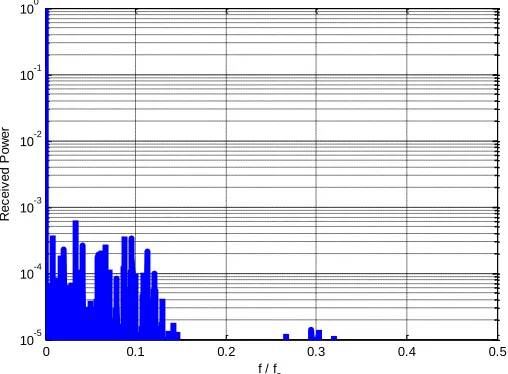
Fig. (a) shows raw RSSI distributions with a large decision error of 37% in detecting the RSSI change from 6 cm apart locations due to a large amount of shared RSSI distributions. Thus we first investigate the noise spectrum of raw RSSI and evaluate three different RSSI estimators to remove the raw RSSI noise. Fig. 1. The normalized power spectrum of raw RSSI from a stationary tag at fs = 30 Hz. shows the normalized power spectrum of raw RSSI reads from a stationary RFID tag. The tag is 2 meters apart from a RFID reader antenna and 10,000 samples are used to compute the spectrum using a Fourier transform algorithm. This spectrum indicates that the noise spectrum of the stationary RSSI is clustered mostly around the DC level and low-pass filter (LPF) types are applicable to suppress these noises.
Fig. 1. The normalized power spectrum of raw RSSI from a stationary tag at fs = 30 Hz.
Based on LPF types of RSSI estimator, desired properties for the RSSI estimation in our context are: (a) The filter lag of the estimation is predicable to detect moving or stationary state time; (b) For the different gains of tag’s antennas, Estimation
[αx(n)] = Estimation α[x(n)] where x(n) is the RSSI reads; (c) The estimation should not smear out sharp transitions in the data; and, (d) The estimation must work for nonlinearly moving objects in crowded rooms. We evaluate three different types of noise suppressor as a RSSI estimator that meet the desired properties.
1) LPF filter
A LPF filter removes higher spectral noise than signal spectral. We use a FIR type to evaluate.
2) Hanning window
Hanning window has a reasonable balance between reducing raw RSSI variance and removing spectral noise with the property of a sharp cutoff frequency response of the Hann function [16].
1
2
cos
1
5
.
0
)
(
N
n
n
w
(1)Where N is the window length.
3) Savizky-Golay
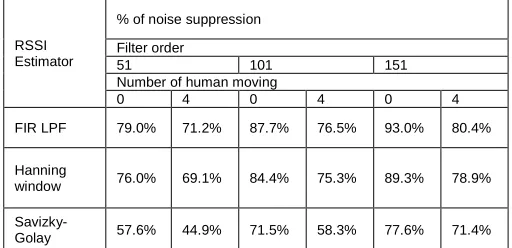
Savizky-Golay smoothing filters, known as polynomial smoothing, reserve better the high-frequency content of the desired signal at expense of not removing as much noise as linear filters [16]. To verify the performances of the different noise suppressors, we define test data sets. Twenty sets of test data in total are used. Sets are collected from a stationary tag at ten different locations of the patient bed. Each set consists of 104 RSSI reads. The ten sets are made with a person present and another ten sets are made with four people moving around the patient bed. Table 1 presents a performance comparison of the three RSSI estimators. The filter coefficients are set to suppress noise around DC level to produce its best estimation of RSSI. Eqn. 2 is used to calculate % of noise suppression.
0 0.1 0.2 0.3 0.4 0.5
10-5 10-4 10-3 10-2 10-1 100
f / f s
R
e
c
e
iv
e
d
P
o
w
e
3
% of noise suppression =
( ) (2)
Where the maximum peak of input noise is the maximum difference between the input mean and the peak of input RSSI data. The same procedure is applied for the maximum peak of output noise. The noise peak suppression focuses on the maximum peak of noise. Because a moving tagged object causes a change in the RSSI values, high noise peaks can result in false detections. Greater noise-peak suppression yields higher accuracy of detection. From Table 1, the FIR LPF shows a better suppression ratio than the other two. The FIR LPF RSSI estimator with the order 151 achieves, on average, about 93% of noise peak suppression without a person present, and 80% of noise peak suppression with four people moving around the patient bed. After passing through the FIR LPF, the noise on the RSSI is suppressed and the output converges closely to the mean value (Fig. 2). FIR LPF is decided to use for a RSSI estimator of our motion detection system.
RSSI Estimator
% of noise suppression
Filter order
51 101 151
Number of human moving
0 4 0 4 0 4
FIR LPF 79.0% 71.2% 87.7% 76.5% 93.0% 80.4%
Hanning
window 76.0% 69.1% 84.4% 75.3% 89.3% 78.9%
Savizky-Golay 57.6% 44.9% 71.5% 58.3% 77.6% 71.4%
Table 1. Noise peak suppression ratios of three RSSI estimators with a person present and with four people moving
around the patient bed.
Fig. 2. Raw RSSI measurement and the output of the estimator
Fig. shows that the RSSI estimator reduces errors from 37% to 1.2% in distinguishing RSSI reads from 6 cm apart
locations.
Fig. 3. Gaussian fitted distributions of raw RSSI and estimated RSSI at 6 cm apart locations on a patient bed in the case of four people moving around. The origin, 0 cm, is the point on the bed right below the reader antenna; (a) raw RSSI distributions and the error probability (37%); and (b) estimated RSSI distributions and the error probability (1.2%)
C. The Motion Detection System
Our detection system uses RSSI change to make the decisions of tagged object states as ―moving‖ or ―stationary‖ (Fig. 4). The main components of the motion detection system are a RSSI estimator, a comparator, and an adaptive threshold. This system first estimates raw RSSI reads from a tagged object and compares a set of 151 RSSI estimations with the adaptive threshold. If the result remains within the adaptive threshold, the object is in the stationary state.
RSSI Reads
RSSI
Estimator Comparator
Stationary
Moving
Reset Adaptive Threshold Adaptive Threshold
Estimator
Fig. 4 The proposed motion detection system with a RSSI estimator.
1) The Adaptive Threshold
The noise level for a stationary tag can be very different with different environments such as no people moving versus a crowded place with several people quickly moving around. For the reasons our system uses adaptive threshold. By averaging raw RSSI reads, the noise of RSSI data from a stationary tag converges to zero and the estimation of RSSI data converges to the mean (Eqn. 22222222 and 3). Starting with the full range of the premeasured noise level for the stationary state, the proposed system can reduce this full range down to zero as long as the object remains in a stationary state2222222.
RSSI mean =
1
0
1 0
(
)
1
)
(
)
(
1
ni
n
i i
i
V
i
n
S
i
V
i
S
n
mean (2)Where S(i) + V(i) represents noisy RSSI values. S(i) is the RSSI value without the noise and V(i) is the uncorrelated random noise with zero mean.
0 100 200 300 400 500 600 700 800 900 1000
1000 1500 2000 2500 3000 3500 4000
R
S
S
I
V
a
lu
e
s
Samples
Raw RSSI Output of Estimator Mean value
0 1000 2000 3000 4000 5000 6000 0
0.2 0.4 0.6 0.8 1
RSSI (a) Raw RSSI Distribution
0 1000 2000 3000 4000 5000 6000 0
0.2 0.4 0.6 0.8 1
RSSI (b) Estimated RSSI Distribution
4
The noise variance of sum of N RSSI reads is
2 22 2 2
2 2
2 1 ... 1 1
v v v
v v v
n N n
n
(3)
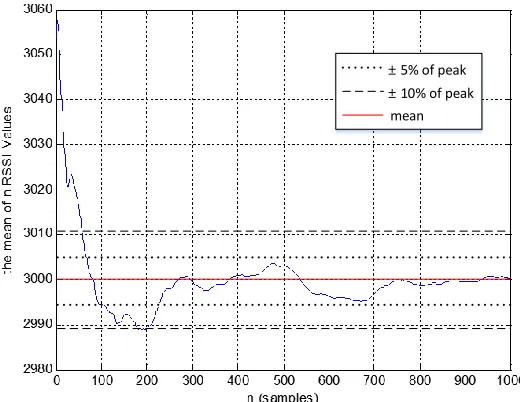
The noise variance is proportional to 1/n. Thus when n becomes a large number, the variance goes to zero [17]. Fig. shows that how rapidly averaging becomes the true mean.
After about 50-sample time, the mean remains within 10% of
the noise peak and after about 220-sample time, it remains within 5% of the noise peak. Therefore, after 220 stationary RSSI data, the upper and lower thresholds will be adaptively reduced up to 5% of the noise peak. When a tag remains stationary, the adaptive threshold is reduced as:
The adaptive threshold =
{1 – 0.5(n- Tm ) / Ts} the absolute threshold, (4)
where n is the sampling time taken over the period
, Ts is the time to reach 2% of the mean, and Tm is the time to read a set of 151 raw RSSI. The absolute threshold is a full noise level, premeasured in a set of 151 raw RSSI. When n
approaches Ts, the adaptive threshold converges to about half of the absolute threshold. Therefore the adaptive threshold process will double the accuracies in detecting object motion. Fig. 6 shows the Pseudo code for the system.
± 5% of peak
± 10% of peak mean
Fig. 5. The estimation of stationary RSSI data as the number of RSSI reads increases.
/* Function and Variable */
// The function of noiseEstimator() denotes the output of the RSSI Estimator
// The variable of flag indicates the state of the tag is stationary or moving /* Constants */
absolute_threshold = the premeasured threshold Ts = the time to reach 2% of the noise peak Tm = time to read a set of 151 raw RSSI
/* Initialization */
sum = 0; // the integrator for the adaptive threshold n = 0; // the counter
flag = "Stationary" ; // it indicates the state of "Moving" or "Stationary"
/* filter loop */
while (true)
temp += noiseEstimator(); sum += temp;
if ( Ts <= n <= Tm)
adaptive_threshold = (1 – 0.5 * ( n – Ts) / Ts) * absolute_threshold; else
adaptive_threshold = absolute_threshold; n++;
do every 2 seconds {
if ( abs( (temp – sum) / n) > adaptive_threshold ) then flag = "Moving", sum = 0, n = 0;
else flag = "Stationary"; }
end while
Fig. 6 Pseudo code for the object motion detection system with the adaptive threshold.
2) System evaluation
Three experimental scenarios are used to show how the motion detection system works. The raw RSSI values were captured on a reader antenna from a tag attached to an object on the patient bed. The object was moved 4-6 times, producing a corresponding number of different groups of noisy raw RSSI values (Fig. 7 (a), 8 (a) and 9 (a)). Fig. 7 - 9 (b) and (c) are motion detection comparison for the adaptive threshold. (b) is the detection results with adaptive threshold and (c) is the detection results using the premeasured threshold. Fig. 7 shows that the motion detection system with and without the adaptive threshold produces the same correct outputs at every tag’s movement. Fig. 8 is the case that RSSI reads are made with tag’s orientation changes. Because each group of RSSI is not much different from others, the system without the adaptive threshold misses two detection points. Fig. 9 shows interference with human present and moving. Four people are present and moving around the patient bed. Compared to the one-person case, the output of the RSSI estimator fluctuates more due to the interference but all the movements are detected with the adaptive threshold. Overall, the proposed system detects all the tag’s movement including small changes and four people moving around.
Fig. 7 Scenario 2 – RSSI changes due to tag’s location
changes with a person present.
0 200 400 600 800 1000 1200 1400
0 2000 4000 6000
(a) RSSI estimator
R
S
S
I
V
a
lu
e
s
raw RSSI RSSI estimator
0 200 400 600 800 1000 1200 1400
Stationary Moving
(b) with Adaptive Thresholder
0 200 400 600 800 1000 1200 1400
Stationary Moving
RSSI Reads
5
Fig. 8. Scenario 2 – smooth RSSI changes due to tag’s
orientation changes with a person present.
Fig. 9. Scenario 3 – RSSI changes due to tag’s location changes with four people moving.
4. Experimental Results
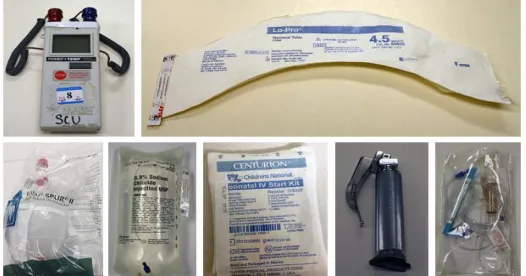
Tagged medical objects: we selected medical objects that are mostly used around the patient bed and tagged them with UHF RFID tags. The medical objects used are bag valve mask (BVM), collar, laryngoscope, ETtube (ETT), Stethoscope, Fluid bag, IV start kit, IV tubing, and thermometer (Fig. 10). One RFID reader antenna is on the ceiling right above the patient bed and another RFID reader antenna is on the ceiling facing down to a tool cart near the bed (Fig. 11).
Fig. 10. Tagged medical objects; from upper left, thermometer
and ETT, from low left, BVM, fluid bag, IV start kit, laryngoscope and IV tubing.
Antenna 1 Antenna 2
Tool cart
Cabinets
IV hanger
Counter Patient bed
Fig. 11. The trauma room with two reader antennas
Data collection and ground truth data: Four different trauma teams simulated each two resuscitations with the tagged medical objects. During the resuscitations, RSSI and ID of tags are recorded with time stamps and two video cameras are used to produce ground truth by hand. Table 2 shows the performance results. The motion detection system with the adaptive threshold shows 11.5 % improvement in accuracy on average. Stethoscope shows the lowest accuracy of 64.8 % because it is usually around shoulders and human body interferes with RFID signals.
Items
Accuracy (%) With Adaptive
threshold
Without Adaptive Threshold
BVM 90.0 80.2
Collar 92.1 89.2
Laryngoscope 86.3 71.3
ETtube 85.9 69.4
Stethoscope 64.8 57.9
Fluid bag 86.8 70.1
IV start kit 91.6 78.6
IV tubing 90.4 78.4
Thermometer 91.7 81.0
Table 2. motion detection accuracies for each medical objects
5. Conclusion
In this paper we have presented a RSSI estimator and a motion detection system for medical objects in trauma bays. The system uses received power strength indication, from UHF passive RFID tags on objects. The RSSI estimator keeps the noise variance down to more than one thirteenth of the raw noise variance and allows to make boundaries accurate for decisions on object motion. The adaptive threshold increased the detection accuracies by 11.5% on average compared to a simple detection system. Our system has been evaluated with recorded RSSI reads in an actual trauma and shown 85.9 - 92.1% accuracies for most passive items. From these high accuracies with long working rages, passive UHF RFID can be one of sensors that provide information on motions of passive medical objects for context-aware systems in hospital settings.
0 500 1000 1500 2000 2500
0 2000 4000 6000
R
S
S
I
V
a
lu
e
s
(a) RSSI estimator raw RSSI RSSI estimator
0 500 1000 1500 2000 2500
Stationary Moving
(b) with Adaptive Thresholder
0 500 1000 1500 2000 2500
Stationary Moving
(c) without Adaptive Thresholder
samples
0 200 400 600 800 1000 1200 1400 1600 1800 0
2000 4000 6000
(a) RSSI estimator
R
S
S
I
V
a
lu
e
s
raw RSSI RSSI estimator
0 200 400 600 800 1000 1200 1400 1600 1800 Stationary
Moving
(b) with Adaptive Thresholder
0 200 400 600 800 1000 1200 1400 1600 1800 Stationary
Moving
RSSI Reads
6
References
[1] S. Agarwal, A. Joshi, T. Finin, Y. Yesha, and T.
Ganous, "A pervasive computing system for the operating room of the future," Mobile Networks and Applications, vol. 12, no. 2-3, pp. 215-228, 2007.
[2] K. Ohashi, S. Ota, L. Ohno-Machado, and H. Tanaka,
"Smart medical environment at the point of care: Auto-tracking clinical interventions at the bed side using RFID technology," Computers in Biology and Medicine, vol. 40, no. 6, pp. 545-554, 2010.
[3] S. Parlak, A. Sarcevic, I. Marsic and R. S. Burd,
"Introducing RFID technology in dynamic and time-critical settings: Requirements and challenges," Journal of Biomedical Informatics, vol. 45, no. 5, pp. 958-974, 2012.
[4] J.L. Brchan, L. Zhao, J. Wu, R.E. Williams, and L.C. Pérez, "A real-time RFID localization experiment using propagation models," 2012 IEEE International Conference on. IEEE, 2012.
[5] B. Jiang, K. P. Fishkin, S. Roy, and M. Philipose, "Unobtrusive long-range detection of passive RFID tag motion," Instrumentation and Measurement, IEEE Transactions on, vol. 55, no. 1, pp. 187-196, 2006.
[6] J.E. Bardram, A. Doryab, R. M. Jensen, P.M. Lange,
K.L. Nielsen, and S.T. Petersen, "Phase recognition during surgical procedures using embedded and body-worn sensors," In Pervasive Computing and
Communications (PerCom), IEEE International
Conference on, pp. 45-53, 2011, March.
[7] T. Inomata, F. Naya, N. Kuwahara, F. Hattori, and K.
Kogure, "Activity recognition from interactions with objects using dynamic bayesian network," In Proceedings of the 3rd ACM International Workshop on Context-Awareness for Self-Managing Systems, pp. 39-42, 2009, May.
[8] R. Poppe, "A survey on vision-based human action recognition," Image and Vision Comput., vol.28, no.6 pp.976-990, 2010..
[9] D. Weinland, R. Ronfard, and E. Boyer, "A survey of vision-based methods for action representation, segmentation and recognition," Computer Vision and Image Understanding, vol.115, no.2, pp.224-241, 2011.
[10] S. Parlak and I. Marsic, "Detecting Object Motion Using Passive RFID: A Trauma Resuscitation Case Study," Instrumentation and Measurement, IEEE Transactions on 62(9), 2430-2437., 2013 .
[11] "Alien Technology", http://www.alientechnology.com/.
[12] GS1 Standards, http://www.gs1.org/epc-rfid.
[13] D. Joho, C. Plagemann, and W. Burgard, "Modeling RFID signal strength and tag detection for localization
and mapping," in Proc. IEEE Int’l Conf. Robotics and Automation, pp.3160-3165, 2009.
[14] J. Torres-Solis, T.H. Falk, and T. Chau, "A review of indoor localization technologies: towards navigational assistance for topographical disorientation," Ambient Intelligence, pp.51-84, 2010.
[15] S.R. Banerjee, R. Jesme, and R.A. Sainati,
"Performance analysis of short range UHF
propagation as applicable to passive RFID," Proc. IEEE RFID Conference, pp. 30-36, 2007.
[16] Sophocles J. Orfanidis, "Signal Processing," Prentice Hall, pp. 549-550, pp. 434-462, 1996.