www.nat-hazards-earth-syst-sci.net/15/2653/2015/ doi:10.5194/nhess-15-2653-2015
© Author(s) 2015. CC Attribution 3.0 License.
Evaluation of a compound distribution based on weather pattern
subsampling for extreme rainfall in Norway
J. Blanchet1,2, J. Touati1,2, D. Lawrence3, F. Garavaglia4, and E. Paquet4 1Univ. Grenoble Alpes, LTHE, 38000 Grenoble, France
2CNRS, LTHE, 38000 Grenoble, France
3Norwegian Water Resources and Energy Directorate (NVE), P.O. Box 5091, Majorstua, Oslo, Norway 4EDF – DTG, 21 Avenue de l’Europe, BP 41, 38040 Grenoble CEDEX 9, France
Correspondence to: J. Blanchet ([email protected])
Received: 16 April 2015 – Published in Nat. Hazards Earth Syst. Sci. Discuss.: 3 June 2015 Revised: 13 October 2015 – Accepted: 13 November 2015 – Published: 10 December 2015
Abstract. Simulation methods for design flood analyses re-quire estimates of extreme precipitation for simulating maxi-mum discharges. This article evaluates the multi-exponential weather pattern (MEWP) model, a compound model based on weather pattern classification, seasonal splitting and expo-nential distributions, for its suitability for use in Norway. The MEWP model is the probabilistic rainfall model used in the SCHADEX method for extreme flood estimation. Regional scores of evaluation are used in a split sample framework to compare the MEWP distribution with more general heavy-tailed distributions, in this case the Multi Generalized Pareto Weather Pattern (MGPWP) distribution. The analysis shows the clear benefit obtained from seasonal and weather pattern-based subsampling for extreme value estimation. The MEWP distribution is found to have an overall better performance as compared with the MGPWP, which tends to overfit the data and lacks robustness. Finally, we take advantage of the split sample framework to present evidence for an increase in ex-treme rainfall in the southwestern part of Norway during the period 1979–2009, relative to 1948–1978.
1 Introduction
Flood estimation is important for design and safety assess-ments, flood risk management and spatial planning. It aims to assess the probability of occurrence of large events, e.g., discharges with return periods of 100 to 10 000 years. Es-timation of events with such low probability is particularly arduous. It can only be based on a few data points
gener-ating a continuous streamflow series (continuous simulation approach).
In Norway, a simple event-based rainfall–runoff model, PQRUT, has been used since the 1980s as a simulation method for dam safety analyses for which the magnitude of low frequency events (e.g., 500-, 1000-year peak inflow) and the probable maximum flood are required. Recently, a semi-continuous model, SCHADEX (Paquet et al., 2013) has been tested as an alternative approach for obtaining such esti-mates. SCHADEX has been developed and applied in France by Electricité de France (EDF) for dam spillway design since 2006. It has also recently been applied in different regions of the world (in France, Austria, Canada and Norway) (e.g., Brigode et al., 2014) and has been more extensively eval-uated for three catchments in Norway in Lawrence et al. (2014). Of particular interest in Norway is the need for a method which takes the combined probability of extreme rainfall and snowmelt into account, for which SCHADEX is well suited in comparison with event-based approaches. It is expected that the SCHADEX method should give re-sults more similar to those obtained with statistical flood frequency analysis based on observed discharge series, and this was found in two of the three catchments considered by Lawrence et al. (2014). However, a global evaluation of the SCHADEX method covering the range of conditions found in Norway has yet to be achieved and is a necessary pre-cursor to the wider implementation of the method in stan-dard practise. This article aims to make the first step to-wards such an evaluation. More specifically, we evaluate the rainfall probabilistic component of SCHADEX: the so-called multi-exponential weather pattern (MEWP) distribu-tion (Garavaglia et al., 2010), a compound distribudistribu-tion based on season and weather pattern subsampling, for the whole of Norway. This approach is in contrast with the recent anal-yses of extreme precipitation in Norway based on annual maximum series and the application of a generalized extreme value distribution undertaken by Dyrrdal et al. (2014). In our work we analyze over threshold values for rainfall, rather than using a block maxima approach. Our goal is to evalu-ate the performance of MEWP at the national scale and to decide whether it should be preferred to simpler, and per-haps more classical, seasonal and nonseasonal distributions, or, further, whether its generalization towards heavy-tailed distributions should be considered. A brief analysis of trends in extreme precipitation is also performed based on the split samples used in the evaluation.
2 Data
Daily data from 368 precipitation stations in Norway were extracted from the European Climate Assessment and Dataset (ECA&D), a database of daily meteorological sta-tions across Europe. From these 368 stasta-tions, 192 stasta-tions with at least 50 years of record with less than 10 %
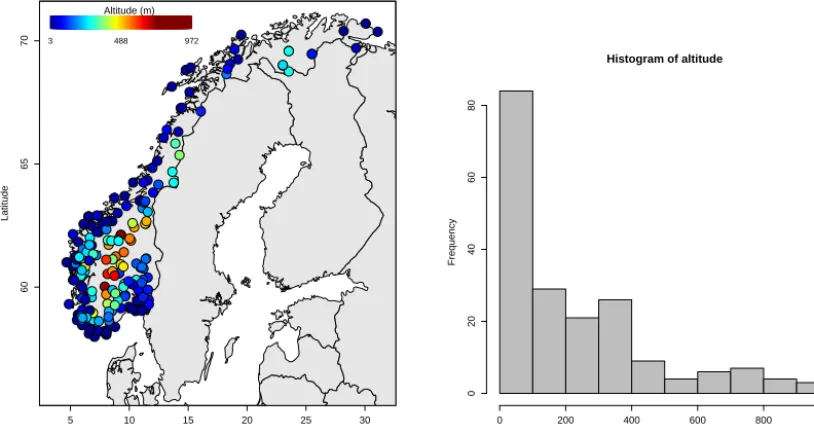
miss-ing data per year over the period 1948–2009 were selected for further analyses. Years with more than 10 % missing data are entirely replaced by ’NA’, representing missing values. Figure 1 shows the location and altitude of the 192 sta-tions. Station altitude ranges from sea level to approximately 1000 m a.s.l., i.e., none of the stations lie at the higher al-titudes in the mountainous regions. All the stations above 500 m a.s.l., however, are found in the central southern in-land region adjacent to zones of higher altitude. The net-work is denser in southern Norway, particularly along the coast, reflecting the higher population densities in this zone. This implies that southern Norway will have more weight in the model evaluation but we view this as preferable to delet-ing a number of stations to create a more spatially uniform network density. The mean number of observed years is 56 (maximum 62, minimum 50).
5 10 15 20 25 30
60
65
70
Longitude
Latitude
3 488 972
Altitude (m)
Histogram of altitude
Altitude
Frequency
0 200 400 600 800 1000
0
20
40
60
80
1
Figure 1. Left: location and altitude (m a.s.l.) of the stations. Right: histogram of altitude (m a.s.l.).
a mean cluster size of about 1.25 days). The central rainfall values can therefore be considered to be close to the case of complete independence.
3 Model and method 3.1 Modeling
3.1.1 Exponential and GPD models
LetXbe the random variable of central rainfall at some lo-cation in Norway. We are interested in the distribution of ex-treme values, i.e., of Pr(X≤x)whenxis large. Let us con-sider a (high) levelαand writeqα theα-quantile ofX, i.e.,
such thatα=Pr(X≤qα). Then, for allxexceedingqα, we
have the decomposition
F (x)≡Pr(X≤x)=α+(1−α)Pr(X≤x|X≥qα). (1)
Extreme value theory (EVT) ensures that if the central rain-fall values are independent and identically distributed and for large enoughα, Pr(X≤x|X≥qα)can be approximated by
the distribution
G(x;σα, ξ )=
1−1+ξ(x−qα) σα
−1/ξ
, ifξ6=0, (2)
1−exp−(x−qα) σα
, ifξ=0, (3)
for allx≥qα, provided in Eq. (2) thatx≤qα−σα/ξifξ <0.
Parameterξ in Eq. (2) is independent ofα; this is the shape parameter which models the heaviness of the tail of the dis-tribution. Parameterσα>0 in Eqs. (2) and (3) depends upon
α and is called the scale parameter. Equations (2) and (3)
imply that excesses(X−qα|X≥qα)follow the generalized
Pareto distribution (GPD) in Eq. (2) and the exponential dis-tribution (EXP) with rate 1/σα in Eq. (3). Models (Eqs. 2
and 3) have been widely used worldwide for modeling rain-fall extremes. A good review is provided in the introduction of Serinaldi and Kilsby (2014). Equations (2) and (3) com-bined with Eq. (1) give the approximation of the distribution ofXfor allx≥qα:
F (x)≈α+(1−α) G(x;σα, ξ ), (4)
whereα=Pr(X≤qα).
3.1.2 MEWP and MGPWP models
In the previous section, we implicitly assumed that central rainfall,X, is identically distributed throughout the year. This assumption may be questioned. Indeed, different climatolog-ical processes trigger precipitation, leading to the occurrence of rainfall of different natures and intensities (e.g., convec-tive vs. stratiform precipitation). Furthermore, rainfall occur-rence and intensities often vary with season, reflecting both variations in temperature and in storm tracks, for example. For this reason, Garavaglia et al. (2010) proposed the use of subsampling based on seasons and weather patterns (WP). Each day of the record period is assigned to a WP. IfS sea-sons andKWP are considered, then days are classified into
S×K subclasses. The law of total probability gives, for all
x,
F (x)= S X
s=1
K X
k=1
Pr(X≤x|season=s,WP=k) ps,k, (5)
whereps,k is the probability that a given day is in season
s and in WP k (thusP s
P
values occurring in seasons and WP k can be assumed to be identically distributed (Garavaglia et al., 2010). Thus the extreme value theory described in Sect. 3.1.1 can be applied toFs,k(x)=Pr(X≤x|season=s,WP=k). Let us consider
a high levelα(taken for simplicity constant for allFs,k) and
qα,s,k, theαquantile ofFs,k. Application of Eq. (4) toFs,k
gives the approximation forx≥qα,s,k,
Fs,k(x)≈α+(1−α)G(x;σα,s,k, ξs,k), (6)
whereG(x;σα,s,k, ξs,k)is given by Eqs. (2) and (3), where
qα, σα and ξ are respectively replaced by qα,s,k, σα,s,k
and ξs,k. Thus, Eqs. (5) and (6) give, for all x≥qα+=
maxs,kqα,s,k, the approximation of the distribution ofX:
F (x)≈α+(1−α)
S X
s=1
K X
k=1
G(x;σα,s,k, ξs,k) ps,k. (7)
MEWP and MGPWP (Multi Generalized Pareto Weather Pattern) models are both defined by Eq. (7) with different choices of ξs,k (Garavaglia et al., 2010, 2011): in MEWP
allξs,k are set to 0 – in which caseGis the EXP
distribu-tion – while in MGPWP, ξs,k is free to vary in the positive
range. We exclude casesξs,k<0 because they give bounded
GPD distributions with an upper bound atqα,s,k−σα,s,k/ξs,k,
which is usually unrealistically low for rainfall. Using the GPD withξs,k>0 in Eq. (7) allows models with heavier tails
than with the EXP distribution, which is light-tailed. Theo-retically, other heavy-tailed distribution could be used forG
in Eq. (7) but the GPD is justified by EVT and it provides a natural generalization of MEWP by allowing theξs,tto vary
freely (within the positive range). Both models, MEWP and MGPWP, will be evaluated on the Norwegian data. To keep track of the levelαand of the fact thatSseasons andKWP are used in Eq. (7), we will respectively write these two mod-els as MEWP(α, S, K)and MGPWP(α, S, K). Likewise, we write EXP(α) and GPD(α) to represent the basic cases of Eq. (4) when neither season nor WP are considered, corre-sponding to cases MEWP(α,1,1)and MGPWP(α,1,1). 3.2 Model estimation
Use of the EXP, GPD, MEWP and MGPWP models requires the choice of high enough thresholds such that EVT can be applied. Selection of an adequate threshold gives rise to a bias-variance tradeoff: the higher the threshold, the better the approximation of the tail ofF (smaller bias), but at the same time, the higher the variance of the estimated parameters be-cause a smaller number of exceedances are available. Graph-ical tools for threshold selection, such as mean residual life plots (Coles, 2001), are usually difficult to interpret in prac-tice. Therefore, the common practice is to fix a high enough levelαand to set thresholdsqα,s,kto the empiricalαquantile
of rainfall occurring in seasonsand WPk.
Given α(and thereforeqα), the parameters that must be
estimated for the EXP and GPD models (Eq. 4) are those of
Gin Eqs. (2) and (3). Estimation is made by the method of L-moments (Hosking, 1990):
ˆ
ξ=(λ1−qα)/λ2−2, σˆα=(1− ˆξ )(λ1−qα),for GPD(α), ˆ
σα=λ1−qα,for EXP(α),
whereλ1andλ2are the sample L-moments of order 1 and 2 for the central rainfall exceedingqα, which are independent;
see Sect. 2. In the GPD case, ifξ <ˆ 0, thenξˆ=0 is imposed (i.e., the EXP distribution) to exclude bounded distributions. It should be noted that the choice of the L-moments method only affects the GPD case since for the EXP case, the com-monly used L-moments, moments and maximum likelihood estimators coincide. For the GPD case, a separate analysis (not shown) reveals that the choice of the estimation method does not actually affect the regional evaluation very much be-cause slight differences in estimation that occur at the local scale are smoothed out at the regional scale.
Parametersξs,k andσα,s,k inGof Eq. (7) for MEWP and
MGPWP are estimated likewise by the L-moments method, using the observed central rainfall of seasonsand WPk ex-ceedingqα,s,k. Probabilityps,kis estimated as the empirical
proportion of days in seasonsand WPk. Estimation ofF is then obtained for allx > qα+with Eq. (7).
3.3 Computation of return levels
The T-year return level rT is the level expected to be
ex-ceeded on average once every T years. It satisfies the re-lationshipF (rT)=1−1/(T ζ ), whereζ is the mean
num-ber of central rainfall events per year. WhenF is EXP(α)or GPD(α), estimation ofrT is obtained explicitly as
ˆ rT =
q
α+ ˆσαlog{(1−α)T ζ} for EXP(α)
qα+ ˆσα{[(1−α)T ζ]
ˆ
ξ−1}/ξˆ for GPD(α), (8)
whereσˆαandξˆare the parameter estimates ofF of Sect. 3.2.
For the MEWP and MGPWP models, there is not an explicit formulation forrˆT and it is obtained numerically by
solv-ingF (rˆT)=1−1/(T ζ )in Eq. (7). Equation 8 shows that in
GPD(α)model,rˆT is mainly influenced by the value ofξˆ.
For the MGPWP model, practice shows that for reasonable to largeT (typicallyT >50 years),rˆT is mainly influenced
by the largestξˆs,k.
3.4 Model evaluation
The goal of this evaluation is to assess which model per-forms better at the regional scale, i.e., for a set ofNstations taken as a whole, rather than individually. We follow the split sample evaluation proposed in Garavaglia et al. (2011) and Renard et al. (2013). We divide the data for each stationi
data and predictions of the estimates, and the accuracy and stability of the estimates when calibration data change. For this, three scores are computed, assessing respectively stabil-ity (SPAN) and reliabilstabil-ity (AREA(FF) and AREA(NT)) of
the fits. These scores were proposed and used in Garavaglia et al. (2011) and Renard et al. (2013).
The SPAN criterion evaluates the stability of the return level estimation, when using data for each of the two subsam-ples. More precisely, for a given return periodT and station
i,
SPANT ,i=
| ˆrT ,i(1)− ˆrT ,i(2)|
1/2{ ˆrT ,i(1)+ ˆrT ,i(2)} ,
whererˆT ,i(1), e.g., is theT-year return level for the distribution
F (see Sect. 3.3) estimated on subsample C(i2) of station i. SPANT ,i is the relative absolute difference inT-year return
levels estimated on the two subsamples. It ranges between 0 and 2; the closer to 0, the more stable the estimations for sta-tioni. For the set ofNstations, we obtain a vector of SPANT
of lengthN with a distribution which should remain reason-ably close to zero. A rough summary of this information is obtained by computing the mean of theNvalues of SPANT ,i,
i=1, . . ., N:
MEAN(SPANT)=
1
N
N X
i=1
SPANT ,i. (9)
For competing models, the closer the mean is to 0, the more stable the model is.
The FF criterion is used to estimate the reliability in es-timating the probability of occurrence of the maximum of independent variables. Let(X1, . . ., Xn)be a set of n
inde-pendent and identically distributed rainfall values with dis-tributionF andZ=maxnj=1Xj. Then Pr(Z≤x)= {Pr(X≤
x)}n= {F (x)}n and, thus, the distribution of Z is Fn. Therefore FF= {F (Z)}nfollows the uniform distribution on
(0,1). Now write Fˆ1,i andFˆ2,i, where the estimation ofF
for station i is obtained respectively for subsamples C(i1) and C(i2). If Fˆ1,i andFˆ2,i are good estimations ofF, then
FFi(1)= { ˆFi(1)(Z)}nand FFi(2)= { ˆFi(2)(Z)}nshould
approx-imately follow the uniform distribution, Unif(0,1). Now let
n(i1)(resp.n(i2)) be the number of central (thus independent) rainfall values in subsamples Ci(1)(resp. Ci(2)) andzi(1)(resp.
z(i2)) the corresponding observed maximum, then ffi(12) = [ ˆFi(2)(z(i1))]n(i1)
ffi(21) = [ ˆFi(1)(z(i2))]n(i2)
should both be realizations of the uniform distribution. For the set of N stations, this gives two uniform samples ff(12) and ff(21)of sizeN each. Hypothesis testing for assessing if the uniform assumption is valid is challenging because the
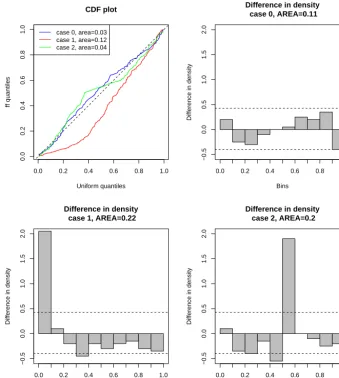
ffiare not independent from site to site, due to the spatial de-pendence between data. Thus Renard et al. (2013) proposed to base comparison on the graphical analysis of cumulative distribution functions (CDFs), by inspecting how much the CDF of the ff diverge from the 1:1 line, corresponding to the CDF of uniform variates on(0,1). A quantitative assess-ment of this divergence is provided by computing the area between both CDFs. However, we find such evaluation con-fusing because the value of the area depends on where, be-tween 0 and 1, the divergence is located. An illustration of this is given in Fig. 2 for three simulated series of length 200 (which is about the number of stations). In case 0, the ff are all drawn from Unif(0,1)(reference case). In cases 1 and 2, 80 % of the ff are drawn from Unif(0,1)and 20 % are drawn from Unif(0,0.1)in case 1 and from Unif(0.5,0.6)in case 2. Departure of ff from the uniform case is sometimes not easy to interpret. However case 1 corresponds usually to a tendency towards an overestimation of the largest observa-tion, while case 2 corresponds to a tendency towards over-fitting the largest observation. In the CDF plot (upper left), the area value is as expected the lowest for case 0. However case 2 gives surprisingly also a very good score, whereas that of case 1 is 3 times as large. Therefore these criteria would falsely indicate a better performance (i.e., smaller area value) of case 2 (overfitting) as compared to case 1 (overestimation), although they both contain 20 % data diverging from the uni-form on(0,1). As an alternative, we prefer to base evaluation on divergence between densities rather than CDFs. A reason-able estimate of this latter is obtained by computing the em-pirical histogram of the ff with 10 equal bins between 0 and 1, and comparing it with the uniform density between 0 and 1 (which equals 1). For a more quantitative assessment, we compute the area between both densities as follows:
AREA(FF)= 1
18 10
X
`=1
10Card{ffi ∈bin(`), i=1, . . ., N}
N −1
0.0 0.2 0.4 0.6 0.8 1.0
0.0
0.2
0.4
0.6
0.8
1.0
Uniform quantiles
ff quantiles
case 0, area=0.03 case 1, area=0.12 case 2, area=0.04
CDF plot
−0.5
0.0
0.5
1.0
1.5
2.0
0.0 0.2 0.4 0.6 0.8 1.0
Difference in density case 0, AREA=0.11
Bins
Diff
erence in density
−0.5
0.0
0.5
1.0
1.5
2.0
0.0 0.2 0.4 0.6 0.8 1.0
Difference in density case 1, AREA=0.22
Bins
Diff
erence in density
−0.5
0.0
0.5
1.0
1.5
2.0
0.0 0.2 0.4 0.6 0.8 1.0
Difference in density case 2, AREA=0.2
Bins
Diff
erence in density
Figure 2. Graphical tools for model evaluation based on FF scores, for three simulated series of length 200. The CDF case (upper left) is the
method of Renard et al. (2013). The density case (upper right and lower panels) is the alternative method comparing densities (Eq. 10). The
dotted horizontal lines show the 95 % confidence interval for uniform variates on(0,1)of length 200, based on 1000 simulations.
ff(21), this gives us two scores of model evaluation, namely AREA(FF(12))and AREA(FF(21)).
The NT criterion assesses reliability of the fit, as FF,
but focuses on prescribed quantiles rather than on the over-all maximum. Let (X1, . . ., Xn)be a set of n independent
and identically distributed rainfall values with distribution
F, and let NT be the random variable equal to the
num-ber of exceedances of the T-year return level, i.e., NT =
Card{Xj;F (Xj) >1−1/(ζ T )}, whereζ is the mean
num-ber of observations per year. Since every event{F (Xj) >
1−1/(ζ T )}occurs with probability 1/(ζ T ),NT follows a
binomial distribution with parameters (n,1/(ζ T )). LetHT
be the corresponding cumulative distribution function, i.e., such thatHT(k)=Pr(NT ≤k),k=0, . . ., nandH (−1)=0.
Because HT is not continuous, the probability-transformed
indicesHT(NT)are not uniform. Thus, Renard et al. (2013)
propose to consider the random variableNeT such that
e
NT|NT =k∼Unif{HT(k−1), HT(k)},
and show that NeT is uniform on(0,1). Now, consider the
estimatesFˆ(1) i andFˆ
(2)
i for a given stationiand
n(T ,i12) = Card{xi,j ∈C(i1); ˆFi(2)(xi,j) >1−1/(ζiT )},
n(T ,i21) = Card{xi,j ∈C(i2); ˆF (1)
i (xi,j) >1−1/(ζiT )},
whereζi is the mean number of central rainfall events per
year at stationi. IfFi(1)andFi(2)are exact estimates forF, thenn(T ,i12) (resp.n(T ,i21)) should be realizations of a binomial with parametersn(i1) (resp.ni(2)) and 1/(ζiT ). LetHT ,i(1) and
betweenHT ,i(k)(n(j k)T ,i −1)andHT ,i(k)(n(j k)T ,i ). Thenen(j k)T ,i are re-alizations of the uniform distribution (Renard et al., 2013). Foriranging over the set ofN stations, we thus obtain two vectors of size N of uniform samples, so that we can write
en (12) T ,en
(21)
T . Scores are calculated as for FF by comparing
the empirical densities ofen(j k)T ,j, k=1,2 to the theoretical uniform density, giving the two scores AREA(NT(j k)).
4 Application of MEWP and MGPWP in Norway 4.1 Models considered
We wish to evaluate and compare the performance of EXP, GPD, MEWP and MGPWP for estimating central rainfall values across Norway. To apply the split sample procedure described in Sect. 3.4 for each station i, we randomly di-vide years into two subsamples such that 50 % of the ob-served years are in sample C(i1)and the remaining 50 % are in sample C(i2). This split sample procedure is applied to each station independently (meaning that years of C(i1) and C(i10)
are very unlikely to all be equal fori6=i0). This creates two new data sets, each comprising 192 stations with a maximum of 31 years of observations.
As is always the case for extreme value analysis, thresh-old choice is uncertain. We therefore considered a large set of thresholds withαbetween 0.50 and 0.97. The evaluation scores are then used to select both the best model and the best threshold(s). Choice ofαas low as 0.50 may at first glance appear to be very low for studying extremes, but one has to remember that the data series are already preprocessed to in-clude only central rainfall values. Days with central rainfall will tend to have higher intensities than a randomly selected day with rainfall, as by construction, the central rainfall series excludes the previous and following days with lower rain-fall intensities (see Sect. 2). A threshold level of 0.50 corre-sponds actually to a level of about 0.75 for the daily (non-zero) rainfall values.
The estimation scheme can be summarized as follows. For each of the consideredαvalues, we fit six models with the exponential distribution:
– EXP(α), which is a particular case of MEWP, whereS
is one season andKis one weather pattern;
– MEWP(α,1, K), i.e., a combination ofKWP distribu-tions, whereK=4 or 8 (see below);
– MEWP(α,2,1), i.e., a combination of two seasonal dis-tributions. Choice of the seasons is explained below; – MEWP(α,2, K), i.e., a combination of seasonal and
WP distributions, withK=4 or 8;
and the six corresponding models with the GPD distribution. This gives in total 12 fitsFˆi(1)and 12 fitsFˆi(2), for each sta-tioniand each levelα.
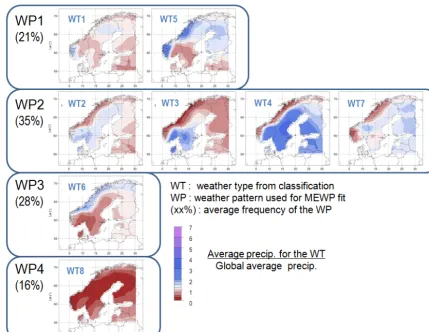
For the cases involving the use of WP, we employ the weather-type (WT) classification described in Fleig (2011), following the “bottom-up” method presented in Garavaglia et al. (2010). Details of this scheme are also reported in Lawrence et al. (2014) and can be briefly summarized as fol-lows: ascending hierarchical classification is first performed on the rain fields for days with rain, as described by 175 sta-tions in Norway and the surrounding region. The average synoptic pattern (WT) associated with each rain-field class is then identified from an atmospheric pressure data set con-structed from geopotential height data centered over Norway. Finally, every day of the period considered (1948–2009) is assigned to a WT using the proximity of its geopotential height data to one described by a WT. In the first instance (Fleig, 2011), eight distinct WTs were defined, seven corre-sponding to days with rain and one representing dry days. For the first application of SCHADEX in Norway (Lawrence et al., 2014), a grouping of the eight weather types into four weather patterns (WP) was made to improve the robustness of the MEWP models (Fig. 3) by increasing the number of values in the subsamples. In this paper we, however, use the term “weather patterns” (WP) to refer to both sets of classifi-cations, i.e., having four or eight classes; and both the use of the full set of eight classes or the grouped set of four classes are evaluated.
In cases where subsampling is also undertaken by sea-son, we impose a restriction of S being two seasons, rep-resenting the season-at-risk and the season-not-at-risk. Fur-thermore, we impose the season-at-risk to be composed of 2 to 4 consecutive months (the remaining months falling in the season-not-at-risk). The optimum choice of the months com-posing the season-at-risk is made following the procedure of Penot (2014), which is applied to each station and model sep-arately, using the whole series (i.e., without splitting into C(1) or C(2)). The principle is to find the season-at-risk for which the estimated model fits at best the months with the highest risk (of extreme rainfall intensities). In detail, the procedure is as follows:
– Step 1: compute the 12 mean monthly maxima of cen-tral rainfall.
– Step 2: setM=2.
– Step 3: compute the mean of these values over moving windows of sizeMmonths.
– Step 4: select theM consecutive months correspond-ing to the highest of these values. TheseMmonths de-fine the season-at-risk. The remaining months dede-fine the season-not-at-risk.
– Step 5: fit the considered model (e.g., MEWP(0.5,2,8)) with this seasonal definition.
Figure 3. Weather pattern classification with four classes (denoted WT1 to WT4 above) and eight classes (WP1 to WP8 above). This is Fig. 5
of Lawrence et al. (2014). Case with four classes is obtained by combining the eight classes into four. The last class of each classification (respectively WT4 and WP8) represent dry days.
KGE score (Kling–Gupta efficiency, Gupta et al., 2009), which is computed for a given month,m, as
KGEm= n
corr(Fem,Fˆm)−1 o2
+ (
std Fem
ˆ Fm
!
−1
)2
+ (
mean Fem
ˆ Fm
!
−1
)2 ,
whereFemandFˆmare respectively the empirical and
fit-ted distributions for monthm. It should be noted that the KGE criterion is not the only score which could be used here, and was not necessarily developed for scoring dis-tributions. However, the final result (i.e., the seasonal split selected) is not particularly sensitive to the score used.
– Step 7: compute a global KGE score as a weighted mean of these 12 KGE scores, with weights proportional to the mean monthly maxima, in order to force the model to have the best fits for the months with the highest risk.
– Step 8: setM=3 and apply steps 3 to 7. – Step 9: setM=4 and apply steps 3 to 7.
– Step 10: compare the three global KGE scores obtained respectively forM=2,3,4. Select the seasonal defini-tion corresponding to the lowest of these scores. This procedure is applied for each station and each model separately. This implies that, for a given station, the choice of season may vary among models. However, it was found that changes in the definition of the season-at-risk for a given station are very minimal (i.e., a few percent difference, and always pertain to the intermediate months that could well be classified into either of the two periods). We believe that these differences have very little influence on the evaluation of the model fits. For illustration, Fig. 4 shows the length of the season-at-risk and the first month of this season for the 192 Norwegian stations when using MEWP(0.5,2,8)
0 5 10 15 20 25 30
58
60
62
64
66
68
70
Longitude
Latitude Jan
Feb Mar Apr May Jun Jul Aug Sep Oct Nov Dec 2 months
3 months 4 months
Jun−Jul−Aug−Sept
July−Aug−Sep−Oct Sept−Oct
Sept−Oct−Nov
Figure 4. Length of the season-at-risk (shapes) and first month
of the season (color code in the inset) for each station, with
model MEWP(0.5,2,8). The local definition of seasons is used in
Sect. 4.2.1, while the regional definition, with four regions, is used in Sect. 4.2.2.
in the eastern part. Furthermore, the intense season starts 1 month earlier in the eastern part than in the western part. The distinction between a heavy rainfall season beginning in the fall in western Norway vs. late summer in eastern Nor-way is associated with the two different mechanisms leading to heavy precipitation in each of these regions. In western Norway, heavy precipitation is most commonly derived from frontal activity leading to storms arriving from the southwest. The eastern part of Norway is in the lee of the mountainous area in the central zone of southern Norway, and is, there-fore, somewhat sheltered from this storm activity. The heav-iest precipitation in the eastern region generally occurs due to convective activity producing intense rain showers, often during the late summer months. It can also be noted that the spatial pattern of the precipitation seasons shows a good cor-respondence with previously published maps of precipitation regions in Norway (see e.g., Hanssen-Bauer and Førland, 2000, Fig. 1) and with the occurrence of days with precip-itation over 10 mm (see Tveito et al., 2001, Fig. 2.5). The regional seasons will be used in Sect. 4.2.2 to check the sen-sitivity of MEWP with respect to slight changes in the defi-nition of the season-at-risk.
4.2 Results
4.2.1 Model evaluation and selection
The SPAN, FF andNT scores presented in Sect. 3.4 are used
to assess the quality of the estimations. We use the three
scores because they give complementary answers. Taken to-gether, they allow a global evaluation of both the reliability and the stability of the fits. Different return periodsT are also considered for SPAN andNT in order to evaluate
differ-ent parts of the tail of the distribution. With largeT we assess the very tail of the distribution while with smallT we assess the bulk of the distribution.
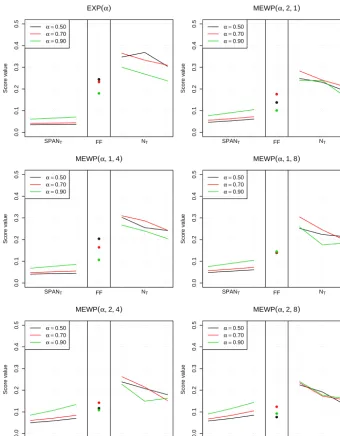
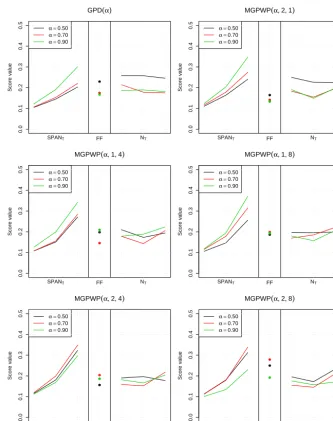
Scores are reported in Figs. 5 and 6 for the 12 mod-els, using threshold values equal to the 0.5-, 0.7- and 0. 9-quantile of the central rainfalls. Keep in mind that all scores lie in the range (0,1)and the closer to 0, the bet-ter the score. For each model and threshold, we depict three MEAN(SPANT)scores forT =20,100 and 1000 years, the
value of AREA(FF(12)) and the three AREA(NT(12)) values for T =5,10 and 20 years. Values of AREA(FF(21)) and AREA(NT(21)) are not shown as they are very similar. For the SPAN scores, it may seem highly questionable to extrapolate return levels up to 1000 years given that estimation is based on about 30 years of data. This is actually the level required by engineering practices and regulatory rules (if not higher) in many countries for risk assessment associated with dam safety. For example, in France 1000- or even 10 000-year re-turn periods are used to design dam spillways (Paquet et al., 2013), and the 1000-year return period is also used as the design flood level for the higher risk classes of dams in Nor-way, whilst the probable maximum flood is used to assess the safety of these dams with respect to the potential for dam failure (Midttømme et al., 2011).
Figure 5 shows that for the exponential models, there is a clear benefit obtained from the use of seasonal splitting (case EXP vs. (S, K)=(2,1)) and WP splitting (case EXP vs.
(S, K)=(1,4)and(1,8)), and the combination of both sea-sonal and WP splitting performs even better (see cases(2,4)
and(2,8)). Indeed, subsampling by season and WP creates groups of rainfall values that are more likely to be identi-cally distributed and therefore more easily fitted than groups of rainfall values derived from different parent populations. Using eight rather that four WPs also slightly improves the
NT scores, but the improvement is somewhat marginal when
compared with the gain derived from sampling by season and WP.
Figure 5 surprisingly shows that for MEWP distributions, scores ofNT improve whenT increases, meaning that the
bulk of the distribution is actually less well fitted than the tail. This may be due to the lack of flexibility of the exponential distribution. Using the more flexible GPD distribution (in the GPD and MGPWP models of Fig. 6) indeed tends to improve
Score v
alue
0.0
0.1
0.2
0.3
0.4
0.5 α =0.50
α =0.70
α =0.90
SPANT FF NT
EXP(α)
Score v
alue
0.0
0.1
0.2
0.3
0.4
0.5 α =0.50
α =0.70
α =0.90
SPANT FF NT
MEWP(α, 2, 1)
Score v
alue
0.0
0.1
0.2
0.3
0.4
0.5 α =0.50
α =0.70
α =0.90
SPANT FF NT
MEWP(α, 1, 4)
Score v
alue
0.0
0.1
0.2
0.3
0.4
0.5 α =0.50
α =0.70
α =0.90
SPANT FF NT
MEWP(α, 1, 8)
Score v
alue
0.0
0.1
0.2
0.3
0.4
0.5 α =0.50
α =0.70
α =0.90
SPANT FF NT
MEWP(α, 2, 4)
Score v
alue
0.0
0.1
0.2
0.3
0.4
0.5 α =0.50
α =0.70
α =0.90
SPANT FF NT
MEWP(α, 2, 8)
Figure 5. Scores of evaluation for MEWP models, forα=0.5, 0.7 and 0.9. Better scores have values closer to 0. Scores of SPANT, for
T =20−,100−and 1000-year return periods, are the mean scores of Eq. (9), while scores of FF andNT,T=5,10 and 20 years, are based
on the density areas (Eq. 10).
Figure 6 also shows a clear loss in stability (indicated by the SPAN scores) when using the MGPWP distribution. Fig-ure 7 illustrates this issue by comparing the 100-year and 1000-year return levels estimated on C(1)and C(2)with the four MEWP models and the four MGPWP models, with a levelα=0.5. This shows a difference of up to 100 mm day−1 with MGPWP models for the 100-year return level and up to 300 mm day−1for the 1000 year-return level, whereas the MEWP models are much more stable. This lack of robust-ness is due to the difficulty in estimating the shape param-eter ξ of the GPD distribution, which has a large influence on the extrapolation to long return periods (see also page 528 of Garavaglia et al. (2011) or the upper right of page
of-Score v
alue
0.0
0.1
0.2
0.3
0.4
0.5 α =0.50
α =0.70 α =0.90
SPANT FF NT
GPD(α)
Score v
alue
0.0
0.1
0.2
0.3
0.4
0.5 α =0.50
α =0.70 α =0.90
SPANT FF NT
MGPWP(α, 2, 1)
Score v
alue
0.0
0.1
0.2
0.3
0.4
0.5 α =0.50
α =0.70 α =0.90
SPANT FF NT
MGPWP(α, 1, 4)
Score v
alue
0.0
0.1
0.2
0.3
0.4
0.5 α =0.50
α =0.70 α =0.90
SPANT FF NT
MGPWP(α, 1, 8)
Score v
alue
0.0
0.1
0.2
0.3
0.4
0.5 α =0.50
α =0.70 α =0.90
SPANT FF NT
MGPWP(α, 2, 4)
Score v
alue
0.0
0.1
0.2
0.3
0.4
0.5 α =0.50
α =0.70 α =0.90
SPANT FF NT
MGPWP(α, 2, 8)
Figure 6. Same as Fig. 5 for MGPWP models.
50 100 150 200 250 300
50
100
150
200
250
300
RL estimated on C1
RL estimated on C2
MEWP models MGPWP models
100−year return level
100 200 300 400 500 600
100
200
300
400
500
600
RL estimated on C1
RL estimated on C2
MEWP models MGPWP models
1000−year return level
Figure 7. Comparison of the 100-year and 1000-year return levels (in mm) estimated on C(1)and C(2), for the four MEWP models (in red)
and the four MGPWP models (in black), with a levelα=0.5 (one point per station).
−1.0 −0.5 0.0 0.5 1.0
−1.0
−0.5
0.0
0.5
1.0
ξ estimated on C1
ξ
estimated on C2
MEWP models (ξ=0) MGPWP models
ξ C1 vs. C2
0 500 1000 1500 2000 2500
−1.0
−0.5
0.0
0.5
Number of observations
ξ
MGPWP without WP MGPWP with WP
ξ vs. sample size
1
Figure 8. Left: estimatedξs on C(1)and C(2)for the four MGPWP models, withα=0.5 (one point per station). MEWP models correspond
toξ=0 (red points). Right: sameξs as a function of the sample size with WP (black points) and without WP (white points) (one point per
station and period).
ten when WP are considered, due to the additional subsam-pling which produces smaller data sets. However, the SPAN values of Fig. 6 show that even for the GPD and MGPWP withK=1, robustness is very poor. This lack of robustness is an important limitation of their value and suitability for practical applications.
Regarding the choice of threshold, MEWP distributions give relatively stable scores for α between 0.5 and 0.7 (see Fig. 5) but there is a loss in stability as α increases over 0.9 (see green curves of SPAN scores in Fig. 5). For MEWP(α,2,8), which gives the best scores overall, the case
α=0.5 usually seems to be slightly better. Therefore we se-lect the model MEWP(0.5,2,8)for further consideration.
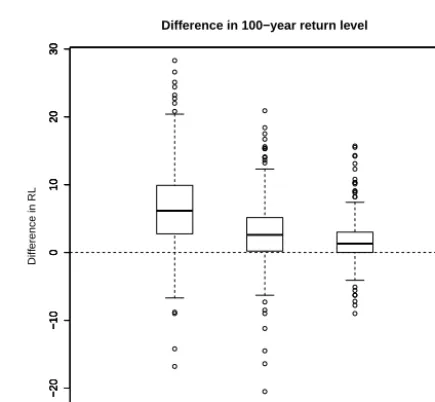
It is interesting at this point to compare large return lev-els obtained with the selected MEWP(0.5,2,8)with those obtained for the other MEWP models with the sameα. Fig-ure 9 makes this comparison for the 100-year return lev-els. It appears that the other MEWP models tend to give lower return levels (i.e., positive values of the difference). This underestimation is more marked for the EXP model (mean underestimation of about 5 mm of the 100-year return level), and decreases when seasons (MEWP(0.5,2,1)) and WP (MEWP(0.5,2,4)) are used. Therefore, the use of more WPs helps to better model the heaviness of the tail.
4.2.2 Use of regional seasons
We have already mentioned in Sect. 4.1 that the local defini-tion of the seasons displays a regional pattern, with a season-at-risk in late summer in the two eastern regions and in fall in the two western ones, as illustrated in Fig. 4. We test here the use of this regional definition of the seasons by fitting new MEWP(0.5,2,8)models and comparing the overall scores to those of the local definition of Sect. 4.2.1. As shown in Table 1, scores of the two definitions are fairly similar,
partic-Diff
erence in RL
−20
−10
0
10
20
30
EXP(α) MEWP(α,2,1) MEWP(α,2,4)
−20
−10
0
10
20
30
−20
−10
0
10
20
30
−20
−10
0
10
20
30
Difference in 100−year return level
Figure 9. Box plot of the difference (in mm) between the 100-year
return levels of MEWP(α,2,8)and the three other EXP-based
mod-els, forα=0.5 (one point per station and period).
Table 1. Scores of evaluation for the local and regional definition of the seasons. Better scores have values closer to 0. Scores of SPANT, for
T =20,100 and 1000 years, are the mean scores of (Eq. 9), while scores of FF andNT,T =5,10 and 20 years, are based on the density
areas (Eq. 10).
SPAN20 SPAN100 SPAN1000 FF(12) N5(12) N10(12) N20(12)
Local seasons 0.058 0.070 0.085 0.076 0.209 0.163 0.130
Regional seasons 0.053 0.062 0.074 0.080 0.202 0.185 0.158
Random sampling AREA(FF)=0.08
Bins
−0.5
0.0
0.5
1.0
0.0 0.2 0.4 0.6 0.8 1.0
Temporal sampling AREA(FF)=0.15
Bins
−0.5
0.0
0.5
1.0
0.0 0.2 0.4 0.6 0.8 1.0
Figure 10. Divergence in density between ff(12) and the uniform case, under random sampling (left) and temporal sampling (right),
with corresponding scores AREA(F F ). The closer the bars are to
0, the better the fit is. The dotted horizontal lines show 95 % confi-dence interval for uniform variates.
4.2.3 Evidence of trend
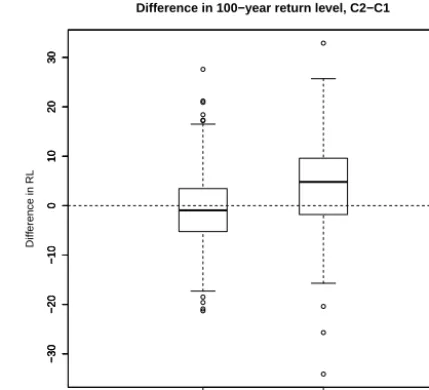
The split sample procedure can be used to give insight about potential change in extreme rainfall in Norway over the pe-riod represented by the rainfall time series. For this we split the observed years of each station into two subsamples: C(1) contains all years between 1948 and 1978 and C(2)contains all the remaining years, between 1979 and 2009. So, in con-trast with the previous analysis, all stations are assigned the same C(1) and C(2) and these are temporal instead of being random. Remember that ff(12) assesses how well the maxi-mum of C(1) is fitted by the distribution estimated on C(2), namely Fˆ(2) (see Eq. ). Therefore a parallel comparison of the density of the values of ffi(12), fori=1, . . .,192, for this temporal sampling compared to the random one of Sect. 4.2.1 can give insight into increases or decreases in extreme rain-fall in Norway between the two periods. The density of these values is shown in Fig. 10.
We see that ff(12) tends to have too many small values with respect to the uniform density under the temporal pling, whereas it was fairly uniform under the random sam-pling of Sect. 4.2.1 (a complementary analysis, not shown, revealed that very similar densities are obtained with other random splitting approaches). We conclude that Fˆ(2) tends to overestimate the probability of occurrence of the
maxi-Diff
erence in RL
−30
−20
−10
0
10
20
30
Random Temporal
−30
−20
−10
0
10
20
30
−30
−20
−10
0
10
20
30
Difference in 100−year return level, C2−C1
Figure 11. Box plot of the difference in 100-year return level
esti-mated for C(1)and C(2)with MEWP(0.5,2,8)under random
sam-pling (left) and temporal samsam-pling (right) (one point per station).
5 10 15 20 25 30
60
65
70
Longitude
Latitude
40 131 221
100−year return level for C2
5 10 15 20 25 30
60
65
70
Longitude
Latitude
Decrease Increase 1 mm 10 mm 20 mm
Difference in 100−year return level, C2−C1
1
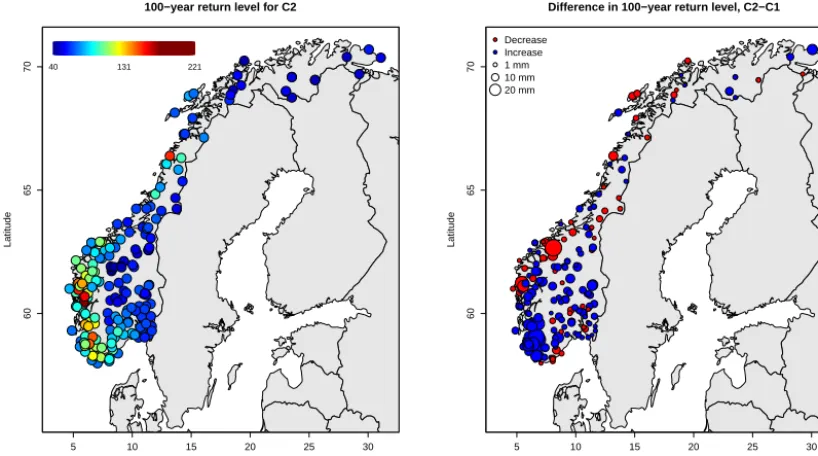
Figure 12. Left: map of 100-year return level estimated on C(2)(1979–2009) with MEWP(0.5,2,8). Right: difference in 100-year estimated
on C(1)and C(2).
and their consistency over time is beyond the scope of this paper, but may be of interest in future studies.
5 Conclusions
This article evaluates a compound model based on weather pattern classification, seasonal splitting and exponential dis-tributions, the so-called MEWP model, for its suitability for use in Norway. The MEWP model is the rainfall probabilis-tic model used within the SCHADEX method, which is cur-rently being tested in Norway as an alternative simulation method for flood estimation. We show in particular the ben-efit gained by subsampling the heavy rainfall data according to season and weather pattern. Our results also indicate that models based on the exponential distribution perform better than those based on the more flexible generalized Pareto dis-tribution, which tends to overfit the data and lacks robustness. We have also demonstrated that a regional definition of sea-sons in MEWP is possible. Finally, we give evidence for an increase in extreme rainfall intensities in Norway in recent years, particularly in the southwestern region.
Our analysis has also shown that the GPD distribution bet-ter models the bulk of the distribution of extremes, but fails to robustly estimate the tail, and therefore fails in extrap-olation to large return levels. The reason for this failure is twofold: firstly, the lack of data for estimating such a flexible distribution when using a local approach; secondly, the inher-ent nature of the GPD, which is a heavy-tailed distribution when the shape parameter is positive, and can therefore tend to give unrealistic return levels for very long return periods.
To address this issue, a regional approach allowing the use of neighboring stations to infer MEWP distributions at local sites is of interest. Finally, there are also other, more flexible, distributions which may be more robust than the GPD distri-bution and could be used within the MEWP approach. This also represents an important topic for future work.
This study is the first extensive evaluation of MEWP in Norway. It has also been applied successfully in France (Gar-avaglia et al., 2011; Neppel et al., 2014), Austria and West Canada (Brigode et al., 2014). MEWP is a general model im-posing no specific hypotheses on the data, so its application in other regions of the world is absolutely worth considering. The only limitation is that a classification into weather pat-terns suitable for evaluating extreme precipitation is needed as a precursor to such an analysis, but this is already avail-able in several regions around the world (see Brigode et al., 2014)
Acknowledgements. Deborah Lawrence acknowledges support
from the project “FLOMQ – Robust framework for estimating extreme floods in Norway” supported by the ENERGIX program of the Norwegian Research Council, as well as internal research funds from NVE which have made the collaboration with LTHE possible. The authors acknowledge support from the COST Action ES0901 FloodFreq which has made the collaboration between NVE and EDF possible, including a Short Term Scientific Mission for Anne Fleig to EDF.
Edited by: P. Tarolli
References
Brigode, P., Bernardara, P., Paquet, E., Gailhard, J., Garavaglia, F., Merz, R., Mi´covi´c, Z., Lawrence, D., and Ribstein, P.: Sensi-tivity analysis of SCHADEX extreme flood estimations to ob-served hydrometeorological variability, Water Resour. Res., 50, 353–370, doi:10.1002/2013WR013687, 2014.
Coles, S.: An introduction to statistical modeling of extreme values, Springer Series in Statistics, Springer-Verlag, London, 208 pp., 2001.
Dyrrdal, A. V., Skaugen, T., Stordal, F., and Førland, E. J.: Estimat-ing extreme areal precipitation in Norway from a gridded dataset, Hydrolog. Sci. J., doi:10.1080/02626667.2014.947289, 2014. Ferro, C. A. T. and Segers, J.: Inference for Clusters of Extreme
Values, J. Roy. Stat. Soc. B, 65, 545–556, 2003.
Fleig, A.: Scientific Report of the Short Term Scientific Mission -Anne Fleig visiting Électricité de France, Grenoble, Tech. rep., NVE, available at: http://www.costfloodfreq.eu/component/k2/ item/download/6_8e45d035c2e09839e0c43e63ed0cdc81, 2011. Garavaglia, F., Gailhard, J., Paquet, E., Lang, M., Garçon, R.,
and Bernardara, P.: Introducing a rainfall compound distribution model based on weather patterns sub-sampling, Hydrol. Earth Syst. Sci., 14, 951–964, doi:10.5194/hess-14-951-2010, 2010. Garavaglia, F., Lang, M., Paquet, E., Gailhard, J., Garçon, R., and
Renard, B.: Reliability and robustness of rainfall compound dis-tribution model based on weather pattern sub-sampling, Hydrol. Earth Syst. Sci., 15, 519–532, doi:10.5194/hess-15-519-2011, 2011.
Guillot, P.: The arguments of the gradex method: a logical support to assess extreme floods, Proceedings of the Yokohama Sympo-sium, 213, 287–298, 1993.
Gupta, H. V., Kling, H., Yilmaz, K. K., and Martinez, G. F.: Decom-position of the mean squared error and NSE performance criteria: Implications for improving hydrological modelling, J. Hydrol., 377, 80–91, doi:http://dx.doi.org/10.1016/j.jhydrol.2009.08.003, 2009.
Hanssen-Bauer, I. and Førland, E.: Temperature and precipitation variations in Norway 1900-1994 and their links to atmospheric circulation, Int. J. Climatol., 20, 1693–1708, doi:10.1002/1097-0088(20001130)20:14<1693::AID-JOC567>3.0.CO;2-7, 2000. Hosking, J. R. M.: L-moments: analysis and estimation of
distribu-tions using linear combinadistribu-tions of order statistics, J. Roy. Stat. Soc. B, 52, 105–124, 1990.
Klemes, V.: Tall Tales about Tails of Hydrological Distribu-tions. I, J. Hydrol. Eng., 5, 227–231, doi:10.1061/(ASCE)1084-0699(2000)5:3(227), 2000a.
Klemes, V.: Tall Tales about Tails of Hydrological Distribu-tions. II, J. Hydrol. Eng., 5, 232–239, doi:10.1061/(ASCE)1084-0699(2000)5:3(232), 2000b.
Lawrence, D., Paquet, E., Gailhard, J., and Fleig, A. K.: Stochas-tic semi-continuous simulation for extreme flood estimation in catchments with combined rainfall-snowmelt flood regimes, Nat. Hazards Earth Syst. Sci., 14, 1283–1298, doi:10.5194/nhess-14-1283-2014, 2014.
Midttømme, G., Pettersson, L., Holmqvist, E., Nøtsund, Ø., His-dal, H., and Sivertsgård, R.: Retningslinjer for flomberegninger (Guidelines for flood estimation), NVE Retningslinjer, 4/2011, 2011.
Neppel, L., Arnaud, P., Borchi, F., Carreau, J., Garavaglia, F., Lang, M., Paquet, E., Renard, B., Soubeyroux, J., and Veys-seire, J.: Résultats du projet Extraflo sur la comparaison des méthodes d’estimation des pluies extrêmes en France, La Houille Blanche – Revue internationale de l’eau, 2, 14–19, doi:10.1051/lhb/2014011, 2014.
Paquet, E., Garavaglia, F., Garçon, R., and Gailhard, J.: The SCHADEX method: A semi-continuous rainfall-runoff simu-lation for extreme flood estimation, J. Hydrol., 495, 23–37, doi:http://dx.doi.org/10.1016/j.jhydrol.2013.04.045, 2013. Penot, D.: Cartographie des événements hydrologiques extrêmes et
estimation SCHADEX en sites non jaugés, PhD thesis, Univer-sité de Grenoble, 244 pp., 2014.
Renard, B., Kochanek, K., Lang, M., Garavaglia, F., Paquet, E., Neppel, L., Najib, K., Carreau, J., Arnaud, P., Aubert, Y., Borchi, F., Soubeyroux, J.-M., Jourdain, S., Veysseire, J.-M., Sauquet, E., Cipriani, T., and Auffray, A.: Data-based comparison of fre-quency analysis methods: A general framework, Water Resour. Res., 49, 825–843, doi:10.1002/wrcr.20087, 2013.
Serinaldi, F. and Kilsby, C. G.: Rainfall extremes: Toward recon-ciliation after the battle of distributions, Water Resour. Res., 50, 336–352, doi:10.1002/2013WR014211, 2014.