Introduction
Over the years computer simulation programs have played an important role in providing power system engineers with a better understanding of power system operation. Because of the rapid advances in computer hardware and software, computer based power system educational tools have grown from very simple implementations, providing the user with little more than a stream of numerical output, very detailed representations of the power system with an extensive graphical user interface[7]. A Power System Simulator (PSS) that allows engineers, technicians and control room operators to gain knowledge-based learning and skills-based training in all aspects of electrical power systems. The Power System Simulator contains everything needed to teach students, how electrical power systems work. It is a self-contained unit (only needs electrical power) with full safety features. It includes all the main parts of an electrical power system, from supply (generation) to demand (utilization). Each part includes dedicated industrial-standard protection relays that do specific jobs, from generator protection to distance protection on transmission lines and distribution transformer protection.
Features of Power System Simulator 1. Completely self-contained teaching
module for class and project work. 2. Simulates generation, transmission,
transformation, distribution, utilisation and protection.
3. Fully controllable generator and prime mover mounted inside the cabinet for safety.
4. Twin distribution transformers with variable tapping for parallel transformer and load flow tests. 5. Simulated power transmission lines
and distance protection relay for realistic experiments.
6. ‘Double bus’ switched bus bar with protection relays to connect the main systems together.
7. Includes supplies, circuit protection, internal load banks, instruments and controls.
Power System Simulation Models Models are a class of computer simulation programs that focus on the operation of electrical power systems. These computer programs are used in a wide range of planning and operation including:
Revelation For New User To Select Power System Simulation Software
Abstract
Author
P.Selvan
Associate Professor, Department of Electrical and Electronics Engineering, M.P.N.M.J. Engineering College, Erode – 638 112 E-mail:selvan_ [email protected]
R.Anita
Professor, Department of Electrical and Electronics Engineering, Institute of Road and Transport Technology, Erode – 638 316. E-mail: [email protected]
Keywords: Index terms : Power System Simulation, MiPower, ETAP, EasyPower and Powerworld
Long-term generation and transmission expansion planning
Short-term operational simulations
Market analysis (e.g. price forecasting)
These programs typically make use of mathematical optimization techniques such linear programming, quadratic programming, and mixed integer programming.
Key elements of power systems that are modeled include:
1. Load flow (power flow study) 2. Short circuit
3. Transient stability
4. Optimal dispatch of generating units (unit commitment)
5. Transmission (optimal power flow) 6. Harmonic Study
7. Voltage Instability Analysis 8. Relay Coordination
9. Sub-synchronous Resonance 10. Load forecasting
11. Load shedding studies 12. Online monitoring
Load flow calculation: The load-flow calculation is the most common network analysis tool for examining the undisturbed and disturbed network within the scope of operational and strategically planning.
Based on the network topology with the impedances of all devices as well as with the in feeds and the consumers, the load-flow calculation can provide voltage profiles for all nodes and loading of network components, such as cables and transformers. With this information, compliance to operating limitations such as those stipulated by voltage ranges and maximum loads, can be examined. This is, for example, important for determining the transmission capacity of underground cables, where the influence of cable bundling on the load capability of each cable also has to be taken into account. The ability to determine losses and reactive-power allocation, load-flow calculation also supports the planning engineer in the investigation of the most economical operation mode of the network.
When changing over from single and/or multi-phase in feed low-voltage meshed networks to isolated networks, load-flow calculation is essential for operational and economical reasons. Load-flow calculation is also the basis
of all further network studies, such as motor start-up or investigation of scheduled or unscheduled outages of equipment within the outage simulation. Especially when investigating motor start-up, the load-flow calculation results give helpful hints, for example, of whether the motor can be started in spite of the voltage drop caused by the start-up current.
Short circuit analysis: Short circuit analysis analyzes the power flow after a fault occurs in a power network. The faults may be three-phase short circuit, one-three-phase grounded, two-phase short circuit, two-two-phase grounded, one-phase break, two-one-phase break or complex faults.
Transient stability: The goal of transient stability simulation of power systems is to analyze the stability of a power system in a time window of a few seconds to several tens of seconds. Stability in this aspect is the ability of the system to make a quick return to a stable operating condition after being exposed to a disturbance such as for example a tree falling over an overhead line resulting in the automatic disconnection of that line by its protection systems. In engineering terms, a power system is stable if the rotational speeds of motors and generators, and substation voltage levels must return to their normal values in a quick and stable manner.
Unit commitment: The problem of unit commitment involves finding the least-cost dispatch of available generation resources to meet the electrical load. Generating resources includes a wide range of types, such as
1. Nuclear 2. Thermal
3. Renewables (including hydro, wind, wave-power, and solar)
The key decision variables that are decided by the computer program are:
1. Generation level (in megawatts) 2. Number of generating units ON
The latter decisions are binary (0s,1s), which means the mathematical problem is not continuous. In addition, generating plant is subjected to a number of complex technical constraints, including:
1. Minimum stable operating level 2. Maximum rate of ramping up or
3. Minimum time the unit is up and/or down
These constraints are amenable to mathematical programming as linear or mixed-integer constraints.
Optimal power flow: Electricity flows through an AC network according to Kirchhoff's Law. Transmission lines are subjected to thermal limits (simple megawatt limits on flow), as well as voltage and electrical stability constraints. The simulator must calculate the flows in the AC network that result from any given combination of unit commitment and generator megawatt dispatch, and ensure that AC line flows are within both the thermal limits and the voltage and stability constraints. This may include contingencies such as the loss of any one transmission or generation element, so called security-constrained optimal power flow (SCOPF) and if the unit commitment is optimized inside this framework, have a security-constrained unit commitment (SCUC).
Power System Simulation Challenge
Today’s Power System Simulation Challenges are High-performance, Scalable, Upgradable, Affordable COTS-Based Real-Time Digital Simulators. The secure operation of power systems has become more and more dependent on complex control systems and power electronic devices. Furthermore, the proliferation of distributed generation plants, often based on the use of renewable energy resources, presents significant challenges to the design and stable operation of today’s power systems. Examples include the integration of wind farms, photovoltaic cells or other power electronic based distributed energy generation systems, domestic loads and future plug-in electric vehicles into the existing power grid. Power system simulation software was introduced mainly for time consumption and accuracy of power flow calculations. There are so many software hits in the Indian market based on different aims. A new user gets confused in making a choice of the right software among the alternatives. This paper gives a solution for such problems. Different software has been taken and their
performances are compared based on different methodologies like equipment model, user friendliness, cost of the software, graphical user interface and modules available and tabulated. Because software purchase is a one time activity but it is used for a long time, suitable selection of power system simulation software is a challenging one. In this paper, MiPower, ETAP, EasyPower and PowerWorld software have been taken because of their popularity in Indian economy. MiPower and ETAP has 40% market share in India and that of PowerWorld is 5%. EasyPower is considered due to their user friendliness.
Role of computers in power system
The first method for solving various power system problems were AC and DC network analyzers developed in early 1930s. AC network analyzers were used for load flow and stability studies whereas DC network analyzers were preferred for short-circuit studies. Analog computers were developed in 1940s and were used in conjunction with AC network analyser to solve various problems for off-line studies. In 1950s, many analogue devices were developed to control the on-line functions such as generation control, frequency and tie-line control. The 1950s also saw the advent of digital computers, which were first used to solve a load flow problem in 1956. Power system studies by computers gave greater flexibility, accuracy, speed and economy. Till 1970s, there was a wide spread use of computers in system analysis. Off-line applications include research, routine evaluation of system performance, data assimilation and retrieval. It is mainly used for planning and analysing some new aspects of the system. On-line and real time applications include data-logging and monitoring of the system state. A large central computer is used in central load despatch centres for economic and secure control of large integrated systems.
Selection of Software
Sl. No Company Software Website
1 DIgSILENT Power Factory http://www.digsilent.de/
2 Manitoba
HVDCResearch Centre
PSCAD
http://pscad.com/
3 NREL HOMER, HYBRID2 http://www.nrel.gov/homer/
http://www.ecs.umass.edu/ 4 CYME International
T&D PSAF, CYMDIST http://www.cyme.com/
5 STRI AB SIMPOW http://www.stri.se/
6 PowerWorld
Corporation PowerWorld http://www.powerworld.com/
7 DMS Group DMS Software http://www.dmsgroup.co.yu/
8 Optimal
Technologies AEMPFAST http://www.otii.com/
9 SAMsixED DEW http://www.samsix.com/
10 EDSA Micro
Corporation EDSA Micro http://www.edsa.com/
11 IPSA Power IPSA http://www.ipsa-power.com/
12 Etta Etap http://www.etap.com/
13 ASPEN OneLiner, Breaker Rating
Module, Relay Database, Power Flow, DistriView
http://www.aspeninc.com/
14 Modelica ObjectStab http://www.modelica.org/
15 CESI SPIRA http://www.cesi.it/
16 BCP NEPLAN http://www.neplan.ch/
17 Siemens PTI PSS/E http://www.pti-us.com/m
18 ECI Quickstab http://www.scscc-us.com/
19 Electrocon CAPE http://www.electrocon.com/
20 SKM Power* Tools http://www.skm.com/
21 Fujitsu DINIS http://www.dinis.com/
22 Energy Computer
System SPARD http://www.energyco.com/
23 ESA Easy Power http://www.easypower.com/
24 Powertech DSATools http://www.dsapowertools.com/
25 Advantica SynerGEE http://www.advantica.biz/
http://www.advantica.biz/ 25
Nexant Modelex, Gen-se, Topaz, Flash http://www.nexant.com/http://www.nexant.com/
26 SES CDEGS http://www.sestech.com/
27 DCG EMTP-RV http://www.emtp.com/
28 Personnal ATP http://www.emtp.org/
29 Tractebel EDF-RTE Eurostag http://www.eurostag.be/
http://www.rte-france.com/ 30 V&R Energy System POM, OPM, BOR http://www.vrenergy.com/
31 CAI TRANSMISSION 2000 http://www.cai-engr.com/
32
CEPEL Anacoge, Anaquali, Anatem, Asloss, Anafas, Anafin, http://www.cepel.br/
33 Milsoft WindMil http://www.milsoft.com/
34 GE Energy PSLF http://www.gepower.com/
35 PRDC MiPower http://www.mipowersoftware.com/
36 University of British
Columbia Microtran http://www.microtran.com/
37 Siemens PSS/NETOMAC http://www.netomac.com/
38 The MathWorks SimPowerSystem http://www.mathworks.com/
Scientific Software
40 Electrotek Concepts PQView, PQWeb, SuperHarm, …
http://www.electrotek.com/ http://www.pqsoft.com/ 41 Sumatron Power Engineering EE Helper http://www.sumatron.com/ 42
Intellicon VCCS, THERM,PLSC, PVR, CVA, VCPP, http://www.intellicon.biz
43 Psap Psap http://www.psasp.com.cn/
44 EleQuant AGORA http://www.elequant.com/
45 Fractal WINdis, PowerCAD http://www.fractal.hr/
46 NexGen EL-PSoft http://nexgenconsultancy.com/
47 PSI Visual PSA, Visual DSA,
Visual CON, Visual EMF http://www.visualpes.com/
48 PSerc MATPOWER http://www.pserc.cornell.edu/
49 Personnal FENDI http://www.martinole.org/
Free programs
Sl. no Company Software Website
1 InterPSS InterPSS project http://www.interpss.org/
2 Personnal Power Designer http://www.baghli.com/
3 University of
Waterloo UWPFLOW http://www.power.uwaterloo.ca/
4 University of Texas PCFLO, PCFLOH http://www.ece.utexas.edu/
5 Universidad de
Castilla-La Mancha PSAT http://thunderbox.uwaterloo.ca/
6 PSerc MATPOWER http://www.pserc.cornell.edu/
7 Personnal FENDI http://www.martinole.org/
Software compared The following software has been taken for comparison because of their popularity in Indian economy.
MiPower
ETAP
EasyPower
PowerWorld
MiPower: MiPower is the state-of-the-art Windows based power system software. MiPower is highly interactive, user-friendly software for all analysis, planning, design and simulation of any given power system irrespective of the geographical and environmental constraints. MiPower is widely used by consultants, power utilities, state electricity authorities and academic and research institutes for more than a decade. MiPower is aimed with robust power system engine in the backend and a lucid top-notch windows GUI in the front-end. Approach, technique and methodology employed are field proven and time-tested. These conform to
ETAP: ETAP is the most comprehensive analysis platform for the design, simulation, operation, control, optimization, automation of generation, transmission, distribution and industrial power systems. Release 7.5 of the ETAP enterprise solution brings design and analysis innovation to a new level of advancement and provides the platform upon which future ETAP innovation will follow. ETAP 11 is expected well within this year to meet all the requirements of industries in all aspects. This release adds new powerful analysis modules and time-saving capabilities to the ETAP suite. ETAP offers a suite of fully integrated software solutions including arc flash, load flow, short circuit, relay coordination, cable capacity, transient stability, optimal power flow, and more. Its modular functionality can be tailored to fit the needs of any company from small to large power systems. Typical information for all equipment (Generator, Transformer, Shunt equipment) are readily available which reduces the considerable time of the user. ETAP provided error report and highlight the mistake to the user in brief report. [4]
Easy Power : Easy Power is a computer aided engineering tool for the analysis of industrial, utility and commercial electrical power systems. Easy Power is unique in that it completely integrates the short circuit, power flow, protective device coordination and database functions under control of the interactive graphical one-line diagram. Easy Power lets normally do directly from the one-line diagram. Easy Power has the most interactive and user friendly interface ever developed for power system analysis software. Easy Power uses the latest network analysis techniques developed by world leaders in sparsity solution algorithms and innovative computer techniques. Many of the algorithms used in Easy Power are not available in any other program. This gives Easy Power a tremendous advantage over other programs in execution time, modeling capabilities and accuracy. Each focus has its own menu bar and toolbar, showing only the commands that are appropriate for that focus. This feature keeps the user interface for each focus simple. For example, one does not have to wade through a bunch of Short Circuit menus, when all that is really wanted to do is power flow. In addition, as major new analysis capabilities are added to Easy Power in the future, they can each have their own focus. This helps to avoid the problem plaguing many programs today - a cluttered, complicated user interface. [3]
Power World Simulator: Power World Simulator is a power system simulation package designed from the ground up to be user-friendly and highly interactive. Simulator has the power for serious engineering analysis, but it is also so interactive and graphical that it can be used to explain power system operations to non-technical audiences. Simulator consists of a number of integrated products. At its core is a comprehensive, robust power flow solution engine capable of efficiently solving systems of up to 1,00,000 buses. This makes simulator quite useful as a stand-alone power flow analysis package. Unlike other commercially available power flow packages, however, simulator allows the user to visualize the system with full-color animated one line diagrams complete with zooming and panning capability. System models can be either modified on the fly or built from scratch using simulator’s full-featured graphical case editor. Transmission lines can be switched in (or out) of service, new transmission or generation can be added and new transactions can be established, all with a few mouse clicks. Simulator’s extensive use of graphics and animation greatly increases the user’s understanding of system characteristics, problems and constraints, as well as of how to remedy them. The base package of simulator is capable of solving power systems comprised of up to 100,000 buses. The base package also contains all the tools necessary to perform integrated economic dispatch, area transaction economic analysis, Power Transfer Distribution Factor (PTDF) computation, short circuit analysis and contingency analysis. [6]
Test system
Real time system is taken for analyzing the various performances (like Load flow, Short circuit and Transient study) of ETAP & MiPOWERsoftware.
Simulation Results
To compare the performance of ETAP and MiPOWER, load flow study and transient study of real time system is performed and their graphical results are given.
Load flow study of real time system
Fig.1. Load flow analysis
Fig.1 shows the load flow result of real time system. In this, real power(P) and the reactive power(Q) are shown in the form of P+ jQ. The bus voltage is indicated as % value.
Short circuit study of real time system
Fig.2. Short circuit analysis
The short circuit current is represented as kA and the voltage as kV as shown in figure 2. In addition, the current flow direction is indicated.
Transient study of real time system
Fig.3. Transient output for bus voltage per Hertz
Fig.4. Transient output for bus voltage angle
Fig.5. Transient output for bus reactive power loading
Fig.6. Transient output for bus real power loading
Fig.7. Transient output for bus frequency
Simulation results in MiPower Load flow study of real time system
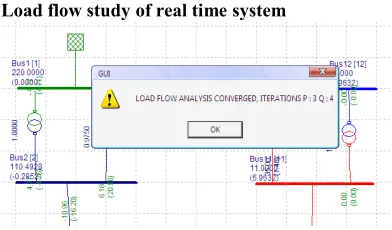
Fig.9. Load Flow Analysis
Figure 9 shows the load flow result of real time system. From this, it is clear that, the load flow converged for real power in three iterations and for reactive power in four iterations.
Transient study of real time system
Fig10. Swing curve of bus 11
Fig.11. Reactive power of bus 11
Fig.12. Real power of bus 11
Fig.13. Bus voltage in per unit for bus 14 When transient occurs, the effect on swing curve (angle), reactive power, real power and bus voltage are shown in figures 10, 11, 12 and 13 respectively.
TABULATION OF PERFORMANCE OF SOFTWARE
The result of this paper after analyzing the performances of all the software is shown below.
Features Mi Power ETAP EasyPower PowerWorld
1. Equipment 1.1 Generator a) Multi swing bus
option Not available Available Not available Not available
b) AVR Modeling Available (To be modeled by user in Free Programmable Block)
Available (Interface with Matlab for modeling)
Available Not available
c) Governor
Modeling Available Available Available
Not available
1.2 Two Winding Transformer a) ON Load Tap
Changer Not available Available Available Not available
b) Phase
displacement Not available directly Available Not available Not available 1.3 Transmission Line
a) Notation of Resistance value
Ω/Km only available. p.u is also available
Ω/Km,Ω/m, Ω/mile or Ω
Ω/Km,Ω/m,
a) Static Load Available Available Available Available b) Lumped Load Not available Available Not available Not available
c) Constant current, power, Impedance
Load Available
Static load / Lumped load shall be modified with user data
Not available Not available
1.5 Series Reactor, Capacitor
Modeling Available Not available Not available Available
1.6 Shunt Reactor, Capacitor
Modeling Available Available Available Available
1.7 Static Var compensator
Modeling Available for Load flow analysis Available Not available Not available 1.8 Current transformer
Modeling Not available Available Not available Not available
1.9 Relay & Releases
Modeling Not available Available Not available Not available
2.Graphical User Interface
a) Animation Not available Not available Not available Available
b) Bus Coloring Available Available No Not available
c) Display of Cable
Length Not available Available Not available Not available
d) Symbol IEEE only Both IEC and IEEE IEEE only IEEE only
3.Modules available 3.1 Load Flow
a) Types of load flow
Available(Frequency Dependent, Slack Bus, Optimal Load Flow, Contingency Analysis, B co-efficient& Economic Dispatch)
Slack bus
option only onlySlack bus option Slack bus option only
3.2 Short circuit analysis 3.2.1 Modeling standards
a) IEEE Partially available Available Available Not available
b) IEC Not available Available Available Not available
3.2.2 Topographical
representation Available Not available Not available Not available 3.3 Transient analysis
a) Simulation of
multiple events Available Available Not available Not available b) Auto recloser Available (only forL - G fault) Not available Not available Not available
Conclusion
In this paper, the various performance of all software are compared and tabulated. The table given, contains all the relevant information about the power system simulation software. It gives an ultimate solution for the long time unresolved problem in a specialized area. It will be a revelation for selecting power system simulation software especially for new users.
References
1. www.martinole.org
2. www.google.com
3. www.easypower.com
4. www.etapsoftware.com
6. www.powerworld.com