IJEDR1802020
International Journal of Engineering Development and Research (
www.ijedr.org
)
104
A Simple Query Retrieval framework on a
Personnel Centric Knowledge Management System
Raghvendra Patel
Assistant Professor,Computer Applications, Bastar University, India
_____________________________________________________________________________________________________
Abstract— The personnel centric Knowledge Management System (KMS) is a help desk that provides answers/solutions to queries of the clients. The knowledge workers are chosen by the organization. They are people who posses knowledge in their domain/area of expertise. These people (or knowledge workers) let know their area of interest to the system. As queries are fed to the system, it redirects the queries to some relevant knowledge workers who posses expertise in the subject of the query. If the solution to the query exists in the knowledge base (created by the knowledge workers), then the query is answered instantly by the system, or else, the client waits for the most relevant knowledge worker to reply to the query personally. The query along with the solution is then stored in the knowledge base by the knowledge worker to allow instant query retrieval by the system for such repeated query. In this paper ,we have discuss A Simple Query Retrieval framework on a Personnel Centric Knowledge Management System using tourism knowledge system.
Index Terms—
Knowledge Management System, ontology,object oriented Database.
_____________________________________________________________________________________________________
I. INTRODUCTION
Knowledge is the defined body of information which provides the ability of an actor to respond to a body of facts and principles accumulated over a period of time .i.e. data information knowledge. Data=one unit of fact; information=aggregation of data; knowledge=potential for action on information.
Now this knowledge is used by various organisations to generate value from intellectual and knowledge based assets. The explicit knowledge in a system is stored in terms of reports,documents,manuals, procedures etc. They are easy to communicate and share.but explicit knowledge alone cannot provide us with all the information we may need. For that we have to create a means of interaction between tacit knowledge and explicit knowledge. Tacit knowledge are informal assets that are rooted in human experience and include personal belief, perspective, and values. It is important to manage knowledge assets because Organizations compete increasingly on the base of knowledge (the only sustainable competitive advantage, according to some) and Workforces are increasingly unstable leading to escalating demands for knowledge replacement/acquisition.Our approach to the KMS has been using Object Oriented paradigm.
II. STATIC & DYNAMIC KNOWLEDGE BASE
The knowledge management system using tourism knowledge system which is dynamic. In our poposed system, tags are used to redirect the query to a specific knowledge worker rather than to all the knowledge workers. Initially, all the queries will yield new tags to the database. Once the system is well in use, all those queries those yield the same tags shall yield no more new tags and response would be immediate.In this way it is one step ahead of the normal database system. As in a normal database system, search is keyword/index based whose response is much slower the our system when the system is well in use. The time required to retrieve the response will go on decreasing as we make more and more use of the system. A static knowledge base will give better response than a dynamic knowledge base.
III. FRAMEWORK
The entire knowledge management system is divided into two groups: Knowledge workers and Clients.
a. Clients :- A person who queries the Knowledge worker is known as a client. Based on the system made, the domain
of clients will vary. In case of an tourism knowledge management, a client can be any person interested in see hitorical plase and natural plase.
IJEDR1802020
International Journal of Engineering Development and Research (
www.ijedr.org
)
105
c. Creation of Domain Knowledge Base Ontology
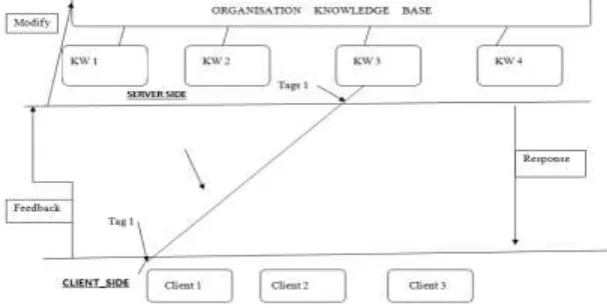
Every knowledge worker provides (has got its) his/her own Tags (tags). Tags of a knowledge worker specify the fields of interest (Domain of Knowledge) of the worker i.e. the area in which the knowledge worker is comfortable in replying for the queries. Tags are entered in the database of the worker at the time of registation of the worker or can be added/updated (later)afterwards in due course of time. This is important as the knowledge of the worker regarding a particular field/domain can change (would increase).
Modify The Tag Arrow To Query,Match Tag And Key Word & Method Below Response(Return Values) And Below Feedback(Client Rating) Figure: 1.Creation of Domain Knowledge Base Ontolog
IV. ONTOLOGY
Ontology is a formal representation of a set of concepts within a domain and the relationships between those concepts. It is used to reason about the properties of that domain, and may be used to define the domain.IN case of tourisms ontology, the ontology can be made as :
Figure: 2. Tourisms Ontology
This ontology can be efficiently used by converting it to database. In the database against each knowledge worker, his domain knowledge (names, methods and return values) is stored hierarchically.
Worker_id Instance Method Return values
ID_01 National Treasure ID_02 National Treasure
…… ……….. …………. …………
Figure: 3.Table of Domain Knowledge (names, methods and return values)
Each instance, such as “National Treasure”, will have a knowledge Base (in terms of Methods and Return Values) created around it .The knowledge base will contain some initialized/predefined methods along with solution to the method.
IJEDR1802020
International Journal of Engineering Development and Research (
www.ijedr.org
)
106
Degree of Relevance : The Degree of Relevance (DOR) of a Knowledge Worker is calculated according to his:Qualification: More qualified a person is, higher is its degree of relevance.
Experience: A more experienced person in a particular field has got higher degree of relevance. Time spent on a project: The greater the time spent on the project, higher is the rating.
Funding: Higher the budget allocated to a project, more is its rating i.e more is the degree of relevance. more preference to answer the particular query is given to the knowledge worker.
• Based on the degree of relevance and feedback given by the client on their response the rating of a worker is determined as
Net_Rating of KW = client_feedback + (DOR)
Net_Rating of KW = client_feedback + (quaificatiuon*experience*time_spent*funding)
So rating of a knowledge worker is a dynamic value and keeps on changing throughout. Each worker should strive for higher rating which may lead to some kind of incentive earned by the knowledge worker. (given by the organisation).
• When a query is submitted by a client ,an algorithm is used to extract the tags from the submitted query. the query is submitted with a fixed number of worker who has the same tags and higher rating among other users. After submission of response by the knowledge worker, the client provides rating according to the usefulness/elaboration of the response which is used to re-evaluate the rating of the worker.
• In case the tags extracted are not already listed with any of the worker ,it can be stored in a tempory table and the query can be populated to each knowledge worker.The worker knowing the answer to the query can answer that query.The worker getting the highest rating from the client for its response will have the new tag added to its own list of tags.
• Algorithm for extracting tags from a query [Algorithm1]:
1. str is the query submitted.
2. Remove all questions, article, conjunction, prepositions and pronouns from the str to get new str1.(this is the tag) 3. Keep all the words of the str1 in an array.
4. Do combination of words (taking 1, 2, 3, …. n words at a time) to obtain multiple tags.
Figure: 4.Tourism knowledge system
Front-End
The main page of the Tourisms Knowledge management System, common for both the client and the knowledge worker. #Welcome Screen for the Kowledge Worker and Register Form for the Knowledge Worker.
• A new Knowledge worker of the system can modify or add new registration and the existing worker respond to the queries submitted by the clients.
• The registration of worker collects the necessary information required for calculating the Degree of relevance for each worker such as experience, qualification, time spent on project etc.
# Tags Form for the Knowledge Worker
• Any registered knowledge worker can view the tags already associated with him. He can add new tags to its database also based on the work he is doing.
IJEDR1802020
International Journal of Engineering Development and Research (
www.ijedr.org
)
107
• The Knowledge Worker also has the priviledge to add user defined tags and keywords.
# Knowledge Base form
• The knowledge worker will describe the method and the return values for the instance which is included in its query.
• If any new methods requested by the client, it will be added to the knowledge base by the worker. (so as to automatically retrieve the response if such a query is repeated).
# Synonym Methods form for the Knowledge Worker
• The knowledge worker describes “Synonym Methods” that aid in handling alternate queries that have the same return values or answers.
• The synonym method tags are so structured that would occur in a query e.g who is the music diector of ‘National Treasure’ and who directed music in ‘National Treasure’ would yield the same answer. Hence ‘directed music’ is a Synonym Method Tag of the primary tag ‘music director’. The primary method is so chosen that is the method tag of most common direct query.
• The above form allows the knowledge workers to modify at most 5 synonym methods according to the most common queries.
# Submit Response form for the Knowledge Worker
• A knowledge worker can look into the queries submitted to him by submitting his ID and clicking on the ‘Go’ button. Queries are submitted to a knowledge worker if the knowledge workers submitted tags and tags generated by the Query matches.
• All the queries will be populated in the dropdown box.
• Worker can select the Query for which he wishes to reply and submit the response in the text area provided. Welcome page for the client
# Query Form for the client
• The client can have its query posted. He/she may also select from the list of existing tags to add to his/her query so as to better redirect the query to the knowledgeble worker.
• The client can select hierarchically the instance (such as movie name or song ) . He can then submit his query.
• The tags of his entered query will be extracted using ALGORITHM 1
• If the instance and method exists then response will be provided by the knowledge base otherwise new tags will be populated to the user having the tags only.
# Response View Form for the Client
• In the response page, against each query, at most 5 responses (the most relevant ones i.e the responses from the Knowledge Workers having maximim DOR) are displayed from different workers. These workers are selected according to the highest DOR among all workers.
• Client can provide the rating against each response based on how useful/eleborate the response is to him. On the rating provided by the client, the DOR of the worker is modified. So, the DOR is dynamic and changes throughout the time period of the system.
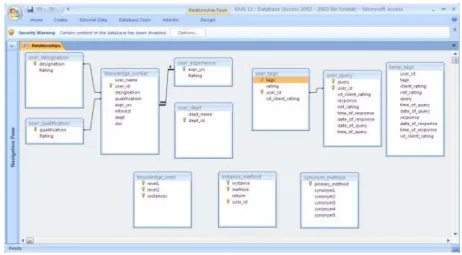
KNOWLEDGE BASE -There are 11 tables in the back end .
• Knowledge_worker: It stores all the information related to the worker. i.e. name, id, designation, qualification, experience , dept which is used to calculate the DoR .
IJEDR1802020
International Journal of Engineering Development and Research (
www.ijedr.org
)
108
.Figure : 5. Backend Tables (11 tables in the back end)
PERFORMANCE ANALYSIS OF THE SYSTEM WITH REPEATED QUERIES
Performance of the system steadily increases with increase in the number of repeated queries. The time difference between the time of query and time of response decreases till the system becomes static for some time. For example, here up to query 6 it steadily decreases. After that if some new tourism place, then again the database is new to it and hence the sharp increase in the difference between the two times. Again after some period of time, when the system becomes static for some time, the two curves merges. And this pattern follows.
Figure: 1a.Difference between the time of query and time of response decreases
IJEDR1802020
International Journal of Engineering Development and Research (
www.ijedr.org
)
109
LIMITATIONSThere are a certain restrictions to the query response system. The performance to the query response system would greatly depend on some of these factors:
1. The knowledge of the knowledge workers regarding the subject matter that they would like to share. The more knowledge they are able to share, the better the clients would get the response, i.e in quicker time.
2. The activeness of the knowledge worker also comes into play. The more active the knowledge worker is, the better would be the performance. i.e max performance could be achieved by installing this application with the one which the knowledge worker uses often e.g mobile device, or mailbox etc. The quicker the response is the more motivated will the clients be to ask queries.
3. The vastness of the issue on which the query system is based will also come into play. If the subject is very dynamic, i.e new knowledge comes every now & then like news etc, then the system would not be very fruitful. But in case of more static information like policies in a company, or services & products in a company or e-government services would prove to be very helpful. The database storing the knowledge base, would grow as and when new policy, or service is launched. Before its launch, the knowledge worker should specify their specialty or skills in terms of tags and put up their material in correspondence to their proper-nouns i.e names of services etc. as the knowledge base. The client queries the system about the service, if present in the knowledge base, then his query is answered, else the query is mailed to the knowledge worker who has the tags corresponding to the query.
CHARACTERISTICS OF PERFORMANCE
1. If the numbers of clients are huge, then there is a greater probability that a query would get repeated with a few numbers of variations and vice-versa.
2. If the number of knowledge workers increases, then there is a greater probability that the client would be able to find the right answer and the knowledge base would increase i.e. the knowledge base would be more fruitful. Else the client would not be satisfied with the answer and hence the knowledge base would not increase.
CONCLUSION AND FUTURE WORK
The proposed system is efficient after a long run. Initially it acts as a normal database.
• The knowledge worker does not initialize the database. Hence the learning process of the system is slow. If we could use methods (predefined methods and its associated return values) in the knowledge base for each instance, then the very common queries can be answered instantaneously, without submitting the queries to the worker. The query process performs well if the method type is defined for a particular instance.
• Another limitation is that the query should also match its construct with the defined method type if that is not the case, then the tags extracted from the query would not match with the tags stored in the database, and hence the response time, and hence throughput of the system would fall. So our aim in the future would be to incorporate various common language constructs that generally occur for any query regarding a particular knowledge domain We should adapt our query construct accordingly, and try to match with the stored instances and method in the knowledge base efficiently.
• We can also design the system in a modular way such that the system can be manipulated easily when we deal with a separate ontology. like in the given system , is meant for only tourism. it would be better if we could design the system in such a way that any organization can implement it by using its black box architecture and just changing its ontology structure with going into much details about the programming if the query is such that it requires to go through some case history, then the language construct for such queries could be made in such a way, that it would automatically parse the query to get the required values for the fields and hence try to find the similarity measure with previous cases.
REFERENCES
[1] S. Staab, R. Studer, H. Schnurr, and Y. Sure, "Knowledge Processes and Ontologies," IEEE Intelligent Systems, pp. 26-34, 2001.
[2] D. O'Leary, "Enterprise Knowledge Management," Computer, pp. 54-61, 1998.
[3] X. Yang, “To facilitate knowledge management using basic principles of knowledge engineering,” in Proc. Pacific-Asia Conference Knowledge Engineering and Software Engineering, 2009, pp. 94-97.
[4] F. McKenna. (April 2008). A knowledge management system a discourse. [Online]. pp. 1-9. Available
http://www.knowledgeonecorp.com/news/pdfs/A%20Knowledge%20 Management%20System%20- %20A%20Discourse.pdf [5] S. Assegaff and A. R. C. Hussin. (2012). Review of knowledge management systems. [Online]. pp. 1-6. Available: http://arxiv.org/ftp/arxiv/papers/1212/1212.0387.pdf
IJEDR1802020
International Journal of Engineering Development and Research (
www.ijedr.org
)
110
[7] W. Han and Y. Wang, “Knowledge management, knowledge management system, and organizational performance: An empirical study,” in Proc. International Conference on Systems and Informatics, May 2012, pp. 2488-2492.[8] H. Faris, S. Totaro and A. Corallo, “Framework and implementation of a knowledge management system for aerospace collaborative working environments,” in Proc. IEEE International Conference on Mobile Data Management, June 2011, pp. 92-97.
[9] ZHANG Dongmin. Design Knowledge Modeling Based on Ontology[J]. Journal of South China University of Technology (Natural Science Edition) ,2005,33(5), pp.26-31.
[10] PAN Xuwei Knowledge management-oriented knowledge modeling technology[J]. Computer Integrated Manufacturing System, 2003,9(7), pp.517-521.
[11] Barnard Y, Rothe A. Knowledge management in engineering: supporting analysis and design processes in innovative industries [A]. Building the Knowledge Economy, lssues, applications, case studies, 2003: 931-938