The culture of benthic marine algae in the laboratory
and the field
R. M. SMITH and W. E. JoNrs
University College of North Wales, Marine Science Laboratory; Menai Bridge, Anglesey, U. K.
KURZFASSUNG: Die Kultur mariner Algen im Laboratorium und am natiirlichen Stand- ort. Der Aspekt der sublitoralen Algenvegetation vor der Kiiste yon Ravenspoint (Westkiiste yon Anglesey) wird entscheidend yon der mechanischen Wellenwirkung, der TriJbung des Was- sers und der Sedimentierung gepr~gt. Auf den durch die Winterstiirme stark verlagerten und abgescheuerten Steinen in 4 m Tiefe dicht unter der Kiiste kann sich erst ab April-Mai eine i~ppige Vegetation annueller Arten entwickeln. In 9 m Tiefe iiberstehen nut derbere Formen wie Chondrus oder Furcellaria die winterliche Sedimentablagerung. Hier stellen sich in den Somermonaten auBer den auch in 4 m vorkommenden Arten einj~ihrige Rotalgen wie Naccaria, Halarachnion, Scinaia und Helmintbora ein. Zur Kl~irung ihrer Ukologie und Lebensgeschichte wurden Steine ins Laboratorium verbracht und der sich entwickelnde Aufwuchs untersucht, au~erdem Kulturen dieser Arten auf Objekttr~igern im Laboratorium und am nati~rlichen Standort verglichen. Besonderes Interesse verdienen Vertreter der Nemalionales (Rhodophy- ceae), in deren Lebenszyklus bisher nur die karposporentragende Phase bekannt ist. Zwei Monate alte Kulturen yon Naccaria wurden im November aus dem Laboratorium an ihren natiirlichen Standort gebracht. Nach gleichartiger Entwicklung bis zum Mai des folgenden Jahres bildeten sie Strukturen, die vielleicht der tetrasporentragenden Phase entsprechen. Solche Stadien wurden w~ihrend der dreij~ihrigen Kultur im Laboratorium nicht beobachtet. Daher ist eine kritische Beurteilung der an Laboratoriumskulturen erhaltenen Ergebnisse angezeigt, be- sonders bei der Untersuchung des Lebenszyklus yon Algen. Die Zellenanordnung junger Corallinaceen-Krusten zeigte charakteristische Unterschiede, die vielleicht als taxonomische Kriterien verwertbar sind.
I N T R O D U C T I O N
This w o r k forms p a r t of an investigation of a number of problems concerned with the ecology of the sub-littoral benthic marine algae. On the west coast of Anglesey (U. K.) at T r e a d d u r Bay, there is a seasonal development of an algal flora on a substratum of loose stones in the sub-littoral region. Collections have been made from 3 distinct regions representing 3 different habitats at depths of 4, 9 and 30 m below low water mark.
Culture of benthic marine algae 63
of the swells from the rock face. The movement of the stones was sufficient to abrade from their surfaces all the visible algae which had developed there during the sum- mer months. From April to May onwards, the duration and intensity of the storms was insufficient to cause movement of the stone bed. During this stable period, the reduced water movement resulted in a decrease in the sediment load, thus allowing greater penetration of light and the water temperature reached about 100 C at the same time. Soon a~er this, a large number of species developed on the stones resulting in a luxuriant plant cover.
At a depth of 9 m the stone bed was not subjected to much movement and the mutual abrasion of the stone surfaces was slight. However, the stones became covered during the winter months with a layer of sand and shell gravel of variable depth. This was sufficient to destroy all but the larger cartilagenous species [Chondrus
crispus STAC~H., Furcellaria fastigiata LAMOUR and Rhodomela confervoides (Hubs.)
SILVA] of a population which had developed during the summer months. This popu- lation included most of the species recorded at 4 m and, in addition, species of annual red algae, in particular Naccaria wiggii (TURN.) ENDL., Halarachnion ligu-
latum (WooDxv.) KOTz, Scinaia furcellata (TURN.) BIv., Helminthora divaricata
(C. Ao.) J. Ac. In order to investigate the origins and fate of the summer flora of the stone beds, 3 lines of study were pursued. Firstly, the culture of the main com- ponents of the flora 'was attempted; secondly, stones from the sub-littoral stations were collected and transferred to laboratory culture conditions and, thirdly, the development of spores of some species was observed both in the laboratory and in the field.
The stones from 30 m depth were collected on a dive 5.6 km North-West of the station sites of the 4 and 9 m collections. The object of the dive was to establish the limit of the penetration of algae below the tide level. At this station the limit of growth was found to be 25 m, at the fringe of a region of heavy sedimentation on the rock surfaces. Stones from 30 m appeared to be without algae on the surface even when examined with a stereo-microscope. The examination of rock scrapings from this depth also failed to reveal algal growth.
MATERIAL A N D M E T H O D S
Material for work on spore development was obtained from the algae collected at local sites. The fertile material was placed over glass or roughened perspex micro- scope slides in dishes of sea water in the laboratory. A~er 24 h, during which time mature spores were shed, the plant material was removed and the slides were lett for a further 24 h to facilitate spore attachment. The slides were then transferred, with the attached spores, to running sea water under illumination regimes which are sum- marised in Table 1. The illumination was provided by Atlas Daylight fluorescent tubes, and was measured by an EEL photometer of the selenium barrier cell type.
placed in a water bath. The sea water used in these cultures was untreated sea water, filtered through glass wool to remove the diatoms, and was changed weekly. All materials on slides and stones maintained at laboratory temperature were placed in the recirculating sea water system described by JoNEs & D~NT (1970). The flow rate
15
Q.
W
,,///LABORATORY
\ ' k / o /
o
\
o
' I X ' X 'XI'XII { l hi{ ' I l l ' i V ' V ' V i i V l l ' V l l l ' l X ' X 'Xl 'Xll { M O N T H S
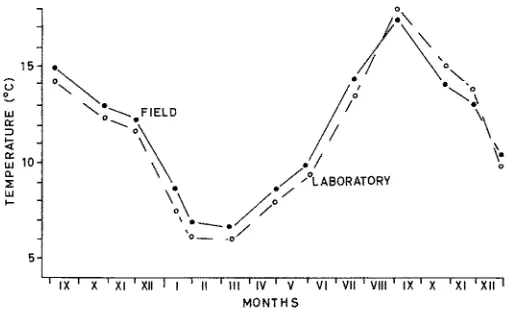
Fig. 1: Variation of sea water temperature during experiments
of the water through the dishes was 0.014 1/sec. The laboratory temperature main- tained by this system is shown in Figure 1 together with temperatures measured in the field during the experiment. Illumination received by the plants in the field was calculated according to the method outlined by SMITH & JONAS (1970). Field light readings were measured at the surface, at 4 and 9 m. The reading s were integrated over the day to allow for diurnal variation in radiation. From the integrated value laboratory 'daylength' was calculated to irradiate the sporelings with the same total radiation being received by plants in the field. Adjustments for seasonal variation were made from time to time.
RESULTS AND DISCUSSION
G e n e r a l e f f e c t s o f t h e r e g i m e s o n t h e g r o w t h o f t h e a l g a e
In general the rate of growth of plants in the laboratory was slower than that of the same species in the field. The reaction of sporelings to the irradiation regimes ot~en complemented the observed distribution of the plant in the field.
Culture of benthic marine algae 65 restricted to the shade of steep sided gullies were oiten influenced by the canopy shade of L a m i n a r i a h y p e r b o r e a (GuNN) FOSL~. The growth of the sporelings of
D. s a n g u i n e a was adversely affected by irradiation intensities of 1000 lux at the 4 celled stage. This corresponds to the highest irradiation level measured at the site
Table 1
Comparative development of spores and sporelings cultured under laboratory and field con- ditions. Irradiation levels in the laboratory were determined using a barrier-layer photocell. The 4 and 9 m depths of the field cultures represented irradiation levels of approximately 100 and 750 lux, respectively. Growth index of sporelings used: 0 = dead; 1 = spores alive but undivided; 2 = little development beyond initial divisions; 3 = poor development spore-
ling; 4 = normal development but smaller than 5; 5 = good development of sporeling Irradiation levels (lux) Depth of field cultures (m)
Species 180 200 360 500 1000 4 9
Laminaria hyperborea 5 5 - - - 0 5 Delesseria sanguinea 5 5 3 3 0 0 0 Hypoglossurn woodwardii 5 5 5 5 5 0 5 Chondrus crispus 5 5 5 5 5 5 5 Callophyllis laciniata 5 5 5 4 3 0 5 Rhodomela confervoides 5 5 5 5 5 5 5 Polysiphonia elongata 5 5 0 0 0 5 5 Lithophyllum sp. 5 5 5 5 5 5 5
Corallina sp. 5 5 5 5 5 5 5
Lithotharnnion sp. 5 5 5 5 5 5 5
Rhodyrnenia palmata 0 0 4 5 5 5 5
of a fertile D. sanguinea. Thus, the distribution of this species may be a result of the reaction of the Sporeling to the irradiation leve !. The species has a restricted period of spore release between January and March. Plants derived from tetraspores and carpospores showed similar reactions. There appears to be no difference in the distri- bution of the two reproductive phases in the field.
Species transferred to the frames in the field showed one of two contrasting reactions. Plants would either develop well (o~en to maturity) or disappear from the culture slide. The reason for the disappearance of some species was probably twofold: firstly, a plant developing poorly would survive only a very short time under natural conditions of water movement; secondly, the high density of grazing animals would constitute another hazard. The grazing of G i b b u l a cinerea, in partic- ular, must account for the loss of a high proportion of both healthy and poorly developing plants. Trails le~ by the radulae of grazing animals were clearly visible on the slides. The efficiency of their grazing was high, even small coralline crusts were damaged. Densities of up to 50 animals/m 2 were measured.
field from other calcified crusts under natural conditions when upright filaments were absent. Plates of Lithophyllurn sp. became rapidly fertile in the laboratory under a wide range of irradiation levels. The typical cystocarps with a single ostiole devel- oped on plates 80 # and larger in diameter. The cell arrangement of the plates was typical of specimens growing as epiphytes on Furcellaria in the field. The cell ar- rangement of the third type of plate quickly became obscured as the result of divi- sions of the cells in the horizontal plane. Larger specimens grown in the laboratory and the field showed the characteristic form of Lithothamnion sp. No differences attributable to speciation could be distinguished at this stage. The other two forms observed have not yet been identified.
C u l t u r e o f a l g a e o n s t o n e s f r o m s u b - l i t t o r a l s t a t i o n s
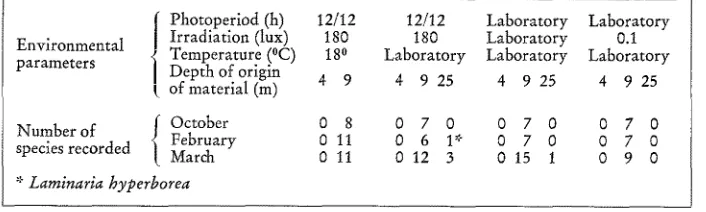
The results of cultivating algae on stones are summarised in Table 2. Complete absence of algal development from stones collected at 4 m depth confirmed the initial field observations that the movement to which the stones had been subjected de- stroyed all algae present, including sporelings and perennating bases. This fact indi- cates that the summer population develops entirely by recruitment of spores from plants already established on the surrounding rocks and the littoral region. The presence of sporelings of Fucus sp. (probably F. serratus L.), confirms the latter
Table 2
Culture of algal material present on the surface of stones collected in the sub-littoral in autumn. The stones were placed in the culture medium intact. In all cases the numbers of species present increased during the period of culture, indicating that perennating structures such as spores or vegetative fragments were present on the stones at the time of collection
i Photoperiod (h) I2/12 12/12 Laboratory Laboratory Irradiation (lux) 180 180 Laboratory 0.1 Environmental Temperature (°C) 18 ° Laboratory Laboratory Laboratory parameters Depth of origin
of material (in) 4 9 4 9 25 4 9 25 4 9 25
October 0 8 0 7 0 0 7 0 0 7 0 Numberof February 0 1t 0 6 1" 0 7 0 0 7 0 species recorded March 0 11 0 12 3 0 15 1 0 9 0
* Laminaria hyperborea
Culture of benthic marine algae 67
0.1 lux in the laboratory grew much more slowly than plants under the other 3 regimes.
The populations which developed in the laboratory on the stones from 9 m depth contained most of the components of the populations that developed in the field during the same period, with some exceptions. These exceptions included the following species of red algae -
Naccaria wiggii
(TraiNeR) ENDL.,Scinaia furcellata
(TuRN~R) BIv.,
Helrninthora divaricata
(C. AG.) J. Ao.,Halaracbnion ligulaturn
(WooDw.) KOTz. The significance of the absence of these species is that they are seasonal forms present between July and October; only the cystocarpic generation is represented. The alternate tetrasporic generation is known only for
Halarachnion
Iigulatum
(BoIL~OT 1965). The absence of these species on the stones in the labo- ratory prompted further investigation of their life histories.The stones from 30 m depth were devoid of any algal growth when collected in September. They formed part of a rocky face continuous from the upper littoral to a depth of 35 m. The limit of algal growth was found to be 25 m at this station. Plants of
Delesseria sanguinea, Phyllophora crispa
(HuDs.) DixoN andPlocarniurn
cartilaginurn
(L.) Dixon persisted to 20 m.Phyllophora crispa
penetrated a fur- ther 5 m. During maintenance of the stones in the laboratory, the appearance ofLarninaria hyperborea
during January andChaetomorpha rnelagonium
( W ~ & MOHR) KOTz andPhyllophora crispa
in March suggests that the limit of algal growth at 25 m may be a result of low irradiation. There is no doubt that these conditions exist; the sediment load of the water is high and the settled sediment, which covers all the rock surfaces within 10 m of the stone bed, has a blanketing effect. The sea bed seawards from this station consisted of fine yellow mud.C u l t u r e o f s e a s o n a l s p e c i e s
The initial development of seasonal species showed stages which have been described by other workers, in particular CHE~IN (1927).
Naccaria wiggii
was cul- tured in the laboratory under regimes summarised in Table 3.So far, the evidence of BoiLtOr (1968) suggests that there is no alternate tetrasporic phase in
Naccaria wiggii.
Carpospores ofN. wiggii
give rise, in theTable 3
Culture of filaments derived from carpospores of
Naccaria wiggii.
Laboratory regimes were designed to determine the irradiation/daylength/temperature requirements of tetraspore for- mation. TetrasporicN. wiggii
have not been recorded from the field under natural conditions.M: Monosporangia; T: Tetrasporangia; Lab.: laboratory
Photoperiod (h) 12/12 12/12 Lab. Lab. Field Lab. Environmental Irradiation (lux) 180 180 Lab. .1 Field parameters Temperature (°C) 18 o Lab. Lab. Lab. Field
Type of spore ~ January M M M M
laboratory, to filaments from which cystocarpic plants are directly derived. During our work, the filaments grown in laboratory culture failed to develop any structures that could be recognised as the possible tetrasporic generation. The cultures were maintained for 3 years. Slides bearing filaments derived from the carpospores were transferred to the field. These filaments showed a pattern of development similar to the laboratory cultures until the beginning of summer. At this time crowded vertical filaments arose from the creeping filaments, and structures resembling the tetra- sporangia of Rhodochorton sp. developed in terminal and lateral positions. The contents of these sporangia were released and behaved as spores, giving rise to fila- ments morphologically similar to the filaments derived from the carpospores. These are now in field culture. The difference between the results of laboratory and field cultures illustrates the care with which life history studies should be interpreted when
algae are maintained in laboratory culture only.
CONCLUSION
The 3 topics discussed here show the value of close comparisons between culture of marine algae in the laboratory and the field. The clarification of the identification of coralline crusts in the field is most important taxonomically and should also assist ecological work which is so far lacking on these forms. Further work in the field should aid the identification of the plate types which have, as yet, been observed in the laboratory only.
SUMMARY
1. Growth and development of algae from spores has been observed in the labo- ratory (Menai Bridge) and under field conditions at Ravenspoint (West coast of Anglesey). Attempts were made to culture all main components of the sub-littoral flora. Spore material was obtained from spores allowed to settle onto plastic slides in the laboratory sea water system and from spores settled on slides sta- tioned in the field.
2. Attention was given to the summer annual species and, in particular, to those members of the Nemalionales (Rhodophyceae) which have incompletely known life histories. In these plants, the tetrasporic phase during which reduction division normally takes place, has so far been undetected in the field. The plants are represented by the cystocarpic phase of the life cycle only.
Culture of benthic marine algae 69 4. The results of these experiments illustrate that care must be taken in interpreting results of laboratory cultures of algae, in particular in regard to their life histories.
L I T E R A T U R E C I T E D
BOILLOT, A., 1968. Sur l'existence d'une tetrasporophyte dans le cycle de Scinaia furcellata
(TURN.) BIV. C. r. S~anc. Acad. Sci., Paris 266, 1813-1832 P. 12 65.
C~EMm, 1927. Sur le d6veloppement des spores chez quelques Nemalionalees. Bull. Soc. bot. Fr. 74, 163-167.
JoN~s, W. E. & DENT, E. S., 1970. Culture of marine algae using a recirculating sea water system. Helgollinder wiss. Meeresunters. 20, 70-78.
S~ITH, R. M. & JoNas, W. E., 1970. Measurement of submarine illumination. In: Proceedings of the 4th European Symposium on marine biology, Bangor (Wales), 1969. Univ. Press, Cambridge (in press).
First author's adress: R. M. SMITH