S T U D Y P R O T O C O L
Open Access
Study Protocol: The Behaviour and Pain in
Dementia Study (BePAID)
Sharon Scott
1, Louise Jones
1, Martin R Blanchard
3and Elizabeth L Sampson
1,2*Abstract
Background:People with dementia admitted to the acute hospital often receive poor quality care particularly with regards to management of behavioural and psychiatric symptoms of dementia (BPSD) and of pain. There have been no UK studies on the prevalence and type of pain or BPSD in people with dementia in this setting, or on how these may impact on patients, carers, staff and costs of care.
Methods/Design:We shall recruit older people with dementia who have unplanned acute medical admissions and measure the prevalence of BPSD using the Behave-AD (Behaviour in Alzheimer’s Disease) and the CMAI (Cohen Mansfield Agitation Inventory). Pain prevalence and severity will be assessed by the PAINAD (Pain
Assessment in Advanced Dementia) and the FACES pain scale. We will then analyse how these impact on a variety of outcomes and test the hypothesis that poor management of pain is associated with worsening of BPSD. Discussion:By demonstrating the costs of BPSD to individuals with dementia and the health service this study will provide important evidence to drive improvements in care. We can then develop effective training for acute hospital staff and alternative treatment strategies for BPSD in this setting.
Background
Dementia is common in older people admitted to acute hospitals in the United Kingdom (UK), affecting 42% of adults over 65 years with an unplanned medical admis-sion. These patients have high mortality with a quarter of those with severe impairment dying during the index hospital admission [1]. Dementia significantly increases the length of hospital admission [2-5], complications [4] and the risk of iatrogenic harm through polypharmacy [6]. A number of recent documents including the Eng-lish National Dementia Strategy, the National Dementia
Research Summit and Alzheimer’s Society“Counting
the Cost” report have raised concerns regarding the
quality of care received by people with dementia in acute hospitals and have highlighted lack of original research in this field [7-9].
Behavioural and psychological symptoms of dementia in the acute hospital
The term “behavioural and psychological symptoms of
dementia” (BPSD) encompasses a range of symptoms
including agitation, aggression, delusions, hallucinations, depression and apathy. These are common in dementia, multifactorial in origin and often secondary to complex interactions between the severity of dementia, the envir-onment and other illness [10]. BPSD are extremely dis-tressing for the patient and difficult to manage in the busy acute hospital. They may lead to the inappropriate use of antipsychotic drugs, increasing the risk of stroke, falls and death [11].
Carers have given rich reports on how BPSD may worsen during hospital admission[9]. However, although there is some qualitative research, [12] in our recent sys-tematic review [13], we found no studies on the type, severity or frequency of BPSD in the acute hospital, how hospital staff manage these symptoms and the impact on patients. These data are vital if we are to develop and evaluate effective non-pharmacological interventions for BPSD in the acute hospital.
* Correspondence: [email protected]
1Marie Curie Palliative Care Research Unit, UCL Mental Health Sciences Unit University College Medical School, 1st Floor, Charles Bell House, 67-73 Riding House Street, London, W1W 7EJ, UK
Full list of author information is available at the end of the article
Pain
Pain is commonly under detected and undertreated in people with dementia [14,15]. Many clinical staff believe that people with dementia actually experience less pain [16]. This may occur because people with dementia are unable to express clearly that they are in pain. Under-treatment of pain may lead to protective responses such as aggression, distress and agitation, vocalisations or depression and withdrawal [17]. It may increase the risk of delirium [18], slowing recovery and increasing func-tional decline [16]. In acute hospitals in the UK it is not usual clinical practice to assess routinely whether people with dementia are in pain. However, this may be a worthwhile approach as when pain assessment scales are used in dementia patients the use of analgesics increases significantly [19].
The relationship between BPSD and pain
Behavioural problems in people with dementia may be an expression of unmet needs such as boredom, fear, discomfort or pain [20]. However, the relationship between BPSD and pain is poorly understood. The per-ception and communication of pain is a complex pro-cess and particular behaviours are not exclusively associated with pain. In people with dementia such behaviours may also indicate embarrassment, depression or distress.“Pain behaviours” therefore lack specificity
and some “pain scales” may actually be detecting
broader distress. To understand any direction of causal-ity, it is important to use self-report and observational/ behavioural pain scales concurrently [14]. More work is required to establish whether the use of pain tools is feasible in the acute hospital, whether these tools are reliable in detecting pain and whether there is a rela-tionship between pain, particularly that which is unde-tected and undertreated, and BPSD.
Methods/Design Aims
Our aim is to examine the impact of behavioural and psychological symptoms (BPSD) and pain, during an acute hospital admission, in people with dementia. We shall explore two specific areas. First, how behavioural and psychological symptoms (BPSD) affect outcomes for the person with dementia, informal carers and the hos-pital, and second the detection and management of pain in people with dementia.
Objectives
Our main objectives are to examine, in older people with dementia admitted to acute hospital wards:
•the prevalence and types of BPSD
•how hospital staff respond to and manage these
symptoms
•the impact of BPSD on costs of care
•the impact of BPSD on the person with dementia,
for example the prescription of antipsychotic drugs, the length of hospital stay, quality of care and the risk of adverse events
•prevalence of pain and how well this is detected
and managed by hospital staff
•the time spent by informal carers assisting nursing staff with basic care tasks
Finally, we shall test the hypothesis that there is an association between BPSD and pain, particularly whether BPSD are a manifestation of under-detected or under-treated pain.
Methods
This protocol describes an observational cohort study.
Setting
To ensure our population is representative we will recruit from two London hospitals. Both cover a large area of London encompassing socioeconomic and ethnic diversity, serving a population of two million people, six primary care trusts and four mental health trusts. The hospitals have differing strengths and weaknesses in terms of their Care Quality Commission ratings and are at different stages of implementing the English National Dementia Strategy with varying provision of liaison psychiatry.
Sample size
Identification of participants
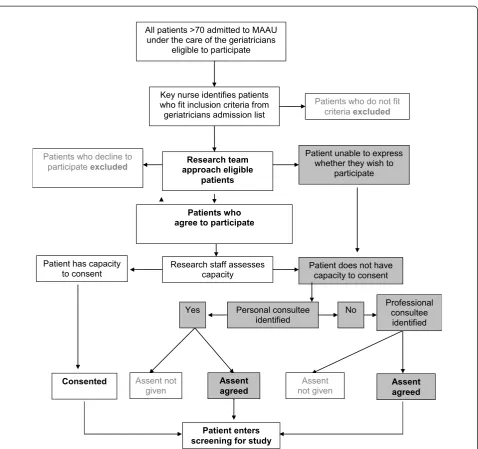
In both hospitals, all patients are admitted to the medical acute admissions unit (MAAU), before transfer to the care of the elderly wards. Two research assistants will spend four months at each site and see all patients admitted to each MAAU who are under the care of the geriatricians within 72 hours of admission. The geriatri-cians will provide a list of people who have been admitted under their care over the previous 24 hours. Research assistants will ask ward nursing staff to identify patients from this list who fit the inclusion criteria, see Figure 1.
Inclusion criteria
•patients over the age of 70 who have an unplanned
acute medical admission
•able to give verbal consent or an informal carer or “professional consultee”available to give assent
•sufficient English language to complete the study
ratings
•Abbreviated Mental Test Score (AMTS [23]) of≤
7/10 (routinely measured on admission)
Exclusion criteria
•patients who indicate either verbally or non-verb-ally that they do not wish to participate
•patients consistently rated as being delirious during the study without a previous diagnosis of dementia
•patients who are moribund, in a coma, non-English
speaking (the assessment tools selected for this study
Key nurse identifies patients who fit inclusion criteria from geriatricians admission list
Research team approach eligible
patients
Patients who do not fit criteria excluded
All patients >70 admitted to MAAU under the care of the geriatricians
eligible to participate
Patient unable to express whether they wish to
participate
Personal consultee identified
Yes No
Patient does not have capacity to consent Research staff assesses
capacity
Patients who agree to participate
Patient enters screening for study Patients who decline to
participate excluded
Patient has capacity to consent
Consented
Professional consultee identified
Assent agreed Assent
agreed Assent not
given
Assent not given
have not been translated or validated in languages other than English) or where there are clinical con-cerns that may preclude them being approached
Screening
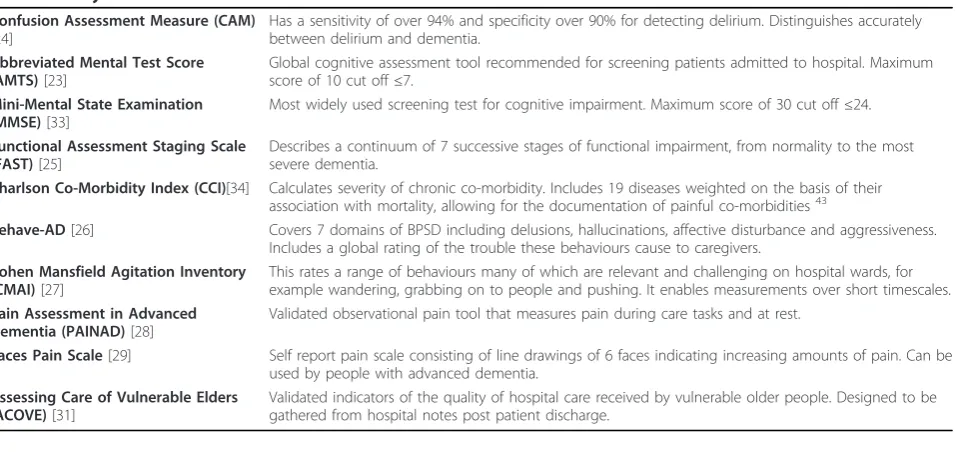
All potential participants will be screened for delirium using the Confusion Assessment Method (CAM) [24], (Table 1). Those who are not delirious will be consented to the study and have a MMSE assessment. If their
score is ≤ 24 they will be entered into the study.
Patients with delirium will be screened again 48 hours later, if this has resolved they will undergo testing with the MMSE. If they remain persistently delirious they will not be eligible to participate as we will be unable to establish whether or not they have an underlying dementia. Patients with delirium but who have a clearly documented previous diagnosis of dementia in the hos-pital notes will enter the study.
If we were to exclude dementia patients with delirium we would risk excluding those patients who are most likely to have the greatest symptom burden and the study would not be truly representative of patients admitted to acute hospital wards in the UK.
Consent
Many patients will be acutely ill. They will have a dementia, delirium or both and will not be able to give fully informed consent. Therefore our consent proce-dure has been developed to comply with capacity legis-lation governing England and Wales (Mental Capacity Act 2005). Our study was approved by the ethics
com-mittee of Central London REC3 which is “flagged” to
consider research on those unable to consent for
themselves. This is an observational study and the risk of harm to the patient is negligible.
1. If a patient agrees to participate we will conduct a brief, structured assessment of their capacity to con-sent. If they have capacity to consent we will obtain written informed consent from them.
2. If they do not have capacity to consent we will attempt to identify their next of kin, carer or some-one close to the person to give proxy assent. If we cannot contact a next of kin within 48 hours of initial screening we will contact a professional con-sultee for assent (professional concon-sultees will be defined as a senior member of the clinical care team who is not directly involved in the research or patient’s care).
Study procedures
Study measures after consent
Dementia diagnosis will be confirmed using the opera-tionalised DSM-1V criteria and dementia severity mea-sured using the Functional Assessment Staging Scale (FAST) [25]. The reason for admission, co-morbidities, medication (cholinesterase inhibitors, analgesia and neu-roleptics) and demographics (i.e. place of residence) will be obtained from medical notes. Patients will undergo observational assessment for BPSD (Behave-AD and Cohen-Mansfield Agitation Inventory-CMAI[26,27]). Pain will be assessed using a combination of methods concurrently. The Pain Assessment in Advanced
Table 1 Study Assessment Tools
Confusion Assessment Measure (CAM)
[24]
Has a sensitivity of over 94% and specificity over 90% for detecting delirium. Distinguishes accurately between delirium and dementia.
Abbreviated Mental Test Score (AMTS)[23]
Global cognitive assessment tool recommended for screening patients admitted to hospital. Maximum score of 10 cut off≤7.
Mini-Mental State Examination (MMSE)[33]
Most widely used screening test for cognitive impairment. Maximum score of 30 cut off≤24.
Functional Assessment Staging Scale (FAST)[25]
Describes a continuum of 7 successive stages of functional impairment, from normality to the most severe dementia.
Charlson Co-Morbidity Index (CCI)[34] Calculates severity of chronic co-morbidity. Includes 19 diseases weighted on the basis of their association with mortality, allowing for the documentation of painful co-morbidities43
Behave-AD[26] Covers 7 domains of BPSD including delusions, hallucinations, affective disturbance and aggressiveness. Includes a global rating of the trouble these behaviours cause to caregivers.
Cohen Mansfield Agitation Inventory (CMAI)[27]
This rates a range of behaviours many of which are relevant and challenging on hospital wards, for example wandering, grabbing on to people and pushing. It enables measurements over short timescales.
Pain Assessment in Advanced Dementia (PAINAD)[28]
Validated observational pain tool that measures pain during care tasks and at rest.
Faces Pain Scale[29] Self report pain scale consisting of line drawings of 6 faces indicating increasing amounts of pain. Can be used by people with advanced dementia.
Assessing Care of Vulnerable Elders (ACOVE)[31]
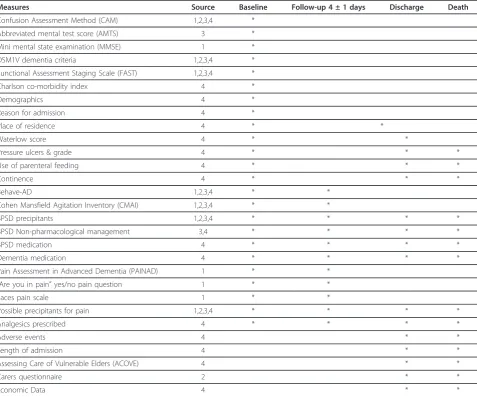
Dementia (PAINAD) observational behavioural pain scale [28] will be used to assess pain at rest and during a care task activity, followed by the self-reporting assess-ments, the question“Do you have pain at this moment"? and the Faces pain scale [29] (see Table 2). Pain and BPSD measures will be obtained independently by sepa-rate researchers.
Subsequent study assessments
Patients will be reviewed every 4 ( ± 1 days) and the assessment for BPSD and pain repeated. Notes will be
reviewed and discussions held with the patient’s key
nurse to identify any possible cause for pain, e.g. consti-pation or injury, adverse incidents, the context and pre-cipitants for any BPSD e.g. during personal care tasks and how staff dealt with any BPSD (for example with sedatives) or managed pain (i.e. analgesia prescribed).
We will calculate the inter-rater reliability for the pain and BPSD tools at regular intervals during the study.
On discharge from hospital
Data will be collected from notes and will include adverse events, measured using validated pre-defined criteria[30], falls, length of stay, whether antipsychotic or pain medication was prescribed on discharge, and whether there was a change of residence after discharge. The ACOVE (Assessing Care of Vulnerable Elders) tool will be used to assess quality of care. This examines 16 specific quality indicators in general hospital care and geriatric-prevalent conditions (e.g., dementia, delirium, pressure ulcers) and allows the calculation of adherence rates for care processes (screening, diagnosis and treat-ment) [31].
Table 2 Study Assessment Schedule
Measures Source Baseline Follow-up 4 ± 1 days Discharge Death
Confusion Assessment Method (CAM) 1,2,3,4 *
Abbreviated mental test score (AMTS) 3 *
Mini mental state examination (MMSE) 1 *
DSM1V dementia criteria 1,2,3,4 *
Functional Assessment Staging Scale (FAST) 1,2,3,4 *
Charlson co-morbidity index 4 *
Demographics 4 *
Reason for admission 4 *
Place of residence 4 * *
Waterlow score 4 * *
Pressure ulcers & grade 4 * * *
Use of parenteral feeding 4 * * *
Continence 4 * * *
Behave-AD 1,2,3,4 * *
Cohen Mansfield Agitation Inventory (CMAI) 1,2,3,4 * *
BPSD precipitants 1,2,3,4 * * * *
BPSD Non-pharmacological management 3,4 * * * *
BPSD medication 4 * * * *
Dementia medication 4 * * * *
Pain Assessment in Advanced Dementia (PAINAD) 1 * *
“Are you in pain”yes/no pain question 1 * *
Faces pain scale 1 * *
Possible precipitants for pain 1,2,3,4 * * * *
Analgesics prescribed 4 * * * *
Adverse events 4 * *
Length of admission 4 * *
Assessing Care of Vulnerable Elders (ACOVE) 4 * *
Carers questionnaire 2 * *
Economic Data 4 * *
Carer involvement
When the person with dementia has been discharged from hospital, we will send a brief questionnaire to the identified carer or next of kin asking questions about their experiences of visiting their relative whilst in hos-pital. We will clearly state that this will be anonymised and will not be directly fed back to the clinical team. We will not collect any personal data on the carers. The ethics committee agreed that we will not ask them to give signed consent; we will assume that if they have completed the questionnaire and return it to us, they have consented to participate.
General principles of data analysis
We shall use simple descriptive statistics for the demo-graphic features of the cohort using Chi squared, t-tests or non-parametric statistics if indicated. For prevalence estimates of BPSD we will conduct a sensitivity analysis, excluding patients whose BPSD appeared only in the context of delirium. For some analyses we will create overall“indicator” variables i.e. one to denote presence of any BPSD at any time during the admission. Out-comes will be divided into clinically relevant sub group-ings i.e. falls, use of medications (antipsychotics, sedatives) or prolonged length of stay above the median. We shall use logistic regression to analyse the relation-ship between our principle exposures, i.e. BPSD and outcomes such as falls, controlling for potential con-founders identified through clinical experience and bivariate analyses. Appropriate corrections will be made for multiple comparisons. For the analysis of the overall relationship between pain and BPSD we will use Gener-alised estimating equations (GEE) as we are using multi-ple observations on the same individual and analyses are clustered by participant. GEE is advantageous for use in the context of this project as it does not require a “balanced” design i.e. observations on all occasions on each individual.
Health economics
We shall compare the average cost of care per hospital admission for patients with and without BPSD. The ana-lysis of hospital costs will include all costs incurred dur-ing the admission, such as hotel costs, nursdur-ing, specialist consultations, investigations, surgery, and additional agency staff.
Unit costs will be obtained from the hospital finance department, and applied to estimates of resource use. These may vary in between the hospitals, which may result in different average costs per admission.
Staff training
We recruited two research associates, ensuring that they had experience of working with people with dementia and in the busy acute hospital environment. They were trained by ES and SS over a period of two weeks. This included in-depth discussion and practice on all of the
study assessment tools, data collection and the process of assessing mental capacity and obtaining consent for people who do not have capacity, approaching carers and the use of professional consultees according to the MCA (2005).
Pilot study
The pilot study took place over a period of two weeks and assessed the following: the identification and screen-ing of patients, the consent process (includscreen-ing proce-dures for informal carers and professional consultees to give assent), practice and use of selected assessment tools and the collection of data from varying sources. This demonstrated that the study recruitment schedule was both practical and feasible and that we were able to, on average, recruit eight participants per week (the number required to achieve an adequate sample size).
Discussion
When older people with dementia are admitted to hos-pital with acute medical illness, it can be distressing for them and their families. Symptoms such as pain may be poorly detected and managed and often BPSD such as agitation and aggression are exacerbated in this busy environment. In turn disturbed behaviour in people with dementia may be problematic for other patients and health professionals. BPSD and pain may result in, and be the result of, poor quality of care. There may also be economic costs to the hospital. The need to con-duct research in this field has recently been highlighted by a number of government reports and strategies [32]. However, conducting clinical studies of people with dementia in the acute hospital poses considerable chal-lenges to researchers and this may explain why we found little previous evidence of work in this setting [13].
Challenges related to capacity and consent
The development of this study gave us the opportunity to explore ways in which we could recruit patients with dementia who, by the nature of their illness, may not have the mental capacity to give informed consent. From the literature and personal communication with other researchers in the field we were aware that gaining ethical approval for similar studies has proved challen-ging. We therefore explored and negotiated various ways of obtaining consent (or proxy assent) within ethi-cal guidelines whilst balancing the need to be able to do research in this very difficult area. We followed advice from the Mental Capacity Act (2005) Code of Practice i. e. assessing the person with dementia using a structured approach for testing capacity, seeking assent from a carer when the person had lost capacity and using pro-fessional consultees when a carer could not be con-tacted. The pilot study demonstrated that this method of obtaining consent was both practical and feasible within the acute setting. Our methods may prove useful to other researchers embarking on similar projects in the future.
Challenges in supporting study staff
There is a high volume and rapid turnover of patients, and research workers screen numerous patients to iden-tify potential participants. This involves, the assessment of capacity, contacting carers or professional consultees to give assent within a short window of opportunity (72 hours of admission). The researchers may have a large number of follow-up assessments to complete on a daily basis.
In addition researchers may occasionally witness poor quality care, for example, when pain or BPSD are not managed appropriately by staff, and not be able to directly and immediately intervene. This is not an inter-vention study and there is the potential for a Hawthorne effect around study participants. However, procedures have been put in place for the reporting of perceived sub-standard clinical care to the study supervisors who then follow a standardised procedure to inform the appropriate senior clinical staff. Supportive regular clini-cal supervision is provided within the research team.
Importance of support from other agencies
The success of this study depends upon support from senior staff in NHS trusts. This work may be perceived as potentially critical to the clinical teams involved, but they were willing for us to research the clinical care delivered in their organisations. The Alzheimer’s Society Quality Research Monitors (mainly former family carers of people with dementia) are provided by our funding organisation to help ensure that our study gains a
perspective from people with dementia and their carers. Their advice has been vital in developing our proxy assent procedures and they continue to actively partici-pate in our study steering group meetings.
Final conclusions
We have overcome numerous challenges in the develop-ment of this study, particularly in regard to consent pro-cedures and the large number of potential study participants who need to be screened. The study will help to fill in many of the gaps we have identified in the current literature regarding the effects of BPSD and pain during acute hospital admission on older people with dementia. Improved detection and treatment of pain with adequate analgesia may be an effective strat-egy for treating BPSD, without necessarily resorting to antipsychotic medications.
A better understanding of these symptoms, their impact and costs will drive more effective treatment strategies and investment in services, to improve the standard of hospital care and the quality of life for peo-ple with dementia.
Author information
Sharon Scott MSc, RGN, Senior Research Nurse
Louise Jones FRCP Head of Marie Curie Palliative Care Research Unit
Martin R Blanchard MD MRCPsych Senior Lecturer in Old Age Psychiatry
Elizabeth L Sampson MD MRCPsych, Clinical Senior Lecturer
Acknowledgements
This project is funded jointly by Alzheimer’s Society and the BUPA Foundation (Grant reference number: 131). We would like to thank our Alzheimer’s Society Quality Research Monitors Barbara Di Vita, Sylvia Wallace and Lynn Whittaker, the staff from Health Services for Older People at the Royal Free NHS Trust and the North Middlesex University Trust and Kathryn Lord and Nicola White (Research Assistants).
Author details
1Marie Curie Palliative Care Research Unit, UCL Mental Health Sciences Unit University College Medical School, 1st Floor, Charles Bell House, 67-73 Riding House Street, London, W1W 7EJ, UK.2Barnet Enfield and Haringey Mental Health Trust, St Ann’s Hospital, St Ann’s Road, London, N15 3TF, UK.3UCL Mental Health Sciences Unit, University College Medical School, 1st Floor, Charles Bell House, 67-73 Riding House Street, London, W1W 7EJ, UK.
Authors’contributions
ELS, LJ and MB devised the project and obtained funding. ELS, SS, LJ and MB wrote the study protocol. SS managed the piloting of the study and with LJ and ELS refined the study processes. All authors read and approved the final manuscript
Competing interests
The authors declare that they have no competing interests.
References
1. Sampson EL, Blanchard MR, Jones L, Tookman A, King M:Dementia in the acute hospital: prospective cohort study of prevalence and mortality.Br J Psychiatry2009,195:61-66.
2. Lyketsos CG, Sheppard JM, Rabins PV:Dementia in elderly persons in a general hospital.Am J Psychiatry2000,157:704-707.
3. Fulop G, Strain JJ, Fahs MC, Schmeidler J, Snyder S:A prospective study of the impact of psychiatric comorbidity on length of hospital stays of elderly medical-surgical inpatients.Psychosomatics1998,39:273-280. 4. Fields SD, MacKenzie CR, Charlson ME, Sax FL:Cognitive impairment. Can
it predict the course of hospitalized patients?J Am Geriatr Soc1986, 34:579-585.
5. Erkinjuntti T, Autio L, Wikstrom J:Dementia in medical wards.J Clin Epidemiol1988,41:123-126.
6. Zekry D, Herrmann FR, Grandjean R, Meynet MP, Michel JP, Gold G,et al: Demented versus non-demented very old inpatients: the same comorbidities but poorer functional and nutritional status.Age Ageing 2008,37:83-89.
7. Sampson EL, Gould V, Lee D, Blanchard MR:Differences in care received by patients with and without dementia who died during acute hospital admission: a retrospective case note study.Age Ageing2006,35:187-189. 8. Bourne J:Improving services and support for people with dementia.
National Audit Office; 2007, Ref Type: Report.
9. Alzheimer’s Society:Counting the Cost: Caring for people with dementia on hospital wards. Lakkey, L.London, Alzheimer’s Society; 2009, Ref Type: Report.
10. Lyketsos CG, Steinberg M, Tschanz JT, Norton MC, Steffens DC, Breitner JC: Mental and behavioral disturbances in dementia: findings from the Cache County Study on Memory in Aging.Am J Psychiatry2000, 157:708-714.
11. Douglas IJ, Smeeth L:Exposure to antipsychotics and risk of stroke: self controlled case series study.BMJ2008,337:a1227.
12. Thuné-Boyle ICV, Sampson EL, Jones L, King M, Lee D, Blanchard MR: Challenges to improving end of life care of people with advanced dementia in the UK.Dementia2010,9:285-298.
13. Mukadam N, Sampson EL:A systematic review of the prevalence, associations and outcomes of dementia in older general hospital inpatients.Int Psychogeriatr2010, 1-12.
14. Horgas AL, Tsai PF:Analgesic drug prescription and use in cognitively impaired nursing home residents.Nurs Res1998,47:235-242.
15. Sengstaken EA, King SA:The problems of pain and its detection among geriatric nursing home residents.J Am Geriatr Soc1993,41:541-544. 16. Scherder E, Herr K, Pickering G, Gibson S, Benedetti F, Lautenbacher S:Pain
in dementia.Pain2009,145:276-278.
17. Ryden MB, Feldt KS, Oh HL, Brand K, Warne M, Weber E,et al:Relationships between aggressive behavior in cognitively impaired nursing home residents and use of restraints, psychoactive drugs, and secured units.
Arch Psychiatr Nurs1999,13:170-178.
18. Inouye SK:Delirium in hospitalized elderly patients: recognition, evaluation, and management.Conn Med1993,57:309-315.
19. Lloyd-Williams M, Payne S:Can multidisciplinary guidelines improve the palliation of symptoms in the terminal phase of dementia?International Journal of Palliative Nursing2002,8:370-375.
20. Kovach CR, Noonan PE, Schlidt AM, Wells T:A model of consequences of need-driven, dementia-compromised behavior.J Nurs Scholarsh2005, 37:134-140.
21. Shega JW, Hougham GW, Stocking CB, Cox-Hayley D, Sachs GA: Management of noncancer pain in community-dwelling persons with dementia.J Am Geriatr Soc2006,54:1892-1897.
22. Shega JW, Hougham GW, Stocking CB, Cox-Hayley D, Sachs GA:Factors associated with self- and caregiver report of pain among community-dwelling persons with dementia.J Palliat Med2005,8:567-575. 23. Hodkinson HM:Evaluation of a mental test score for assessment of
mental impairment in the elderly.Age Ageing1972,1:233-238.
24. Inouye SK, van Dyck CH, Alessi CA, Balkin S, Siegal AP, Horwitz RI:Clarifying confusion: the confusion assessment method. A new method for detection of delirium.Ann Intern Med1990,113:941-948.
25. Reisberg B:Functional assessment staging (FAST).Psychopharmacol Bull 1988,24:653-659.
26. Reisberg B, Borenstein J, Salob SP, Ferris SH, Franssen E, Georgotas A: Behavioral symptoms in Alzheimer’s disease: phenomenology and treatment.J Clin Psychiatry1987,48(Suppl):9-15.
27. Cohen-Mansfield J, Marx MS, Rosenthal AS:A description of agitation in a nursing home.J Gerontol1989,44:M77-M84.
28. Warden V, Hurley AC, Volicer L:Development and psychometric evaluation of the Pain Assessment in Advanced Dementia (PAINAD) scale.J Am Med Dir Assoc2003,4:9-15.
29. Pautex S, Herrmann F, Le LP, Fabjan M, Michel JP, Gold G:Feasibility and reliability of four pain self-assessment scales and correlation with an observational rating scale in hospitalized elderly demented patients.J Gerontol A Biol Sci Med Sci2005,60:524-529.
30. Vincent C, Neale G, Woloshynowych M:Adverse events in British hospitals: preliminary retrospective record review.BMJ2001,322:517-519. 31. Arora VM, Johnson M, Olson J, Podrazik PM, Levine S, Dubeau CE,et al:
Using assessing care of vulnerable elders quality indicators to measure quality of hospital care for vulnerable elders.J Am Geriatr Soc2007, 55:1705-1711.
32. Banerjee S, Owen J:Living well with dementia: A National Dementia Strategy London: Department of Health; 2009.
33. Folstein MF, Folstein SE, McHugh PR:“Mini-mental state”. A practical method for grading the cognitive state of patients for the clinician.J Psychiatr Res1975,12:189-198.
34. Charlson ME:Studies of prognosis: progress and pitfalls.J Gen Intern Med 1987,2:359-361.
Pre-publication history
The pre-publication history for this paper can be accessed here: http://www.biomedcentral.com/1471-2318/11/61/prepub
doi:10.1186/1471-2318-11-61
Cite this article as:Scottet al.:Study Protocol: The Behaviour and Pain in Dementia Study (BePAID).BMC Geriatrics201111:61.
Submit your next manuscript to BioMed Central and take full advantage of:
• Convenient online submission
• Thorough peer review
• No space constraints or color figure charges
• Immediate publication on acceptance
• Inclusion in PubMed, CAS, Scopus and Google Scholar
• Research which is freely available for redistribution