Available Online atwww.ijcsmc.com
International Journal of Computer Science and Mobile Computing
A Monthly Journal of Computer Science and Information Technology
ISSN 2320–088X
IMPACT FACTOR: 6.199
IJCSMC, Vol. 8, Issue. 7, July 2019, pg.88 – 97
PERFORMANCE COMPARISION OF DATA
CLASSIFICATION ALGORITHM FOR
ANALYSIS LUNG CANCER DATASETS
Dr. M.Mayilvaganan
1; N.Thamaraikannan
2Associate Professor, Department of Computer Science, PSG College of Arts and Science, Coimbatore, India1 Email Id – [email protected]
Research Scholar, Department of Computer Science, PSG College of Arts and Science, Coimbatore, India2 Email Id – [email protected]
ABSTRACT: Lung cancer is the major cause of cancer deaths in both men and women in world wide. Lung
malignancy begins when cells of the lung begin unusual cells grow into the lungs. Various types of approaches
have been used for lung cancer diagnosis. There are two kinds of lung cancer that is small cell lung cancer
(SCLC) and non-small cell lung cancer (NSCLC).People who smoke have greatest risk of carcinoma. The risk
of carcinoma will increase with the length of your time and variety of cigarettes they need preserved. To gather the information and to measure the data’s based on smokers, Nonsmokers in keeping with their age and history
of habit. In this research works mainly specialized in lung cancer data and it uses machine learning techniques
Naive bayes and decision tree. The main objective of this technique used for classification and prediction and
mainly focused on performance comparison of machine learning algorithm with respective run time execution of
each algorithm. The naïve bayes and decision tree algorithm used to analysis for performance comparison
accuracy of each algorithm. We were using the Rapid Miner software to predict the accuracy of Classification
algorithms. In this comparison we use Lift Chart and ROC curve in which it displays the accurate value of
INTRODUCTION
Data mining refers to extracting information from vast volume of data.its commonly used in
proflie practices such as marketing, survalience, frauddection, customer retentation, production
control, science exploration.
Data mining have been drawing in a lot of consideration in the data business and in the
public eye in general. Because of accessibility of wide information an unavoidable requirement
for preparing those information into learning. Those data or information picked up can be
utilized for applications ranging from market examination, misrepresentation discovery, and
client maintenance, to create control and science investigation.
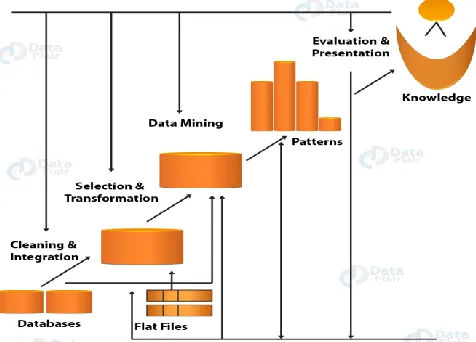
DATA MINING IN KDD
Data Mining, additionally famously known as Knowledge Discovery in Databases
(KDD), alludes to the nontrivial extraction of verifiable, beforehand obscure and possibly
valuable data from information in databases. While information mining and learning revelation
in databases (or KDD) are as often as possible regarded as equivalent words, information mining
is entirely of the learning disclosure process.
Data mining is only one of the many steps involved in knowledge discovery in
databases.the various steps in the knowledge discovery process include data selection,data
cleaning and preprocessing,data transformation and reduction,data mining algorithm selection
and finally the post processing and the interpretation of the discovery knowledge.The KDD
process is highly iterative and interactive.
1.Data Cleaning
In this phase as cleaning data and remove noise data and unrelated data.
2.Data Integration
In this phase multiple data source may be integrated in common source.
3.Data Selection
In this phase,the data applicable to the analysis is decided on recover from the data.
4.Data Transformation
In this phase transforned in order to be acceptable task of data.
5.Data Mining
In this phase extraction of patterns from data.
6.Pattern Evalution
In this phase strictly interesting pattern representing information are identified based on
given measured.
7. Knowledge Representation
In this final phase in which the find the information is visually represented to the user.
This requirment step uses visualization techniques to understand and explain the data mining
results.
LUNG CANCER
Lung disease is a growth that begins in the lungs. Lung disease is the most widely
recognized reason for malignancy demise around the world. The event of lung growth has
expanded quickly and turned into the most widely recognized malignancy in men in many
nations. Smoking is by a wide margin the most critical preventable reason for disease on the
planet. In the event that the first lung disease has spread, a man may feel side effects in different
lungs in Tumor, lymph hubs, bones, cerebrum, liver. The frequency of lung tumor is
unequivocally connected with cigarette smoking, with around 90% of lung growths emerging
because of tobacco utilize. The danger of lung disease increments with the quantity of cigarettes
smoked after some time. The danger of lung disease increments with the quantity of cigarettes
smoked after some time.
There are two type of lung cancer
Small Cell Lung Cancer(SCLC)
Its construct the 15-20% of lung cancer.SCLC tends to growth in the middle of lungs and
regularly spread more immediate than NSCLC
Non Small Cell Lung Cancer(NSCLC)
Its construct 80% of lung cancer.NSCLC classifief by
o Adeno carcinoma
o Squamous cell carcinoma
o Large cell carcinoma
CAUSE OF LUNG CANCER
o Smoking
o Passive smoking
o Radon
o Asbestos
o Air pollution
SYMPTOMOS
o Cough
o Breathlessness
o Chest pain
o Wheezing
o Fatigue and weakness
o Clubbing of the fingernails
o Shortness of breath
o Loss of appetite
SCOPE OF THE RESEARCH
The scope of the research is to accuracy of data. This system compares the classification
of naive bayes and decision tree machine algorithm to find which is better. We classify the data
based on accuracy, Precision, Accuracy and Recall. We finally predict the data and remove the
sensitive data.
NAÏVE BAYES ALGORITHM
The Bayesian Classification speaks to an administered learning strategy and in addition a
measurable technique for characterization. Accept a fundamental probabilistic model and it
enables us to catch vulnerability about the model principally by deciding probabilities of the
results. It can take care of analytic and prescient issues. This Arrangement is named after
Thomas Bayes (1702-1761), who proposed the Bayes Hypothesis.
Bayesian arrangement gives commonsense learning calculations and earlier information
and watched information can be consolidated. Bayesian Classification gives a valuable viewpoint
to comprehension and assessing many learning calculations. It figures express probabilities for
theory and it is hearty to commotion in information.
The overall precision for a classifier for a given dataset, average of precision of both
classes is calculated. Bayes hypothesis gives a method for ascertaining the back likelihood, P
(c|x), from P(c), P(x), and P (x|c). Credulous Bayes classifier thinks about that the impact of the
estimation of an indicator (x) on a given class (c) is free of the estimations of different indicators.
Problem definition
• A training set X, where each training instance x is represented as an n-dimensional attribute
vector: (x1, x2…xn)
P(c|x)
=
P(c|X) = P(x1|c) * P(x2|c) * ………. *P(xn|c)*P(c)
P(c|x) is the posterior probability of class given predictor od class.
P(c) is called the prior probability of class
P(x|c) is the likelihood which is the probability of predictor of given class
P(x) is the prior probability of predictor of class.
Fig 1.2 PERFORMANCE OF NAÏVE BAYES ALGORITHM
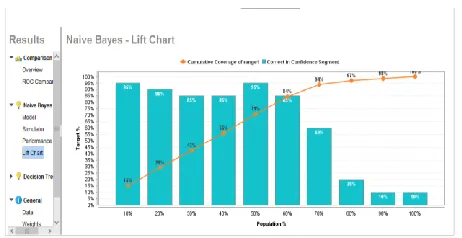
Fig 1.3 LIFE CHART AND ROC CURVE OF NAÏVE BAYES ALGORITHM
DECISION TREE
The decision tree is a work of art and common model of learning. It is firmly identified
with the essential software engineering thought of "divide and prevail." Although decision trees
can be used too many learning problems, we will start with the simplest case: binary
Classification tree method use to classify data. the method gas establish and use to various
environment medical, market research,statisticalanalysis,masketking and customer relationship.
The various types of application use classification tools in huge data’s. The major use of decision
tree to uncover the formation that contained into data and arrange the data.
Decision tree can hold both nominal and numeric input values.
Decision tree are read to non-parametric method.
Decision tree are fit for taking care of datasets that may have missing qualities.
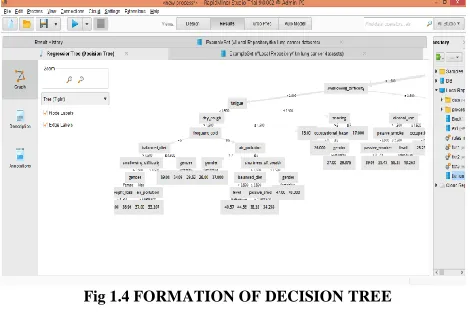
Decision tree are efficient to holding datasets that have missing valuesFig 1.4 FORMATION OF DECISION TREE
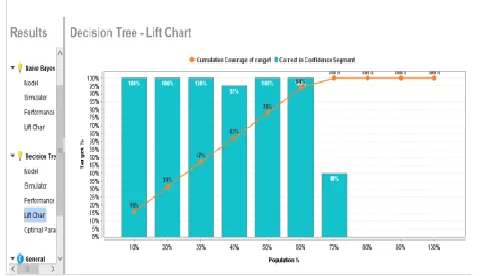
Fig 1.6 LIFE CHART AND ROC CURVE OF NAÏVE BAYES ALGORITHM
DATA FOR RESEARCH
RESULTS AND DISCUSSION
The comparison of Machine Learning algorithm Naïve Bayes and Decision Tree
algorithm using Rapid Miner studio. We have classifier analyzed large volume of data. The
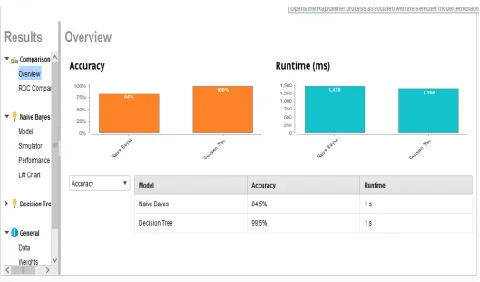
Naïve Bayes classifiers provides the highest accuracy of 84.5% per 1 Second and Decision tree
classifier provides 99.5% per 1 Second accuracy provided. In this research work, we have found
PERFROMANCE COMPARISON FOR NAÏVE BAYES
Fig 1.7 ALGORITHM AND DECISION TREE ALGORITHM
CONCLUSION
In this research work was comparison between two various types of machine Learning
classification algorithms based on the Lung cancer dataset. This comparison on classification
algorithm helps to detect the accuracy of data. We used the Lift chart and ROC Curve to display
the output for this comparison technique. So we can easily understand the results on lung cancer
data. The performance of algorithm on this dataset have been evaluated and classified based on
the Bayes Classifier. Therefore the Decision Tree algorithms performance is high and results the
more accurate data set which is compared to decision tree. We came to a conclusion that
Decision Tree algorithm is the best.
FUTURE WORK
This research work mainly deals with machine learning algorithm for early find of Lung
Cancer. These techniques are useful for the detect of lung cancer then use to new classification
algorithms which one can provide better solution. Further this research can be enhancing using
big data, IoT, Deep Learning methods to increase the delicate and specificity and to provide
BIBLIOGRAPHY
[1] Jiawei Han, MichelineKamber “Data Mining Concepts and Techniques” in proceeding of second edition Morgan Kaufmann Publisher an imprint of Elsevier 2006.
[2] AlkaGangrade, Ravindra Patel “ SMC Protocol for Naïve Bayes classification over Grid Partitioned Data using Multiple UTPs” International Journal of Computer Applications(0975 – 8887) Volume 64- No 6. February 2013.
[3] Li Liu, Murat Kantarcioglu and BhavaniThurasingham”A Novel Privacy Preserving Decision Tree Algorithm” Technical Report October 2006.
[4] Ashmeet Singh, R Sathyaraj “A Comparison Between Classification Algorithms on Different Datasets Methodologies using Rapid miner” International Journal of Advanced Research in Computer and Communication Engineering Vol. 5, Issue 5, May 2016.
[5] JosipMesarić, Dario Šebalj”Decision trees for predicting the academic success of Students” Croatian Operational Research Review CRORR 7(2016), 367–388 December 30, 2016.
[6] ShahrukhTeli, PrashastiKanikar "A Survey on Decision Tree Based Approaches in Data Mining", International Journal of Advanced Research in Computer Science and Software Engineering, Volume 5, Issue 4, 2015.
[7] SunpreetKaur, Sonikaa Jindal,” A Surveyon Machine Learning Algorithms”, International Journal of Innovative Research in Advanced Engineering (IJIRAE),ISSN: 2349-2763,November 2016.
[8] KajareeDas,Rabi Narayan Behera,” A Survey on Machine Learning: Concept, Algorithms and Applications”, International Journal of Innovative Research in Computer and Communication Engineering,ISSN:2320-9801,February 2017.
[9] FatmaTaher, NaoufelWerghi and Hussain Al-Ahmad (2012), “Bayesian Classification and Artificial Neural Network Methods for Lung Cancer Early Diagnosis”, IEEE.
[10] Thangaraju P, Karthikeyan T, Barkavi G, Mining Lung Cancer Data for Smokers and Non-Smokers by Using Data Mining Techniques, International Journal of Advanced Research in Computer and Communication Engineering Vol. 3, Issue 7, July 2014.
[11] Krishnaiah V, Narsimha G, Subhash Chandra N , Diagnosis of Lung Cancer Prediction System Using Data Mining Classification Techniques, International Journal of Computer Science and Information Technologies, Vol. 4 (1) , 2013, 39 – 45.
[12] ParagDeoskar, Dr. Divakar Singh, Dr. Anju Singh, Mining Lung Cancer Data And Other Diseases Data using Data Mining Techniques, A Survey, Volume 4, Issue 2, March – April (2013).
[13] Sowmiya T, Gopi M, Thomas Robinson, Optimization of Lung Cancer using Modern Data Mining Techniques, International Journal of Engine Engineering Research Volume No.3, Issue No.5