GRANT SCHEMES GUIDANCE FOR SLOVAK UNIVERSITIES Juraj Fabuš, Iveta Kremeňová, Jozef Fabuš
Department of Communications, Faculty of Operation and Economics of Transport and Communications, University of Zilina, 010 26 Zilina, Slovak Republic
Abstract
This work deals with the possibilities of financing the universities projects with a focus on innovation of the process of finding sources of financing. There are characterized different funding opportunities for universities projects, both domestic and foreign. The emphasis is primary put on identifying specific focus of each organization providing grants. It is followed by an analysis that deals with the identification of the use of different sources of financing projects within a particular university. Within the analysis the results of the university were compared to other universities in the Slovak Republic. On the basis of the findings was designed electronic guidance of grant schemes to assist project participants in finding sources of financing.
Key words: projects financing, public universities grants, research grants, state budget, VEGA, KEGA, ESF
1. INTRODUCTION
Educated nation is one of the key aspects of the functioning of our modern society. The basic condition for creating and maintaining a high educational level is the existence of educational system, especially higher education, which is developed and capable of providing quality education. With university development is closely related the financing and funding not only basic activities but also the funding of scientific, research and other work taking place within higher education projects.
The aim of this research was to create an electronic grant schemes guidance, whose task will be to assist project participants in finding sources for financing their activities.
2. THEORETICAL BASIS
For a proper understanding of the issue is necessary acquaintance and proper understanding of the terms that are related to the topic.
Project
There is mentioned the term „project„ in the name of the work which is presented as an object whose financing need to be ensure. The term „project„ refers also to the compact program sequence of actions, which subjects to certain criteria, based on its characteristics. The main characteristics of the project are: [1]
- the original sequence of processes,
- the limitation, defined beginning and end,
- its own budget using resources,
- a measurable outcome,
- the sequence of given steps going in phases.
Among other important features of the project belong robustness (including a number of specific elements and processes), coherence (requires the existence of links between sub-activities), limitation
of resources (personnel and material) and diversity (coordination is essential for workers of different orientation). By the term project cannot be described regularly recurring process. [2]
The term project is very closely related to the term project management. It is a form of preparation and implementation of the project, which comes from the main tasks of management (planning, organization, management and review).
From the fundamental characteristics results that each project has its own life cycle, which generally defines specific tasks to be carried out in different stages and at the same time determines the staff representation at these stages.
The environment of university education
Under the Act universities in Slovakia are defined as legal entities and institutions dealing with the highest educational, scientific and artistic activities. Their mission is to develop the personality of
an individual its knowledge and intelligence, awakening of creative potential and promote individual thinking in the spirit of harmony and common good. Fulfilling of this
mission provides on the one hand individual growth of the person receiving university education, on the other hand contributes to the educational, cultural and scientific development of society. [3]
There are four types of universities in Slovakia:
- the public universities,
- the state universities,
- the private universities,
- the foreign universities.
Financing of public universities is carried out in several ways. Crucially is the activity of the public universities provided through the state budget through the Ministry of Education, Science, Research and Sport SR (MESRaS SR), or other ministries of SR. Funding takes the form of dotation which is provided under a contract between the parties. Other possible sources of funding of public universities are:
- tuition fees,
- the related fees with study,
- incomes from tangible assets of university,
- incomes from intangible assets of university,
- incomes from universities funds,
- other incomes of the primary activities of universities.
Public university may also conduct the business activities. The received funds are used for filling the tasks for which it was established. [3]
3. FINANCING OF PROJECTS IN THE AREA OF UNIVERSITY EDUCATION
One of the basic conditions to realize a quality project is to secure its financing. For the projects financing in an environment of university education is possible to use many agencies and organizations whose mission is subsidizing such projects.
The main organization which covers universities of the MESRaS SR. To assist universities in implementing the projects there have been established within the ministry the agencies whose task is to collect the projects under the thematic classification and under the evaluation of projects the selection of specific projects and providing subsidies.
According to the examined issue is necessary to mention three sections of MESRS SR, which are closely related with universities on the one hand, on the other hand with the financing of their activities. The mentioned sections are:
- the section of universities,
- the section of funding and budget,
- the section of EU structural funds.
a. VEGA serves as an advisory body to the Minister of Education and a subsidiary body of Academy of Sciences to identify research projects
b. The focus of KEGA agency is mainly to support projects in development field in education and to finance projects in the creative arts.
c. APVV agency's mission is to promote research and development by providing financial grants to solve specific projects in research and development and projects oriented in infrastructure development for future research and development. [4]
d. According to delegation of tasks by ministry of education is ASFEU an directional element for operational programs - Education and Research and development. [5]
a. OP Education is a reference document for the period 2007 to 2013. On its basis will be available the support to human capital development with using the European Social Fund grants and subsidies of the Slovak Republic.
b. OP Research and development represents a strategy for the Slovak Republic in order to create balanced development of research in Slovakia regions.
e. GAAV projects come from the initial results of research carried out for example by agency VEGA. The evaluation criterion serves the benefit for commercial practice, which is the output from primary project. [6]
f. International scientific-technical cooperation is an intra-departmental system for financial assistance of the projects in the field of international scientific and technological cooperation. [7]
One of the other options of financing university education projects is the use of grant agencies existing within specific universities. These agencies provide funds for basic and applied scientific research projects by tenders which run with limitation to a particular university, where the grant agency operates. [8]
The European Union represents a foreign source, which helps to finance the projects. Due to its economic stability and cohesion it is the largest international organization through which it is possible to obtain grant funds. There is:
a. European Social Fund. Represents the oldest existing structural funds.
b. The main tool of the European Union to subsidize technic and science are the framework programs for research, technological development and demonstration activities. 7th framework program consists of four specific programs, namely Cooperation, Ideas, People and Capacities. [9]
NATO - North Atlantic Treaty Organization was established as an organization bringing together the needs of its member states in security matters. Even though it is not the primary mission of the alliance, NATO is involved in various projects undertaken by staff from member and partner countries. Through the grant program, Science for Peace are supported applied research projects and development projects. The condition of obtaining a grant project is focusing on safety.
The International Visegrad Fund is an organization created by the governments of the Visegrad Group (V-4) - Slovak Republic, Czech Republic, Poland and Hungary. The purpose of the Fund is to promote cooperation among the countries of the group through scientific, educational and cultural projects. The grant may also apply for individual artists and students. [10]
Norwegian Financial Mechanism (EEA) is a support system, whose role is to help to get to minimize the social and economic disparities in the European Economic Area by providing grants for development and investment projects.
Another option for funding university projects is the use of Swiss financial mechanism. It is a mechanism to provide financial support for the new European Union member states. Financial contributions are compensations for the benefit of Switzerland's approach to the extended European Union market. [11]
Slovak Academic Association for International Cooperation, known under the name SAAIC is an association of persons and entities, whose mission is to coordinate and assist in implementation of international programs of cooperation between the Slovak universities and other organizations in the educational programs. Among these programs belong for example the student mobility support program Erasmus, or by now completed program Leonardo da Vinci, which became part of the Lifelong Learning Programme. [12]
Besides the aforementioned, there are other financing options that can use project leaders. Universities can apply for grants in a variety of domestic and foreign organizations, public and private. Selection of a particular organization depends on the specific focus of school or part of school applying for grants.
Financing of science and research from public sources, with the exception of budgetary chapter of the ministry of education in 2011, was carried out within the following sectors:
- the Ministry of Transport, Construction and Regional Development,
- the Ministry of Agriculture and Rural Development,
- the Ministry of Labour, Social Affairs and Family,
- the Ministry of Health,
- the Ministry of Environment,
- the Nuclear Regulatory Authority of the Slovak Republic,
- the Institute for Standards, Metrology and Testing,
- the Statistical Office of the Slovak Republic,
- the Slovak Academy of Sciences.
4. ALEXANDER DUBCEK UNIVERSITY IN TRENCIN
The next part of the work deals with the analysis, which will serve as the basis to fulfil the given aim. We have chosen Alexander Dubcek University in Trencin as an object on which the analysis will be performed.
In terms of project solutions Alexander Dubcek University in Trencin can be divided into the following sections:
- The Faculty of Special Technology.
- The Faculty of Mechatronics.
- The Faculty of Social and Economic Relations.
- The Faculty of Industrial Technologies.
- The Faculty of Health.
- The Institute of science and humanities.
- University departments.
We will examine the amount of funds that departments managed to get and also the source from which the funds were granted. The analyses were performed for the years 2009, 2010 and 2011. It is not possible to extend the analysis for 2012 because currently the ministry of education does not have materials processed that are necessary for the analysis. After the analysis follow the evaluation of the results by comparing the success of individual departments and by comparing the university as a whole with other universities in the Slovak Republic.
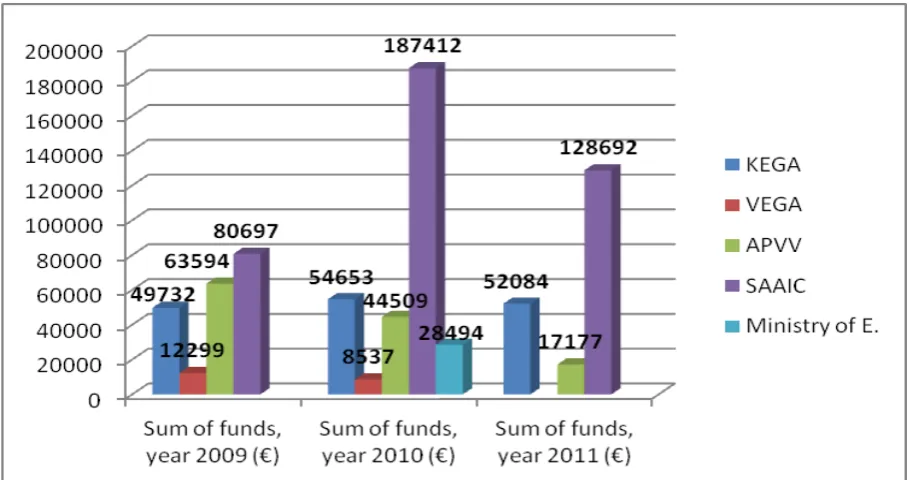
There are solved only KEGA, VEGA and APVV projects at the individual faculties. The institute does not have any projects. So the most successful institutions are university departments. Within the university departments are solved mainly projects which have whole university impact, particularly student mobility programs, projects falling under the Lifelong Learning University of the Third Age, or projects related to the study programs of the university. VILA centre is aimed for solving research and development projects related to the glass materials. In Figure 1 there are the specific amounts allocated to individual organizations.
Figure 1. Sources of funding projects utilized university workplaces from 2009 to 2011 (Source: own processing)
Within the Alexander Dubcek University we can evaluate the success of obtaining grants through the amount of funds allocated to individual faculties of the university in the years falling into the analysed period. For the reporting period from 2009 to 2011 received Alexander Dubcek University a total of 887 710 EUR. There are included all received grants regardless of whether it was a grant domestic, foreign or other foreign research grant.
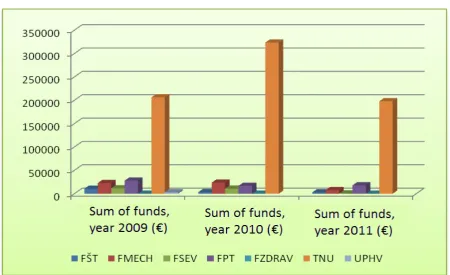
The chart below (Fig. 2) shows the results of financing of certain parts of the university dealing with the various projects in the years 2009, 2010 and 2011. There are individual faculties displayed in the chart, Institute of Science and Humanities and whole university departments identified by the abbreviation 'TNU'.
Figure 2. Comparison of the success of fundraising by departments of Alexander Dubcek University in Trencin for the monitored period from the perspective of years (Source: own processing)
Foreign research grants (FRG) and other foreign grants (OFG) were during the years 2009 to 2011 provided to the following organizations (Fig. 3).
Figure 3. The usage of grant agencies for financing „FRG“ and „OFG“ by Alexander Dubcek University in Trencin in the monitored period (Source: own processing)
5. COMPARISON OF THE GIVEN GRANTS OF ALEXANDER DUBCEK UNIVERSITY IN TRENCIN TO OTHER UNIVERSITIES IN SR
Universities are trying to obtain grants to the extent possible. In the following section there is a comparison of the received grants for Slovak universities projects. For an objective comparison is necessary to identify the size of a particular university. While there are several criteria that can be taken into account when comparing:
- comparison of the number of students
- define the number of employees, namely the number of teachers and number of researchers.
Data of universities are listed in Figure 4. The data shown in Figure 4 are from the year 2011 as comprehensive information from the 2012 is not currently available
Figure 4. The number of university teachers and researchers at various universities in 2011. (Source: Own processing by: <http://www.minedu.sk/index.php?lang=sk&rootId=529>)
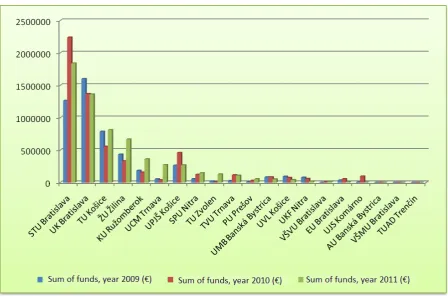
The rate of utilization of domestic grants for the years 2009 to 2011 can be expressed in the following graph (Fig. 5).
Figure 5. Home grants awarded to universities from 2009 to 2011. (Source: Own processing)
The rate of utilization of foreign research grants for the years 2009 to 2011 is captured in Figure 6.
Figure 6. External research grants awarded to universities from 2009 to 2011. (Source: Own processing)
The graph shows that the majority of Slovak universities use external grants for research only minimally. The highest activity can be observed as in the previous comparison, at Comenius University in Bratislava and Slovak University of Technology in Bratislava. The extent of use of other foreign grants in the years 2009 to 2011 can be expressed in the following chart.
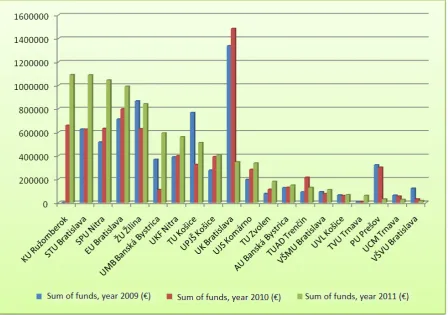
Figure 7. Other external grants awarded to universities from 2009 to 2011. (Source: Own processing)
The graph in Figure 7 shows that in the area of acquisition of foreign grants, which are intended for other than research activities is the success of Slovak universities more balanced than in previous cases.
6. ELECTRONIC GRANT SCHEMES GUIDANCE
During the analysis has been identified one factor which negatively affect the process of obtaining grant funds, it is opacity of grant schemes. Under the term opacity we understand the fact that information about individual funding opportunities have to be searched at the various sources, problematic is also to obtain information about projects running in the past and about the amounts allocated to these projects, also searching for actual calls can be difficult to that extent that may discourage potential participants. To eliminate this lack was in the next part of this research proposed electronic grant schemes guidance. Design of the guidance consists in putting theoretical characteristics describing potential uses in practice and in construction of functional application that represents a model of the electronic guidance, which can demonstrate the usefulness of its basic functions.
We have decided to propose electronic grant schemes guidance as an application, which will take the form of a website. The application is written in HTML code and is usable without further adjustments
both locally by placing it in a particular computer, but also by means of computer networks (the Internet, local area networks, etc.) upon its position on the server.
The main menu is located on the left of the web page and is the most important part of the application, through which you can easily access the information on the web page. Items that are selected via menu appear in the middle of the page, which when launched displays the contents of the index. Division of the menu is as follows:
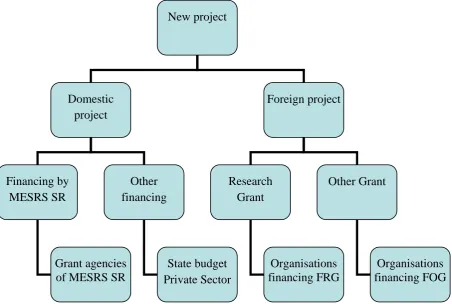
- project funding - the user can through the few steps find a suitable source of funding for his project ( the sequence of steps in finding financing of the project is displayed through the flowchart in Figure 8),
- an overview of funding opportunities includes various financing options, which were described in the previous sections of the work, but also includes the characteristics of individual organizations,
- the contacts contain a list of the most important organizations that are associated with university projects , while allowing easy access to the websites of these organizations.
Figure 8. Sequence of steps in searching of funding (Source: Author)
As mentioned before, the electronic guidance has been created solely for the purpose of research and its use in practice is not possible in its current form. For practical use it would be necessary to make some adjustments.
7. CLOSURE/SUMMARY
Development of research activities is a major presumption of the success of a quality university education. Based on the evaluation results of the analysis we have found that Alexander Dubcek University receive poor results in handling projects, specifically in raising funds for these projects.
New project
Domestic
project
Foreign project
Financing by
MESRS SR
Other
financing
Research
Grant
Other Grant
Grant agencies
of MESRS SR
State budget
Private Sector
Organisations
financing FRG
Organisations
financing FOG
Despite the fact that Dubcek University cooperates with the private sector, there were no projects implemented for the analysed period that would be funded by the private sector.
To finance a university education projects is possible to use a number of organizations involved in this activity, whether primary or within their secondary activities. The largest number of organizations is hosted by the Ministry of Education, Science, Research and Sport of the Slovak Republic, which manages grants in science, research, cultural and educational activities. It participates also in the implementation of structural funds. Except national there exists also foreign systems of helps to universities, it is primarily the European Union, North Atlantic Treaty Organization and European Union countries providing assistance within its own financial arrangements. Identification of the specific organization, its focus and requirements is crucial in the implementation of the projects.
There is no doubt that university science and research is very important part of the education therefore the solution to the current situation is required. The electronic guidance is only one option that would help to improve the quality of the field of education. Finally in the closure of this work we express the belief that activities to promote research and development in general and within universities will be carried out continuously and that these activities ultimately bring the benefits to the whole society.
ACKNOWLEDGEMENTS
The present work is supported by Ministry of Education, Science, Research and Sport of the Slovak republic and grant KEGA-052ŽU-4/2012, KEGA-070ŽU-4/2011 and VEGA 1/0199/11.
REFERENCES
1. ŠTOFKOVÁ, J. a kol. Manažment podniku. Žilina : EDIS, 2007. 365 s. ISBN 978-8070-713-2.
2. KREMEŇOVÁ, I. a kol. Projektový manažment. Žilina : EDIS, 2009. 442 s. ISBN 978-80-554-0148-5.
3. Law no. 131/2002 of 21 February 2002 about university education.
4. Statute of the Agency to support research and development. Available at: <http://www.apvv.sk/dokumenty/pravne-predpisy>.
5. Agency for EU Structural Funds - Tasks of agency.
Available at: <http http://www.asfeu.sk/agentura/o-nas/ulohy-agentury>.
6. Information about the suspension of funding and implementation of final opponencies of ending projects. Available at: <http://www.minedu.sk/index.php?lang=sk&rootId=4421>.
7. Information about the implementation of the final opponencies of all MTVTS projects financing by OVTVS.
Available at: <http://www.minedu.sk/index.php?lang=sk&rootId=3247>.
8. CUGA. Available at:
<http://www.vav.tnuni.sk/index.php?id=118&L=1%2F%2Ferrors.php%3Ferror%3D>.
9. 7th Framework Programme. Available at: <http://oms.apvv.sk/section167.html>.
10. The International Visegrad Fund. Available at:
<http://www.vav.tnuni.sk/index.php?id=95&L=gefkxhlpnwr>.
11. Swiss financial mechanism Available at:
<http://www.minedu.sk/index.php?lang=sk&rootId=1149>.
12. Slovak Academic Association for International Cooperation.
Available at: <http://www.saaic.sk/_main.php?prog=SAAIC&str=saaic_o_nas.html>.