THE DEVELOPMENT OF VISUAL THINKING IN LEARNING COMPUTER 3D MODELING
Dmitriy О. Makhlay, Vladimir А. Lokalov, Igor V. Klimov
ITMO University, 49 Kronverkskiy pr., Saint Petersburg, Russia
Abstract
The article describes theoretical approaches to the development of visual-spatial abilities in the process of three-dimensional computer modeling. The main skill that a learner needs to develop in the process of analysis of modeling form is considered to be the result of interiorization of external activity, directed to create a shape. The article describes a system for development of tasks and principles and their application in the practice of teaching 3D modeling. The paper also reports the results of using this method in practice.
Key words: 3D modeling, visual thinking, development of abilities, teaching 3D modeling, shaping, interiorization of external activity
1. INTRODUCTION
The development of visual thinking and spatial skills is defined by a system of intellectual visual-spatial abilities helping carry out various mental manipulations over visual images, including changing spatial position, orientation and converting geometric characteristics of objects (Sorby 1999). Despite the fact that every person’s visual thinking is developed to some extent, there are lots of professions which require advanced development of this kind of thinking. These include such professions as a sculptor, an architect, a design engineer and recently appeared 3D modeler as well. While teaching these professions it is crucial to provide effective development of visual-spatial abilities.
In spite of the fact that development of visual-spatial abilities is either hardly ever given separate educational direction or not mentioned at all in educational programs on artistic, designing and engineering disciplines, these programs are often oriented on methods helping students perceive 3D structure in different projections, perspectives, carry out dimensional transformations. For instance, future artists are taught to display three-dimensional forms on a plane, add constructions in form of lines and simple figures, making comprehension of spatial structure and spatial interconnections of these forms easier. In order to transfer plastics of a complex kinematic figure (e.g. a human being) it is necessary to build its structure on the basis of a subsidiary simplified skeleton image (Stanyer 2003).
Including additional special tasks on spatial design in practice of professional training contributes to development of visual thinking. This fact was discovered at including structural design problems in engineer training (Maizam A, Thomas RB & David EG 2003) and proven with the help of testing visual-spatial abilities.
Unlike an artist or engineer’s training, 3D modeling training has its own peculiarities. A person may learn to design 3D models not knowing how to paint or draw. The biggest part of all spatial transformations will be done by a computer. Therefore, it often happens that methods of teaching 3D modeling do not pay enough attention on development of visual abilities.
Currently, teaching 3D computer modeling often starts at school as a part of non-formal educational system, while existing teaching methods and textbooks draw learners’ attention mainly on a tool, its interface and possibilities (Infinite Skills 2014), often neglecting tasks which require spatial thinking and imagination. A person educated this way may get accustomed to carrying out manipulations, analyzing the form only in external plan, not loading his/her brain. Thereafter, automation of ineffective external action forms will inevitably result in a number of negative consequences, e.g. highly ineffective performance and fundamental increase in time for development of complex forms. Therefore, the article represented is dedicated to considering theoretical approaches to development of
visual thinking of schoolchildren learning 3D modeling and implementation suggested approaches in teaching practice.
2. METHOD
In the process of 3D modeling a person consciously operates visual presentations and images aiming at solving a task given. It allows referring voluntary visual-spatial abilities to the class of higher mental functions (Vygotsky 1962) and applying the genetic approach to describe their appearance and development.
During the process of development higher mental functions pass the stage of external operations. Regarding voluntary spatial transformations it means that any operation carried out with the help of visual image of an object in mind was initially external and performed with help of a real or virtual physical object. Transferring external operations into internal plan is realized with the help of interiorization. Consequently, the main idea of development of visual-spatial abilities is interiorization of new external visual operations or mental building of combinations of existing interiorized operations.
It is important to mention that not all external visual operations become interiorized. Operations performed externally without any challenges or automatically are not interiorized. For instance, if a learner finds it easier to search for a compositional solution moving virtual objects in 3D graphic editor than doing it mentally or a learner has got accustomed to doing it, search for a composition will remain an external operation.
Thus, in order to develop visual-spatial abilities it is necessary to put learners in such conditions so that they will have to use their intellect referring to personal visual experience and getting a new one on its basis. Another condition of each learner’s development is correspondence of task complexity to the zone of his/her proximal development. This zone is described by difference between learner’s knowledge at the beginning of education, i.e. level of his/her actual development, and result that he/she will be able to get in collaboration with a teacher.
At the beginning of learning 3D modeling level of actual development of students’ visual-spatial abilities is indicated by all peculiarities of development of these abilities in ontogeny. First of all, visual abilities can be considered as necessary conditions allowing organizing movements in object-spatial environment (Bernstein 1967). Therefore, primary understanding of a form and mental transformation of its geometric image are closely connected with development of external motor skills and collecting motor-visual experience of transforming physical objects.
Directed development of spatial thinking starts at pre-schooling age when children are taught to complete simple constructions from a set of basic figures (cubes, puzzles, simple constructors) and work with different shaping materials (paper, plasticine, clay etc). This kind of activity develops spatial skills as well as motor ones (KinderArt 2014).
Further development of visual abilities is accomplished by including more complex tasks of various directions of technical engineering in experience. Perhaps, gender specific of these tasks is one of the additional factors influencing development of male and female spatial abilities (Stanyer 2003). Transferring to abstract language of shape description which is studied on geometry lessons at school is an important stage of spatial abilities development.
All intellectual experience of external spatial-object transformations collected by the beginning of learning 3D modeling can and should be used for getting new visual experience of “computer shaping” at working with computer “material” – polygonal mesh. At a certain stage of education students begin learning methods of three-dimensional computer modeling which are mainly based not on “material” but reacquired intellectual experience of designing and transforming computer objects.
In order to organize fundamental development of visual-spatial abilities in the context of development process stated above it is necessary to have well elaborated system of task complexity on 3D modeling including the stage of preliminary shape analysis of a physical or an imaginary object. Shape
complexity mainly denotes complexity of shaping operations with the help of which this form can be made. The more ways of shape designing students are aware of, the more complicated shape they can make and the more technological variants they can offer for the same shape.
It is important to carry out shape analysis in mind without any help of a computer. Obviously, this analysis indicates the following: firstly, how effectively a model will be implemented in the future; secondly, how proper polygonal designing of a model will be. Thanks to the shifting learner’s attention to the process of shaping, they can abstract themselves from the interface or concrete realization of 3D graphic editor. Learning technologies stops being the main aim. And technologies themselves are turning into tools of implementing visual-spatial ideas.
As the main idea of spatial analysis is implementation of various visual-mental operations, its evaluation of such criteria as variability and effectiveness can be used to estimate the level of visual thinking development. Evaluation of performing suggested methods is represented at the end of the article.
3. TASK SYSTEM
3.1. General requirements to tasks and their succession
Solving each task on 3D modeling should aim at getting at least three goals. Firstly, it should develop spatial abilities; secondly, it should orient schoolchildren on some sphere of application of 3D technologies; lastly, it should develop certain skills of working with concrete technologies. A number of requirements which are to be met by a task correspond to these goals.
The shape of an elaborated model should suppose various interpretations, from the viewpoint of geometric structure as well as its polygonal realization. At the level of shape analysis this requirement gives learners an opportunity to carry out mentally various transformations and manipulations with perception or image of a shape. This level of preliminary shape analysis (before working on a computer) is considered by us as the main stage of learning at which visual thinking and visual-spatial abilities develop.
In order to motivate a learner to solve a task it is crucial to make it conscious, i.e. to relate it to definite application domain. The question “What is this model being designed for?” is important not only for motivation. Requirements to polygonal mesh of a model depend on the answer on this question. For instance, models of computer game characters should have the simplest polygonal mesh. Dependence of a task on application domain means carrying out special mental-visual operations at the level of analysis which are oriented on creating effective polygonal perceptions of a model.
Solving a 3D modeling task should become the main motive for learning any new technologies or reinforcing existing modeling skills. Introducing a new technology should ground on the fact that it is impossible or hardly possible to design a shape needed without this technology. For instance, it will be the easiest to make a model of a pot if to learn technology of solid of revolution creation.
An example of a learning task connected with elaboration of a Plasticine figure model is given below (Fig.1). This task meets all requirements stated above and is solved at studying skeletal animation. There are lots of interpretations of figure’s initial shape (Fig. 1a). The following presentations are the most obvious ones: in form of interconnected parallelepipeds and a cylinder (Fig. 1b); in form of an extruded profile (Fig. 1c) or modified and smoothed parallelepiped (Fig. 1d). If to consider designing of this model in context of its applicability to skeletal animation, the first variant will be mostly appropriate as it provides the simplest and adequate polygonal mesh convenient for inserting skeletal structure. Development of this model at the level of studying animation methods doesn’t aim at learning new shaping technology, as all students’ attention should be paid on animation. It aims mainly at reinforcing basic skills of 3D modeling and discussing questions of effective modeling.
(b) (c)
(a) (d)
Fig. 1. An example of a task (a) and the main variants of interpretation: (b)-modeling using simple figures, (c)-extrusion, (d)-polygonal modeling with smoothing.
It is obvious that general requirements claimed to a task depend a lot on the place it takes in task complexity succession given to learners during the whole educational process. It is easy to notice that main characteristic defining this place is complexity of a shape being modeled. The more complicated this shape is, the higher level of visual-spatial abilities development is required for its analyzing and the more advanced knowledge of technologies is needed for its implementation.
Appearing of new methods of shape development takes place in ontogeny step by step by means of gradual mastering the following shaping processes:
• moving and joining physical objects (by type of building of cubes, constructor);
• deformation and differentiation of monolithic pieces (by type of plasticine modeling or carving shapes);
• development of complex objects and scenes on the basis of previous techniques; • applying various shaping technologies (e.g. making pots on potter’s wheel).
It is advisable to correspond these stages to the ones of mastering 3D modeling. Each of these stages will be characterized by definite class of 3D modeling tasks, technologies needed for solving these tasks, requirements claimed to the quality and functionality of designed models as well as visual-spatial abilities which are used and develop in process of analyzing initial forms and their realization. Furthermore, task classes are considered stage by stage.
3.2. Tasks on modeling geometric primitives
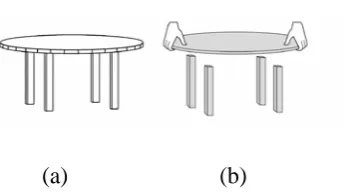
Tasks belonging to this class require development of a new model or presenting an existing shape with the help of simple figures such as parallelepiped, sphere, cylinder and pyramid. An example of a model is provided in Fig. 2. A possibility to change scale and proportioning of stated figures in 3D graphic editor gives an opportunity to work with wide variety of shapes.
Shape analysis needed for solving tasks of this kind is based on interiorization of processes of moving and joining objects (Fig. 2b). An ability to represent an object in form of simple shapes or organize space with their help is the basic skill in most of activities connected with object-spatial changes (design, sculpture, architecture). In 3D computer modeling this skill gives an opportunity to maximize effectiveness in solving wide class of tasks which can use existing models as constructive part. At the same time, from technological point of view this stage helps reinforce significant skills of working with 3D graphic editor (moving and orienting an object in space, working with views, positioning and settings adjustment of an object).
(a) (b)
Fig. 2. Modeling on the basis of geometric primitives (a), using an experience of forming simple physical objects (b).
Despite the fact that the models elaborated from ready primitives cannot look realistic, it is possible to use them in rendering solid figures being simplified and schematic and not claiming to be realistic. Structures of this kind may include schemes of molecular aggregation, module architecture and solid pictograms similar to those seen on presentations.
3.3. Task on modifying and differential transformations
During the process of teaching shaping on the basis of modifications at the stage of analysis a learner should match a necessary semimanufacture, which can be modified to a target shape, to a specified target shape (Fig. 3a). A learner should use his/her thinking experience and see the method of getting a future shape out of a semimanufacture (Fig. 3b) – just like sculptors do.
(a)
(b)
Fig. 3. Modeling on the basis of modifying transformations (a), using experience of deformation of physical objects (b).
The main approaches to choosing and developing this “semimanufacture” should be learnt at the simple figure modeling level. A new model can be created from a 3D semimanufacture made from specific material usually called “polygonal mesh” by means of acting on the whole semimanufacture or its separate sites, faces, edges as well as various figures can be made from a piece of plasticine by means of extrusion, flattening, cutting-off and other similar procedures.
At this level learners face the specifics of such “material” as polygonal mesh that leads to the necessity of understanding peculiarities of working with this material (planes, edges, vertices) and, consequently, peculiarities of shaping unlike real clay or plasticine. Number of polygons indicates degree of flexibility and ductility of this material and is connected with a possibility to make it more realistic. At the same time, it is preferable to minimize this number as the duration of computer model counting depends on it. Therefore, tasks connected with deformations or modifications cause lots of discussions connected with the quality of modeling, particularly, searching for a compromise between realistic property and number of polygons.
3.4. Tasks on modeling complex figures and scenes
Tasks of this class are built on the combination of ones belonging to two previous classes. They are oriented on development of more complex models consisting of modified objects and ready figures and (or) modeling of scenes (Fig. 4). Occasionally it is possible to return to the first or the second group of tasks but at the level of implementing new technological solutions. For instance, creating complex compositions with hierarchical structure or application of layers (returning to the first group) or complex modifications using spline mesh, multi-resolution mesh or “sculpting”.
Fig. 4. Scene modeling including task combinations.
Complexity of 3D project’s structure, diversity of possible forming variants should lead to development of new skills of visual-spatial thinking: ability to see the shape at different levels of detailing and analyze quality and effectiveness of modeling. The first ability is acquisition mainly connected with interiorization of working with virtual computer shape in different scales; the second one is gained due to gradual accumulation of visual experience with the help of which at the level of analyzing learners can search for possible solutions mentally and on the basis of this search choose the most appropriate technological variants.
3.5 Tasks on modeling a 3D object with the help of automated transformations
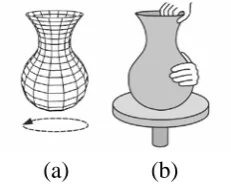
Some tools of 3D graphic editors provide getting new shapes with the help of various automated transformations in which new shapes are developed from a set of initial geometric ones by rotating, moving, interaction (Fig. 5a). In real world these transformations correspond to various shaping technologies such as making pottery on potter’s wheel, stamping, covering a solid framework with plastic material etc.
(a) (b)
Fig. 5. Solid of revolution model in 3D graphic editor (a), similar technology (b).
The result of creating a new shape is evaluated due to specified parameters of interaction. This automation along with simplifying some routine processes causes some difficulties at modeling. Learners don’t have already a semimanufacture that would help them see the future model as it was in tasks on deformation. In order to understand if a shape needed can be acquired with the help of any automated method, a learner should do mentally backward conversion into the initial shapes. Sometimes it is as difficult as to identify initial positions of bits of glass in a kaleidoscope after getting a colorful pattern by means of reflection of the mirrors in a cylinder. Impossibility of solving a
problem mentally results in the fact that modeling process turns into random selection of shapes and settings.
In order to avoid this fact it is necessary develop learners’ ability to predict what can come out from initial shapes and settings after transformations. For instance, on the basis of ideas about working process on a potter’s wheel learners can be taught to identify mentally what flat form and along which axis should be rotated in order to make a vase, a glass or a bottle. For forming internal representation of complex transformations conscious acquisition of visual experience might be needed.
3.6. Tasks on development of dynamic forms connected with physical processes
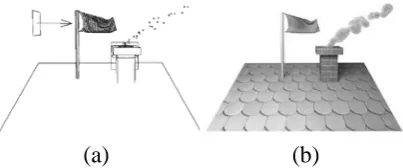
Last but not the least is a very specific class of modeling tasks which require creation of flowing, granular shapes sensitive to small actions. These shapes are found in liquids, smoke, granular materials, fabrics, flame etc (Fig. 6b). They are changed considerably if exposed by wind, gravity etc.
The process of creation such an unstable shape is completely automated in 3D graphic editor and depends only on a number of initial settings. At this stage students work with shape a little. They work only with spatial geometry, arranging directional disturbance sources and objects influenced by these disturbances (Fig. 6a). Visual match of created models to real phenomena is, obviously, the most important criterion of model quality, not considering the fact that these models as well as models on the basis of polygonal mesh require lots of calculations.
(a)
(b)
Fig. 6. Dynamic shape model in 3D graphic editor (a), modeled objects (b).
Solving tasks of this class provides learners with visual experience of influencing initial object settings (particle systems, disturbance sources) on the final rendering. An experienced 3D modeler can predict how to arrange initial objects on the scene and which parameters to set in order to get desired effect and what happens if to change these parameters.
4. EVALUATION OF VISUAL-THINKING DEVELOPMENT
Suggested theoretical and practical approaches have been implemented at passing annual course “Basics of 3D computer modeling” in St. Petersburg children’s computer club (Children’s Computer Club of St. Petersburg 2014). For proving effectiveness of the approaches stated above the method providing quantitative evaluation of visual-spatial abilities development was suggested.
The necessity of elaborating an individual method was caused by the fact that existing tests of visual abilities development such as MCT or DAT:SR (Sorby, 1999) which estimated separate types of general visual abilities required definite laboratory conditions and didn’t provide organic combination of checking visual abilities with the learning process. We have set a task to turn study of visual-spatial abilities of learners into natural component of a computer lesson so they wouldn’t take this process as external testing.
In this case it is important to choose an appropriate stage of a lesson so that checking of visual thinking would fit in the process of solving a task. Besides, it is significant to encourage learners to solve visual tasks relying only on their internal visual images without any external support. This stage is the one which includes analyzing the shape of an object being modeled when learners identify
geometric structure of developed shape in context of searching for a future technology of its elaboration. Interiorized visual images of technological processes represent those mental visual operations which are carried out by learners for analyzing the shape.
It is possible to distinguish two types of visual-thinking operations needed for analyzing the shape. The first one is directed to getting diverse variants of approaches to shape development. According to Guilford’s classification of intellectual processes (Guilford & Hoepfner 1971) divergent visual abilities are responsible for this type of operation. Another type of operations help identify and choose the most appropriate chain of operations providing effective solution and relevance of gained result to the goals set in the beginning. Convergent abilities are responsible for this. Degree of development of the abilities types stated above was evaluated directly during the lessons. Divergent abilities was evaluated due to the average number of suggested variants of shaping in a group (parameter DV), and convergent abilities – due to the percentage of effective solutions (parameter CV).
The experiment was carried out in experimental and control groups of schoolchildren (age 12-14 years old), who were doing 3D modeling. The number of learners in control groups is 57 people, in experimental ones there are 61 people. Age of learners and educational level was approximately the same.
Lessons in experimental groups were organized in strict correspondence to the suggested approach, i.e. task complexity succession described above was strictly followed. Analyzing the shape of a developed model was an obligatory element of solving any task. In control groups main attention was paid on learning tool possibilities of 3D graphic editor. Logic of learning task sequence was determined by logic of the interface which corresponds to traditional approach at learning 3D graphics.
The values of DV and CV parameters were calculated for two points during educational process in three and six month time since the beginning of education. Dynamics of result changes can be seen on Fig. 7.
0 0,5 1 1,5 2 2,5 3
3 6
learning time, months
DV
Contr ol groups
Experimental groups
0 0,2 0,4 0,6 0,8 1
3 6
learning time, months
CV
Control groups
Experimental groups
(a)
(b)
Fig. 7. Changes of DV (a) and CV (b) parameters during the educational process in control and experimental groups.
The figures given above show advanced development of visual-spatial convergent and divergent abilities in experimental groups.
Beside this fact, there also could be observed some qualitative distinctions noticed by teachers in experimental groups. Due to the fact that attention of learners in experimental groups was concentrated on shaping process and not on interface peculiarities, their desire to learn new possibilities of tools was mainly determined by the idea of future shape project. Therefore, logic of interface organization was
comprehended by means of shaping operations which created preconditions for prompt independent studying new tools of 3D computer modeling.
5. CONCLUSION
Some problems of visual-spatial abilities development at learning computer 3D graphics were considered in this article. It was shown that development of these abilities is based on interiorization of shaping operations performed with real objects as well as on the experience of manipulations with virtual shapes complexity which is accumulated in the process of solving task succession. Analysis of a modeled shape is an essential stage of solving each modeling task and contributes to the development of convergent as well as divergent abilities of visual thinking.
There were elaborated methods of evaluating development of convergent and divergent abilities of visual thinking based on calculating values of objective parameters gained directly at the process of education which allowed keeping its integrity and controlling dynamics of visual thinking development.
Suggested method may be generalized and applied to problems of developing other abilities at learning other computer technologies. The basic principles of this approach are relying on intellectual abilities developed before acquiring computer technology skills and creating favourable conditions for activating abstract thinking in the process of solving tasks on the computer.
6. REFERENSES
Bernstein, NA 1967, The coordination and regulation of movements, Pergamon Press, Oxford.
Children’s Computer Club of St. Petersburg 2014, Computer clubs for children in University ITMO, viewed 10 March 2014, http://ccc.spb.ru (Russian).
Guilford, JP & Hoepfner, R 1971, The Analysis of Intelligence, New York: McGraw-Hill.
Infinite Skills 2014, Learning Autodesk 3ds Max 2014 Training Video, viewed 10 March 2014, <http://www.infiniteskills.com/training/learning-autodesk-3ds-max-2014.html>.
KinderArt 2014, Free Art and Craft Lesson Plans, viewed 10 March 2014, <http://www.kinderart.com/index.html>.
Maizam, A, Thomas, RB & David, EG 2003 ‘The relationship between spatial visualisation ability and problem solving in structural design’, World Transactions on Engineering and Technology Education, UICEE vol.2, no. 2, pp. 273-276.
Sorby, SA 1999 ‘Developing 3-D Spatial Visualization Skills’, Engineering Design Graphics Journal, vol. 63, no. 2, pp. 21-32, viewed 10 March 2014,
<http://www.edgj.org/index.php/EDGJ/article/viewFile/126/122>.
Stanyer, P 2003, The Complete Book of Drawing Techniques: A Complete Guide for the Artist, Arcturus, London.
Vygotsky, LS 1962, Thought and Language, MA: MIT Press, Cambridge.