www.atmos-meas-tech.net/10/1181/2017/ doi:10.5194/amt-10-1181-2017
© Author(s) 2017. CC Attribution 3.0 License.
An automated method for the evaluation of the
pointing accuracy of Sun-tracking devices
Dietmar J. Baumgartner1, Werner Pötzi1, Heinrich Freislich1, Heinz Strutzmann1, Astrid M. Veronig1,2, and Harald E. Rieder3,2,4
1Kanzelhöhe Observatory for Solar and Environmental Research (KSO), University of Graz, Treffen, Austria
2Institute for Geophysics, Astrophysics and Meteorology/Institute of Physics (IGAM/IP), University of Graz, Graz, Austria 3Wegener Center for Climate and Global Change (WEGC), University of Graz, Graz, Austria
4Austrian Polar Research Institute (APRI), Vienna, Austria
Correspondence to:Dietmar J. Baumgartner ([email protected]) Received: 26 April 2016 – Discussion started: 6 September 2016
Revised: 20 February 2017 – Accepted: 23 February 2017 – Published: 22 March 2017
Abstract.The accuracy of solar radiation measurements, for direct (DIR) and diffuse (DIF) radiation, depends signifi-cantly on the precision of the operational Sun-tracking de-vice. Thus, rigid targets for instrument performance and op-eration have been specified for international monitoring net-works, e.g., the Baseline Surface Radiation Network (BSRN) operating under the auspices of the World Climate Research Program (WCRP). Sun-tracking devices that fulfill these ac-curacy requirements are available from various instrument manufacturers; however, none of the commercially avail-able systems comprise an automatic accuracy control sys-tem allowing platform operators to independently validate the pointing accuracy of Sun-tracking sensors during oper-ation. Here we present KSO-STREAMS (KSO-SunTRackEr Accuracy Monitoring System), a fully automated, system-independent, and cost-effective system for evaluating the pointing accuracy of Sun-tracking devices. We detail the monitoring system setup, its design and specifications, and the results from its application to the Sun-tracking system operated at the Kanzelhöhe Observatory (KSO) Austrian ra-diation monitoring network (ARAD) site. The results from an evaluation campaign from March to June 2015 show that the tracking accuracy of the device operated at KSO lies within BSRN specifications (i.e., 0.1◦ tracking accuracy)
for the vast majority of observations (99.8 %). The eval-uation of manufacturer-specified active-tracking accuracies (0.02◦), during periods with direct solar radiation exceed-ing 300 W m−2, shows that these are satisfied in 72.9 % of observations. Tracking accuracies are highest during
clear-sky conditions and on days where prevailing clear-clear-sky con-ditions are interrupted by frontal movement; in these cases, we obtain the complete fulfillment of BSRN requirements and 76.4 % of observations within manufacturer-specified active-tracking accuracies. Limitations to tracking surveil-lance arise during overcast conditions and periods of partial solar-limb coverage by clouds. On days with variable cloud cover, 78.1 % (99.9 %) of observations meet active-tracking (BSRN) accuracy requirements while for days with pre-vailing overcast conditions these numbers reduce to 64.3 % (99.5 %).
1 Introduction
Marty et al., 2003; Donner et al., 2011; Freidenreich and Ra-maswamy, 2011) and reanalysis products (e.g., Allan, 2000). Driven by the increasing need for high-accuracy surface radiation data for scientific and technical applications, e.g., to enhance the performance of solar photovoltaic plants (e.g., Fontani et al., 2011), national and international radi-ation monitoring networks have been established over re-cent decades. The most prominent international radiation monitoring network is the so-called Baseline Surface Radi-ation Network (BSRN) operating under the auspices of the World Climate Research Program (WCRP), e.g., Ohmura et al., (1998). BSRN sites are equipped with instruments of the highest accuracy. Targets for instrument performance and operation are specified in the BSRN guidelines (McArthur, 2005). Furthermore, BSRN guidelines are (closely) adopted by national radiation monitoring networks, e.g., ARAD (Austrian radiation monitoring network) in Austria (Olefs et al., 2016), SACRaM in Switzerland (Wacker et al., 2011), or SURFRAD in the US (Augustine et al., 2005).
BSRN guidelines require the operation of radiation sen-sors on Sun-tracking devices with specified accuracy, avail-able, in various designs, from different instrument manufac-turers. BSRN guidelines recommend the use of (i) single-axis synchronous-motor tracking devices, (ii) dual-axis passive-tracking (algorithm-controlled) devices, or (iii) dual-axis active-tracking (quadrant-sensor-controlled) devices. For a detailed overview about advantages and disadvantages of these tracking devices, we refer the interested reader to Sect. 4 in McArthur (2005).
Among the suite of solar radiation measurements, the ac-curacy of pyrheliometer (direct solar radiation, DIR) and pyranometer measurements (diffuse solar radiation, DIF) de-pends significantly on the accuracy of the operational Sun-tracking device. Precise alignment is of the highest prior-ity for the monitoring of DIF, as small misalignments can significantly affect the measurement accuracy. For measure-ments of DIF, one strives to solely shade the pyranometer’s glass dome to mask as little of the diffuse component as pos-sible while simultaneously shielding direct solar irradiance. As the BSRN network strives to achieve measurements at the highest possible accuracy, its guidelines recommend us-ing a Sun-trackus-ing device with an accuracy of±0.1◦or bet-ter (McArthur, 2005). For the monitoring of DIR, pointing accuracy is also important, but maybe less crucial than for DIF. This has been addressed in a study by Major, presented in Annex D of McArthur (2005), concluding that pointing errors are (i) negligible if smaller than a pyrheliometer’s slope angle, but (ii) increasingly important with increasing error as measured irradiance decreases rapidly with increas-ing mispointincreas-ing. Furthermore, BSRN guidelines recommend that tracking is monitored using a four-quadrant sensor, as the pointing accuracy is important in determining the quality of the direct beam measurement (McArthur, 2005).
Sun-tracking devices fulfilling these BSRN recommenda-tions are available from various instrument manufacturers.
Nevertheless, none of the commercially available platforms comprise an automatic accuracy control system allowing platform operators to check whether the operational point-ing accuracy of the Sun-trackpoint-ing device indeed fulfills BSRN targets. The lack of a pointing accuracy control system is not unique to Sun-trackers used to accommodate solar radiation sensors. In fact, the determination of pointing accuracy is a common challenge for most types of Sun-pointing instru-ments, and various approaches have been presented to ad-dress this issue. For example, innovative camera-based (e.g., Gisi et al., 2011) and camera-free (e.g., Reichert et al., 2015) approaches to monitor tracking accuracy have been presented in the field of solar Fourier transform infrared (FTIR) spec-trometry. While Gisi et al. (2011) documents a camera setup with real-time image-evaluation and tracking software (Cam-Track), Reichert et al. (2015) presents an approach based on subsequent FTIR measurements with a different orienta-tion of the solar rotaorienta-tion axis relative to the zenith direcorienta-tion, which allows us to obtain both mispointing components, the component in the zenith direction, and the component per-pendicular to the solar rotation axis.
Here we present a related, camera-based, fully automated, system-independent, and cost-effective observing system to determine the pointing accuracy of Sun-tracking devices used in solar radiation monitoring networks which can be easily added to existing monitoring platforms, and its appli-cation to the Sun-tracking device operated at the Kanzelhöhe Observatory (KSO), Austria. We note that KSO-STREAMS (KSO-SunTRackEr Accuracy Monitoring System) is solely intended to monitor tracking accuracy and not to adjust the alignment of an operational Sun-tracking device.
2 The proposed observing system for the evaluation of Sun-tracking device pointing accuracy
2.1 Components and installation
Table 1.Components of the KSO-STREAMS device and their characteristics.
Component Characteristics
Circular aperture Entrance window with a diameter of 12 mm
Filter block Combination of neutral- and gold-coated bandpass filter to prohibit detector saturation
Achromatic lens Focal length of 60 mm
Camera Compact network camera LAN; real-time images in VGA resolution; 1/400CMOS-sensor; adapted to Power over Ethernet (PoE); special housing for outdoor usage Housing and
mounting system
Meet requirements of IP65 and is ready to install like a pyrheliometer on a Sun-tracking device
Figure 1.The instrumental setup is described as follows:(a) oper-ating device;(b)optical layout with the following labeled compo-nents: circular aperture (A), filter block (F), achromatic lens (L), and camera chip (C);(c)mounting system;(d)radiation platform with KSO-STREAMS mounted on the Sun-tracking device (SOLYS2, Kipp & Zonen) at the Kanzelhöhe Observatory ARAD site.
two solar radii) in each direction from the image center (see Fig. 2a). Fortunately, such severe misalignment hardly occurs in commercial Sun-tracking devices. Nevertheless, choosing such a wide range allows us to even quantify severe misalign-ments and enables us to identify the pointing accuracy of the Sun-tracking device and to quantify potential misalignments. 2.2 Principle and defined accuracy limits
KSO-STREAMS is operated by an automated script and takes, between sunrise and sunset, a snapshot every 15 s of the solar disk. The images taken are immediately pro-cessed as detailed below. A typical image taken by KSO-STREAMS is given in Fig. 2b. We note that high image contrast and minimal stray light, not image type (i.e., color), are important in further steps for solar-limb detection. Thus all KSO-STREAMS pictures are first converted to grayscale
Figure 2.Solar disk images on the sensor array (VGA resolution) of the compact network camera of KSO-STREAMS.(a)Range of the detectable free movement of the positions of solar disk images within the detector array due to possible misalignment of the Sun-tracking device (the yellow area is the optimal position of the so-lar disk image, the green marked zone is the possible center of the solar disk image to be within BSRN requirements, and the yellow shaded area is the detectable misalignment of the Sun-tracking de-vice through KSO-STREAMS);(b)typical solar disk image under clear-sky conditions.
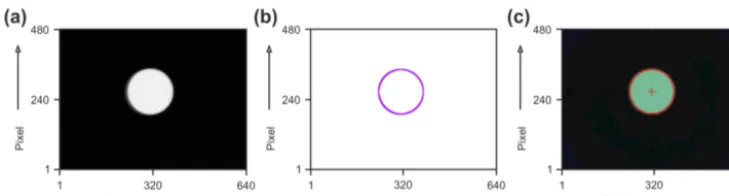
Figure 3.Illustration of individual steps in KSO-STREAMS image processing to derive a circular fit to solar-limb pixels:(a) grayscale-transformed solar disk image (original KSO-STREAMS picture is shown as background in panelc);(b)solar-limb pixels (purple) identified through the application of a Sobel operator to panela; and(c)the best fitting circle (red) to solar-limb pixels from panelbderived by a least-squares fitting approach superimposed on the original KSO-STREAMS picture. The red cross in panelcmarks the center of the fitted circle.
estimate the gradients in the horizontal and vertical direc-tions. The sum of the gradients in the horizontal and ver-tical directions yields the magnitude of the gradient. Given the high contrast between the Sun and background in KSO-STREAMS images, the solar limb is in first order defined through the pixels with the largest gradient (see Fig. 3b).
Next, we apply a classical least-squares circle fit (Ludwig, 1969) to the solar-limb pixels identified to calculate the ra-dius and the center of the solar disk. Each of the first order solar-limb pixels identified is characterized through coordi-nates in thexy plane, and the classical least-squares fitting approach minimizes the geometric distance of these points to the fitted circle.
The best fit through the set ofnpoints (i.e., the first order identified solar-limb pixels) is achieved through minimiza-tion of Eq. (1) by solving the system for ∂F∂h =0, ∂F∂k =0, and ∂F∂r =0:
F (h, k, r)= n X
i=1 q
(xi−h)2−(yi−k)2−r2
→min, (1)
where (xi,yi)denotes the first order solar-limb pixels, (h,k) the circle center, andrthe radius of the fitting circle. As only coordinate pairs (xi,yi)are known, the circle equation has to be linearized to obtain a series of linear equations yielding Eq. (4), which is linear in the undetermined coefficientsa,b, andc, that allow us, oncea,b, andcare derived, to solve backwards forh,k, andr:
r2=(x−h)2+(y−k)2=x2−2hx+h2+y2
−2ky+k2, (2)
x2+y2=2hx+2ky+r2−h2−k2, (3)
x2+y2=ax+by+c. (4)
The coefficientsa,b, andcare derived by applying the ma-trix equation for a circular regression (Eq. 5):
Px2
i Px
iyi Pxi P
xiyi Pyi2 P
yi P
xi Pyi n " a b c # = P
xi xi2+yi2
P
yi xi2+yi2
P
xi2+yi2
, (5)
wherendenotes the number of individual points (xi,yi). It follows that a unique set of values for the coefficientsa,b, andc– that generate the circle of best fit – exist when the 3-by-3 matrix on the left side of Eq. (5) is invertible. After de-riving the coefficientsa,b, andc, the center (h,k) and radius
rcan be computed through the following transformations:
h= −a
2, (6)
k= −b
2, (7)
r= √
4c+a2+b2
2 . (8)
Then, the best fitting circle can be established (see Fig. 3c). The error on the circle fit has to be less than 1 pixel, con-sidering the observing conditions (astronomical seeing). As the solar radius varies throughout the year uncertainty limits for the detection of the solar limb have been defined as+5 % of the largest and−5 % of the smallest astronomically cal-culated solar radius (∼76 pixel and∼74 pixel, respectively) throughout the year. As we use a prime lens (i.e., a lens with a fixed focal length of 60 mm), KSO-STREAMS focal length is not an issue. The results of the processing algorithm are stored in daily look-up tables for further post-processing and archived to allow retrospective investigation of the represen-tativeness of solar radiation measurements found “dubious” in further analyses.
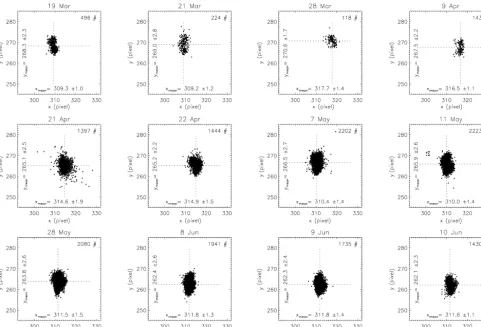
Figure 4.Solar disk center positions (black dots) determined by KSO-STREAMS, used for the determination of the mean daily zero-point centers on 12 clear-sky days in 2015. The zero-point center of KSO-STREAMS is defined as the mean value of these 12 zero-point centers.
2.3 Initial zero-point determination of the solar center determined by KSO-STREAMS
To determine the average solar disk center, we utilize data from 12 days from mid-March to mid-June 2015 (3 days each in March, April, May, and June; see Fig. 4) with perpetual clear-sky conditions and a high (and continuous) availability of observational data. Furthermore, we restrict the accuracy of limb detection to less than half a pixel. We then determine the average of the 12 individual daily-mean solar disk center positions and use this average as the initial zero point. We note that the difference among individual daily-mean zero positions (in both azimuthal and zenithal directions) is small, i.e., less than 8 pixels (which corresponds to approximately 0.03◦or 6 % of the solar disk diameter), and is mainly af-fected by different atmospheric conditions (e.g., turbidity and humidity). In the following, the accuracy of the Sun-tracking device is characterized by the difference of KSO-STREAMS solar disk centers to this defined initial zero-point center.
3 Application to the Sun-tracking device at the Kanzelhöhe Observatory, Austria
3.1 Field Measurements
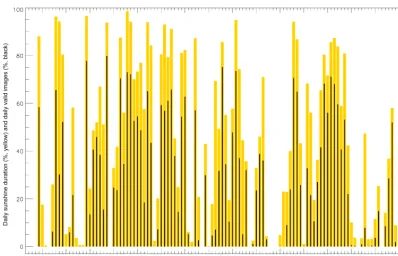
Figure 5.Relative daily sunshine duration (yellow) and valid KSO-STREAMS results (black) during the evaluation period from 14 March to 27 June 2015.
3.2 Evaluation of the pointing accuracies of Sun-tracking devices under different meteorological conditions
Over the 15-week evaluation period, a total of 100 939 valid observations by KSO-STREAMS were available. This cor-responds to 28 % of the astronomically possible observations (360 228). The remaining observations (72 %) have been dis-carded due to exceedance of the accuracy requirements, de-tailed in Sect. 2.2. An overview of data availability (and rel-ative sunshine duration) per day during the evaluation period is given in Fig. 5. We note that only 43.7 % of the theoret-ically possible sunshine duration was observed during the evaluation period because of ambient weather conditions.
KSO-STREAMS allows identifying the fraction of obser-vations within manufacturer-specified (i) active-tracking ac-curacy during periods with direct solar radiation exceeding 300 W m−2 and (ii) passive-tracking accuracy during peri-ods with DIR below 300 W m−2. While the manufacturer-specified tracking accuracy deteriorates during periods with DIR below 300 W m−2(passive tracking), this is not inherent to KSO-STREAMS observations. However, as the applied monitoring scheme is optical, it relies on the visibility of the solar disk; thus, no evaluation of the tracking accuracy is pos-sible during periods of partial or full solar disk obstruction (see discussion below).
In the following, we illustrate the performance of the Sun-tracking device at the Kanzelhöhe Observatory in four se-lected situations, illustrating (i) nearly continuous clear sky,
(ii) clear sky interrupted by frontal movement, (iii) variable cloud cover, and (iv) nearly perpetual overcast conditions.
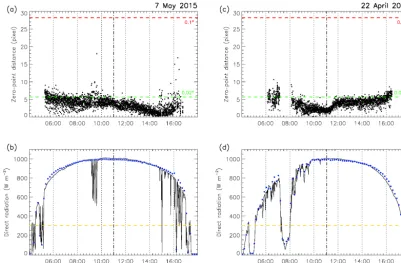
Nearly continuous monitoring of the Sun-tracking device pointing accuracy was possible on 7 May 2015, with pre-vailing clear-sky conditions. Figure 6 shows the result of the zero-point distance determined by KSO-STREAMS (in 15 s intervals; panel a), and the result of direct solar radiation (panel b), derived from ARAD (1 min averages) and the ac-tual total output of the Sun sensor of the Sun-tracking device (in 10 min increments) for this day. All available Sun disk centers, according to the selected restrictions (see Sect. 2.2), monitored on 7 May 2015 have been within the 0.1◦limit, as
specified in the BSRN guidelines. A total of 90.7 % of them have been within the manufacturer-specified active-tracking pointing accuracy of 0.02◦. Individual Sun disk centers devi-ate from the overall set, triggered by individual clouds affect-ing the determination of the solar limb. Nevertheless, duraffect-ing these periods, the pointing accuracy of the Sun-tracking de-vice lies well within manufacturer specifications for passive-tracking (0.1◦) and BSRN targets.
Figure 6.Performance of the Sun-tracking device at the Kanzelhöhe Observatory ARAD site for days with nearly continuous clear sky (7 May 2015, left column) and clear sky interrupted by frontal movement (22 April 2015, right column):(a)radial distance from the zero point of each valid image (asterisks);(b)direct radiation (1 min averages) derived from the Kanzelhöhe Observatory ARAD site (line) and from actual Sun-sensor measurements of the Sun-tracking device (in 10 min intervals, blue dots) on 7 May 2015.(c–d)As panelsa–bbut for 22 April 2015. Limits of active tracking (i.e., alignment within 0.02◦accuracy, green line) and passive tracking (i.e., alignment within 0.1◦accuracy, red line) are shown in panelsaandc.The yellow dashed line in panelsbanddindicates the manufacturer-specified minimum of direct radiation (300 W m−2)needed for active-tracking mode. The vertical black dot–dashed line indicates the astronomical noon in all panels.
and largely (89.2 % of the observations) within manufacturer specifications for active tracking (see Fig. 6c).
Next, we focus on the evaluation of Sun-tracking accu-racy during variable cloud cover as well as on days with nearly continuous cloud coverage, where active-tracking mode (manufacturer requirement is denoted by a total output of the Sun sensor of at least 300 W m−2)and, therefore, its evaluation is only possible during short temporal increments. 12 April and 10 May 2015 are representative for days with variable meteorological conditions, and, therefore, large vari-ations in cloud cover. Periods with high (thick) cloud cover-age, and limited direct radiation (Fig. 7b and d), affect KSO-STREAMS’ ability of solar-limb detection. During times with thinner clouds, limb detection is possible, just as under the clear-sky conditions discussed above. Pointing accuracies are within manufacturer specifications for passive-tracking (0.1◦) throughout, and consequently, also within BSRN tar-gets. However, despite DIR exceeding manufacturer require-ments for active tracking frequently on these days, only 68– 78 % of the valid observations are within specifications for active tracking (Fig. 7a and c).
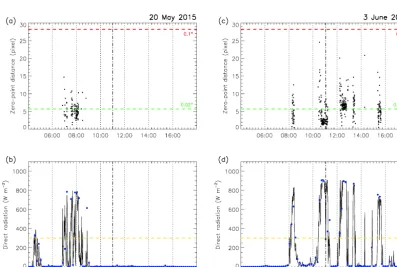
Similar results are found on days with prevailing overcast conditions, where only small gaps in cloud cover occur. Fig-ure 8 shows data on pointing accuracy and direct radiation on 20 May and 3 June 2015, which are representative of overcast days during the evaluation period. On both days, the evalua-tion of the pointing accuracy of the Sun-tracking device was only possible during small gaps in cloud cover. We evalu-ate tracking accuracy within manufacturer targets for active tracking on these days, utilizing all observational data where the minimum of the ARAD direct radiation measurements (performed at a sample rate of 10 Hz) within a minute ex-ceeds 300 W m−2. On 20 May and 3 June 2015, 42.6 % and 49.2 % of these selected observations, respectively, indeed fulfill the targeted accuracy of≤0.02◦.
dur-Figure 7.As Fig. 6, but for days with variable cloud cover (left, 12 April 2015; right, 10 May 2015).
Figure 8.As Fig. 6, but for days with nearly perpetual overcast conditions (left, 20 May 2015; right, 3 June 2015).
ing breaks in overcast conditions. Nevertheless, it is impor-tant to note that even though larger fractions of the observa-tions on days with overcast condiobserva-tions do not fulfill active-tracking requirements, they still fulfill BSRN targets.
Table 2.Summary of the achieved tracking accuracy for the determined sky-cover categories.
Classification Relative amount of Active BSRN Number of valid Number of
valid observations (V) tracking requirement observations days
Nearly continuous clear sky or clear sky V> 65 % 76.4 % 100 % 33 179 14
interrupted by frontal movement
Variable cloud cover 15 % <V≤65 % 78.1 % 99.9 % 62 735 46
Nearly perpetual overcast conditions V≤15 % 64.3 % 99.5 % 5025 25
Total 72.9 % 99.8 % 100 939 85
cloud cover, and (iv) nearly perpetual overcast conditions. On days with nearly continuous clear-sky conditions and with dominating clear-sky conditions interrupted by frontal movement, the BSRN targets are fully met, and the active-tracking requirements are met for 76.4 % of valid obser-vations. Active-tracking accuracy requirements are less fre-quently met during variable cloud-cover conditions (defined as days with≤65 and > 15 % of theoretically possible daily KSO-STREAMS observations). During the 3-month period, about half of the observational days (46 days) were cate-gorized as “variable”, and 78.1 % (99.9 %) of the observa-tions fulfilled the active-tracking requirements (BSRN tar-gets). Days with nearly perpetual overcast conditions are de-fined as days with≤15 % of the theoretically possible KSO-STREAMS observations. On these days, 64.3 % of the avail-able valid observations fulfilled active-tracking accuracy re-quirements, and 99.5 % of the available valid observations fulfilled BSRN targets. Calculated over all 85 days with available measurements during the evaluation period, 72.9 % of observations fulfill active-tracking accuracy requirements and 99.8 % fulfill BSRN targets. A detailed summary of the achieved tracking accuracy (per category and total) is pro-vided in Table 2.
4 Conclusions
Precise Sun-tracking is necessary for high-accuracy mea-surements of direct and diffuse solar radiation. Therefore, rigid targets for Sun-tracking pointing accuracies are spec-ified in national and international radiation monitoring net-works, e.g., the Baseline Surface Radiation Network, which specifies pointing accuracy requirements within 0.1◦. Sun-tracking devices fulfilling this pointing accuracy are available from a variety of instrument manufacturers, but none of the commercially available instruments comprise an automatic monitoring system allowing station operators independent evaluation of pointing accuracies during operation. In this paper, we present KSO-STREAMS, a platform-independent, fully automated, and cost-effective system to evaluate the pointing accuracy of Sun-tracking devices. During operation, KSO-STREAMS is mounted like a pyrheliometer on the
Sun-tracking device to ensure correct imaging of the Sun’s position, as identified by the tracking device
To determine the pointing accuracy of the Sun-tracking device operated at the Kanzelhöhe Observatory Austrian ra-diation monitoring network (Olefs et al., 2016) site, obser-vations by KSO-STREAMS, taken over a 15-week period from March to June 2015, were analyzed. Instrument per-formance was evaluated for valid KSO-STREAMS observa-tions during four sets of ambient meteorological condiobserva-tions: (i) nearly continuous clear sky, (ii) clear sky interrupted by frontal movement, (iii) variable cloud cover, and (iv) nearly perpetual overcast conditions. The results show that 72.9 % of all observations made during periods with DIR more than 300 W m−2, fulfill manufacturer-specified active-tracking ac-curacy requirements (0.02◦) and 99.8 % fulfill BSRN targets (0.1◦). On days with nearly continuous clear-sky conditions and/or clear-sky conditions interrupted by frontal movement, the BSRN requirements are fully satisfied and accuracies for active tracking are met for 76.4 % of observations. Similar re-sults are found for days with variable cloud-cover conditions. As expected, Sun-tracking pointing accuracies are lowest during days with nearly perpetual overcast conditions; here, 64.3 % of observations meet active-tracking requirements. Nevertheless, the BSRN accuracy targets are still almost completely met (99.5 %), illustrating the strong performance of the Sun-tracking system operated at KSO (SOLYS2, Kipp & Zonen). The result of less accurate quadrant-sensor-based tracking on days with cloud influence is robust and not de-pendent on the KSO-STREAMS analysis algorithm, as all analyses were restricted to valid KSO-STREAMS observa-tions. We conclude that KSO-STREAMS provides valuable information on the quality of radiation measurement accura-cies through evaluation of the underlying pointing accuraaccura-cies of the operational Sun-tracking device.
Data availability. The data presented in this article are available at www.kso.ac.at/publication_data/baumgartner_amt_2017/.
Acknowledgements. The authors thank three anonymous referees for their useful suggestions and their help in improving this article during the discussion phase.
Edited by: M. Van Roozendael Reviewed by: three anonymous referees
References
Allan, R. P.: Evaluation of simulated clear-sky longwave radiation using ground-based observations, J. Climate, 13, 1951–1964, doi:10.1175/1520-0442(2000)013<1951:Eoscsl>2.0.Co;2, 2000. Augustine, J. A. and Dutton, E. G.: Variability of the surface ra-diation budget over the United States from 1996 through 2011 from high-quality measurements, J. Geophys. Res.-Atmos., 118, 43–53, doi:10.1029/2012JD018551, 2013.
Augustine, J. A., Hodges, G. B., Cornwall, C. R., Michalsky, J. J., and Medina, C. I.: An update on SURFRAD – The GCOS Surface Radiation budget network for the continen-tal United States, J. Atmos. Ocean. Tech., 22, 1460–1472, doi:10.1175/Jtech1806.1, 2005.
Donner, L. J., Wyman, B. L., Hemler, R. S., Horowitz, L. W., Ming, Y., Zhao, M., Golaz, J. C., Ginoux, P., Lin, S. J., Schwarzkopf, M. D., Austin, J., Alaka, G., Cooke, W. F., Delworth, T. L., Freiden-reich, S. M., Gordon, C. T., Griffies, S. M., Held, I. M., Hurlin, W. J., Klein, S. A., Knutson, T. R., Langenhorst, A. R., Lee, H. C., Lin, Y. L., Magi, B. I., Malyshev, S. L., Milly, P. C. D., Naik, V., Nath, M. J., Pincus, R., Ploshay, J. J., Ramaswamy, V., Se-man, C. J., Shevliakova, E., Sirutis, J. J., Stern, W. F., Stouffer, R. J., Wilson, R. J., Winton, M., Wittenberg, A. T., and Zeng, F. R.: The Dynamical Core, Physical Parameterizations, and Basic Simulation Characteristics of the Atmospheric Component AM3 of the GFDL Global Coupled Model CM3, J. Climate, 24, 3484– 3519, doi:10.1175/2011jcli3955.1, 2011.
Fontani, D., Sansoni, P., Francini, F., Jafrancesco, D., Mercatelli, L., and Sani, E.: Pointing Sensors and Sun Tracking Techniques, Int. J. Photoenergy, 806518, doi:10.1155/2011/806518, 2011. Freidenreich, S. M. and Ramaswamy, V.: Analysis of the biases in
the downward shortwave surface flux in the GFDL CM2.1 gen-eral circulation model, J. Geophys. Res.-Atmos., 116, D08208, doi:10.1029/2010jd014930, 2011.
Gisi, M., Hase, F., Dohe, S., and Blumenstock, T.: Camtracker: a new camera controlled high precision solar tracker sys-tem for FTIR-spectrometers, Atmos. Meas. Tech., 4, 47–54, doi:10.5194/amt-4-47-2011, 2011.
Gupta, S. K., Kratz, D. P., Wilber, A. C., and Nguyen, L. C.: Valida-tion of parameterized algorithms used to derive TRMM-CERES surface radiative fluxes, J. Atmos. Ocean. Tech., 21, 742– 752, doi:10.1175/1520-0426(2004)021<0742:Vopaut>2.0.Co;2, 2004.
Jaehne, B.: Digitale Bildverarbeitung, Springer, Berlin Heidelberg, 1991.
Ludwig, R.: Methoden der Fehler- und Ausgleichsrechnung, Vieweg, Braunschweig, 1969.
Marty, C., Philipona, R., Delamere, J., Dutton, E. G., Michalsky, J., Stamnes, K., Storvold, R., Stoffel, T., Clough, S. A., and Mlawer, E. J.: Downward longwave irradiance uncertainty under arctic atmospheres: Measurements and modeling, J. Geophys. Res.-Atmos., 108, 4358, doi:10.1029/2002jd002937, 2003.
McArthur, L. J. B.: Baseline Surface Radiation Network (BSRN) Operations Manual Version 2.1WCRP-121, WMO/TD-No. 1274, Geneva, 2005.
Ohmura, A., Dutton, E. G., Forgan, B., Frohlich, C., Gilgen, H., Hegner, H., Heimo, A., Konig-Langlo, G., McArthur, B., Muller, G., Philipona, R., Pinker, R., Whitlock, C. H., Dehne, K., and Wild, M.: Baseline Surface Radiation Network (BSRN/WCRP): New precision radiometry for climate research, B. Am. Meteorol. Soc., 79, 2115–2136, doi:10.1175/1520-0477(1998)079<2115:Bsrnbw>2.0.Co;2, 1998.
Olefs, M., Baumgartner, D. J., Obleitner, F., Bichler, C., Foelsche, U., Pietsch, H., Rieder, H. E., Weihs, P., Geyer, F., Haiden, T., and Schöner, W.: The Austrian radiation monitoring network ARAD – best practice and added value, Atmos. Meas. Tech., 9, 1513– 1531, doi:10.5194/amt-9-1513-2016, 2016.
Pinker, R. T., Zhang, B., and Dutton, E. G.: Do satellites de-tect trends in surface solar radiation?, Science, 308, 850–854, doi:10.1126/science.1103159, 2005.
Reichert, A., Hausmann, P., and Sussmann, R.: Pointing errors in solar absorption spectrometry – correction scheme and its vali-dation, Atmos. Meas. Tech., 8, 3715–3728, doi:10.5194/amt-8-3715-2015, 2015.
Wacker, S., Grobner, J., Hocke, K., Kampfer, N., and Vuilleumier, L.: Trend analysis of surface cloud-free downwelling long-wave radiation from four Swiss sites, J. Geophys. Res.-Atmos., 116, D10104, doi:10.1029/2010jd015343, 2011.
Wang, P., Sneep, M., Veefkind, J. P., Stammes, P., and Levelt, P. F.: Evaluation of broadband surface solar irradiance derived from the Ozone Monitoring Instrument, Remote Sens. Environ., 149, 88–99, doi:10.1016/j.rse.2014.03.036, 2014.
Wild, M., Ohmura, A., Gilgen, H., Roeckner, E., Giorgetta, M., and Morcrette, J. J.: The disposition of radiative energy in the global climate system: GCM-calculated versus observational estimates, Clim. Dynam., 14, 853–869, doi:10.1007/s003820050260, 1998. Wild, M., Folini, D., Hakuba, M. Z., Schar, C., Seneviratne, S. I., Kato, S., Rutan, D., Ammann, C., Wood, E. F., and Konig-Langlo, G.: The energy balance over land and oceans: an assess-ment based on direct observations and CMIP5 climate models, Clim. Dynam., 44, 3393–3429, doi:10.1007/s00382-014-2430-z, 2015.