INTRODUCTION
Pharmaceutical, medicinal and biochemical literature survey reveals that s-triazino and thiocarbamido nucleus containing drugs have their own identity in drug chemistry. Many of them are used as drugs as muscle relaxant1, hypoglycemic agent2, blood pressure depressant3, anti-diabetic drug4. With the development in medical field, it is reported that the drug having s-triazino nucleus possess anti-tumor properties5-6, anti-bacterial7-9, anti-inflammetry10 and anti-cancer properties11. These drugs were also be used as hormone antagonists12 and antipsychotic agent13. Some of them are used in industries such as finishing and brightening agents14. They are also
www.orientjchem.org
CODEN: OJCHEG 2012, Vol. 28, No. (1): Pg. 559-564
Est. 1984
An International Open Free Access, Peer Reviewed Research Journal
Investigations in the Refractrometric Study of
S-trizinothiocarbamides in Dioxane-water Systems
D. T. TAYADE* and RAHIM SHEIKH
Department of Chemistry , Government V.I.S.H, Amravati - 444 602 (India). *Corresponding author: E-mail: [email protected]
(Received: October 12, 2011; Accepted: December 21, 2011) ABSTRACT
Refractrometric measurements of recently synthesized drugs viz. 1-(4-Hydroxy-6-phenyl)-s-triazino-3-phenylthiocarbamide (L1), 1-(4-Hydroxy-6-phenyl)-s-triazino-3-ethylthiocarbamide (L2), 1-(4-Hydroxy-6-phenyl)-s-triazino-3-methylthiocarbamide (L3) were carried out at various percentage composition of solvent to investigate effects of structure, groups on s-triazino thiocarbamides. The data and the results obtained during this investigation gave detail information regarding drug absorption, transmissions activity and effect of these drugs. Taking all these things, this research work was carried out.
Key words: 1-(4-Hydroxy-6-phenyl)-s-triazino-3-phenylthiocarbamides (L1), 1-(4-Hydroxy-6-phenyl)-s-triazino-3-ethylthiocarbamide (L2), 1-(4-Hydroxy-6-phenyl)-s-triazino-3-methylthiocarbamide (L3),
Dioxane-Water percentage composition, Refractrometry study.
important tool for pharmaceutical and medicinal sciences. Taking all these things into consideration and as a wider programme of this laboratory in the synthesis of nitrogen, sulphur and nitrogen and sulphur containing heteroacycles and heterocycles, it was thought interestingly to carry out the refractrometric measurements of newly synthesized drugs in this laboratory.
This study explores the potency of newly synthesized drugs, stability of drug and also to renovate and modify the traditional drugs which are used by medicinal practitioners. One of a unique and important property of liquid is refractive index. When a ray of light passes from less dense to denser medium then there is a change in the direction of refraction and angle of refraction changes and ultimately the refractive index gets changed. The result obtained during this investigation directly through light on the dipole association of ligand, intermolecular attraction between solute and solvent, dielectric constant of medium, polarizability, and mutual compensation of dipoles. These results are much more useful for transmission, stability, activity and effect of drug hence this study is essential. From this point of view the present investigation was carried out. L1, L2 and L3 in dioxane were studied at various percentage compositions. This is hither to unknown. This study becomes milestone in the drug, medicinal, pharmaceutical of triazinothiocarbamido molecules.
EXPERIMENTAL
The 0.1M solution of ligands in different percentage of dioxane-water and the solutions of different concentration of ligands (0.1M, 0.075M, 0.056M, 0.042M) in 60%, 70% and 80%dioxane-water mixture were prepared. All weighing were made on Mechaniki Zaktady Precyzying Gdansk Balance [ Poland make, ( ±0.001gm)] The densities of solutions were determined by a bicapillary Pyknometer (±0.2%) having a bulb volume of about 10cm3 and capillary having an internal diameter of 1mm. The refractive indices of solvent mixture and solutions were measured by Abbe’s refractometer ( ±0.001). The temperature of the prism box was maintained at 27°c. Initially, the refractometer was caliberated with glass piece (n=1.5220) provided with the instrument.
Observation and calculation
The present work deals with the study of molar refraction and polarizability constant of ligand (L1), ligand (L2) and ligand (L4) in 60% dioxane-water, 70% dioxane-water and 80% dioxane-water mixtures at different composition at 303.15°K (30°c). The data obtained have been used to compute intermolecular interactions. The refractometric reading were taken as described in literature. Here, (L1) is 1-(4-Hydroxy-6-phenyl)-s-triazino-3-phenylthiocarbamide, (L2) is 1-(4-Hydroxy-6-phenyl)-s-triazino-3-ethylthiocarbamide and (L3) is 1 ( 4 H y d r o x y 6 p h e n y l ) s t r i a z i n o 3 -methylthiocarbamide.
RESULTS AND DISCUSSION
The molar refraction of solutions of ligand in Dioxane-Water mixture were determined by a following equation,
Rmixture = [(η2-1)/(η2+2)]{[X
1M1+X2M2+X3M3]/d} where,
η is the refractive index of solution, X1 is mole function of Dioxane, X2 is mole function of Water, X3 is mole function of Solute,
M1, M2, M3 are molecular weights of Dioxane, water and solute respectively,
D is density of solution
The molar refraction of ligand is calculated as, Rlig = Rmixture – RDioxane-Water
Where,
RDioxane-Water - The molar refraction of solvent, Dioxane-Water mixture
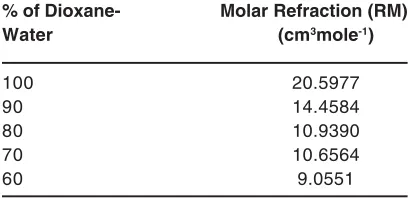
Table 1: Molar Refraction of Different Percentage of Dioxane-Water Mixture % of Dioxane- Molar Refraction (RM)
Water (cm3mole-1)
100 20.5977
90 14.4584
80 10.9390
70 10.6564
A] Molar Refraction and Polarizability constant at different concentration for L1 Table 2:
System: 60% Dioxane –Water Temp : 30±0.1°c Concentration DensityPx103 Refractive R
mix RLig αααααx10
-23
C(M) (Kg-m-3) Index(ηηηηη) (m3mole-1) (m3mole-1) (cm3)
0.1 1.0234 1.4020 8.4887 0.4347 0.01722
0.075 1.0232 1.4016 8.4407 0.3856 0.01527
0.056 1.0229 1.4010 8.3991 0.3440 0.01362
0.042 1.0226 1.4004 8.3954 0.3403 0.01347
Table 3:
System: 70% Dioxane –Water Temp : 30±0.1°c Concentration DensityPx103 Refractive R
mix RLig αααααx10
-23
C(M) (Kg-m-3) Index(ηηηηη) (m3mole-1) (m3mole-1) (cm3)
0.1 1.0286 1.4030 9.9844 0.3280 0.01328
0.075 1.0279 1.4018 9.9148 0.2584 0.01023
0.056 1.0269 1.4010 9.8659 0.2095 0.00829
0.042 1.0257 1.4399 9.8272 0.1711 0.00676
Table 4:
System: 80% Dioxane –Water Temp : 30±0.1°c Concentration DensityPx103 Refractive R
mix RLig αααααx10
-23
C(M) (Kg-m-3) Index(ηηηηη) (m3mole-1) (m3mole-1) (cm3)
0.1 1.0312 1.4086 12.2639 0.3249 0.01286
0.075 1.0291 1.4078 12.2081 0.2691 0.01065
0.056 1.0279 1.4070 12.1581 0.2146 0.00849
0.042 1.0263 1.4058 12.1059 0.1669 0.00661
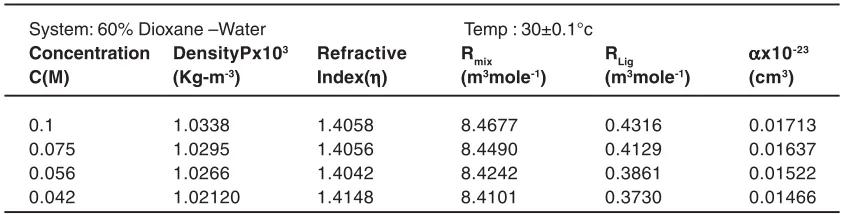
B ] Molar Refraction And Polarizability constant at different concentration for L2 Table 5:
System: 60% Dioxane –Water Temp : 30±0.1°c Concentration DensityPx103 Refractive R
mix RLig αααααx10
-23
C(M) (Kg-m-3) Index(ηηηηη) (m3mole-1) (m3mole-1) (cm3)
0.1 1.0338 1.4058 8.4677 0.4316 0.01713
0.075 1.0295 1.4056 8.4490 0.4129 0.01637
0.056 1.0266 1.4042 8.4242 0.3861 0.01522
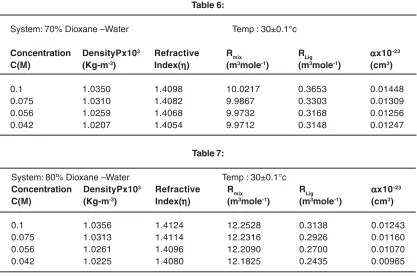
Table 6:
System: 70% Dioxane –Water Temp : 30±0.1°c Concentration DensityPx103 Refractive R
mix RLig αααααx10
-23
C(M) (Kg-m-3) Index(ηηηηη) (m3mole-1) (m3mole-1) (cm3)
0.1 1.0350 1.4098 10.0217 0.3653 0.01448
0.075 1.0310 1.4082 9.9867 0.3303 0.01309
0.056 1.0259 1.4068 9.9732 0.3168 0.01256
0.042 1.0207 1.4054 9.9712 0.3148 0.01247
Table 7:
System: 80% Dioxane –Water Temp : 30±0.1°c Concentration DensityPx103 Refractive R
mix RLig αααααx10
-23
C(M) (Kg-m-3) Index(ηηηηη) (m3mole-1) (m3mole-1) (cm3)
0.1 1.0356 1.4124 12.2528 0.3138 0.01243
0.075 1.0313 1.4114 12.2316 0.2926 0.01160
0.056 1.0261 1.4096 12.2090 0.2700 0.01070
0.042 1.0225 1.4080 12.1825 0.2435 0.00965
C] Molar Refraction And Polarizability constant at different concentration for L3 Table 8:
System: 60% Dioxane –Water Temp : 30±0.1°c Concentration DensityPx103 Refractive R
mix RLig αααααx10
-23
C(M) (Kg-m-3) Index(ηηηηη) (m3mole-1) (m3mole-1) (cm3)
0.1 1.0360 1.4112 8.5028 0.4477 0.01774
0.075 1.0330 1.4098 8.4709 0.4158 0.01648
0.056 1.0290 1.4074 8.4357 0.3806 0.01508
0.042 1.0240 1.4058 8.4255 0.3704 0.001468
Table 9:
System: 70% Dioxane –Water Temp : 30±0.1°c Concentration DensityPx103 Refractive R
mix RLig αααααx10
-23
C(M) (Kg-m-3) Index(ηηηηη) (m3mole-1) (m3mole-1) (cm3)
0.1 1.0385 1.4120 10.0242 0.3658 0.01456
0.075 1.0332 1.4110 10.0176 0.3612 0.01430
0.056 1.0288 1.4102 10.0128 0.3564 0.01411
Table 10:
System: 80% Dioxane –Water Temp : 30±0.1°c Concentration DensityPx103 Refractive R
mix RLig αααααx10
-23
C(M) (Kg-m-3) Index(ηηηηη) (m3mole-1) (m3mole-1) (cm3)
0.1 1.0394 1.4150 12.2618 0.3228 0.01278
0.075 1.0356 1.4138 12.2336 0.2945 0.01166
0.056 1.0313 1.4126 12.2203 0.2813 0.01113
0.042 1.0274 1.4112 12.2050 0.2660 0.01053
The polarizability constant (α) of ligand is calculated from the following relation,
Rlig = (4/3) π Noα Where, No is Avogadro’s number.
The values of molar refraction of Dioxane-Water mixture were presented in Table 1. The values of molar refraction and polarizability constant of ligand L1, L2, L3 in 60%, 70% and 80% of Dioxane-Water mixtures were presented in Table 2 to 10.
The values of molar refraction and polarizability constant at different concentrations of ligands L1, L2, L3 at 60%, 70% and 80% Dioxane-Water mixtures were given in Table 2 to 10. It was observed from these tables that, the molar refractions and polarizability constants of the ligands decreases in the concentration of ligand.
From the data, it can be predicted that, when the percentage of dioxane increases, the molar refractivity (true molar volume) continuously increases. At the same time the polarizability constant of ligand (á) decreases. This may be attributed to the fact that with the increase in percentage of dioxane it causes decrease in dielectric constant of medium and also considerable dipole association (intermolecular attraction) take place, which would be accompanied by decrease in polarizability. It was observed from Table 2-10 when concentration of dioxane
increases the refractive index also increases for L1,L2,and L3. It was also observed that the refractive index was increase from L1 to L3. The increase in refractive index in L3 is due to –methyl group on thiocarbamido moiety. Refractive index of L2 is more than L3 because -ethyl group is present on thiocarbamido moiety. Refractive index of L1 is more than L2 because -phenyl group is present on thiocarbamido moiety. This clearly indicated that when the substituent on thiocarbamido group is bulkier like –phenyl or –ethyl, then the refractive index decreases.The bulky nature as well as resonance stabilization in the ring or in the molecule directly affect the solute –solvent interactions which affect on the result refractive index.At the same time the –phenyl as well as –ethyl groups directly affect the polarisability constant and dipole association propertise of the solution.From this investigation it was clear that L3 is more suitable drug than L1 and L2 at preliminary stage.Much more anatomical, biochemical and medicinal study is required for these synthesized drugs. Then these drugs will renovate the old drug therapies in malaria typhoid, ulcer and cancer diseases.
REFERENCES
15. Sanchez M., Garbi C., Martinez-Alvarez R., Ortiz I.T., Allende J.L., and Martin M., Applied Microbiology and Biotechnology, 66(5), 589 (2005).
16. Marcacci Sylvie, Raveton Muriel, Ravanel Patrick, and Schwitzguebel Jean-Paul, Environmental and Botony, 56(2), 205 (2006). 17. Trimble A.J., and Lydy M.J., Archives of Environmental and Experimental Contamination and Toxicology, 51(1), 29 (2006).
18. Sergeyeva T.A., Brovko O.O., Piletska E.V., Piletsky S.A., Goncharova L.A., and El’skaya A.V., Analytic Chimica Acta, 582(2), 311 (2007).
19. Salmain M., Fischer-Durand N., and Pradier C.M., Analytical Biochemistry, 373(1), 61 (2008).
20. Herranz S., Azcon J.R., Pena E.B., Maruzuela M.D., Marco M.P., and Mereno-Bundi M.C., Analytical and Bioanalytical Chem., 391(5), 1801 (2008).
21. Hase Y., Tatsuno M., Nishi T., Kotaoka K., Kabe Y., and Watanabe H., Biochemical and Biophysical Research Communication, 366(1), 66 (2008).
22. Franek M., and Hruska K., Vet Medi-Czech, 50(1), 1 (2005).
23. Dolaptsogloy C., Karpouzas D.G., Spiroudi D.M., Eleftherohorinos I., and Voudrias E.A., J. Environ. Qual, 38,782 (2000).
24. Lam Ka Ho, Ph.D., Thesis Submitted to Hong Kong University, (2000).
25. Oyawa N., Okamura H., Hiral H., and Nishida T., Chemosphere, 55(3), 487 (2004). 26. Piletska E.V., Turner N.W., Anthony P.F., Turner,
and Piletsky S.A., J. Controlled Release, 108(1), 132 (2005).
27. Kim G.Y., Shim J., Kang M., and Moon S.H., J. Environ. Monti, 10, 632 (2008).
1. Dandia A, Arya K, Sati M, Synthetic Communication, 34(6), 1141 (2004). 2. Nitha B, Strayo De, Adikari S.K.,
Devasagayam T.P.H., And Janardhanan K., Pharmaceutical Biology, 48(4), 453 (2010). 3. Yang J.J., Tian Y.T., Yang Z., and Zhang T.,
Tuxicology in Vitro, 24(2), 397 (2010). 4. Gorinstein, Najaman K., Park Y.S., Heo B.G.,
Cho J.Y., and Bae J.H., Food Control, 20(4), 407 (2009).
5. Saczewski F., and Bulakowska A., European J. Medicinal Chem., 41(5), 611 (2006). 6. Krauth F., Dalise H.M., Ruttinger H.H., and
Erobberg P., Bioorganic and Medicinal Chem., 18(5), 1816 (2010).
7. Gang Cheng, Nir Shapir, Michael J., Sadowsky, and Lawrence P., Wackett, Applied and Environmental Microbiology, 71(8), 4437 (2005).
8. Vicente Garcia-Gonzalez, Fernando Govantes, Odil Porr ua, and Eduardo Santero, J. Bacteriology, 187(1), 155 (2005). 9. Srinivas K., Srinivas W., Bhanuprakash K., Harkishore K., Murthy U.S.N., and Jayathirtha Rao V., Europea J. Medicinal Chem., 41(11), 1240 (2006).
10. Adebiyi A.O., Koekemoer T., Adebiyi A.P., and Smith N., Pharmaceutical Biology, 47(4), 320 (2009).
11. Paquin Isabelle, Lu Aihua, Claude Marie, and Delcome Daniel, Bioorganic and Medicinal Chem. Lett., 18(3), 1067 (2008). 12. Pontillo Joseph, Guo Zhiqiang, Wu Dongpei,
Scott R. Struthers, and Chen Chen, Bioorganic and Medicinal Chem. Lett., 15(19), 4363 (2005).
13. Frankenburg Frances R., and Baldessanini Ross J., Harverd Reviewof Psychiatry, 16(15), 299 (2008).