2532
AGC Of Multi Area Hybrid Power System Based
On Multi Objective Optimization
V.S.R.Pavan Kumar.Neeli, Dr.U.SalmaAbstract:— This paper presents Automatic Generation Control (AGC) of a Multi area Hybrid power system. The Hybrid power system considered is the combination of thermal generation unit and Distributed generation (DG) resources. The DG system consists of Wind turbine generator, Solar PV system, Diesel engine generator, Fuel cell with Aqua electrolyzer and Energy storage like Battery energy storage system. A Novel Fuzzy PID plus double integral (FPID-II) controller is treated as secondary controllers in the system. This controller gains are tuned with Novel soft computing techniques such as Salp Swarm Algorithm (SSA) based on Multi objective approach and their performances are compared with three different controllers like PI, PID, Twodegree of freedom PID (TDOFPID) controllers.Further in order to extract the effectivenessof SSA technique,the responses are being compared with other popular swarm intelligence technique such as Grasshopper Optimization Algorithm (GOA), Ant Lion Optimization (ALO), Dragonfly Algorithm (DA) and Particle swarm optimization (PSO) for different loading circumstances. A comparative performance of various algorithms proves that the SSA tuned FPID-II controller shows superior and satisfactory performance over other controllers.
Index Terms:— Power system, Distributed generation, Fuzzy PID plus Double integral (FPID-II) controller, Frequency control, Soft computing techniques, MATLAB/SIMULINK, Salp Swarm Algorithm (SSA), Grasshopper Optimization Algorithm (GOA), Ant Lion Optimization (ALO) , Dragonfly Algorithm(DA)and Particle Swarm Optimization (PSO).
—————————— ——————————
1
I
NTRODUCTIONThe present scenario running in the electricity market is about interconnected power grid. Renewable power sources are more economical to meet the load requirement of consumers and industries that too pollute the enironment. So many markets are looking forward for the inegration of Non-renewable power sources to the interconnection of power grid [4]. Wind and solar energies are being more preferable energy sources.In addition to these sources ther are many more sources such as Bio mass, MHD, tidal energy, wave energy etc., which can be used for integrated but the major drawback is about it can produce only a minimum amout of elecrical energy compared with other sources. The main aim of the AGC is to balance load demand and generation maintaing frequency at an acceptable range. But in the interconnection of power grid there occurs load fluctuations due to many transients etc., which may lead to the frequecny deviations [2]. İn order to regain the power system to the normal operating condition a controller action is necessary.
In this paper a two different hybrid power systems is considered such as
Two area interconnected thermal power system integrated with DG in area 1
Three area interconnected thermal power system integrated with DG in area 1
The performance measures such as Integral square error (ISE), minimization of overshoot and minimization of Area control error (ACE) are considered to obtain the controller parameters.
The main contribution of the work are summarised below: To develop the model of Multi area hybrid power
system.
To obtain the parameters of proposed controller using different optimization techniques.
To examine the effectiveness and robustness of proposed controller when subjected to Step load perturbation.
Deepak kumar and Ajit kumar [1] has established a fuzzy PID controller for a Single area hybrid power system in which the controller parameters are tuned with Moth flame optimization. Similarly pandey et.al [2] has presented a control scheme of linear matrix inequalities (LMI) for the single area hybrid system along with a two area hybrid power system. The LMI approch is developed with the help of Genetic algorithm and Particle swarm optimization algorithms. Sarada prasanna Behera et.al [3-4] demostrates the load frequency control problem for a Two area interconnected Hybrid power system with two types of controllers like Hybrid PIDF controller and a TID controller, Differential evolution (DE) is used for parameter extraction of the respective controllers. Raju et.al [5] presented the frequency control problem of three area interconnected Hybrid power system with secondary controller considered as Two degree of Freedom controller, Symbiotic organisms search (SOS) technique is applied for obtaining the parameters of the controllers. Yogendra arya [6] has proposed a Fuzzy PID with filter plus double integral controller with out scaling factors for AGC of a two area electric power system.
2
M
ATHEMATICALM
ODELLING OFP
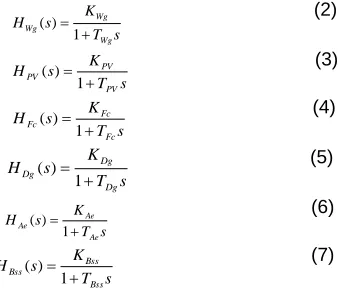
OWER SYSTEMFor simulation of the large scale systems, simplified models such as transfer function models are to be developed. Hence all generating units are developed as first order tranfer funtion models. Therefore the total power obtained is the combination of power from thermal unit and power from the DG resources [12]. The output power of Distributed Generation system is given
_____________________________
2533 s TFc 1 s T K s H Dg Dg Dg
1 )
( (5) s T K s H Ae Ae Ae
1 )
( (6) s T K s H Bss Bss Bss
1 )
( (7)
2.1 Fuzzy PID plus double Integral controller
General layout of FPID-II controller is shown in figure 1. The performance of this controller depends upon five different parameters including the scaling factors. The parameters values are been tuned with the help of SSA optmization technique. Apart from the controller parameters fuzzy logic controller (FLC) ues error and derivative of error as input signals to get the best performance of FPID-II controller.
Fig 1: Structure of FPID-II Controller The control signal of proposed controller is given by
2 . s Kii s Kd s Ki Kp
U
(8) Different membership functions such as traingular, trapezoidal and Gaussian shaped functions are employed in fuzzy logic controller design proess.In this view three traingular membership functions are considered with three Linguistic variables namely Negative (N), Zero (Z) and Positive (P) which consists of nine set of fuzzy rules with membership function ranges from [-1 to 1].The two dimensional rule base are listed in table.1
e
e*
N Z P
proposed FPID-II controller. In this paper for the Hybrid power systems considered two objective and three objective functions [13] are employed for the tuning process which are listed below.
For Two area Interconnected system Two objective Function
dt P f f J Tie T ) (
min 0 212
2 2 2 1
1
(9) J2= Minimum Overshoot {(∆f1) + (∆f2) + (∆Ptie12)} (10) Three objective Function
dt P f f J Tie T ) ( min 2 12 0 2 2 2 1
1
(11) J2= Minimum Overshoot {(∆f1) + (∆f2) + (∆Ptie12)} (12)
dt ACE ACE J T ) ( min 2 2 0 2 1
3
(13)
For Three area Interconnected system Two objective Function
dt P P P f f f
J min T( Tie Tie Tie2 )
13 2 23 2 12 2 3 0 2 2 2 1
1
(14) J2= Minimum Overshoot {(∆f1)+(∆f2) + (∆f3) + (∆Ptie12) + (∆Ptie23) + (∆Ptie13)}
(15)
Three objective Function
dt P P P f f f
J min T( Tie Tie Tie2 )
13 2 23 2 12 2 3 0 2 2 2 1
1
(16) J2= Minimum Overshoot {(∆f1)+(∆f2) +(∆f3)+(∆Ptie12) + (∆Ptie23) + (∆Ptie13)} (17) dt ACE ACE ACE J T ) ( min 2 3 2 2 0 2 1
3
(18) Where ‘J’ is minimized subjected to
max 1 1 min
1 K K
K max
2 2 min
2 K K
K
max min
P P P K K
K KImin KI KImax
max min
D D D K K
K min max
II II II K K
2534
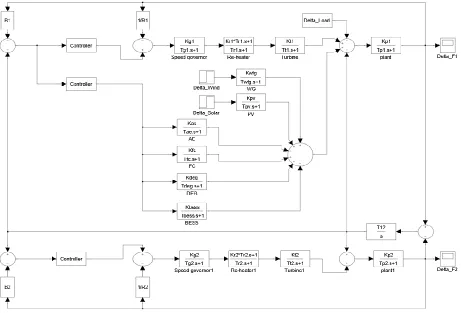
Fig 2. Two area Interconnected thermal Power system Integrated with DG in area1
4 O
VERVIEW OFS
ALP SWARMA
LGORITHMSalpSwarm Algorithm (SSA) is a recent Swarm intelligence algorithm [7] developed in 2017 by Mirjalili. SSA is a population based method which explains the mimicking behaviour of Salp Swarms and their social interaction. The group of Salps called salp chains mathematically divide in to two groups: head salp is a leader and other arefollowers. Till now, the behaviour of salp swarm is not well conveyed, hence the researcher scholars consider the behavior of it to intensify their movement in seeking for food.
Steps followed in SSA
Parameter initialization: The algorithm starts by initializing the parameters such as size in population N, no.of iterations t, and maximum iterations maxiter.
Initial Population: We generate initial population xi, i= {1…..n} randomly in the range of [u,l] where u,l are upper and lower boundaries respectively.
Individuals Evaluations: Each individual (solution) in the population are evaluated by calculating its objective function value and the overall the best solution is assigned for F.
Exploration and exploitation: In order to balance between the Explorations and exploitations of the algorithm, we update the value of parameter c1 given in the equation
(4 )2
1 2 L
l e
c (20)
Where l is the present iteration and L is the maximum no.of. Iterations.
Position updation of solutions: The position of the leader solution and the other follower solutions are updated as given by
0 0 ) (( ) (( 3 3 2 1 2 1 1 forc forc lb c lb ub c F lb c lb ub c F x j j j j j j j j j (21)
Where xj 1
is the leader position in jth dimension and ubj & lbj are the max and min boundaries for j
th
dimension and Fj is the food source position.
And ( )
2
1 1
i
j i j i
j x x
x
(22)
Where i2; xj i
depicts the position of ith follower Salp in the jth dimension
Boundaries violations: If any solution violates the range of the search space during the update process, it returned back in the range of the problem.
2535
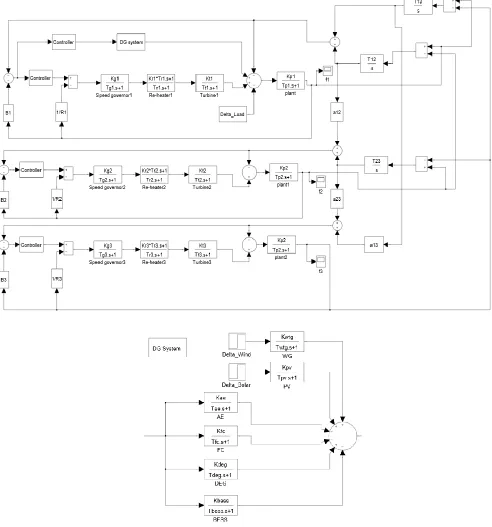
Fig 3. Three area Interconnected Thermal Power system Integrated with DG in area 1
5 R
ESULTS ANDD
ISCUSSIONSThe Dynamic behaviour of the choosen power system is analyzed in two different scenarios.Simulations were
conductedon an Intel, Core i-3 and 4 GB RAM computers
in the MATLAB (R2010a) software environment. The wind
power and solar power variations applied to the power system are considered as ∆Pwtg =0.5 p.u and ∆Ppv=0.18 p.u Initially the comparison of dynamic responses of PI, PID, TDOFPID and FPID-II controller is carried out with the SSA technique. The results depicts that the FPID-II controller performs better controlling action compared to PI, PID and
TDOFPID. Furthermore the comparison of dynamic responses of SSA, GOA, ALO, DA and PSO [8-11] are carried out with FPID-II controller for different loading conditions.
5.1. Two area Interconnected thermal Power system Integrated with DG in area1
2536 Case 1: Step Load perturbation of 0.03 p.u in area 1
Fig 4.Deviation in frequency in area 1 Fig 5.Deviation in frequency in area 2
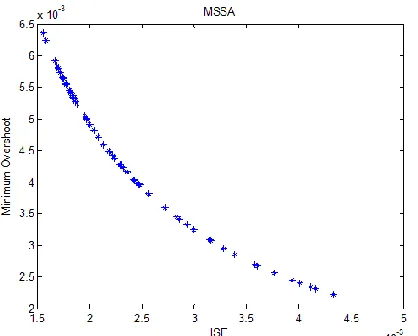
Fig 6.Deviation in Tie-line power Fig 7.Optimal response for Two objective function
Case 2: Step Load perturbation of 0.045 p.u in area 1
2537
Fig 10.Deviation in Tie-line power Fig 11.Optimal response for Two objective function
Three objective results
Case 1: Step Load perturbation of 0.03 p.u in area 1
Fig 12.Deviation in frequency in area 1 Fig 13.Deviation in frequency in area2
Fig 14.Deviation in Tie-line power Fig 15.Optimal response for Three objective function
2538
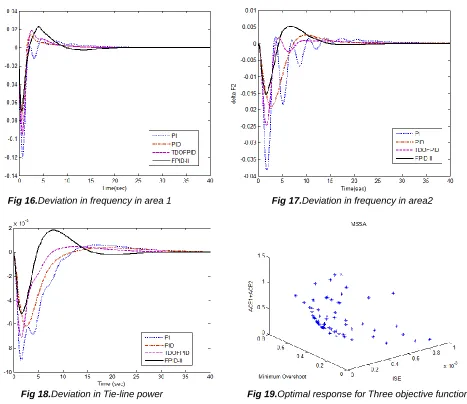
Fig 16.Deviation in frequency in area 1 Fig 17.Deviation in frequency in area2
Fig 18.Deviation in Tie-line power Fig 19.Optimal response for Three objective function
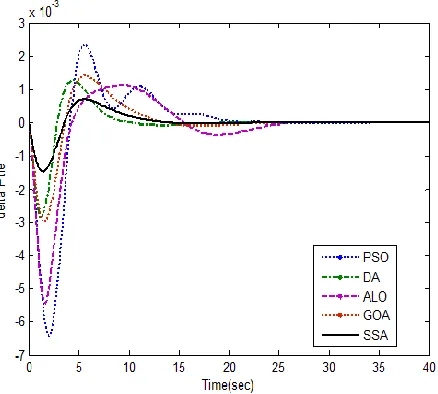
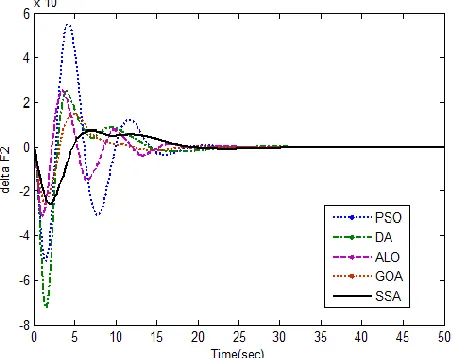
Case 3 : Comparison of SSA respone with different optimization techniques under case-1 of Two objective function
2539 Fig 22.Deviation in Tie-line power
The results depicts the capability of proposed FPID-II controller compared with rest of the controllers. Similarly the dynamic performance of the system is significantly improved with proposed SSA optimization technique under
the considered load varaiations.
The oscillatory condition will sustain for less duration with the implementation of FPID-II controller, making the system stable. The proposed optimization performance can be evident from the table mentioned below.
Comparison of different optimization techniques
Objectives SSA GOA ALO DA PSO
J1 0.0065 0.0084 0.0098 0.0158 0.0194
J2 0.0010 0.0016 0.0025 0.0031 0.0049
Table.2: Comparison of objective fuction values under case-1 of Two objective function
Controllers
Two area Interconnected Thermal power system integrated with DG in area-1
Two objective Three Objective
Case1 Case 2 Case 1 Case 2
J1 J2 J1 J2 J1 J2 J3 J1 J2 J3
PI 0.0086 0.0021 0.0042 0.0062 0.0077 0.6521 1.8665 0.0042 0.6632 3.8689 PID 0.0074 0.0016 0.0023 0.0052 0.0060 0.4633 0.8244 0.0034 0.6591 2.9707 TDOFPID 0.0070 0.0014 0.0019 0.0043 0.0045 0.3432 0.3538 0.0030 0.5563 2.6835 FPID-II 0.0065 0.0010 0.0014 0.0024 0.0008 0.1115 0.0709 0.0003 0.3462 1.0328
Table.3: Comparison of objective fuction values of considered controllers
5.2. Three area Interconnected thermal Power system Integrated with DG in area1
Two objective results
2540
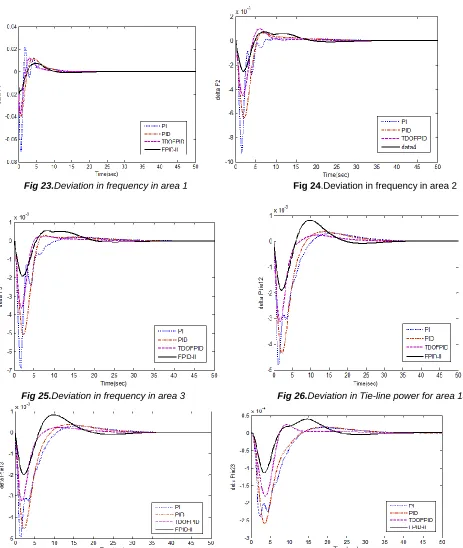
Fig 23.Deviation in frequency in area 1 Fig 24.Deviation in frequency in area 2
Fig 25.Deviation in frequency in area 3 Fig 26.Deviation in Tie-line power for area 1&2
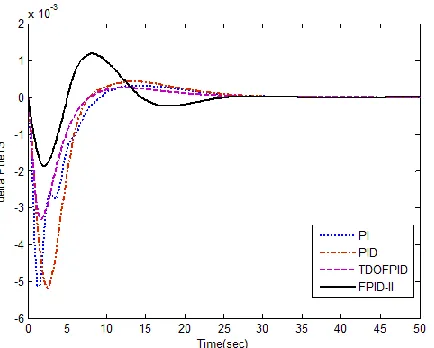
Fig 27.Deviation in Tie-line power for area 1&3 Fig 28.Deviation in Tie-line power for area 2&3
2541
Fig 29.Deviation in frequency in area 1 Fig 30.Deviation in frequency in area 2
Fig 31.Deviation in frequency in area 3 Fig 32.Deviation in Tie-line power for area 1&2
2542
Fig 35.Optimal response for Two objective function under Fig 36.Optimal response for Two objective function under case 1 case 2
Three objective results
Case 1: Step Load perturbation of 0.03 p.u in area 1
Fig 37.Deviation in frequency in area 1 Fig 38.Deviation in frequency in area 2
2543
Fig 41.Deviation in Tie-line power for area 1&3 Fig 42.Deviation in Tie-line power for area 2&3
Case 2: Step Load perturbation of 0.045 p.u in area 1
Fig 43.Deviation in frequency in area 1 Fig 44.Deviation in frequency in area 2
2544
Fig 47.Deviation in Tie-line power for area 1&3 Fig 48.Deviation in Tie-line power for area 2&3
Fig 49. Optimal response for Three objective function Fig 50. Optimal response for Three objective function under case 1 under case 2
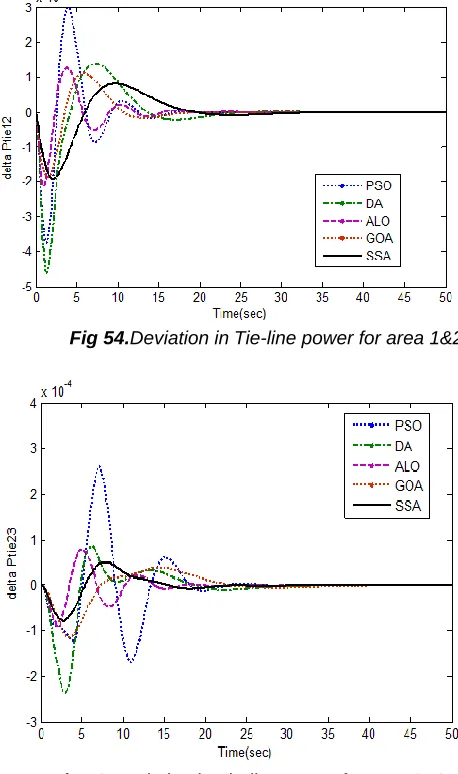
Case 3 : Comparison of SSA respone with different optimization techniques
2545
Fig 53.Deviation in frequency in area 3 Fig 54.Deviation in Tie-line power for area 1&2
Fig 55.Deviation in Tie-line power for area 1&3 Fig 56.Deviation in Tie-line power for area 2&3
Controllers
Three area Interconnected Thermal power system integrated with DG in area-1
Two objective Three Objective
Case1 Case 2 Case 1 Case 2
J1 J2 J1 J2 J1 J2 J3 J1 J2 J3
PI 0.0758 0.0024 0.0136 0.0097 0.0087 0.5261 0.6717 0.0024 0.8744 1.3221 PID 0.0689 0.0021 0.0117 0.0088 0.0082 0.3783 0.5117 0.0022 0.7431 1.2666 TDOF 0.0432 0.0014 0.0113 0.0085 0.0056 0.2820 0.3824 0.0015 0.6983 0.9297 FPID-II 0.0406 0.0012 0.0102 0.0073 0.0004 0.2378 0.2245 0.0001 0.6776 0.7522
Table. 4: Comparison of objective fuction values of considered controllers
Table.5: Comparison of objective fuction values under case-1 of Two objective function
Comparison of different optimization techniques
Objectives SSA GOA ALO DA PSO
J1 0.0406 0.0694 0.0710 0.0769 0.0778
2546 A critical inspection from above results, unveils that the
proposed FPID-II controller exhibits the robustness and authority for Step load perturbations applied in area-1.The dynamic responses also reveals the superiority of the SSA optimization technique based FPID-II controller in minimising the frequency deviations that occurred due to certain load disturbances.
6 C
ONCLUSIONSalp swarm Algorithm (SSA) based Fuzzy PID plus double integral (FPID-II) controller is presented for the AGC problem of Interconneted Hybrid power systems.The test systems considered are Two area interconnected Thermal power system integrated with (Distributed Generation) DG in area-1and Three area interconnected Thermal power system integrated with DG in area-1.The simulation results are carried out with Step load perturbation of 0.03 p.u and 0.045 p.u in area-1.The controller parameters are obtained with SSA technique based on two objective and three objective functions.The dynamic performance of FPID-II controller are being compared with PI,PID and TDOF controllers. Further more, the responses obtained from SSA techniques are been compared with other techniques like GOA, ALO, DA and PSO. With the comparison of the results, it can be concluded that the proposed SSA optimized FPID-II controller provides appreciative results via minimising the oscillations in the system frequency and tie-line power flow.
R
EFERENCES[1] [1] Lal, Deepak Kumar, and Ajit Kumar Barisal. "Load frequency control of AC microgrid interconnected thermal power system." IOP Conference Series: Materials Science and Engineering. Vol. 225. No. 1. IOP Publishing, 2017.
[2] [2] Pandey, Shashi Kant, et al. "Frequency regulation in hybrid power systems using particle swarm optimization and linear matrix inequalities based robust controller design." International Journal of Electrical Power & Energy Systems 63 (2014): 887-900.
[3] [3] Behera, Sarada Prasanna, et al. " Hybrid power systems Frequency regulation using Hybrid PIDF based robust controller design and Differential Evolution (DE) algorithm." 2018 Technologies for Smart-City Energy Security and Power (ICSESP). IEEE, 2018.
[4] [4] Behera, Sarada Prasanna, et al. "Hybrid power systems Frequency regulation using TID based robust controller design and differential evolution (DE) algorithm." 2018 Technologies for Smart-City Energy Security and Power (ICSESP). IEEE, 2018.
[5] [5] Saikia, Lalit Chandra, and Nidul Sinha. "Load frequency control of multi-area hybrid power system using symbiotic organisms search optimized two degree of freedom controller." International Journal of
Renewable Energy Research (IJRER) 7.4 (2017): 1663-1674.
[6] [6] Arya, Yogendra. "Automatic generation control of two-area electrical power systems via optimal fuzzy classical controller." Journal of the Franklin Institute 355.5 (2018): 2662-2688.
[7] [7] Mirjalili, Seyedali, et al. "Salp Swarm Algorithm: A bio-inspired optimizer for engineering design problems." Advances in Engineering Software 114 (2017): 163-191.
[8] [8] Mirjalili, Seyedeh Zahra, et al. "Grasshopper optimization algorithm for multi-objective optimization problems." Applied Intelligence 48.4 (2018): 805-820. [9] [9] Mirjalili, Seyedali, Pradeep Jangir, and Shahrzad
Saremi. "Multi-objective ant lion optimizer: a multi-objective optimization algorithm for solving engineering problems." Applied Intelligence 46.1 (2017): 79-95.
[10][10] Mirjalili, Seyedali. "Dragonfly algorithm: a new meta-heuristic optimization technique for solving single-objective, discrete, and multi-objective problems." Neural Computing and Applications 27.4 (2016): 1053-1073.
[11][11] Kennedy, J., and R. Eberhart. "Particle swarm optimization (PSO)." Proc. IEEE International Conference on Neural Networks, Perth, Australia. (1995):1942-1948.
[12][12] Das, Dulal Ch, A. K. Roy, and N. Sinha. "GA based frequency controller for solar thermal–diesel– wind hybrid energy generation/energy storage system." International Journal of Electrical Power & Energy Systems 43.1 (2012): 262-279.
[13][13] Seshadri, Aravind. "Multi-objective optimization using evolutionary algorithms (MOEA)." (2006): 1-20.
[14]
[14] Shankar, G., and V. Mukherjee. "Load frequency control of an autonomous hybrid power system by
quasi-oppositional harmony search