Fourth-Order Dependency Parsing
∗X uezhe M a
1,2Hai Zhao
1,2†(1) Center for Brain-Like Computing and Machine Intelligence Department of Computer Science and Engineering, Shanghai Jiao Tong University (2) MOE-Microsoft Key Laboratory for Intelligent Computing and Intelligent Systems
Shanghai Jiao Tong University 800 Dong Chuan Rd., Shanghai 200240, China [email protected], [email protected]
A
BSTRACTWe present and implement a fourth-order projective dependency parsing algorithm that ef-fectively utilizes both “grand-sibling” style and “tri-sibling” style interactions of third-order and “grand-tri-sibling” style interactions of forth-order factored parts for performance enhance-ment. This algorithm requiresO(n5)time andO(n4)space. We implement and evaluate the parser on two languages—English and Chinese, both achieving state-of-the-art accuracy. This results show that a higher-order (≥4) dependency parser gives performance improvement over all previous lower-order parsers.
K
EYWORDS:
Dependency Parsing, Fourth-order.∗
This work was partially supported by the National Natural Science Foundation of China (Grant No. 60903119 and Grant No. 61170114), the National Research Foundation for the Doctoral Program of Higher Education of China under Grant No.20110073120022, the National Basic Research Program of China (Grant No. 2009CB320901), and the European Union Seventh Framework Program (Grant No. 247619).
†
1 Introduction
In recent years, dependency parsing has gained universal interest due to its usefulness in a wide range of applications such as synonym generation (Shinyama et al., 2002), relation extraction (Nguyen et al., 2009) and machine translation (Katz-Brown et al., 2011; Xie et al., 2011).
CoNLL-X shared task on dependency parsing (Buchholz and Marsi, 2006; Nivre et al., 2007) made a comparison of many algorithms, and graph-based parsing models have achieved state-of-the-art accuracy for a wide range of languages. Graph-based dependency parsing algo-rithms usually use the factored representations of dependency trees: a set of smallpartswith special structures. The types of features that the model can exploit depend on the informa-tion included in the factorizainforma-tions. Several previous works have shown that higher-order parsers utilizing richer contextual information achieve higher accuracy than lower-order ones— Chen et al. (2010) illustrated that a wide range of decision history can lead to significant improvements in accuracy for graph-based dependency parsing models. Meanwhile, several previous works (Carreras, 2007; Koo and Collins, 2010) have shown that grandchild interac-tions provide important information for dependency parsing. However, the computational cost of the parsing algorithm increases with the need for more expressive factorizations. Conse-quently, the existing most powerful parser (Koo and Collins, 2010) is limited to third-order parts, which requiresO(n4)time andO(n3)space.
In this paper, we further present a fourth-order parsing algorithm that can utilize more richer information by enclosing grand-sibling and tri-sibling parts into a grand-tri-sibling part. Koo and Collins (2010) discussed the possibility that the third-order parsers are extended to fourth-order by increasing vertical context (e.g. from grand-siblings to “great-grand-siblings”) or horizontal context (e.g. from grand-siblings to “grand-tri-siblings”), and Koo (2010) first described this algorithm. In this work, we show that grand-tri-siblings can effectively work. The computational requirements of this algorithm areO(n5)time andO(n4)space. To achieve empirical evaluations of our parser, we implement and evaluate the proposed parsing algo-rithm on the Penn WSJ Treebank (Marcus et al., 1993) for English, and Penn Chinese Tree-bank (Xue et al., 2005) for Chinese, both achieving state-of-the-art accuracy. A free distribu-tion of our implementadistribu-tion in C++has been put on the Internet.1
2 Related Work
There have been several existing graph-based dependency parsing algorithms, which are the backbones of the new fourth-order dependency parser. In this section, we mainly describe four graph-based dependency parsers with different types of factorization.
The first-order parser (McDonald et al., 2005) decomposes a dependency tree into its indi-vidual edges. Eisner (2000) introduced a widely-used dynamic programming algorithm for first-order parsing, which is to parse the left and right dependents of a word independently, and combine them at a later stage. This algorithm introduces two types of dynamic program-ming structures: completespans, andincompletespans (McDonald, 2006). Larger spans are created from two smaller, adjacent spans by recursive combination in a bottom-up procedure. McDonald and Pereira (2006) defined a second-order sibling dependency parser in which inter-actions between adjacent siblings are allowed. Koo and Collins (2010) proposed an algorithm
that factors each dependency tree into a set ofgrandchildparts. Formally, a grandchild part is a triple of indices(g,s,t)wheregis the head ofsandsis the head oft. In order to parse
this factorization, it is necessary to augment both complete and incomplete spans with grand-parent indices. Following Koo and Collins (2010), we refer to these augmented structures as g-spans. The second-order parser proposed in Carreras (2007) is capable of scoring both sibling and grandchild parts with complexities ofO(n4)time andO(n3)space. However, the parser suffers a crucial limitation that it can only evaluate events of grandchild parts for outermost grandchildren.
Koo and Collins (2010) proposed a third-order grand-sibling parser that decomposes each tree into set ofgrand-siblingparts—parts combined with sibling parts and grandchild parts. This factorization defines all grandchild and sibling parts and still requiresO(n4)time andO(n3) space. Koo and Collins (2010) also discussed the possibility that the third-order parsers are extended to fourth-order by increasing vertical context or horizontal context and Koo (2010) first described this algorithm.
Zhang and McDonald (2012) generalized the Eisner (1996) algorithm to handle arbitrary fea-tures over higher-order dependencies. However, their generalizing algorithm suffers quite high complexities of time and space – for instance, the parsing complexity of time isO(n5)for a third-order factored model. In order to achieve asymptotic efficiency of cost, cube pruning for decoding is utilized (Chiang, 2007).
Another dominant category of data-driven dependency parsing systems is local-and-greedy transition-based parsing (Yamada and Matsumoto, 2003; Nivre and Scholz, 2004; Attardi, 2006; McDonald and Nivre, 2007) which parameterizes models over transitions from state to another in an abstract state-machine. In these models, dependency trees are constructed by making a series of incremental decisions. Parameters in these models are typically learned using standard classification techniques.
3 Fourth-Order Parsing Algorithm
In this section, we propose our fourth-order dependency parsing algorithm, which factors each dependency tree into a set ofgrand-tri-siblingparts. Specifically, a grand-tri-sibling is a 5-tuple of indices(g,s,r,m,t)where(s,r,m,t)is a tri-sibling part and(g,s,r,m)and(g,s,m,t)are grand-sibling parts.
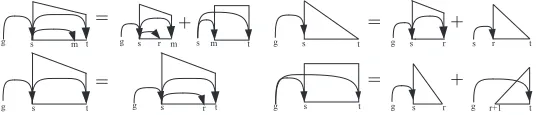
The algorithm is characterized by introducing a new type incomplete g-spans structure: grand-sibling-spans orgs-spans, by augmenting incomplete g-spans with a sibling index. Formally, we denote gs-spans as[g,s,m,t]where[g,s,t]is a normal incomplete g-span and m is an index
Initialization:C[g][s][s][d][c] = 0.0 ∀g, s, d, c
Figure 2: Pseudo-code of bottom-up chart parser for fourth-order grand-tri-sibling parsing algorithm
Figure 1 provides a graphical specification of the fourth-order grand-tri-sibling parsing algo-rithm. An incomplete gs-span is constructed by combining a smaller incomplete gs-span, rep-resenting the next-innermost pair of modifiers, with a sibling g-span. The algorithm resembles the third-order grand-sibling parser except that the incomplete g-spans are constructed by an incomplete gs-span with the same region.
We will now describe the fourth-order grand-tri-sibling parsing algorithm in more detail. Like factored parsing algorithms presented in the previous section, this parsing algorithm can be parsed via adaptations of standard chart-parsing techniques. Following McDonald (2006), let C[g][s][t][d][c]be a dynamic programming table that stores the score of the best subtree from positionsto position t,s<t, with grandparent positiong, directiondand complete valuec. The variabled∈ {←,→}indicates the direction of the subtree (gathering left or right dependents). The variablec∈ {0, 1, 2}indicates if a subtree is complete (c=1), incomplete (c=0) or represents sibling subtrees (c=2). Sibling types have no inherent direction, so
grand-sibling features for part(g,s,m,t)
grand-tri-sibling features for part(g,s,r,m,t)
5-gram features 4-gram backed-off features L(g)·P(s)·P(r)·P(m)·P(t) P(g)·L(s)·P(r)·P(m)·P(t) L(g)·P(r)·P(m)·P(t) P(g)·L(r)·P(m)·P(t) P(g)·P(s)·L(r)·P(m)·P(t) P(g)·P(s)·P(r)·L(m)·P(t) P(g)·P(r)·L(m)·P(t) P(g)·P(r)·P(m)·L(t) P(g)·P(s)·P(r)·P(m)·L(t) P(g)·P(s)·P(r)·P(m)·P(t) P(g)·P(r)·P(m)·P(t)
4 Feature Space
Following previous works (McDonald and Pereira, 2006; Koo and Collins, 2010), the fourth-order parser captures not only features associated with corresponding fourth-fourth-order grand-tri-sibling parts, but also the features of relevant lower-order parts that are enclosed in its factor-ization.
The lower-order features (first-order features of dependency parts and second-order features of grandchild and sibling parts) are based on feature sets from previous work (McDonald et al., 2005; McDonald and Pereira, 2006; Carreras, 2007). We added lexicalized versions of several features. For example, second-order grandchild feature set defines lexical trigram features, while previous work only used POS trigram features.
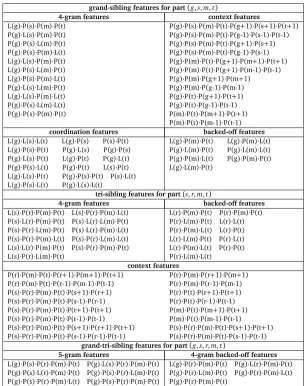
Table 1 outlines all feature templates of third-order grand-sibling, third-order tri-sibling, and fourth-order grand-tri-sibling parts. The fourth-order feature set consists of two sets of features. The first set of features is defined to be5-gram featuresthat is a 5-tuple consisting of five relevant indices using words and POS tags. The second set of features is defined asbacked-off features(Koo and Collins, 2010) for grand-tri-sibling part(g,s,r,m,t)—the 4-gram(g,r,m,t), which never exist in any lower-order part. The determination of this feature set is based on on experiments on the development data for both English and Chinese. In section 5.1 we examine the impact of these new features on parsing performance.
According to Table 1, several features in our parser depend on part-of-speech (POS) tags of input sentences. For English, POS tags are automatically assigned by the SVMTool tag-ger (Gimenez and Marquez, 2004). The accuracy of the SVMTool tagtag-ger on PTB is 97.3%; For Chinese, we used gold-standard POS tags in CTB. Following Koo and Collins (2010), two versions of POS tags are used for any features involve POS: one using is normal POS tags and another is a coarsened version of the POS tags.2
5 Experiments
The proposed fourth-order dependency parsing algorithm is evaluated on the Penn English Treebank (PTB 3.0) (Marcus et al., 1993) and the Penn Chinese Treebank (CTB 5.0). For English, the PTB data is prepared by using the standard split: sections 2-21 are used for training, section 22 is for development, and section 23 for test. For Chinese, we adopt the identical training/validation/testing data split and experimental set-up as Zhang and Clark (2009). Dependencies are extracted by using Penn2Malt3tool.
Parsing accuracy is measured with unlabeled attachment score (UAS): the percentage of words with the correct head, and the percentage of complete matches (CM).4
Thek-best version of the Margin Infused Relaxed Algorithm (MIRA) (Crammer and Singer, 2003; Crammer et al., 2006; McDonald, 2006) for the max-margin models (Taskar et al., 2003) is chosen for parameter estimation of our parsing model, In practice, we setk=10 and exclude the sentences containing more than 100 words in both the training data sets of English and Chinese in all experiments.5
2For English, we used first two characters of the tag, exceptPRP$; For Chinese, we dropped the last character, exceptPUandCD
3http://w3.msi.vxu.se/˜nivre/research/Penn2Malt.html
4As in previous work, English evaluation ignores any token whose gold-standard POS tag is one of{“ ” : , .}, and Chinese evaluation ignores any token whose tag is "PU".
Eng Chn
Feature UAS CM UAS CM
baseline 93.45 49.06 87.38 38.85 +tri-sibling 93.62 49.42 87.60 38.94 +grand-tri-sibling 93.70 49.76 87.69 39.12 +4-gram backed-off 93.77 50.82 87.74 39.23
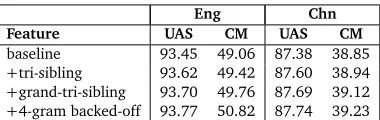
Table 2: The effect of different types of features on the development sets for English and Chinese.
5.1 Development Experiments
In this section, we dissect the contributions of each type of features. Table 2 shows the effect of different types of features on the development data sets for English and Chinese. Each row in Table 2 uses a super set of features than the previous one. Third-order grand-sibling parser is used as the baseline, and third-order tri-sibling, 5-gram grand-tri-sibling and 4-gram backed-off feature templates in Table 1 are incrementally added. All systems use our proposed fourth-order parsing algorithm. Since the only difference between systems is the set of features used, we can analyze the improvement from additional features.
From Table 2, we can see that each of the following parser capturing a group of new feature templates makes improvement on parsing performance over the previous one. Thus, we can conclude that the improvements come from the factorization’s ability of capturing richer fea-tures which contains more context information.The parser with all these feafea-tures achieves UAS of 93.77% and CM of 50.82% on PTB and UAS of 87.74%, CM of 39.23% on CTB.
5.2 Results and Analysis
Our parser obtains UAS of 93.4% and CM 50.3% of on PTB, and UAS of 87.4%, CM of 36.8% on CTB. Both of the results are state-of-the-art performance on these two treebanks. Table 3 illustrates the UAS and CM of the fourth-order parser on PTB, together with some relevant results from related work. We compare our method to first-order and second-order sibling dependency parsers (McDonald and Pereira, 2006), and two third-second-order based parsers (Koo and Collins, 2010). Additionally, we compare to a state-of-the-art graph-based parser (Zhang and McDonald, 2012) as well as a state-of-the-art transition-graph-based parser (Zhang and Nivre, 2011).
Parser UAS CM
McDonald and Pereira (2006), 1storder 90.9 36.7 McDonald and Pereira (2006), 2ndorder 91.5 42.1 Zhang and Clark (2008) 92.1 45.4 Zhang and Nivre (2011) 92.9 48.0 Koo and Collins (2010), model 2 92.9 – Koo and Collins (2010), model 1 93.0 – Zhang and McDonald (2012) 93.1 –
this paper 93.4 50.3
Koo et al. (2008)† 93.2 –
Carreras et al. (2008)‡ 93.5 – Suzuki et al. (2009)† 93.8 –
Table 3: UAS and CM of different parsers on PTB 3.0
Parser UAS CM
Huang and Sagae (2010) 85.2 33.7 Zhang and Clark (2008) 85.7 34.4 Zhang and Nivre (2011) 86.0 36.9 3rdorder grand-sibling 86.8 35.5 Zhang and McDonald (2012) 86.9 –
this paper 87.4 36.8
Zhang and Clark (2009)‡ 86.6 36.1
Table 4: UAS and CM of different parsers on CTB 5.0
Next, we turn to the impact of our fourth-order parser on Chinese. Table 4 shows the comparative results for Chinese. Here we compare our method to an implement of the third-order grand-sibling parser — whose parsing performance on CTB is not re-ported in Koo and Collins (2010), and the dynamic programming transition-based parser of Huang and Sagae (2010). Additionally, we compare to the state-of-the-art graph-based de-pendency parser (Zhang and McDonald, 2012) as well as a state-of-the-art transition-based parser (Zhang and Nivre, 2011). The results indicates that our parser achieved significant im-provement of the previous systems on this data set. The parsing model of Zhang and Clark (2009), which is marked ‡, also depends on phrase-structure annotations. So it cannot com-pare with ours directly, even through our results are better.
6 Conclusion
We have presented an even higher-order projective dependency parsing algorithm that can evaluate the fourth-order sub-structures of grand-tri-siblings. This algorithm achieves stage-of-the-art performance on both PTB and CTB, which demonstrates that the fourth-order grand-tri-sibling features have important contribution to dependency parsing.
References
Attardi, G. (2006). Experiments with a multilanguage non-projective dependency parser. In Proceedings of the Tenth Conference on Natural Language Learning (CoNLL-2006), pages 166– 170, New York, USA.
Buchholz, S. and Marsi, E. (2006). CoNLL-X shared task on multilingual dependency parsing. InProceeding of the 10th Conference on Computational Natural Language Learning (CoNLL’06), pages 149–164, New York, NY.
Carreras, X. (2007). Experiments with a higher-order projective dependency parser. In Pro-ceedings of the CoNLL Shared Task Session of EMNLP-CONLL, pages 957–961.
Carreras, X., Collins, M., and Koo, T. (2008). Tag, dynamic programming, and the perceptron for efficient, feature-rich parsing. InProceedings of CoNLL, pages 9–16, Manchester, England. Chen, W., Kazama, J., Tsuruoka, Y., and Torisawa, K. (2010). Improving graph-based depen-dency parsing with decision history. InProceeding of the 23rd International Conference on Computional Linguistics (COLING’10), pages 126–134, BeiJing, China.
Chiang, D. (2007). Hierarchical phrase-based translation.Computational linguistics, 33(2). Crammer, K., Dekel, O., Keshet, J., Shalev-Shwartz, S., and Singer, Y. (2006). Online passive-aggressive algorithms.Jornal of Machine Learning Research, 7:551–585.
Crammer, K. and Singer, Y. (2003). Ultraconservative online algorithms for multiclass prob-lems.Journal of Machine Learining Research, 3:951–991.
Eisner, J. (1996). Three new probabilistic models for dependency parsing: An exploration. InProceedings of the 9th International Conference on Computational Linguistics (COLING’06), pages 340–345.
Eisner, J. (2000). Bilexical grammars and their cubic-time parsing algorithms. In Bunt, H. and Nijholt, A., editors,Advances in Probabilistic and Other Parsing Technologies, pages 29–62. Kluwer Academic Publishers.
Gimenez and Marquez (2004). Svmtool: A general pos tagger generator based on support vector machines. InProceedings of the 4th International Conference of Language Resources and Evaluation (IREC’04), Lisbon, Portugal.
Huang, L. and Sagae, K. (2010). Dynamic programming for linear-time incremental parsing. InProceeding of ACL 2010, pages 1077–1086, Uppsala, Sweden.
Katz-Brown, J., Petrov, S., McDonald, R., Och, F., Talbot, D., Ichikawa, H., Seno, M., and Kazawa, H. (2011). Training a parser for machine translation reordering. InProceedings of the 2011 Conference on Empirical Methods in Natural Language Processing, pages 183–192, Edinburgh, Scotland, UK. Association for Computational Linguistics.
Koo, T. (2010). Advances in Discriminative Dependency Parsing. PhD thesis, Massachusetts Institute of Technology.
Koo, T. and Collins, M. (2010). Efficient third-order dependency parsers. InProceedings of 48th Meeting of the Association for Computional Linguistics (ACL’10), pages 1–11, Uppsala, Sweden.
Marcus, M., Santorini, B., and Marcinkiewicz, M. A. (1993). Building a large annotated corpus of English: the Penn Treebank.Computational Linguistics, 19(2):313–330.
McDonald, R. (2006).Discriminative learning spanning tree algorithm for dependency parsing. PhD thesis, University of Pennsylvania.
McDonald, R., Crammer, K., and Pereira, F. (2005). Online large-margin training of depen-dency parsers. InProceedings of the 43rd Annual Meeting on Association for Computational Linguistics (ACL-2005), pages 91–98, Ann Arbor, Michigan, USA.
McDonald, R. and Nivre, J. (2007). Characterizing the errors of data-driven dependency parsing models. InProceedings of the 2007 Joint Conference on Empirical Methods in Natu-ral Language Processing and Computational NatuNatu-ral Language Learning (EMNLP-CoNLL 2007), pages 122–131, Prague, Czech.
McDonald, R. and Pereira, F. (2006). Online learning of approximate dependency parsing algorithms. InEuropean Association for Computational Linguistics (EACL-2006), pages 81–88, Trento, Italy.
Nguyen, T.-V. T., Moschitti, A., and Riccardi, G. (2009). Convolution kernels on constituent, dependency and sequential structures for relation extraction. InProceedings of the 2009 Conference on Empirical Methods in Natural Language Processing, pages 1378–1387, Singapore. Association for Computational Linguistics.
Nivre, J., Hall, J., Kübler, S., Mcdonald, R., Nilsson, J., Riedel, S., and Yuret, D. (2007). The CoNLL 2007 shared task on dependency parsing. InProceeding of EMNLP-CoNLL 2007, pages 915–932, Prague, Czech.
Nivre, J. and Scholz, M. (2004). Deterministic dependency parsing of english text. In Pro-ceedings of the 20th international conference on Computational Linguistics (COLING’04), pages 64–70, Geneva, Switzerland.
Shinyama, Y., Sekine, S., and Sudo, K. (2002). Automatic paraphrase acquisition from news articles. InProceeding of the 2nd International Conference on Human Language Technology Research (HLT’02), pages 313–318.
Suzuki, J., Isozaki, H., Carreras, X., and Collins, M. (2009). An empirial study of semi-supervised structured conditional models for dependency parsing. InProceedings of EMNLP, pages 551–560.
Taskar, B., Guestrin, C., and Koller, D. (2003). Max margin markov networks. In Sebas-tian Thrun, L. K. S. and Scholköopf, B., editors,NIPS. MIT Press.
Xue, N., Xia, F., Chiou, F.-D., and Palmer, M. (2005). The Penn Chinese TreeBank: Phrase structure annotation of a large corpus.Natural Language Engineering, 11(2):207–238.
Yamada, H. and Matsumoto, Y. (2003). Statistical dependency analysis with support vector machines. InProceedings of the 8th International Workshop on Parsing Technologies (IWPT-2003), pages 195–206, Nancy, France.
Zhang, H. and McDonald, R. (2012). Generalized higher-order dependency parsing with cube pruning. InProceedings of the 2012 Joint Conference on Empirical Methods in Natural Language Processing and Computational Natural Language Learning, pages 320–331, Jeju Island, Korea. Association for Computational Linguistics.
Zhang, Y. and Clark, S. (2008). A tale of two parsers: investigating and combining graph-based and transition-graph-based dependency parsing using beam search. InProceedings of EMNLP, pages 562–571.
Zhang, Y. and Clark, S. (2009). Transition-based parsing of Chinese treebank using a global discriminative model. InProceedings of the 11th International Conference on Parsing Technolo-gies (IWPT’09), pages 162–171, Paris, France.