O R I G I N A L R E S E A R C H
The Effect of Visual Working Memory Training
Could Transfer Across Stimuli
This article was published in the following Dove Press journal: Psychology Research and Behavior Management
Taiyong Bi 1
Xiaogang Wang2
Hui Kou1
Jiang Qiu2
1Center for Mental Health Research in
School of Management, Zunyi Medical University, Guizhou, People’s Republic of China;2Key Laboratory of Cognition and Personality (Ministry of Education), Southwest University, Chongqing, People’s Republic of China
Background: Working memory, as a fundamental cognitive ability, has been shown to
improve with learning. However, little is known about the learning effect of visual working memory training and its generalization to other stimuli and tasks.
Methods:In the present study, we utilized a delayed match-to-sample task to measure the
working memory of faces and houses. Subjects were trained ten days on this task and were tested on the same task and a memory span task before and after the training.
Results: The results showed that training significantly increased the accuracy of visual
working memory. More importantly, such a learning effect could partly transfer to a visual working memory task with different stimuli. However, the learning effect may not transfer to a memory span task.
Conclusion:Ourfindings demonstrate that training might influence the common processing
of different stimuli in a visual working memory task.
Keywords:training, visual working memory, transfer, face perception
Introduction
Learning could improve the majority of our abilities to perform perceptual tasks.1 For instance, training on an orientation discrimination task of grating led to a large decrease in the discrimination threshold.2 Learning-induced improvements were observed in various tasks, such as contrast discrimination,3 shape identification,4 face view discrimination5 and facial expression discrimination.6A common char-acteristic among these learning effects was that the improvements were specific to the trained task and stimuli. For instance, after learning to identify a set of objects, the performance of identifying new objects remained unchanged, demonstrating a strong stimulus specificity of learning.7This specificity was considered to reflect the phenomenon that training might influence visual processing underlying such perceptual tasks.
Similarly to learning in perceptual tasks, training was also observed to be effective at improving the performance of working memory (WM) tasks.8 WM, which is a fundamental cognitive function of human, is usually characterized as the ability to maintain and manipulate perceptual information in a short period of time.9 Three subsystems were identified, including a central executive system to process information, and two slave systems of visuospatial sketch pad and phonological loop to store visual and verbal information, respectively.9Previous studies usually adapted visuospatial WM (VSWM), n-back or verbal WM tasks to investigate how training improved the perfor-mance on the same and other tasks. For instance, Jolles et al10trained subjects with Correspondence: Hui Kou
Center for Mental Health Research in School of Management, Zunyi Medical University, 6 West Xuefu Road, Zunyi, Guizhou 563000, People’s Republic of China
Email [email protected]
Jiang Qiu
Key Laboratory of Cognition and Personality (Ministry of Education), Southwest University, 2 Tiansheng Road, Beibei, Chongqing 400715, People’s Republic of China
Email [email protected]
Psychology Research and Behavior Management
Dove
press
open access to scientific and medical research
Open Access Full Text Article
Psychology Research and Behavior Management downloaded from https://www.dovepress.com/ by 118.70.13.36 on 26-Aug-2020
a verbal WM task in which subjects were instructed to name and memorize a series of objects. The researchers observed a significant learning effect after a 6-week training period on the same verbal WM task. However, such a learning effect could not transfer to other WM tasks, such as the digit span task. Interestingly, the transfer effect was also absent in the case of a spatial variant of the trained WM task even if the stimuli were very similar in the two WM tasks. In contrast to this result, other studies observed transfer effects across tasks. For instance, Jaeggi et al11observed that n-back task training also enhancedfluid intelligence. Another animal study showed that WM training improved general cognitive abilities, such as selective attention of mice.12Similarly, in older subjects, train-ing with the n-back task was observed to improve theirfluid intelligence as well as executive functions and processing speed.13 However, meta-analysis results indicated that the transfer from WM training to other cognitive skills such as fluid intelligence was small.14,15 It was proposed that far transfer (between a WM task and other cognitive tasks) was relatively weak, while near transfer (among WM tasks) was evident and sustained.16,17One proposed explanation is that the transfer only occurs when the trained task and the transfer task share the same cognitive processing. Consistent with this hypothesis, Dahlin et al18observed that training on a WM task engaging updating processing could not improve the perfor-mance on another WM task that did not engage such processing.
Although the learning effect and the transfer effect were extensively studied in a variety of WM tasks, we still know little about these effects in visual WM (VWM) tasks. VWM emphasizes the retention of visual content but not the spatial location of the stimuli. For example, Salazar et al19utilized a VWM task in which monkeys were only required to memor-ize the feature of the stimulus, and found content-specific fronto-parietal synchronization during the retention period. Other studies found that the processing of VWM also relied on the activities in the visual cortex.20–22Therefore, it is thus difficult to predict the transfer of VWM training among dif-ferent stimuli. If training primarily influences the perceptual processing of visual stimuli, VWM training may show strong specificity to the visual stimuli. In contrast, if learning infl u-ences the common ability of working memory, transfer should be observed among different visual stimuli. In other words, if VWM training shows strong stimulus specificity, it may imply a distinct learning mechanism underlying VWM training com-pared with other WM training. As mentioned above, the effect of WM training could transfer to other tasks which contained the same cognitive processing as the training task, and
transfers were indeed found for WM training such as n-back task, verbal WM task and VSWM task. As there was no evidence showing that VWM training may be different from other kinds of WM training, we may hypothesize that the transfer effect of VWM training may be observed across different stimuli. More specifically, we predicted that the improvements on the performance for the trained and the untrained stimuli should be the same after training.
In the present study, we investigate whether the learning effect of VWM training could transfer to the same task with untrained stimuli and to a memory span task. We adopted complex visual stimuli such as faces and houses for training and testing because the learning of these stimuli could transfer across the whole visual field,5,7 excluding the influence of location specificity on our results. For example, Bi et al5 trained subjects with a face view discrimination task and found a nearly complete transfer effect of learning across the visualfields. If we adopted a training task with high location specificity, we could not exclude the impact of location speci-ficity when we found a strong specificity of learning among different tasks. In addition, as evidence suggests that learning effect may be easy to generalize among stimuli at the early stage of training,23 in the present study, we examined the transfer effect at different stages of training. As we mentioned above, the observed transfer effect between two tasks may increase with the similarity of the processing between these tasks. Evidently, the processing is largely overlapped for two VWM tasks which are only different in the stimuli. Therefore, the transfer between these two VWM tasks could be consid-ered as near transfer, and we predicted that such a transfer effect could be observed. In contrast, as the underlying proces-sing between VWM and memory span tasks is largely differ-ent, the transfer effect between these two tasks may be considered as far transfer and may be hard to detect. In summary, we hypothesized that the training effect of a VWM task could transfer across different stimuli but not transfer to the memory span task.
Methods
Participants
A total of thirty-eight naïve subjects (27 females) participated in this study. They were right-handed with reported normal or corrected-to-normal vision. All of them were college stu-dents (M=19.74 years, SD=0.88, age-range=17–21). No his-tory of neurological or psychiatric problems was reported. All participants provided written informed consent in accor-dance with the Institutional Human Participants Review
Psychology Research and Behavior Management downloaded from https://www.dovepress.com/ by 118.70.13.36 on 26-Aug-2020
Board of Southwest University, China. This study was approved by the Institutional Human Participants Review Board of Southwest University and was conducted in accor-dance with the Declaration of Helsinki. One participant who was 17 years old gave his written informed consent on his own behalf, which was approved by the Institutional Human Participants Review Board of Southwest University. Twenty of these participants were assigned to the trained group, and eighteen of them were assigned to the untrained group.
As we aimed to measure the memory of faces, it was important to examine whether the face recognition of the participants was normal. Therefore, each participant also com-pleted the 20-item prosopagnosia index (PI20) which is an effective scale for identifying developmental prosopagnosia.24 Demographic characteristics and PI20 scores in each group were presented inTable 1. No significant differences between groups were found for subjects’ sex, age, education level, smoking status and PI20 score.
Materials
Sixty adult faces (thirty females) with neutral expressions were selected from the Chinese Facial Affective Picture System (CFAPS).25 Hair and ears were excluded using Photoshop. Sixty house pictures were downloaded from the Internet. All pictures were then added to a black back-ground and resized to 151*138 pixels (3.3*3 degrees of visual angle). Afterwards, pictures were converted to grey-scale and adjusted to have the same brightness and con-trast using Matlab. Half of the face pictures were randomly selected as the training set of stimuli, while the other half were assigned to the set of untrained faces. Pictures were presented on a Samsung 19-inch LCD monitor with a spatial resolution of 1024x768 and a refresh rate of 60 Hz. Throughout the experiment, subjects were told to fixate on a small white dot presented in the centre of the monitor. To stabilize their head position, a chin rest and a headrest were used. The viewing distance was 100 cm.
Procedure
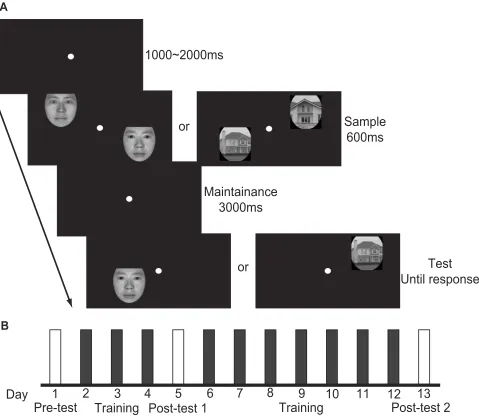
For the trained group, each subject underwent ten daily train-ing sessions (1 hr per day) and three test sessions before the training, after three training sessions, and after ten training sessions (Pre-test, Post-test1, and Post-test2, respectively). Each training session consisted of 12 blocks of VWM tasks. Each block contained 40 delayed match-to-sample (DMTS) trials (Figure 1A). Each trial began with a fixation point. Afterwards, two different faces (samples) randomly selected from the training set were simultaneously presented for 600 ms. A blank interval withfixation was then presented for 3000 ms after the disappearance of the samples. During this period of time, subjects were required to maintain the identities of the sample faces in their mind. A test stimulus was then presented. Participants were asked to make a yes or no judgement of whether the test face was the same as one of the sample faces. A high-pitched sound was played back following an incorrect response, and the next trial began after the feedback. Participants were told to press“m”if the answer was“yes”, and“n”if the answer was“no”, as quickly and accurately as possible. The positions for stimulus presentation were four fixed positions with one in each quadrant of the visualfield. The distance between the stimulus position and thefixation was 3 degrees of visual angle. Stimuli were randomly pre-sented at these four positions.
During each day of the test sessions, subjects com-pleted a total of 18 blocks of VWM tasks. The procedure was similar to that of the training session. Six blocks used the training set of faces as the stimuli. Another six blocks used the untrained set of faces as the stimuli. The remain-ing six blocks used house pictures as the stimuli. In addi-tion, no feedback was provided in the test sessions.
To assess the transfer of VWM training to other WM tasks, subjects were also asked to perform a memory span task in each test session. The memory span task included two subtests: a digit span test (DST) and a letter span test (LST). The procedures followed the standard procedure of memory span test. In each trial of DST, a series of random numbers
Table 1Demographic Characteristics and Scale Scores (Mean±SD)
Trained Group Untrained Group χ2or t p
Sex (female/male) 14/6 13/5 0.023 0.88
Age 19.9(0.788) 19.7(0.958) 0.627 0.535
Education level (year) 12.9(1.119) 12.8(1.383) 0.164 0.871
Smoking status (year) 0.150(0.489) 0.228(0.752) −0.627 0.535
PI20 score 40.1(7.584) 36.4(8.445) 1.387 0.174
Abbreviation:PI20, The 20-item prosopagnosia index.
Psychology Research and Behavior Management downloaded from https://www.dovepress.com/ by 118.70.13.36 on 26-Aug-2020
were sequentially presented at the centre of the screen. Subjects were required to repeat the sequence as accurately as possible. The length of the sequence increased from 3 items to 13 items. Thefinal score of the test was the max-imum length that the subjects successfully recalled. The procedure of LST was totally the same as that of DST, except that the items were random letters instead of numbers.
For the untrained group, each subject only com-pleted the three test sessions on the 1st, 5th and 13th days. The task and procedure matched exactly those of the trained group. It should be noted that for the untrained group, no training was conducted, and
“trained face” and “untrained face” here merely
represented the two sets of faces that were divided prior to the experiment.
The procedure of experiment is illustrated inFigure 1B.
Experimental Design
For the VWM task, the experimental design is a 2 (subject group: trained/untrained)×3 (stimulus category: trained face/ untrained face/house)×3 (session: Pre-test/Post-test1/Post-test2) design. Independent variables of stimulus category and session are within-subject variables, while subject group is a between-subject variable. For the memory span task, the experimental design is a 2 (subject group: trained/untrained)×3 (session: Pre-test/Post-test1/Post-test2) design. Session is
1
2
3
4
5
6
7
8
9
10
11
12
13
Pre-test
Post-test 1
Post-test 2
Day
Training
Training
or
or
Sample
600ms
1000~2000ms
Maintainance
3000ms
Test
Until response
A
B
Figure 1Experimental procedureComment: Dear author: please confirm that the people whose faces are shown in thefigure have consented to the publication of
this image/their likenesses. (A) A sample trial of the VWM task. Sample faces or houses were presented for 600 ms. Subjects were instructed to retain the identity of stimuli for 3 s and were then asked whether the test stimulus was one of the sample stimuli. (B) Each subject underwent 13 days of training and testing. On Day 1, Day 5 and Day 13, WM performance was tested for each type of stimulus. On other days, each subject was trained with the training set of faces.
Psychology Research and Behavior Management downloaded from https://www.dovepress.com/ by 118.70.13.36 on 26-Aug-2020
a within-subject variable, while subject group is a between-subject variable. When an interaction effect or a main effect was significant, post hoc analysis was performed to further indicate the direction of the difference between conditions.
In addition, to reveal the behavioural improvement in the training phase, planned comparisons were conducted between the performances in 2 days during training. For example, the comparison between a latter day and the first day may indicate whether the performance improved with training; the comparison between an earlier day and the last day may indicate whether the performance saturated.
Data Analysis
The accuracy and average reaction time (RT) were first calculated for each block. Afterwards, in the training ses-sions, we averaged the accuracy values and RTs over the 12 blocks for each day. In the test sessions, the accuracy values and RTs were averaged across the six blocks for each condition (trained face/untrained face/house) during each day. In addition, in order to present the learning and transfer effect more clearly, we also calculated the perfor-mance improvement based on the accuracy results. The performance improvement was defined as the difference of accuracy for the same condition in test1 (or Post-test2) and Pre-test sessions. Repeated-measures ANOVA and paired sample t-tests were used to compare means for different conditions and groups. The Bonferroni adjust-ment was adopted to address the multiple comparison problems. Statistical power and effect size (ES: Cohen’s d for t-test and partialη2for F-test) were provided when necessary. SPSS 16.0 ( www.ibm.com/products/spss-statistics) and G*Power 3.126 were used for statistical tests and power analyses.
Results
The VWM Task
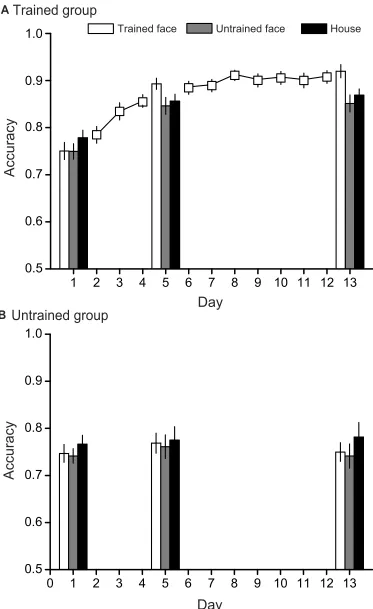
The average accuracy values for each day are shown in
Figure 2. First, we examined whether performance increased with training during the training sessions in the trained group. The accuracy on thefirst day of training (Day 2) was 0.785 (SD=0.080), while that at the last day of training (Day 12) was 0.910 (SD=0.060). The paired sample t-test revealed a significant improvement in the performance of VWM (t (19)=12.4, p<0.001, ES=2.762, power=1.000). Furthermore, we investigated the improvements before Post-test1 and after Post-test1. Before Post-test1, the accuracy increased from 0.785 at Day 2 to 0.857 (SD=0.060) at Day 4 (paired t(19)
=6.8, p<0.001, ES=1.508, power=1.000). After Post-test1, the accuracy increased from 0.887 (SD=0.062) at Day 6 to 0.910 at Day 12 (paired t(19)=2.9, p=0.009, ES=0.654, power=0.792). Performance became saturated at Day 8 (Mean=0.913, SD=0.050), which was not different from performance at Day 12 (paired t(19)=0.5, p=0.603, ES=0.118, power=0.079). These results indicated that accu-racy increased rapidly during thefirst 3 days of training and soon became saturated after 5 days of training.
Next, we compared the performance among different conditions and groups in the test sessions. A 2 (subject group: trained/untrained)×3 (stimulus category: trained face/untrained face/house)×3 (session: Pre-test/Post-test1 /Post-test2) repeated-measures ANOVA was performed on the accuracy results. Results showed a significant interac-tion among the three factors (F(4, 144)=4.3, p=0.002, ES=0.107, power=0.925). In addition, the interactions between group and session (F(2, 144)=38.6, p<0.001, ES=0.517, power=1.000) and between group and stimulus category (F(2, 144)=4.7, p=0.012, ES=0.116, power=0.775) were both significant, indicating two different patterns of results between the two groups. Therefore, we further ana-lysed the data from the two groups separately.
For the trained group, there were significant differences among the three sessions for the trained face (repeated-measures ANOVA, F(2,38)=99.3, p<0.001, ES=0.839, power=1.000), indicating that the accuracy for the trained face increased with training. Post hoc tests with Bonferroni correction showed significantly higher accura-cies in Post-test1 and Post-test2 than Pre-test (all p<0.05) and no significant difference between the performance in Post-test1 and Post-test2 (p>0.05). Similarly, the accura-cies for the untrained face and house were both different among the three sessions (untrained face: F(2,38)=34.9, p<0.001, ES=0.648, power=1.000; house: F(2,38)=33.8, p<0.001, ES=0.640, power=1.000). For both the untrained face and house, post hoc tests showed significant higher accuracies in Post-test1 and Post-test2 than those in Pre-test (all p<0.05), and no difference between Post-Pre-test1 and Post-test2 (all p>0.05). These results demonstrated large improvements after training for not only the trained sti-muli, but also the untrained stimuli.
For the untrained group, no training sessions were con-ducted. Note that the trained faces here represented the training set of faces for the trained group. ANOVAs showed no significant differences among the three sessions for any stimulus category (trained face: F(2,34)=1.4, p=0.258, ES=0.077, power=0.281; untrained face: F(2,34)=1.1,
Psychology Research and Behavior Management downloaded from https://www.dovepress.com/ by 118.70.13.36 on 26-Aug-2020
Trained face Untrained face House
Day
Accuracy
Trained group
A
B
Untrained group
Day
Accuracy
Figure 2Accuracy results for the VWM task. (A) Average accuracy for each day of training and testing in the trained group. Day 1, Day 5, and Day 13 were Pre-test,
Post-test1, and Post-test2, respectively. (B) Average accuracy for each day of testing in the untrained group. Data were averaged across all subjects. Error bars denote one standard error of the mean.
Psychology Research and Behavior Management downloaded from https://www.dovepress.com/ by 118.70.13.36 on 26-Aug-2020
p=0.343, ES=0.061, power=0.228; house: F(2,34)=0.8, p=0.469, ES=0.044, power=0.171). These results indicated no improvement on the accuracy among the three test ses-sions for the untrained group.
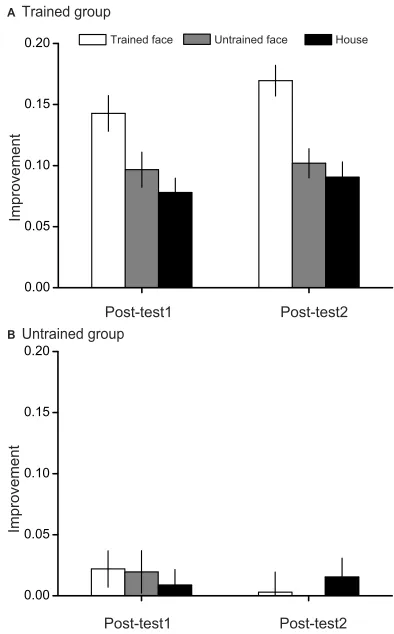
To further illustrate the difference of behavioural improvement among the three stimulus categories, we calculated the improvements for each condition in Post-test1 and Post-test2 sessions (Figure 3). The improvement was defined as the difference between the accuracy values for the same condition in Post-test1 (or Post-test2) and Pre-test sessions. The performance improvement is a direct measurement of the learning and transfer effect. As a result, we can compare the learning effect more directly among different stimuli and between the two groups. The results showed significant improvements for all conditions in both Post-test1 (all t(19)>6, p<0.001) and Post-test2 (all t(19)>7, p<0.001) sessions. However, these improvements were not the same across different condi-tions in Post-test1 (F(2,38)=8.8, p=0.001, ES=0.315, power=0.958) or Post-test2 (F(2,38)=15.1, p<0.001, ES=0.442, power=0.998) sessions. Post hoc tests showed that improvements for the trained faces were the highest in both Post-test1 (both p<0.05) and Post-test2 (both p<0.05) sessions. Improvements for the untrained faces and the houses were not different from each other in either Post-test1 (p>0.05) or Post-test2 (p>0.05) sessions.
Finally, we analysed the RT results to determine if training also influenced the RT performance (Table 2). A 2 (subject group: trained/untrained)×3 (stimulus cate-gory: trained face/untrained face/house)×3 (session: Pre-test/Post-test1/Post-test2) repeated-measures ANOVA was first performed. Results did not show significant interac-tion among the three factors (F(4,144)=1.2, p=0.325, ES=0.032, power=0.362). However, the interactions between session and group and between stimulus category and group were both significant (both F>3.3, p<0.05). These results indicated different patterns of results for different groups. Two 3 (stimulus category)×3 (session) repeated-measures ANOVAs were then performed sepa-rately for the trained group and untrained group. For both the trained group and the untrained group, interac-tions between stimulus category and session were non-significant (both F<1.2, p>0.3). Significant main effects of the session were found for both groups (both F>12.8, p<0.002), indicating that RTs both decreased with time in the two groups. The main effect of stimulus category was significant for the trained group (F(2,38)=4.7, p=0.015, ES=0.198, power=0.754). However, this effect was
nonsignificant for the untrained group (F(3,34)=2.0, p=0.148, ES=0.106, power=0.388). Taken together, these results indicated that a few trials in the Pre-test session were sufficient to shorten the RT performance on the VWM task.
The Memory Span Task
Each subject in the trained group and untrained group also performed the memory span task in each test session. The mean scores of the DST and LST are shown inTable 3. Two 2 (subject group)×3 (session) repeated-measures ANOVAs were performed on the scores. For the DST, no significant interaction effect (F(2,72)=0.20, p=0.822, ES=0.005, power=0.079) and main effects (both F<2.2, p>0.05) were found. Similarly, no significant interaction effect (F(2,72)=2.18, p=0.120, ES=0.057, power=0.432) and main effects (both F<2.2, p>0.05) were found for the LST. These results indicate the learning effect of VSM training could not transfer to the memory span task.
Discussion
In the present study, we observed that the training on a VWM task significantly improved the VWM perfor-mance. Interestingly, such an improvement was not restricted to the training set of stimuli. The learning effect partly transferred to the VWM task in which untrained stimuli were used. Importantly, the transfer effect was nearly the same for the untrained face stimulus and the house stimulus even though we trained subjects with a face WM task, indicating that the transfer effect may not be based on the stimulus category. Furthermore, we did not observe the performance improvement on another WM task (memory span task) with training.
Although the improvements induced by WM training were observed in many WM tasks, such as n-back, VSWM and verbal WM tasks, the effect of VWM training has been less explored. It is necessary to investigate how training influences VWM because the cognitive processing and corresponding neural mechanisms may not be identi-cal between VWM and other WM tasks. For instance, numerous studies demonstrated the crucial role of the prefrontal cortex (PFC) in retaining information during the delay period of multiple WM tasks, including the VWM task.27–29Besides the general ability to retain infor-mation, perceptual processing also played an important role in VWM. Researchers observed that the visual cortex, in addition to the frontal and parietal cortices, also showed sensitivity to the contents of WM during the delay of
Psychology Research and Behavior Management downloaded from https://www.dovepress.com/ by 118.70.13.36 on 26-Aug-2020
Trained face Untrained face House
Improvement
Post-test1
Post-test2
Trained group
A
B
Untrained group
Improvement
Post-test1
Post-test2
Figure 3Accuracy improvements for the VWM task. (A) Improvements in each condition at Post-test1 and Post-test2 compared to Pre-test in the trained group. (B)
Improvements in the untrained group. Data were averaged across all subjects. Error bars denote one standard error of the mean.
Psychology Research and Behavior Management downloaded from https://www.dovepress.com/ by 118.70.13.36 on 26-Aug-2020
VWM tasks.20–22,30 Therefore, it is not clear whether the effect of VWM training is similar to that of other kinds of WM training. Our results showed that VWM training could also improve the performance on the VWM task, which was similar to other kinds of WM training.
A crucialfinding in our study was that the transfer effect of VWM training was not specific to the stimulus category used for training, indicating a stimulus-independent improve-ment induced by VWM training. Using a DMTS task, Meyer et al31observed that VWM training could improve the ability of neurons in the monkey PFC to discriminate matching and nonmatching stimuli. However, the improvement was not stimulus specific, which indicates a general improvement of the WM ability. These results were different from perceptual learning results that usually showed strong stimulus specifi -city in behavioural performance5,7 and the corresponding cortical activities.32,33 The strong stimulus specificity may reflect the phenomenon that learning primarily affects per-ceptual processing of specific stimuli.34,35 In contrast, the small stimulus specificity of the VWM training might indi-cate that training on a VWM task might have a limited impact on perceptual processing. Therefore, the VWM training may exert the impact on a more general and stimulus-independent processing during the WM, for example, the central execu-tive function. Consistent with this hypothesis, in an fMRI study concerning WM training, researchers found significant changes in activations in the executive control network after training.36Nevertheless, further neurophysiological studies were required to elucidate the specific component of VWM affected by training in the present study.
However, it should be noted that the transfer between stimuli was not complete in our results. There might be two explanations. One might be that the VWM training has some stimulus specificity and could influence perceptual processing to some extent. To test this hypothesis, more direct evidence from neurophysiological studies is needed to further investigate the influence of WM training on perceptual processing of a stimulus. Another explanation might be that the trained stimuli became more familiar to the subjects than the untrained stimuli after intensive train-ing and became increastrain-ingly easier to encode in the WM. Evidence showed that the VWM performance was better for famous faces than unfamiliar faces.37Therefore, familiarity is an important factor which may cause the difference of the performance between the trained and untrained stimuli. To exclude such an effect, further studies are needed that include many more faces in the training sessions. An ideal design might be one with each face being presented only in one trial during the entire experiment. Furthermore, our results showed that the improvement in each condition was not different between Post-test1 and Post-test2, which indicated that the transfer effects kept constant when the performance was nearly saturated. How the transfer effect changes before the performance saturation was still elusive. Future studies are needed to address this problem.
In our study, we did notfind a performance improve-ment on the untrained WM task. Whether the effect of WM training could transfer across different tasks remains unre-solved. In several studies, the transfer effects among tasks were very weak.10,17,38 However, other studies observed transfer effects from WM to other cognitive abilities, such
Table 2RTs (Ms) for the VWM Task (Mean±SD)
Trained Group Untrained Group
Pre-Test Post-Test1 Post-Test2 Pre-Test Post-Test1 Post-Test2
Trained face 1021±139 876±106 781±115 1041±184 958±132 935±106
Untrained face 1053±168 905±111 835±114 1033±1555 932±89 930±109
House 1023±180 897±99 824±101 1027±164 928±99 896±117
Abbreviation:VWM, visual working memory.
Table 3Scores for the Memory Span Task (Mean±SD)
DST LST
Pre-Test Post-Test1 Post-Test2 Pre-Test Post-Test1 Post-Test2
Trained group 10.30±1.38 10.50±0.83 10.60±1.14 7.30±0.86 7.70±0.92 7.75±1.02
Untrained group 9.83±1.82 10.11±1.49 10.39±1.79 7.50±1.15 7.17±1.25 7.72±1.07
Abbreviations:DST, digit span test; LST, letter span test.
Psychology Research and Behavior Management downloaded from https://www.dovepress.com/ by 118.70.13.36 on 26-Aug-2020
as fluid intelligence,11,13 selective attention,12 visual search39and reasoning.40Other researchers considered the possibility that WM training could transfer to other WM tasks but not tasks without a WM component.15,16,18 Our results revealed that the transfer might not occur between different WM tasks, at least between the VWM task and memory span task. However, we could not fully exclude the possibility that transfer may take place among different WM tasks. First, WM consists of different components such as the central executive system, the visuospatial sketch pad and the phonological loop.9 Furthermore, there are different ways to measure WM abilities, such as the VSWM task, the verbal WM task and the n-back task. Different measurements may rely on different aspects of the WM ability. Conclusions should not be drawn until sufficient evidence is found. However, it was still note-worthy that our results were consistent with a previous study which also showed no transfer of training effect from a verbal WM task to a digit span task.10 Second, transfers may take place at a stage of learning that we have not tested. In our study, the performance at Post-test1 was nearly saturated. More studies are needed to investigate the transfer effect at other stages, especially the stages before performance saturation.
In the present study, we observed that training not only increased the accuracy of the VWM task but also reduced the RT of this task. This pattern of the results indicated that there may be no “speed-accuracy trade-off” effect in the perfor-mance. Furthermore, the RTs decreased with time in both the trained and untrained groups. These results indicate that even a limited experience with the WM task was sufficient to shorten the RT, probably reflecting a familiarity effect for the task. Regarding the accuracy results, task familiarity may not contribute much to the learning and transfer effect, because the experience of the untrained stimuli was exactly the same for the trained and untrained subjects, while only the performance of the trained subjects improved with time. If the RT perfor-mance change reflects the familiarity effect, any conclusions based on the RT results must be made with care. For instance, a study showed that training reduced the RT of a VSWM task.41However, only small brain activity changes related to the training effect were observed. In this study, if the beha-vioural change resulted from the familiarity effect of the task, the neural response results might not be related to the change in WM ability. More evidence is needed to elucidate how the RT performance changes with WM training.
We note that there are several limitations in our study, which might be improved in further studies. First, the control
group only completed the test sessions and did not perform any alternative training, which may introduce some confound-ing factors such as the motivation and the fatigue effect. Further studies may compare the training group with a control group who receives alternative training irrelevant to WM. Second, the memory load wasfixed at two mnemonic items in the present study. Therefore, the results may not extend to situations with different memory loads. In our study, the average VWM accuracy before training was approximately 75%, indicating a moderate difficulty of the task. The improvement may thus be large enough to be observed. Further studies may investigate the learning effect in a more difficult task with higher memory load. Third, we adopted complex visual stimuli, such as faces and houses, as mnemonic items. Further studies are needed to examine the training effect with other complex stimuli or simple visual stimuli. Fourth, we investigated the transfer effect between the VWM and memory span tasks. It would be interesting to explore whether the transfer could occur between VWM and other cognitive abilities, especially those including visual pro-cessing, to further study whether training influences visual information processing. In addition, more studies on the near transfer among VWM tasks should be performed. For exam-ple, besides examining the transfer across different visual stimuli, further studies may examine the transfer between VWM tasks with different difficulty and different stimulus intensity. These investigations may provide more evidence on the task-independent VWM ability improvement. Finally, it is also interesting to examine the transfer effect from the training of other WM tasks to the VWM task, which may provide us more evidence on the mechanism of WM training.
Acknowledgments
This research was supported by the New Scientist Training Program of Zunyi Medical University ([2017]5733-014), the Scientific Research Startup Foundation of Zunyi Medical University (F-875), the Research Project of Center for Medical Humanities in Guizhou Universities (2019jd035), and the National Natural Science Foundation of China (31400960).
Disclosure
All authors declare that they have no conflicts of interest.
References
1. Gilbert CD, Sigman M, Crist RE. The neural basis of perceptual learning.
Neuron.2001;31(5):681–697. doi:10.1016/S0896-6273(01)00424-X
Psychology Research and Behavior Management downloaded from https://www.dovepress.com/ by 118.70.13.36 on 26-Aug-2020
2. Schoups AA, Vogels R, Orban GA. Human perceptual learning in identifying the oblique orientation: retinotopy, orientation specificity and monocularity.J Physiol. 1995;483(Pt 3):797–810. doi:10.1113/ jphysiol.1995.sp020623
3. Yu C, Klein SA, Levi DM. Perceptual learning in contrast discrimi-nation and the (minimal) role of context.J Vis.2004;4(3):169–182. doi:10.1167/4.3.4
4. Sigman M, Gilbert CD. Learning to find a shape. Nat Neurosci.
2000;3(3):264–269. doi:10.1038/72979
5. Bi T, Chen N, Weng Q, He D, Fang F. Learning to discriminate face views.
J Neurophysiol.2010;104(6):3305–3311. doi:10.1152/jn.00286.2010 6. Du Y, Zhang F, Wang Y, Bi T, Qiu J. Perceptual learning of facial
expressions. Vision Res. 2016;128:19–29. doi:10.1016/j.visres. 2016.08.005
7. Furmanski CS, Engel SA. Perceptual learning in object recognition: object specificity and size invariance. Vision Res. 2000;40 (5):473–484. doi:10.1016/S0042-6989(99)00134-0
8. Klingberg T. Training and plasticity of working memory. Trends Cogn Sci.2010;14(7):317–324. doi:10.1016/j.tics.2010.05.002 9. Baddeley A. Working memory. Science. 1992;255(5044):556–559.
doi:10.1126/science.1736359
10. Jolles DD, Grol MJ, Van Buchem MA, Rombouts SA, Crone EA. Practice effects in the brain: changes in cerebral activation after working memory practice depend on task demands. NeuroImage.
2010;52(2):658–668. doi:10.1016/j.neuroimage.2010.04.028 11. Jaeggi SM, Buschkuehl M, Jonides J, Perrig WJ. Improving fluid
intelligence with training on working memory.Proc Natl Acad Sci U S A.2008;105(19):6829–6833. doi:10.1073/pnas.0801268105 12. Light KR, Kolata S, Wass C, Denman-Brice A, Zagalsky R,
Matzel LD. Working memory training promotes general cognitive abilities in genetically heterogeneous mice.Current Biol. 2010;20 (8):777–782. doi:10.1016/j.cub.2010.02.034
13. Heinzel S, Lorenz RC, Pelz P, et al. Neural correlates of training and transfer effects in working memory in older adults. NeuroImage.
2016;134:236–249. doi:10.1016/j.neuroimage.2016.03.068
14. Au J, Sheehan E, Tsai N, Duncan GJ, Buschkuehl M, Jaeggi SM. Improvingfluid intelligence with training on working memory: a meta-analysis.Psychon Bull Rev.2015;22(2):366–377. doi:10.3758/ s13423-014-0699-x
15. Schwaighofer M, Fischer F, Bühner M. Does working memory train-ing transfer? A meta-analysis includtrain-ing traintrain-ing conditions as moderators. Educ Psychol. 2015;50(2):138–166. doi:10.1080/ 00461520.2015.1036274
16. Brehmer Y, Westerberg H, Backman L. Working-memory training in younger and older adults: training gains, transfer, and maintenance.
Front Hum Neurosci.2012;6:63. doi:10.3389/fnhum.2012.00063 17. Melby-Lervag M, Hulme C. Is working memory training effective? A
meta-analytic review.Dev Psychol. 2013;49(2):270–291. doi:10.10 37/a0028228
18. Dahlin E, Neely AS, Larsson A, Backman L, Nyberg L. Transfer of learning after updating training mediated by the striatum.Science.
2008;320(5882):1510–1512. doi:10.1126/science.1155466
19. Salazar R, Dotson N, Bressler S, Gray C. Content-specific fronto-parietal synchronization during visual working memory.
Science.2012;338(6110):1097–1100. doi:10.1126/science.1224000 20. Christophel TB, Cichy RM, Hebart MN, Haynes JD. Parietal and
early visual cortices encode working memory content across mental transformations. NeuroImage. 2015;106:198–206. doi:10.1016/j. neuroimage.2014.11.018
21. Harrison SA, Tong F. Decoding reveals the contents of visual work-ing memory in early visual areas.Nature.2009;458(7238):632–635. doi:10.1038/nature07832
22. Yu Q, Shim WM. Occipital, parietal, and frontal cortices selectively maintain task-relevant features of multi-feature objects in visual working memory. NeuroImage. 2017;157:97–107. doi:10.1016/j. neuroimage.2017.05.055
23. Ahissar M, Hochstein S. The reverse hierarchy theory of visual perceptual learning. Trends Cogn Sci. 2004;8(10):457–464. doi:10.1016/j.tics.2004.08.011
24. Shah P, Gaule A, Sowden S, Bird G, Cook R. The 20-item proso-pagnosia index (PI20): a self-report instrument for identifying devel-opmental prosopagnosia. R Soc Open Sci. 2015;2(6):140343. doi:10.1098/rsos.140343
25. Wang Y, Luo Y. Standardization and assessment of college students’ facial expression of emotion. Chin J Clin Psychol. 2005;13 (4):396–398.
26. Faul F, Erdfelder E, Lang AG, Buchner A. G*Power 3: a flexible statistical power analysis program for the social, behavioral, and biomedical sciences. Behav Res Methods. 2007;39(2):175–191. doi:10.3758/BF03193146
27. Constantinidis C, Wang XJ. A neural circuit basis for spatial working memory. Neuroscientist.2004;10(6):553–565. doi:10.1177/107385840426 8742
28. Courtney SM, Ungerleider LG, Keil K, Haxby JV. Transient and sustained activity in a distributed neural system for human working memory.Nature.
1997;386(6625):608–611. doi:10.1038/386608a0
29. Rottschy C, Langner R, Dogan I, et al. Modelling neural correlates of working memory: a coordinate-based meta-analysis.NeuroImage.2012;60 (1):830–846. doi:10.1016/j.neuroimage.2011.11.050
30. Ester EF, Sprague TC, Serences JT. Parietal and frontal cortex encode stimulus-specific mnemonic representations during visual working memory. Neuron. 2015;87(4):893–905. doi:10.1016/j.neuron.2015.07. 013
31. Meyer T, Qi X-L, Stanford TR, Constantinidis C. Stimulus selectivity in dorsal and ventral prefrontal cortex after training in working memory tasks. J Neurosci. 2011;31(17):6266–6276. doi:10.1523/ JNEUROSCI.6798-10.2011
32. Bi T, Chen J, Zhou T, He Y, Fang F. Function and structure of human left fusiform cortex are closely associated with perceptual learning of faces. Current Biol. 2014;24(2):222–227. doi:10.1016/j.cub.2013. 12.028
33. Chen N, Cai P, Zhou T, Thompson B, Fang F. Perceptual learning modifies the functional specializations of visual cortical areas.Proc Natl Acad Sci U S A. 2016;113(20):5724–5729. doi:10.1073/ pnas.1524160113
34. Adab HZ, Vogels R. Practicing coarse orientation discrimination improves orientation signals in macaque cortical area v4.
Current Biol.2011;21(19):1661–1666. doi:10.1016/j.cub.2011.08. 037
35. Furmanski CS, Schluppeck D, Engel SA. Learning strengthens the response of primary visual cortex to simple patterns.Current Biol.
2004;14(7):573–578. doi:10.1016/j.cub.2004.03.032
36. Thompson TW, Waskom ML, Gabrieli JD. Intensive working memory training produces functional changes in large-scale frontoparietal networks. J Cogn Neurosci. 2016;28(4):575–588. doi:10.1162/ jocn_a_00916
37. Jackson MC, Raymond JE. Familiarity enhances visual working memory for faces.J Exp Psychol. 2008;34(3):556–568. doi:10.10 37/0096-1523.34.3.556
38. Clark CM, Lawlor-Savage L, Goghari VM. Functional brain activa-tion associated with working memory training and transfer.Behav Brain Res.2017;334:34–49. doi:10.1016/j.bbr.2017.07.030 39. Kundu B, Sutterer DW, Emrich SM, Postle BR. Strengthened
effec-tive connectivity underlies transfer of working memory training to tests of short-term memory and attention. J Neurosci. 2013;33 (20):8705–8715. doi:10.1523/JNEUROSCI.5565-12.2013
40. Klingberg T, Forssberg H, Westerberg H. Training of working mem-ory in children with ADHD. J Clin Exp Neuropsychol. 2002;24 (6):781–791. doi:10.1076/jcen.24.6.781.8395
41. Garavan H, Kelley D, Rosen A, Rao SM, Stein EA. Practice-related functional activation changes in a working memory task.Microsc Res Tech.2000;51(1):54–63. doi:10.1002/(ISSN)1097-0029
Psychology Research and Behavior Management downloaded from https://www.dovepress.com/ by 118.70.13.36 on 26-Aug-2020
Psychology Research and Behavior Management
Dove
press
Publish your work in this journal
Psychology Research and Behavior Management is an international, peer-reviewed, open access journal focusing on the science of psychol-ogy and its application in behavior management to develop improved outcomes in the clinical, educational, sports and business arenas. Specific topics covered in the journal include: Neuroscience, memory and decision making; Behavior modification and management; Clinical
applications; Business and sports performance management; Social and developmental studies; Animal studies. The manuscript manage-ment system is completely online and includes a very quick and fair peer-review system, which is all easy to use. Visit http://www. dovepress.com/testimonials.php to read real quotes from published authors.
Submit your manuscript here:https://www.dovepress.com/psychology-research-and-behavior-management-journal
Psychology Research and Behavior Management downloaded from https://www.dovepress.com/ by 118.70.13.36 on 26-Aug-2020