ISSN (e): 2250-3021, ISSN (p): 2278-8719 Vol. 05, Issue 01 (January. 2015), ||V1|| PP 44-57
Optimizing Reception Performance of new UWB Pulse shape
over Multipath Channel using MMSE Adaptive Algorithm
Nadir M. Abd Elaziz, Abdelrasoul Jabar Alzubaidi, Mustafa A. Hassan
Al Nilain University – College of Postgraduate Studies - Electronics & Communication Dept.Sudan University of science and Technology-- Engineering College – Electronics Dept. Al Nilain University – Electronics & Communication Dept. College of Postgraduate Studies - Al Nilain
University - Sudan, January 2015
Abstract: - this paper examines the performance of Minimum-Mean-Square-Error (MMSE) adaptive algorithm as a reception algorithm for the 6th derivative Ultra-wideband (UWB) Gaussian pulse shape signals compared to the performance of conventional Ultra-Wideband (UWB) Rake receiver with different number of Rake fingers. MMSE adaptive algorithm is more efficient and powerful because of its ability and features of adaptation to the substantial changes in the UWB multipath wireless communication channel model proposed by the IEEE 802.15.3a working group based on modified (S-V) channel model because it is the most realistic and practical channel model due to the nature of multipath wireless environment. The paper demonstrates the performance of two commonly used transmission schemes in UWB communications which are Direct-Sequence (DS-UWB) and Time-Hopping (TH-UWB) to compare between their performances over the previously mentioned UWB multipath channel model using also two reception techniques which are the UWB Rake receiver (with different number of Rake fingers) and the MMSE adaptive algorithm receiver to show the latter efficiency due to its distinctive adaptability. Moreover, the performance comparison between the two reception techniques presented in this paper is assumed to be performed in the presence of both; narrowband interference coming from other networks (e.g. IEEE 802.11a WLAN), and also the presence of Multiple-Access-Interference (MAI) coming from other UWB users in the proximity of the desired UWB user.
Index Terms: - Ultra-Wideband (UWB), Multiple-Access-Interference (MAI), Federal-Communication-Committee (FCC), Bit-Error-Rate (BER), Signal-to-Noise Ratio (SNR), Signal-to-Interference-Noise Ratio (SINR), Power-Spectral-Density (PSD), Minimum-Mean-Square-Error (MMSE), Channel-Model (CM).
I. INTRODUCTION
The field of UWB has drawn a lot of attention and study effort in the last few years as it seems to be a better candidate compared to most of the existing wireless radio technologies supporting short-range high-speed (high data rates) communication networks. A substantial change occurred in February 2002; when the Federal Communication Committee (FCC) has issued ruling report states that UWB signals with its associated very wide bandwidth (7.5 GHz), and extremely low power-spectral-density (PSD) up to -41.3 dBm could be used for commercial data communication applications such as wireless Personal Area Networks (WPANs), the FCC regulation report defines the UWB signal as “ a signal that has a – 10dB bandwidth spectrum greater than at least 500 MHz, or a signal that has a fractional bandwidth (
F
BW ) greater than or equal to 0.20” [1], thefractional bandwidth is defined by the following equation; whereas
f
Crepresents the central frequency,H
f
andf
Lcorrespond to the high and low frequencies identifying the – 10dB bandwidth respectively [1].20
.
0
2
L H L H C L H BWf
f
f
f
f
f
f
F
………. (1)(transmitted without any carrier sinusoidal wave); the feature that eliminates the need for modulator, demodulator, and oscillators circuitries in the transceiver structure. UWB communications utilizes extremely narrow pulses to convey the carrier less UWB signals over the inherited wide spectrum bandwidth [1] [2]. However, the system model is introduced in section II which characterizes the UWB pulse shapes used in the paper and the proposed UWB multipath channel models. While the transmission and multiple access schemes are presented in section III. Section IV demonstrates in details the block diagrams and theory of operation of the different reception schemes and receiver structures. The simulation and performance comparison results are illustrated using MATLAB R2013b and Simulink libraries in section V. Finally, section VI concludes the finishing results of the performance evaluation for the different receiver structures discussed in the paper.
II. SYSTEMMODEL
A. UWB Pulse Shape
Since FCC issued a ruling report in February 2002 authorizing that UWB technology is considered an interesting candidate for indoor wireless communications in the spectrum domain 3.1 – 10.6 GHz for its ability to convey information with very high data rates inherited from the ultra-wide bandwidth (7.5 GHz). UWB utilizes extremely narrow pulses (sub-nanosecond) to spread its signal’s power over the wide bandwidth, taking to consideration that these extremely narrow pulses must fulfill the FCC power spectral density (PSD) requirements presented in the ruling report as “ UWB systems indoor spectral Mask limits” shown in Fig. (1).
Fig. (1): UWB indoor Radiated power mask regulated by FCC
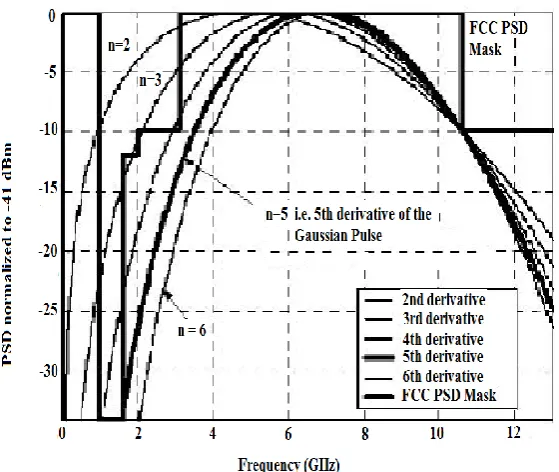
The narrow UWB pulses are emitted from the transmitter in a unique rhythm called “Pulse Repetition Rate” associated to each transmitter and it must be known at the receiver to be able to detect the data and information signal being transmitted. One fundamental challenge is to maximize the radiated UWB pulse energy; yet to assure that the pulse’s PSD complies with the FCC spectral mask limits. Moreover, since the extremely narrow pulses are relatively easy to generate with analog components; the Gaussian “monocycle” pulse and its derivatives are commonly used as basic UWB pulse shapes because their PSD comply with the FCC mask power limits as demonstrated in Fig. (2) [3] [4]. Hence, the pulse shapes used in the simulation in the paper are the derivatives of the Gaussian “monocycle” pulse which can be expressed in the following equation:
2)
exp(
)
(
t
A
dt
d
t
y
n n
Gn ……….. (2)
Where;
A
is the normalized Pulse amplitude, and
is a time-scaling factor and its relation to the pulse widthP
Fig. (2): PSDs of higher order derivatives of UWB Gaussian pulses
It can be seen from Fig. (2) that; PSD of the first derivative of the Gaussian “monocycle” pulse does not totally fit within the FCC spectral mask. Therefore, another pulse shapes founded from derivatives of the Gaussian Pulse because the higher-order derivatives increases the number of zero crossings which correspond to higher “carrier” frequency sinusoid modulated by an equivalent Gaussian envelope. Thus, the Gaussian Doublet which is the 2nd derivative of the Gaussian Pulse expressed in (3) is the most commonly used UWB pulse shape in the literature [4]. However, this paper studies and analyzes the performance of the 6th derivative of the Gaussian Pulse represented in (4) since it satisfies more the power limits of the FCC report and fits much better into the mask limits as shown in Fig. (2).
2 22
(
)
1
4
(
)
exp
2
(
)
t
t
t
y
G ………….. (3)
2 2 4 3 6 26
(
)
exp
2
(
)
15
64
)
(
16
)
(
12
1
)
(
t
t
t
t
t
y
G ………… (4)B. UWB Multipath Channel Model
The modified Saleh-Valenzuela (S-V) model is used in the paper since it was adopted as a reference UWB channel model by the IEEE 802.15.3a working group. The modeling process is based on an indoor propagation environment practical measurement, and the main distinct features of the UWB propagation channel are; its extremely rich multipath components profile and the non-Rayleigh fading amplitude characteristics. In UWB propagation there are much more multipath components than any other wireless propagation channels. As a result of the wide bandwidth of UWB pulses’ waveforms; the different objects exist in the indoor environment will give a rise to much several multipath components all of which would be a part of one “cluster”. Thus, the multipath components arrive at the receiver end in the form of “clusters”, and within each cluster there will be multiple subsequent arrivals called “rays”. Therefore, Time-Of-Arrival (TOA) statistics the IEEE 802.15.3a standard model used (S-V) approach which modeled multipath components in clusters and rays.
1 0 1 0 , ,(
)
)
(
C LC L l K k i l k i l l k ii
t
X
t
T
h
……….(5)Where;
k.il represents the multipath gain coefficients, i lT
represents the delays of thel
th cluster,
k,ilrepresents the delays of the
k
th multipath component “ray” within thel
th cluster arrival time (T
li).Shadowing effect of the total multipath energy is log-normal distributed and is represented by the term
X
i, andi
refers to thei
th realization.A calculation of the delay characteristics of the modified (S-V) model impulse response presented in (5) simulated using MATLAB and the simulation results are shown in Fig. (3). as can be seen in the figure; for any longer delay in time-domain the amplitudes of UWB signal’s pulses are more decreasing and reduced; which is expressed as “Fading” due to the multipath delay spread of the different rays within each of the different clusters.
Fig. (3): Impulse Response and Delay Profile of Modified Saleh-Valenzuela Model
The IEEE 802.15.3a standard multipath channel proposal has defined four different models for different scenarios based on practical measurements found in the indoor environment which are characterized as:
CM1: Line-Of-Sight (LOS) model for distance 0 – 4 m between
T
X andR
X . CM2: Non-LOS (NLOS) model for distance 0 – 4 m between
T
X andR
X . CM3: NLOS model for distance 4 – 10 m between
T
X andR
X . CM4: NLOS for 4 – 10 m between
T
X andR
X , with extreme (dense) multipath channel condition.III. TRANSMISSIONANDMULTIPLEACCESS
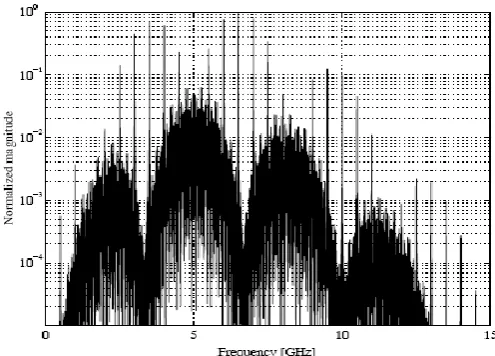
As mentioned in the previous section the UWB pulses must be transmitted as a train of pulses in a rhythm or a regular time called “pulse repetition rate” to carry the information signal for short range (indoor environment). However, this regular pulse repetition rate will cause relatively large frequency PSD peaks of amplitude in the corresponding spectrum at a certain frequencies represent the inverse of the pulse repetition rate as presented in Fig. (4.a) and (4.b) respectively, the thing that contradicts and breaches the FCC power mask regulations.
Fig. (4): (a) UWB pulse train. (b) Frequency spectrum of UWB pulse train.
Fig. (5): Spectrum of the dithered UWB pulse train
Furthermore, the same approach besides dithering the UWB signal periodic pulse train and reducing the PSD amplitude peaks, it also can be used as a “multiple access” scheme for distinguishing each different UWB User by its own random offset. There are two randomizing techniques “multiple access” schemes can be employed to achieve the required goals which are; Direct-Sequence UWB (DS-UWB), and Time-Hopping UWB (TH-UWB). In DS-UWB the Bandwidth spreading effect is achieved by the UWB pulse shaping. The basic format of the DS-UWB for the kth impulse radio transmitter (user) output signal
S
tr(k)(
t
)
is given by equation (6) [4]:
j N n c f tr k n k j k k tr CnT
jT
t
w
c
b
P
t
s
1 0 ) ( ) ( ) ()
(
)
(
…. (6)Where;
w
tr(t
)
represents the transmitted UWB pulse monocycle, ) (k nc
denotes the PN sequence associated
to the kth user,
T
f is the symbol (frame) period,T
cis the chip period such that) (k j c c
f
N
T
b
T
represents
integer= 0,1,2,.. , ) (k n
c
represents the PN sequence associated to the kth user,
1
) (k jb
is the BPSK data(bit) stream of the k th user,
T
f is the pulse repetition period (frame time),T
cis the chip period. While Time-Hopping UWB usually utilizes Pulse-Position-Modulation (PPM) as a modulation scheme. In UWB systems the pulses are assumed to be one of desired UWB pulse shapes mentioned in the previous sub-section. The basic format of the TH using PPM for the kth user transmitted signal is given by [4]:
j PPM k j c k j f tr ktr
t
w
t
jT
c
T
b
T
s
( )(
)
(
( ) ( ))
…. (7)Where;
c
(kj ) represents the PN Time-Hopping sequence associated to the kth user,T
PPM represents the pulse time-shift for the Pulse-Position-Modulation (PPM). The time-shift element of the TH code word assigned to the kth user is chosen from the set: j = 0, 1, 2…N
c
1
; WhereN
c is the number of time-delay bins (chips)in a frame time
T
f .IV. RECEPTIONSCHEMESANDSTRUCTURES
The extremely narrow pulses used in UWB systems give a rise to the phenomena of Multipath characterized by the UWB wireless channel discussed previously in section II due to the mechanisms of reflection, diffraction, and scattering which cause the transmitted UWB signal to be; diverted into many paths, and its energy to be dispersed, and also to arrive at the receiver end after some delays according to each path length and losses. UWB systems utilize spread spectrum techniques as (DS) and (TH) mentioned in section III; the thing that require great accuracy in signal acquisition, synchronization, and tracking at the receiver end.
C. UWB Rake receiver
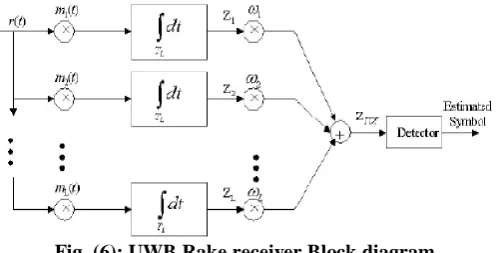
The previously mentioned UWB multipath channel conditions cause significant signal degradations, and consequently make it essential to solve the dispersed signal energy problem and capture as much energy as possible to reconstruct the heavily degraded UWB signal. Rake receiver is a single-user detector designed to collect as much energy as possible from the signal’s multipath components and then combine their contributions together to estimate the transmitted symbol [3]. The UWB Rake receiver extracts information modulated on the UWB Gaussian pulse from the degraded and distorted received waveforms with high accuracy utilizing “correlators” as seen in Fig. (6). Moreover, Rake receiver attempts to collect the time-shifted versions of the original UWB signal by providing a separate correlation receiver for each of the multipath components; each of the correlator receivers is adjusted in time delay so that it can search in different time windows called “search window” for significant multipath components. Rake receiver utilizes multiple correlators to separately detect the strongest multipath components; and then the outputs of the correlators are weighted to provide a better estimate of the transmitted UWB signal than is provided by a single component.
Fig. (6): UWB Rake receiver Block diagram
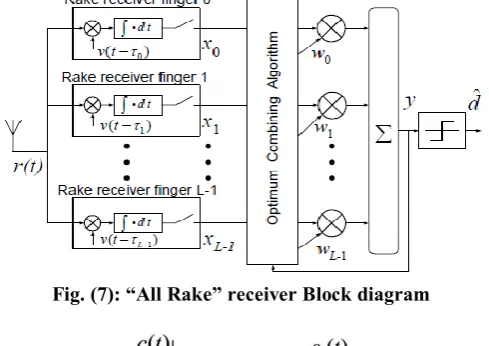
total “L” multipath components that is determined by the Rake finger selection algorithm as presented in Fig. (8) [4] [5].
Furthermore, the “Partial combining Rake” receiver structure (P-Rake) uses “N” multipath components out of the total “L” available diversity multipath; but it combines the first “N” arriving components which are not necessarily the strongest nor the best. The P-Rake structure has drastically reduced the complexity compared to the S-Rake structure due to the absence of the selection mechanism. Thus, the P-Rake mitigates the need to sort the multipath components by their instantaneous path gain magnitudes which would require a highly accurate channel estimation process.
Fig. (7): “All Rake” receiver Block diagram
Fig. (8): “Selective Rake” receiver Block diagram
Instead, the P-Rake structure only needs to find the “position” of the first arriving multipath component, which leads to a substantial circuit complexity reduction.
D. Minimum Mean Square Error (MMSE) algorithm
Significant studies have been made on an adaptive correlator receiver by Pateros and Saulnier in the field of “Direct-Sequence Spread Spectrum” (DS-SS) systems employing BPSK signaling in a single user, time-invariant multipath environment; these studies have proven that MMSE algorithm receiver detects the transmitted data, removes the interference, and coherently combines the multipath components of the signal in the presence of Narrowband Interference (NBI).
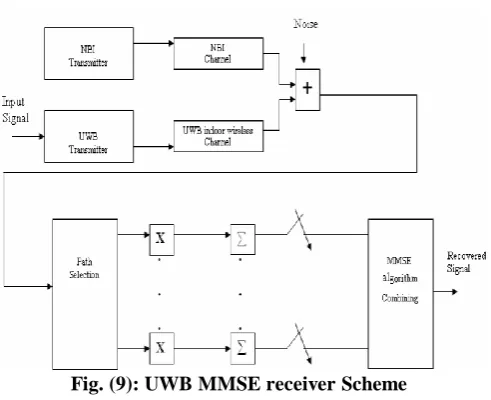
However, this paper demonstrates the performance of the MMSE correlator receiver with its adaptive algorithm and capabilities for both DS-UWB and TH-UWB transmission schemes discussed previously in section III. A major advantage of the MMSE scheme relative to other interference suppression reception schemes is that; explicit knowledge of the interference parameters is not required. Instead, the UWB received signal (template 6th derivative Gaussian pulses) from the multipath components can be sampled at a rate equal to the Pulse-Repetition-Frequency after passing through the correlator receivers with their path selection mechanism, and then the samples are linearly combined using the MMSE algorithm criteria to suppress the NBI and consequently maximize the SINR as shown in Fig. (9).
Fig. (9): UWB MMSE receiver Scheme
Moreover, the MMSE adaptive algorithm receiver consists of two parts; First, correlator receivers which combines the contribution of the strongest best multipath components and mitigates the effect of noise to maximize the SNR. Second, the adaptive filter which is mainly a Finite-Impulse-Response (FIR) digital filter that essentially acts as a matched filter to correlate the received UWB pulse waveform with the well-known template waveform and then re-adjusts the correlator receiver’s taps weights to minimize the Mean Square Error using an adaptive algorithm despite the type of noise and interference may be present in order to maximize the SINR as demonstrated precisely in Fig. (10) [6].
Fig. (10): MMSE Adaptive Algorithm receiver Block diagram
Adaptive algorithms such as “Recursive Least Squares” (RLS) adaptive filter is an algorithm which recursively finds the filter coefficients that minimize a weighted linear least squares cost function relating to the input signals. This is in contrast to other adaptive algorithms such as “Least Mean Squares” (LMS) that aim to reduce the mean square error. In the derivation of the RLS in [5], the input signals are considered deterministic, while for the LMS and similar algorithm they are considered stochastic. Compared to most of its competitors, the RLS exhibits extremely fast convergence. However, this benefit comes at the cost of high computational complexity [5].
V. SIMULATIONANDRESULTS
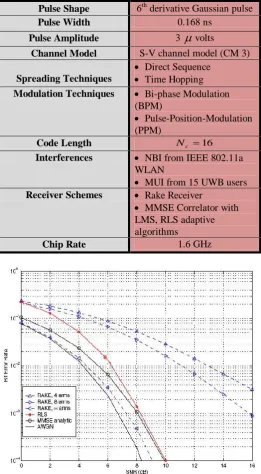
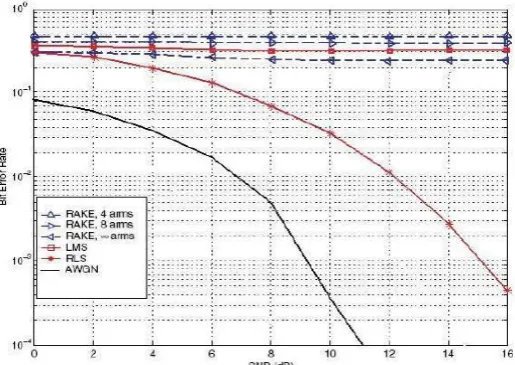
CM3. Moreover, the simulations present another important performance comparison between two significant receiver structures schemes; First, Rake receiver with finger selection mechanism and different number of fingers (4 fingers, 8 fingers, and 128 or an infinite “
” number of fingers). Second, Minimum Mean Square Error (MMSE) correlator receiver with LMS, RLS adaptive algorithms to re-adjust the tap weights for noise and interference suppression to maximize the SINR. The rest of the key simulation parameters are listed in Table (1).Table. 1: Simulation Key Parameters
Pulse Shape 6th derivative Gaussian pulse
Pulse Width 0.168 ns
Pulse Amplitude 3
voltsChannel Model S-V channel model (CM 3) Spreading Techniques
Direct Sequence
Time Hopping Modulation Techniques Bi-phase Modulation
(BPM)
Pulse-Position-Modulation (PPM)
Code Length Nc 16
Interferences NBI from IEEE 802.11a WLAN
MUI from 15 UWB users Receiver Schemes Rake Receiver
MMSE Correlator with LMS, RLS adaptive algorithms
Chip Rate 1.6 GHz
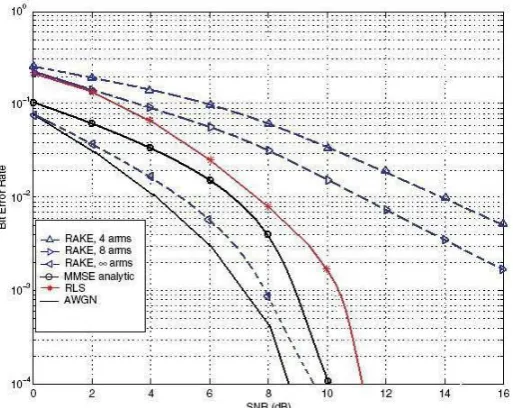
Fig. (12): Performance of TH-UWB over Multipath NLOS Channel with AWGN but no Interference
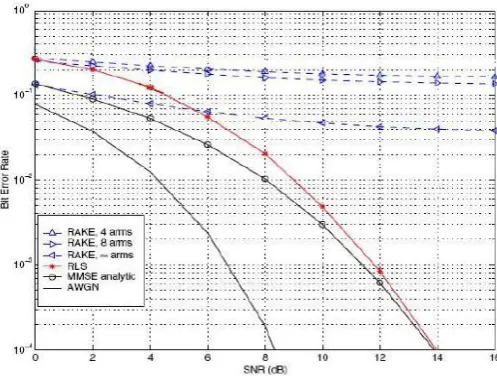
Fig. (13): Performance of DS-UWB over Multipath NLOS Channel with One NBI (SIR= -30 dB)
Fig. (15): Performance of DS-UWB over Multipath NLOS Channel with One Stronger NBI (SIR= 0 dB)
Fig. (16): Performance of TH-UWB over Multipath NLOS Channel with One Stronger NBI (SIR= 0 dB)
Fig. (18): Performance of TH-UWB over Multipath NLOS Channel with Multiple UWB Interferers (MUI of 15 UWB users)
Fig. (19): Performance of DS-UWB over Multipath NLOS Channel with combined NBI (SIR = -30 dB) and Multiple UWB Interferers (MUI)
Fig. (21): Performance of DS-UWB over Multipath NLOS Channel with combined Stronger NBI (SIR = 0 dB) and Multiple UWB Interferers (MUI)
Fig. (22): Performance of TH-UWB over Multipath NLOS Channel with combined Stronger NBI (SIR = 0 dB) and Multiple UWB Interferers (MUI)
Furthermore, as demonstrated in the previous MATLAB simulation Figures (11, 12, 13… 22); the paper has examined the performance of both; Rake receiver structure with different number of Rake fingers, and MMSE correlator receiver structure analytically and with different adaptive algorithms RLS and LMS using the simulation key parameters in Table. (1) for the following five scenarios:
Multipath NLOS Channel with only AWGN but no Interference (neither NBI nor MUI).
Multipath NLOS Channel with the effect of a single NBI Source with SIR= -30 dB
Multipath NLOS Channel with the effect of a stronger single NBI Source with SIR= 0 dB
Multipath NLOS Channel with the effect of Multiple UWB Interference sources (15 MUI sources).
Multipath NLOS Channel with the combined effect of both single NBI source and Multiple UWB Interference sources (15 MUI sources).
VI. CONCLUSION
show that; performance of DS-UWB as a transmission and multiple access technique is slightly better than TH-UWB technique specially in the presence of either Narrowband Interference (NBI) or Multiple User Interference (MUI) in addition to the AWGN. Furthermore, as the Narrowband Interference grow stronger (poorer SIR); the performance of Rake receiver with more Rake fingers is proven to be more efficient than the one with less Rake fingers. However, the reception performance has obviously improved and extensively developed when employing the Minimum Mean Square Error (MMSE) correlator receiver whether analytically or utilizing adaptive filter algorithms such as RLS and LMS especially in case of MUI caused by other UWB users in the proximity of the main desired UWB source.
REFERENCES
[1] Ian Oppermann, Matti Hamalainen “UWB Theory and Applications,” Book, pp. 15–80.
[2] M.Ghavami, L.B.Michael “Ultra-Wideband Signals and Systems in Communication Engineering,” Book, pp. 26–113.
[3] B. M.Mezzour, “Direct Sequence UWB performance over STDL ” paper Journal, vol.3.
[4] Nadir. Abd Elaziz, Abdelrasoul. Alzubaidi, “Performance of the 6th derivative Gaussian Pulse Shape in IEEE 802.15.3a Multipath Fading Channel” IOSR journal of Engineering, Vol3, Issue December 2014. [5] Rashid A. Fayyadh, F. Malik “Adaptive Rake receiver using Matched Filter with Three Combining
Techniques” Australian Journal of Basic and Applied Sciences, 7(5): 26-33, 2013 ISSN 1991-8178. [6] Rashid A. Fayyadh, “Improved Rake Receiver Based On the Signal Sign Separation in Maximal Ratio